



Legal

Legionnaires outbreak renews focus on facility risk
A recent Toronto Public Health investigation has identified a cooling tower at the Toronto Transit Commission’s Hillcrest Complex as the source of a Legionnaires' disease outbreak.

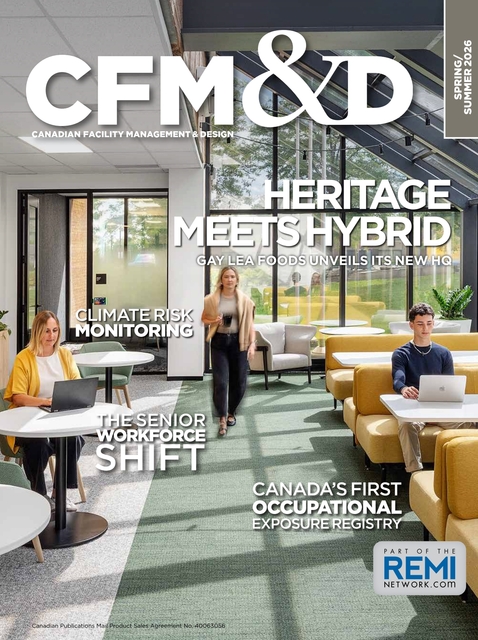
Preparing for the senior workforce shift
More Canadians over the age of 65 are continuing to work, whether full time, part time, or through multiple jobs. For employers, this is no longer a temporary trend; it is a workforce shift that is reshaping hiring, workplace policies, accommodations, benefits, and long-term planning.

Occupational exposure registry a first in Canada
Ontario-based workers can now track their exposure to 11 hazardous substances through Canada’s first-ever occupational exposure registry (OER). The province’s newly launched online portal is

Women could help close skilled trades labour gap
Women are significantly underrepresented in the skilled trades sector, which directly limits the pool of qualified workers that the facilities management industry depends on.

Five AI insights for FMs in 2026
The facility management field faces a range of challenges and opportunities in 2026 as technology drives change across the industry.

Accessibility-first focus strengthens communities
Accessibility is frequently sidelined during building and public-space design, with key features added long after construction is completed. This approach reinforces the notion that such

N.S. requires workplace harassment policies by September
The policy aims to prevent and respond to physical and psychological harassment from co-workers, supervisors, and external sources such as clients, contractors and customers.

Property crime trends call for increased safety
Property crime rates, while still historically low, are on the rise and becoming a great concern in large Canadian cities.

Poll sees decline in global workforce well-being
Being actively disengaged at work is equivalent to or worse than being unemployed when it comes to well-being.

Navigating supply chain transparency legislation
The deadline for Canadian businesses to file their first annual report on supply chain transparency is fast approaching.

Accommodating disabilities in the workplace
The accommodation process is inherently collaborative, and employers and employees need to be cooperative, share information, and work together to find potential accommodation solutions.

A path to barrier-free buildings: Facility assessments and strategic accessibility plans
A pressing issue facing facility managers is the crucial impact that barrier-free accessibility can have on a strategic renewal plan.

The new employee monitoring policy
While the deadline to prepare the policy was October 11, 2022, it is better late than never to get an electronic monitoring policy in place.

A recap of IFMA’s World Workplace
In the past, cleaning suppliers, landscapers, and pest control companies dominated FM shows. Not anymore.

Hybrid workplaces give rise to legal dilemmas
Organizations are kickstarting work models that reflect flexible preferences, but along with this culture shift comes new legal considerations and best practices for equitable treatment.

Strategies to reduce the risk of COVID in schools
Schools should implement these layered prevention strategies to mitigate the risks of COVID infection or transmission to the school community and beyond.

Psychological health of workers at lowest point
New findings revealed that general psychological health is currently at its lowest point in the last 22 months among Canadian workers.