



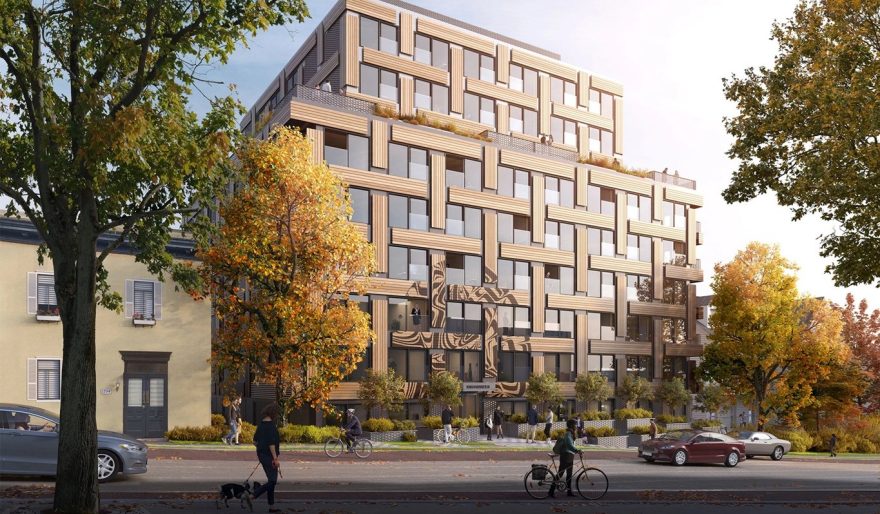
In the heart of East Vancouver, a new building is rising—not just in height, but in meaning. The Chief Leonard George Building project, led by the BC Indigenous Housing Society (BCIHS) and supported by BC Housing, exemplifies how architecture can fulfill both functional and cultural roles, delivering urgently needed affordable housing while honouring Indigenous heritage.
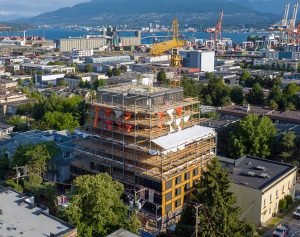 Named after a revered chief of the Tsleil-Waututh Nation, the nine-storey development will offer 81 affordable rental homes for Indigenous residents, many of whom have long been priced out of the city their ancestors once stewarded. For decades, Vancouver’s housing crisis has disproportionately affected Indigenous communities, with displacement, systemic barriers, and intergenerational trauma creating a perfect storm of vulnerability.
Now nearing completion, the Chief Leonard George Building offers a counter-narrative—one where affordability is not an afterthought, but a foundation.
“In my community, I think about our elders and everything they’ve seen in their lifetime,” said Brenda Knights, Executive Director, BCIHS. “I’m often amazed at how emotional they get when they see their grandbabies doing well. It’s a reminder of how much they’ve been through, and how deeply they want the next generation to have it better. Those are the teachings I try to bring into the urban environment.”
That intergenerational lens helped shape every detail of the design, which was spearheaded by GBL Architects. The building prioritizes elder mobility, with wider hallways, accessible kitchens and bathrooms, and universal design features that support independence and aging in place.
“The façade is envisioned as a woven cedar basket, an artistic adaption of the celebrated Coast Salish tradition and technique, providing a striking visual reminder of the historic cultural practices of the Indigenous peoples who have called these lands home,” said Achim Charisius, Associate Principal, GBL. “Beforehand, the project was digitally preconstructed using Building Information Modelling to a fabrication level of detail.”
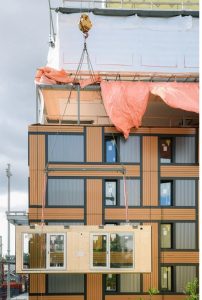 Constructed using mass timber—a fast, cost-effective, and climate-conscious method—it features prefabricated panels assembled off-site to minimize waste and on-site disruption. Also in alignment with Indigenous values of stewardship, the project meets Passive House standards, consuming up to 75 per cent less energy for heating and cooling than conventional buildings.
As the city continues to grapple with affordability and climate resilience, BCIHS sees this as a replicable model, despite its higher initial investment.
“We should be building Passive,” Knights said. “We’re going to pay for it one way or another. Personally, as an Indigenous person, I don’t want to leave that responsibility for future generations. We need to leave this earth better than it was when we arrived.”
Amenities at the property include on-site childcare, community gathering areas, and spaces for children to play and residents to grow food. Many of these shared spaces are located on the seventh floor, extending across the building’s exterior with sweeping views of the North Shore mountains. Both indoor and outdoor areas are available for residents to book for special events. A curated collection of Indigenous artworks will be featured throughout the building, inside and out.
Reconciliation in Real Estate
The Chief Leonard George Building is not a one-off initiative—it’s part of a broader movement across Canada in which Indigenous nations and organizations are reclaiming their roles as urban developers. This shift is reshaping the housing landscape, positioning Indigenous leadership at the forefront of urban planning and infrastructure development. Housing, as essential infrastructure, plays a critical role in advancing public health, economic stability, and community cohesion. It influences outcomes in education, employment, and social inclusion. Indigenous-led housing initiatives respond to longstanding disparities in access to land, capital, and planning authority, while introducing models that integrate cultural knowledge, environmental stewardship, and community governance.
Projects such as the Squamish Nation’s Sen̓áḵw development in Vancouver and the Taza development in Calgary exemplify this paradigm shift. These large-scale, Indigenous-led ventures demonstrate how reconciliation can be operationalized through land use, design innovation, and economic strategy. By embedding culturally informed principles into the built environment, they expand conventional urban planning frameworks and contribute to measurable improvements in housing equity and urban inclusivity.
Indigenous nations are no longer peripheral stakeholders in Canada’s housing future—they are central architects of it.
Chief Leonard George Building – Project Timeline
- 2017: A fire damages the previous building at 1766 Frances Street, displacing residents.
- 2019: Planning and development begin for a new, purpose-built residential building.
- 2023: Construction officially breaks ground.
- December 2025: Tenants will be welcomed into their new homes.
Photos courtesy of GBL Architects: Chief Leonard George Building | GBL Architects