



The past year tested the fundamentals of Canadian multi‑residential real estate. Slower population growth, federal immigration reductions, and a surge of newly completed rental supply softened demand and pushed many markets closer to equilibrium. Yet even in this more challenging environment, Skyline Apartment REIT continued to show resilience, supported by what it calls “a disciplined approach to property acquisition and management.”
The REIT’s long‑standing strategy, refined over nearly two decades, remains anchored in a sustained commitment to portfolio modernization. According to its leadership team, the approach centres on several core principles: maintaining a carefully curated portfolio, investing in retrofits and property‑level improvements, and continually enhancing the tenant experience.
“Despite the trade-related uncertainty and broader economic challenges of 2025, we saw that purpose-built properties in many smaller markets maintained solid performance, posting strong annual rent growth,” said Matthew Organ, President, Skyline Apartment REIT. “For us, it reinforces the importance of focused asset selection over time.”
That focus—combined with the REIT’s broader modernization efforts—not only helped its maintain stability through 2025 but outperform many of its peers. Occupancy remained strong at 95 per cent, and in‑place rents across the Skyline portfolio rose 5.89 per cent by the end of Q3 2025, outpacing the national multifamily average of 4.8 per cent recorded the previous quarter. Today, with more than $5.2 billion in assets under management and plans for further growth in 2026, the REIT emphasizes modernization as a key part of its success.
At the portfolio level, acquisitions focus on new-build assets, value-add opportunities, and selective development or intensification projects, allowing it to modernize as needed, while preserving strong performance for its investors: “We’re constantly looking at how each decision contributes to the REIT’s long-term resilience and adds value for our investors,” explained Organ. “That includes expanding in markets that demonstrate sustainable growth.”
The REIT’s acquisition strategy is rooted in:
- Buying in markets with favourable demographics and supply-demand balance
- Overall geographic diversification to strengthen economic resilience
- Geographic centralization in select areas where it enhances operational efficiency
- Attracting and retaining high-quality tenants through portfolio modernization
Reflecting this approach, in 2025, Skyline added properties in Nanaimo, British Columbia; Guelph and Windsor, Ontario; and Mascouche, Quebec—all communities with strong demographic trends and rising rental demand. In some cases, new assets expanded existing properties, such as North Point Apartments in Nanaimo (now five buildings and 300 suites) and Quartier 7 in Mascouche (now eight buildings and 657 suites), reinforcing the REIT’s confidence in those markets.
Strategic dispositions also remain an important tool for the REIT, allowing it to free up capital and redeploy it toward stronger, long-term prospects. In 2025, Skyline sold properties in Edmonton and Sherwood Park, exiting Alberta in October. Its most recent sale in January was Carlsie Tower, a 34-suite property in Windsor, where it remains a prominent rental housing provider with 31 properties and 2,254 suites.
“Although we plan to maintain a large footprint in key growth markets like Windsor, our sale of Carlsie Tower exemplifies how we evaluate each property individually and will sell when doing so optimizes the portfolio,” Organ said. “By concentrating on markets with proven resilience and growth potential, we are better positioned to weather uncertainty and capitalize on opportunities as they arise.”

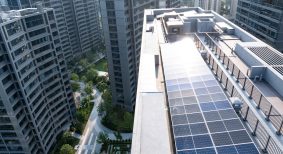
In 2025, Skyline Apartment REIT generated 1.3 million kWh of renewable electricity from its apartment rooftop solar arrays.
Retrofits and enhancements
Beyond strategic acquisitions and dispositions, property retrofits and enhancements play a critical role extending the REIT’s asset lifespans, reducing operating costs, and improving tenant comfort. Last year, Skyline completed a series of retrofits focused on technology integration, energy efficiency, and sustainability, including:
- Installing Building Automation Systems (BAS) at four properties with high natural gas consumption. These systems intelligently adjust heating and domestic hot water in real time, factoring in building demand, outdoor weather conditions, and equipment performance.
- Acquiring a rooftop solar system as part of a Nanaimo property purchase.
- Installing more than 75 EV chargers across properties in British Columbia, Ontario, and Nova Scotia.
Looking ahead to 2026, the REIT plans to:
- Install BAS at four additional properties in Ontario and Nova Scotia.
- Add rooftop solar systems at five properties across British Columbia and Ontario.
- Install over 100 additional EV chargers across Ontario and Quebec (which would bring the REIT’s total EV chargers portfolio-wide to 1,170).
- Introduce smart heating systems at five buildings in Windsor.
- Implement demand-controlled ventilation systems at four Sarnia properties.
“We view these initiatives as important investments in our assets,” said Organ. “Upgrading building systems, improving energy efficiency, and integrating sustainable technologies supports our operating performance and ultimately contributes to the REIT’s long-term portfolio value.”
Enhancing the tenant experience
The REIT also modernizes its portfolio by enhancing how tenants experience their apartment communities. Skyline Living, the REIT’s property management company, invests in technology and partnerships that support tenant convenience and financial wellness. A key example is its partnership with Zenbase, a Canadian financial wellness platform. Tenants have the option to split their rent into two payments per month and can strengthen their credit by reporting on-time rent payments to major credit bureaus. These programs reduce financial stress for tenants while supporting timely rent collection for the REIT.
Skyline Living also partners with APOLLO Insurance to make tenant coverage more affordable and hassle-free. Tenants can get online quotes in minutes, receive instant proof of coverage, and benefit from a Best Price Guarantee and exclusive discounts.
“When tenants feel financially secure and genuinely supported, they’re far more likely to stay longer, engage positively with their community, and take pride in their homes,” said BJ Santavy, Vice President, Skyline Living. “That kind of engagement directly supports stronger property performance through improved retention, more stable operations, and ultimately a healthier, more resilient portfolio.”
Skyline Living is continuing to explore tenant service enhancements in 2026, including potentially integrating AI into its tenant experience practices.
“Tenant expectations don’t stand still, and neither can we,” said Santavy. “We’re continuously evaluating how new tools and service enhancements can elevate our resident experience while also supporting operational efficiency and long-term value creation.”

Skyline Apartment REIT plans to have a total of 1,170 EV chargers at its properties across Canada by year-end 2026.
Modernization as a long-term discipline
As Skyline Apartment REIT approaches its 20th year in business, the team says modernization will remain a core component of its portfolio strategy, guiding everything from asset acquisitions to day-to-day property management. By focusing on “meticulous portfolio design, property-level retrofits and upgrades, and tenant experience,” it hopes to keep delivering stable performance for investors and the long-term resilience is was designed for.
2026 and beyond
Notable market conditions Skyline expects for the coming months and years:
- Near-equilibrium supply-demand dynamics driven by immigration cuts and new supply—likely to persist until the projected population growth rebound in 2027–2028.
- Regional divergence as affordable markets with strong economies tighten, while higher-cost areas with exposure to student housing could weaken further.
- Segment risk in markets heavily reliant on temporary resident and international students amid expected admission declines in 2026.
- Overall strong fundamentals supporting stable performance now, with rents and asset values expected to rise as population growth turns positive.
Visit Skyline Apartment REIT – Focused on apartment real estate investments to learn more.