




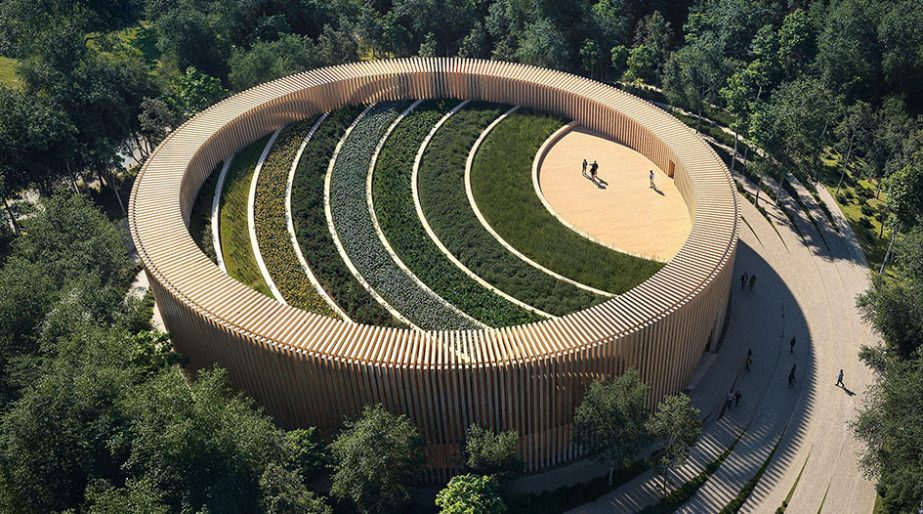
Calgary’s Spectacle Bureau for Architecture and Urbanism has unveiled designs for the Museum of Aboriginal Peoples’ Art and Artifacts (MOAPAA), coming to Portage College in Lac La Biche, Alberta.
The Indigenous-led museum will house a major collection by Professional Native Indian Artists (PNIA), a collective of First Nations artists formed in Winnipeg in 1973.
The mass-timber building features a kinetic wooden veil, a rooftop ceremonial garden, seven elliptical landscape paths honoring PNIA founders, and a fireproof storage vault designed to survive severe wildfires.
The museum’s landscape functions as a narrative journey. Seven nested elliptical paths—each representing one of the seven historic members of the PNIAI (Jackson Beardy, Eddy Cobiness, Alex Janvier, Norval Morrisseau, Daphne Odjig, Carl Ray, and Joseph M. Sánchez)—wrap around the building.
Public spaces are formed where the pathways join – on the east side, in front of the main entrance, and at the sculpture garden on the west side – as symbolic gestures depicting how the artists’ lives have converged and diverged. Every path will be marked with a sculpture dedicated to each of the PNIAI members, created by Indigenous artists.
The building’s elegant veil responds to the verticality of the reconstituted Quaking Aspen forest. Vertical slats hinged at the top swing gently back and forth in the breeze, responding to nature and the elements and moving gracefully together with the surrounding environment. This simple rhythm creates a pleasant shaded and intimate space for walking and viewing the art.
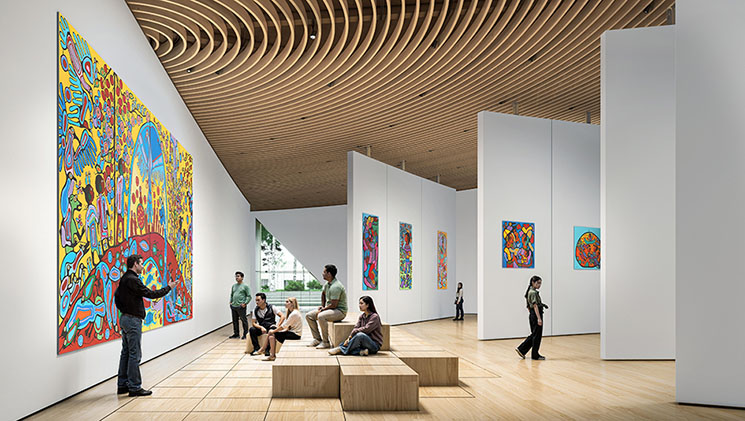
The interior layout purposefully moves away from rigid, traditional museum frameworks. At the core of the gallery area, an innovative retractable platform system can transform from a raked-seating auditorium into benches or sculptural plinths, or disappear entirely into the floor to maintain a free-flowing exhibition space.
“This free-standing museum adds to the Indigenous artistry already on display in the hallways of Portage College,” says Ruby Sweetman, Portage College Elder. “I think more exposure will only draw more inspiration and more education about Indigenous arts and culture.”
