



Digital transformation is no longer on the horizon for Canadian healthcare; it is the operating reality. Health systems are modernizing clinical platforms, connecting building systems to the cloud, and rethinking how people, materials, and information move through their facilities. Amid all of that change, one discipline has quietly evolved from a background utility into a strategic pillar of facility operations: modern access control.
A few years ago, the conversation was about replacing mechanical keys with electronic locks. Today, the conversation is about something bigger: managing identity. Who is this person, what is their role, why do they need access and for how long? The facilities best positioned for the next decade are the ones answering those questions now, in a thoughtful, methodical way.
New pressures are reshaping the mandate
The renewed focus on access control is being driven by pressures that every healthcare facility leader will recognize.
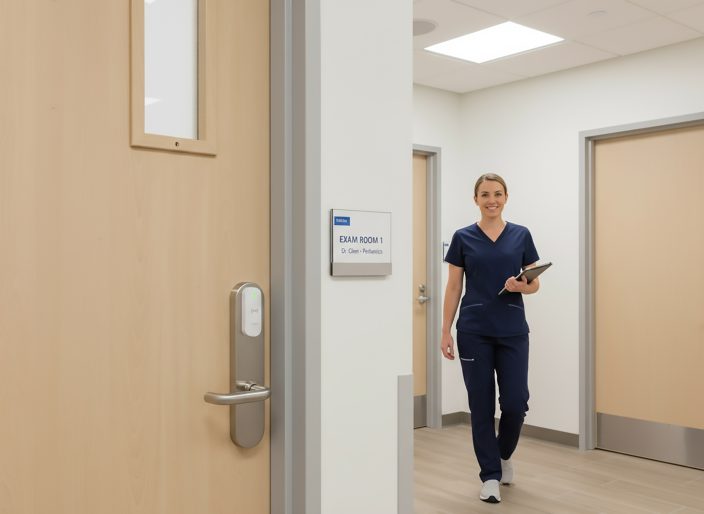
Workplace violence has become one of the most urgent safety issues in Canadian healthcare, and facility teams are on the front line of the response. Modern access control gives them practical tools: granular restrictions on high-risk areas such as emergency departments and maternity wards, real-time visibility into who is in the building, and lockdown capabilities that can be activated instantly — for a single door, a unit, or an entire building or campus — by staff on site or remotely.
A constantly changing workforce has made manual access administration more challenging than ever before. Between agency staff, travelling nurses, students, volunteers, and the steady flow of contractors and service technicians that keep a hospital running, the population moving through a healthcare facility turns over quickly and regularly. Every departure that isn’t processed promptly is a live credential in the wrong hands, and every delayed onboarding is a clinician who can’t get where they need to be.
Cyber-physical convergence means access control is now an IT conversation as much as a facilities one. Electronic locks, credentials and management platforms are networked assets, and health-sector organizations, which are already prime targets for cyberattack, need access infrastructure built on end-to-end encryption, secure cloud architecture, and integration with corporate identity directories rather than standing apart from them.
Identity as the organizing principle
These pressures converge on a single idea that is redefining the category: physical identity and access management, or PIAM. Where a traditional access control system manages doors and cards, a PIAM platform manages the full lifecycle of every identity in the facility. This includes employees, physicians, students, volunteers, visitors, contractors, and others from pre-registration and verification through provisioning, monitoring and revocation.
Salto IDM, the physical identity and access management platform from Salto, is built around this lifecycle approach. Access is governed by policy rather than by ad hoc requests: operators define who should have access, when, and why – before any credential is ever issued. Role-based rules, automated approval workflows and scheduled expirations replace the spreadsheets and email chains that have historically governed contractor and visitor access. Integration with HR systems and IT directories means that when someone’s employment status changes, their physical access authorization automatically changes with it.
For healthcare specifically, the compliance dividend is significant. Unified logs of employees, visitors and contractors across every site, complete audit trails, and real-time occupancy visibility turn what used to be a scramble at accreditation time into a standing capability.
The credential is changing
The migration to mobile access that the industry predicted several years ago has arrived, and it has matured. Digital keys delivered over the air to a smartphone are now a mainstream expectation, and the next step is already here: wallet-native credentials that live alongside payment cards and boarding passes, available with a tap and protected by the phone’s own biometric security.
Biometrics are extending the same logic to the highest-security and highest-convenience use cases. Hands-free face recognition readers, such as Salto’s XS4 Face, allow clinicians to move through controlled areas without touching a surface or fumbling for a badge. Making identity itself the credential can have a big advantage in sterile environments and in moments when hands are full and seconds matter.
From audit trail to operational intelligence
Cloud-based access platforms are also changing what the data is for. The audit trail was once a forensic tool, consulted after an incident. Today, access data flows into the broader operational picture: space utilization, contractor time on site, compliance reporting, maintenance planning. Facility leaders can see patterns across an entire portfolio of sites from a single interface and manage them with consistent policies.
Positioning for what comes next
As always, the technology will keep advancing, but what has changed is the standard for readiness. The healthcare organizations best positioned for the future are those treating access control not as hardware on a door but as identity infrastructure: flexible, standards-based, cloud-connected, and governed by policy. They are the ones that will absorb the next wave of change, whatever form it takes, without ripping and replacing.
For more information on physical identity and access management and smart access best practices for healthcare facilities, visit saltosystems.ca.