



Canada’s infrastructure is aging, and that reality extends far beyond bridges and roadways. Many facilities across the country, from high-rise residential towers to healthcare and government buildings, still rely on outdated communication systems that weren’t designed for today’s digital environment. For facility managers, this illuminates an ever-growing challenge: how to maintain code compliance and resident safety as legacy systems, particularly landline-based emergency phones, near the end of their service life.
The POTS Phase-Out is Happening in Canada Too
The shift away from Plain Old Telephone Service (POTS) lines is not limited to the United States. Canadian telecom providers such as Bell and Telus have been systematically retiring copper networks, replacing them with fiber and internet-based systems. This change is good news for broadband performance but can be problematic for emergency communication systems that depend on analog lines to function reliably.
When a POTS line is discontinued, the emergency phones connected to it are at risk of failure. In an elevator entrapment, a poolside emergency, or a stairwell incident, that failure could mean the difference between a rapid response and a delayed rescue. Even before disconnection, many of these lines are prone to degradation, static, and maintenance issues that compromise reliability.
Why VoIP Isn’t a Plug-and-Play Substitute
Some property teams have turned to Voice over Internet Protocol (VoIP) as a quick replacement for landlines. While VoIP is often reliable for standard business or tenant communications, it can introduce potentially serious risks for life safety systems.
Common vulnerabilities include:
- Power outages that can immediately disrupt connectivity, leaving tenants unable to call for help during emergencies.
- Bandwidth interruptions that affect call clarity or prevent calls from connecting.
- Cybersecurity threats that can expose systems to tampering or data breaches.
These risks mean VoIP systems require careful and specialized IT oversight and backup power to remain compliant and dependable—resources not every facility has in place.
Emergency communication should function independently from the building’s IT infrastructure. It must work even when the power is out or when the network is down. VoIP, unfortunately, does not meet that standard out of the box.
The Cellular Advantage: Reliable, Compliant, and Future-Proof
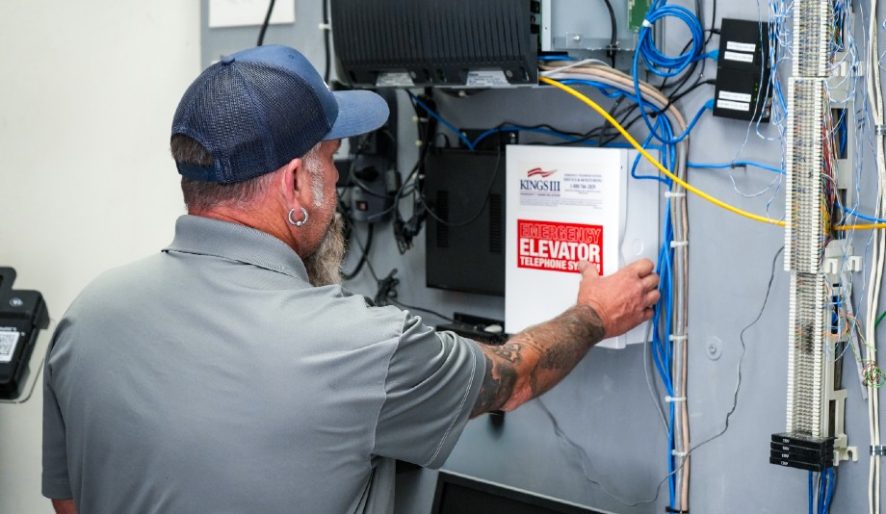
Cellular connectivity has become the most effective and reliable solution for emergency phones. Unlike traditional or VoIP systems, cellular operates independently of the building’s internal network. This separation eliminates common points of failure and provides consistent performance during emergencies. Modern cellular emergency communication systems, like those offered by Kings III, are designed for compliance with the latest building and accessibility codes, including the updated CSA B44 elevator safety standards, which introduced two-way messaging and video monitoring requirements. They include key features such as backup power, two-way communication, and monitoring by highly trained, Advanced Emergency Medical Dispatch (AEMD)-certified operators.
The Importance of Specialized Monitoring
While the hardware and connectivity are essential, the monitoring behind these systems is what ensures complete reliability. Kings III’s emergency dispatch centre is purpose-built for emergency response. Operators are AEMD-certified and trained to manage a wide range of emergencies, from elevator entrapments to medical incidents and severe weather situations. Calls are recorded, timestamped, and documented for compliance verification, liability protection, and continuous quality improvement.
This specialized training means callers are not only connected to a live person within seconds but to someone equipped to triage the situation, provide instructions, and coordinate with local emergency responders. That level of preparedness significantly improves outcomes in emergencies and provides property managers with the assurance that help will always be dispatched appropriately. Learn more about Kings III’s all-inclusive monitoring approach.
Built-In Redundancy and Reliability
Kings III’s cellular systems are equipped with backup batteries to ensure uninterrupted function during power outages. In addition, automated self-testing features confirm communication integrity. These features provide peace-of-mind for property managers by addressing potential issues before they become safety risks.
Equally important, detailed data logs and recordings are kept for every call. These can be used during inspections or audits to demonstrate compliance with national and provincial safety codes. For multi-property portfolios, these reports can help standardize safety protocols across different provinces and building types.
Reducing Liability While Enhancing Safety
More than an inconvenience, an unreliable emergency phone is a liability. Property owners and managers are ultimately responsible for ensuring that communication systems meet national and provincial code requirements. Upgrading to a cellular-based solution is a future-proof option that eliminates the uncertainty of aging infrastructure and helps protect against costly compliance violations. With an all-inclusive service model that covers equipment, installation, maintenance, and 24/7 monitoring, Kings III simplifies the entire process. This approach helps Canadian property teams focus on operations while knowing their emergency communication systems are reliable, code-compliant, and ready when needed.
Preparing for What’s Next
As Canada continues to modernize its infrastructure, upgrading emergency communication systems is an important part of that evolution. The POTS phase-out is accelerating, and the time to act is now. By transitioning to cellular monitoring, facilities can safeguard occupants, maintain compliance, and future-proof their properties against communication disruption. Contact Kings III to learn more about reliable emergency communication solutions for your property and ensure your infrastructure is ready for the future.
Kings III Emergency Communications has been providing complete, compliant, and affordable emergency phone solutions for elevators, poolside, stairwells, and parking areas for more than three decades, monitoring more than 70,000 emergency phones across North America.