


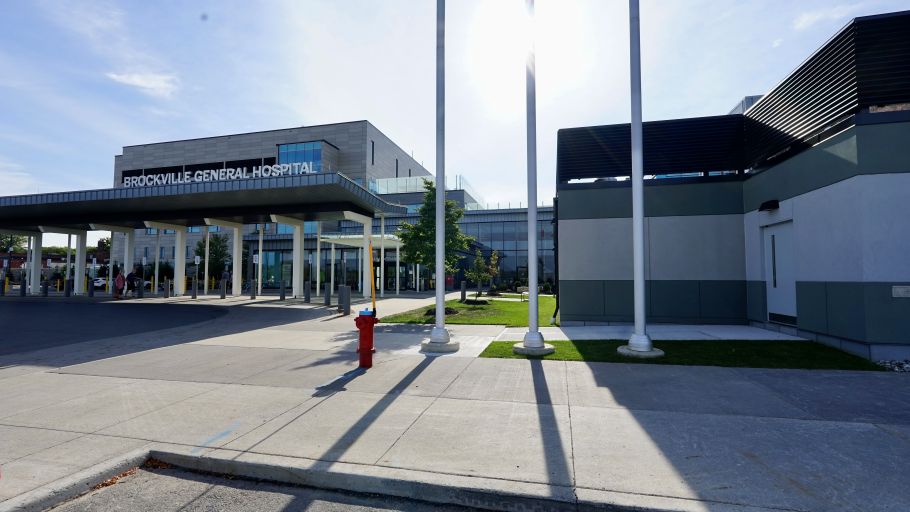
In June 2024, Brockville General Hospital became the first hospital in Ontario to expand their diagnostic imaging department by using modular construction to add a new Siemens MRI. By doing so, the wait time for MRIs at the hospital was reduced by a year and a half.
The timeline for the Brockville project using traditional construction methods was at first anticipated to take two and a half years to complete. SDI Canada was able to deliver the prefabricated Cassette® modules within a year. Given that in one year approximately 5,000 MRI scans can be completed, this means that just as many patients received care one year earlier than expected.
The Cassette Solution
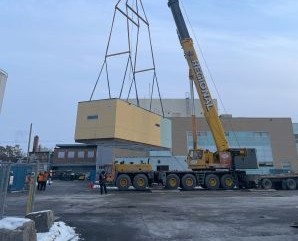
In Ontario, SDI Canada has worked with five hospitals to date who have chosen modular construction as an alternative to traditional construction. The Cassette solution offered by SDI is designed to complement traditional infrastructure. Instead of being constructed onsite, the modules are built in a controlled, factory environment, and then transported to their location ready to be set in place and integrated with the existing architecture.
Prefabricated hospital rooms are built from steel and come fully equipped with plumbing, electrical, HVAC, and the essential connections needed for medical gases. Building off-site reduces the inconvenience and noise pollution of building on location. The practice became more widely familiar during the pandemic, when the need to quickly expand medical facilities was highlighted.
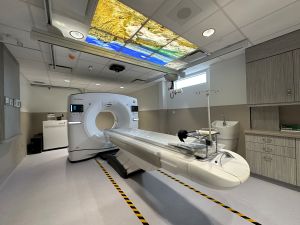
The adaptability of modular construction is increasingly being seen as a solution for healthcare facilities across Canada. Winnipeg’s Health Sciences Centre was the first in Canada to introduce SDI Canada’s Prefabricated Modular MRI Cassette® in 2023. Brockville General Hospital’s modular MRI department was constructed in 2024. Since then, the company has worked with Kemptville District Hospital to build a new GE Computed Tomography (CT) scanner and is currently installing Ontario’s third Prefabricated Modular MRI Cassette® at Headwaters Health Care Centre in Orangeville.
The Cassette is a hospital-grade building, fully compliant with the Canadian Building Code, CWB Certified (CSA A660-10 & CSA W47.1), with ‘Site Rating Classification’ for seismic design and ULc Listed components & design. These are fully finished, ready to use buildings designed with ergonomics and workflow in mind.
“This solution is very robust,” explains Toufic Abiad, Founder and CEO at SDI Canada, who says that cost predictability is another advantage when building modular. “But it doesn’t matter if it’s less expensive or even a little more depending on the scenario — it’s much faster. How do you put a price on that?”
Prioritizing Patient Care
“A patient’s priority is to get the MRI scan as soon as possible,” Abiad states. “I have a solution that will get this to them early.”
Location barriers are also no issue for modular construction, he says. For facilities in remote areas, high performance medical construction for MRIs and CT scans is expensive to build due to the specialist trades required; trades which may be hard to find in remote regions.
“It’s about efficiency. We build the module and send it to you,” says Abiad, who asserts that building in factories speeds up patient care and reduces backlogs in surrounding facilities.
“We construct it in pieces and put it together to form a full facility without any compromise on quality, or patient care and experience.”
Although SDI offers different dimensions and layouts for differing clinical requirements, each standard prefabricated Cassette ® is between 15 and 16 feet wide and 60 feet long and constructed within a factory in a temperature-controlled environment, making for better conditions and work-life balance for those building them.
“The construction worker who was on a three-month rotation waking up at 4 a.m. to go to the jobsite two hours away, now goes to an air-conditioned building and spends more time with his family,” notes Abiad.
The “Innovation of Ways”
Building within a controlled environment ensures speed of production and elevated consistency in the finished product. Abiad describes the “innovation of ways” which keep SDI propelled forward.
“We can deliver a healthcare department in a year. It’s not because we’re smarter than anybody else; technology is helping us. We just have the courage to endorse it.”
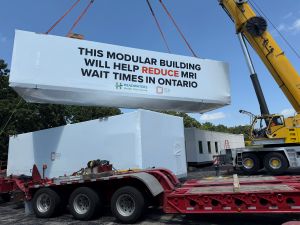
SDI Canada takes a collaborative approach with architects and engineers when extending a hospital’s footprint. Each steel modular cassette is between 800 and 900 square feet and is linked together like pieces of Lego to form extensions of current infrastructure.
Rather than completing inspection on a job site, architects and engineers inspect the construction at the factory, assessing the work at three stages: the onset, while being built, and then the finished product.
While SDI offers both traditional and modular building, Abiad sees the potential growth and resilience of prefabricated hospital departments as worth exploring.
“Within a year we built six departments across Canada in five different provinces. This system can only help the Ministry of Health to deploy faster care to patients.”
SDI has recently also secured contracts with the Sioux Lookout, and the Royal Victoria Regional Health Centre in Barrie. Across Canada, Abiad says Ontario is a leader in adopting modular cassette technology, closely followed by British Columbia.
“We’re at our second system in BC. We started with Richmond, and now we’re working on Squamish.”
As an entrepreneur, Toufic Abiad sees modular construction as a way of breaking the mold. He identifies further potential value in reusing MRI machinery in smaller communities once a machine ages.
“Down the line, maybe the MRI can’t keep up with 5,000 scans a year in Brockville, but it could do 2,000 scans a year in a smaller town,” Abiad suggests. “That MRI module can be brought to a community hospital that doesn’t already have a magnet.”
When it comes to innovation, Abiad encourages us all to be entrepreneurs: “Stop talking about the future. Be part of it,” he suggests.
Founded in 2003, SDI Canada is the Canadian leader in the implementation of MRI and biomedical equipment, the design and construction of medical infrastructures and the distribution of specialized accessories. To learn more, visit www.sdicanada.ca or email [email protected].