




Montreal has introduced strict new rules for short-term rentals in an effort to ease the housing crisis and crack down on unauthorized listings. In March 2025, city council passed a bylaw restricting short-term rentals of principal residences to just three months a year, from June 10 to September 10. Outside of this period, only full-time Airbnb units operated by commercial enterprises will be permitted, and violators will face fines of $1,000 to $2,000. Hosts are required to obtain a $300 permit and register with the province. Principal residences may only be rented for periods of 31 days or less.
The new enforcement measures come after a tragic fire in Old Montreal in 2023 that resulted in the deaths of seven individuals, six of whom were residing in illegal Airbnb rentals. In response to the incident, the Province of Quebec enacted legislation mandating platforms such as Airbnb to display tourism license numbers on their listings. Montreal city officials report that illegal short-term rentals have persisted despite these regulations, noting that as of January 2025, over half of the 4,000 short-term rental units in Montreal were not authorized to operate.
“By adopting its bylaw on short-term tourist accommodation, Montréal is seeking to increase the supply of housing within city limits by encouraging the return of many dwelling units to the rental market,” the official website states.
On the flipside, short-term rental platforms worry that the new restrictions will hurt tourism, raise hotel prices, and deter Quebecers from traveling. Airbnb has criticized the regulations, pointing out that 140,000 people used its rentals in Montreal in 2024, and a three-month annual rental limit may harm tourism and the city’s ability to host major events.
“Instead of enacting extreme and short-sighted restrictions, the City of Montreal should pursue sensible regulations that balance the needs of residents, hosts, and the broader tourism economy,” said Alex Howell, Policy Lead, Airbnb, Canada. “We strongly urge policymakers to reverse this economically damaging law and work collaboratively to support responsible short-term rentals that benefit the city, its economy, and its people.”
According to a study by the Montreal Economic Institute, the city of Montreal regulates housing more heavily than 73 per cent of Canadian cities and provinces. Airbnb suggests that this regulation has contributed to rising housing costs. In the Greater Montreal area, residential real estate prices increased by 30 per cent between Q4-2019 and Q4-2023, despite earlier government efforts to reduce unlawful short-term rental operations.
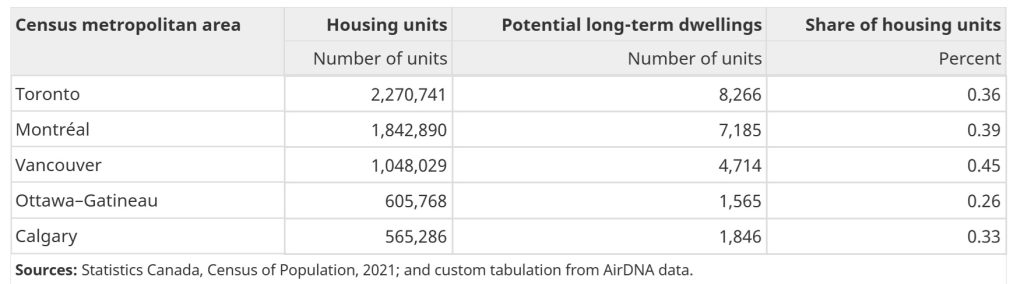 Meanwhile, a 2024 report from Statistics Canada indicates that the number of short-term rental units that could potentially be converted into long-term housing is minimal, accounting for less than one per cent of most cities’ housing supply. In tourist areas and ski towns, like Whistler and Mont Tremblant, the share tends to be higher, in some cases reaching up to 35 per cent.
Common crackdown measures
Montreal isn’t alone in its mission to curtail unlawful short-term rental operations as a way to free up long-term housing. Since 2023-24, Nova Scotia, Vancouver and Toronto have also introduced measures such as setting occupancy limits, introducing licensing requirements and imposing fines for a failure to comply. In BC, hosts must register with the provincial short-term rental registry and pay an annual fee. Short-term rental licenses are only issued for a host’s principal residence, meaning secondary suites or laneway houses are not eligible.
Market data
While it remains to be seen whether the new requirements will achieve the desired outcomes, other factors are influencing Canada’s rental market, including population growth, unemployment rates, the cost of homeownership and construction challenges. According to the latest data from livrent.ca, Montreal’s rental market experienced a slight cooldown in May, with average prices dipping for both furnished and unfurnished units. Furnished one-bedrooms now rent for an average of $1,702 per month, reflecting a 0.20 per cent decrease, while unfurnished units dropped by 0.92 per cent to $1,710 per month. Hochelaga-Maisonneuve remains the most affordable area, averaging $1,474 per month, while Verdun holds the top spot as the priciest neighbourhood at $2,007 per month.
According to recent reports, Montreal has approximately 4,000 short-term rental units available on the market, with the majority of listings concentrated in the following neighbourhoods: Quartier Ville-Marie, Sainte-Marie, Le Sud-Ouest, Parc-La Fontaine, Père-Marquette, and Préfontaine.