



A new analysis from Rentals.ca and Urbanation reveals that although rents across Canada have begun to stabilize, renters are effectively paying more as the average size of rental units continues to decline. Using data from the Rentals.ca National Rent Report, the analysis shows that rental apartments and condominiums have become smaller in recent years, even as rent per square foot remains high in Canada’s largest cities.
“While headline rents have moderated, many renters are still feeling the impact of affordability pressures,” said Shaun Hildebrand, President of Urbanation. “Smaller unit sizes mean renters may be getting less space for their money, particularly in Canada’s largest cities.”
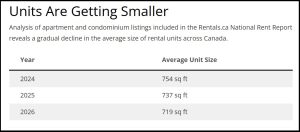
Since 2024, the average size of rental units has decreased from 754 square feet to 719 square feet—a reduction of roughly 35 square feet (4.6%).
Vancouver remains the most expensive market on a per‑square‑foot basis, with renters paying an average of $4.11 per square foot—more than double the rate in cities like Edmonton. Toronto follows at $3.52 per square foot, while Ottawa also exceeds $3 per square foot, placing it among the pricier markets relative to unit size.
By contrast, Calgary and Edmonton offer larger units at lower per‑square‑foot rents, with Edmonton averaging $1.99 per square foot, the lowest among the cities studied.
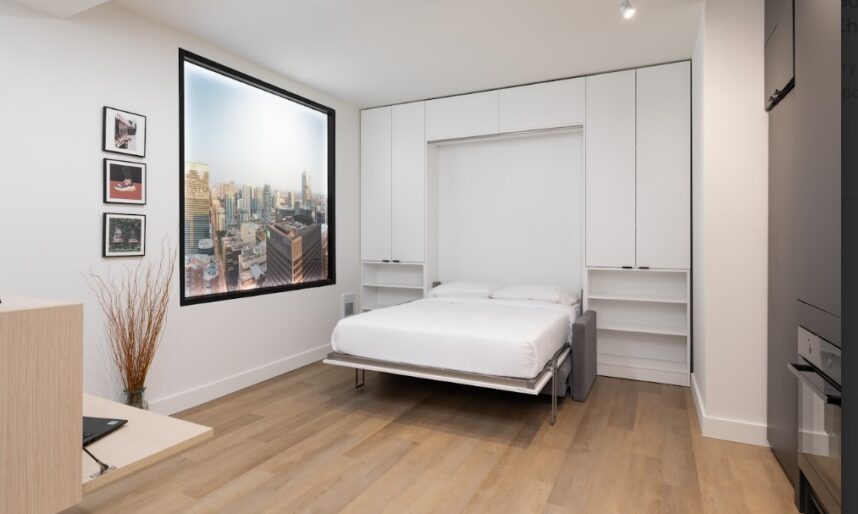
The analysis suggests that the decline in average unit size is partly driven by shifts in the composition of new rental supply. While the size of individual unit types has remained relatively stable, a growing share of studio and one‑bedroom units in newer developments is pulling down overall averages.
Much of the recent housing supply in major Canadian cities has come from condominium developments, where smaller units make up a significant portion of new inventory. At the same time, strong demand for centrally located housing continues to support more compact living arrangements.
Although rent per square foot has eased slightly in line with broader rent trends, it remains elevated in high‑demand urban markets, underscoring the ongoing affordability challenges facing renters.
For the full analysis, visit If Rents are Falling, Why Does it Feel More Expensive?