




With vacancy rates climbing, rent growth slowing, and the smallest second-quarter population increase in nearly eighty years, Canadian apartment owners are facing a cooling rental market. Still, according to Yardi’s Q4-2025 Multifamily Report, it’s not all bad news. Demand remains solid in many urban centres, offering cautious optimism for operators and investors despite six consecutive quarters of rent growth deceleration.
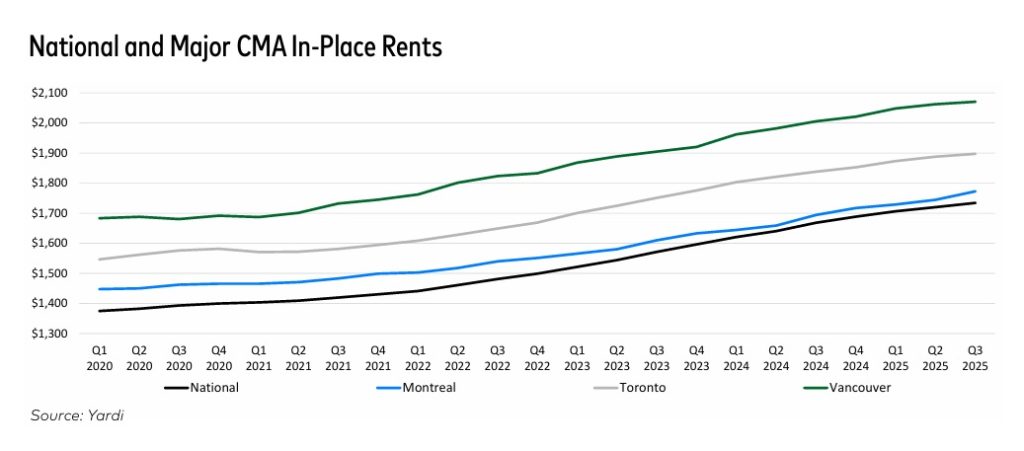
“After several years of above-trend rent increases, growth is diminishing,” Yardi analysts wrote—noting that the average national in-place rent rose by $14 in Q3 2025 to $1,734, while the annual growth rate declined 90 basis points from the previous quarter to 3.9 per cent. In-place rents reflect the aggregate of all rents within a given Census Metropolitan Area (CMA), including new leases, renewals, and existing agreements.
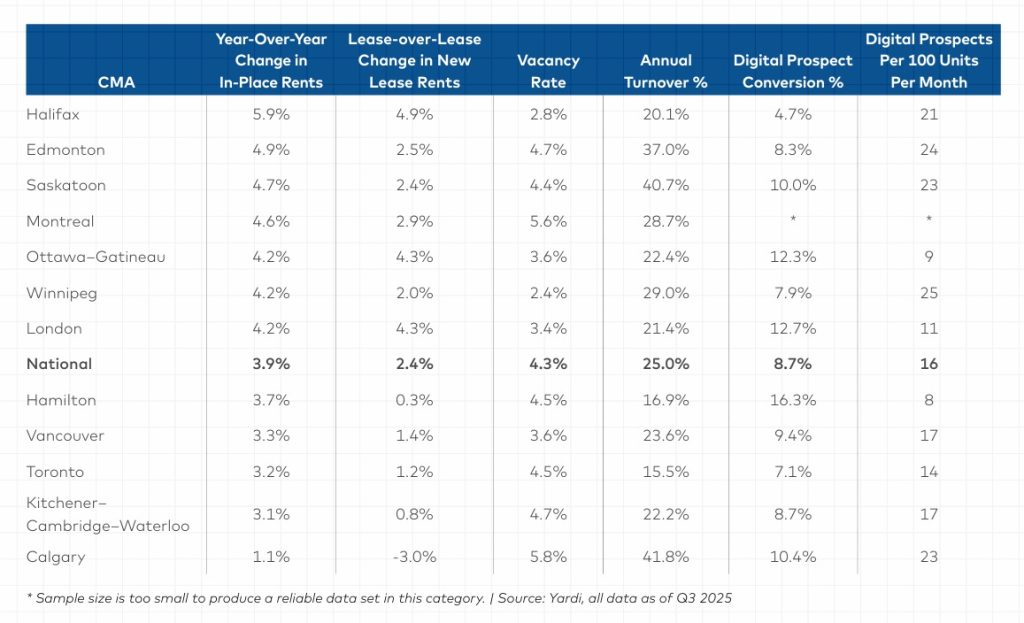 Regionally, Halifax led the country with 5.9 per cent year-over-year rent growth, buoyed by its expanding technology sector. Edmonton (4.9%), Saskatoon (4.7%), and Montreal (4.6%) also posted strong gains. At the other end of the spectrum, Calgary (1.1%), Kitchener–Cambridge–Waterloo (3.1%), and Toronto (3.2%) recorded the slowest increases.
This isn’t a surprise, however, given the backdrop of economic turbulence. Since Q2, tariffs imposed by Canada’s largest trading partner have weighed heavily on exports—especially steel and aluminum, where rates remain as high as 50 per cent. Moody’s Analytics estimates the effective tariff rate at 12 per cent, prompting the Bank of Canada to cut its benchmark interest rate to 2.50 per cent in an effort to stimulate consumer activity.
While GDP posted a modest 0.2 per cent gain in July—driven by mining, manufacturing, and wholesale trade—this followed a sharp 1.6 per cent annualized contraction in Q2, largely due to a 7.5 per cent drop in exports. Employment figures have also faltered, with job creation averaging just 8,000 per month year-to-date, well below the long-term norm. However, a strong September showing offers a glimmer of hope for recovery.
For apartment owners, the key challenge lies in adapting to shifting fundamentals: slower population growth, reduced inflows of non-permanent residents, and economic uncertainty. Yet, with interest rates easing and demand holding firm in many regions, the multifamily sector continues to offer stable return.
National and regional vacancy rates
Lease-over-lease rent growth—an important gauge of market momentum based on newly signed leases for vacated units—continued to decline in Q3 2025. The rate fell to 2.4 per cent, down 40 basis points from the previous quarter and sharply lower than the 9.1 per cent recorded in Q3 2024. Yardi notes that this deceleration reflects a combination of slowing population growth and reduced affordability following several years of elevated rent increases.
The national apartment vacancy rate also continues to rise, though most markets remain relatively tight. The overall vacancy rate reached 4.3 per cent in Q3 2025, up 20 basis points from the previous quarter and 110 basis points year-over-year.
Calgary maintains the highest vacancy rate at 5.8 per cent, though it declined 90 basis points quarter-over-quarter. Winnipeg (2.4%) and Halifax (2.8%) posted the lowest rates, while Toronto’s bachelor unit vacancy rate climbed to 8.9 per cent.
Montreal saw the largest quarterly increase, with its vacancy rate rising 100 basis points to 5.6 per cent. The city added 3.3 per cent to its purpose-built rental stock in 2024 and another 2,136 units in Q1 2025, according to CMHC. Despite this influx, rent growth remains strong, with in-place rents up 4.6 per cent year-over-year.
Tenant turnover and lease renewals
 Shifts in immigration policy have further influenced housing demand, contributing to softer rent growth and increased turnover. The national annual turnover rate rose to 25.0 per cent in Q3 2025—up 220 basis points year-over-year and the highest level in three years. Turnover increased quarter-over-quarter in every major market except Calgary, reflecting loosening conditions driven by reduced immigration and a weaker job market.
At the same time, tenant tenure is lengthening: the average length of stay rose to 36 months nationally, up from 34 months a year earlier. Tenants stay longest in Toronto (47 months), Hamilton (41), and Halifax (40), and shortest in Calgary and Saskatoon (26).
Despite legislative efforts to accelerate housing development, CMHC forecasts a decline in purpose-built rental starts in 2025 compared to 2023 in Vancouver, Toronto, and Ottawa. In contrast, Calgary, Edmonton, and Montreal are expected to see increases, highlighting regional differences in construction activity and market fundamentals.
Renewal lease rates—typically more stable due to provincial rent control—also showed signs of cooling, falling 40 basis points to 3.0 per cent nationally in Q3. Calgary, which does not impose rent control, saw renewal rates turn negative year-over-year at -2.2 per cent. The city’s elevated level of new deliveries and slowing immigration are contributing to this downward pressure.
The full Yardi Multifamily Report is available for download: https://info.yardi.com/multifamily-market-reports-for-canada