




Canada’s housing landscape is undergoing a shift, as evidenced by the cooling rents in most urban markets. In September, residential rents declined 3.2 per cent year-over-year to $2,123, marking the 12th consecutive month of annual rent decreases, according to the latest National Rent Report from Rentals.ca and Urbanation. This follows a 38-month stretch of rent increases between August 2021 and September 2024, and represents the first two-year decline in average asking rents since January 2022.
“Renters in many parts of Canada are experiencing the best levels of affordability in two years, with the most expensive markets in Vancouver and Toronto seeing rents at their lowest in nearly four years,” said Shaun Hildebrand, President of Urbanation. “This is the result of new rental supply outstripping demand, which is unlikely to persist for long as supply from secondary market sources such as condos tightens and demand drivers such as population growth and employment stabilize.”
Rents declined across all property types compared to a year ago, with purpose-built rentals down 2.1 per cent, condo rentals falling 3.0 per cent, and houses and townhomes declining 5.5 per cent. Over two years, rents in the secondary market fell more sharply, with condos dropping 4.7 per cent and houses/townhomes down 8.3 per cent, while purpose-built rental rates increased 3.3 per cent and 18.3 per cent over three years. Among bedroom types, one-bedrooms posted the largest annual rent drop at 4.1 per cent to $1,836, followed by two-bedrooms (-2.6 per cent), studios (-2.4 per cent), and three-bedrooms (-1.3 per cent).
Three-bedroom apartment rents increased 0.9 per cent annually to $2,755 for purpose-built units and 2.4 per cent to $2,923 for condos. At the other end of the spectrum, studio condo rents fell 8.7 per cent year-over-year to $1,708 — the largest decline across all unit types.
At the provincial level, apartment rents declined the most in B.C. and Alberta, both down 5.5 per cent annually. Ontario followed with a 2.7 per cent drop, while smaller declines were recorded in Nova Scotia (-2.2 per cent), Quebec (-0.5 per cent), and Saskatchewan (-0.3 per cent). Manitoba was the only province to record rent growth, increasing 2.6 per cent year-over-year. Over three years, apartment rents rose most significantly in the Prairie provinces, led by Manitoba (+27.1 per cent), Saskatchewan (+26.5 per cent), and Alberta (+20.5 per cent).
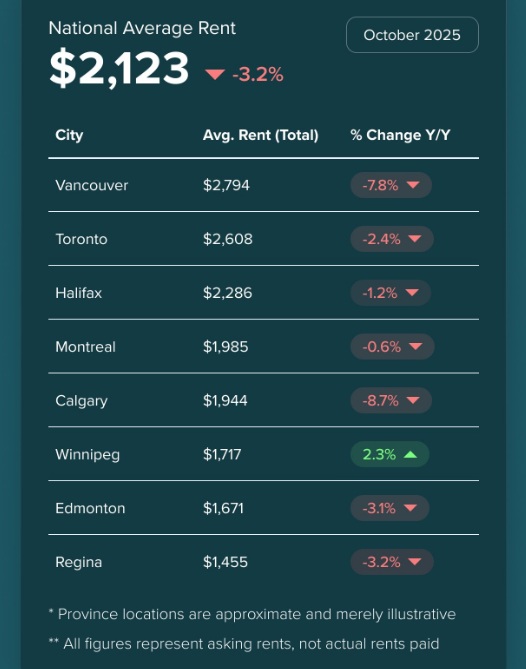 All six of Canada’s largest cities posted annual rent declines in September. Vancouver led with an 8.2 per cent decrease to $2,776, followed by Calgary (-7.4 per cent), Toronto (-2.9 per cent), Edmonton (-2.3 per cent), Ottawa (-1.3 per cent), and Montreal (-0.5 per cent). Vancouver and Toronto rents were also down on a three-year basis, falling 10.5 per cent and 8.6 per cent, respectively. Edmonton, by contrast, saw the strongest three-year growth among major cities at 18.3 per cent.
Among bedroom segments in major markets, the sharpest annual declines occurred in three-bedroom units in Calgary (-9.7 per cent), two-bedroom units in Toronto (-7.0 per cent), and one-bedroom units in Vancouver (-6.4 per cent). Montreal and Edmonton recorded rent increases for three-bedroom units, rising 7.6 per cent and 1.1 per cent, respectively.
The average asking rent for shared accommodations across four provinces fell 6.6 per cent annually in September to $943, returning to the same level as two years ago. Rents declined 7.4 per cent in B.C., 7.1 per cent in Alberta, 6.9 per cent in Ontario, and 3.7 per cent in Quebec. Vancouver saw the steepest annual drop at 14.7 per cent to $1,268, while Ottawa posted the strongest growth at 16.2 per cent to $1,108. Rents remained flat in Toronto and inched up 0.5 per cent in Edmonton.
For the latest National Rent Report, visit: www.Rentals.ca