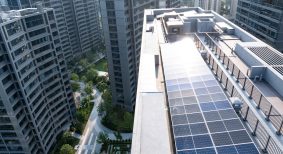



Living rooftops—once dismissed as an architectural novelty—have become a proven tool for cooling cities, reducing emissions, and managing stormwater. Yet in 2025, the Government of Ontario repealed Toronto’s Green Roof Bylaw, raising concerns among sustainability experts who warn the city could lose hard‑won environmental gains. Few people understand those stakes better than Steven Peck, who has spent more than two decades advancing green roof policy and research across North America. Peck has long argued that green roofs are “critical urban infrastructure”—not decorative add‑ons—because they deliver measurable environmental and economic value.
“Green roofs help manage stormwater, reduce building energy use, improve air quality, and create much‑needed green space in dense cities,” he said, adding that healthy vegetation is central to these benefits, improving water quality, reducing runoff, and providing cooling effects that counteract the urban heat island.
He also warned that without mandatory standards, adoption is known to slow—even when the business case is strong. Toronto’s green roof bylaw, introduced in 2009, helped transform the city into a global leader, with more than 1,000 living systems installed over 15 years and supporting more than 1,600 jobs in Ontario.
“Policy drives market transformation,” he said. “When requirements disappear, progress can stall.”
Cooling, absorption, and biodiversity
Multiple studies have shown that conventional black roofs can reach 70–80°C on a hot summer day, while green roofs under the same conditions often stay around 30–40°C. This temperature difference reduces cooling demand and lowers emissions. Green roofs also act as natural stormwater management systems, absorbing rainfall that would otherwise overwhelm aging sewer networks. In cities like Toronto, where heavy downpours are becoming more frequent, this function is critical. A well‑designed green roof can retain up to 70 per cent of annual precipitation, easing pressure on municipal infrastructure and reducing flood risk.
Another overlooked benefit, according to Peck, is that green roofs support biodiversity by creating habitat for pollinators, birds, and insects that struggle to survive in concrete‑dominated environments. For multi‑unit housing developers, these ecological gains translate into human benefits. When designed as accessible public spaces, green roofs become places where residents can reconnect with nature, support their mental well‑being, and enjoy outdoor areas that traditional rooftops simply can’t offer.
Longer life, lower costs
On the investment front, while installation costs can be higher than those of conventional roofs, green roofs last significantly longer because vegetation protects the underlying membrane from UV radiation and extreme temperature swings. Lower energy bills, reduced maintenance, and extended roof lifespan all contribute to long‑term savings.
“A green roof is one of the few building investments that pays back environmentally, socially, and financially,” Peck said.
And new research is reinforcing these claims. A major Canadian study, Nature Cities, published in 2025, used very high‑resolution airborne remote sensing to analyze more than 1,300 green roofs across Toronto. The study demonstrates that cities can now monitor green roof performance at scale, tracking plant health, identifying maintenance needs, and revealing which design factors—such as roof size, height, and vegetation type—most influence long‑term success. This kind of data gives municipalities a powerful new framework for evaluating and optimizing green roofs with far greater accuracy than traditional on‑site inspections.
A call to stay the course
Despite mounting evidence in favour of these systems, the repeal of Toronto’s Green Roof Bylaw—once the first mandatory green roof requirement in North America—marks a step back at a time when climate pressures are intensifying.
Peck and other sustainability leaders argue that this moment should sharpen, not dull, the city’s focus. As Canada works to modernize its building stock and strengthen climate resilience, living systems remain one of the smartest investments available—whether or not they’re required by law.
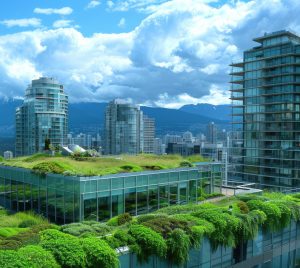
Green roof policies across Canada
Toronto’s 2025 repeal ended the country’s only comprehensive green‑roof requirement for private development. Still, several municipalities promote green roofs through voluntary guidelines, incentives, and density bonuses, including Vancouver, Montreal, and Edmonton.
Learn more about the benefits of green roofs at: www.greenroofs.org