


Toronto’s mayoral race is heating up as the city prepares to head to the polls on October 26. With Chris Alexander now out of the running, leaving 53 active candidates on the ballot, the campaign has effectively narrowed down to two lead contenders: incumbent mayor Olivia Chow and City Councillor Brad Bradford.
The pair have come head‑to‑head in several live debates in recent days, offering sharply different visions for how Toronto should shape its rental future — from policies aimed at keeping development costs in check to solutions for tackling construction delays, escalating fees, and aging infrastructure.
“Even with record construction, Ontario is projected to be 121,000 rental homes short by 2036, and the GTHA accounts for more than 60 per cent of this gap,” said Tony Irwin, President and CEO at the Federation of Rental‑housing Providers of Ontario (FRPO). “Toronto’s next mayor and council has an opportunity to help fill that shortage by cutting red tape, reducing development charges, and planning infrastructure that supports greater infill development and density near transit and jobs.”
Since being elected in June 2023, Chow has centred her tenure on the belief that the city must intervene more directly to protect renters and preserve affordability. Her administration has leaned heavily on public and non‑profit delivery, using municipal land, capital grants, and long‑term tax exemptions to make purpose‑built rental more viable. During her February 2026 budget announcement, she underscored that approach, noting: “Renters are feeling squeezed from the high cost of living. By helping renters have safe and well‑maintained apartments, stopping illegal evictions, and building more affordable homes, we make sure people who work in our city can continue to live here.”
Chow paired that message with a commitment to break ground on more than 9,800 rent‑controlled and affordable homes in 2026, with work continuing on 5,600 more and 1,400 reaching completion, in line with the HousingTO goal of 65,000 rent‑controlled homes by 2030. Meanwhile, projects like the mixed‑income rental building on Kingston Road — a former condo proposal converted with city support — reflect her preference for expanding rental options and backing mission‑driven developers over speculative builders. She also broadened the Multi‑Unit Residential Acquisition (MURA) program, giving non‑profits and Indigenous housing providers the ability to purchase aging apartment buildings before private investors can flip them, preserving affordability and long‑term community ownership.
Overall, Chow’s rental‑housing agenda since 2023 has been defined by stronger tenant protections, tighter oversight of renovations, and enforcement of new anti‑renoviction rules. Her 2024 rental‑renovation licensing regime pushed those expectations further, tying renovation approvals to clear tenant safeguards and baseline maintenance standards. Taken together, these measures signal a city willing to intervene when the market falls short and one that expects landlords and developers to operate within a more regulated, socially oriented framework.
Brad Bradford, by contrast, frames Toronto’s housing crisis as fundamentally a supply problem, arguing that the city must stop making it so expensive and time‑consuming to build. Since launching his mayoral campaign, Bradford’s pitch to housing developers has consistently centred on cutting development charges, streamlining approvals, and opening more land to densification.
His platform also champions multiplexes, mid‑rise apartments along major corridors, office‑to‑residential conversions, and modular construction — the kinds of projects he argues can dramatically speed up delivery. At the same time, while he supports the vacant home tax, Bradford has signalled he would overhaul its “reverse‑onus” structure, and he remains opposed to broad new housing taxes he says could hamper investment. His proposed one‑year property‑tax freeze, aimed at stabilizing operating costs for rental owners, marks a notable departure from Chow’s incremental increases.
Two visions, one city
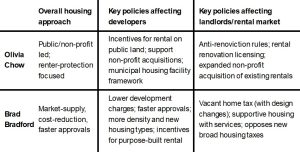 Comparatively speaking, Bradford’s vision of Toronto is one where the private sector is more heavily relied upon to build rental housing, with City Hall acting more as facilitator than enforcer.
“The city needs to get out of the way and let builders build,” he said at a recent housing roundtable. “Faster approvals and lower fees are how we get more rental homes online.”
As election day approaches, the contrast between the two visions is sharpening. While Chow imagines a city where non‑profits hold a larger share of the rental stock and landlords operate under stricter rules, Bradford envisions a city where developers can build more housing without an approval system slowing them down. The choice, therefore, is not simply about political leadership, but also about the operating environment rental housing providers will navigate, and the role City Hall will play in shaping the rental homes Toronto has yet to build.