






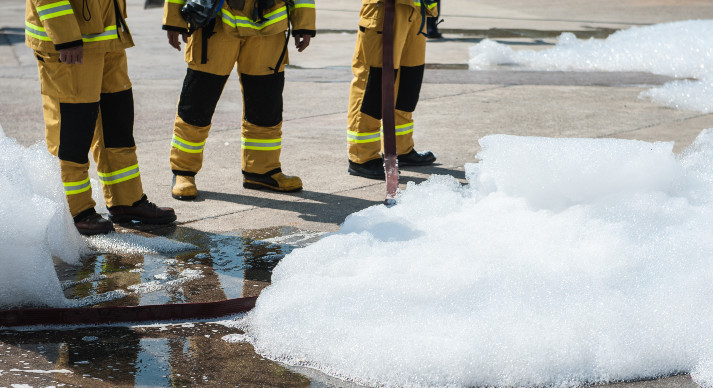
A proposed phase-out of firefighting foams that contain per- and polyfluoroalkyl substances (PFAS) aligns with the Canadian government’s stated intention to add this class of chemicals to the toxic substance list under the Canadian Environmental Protection Act (CEPA). Stakeholders and the general public are invited to provide input on the aqueous film-forming foams (AFFF) that have commonly been used to extinguish burning hazardous liquid fuels, and the feasibility of adopting alternatives that are deemed less detrimental to human health and the natural environment.
PFAS are tapped to be classified as toxic substances due to their adverse properties and potential to be dispersed into the environment in quantities and/or concentrations that could pose immediate or long-term harm to ecosystems and biological diversity or endanger human life. Well documented evidence shows that PFAS exposure can compromise individual organs such as the liver, kidneys and thyroid and/or the body’s immune, nervous and reproductive systems.
The move additionally reflects Canada’s standing as one of the 152 national signatories to the Stockholm Convention on Persistent Organic Pollutants — a global treaty to safeguard against invasive, long-lasting chemicals that can accumulate with damaging consequences in the fatty tissue of humans and wildlife.
“By proposing a phase-out of PFAS in firefighting foams, we aim to reduce harmful exposures and prevent further contamination,” says Julie Dabrusin, Canada’s Minister of Environment and Climate Change. “This transition will also facilitate the adoption of effective alternatives for combatting these hazardous fires.”
Firefighting foams have been central to on-site fire safety preparedness and response in the aviation, petroleum and chemical industries, on board ships and at various other industrial facilities where hazardous products are used or stored. Municipal fire departments are also likely to deploy them, when necessary, when called to incidents at airports or industrial facilities.
AFFFs have been the conventional choice to meet performance specifications set out in numerous standards, codes and regulatory stipulations, such as the National Fire Code of the Canada (NFCC), Canadian Aviation Regulations (CAR), U.S. National Fire Protection Association (NFPA) standards, the U.S. Department of Defense Military Standard and International Maritime Organization (IMO) rules. However, the newly released consultation document from Environment and Climate Change Canada highlights the emergence of fluorine-free foams (F3) that are seen to be gaining credibility as effective alternatives.
In Canada, Transport Canada introduced new flexibility in 2019 to allow airports and heliports to adopt F3s that can meet safety specifications, and the Billy Bishop Toronto City Airport became the first North American airport facility to do so in 2021. CAN/ULC standard 563, developed in 2022, establishes parameters for F3 liquid concentrates that can be used for aircraft firefighting at airports and aerodromes, but no products have yet been certified under the standard.
Canada’s Department of National Defence (DND) is working toward transitioning to PFAS-free alternatives that are approved for military applications, and the NFCC references the new foams in its informational annex. On the flipside, the consultation document notes that general lack of awareness, concerns about cost and technical challenges and the long shelf life of incumbent PFAS-containing products are barriers to the uptake of F3 formulations.
“Nothing has been identified to suggest that F3 cannot be made to work for all required scenarios that have been conventionally managed by AFFF, but there is still work to be done to optimize their performance,” it states.
Under Canada’s regulatory procedures, PFAS must first be listed as toxic substances under CEPA, after which there is a 42-month window to have a risk management approach in place. The consultation on firefighting foams is anticipatory work in advance of that yet-to-be-determined deadline.
The federal government announced its intention to designate PFAS in March this year and also outlined associated proposed risk management steps at that time. That’s to begin with the phase-out of firefighting foams and then move on, in two subsequent steps, to consumer applications and formulations for which there are not yet feasible PFAS-free alternatives.
If that process unfolds as envisioned, regulations pertaining to firefighting foams would come into force six months after they are finalized and published in the Canada Gazette. As proposed, manufacture of, and training exercises employing AFFF would be prohibited at that time. Transition periods of varying lengths would be set before the final stoppage of firefighting uses.
These generally align with the schedule that has been established in the European Union. Proposed transition periods range from 18 months for portable fire extinguishers and municipal fire service applications to three years for civil aviation facilities to six years for civilian ships, military uses, offshore oil and gas installations and industrial facilities accommodating designated high hazards.
There would also be new labelling, disclosure and record-keeping requirements. That includes labels to warn of possible cross-contamination in scenarios where firefighting equipment that formerly contained or dispersed AFFF has been retrofitted for PFAS-free formulations.
The public can submit comments until Nov. 25, 2025.