





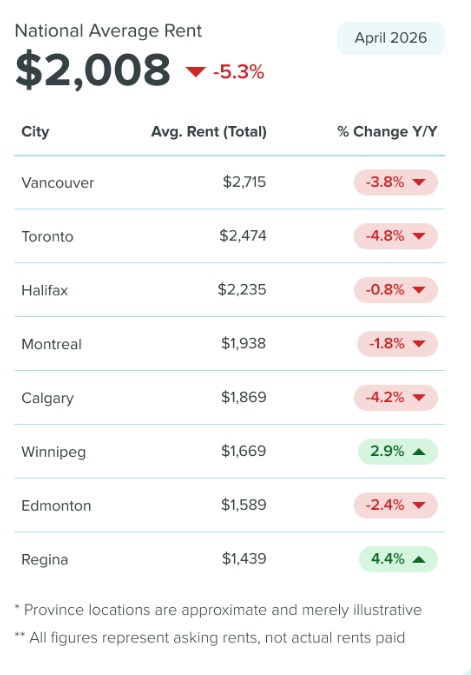
Canada’s rental market continued its downward slide in March, with the average asking rent falling for the 18th straight month to $2,008—the lowest level in nearly three years. According to the latest National Rent Report from Rentals.ca and Urbanation, this marks a 5.3 per cent year-over-year decline, the sharpest annual drop since the early months of the COVID‑19 pandemic.
 “The Canadian rental market downturn has deepened, with rents in March falling at their fastest pace since COVID,” said Shaun Hildebrand, President of Urbanation. “This shows in real-time the market impact from the declining population, coupled with ongoing affordability issues, heightened economic uncertainty, and record high apartment completions.”
The report shows that rents have now fallen 7.9 per cent compared to two years ago, and are roughly in line with levels seen three years ago. Month-over-month, asking rents dipped another 1.1 per cent, following a 1.3 per cent decline in February. Since the market peak in May 2024, average monthly rents have dropped by $194, or 8.8 per cent.
Secondary market hit hardest
All major housing categories saw declines, but the secondary market—condos, houses, and townhomes—experienced the most pronounced drops. Condo rents fell 6.9 per cent year-over-year to $2,077, while houses and townhomes slid 9.0 per cent to $1,990. Purpose-built rentals remained comparatively stable, easing 3.9 per cent to $2,005.
Smaller units also continued to dominate new supply. The average rental size shrank to 831 square feet, while per‑square‑foot rents dipped 1.2 per cent to $2.49. One‑bedroom units saw the steepest annual decline at 5.1 per cent, falling to $1,763.
Provincial and city-level trends
Canada’s largest provinces led the national downturn. Apartment rents fell 4.8 per cent in British Columbia, 4.6 per cent in Alberta, and 4.4 per cent in Ontario, while Quebec posted a more modest 2.1 per cent decline. Meanwhile, rents climbed in Nova Scotia, Saskatchewan, and Manitoba, with Saskatchewan continuing to show the strongest long-term growth.
Among the country’s six biggest cities, every market recorded an annual decline. Calgary led with a 5.0 per cent drop, while Montreal saw the smallest decrease at 1.6 per cent. Toronto rents hit a 46‑month low, and Vancouver rents remained below early‑2022 levels despite recent monthly gains.
Shared accommodations also saw notable softening, with average asking rents across B.C., Alberta, Ontario, and Quebec falling 6.3 per cent to $899, dipping below $900 for the first time in three years.