




According to new data released from Yardi, Canada’s multifamily housing sector entered 2026 on unsteady footing after a year marked by slowing rent growth, softening demand and persistent affordability pressures. Although the country continues to face a structural housing shortage, helping to support generally solid occupancy, market fundamentals weakened noticeably through 2025 and are expected to remain fragile in the year ahead.
“Multifamily performance is healthy but fragile entering 2026,” Yardi analysts wrote. “The market faces decelerating rent increases, weaker demand and affordability challenges.”
Economic conditions played a central role in this shift, according to the report. After the initial shock of U.S. tariff policy early in 2025, Canada’s economy regained some stability in the second half of the year. Still, growth remains subdued. Consensus forecasts place 2026 GDP expansion in the modest 1.0–1.5 per cent range, well below the nation’s full potential. While tariffs created strain in key export industries such as autos, aluminum and steel, nearly 90 per cent of Canadian exports to the U.S. remain tariff‑free, helping ease fears of a deeper downturn.
Labour market performance mirrored the broader economic slowdown, according to Yardi analysts. Job creation lagged for much of 2025, pushing unemployment to 7.1 per cent in August. A late‑year rebound added 188,000 jobs in the final four months, bringing the annual total to 226,000 and nudging unemployment down to 6.8 per cent by December. Healthcare remained a bright spot for hiring, while professional and technical services struggled. Youth unemployment—nearly 15 per cent for young adults and 18 per cent for students—poses a particular challenge for apartment demand, as younger renters are more likely to delay household formation during periods of joblessness.
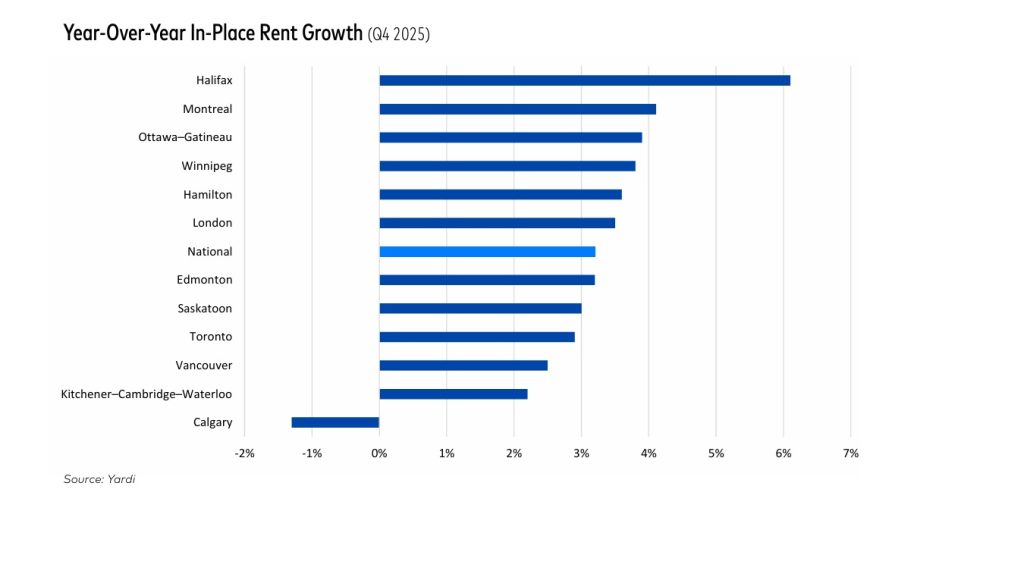
In terms of the housing market, high prices and economic uncertainty kept overall housing activity muted. Single‑family home values declined in expensive markets like Toronto and Vancouver, while multifamily rent growth slowed sharply across most of Canada, rising just $9 on average in Q4 2025. Halifax, Montreal and Ottawa–Gatineau posted the strongest gains, while Calgary saw a 1.3 per cent decline.
Supply trends offered mixed signals: deliveries in the six largest metropolitan areas totaled 94,611 units through November 2025, up slightly from the previous year but with notable declines in several major markets. That said, apartment construction starts surged, with more than 122,000 units underway in the first three quarters of 2025, representing an 8.1 per cent increase and positioning the country to surpass 2024’s record pace. Apartments accounted for 68.5 per cent of all housing starts, underscoring the sector’s long‑term importance despite near‑term fragility.
To download the full report, click here: Yardi Canada | Multifamily Market Reports