


Supply chain disruptions have become an increasingly familiar challenge for facility managers and cleaning professionals. The 2026 Thomson Reuters Global Trade Report found that 72 per cent of trade professionals identified regulatory change as a significant factor impacting supply chains. Delayed shipments, product shortages, rising transportation costs, and unpredictable lead times can make it difficult to keep essential supplies available when they are needed most.
While the immediate impact of a disruption may seem straightforward, such as paying more for a product or waiting longer for an order, the true cost can extend much further. For facilities, disruptions can affect labour efficiency, productivity, inventory management, cleaning quality, and even occupant satisfaction.
Understanding these hidden costs can help facility teams take a more proactive approach to procurement and reduce the operational impact when disruptions occur.
When a shortage becomes a labour issue
When a preferred cleaning product or tool is unavailable, staff may have to spend additional time searching for alternatives, modifying established processes or working with equipment they are less familiar with. Just in 2025 alone, average delivery times were 25 per cent longer than in 2024.
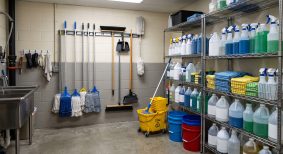
For example, if a facility runs out of a particular mop, dustpan, or waste-handling tool, employees may need to use an alternative that requires more time or additional steps. Individually, those inefficiencies may seem minor, but across an entire facility and over hundreds of cleaning tasks, however, they can add up quickly.
Facility leaders should consider more than the purchase price when evaluating replacement products. A lower-cost alternative may not necessarily be the most economical choice if it requires additional labour or reduces productivity.
The cost of emergency purchasing
Supply disruptions can also force facilities into reactive purchasing decisions. When an essential product is suddenly unavailable, or shipping times take too long, there may not be time to compare suppliers, negotiate pricing or evaluate whether an alternative meets the facility’s performance requirements. Instead, teams may purchase whatever is immediately available, even if it comes at a premium.
Emergency purchases can also create additional costs through expedited shipping, smaller order quantities or purchases from unfamiliar suppliers. Maintaining relationships with reliable suppliers, such as those that are vertically integrated and utilize nearshore manufacturing, can help facility teams navigate disruptions with greater flexibility. Having a backup plan in place allows purchasing decisions to be based on performance and value, rather than urgency.
Inventory can become a balancing act
Supply chain uncertainty creates a difficult question for facility managers. How much inventory is enough? Keeping too little can leave a facility vulnerable to shortages, but keeping too much can tie up capital and take up valuable storage space. In fact, inventory carrying costs can account for approximately 20 and 30 per cent of a business’s total inventory value.
The answer will vary depending on the facility, but regularly reviewing usage patterns can help establish more practical inventory levels. Teams can identify products that are used consistently, determine how quickly they are replenished, and account for potential fluctuations in demand.
It is also worth evaluating the physical durability and longevity of cleaning tools. A tool that lasts longer may need to be replaced less frequently, reducing the facility’s exposure to future supply interruptions.
Disruptions can affect cleaning quality
The consequences of supply chain disruptions are not limited to budgets and logistics; they can also affect the quality and consistency of cleaning operations.
When teams do not have the tools they normally use, they may have to adjust procedures or substitute products that are not ideally suited for the task. Over time, this can make it more difficult to maintain consistent cleaning standards.
For facilities where cleanliness directly affects occupant perceptions, such as schools, healthcare environments, offices and public spaces, maintaining consistency is particularly important.
Standardizing commonly used tools and establishing approved alternatives can help teams maintain consistent procedures even when their first-choice products are temporarily unavailable.
Look beyond the purchase price
The price on the invoice represents only one part of a product’s true cost. Facility teams should consider the total cost of ownership (TCO), which accounts for factors such as durability, productivity, replacement frequency, storage requirements, and end-of-life disposal.
A cleaning tool that costs slightly more upfront may provide greater value if it lasts longer, reduces unnecessary effort or performs more efficiently. Similarly, products designed to withstand demanding commercial environments may help reduce the frequency of replacements.
By considering total cost of ownership rather than simply unit price, facility managers can make purchasing decisions that provide greater long-term value and resilience.
Build resilience before the next disruption
Organizations can reduce their exposure to supply chain risks by preparing beforehand. Facility teams should regularly review their most critical cleaning and maintenance supplies, monitor usage and lead times, identify approved alternatives, and maintain communication with suppliers.
Supply chain planning should be viewed as an ongoing part of facility management, rather than emergency response. Disruptions may be unpredictable, but their impact does not have to be. By looking beyond the immediate purchase price and considering the hidden costs, facility professionals can make smarter procurement decisions and build operations that are better prepared for whatever comes next.
Author Bio: Carlos Albir, Jr. is Vice President of Operations at ABCO Cleaning Products, a leader in sustainable cleaning tools. ABCO is a family-owned, Certified Minority Business Enterprise with Green Seal-certified products, headquartered in Miami.