

Articles Archive - Page 619 of 929 - REMINET
REMI

It’s Time to Rethink Vinyl Flooring

Forget what you remember about your grandmother’s vinyl. Thanks to cutting-edge materials, contemporary designs, and advanced production techniques, the vinyl flooring of yesteryear has been replaced with a more resilient, healthier, and visually dynamic successor that is making a comeback in commercial and residential properties across the country.

The resurgence of vinyl can be attributed to any number of factors, not the least of which being its (now) attention-grabbing visual appeal that is being consistently recognized by interior designers for its value and functionality.

“The patterns of old were ordinary at best, but that’s definitely not the case anymore,” says Laura Piazza, Chief Operating Officer with 4 Corners, a specialist in luxury vinyl flooring. “The new patterns now provide 3D photo-realistic replications of natural materials, so you can have a floor with tactile surface textures and woven textiles in the wear layer that makes it actually look and feel like a wood finish, slate, or even concrete.”

“Even after all these years working with vinyl, I still do a double take when I see how realistic it can be,” she adds “I love showing people our flooring and seeing their reactions. They always reach out to touch it because it looks so real”

Yet while today’s vinyl flooring can replicate natural materials, it is still vinyl (but that’s a good thing). Floors laid with actual natural materials can be hard to maintain, whereas vinyl can be cleaned with a simple sweep and mop. Installers and contractors are also drawn to the product since it is easy to put down without the hassle of the old style click systems; and designers are specifying vinyl planks as a “floor of choice” for many applications from dental offices to hotel rooms.

vinyl flooring

What’s more, modern vinyl is manufactured to be water-resistant and resilient against scratches, stains, and scuffs that are typical in high-traffic areas such as lobbies, office floors, or hallways.

“The thicker your top coating (wear-layer) is, the longer your floor will last; and with today’s vinyl planks and tiles, there are lots of options when it comes to that top coating,” explains Piazza.

As an example, 4 Corner’s own Malibu series of luxury vinyl flooring is 40% thicker than other products in its category, making it far less susceptible to damage. Other products, like its Luxury Vinyl Plank flooring, are formed with multiple layers of vinyl, fibreglass, and a soft backing, providing added protection and greater comfort for those who may be required to stand on it over long periods of time.

Vinyl is also the healthier flooring alternative. Beyond its inherent slip-resistant qualities, many vinyl products feature a polyurethane antimicrobial top coating system that eliminates and destroys up to 99.9 per cent of all bacteria and dirt. This makes them an ideal choice for retirement villages, healthcare facilities, and hotels. Moreover, vinyl floors do not produce off-gassing when installed, making them a more eco-friendly option and – for property stakeholders – an ideal way to meet green building standards such as LEED.

“The reason you find lifetime or 10 to 20-year warranties on vinyl flooring these days is because manufacturing standards have risen and these products are being made to withstand the test of time,” adds Piazza.

In short, says Piazza, it really is what’s inside vinyl that counts: “Manufacturing standards have thankfully risen in the past years, but in some countries more than others. We take pride that our manufacturer is in South Korea, which is one place that has banned phthalates, a known carcinogen in many plastics, and has better controls over the chemicals that go into the final product. At the end of the day, that does make a huge difference.”

Vinyl in the spotlight

For many commercial property managers and residential home owners, the vinyl revolution has already begun. This is especially true in western markets like British Columbia where it is becoming the preferred option.

“We know property managers everywhere are converting to vinyl and getting away from carpeting. Vinyl is so easy to clean and doesn’t retain smells or stains, so it’s the perfect choice for hotels, rental, or condo properties,” says Piazza. “You probably walk on vinyl plank or tiles every day at banks, retail stores, hotels, grocery stores, and even the local big brand coffee shops without even knowing that’s what’s under your feet.”

Misconceptions and outdated perceptions may have slowed its adoption, but Piazza believes it’s only a matter of time before the look, quality, and durability of vinyl leaves everyone floored, adding, “One of the things I love about my job is showing them how 4 Corners can give their project that ‘wow’ factor.”

Laura Piazza is the Chief Operating Officer with 4 Corners, a leader in luxury vinyl flooring. For more information, visit https://4corners.ca/

 

Innovative Wireways Modernize University

Each school year, the Université de Saint-Boniface in Winnipeg, Manitoba retrofits a few classrooms to create a more active learning environment. This summer, the university renovated an IT classroom to provide power and data capabilities to student desks as well as the instructor lectern. For IT classes, technology access was a must.

“We needed LAN and power connectivity for student computers, USB outlets for their laptops, as well as an effective wire management solution for the instructor’s desk,” says Robert Simard, director of facilities and security at the university. “Quite a bit of wiring goes into the professor’s area. We were looking for a clean solution.”

Solution

Space is at a premium at universities across Canada, so Simard and his project team are always mindful of cost and maximizing every square foot possible.

“We have changing needs as programs expand and we must be able to quickly and efficiently reorganize a classroom to accommodate different programs and change the purpose of the space,” he says. “This might not always be a computer lab, so we want to implement features that are as flexible as possible to quickly and economically turn it into an office space if we choose.”

As the team hunted for a wireway system that would give them the freedom to be flexible, they found an invisible solution, one that would eliminate the need for old power poles, core drilling and trenching and open up the space. They also required a system that was compliant with the Electrical Safety Code and fit their budget.

They ordered and installed Connectrac’s ultra-low profile floor mounted wireway system into their classroom. The wireways were fitted under the student desks to provide power, LAN and USB capabilities for each table, which was then distributed to the students station via an under table wire management system. Subsequently, the instructor lecterns in each classroom received power and data access, ensuring the connections they needed.

wireways

The wireway is flexible enough to be moved or reconfigured when future changes come to the classroom.

“The need for space changes quite frequently,” says Simard. “With Connectrac, we know we can make different configurations if we need to.”

The school year at Université de Saint-Boniface has started off smoothly across the campus and in the IT classroom, with Connectrac installations in store for future renovations.

“As long as they are accommodated, students won’t typically notice the upgrades,” adds Simard. “Sometimes, no feedback is good feedback, and to me, that is a positive message that the product is well accepted and doing its job.”

For more information visit https://connectrac.com/


BOMA Canada awards industry’s best

The Canadian commercial real estate industry gathered in the Fairmont Royal York Hotel in downtown Toronto last night for the Building Owners and Managers Association (BOMA) of Canada National Awards gala.

BOMA Toronto celebrated its 100th anniversary as proud hosts of this year’s event, which also topped off the twenty-seventh anniversary of BOMEX – Canada’s Building Excellence Summit.

A total of 17 awards were handed out, recognizing industry achievements across the country from Newfoundland and Labrador to British Columbia.

The Outstanding Building of the Year (TOBY) awards were presented to 10 recipients in recognition of quality commercial real estate buildings and excellence in industry and building management. Judging is based on a number of factors ranging from tenant relations and community impact to energy conservation. Entrants must be BOMA BEST certified.

Bentall Kennedy was feted with three TOBY awards, one in the Retail Building category for managing Cloverdale Mall in  Etobicoke, Ontario, one for Bentall 5 in Vancouver, in the 500,000 to million square feet category and the third in the Historical Building category for Edifice Sun Life Building in Montreal, Quebec.

BOMA Canada introduced two new TOBY award categories this year. The first-ever National TOBY in the Mixed Use category was presented to Crombie REIT in recognition of Barrington Place in Halifax, Nova Scotia, while Aéroports de Montréal took home a TOBY award in the new Public Assembly building category for Aéroports de Montréal in Montreal.

Other TOBYs went to Northam Realty Advisors Limited for 165 Commerce Valley Drive West, Markham, Ontario in the Under 100,000 Square Feet category; Manulife Financial Real Estate for 980 Howe in Vancouver, in the 100,000 to 249,999 Square Feet category and La Capitale Financial Group Inc. for its corporate facility head office in Quebec City.

Brookfield Global Integrated Solutions also took home the coveted award for managing the John E. Brownlee Government Building in Edmonton, while Colliers International earned one for managing Mississauga Executive Centre 1 in the 250,000 to 499,999 Square Feet category.

Earth Awards, which honour resource preservation and environmentally sound commercial building management, were handed out to four industry members, including Montreal’s CHUM Hopital Notre-Dame, managed by CHUM; Retail Building Place Montreal Trust, also in Montreal, owned and managed by Ivanhoe Cambridge; Oxford Properties Group won two Earth Awards, one for the Nestle Building in Brampton in the Industrial Building category and the other for RBC WaterPark Place, an office complex in downtown Toronto.

BOMA Canada also presented its Pinnacle awards celebrating three organizations and industry service providers. In the Customer Service category, Paladin Security Group in Manitoba won, while Turnleaf Consulting Inc. in B.C. received the award in the Innovation category. Bee-Clean Building Maintenance, based in Edmonton, won in the Above & Beyond category.

Closing out the evening, BOMA Canada Chair Kim Saunders, took to the stage to present the BOMA Canada Chair’s Award for individuals who make valuable and long-lasting contributions to BOMA and support the organization in a meaningful way.

This year, the Chair’s Award honoured the BOMA Canada staff.

“Tonight, I’d like to single out that small team who work tirelessly, day in and day out, to deliver such tremendous value for us all,” Saunders said to the crowd. “Ladies and gentlemen, BOMA Canada would not be the industry-leading association that it is today without this hard-working, bright, and dedicated group of individuals. They work for you, and they are responsible for our national successes, including executing on the association’s most recent strategic plan in record time, and growing our association and our industry every day.”

BOMA Canada President and CEO Benjamin Shinewald accepted the award on behalf of his team, including John Smiciklas, Hazel Sutton, Linda Larsen, Mike Parker, Nicole Whitehouse who worked with BOMA Canada over the summer, Cindy Baeta, Victoria Papp and Debbie Prince.

“I am sure I speak for the others when I say that we are all both surprised and delighted at the thoughtfulness of your choice,” said Shinewald. “We are really touched and grateful that you have recognized us, and we hope that we continue to live up to the honour that you have bestowed on us.”

Winners of the 2017 BOMA Canada National Awards may be eligible to compete in the BOMA International TOBY Awards presented at the BOMA International Conference and Expo, June 23 to 26, 2018, in San Antonio, Texas.

The gala concluded with an invitation for industry members to join the Association next year in Calgary, Alberta, for BOMEX 2018.

View all of the 2017 BOMA Canada National Award winners here.

B.C. Community Recognition Awards announced

Six local governments in B.C. were recognized for their leadership in the use of wood in community projects, both architecturally and structurally.

The annual Wood WORKS! BC Community Recognition Awards were presented at the Union of B.C. Municipalities convention in Vancouver to communities that have been exemplary advocates for wood. This may be demonstrated through the specification of wood in a community project and/or through visionary initiatives that work toward building a community culture of wood.

The 2017 recipients are:

Lower Mainland Local Government Association (4 awards)

  • Metro Vancouver for the Kanaka Creek Watershed Stewardship Centre (Photo)
  • District of North Vancouver for the Delbrook Community Recreation Centre
  • City of Richmond for the Alexandra District Energy Building
  • City of Surrey for the Grandview Heights Aquatic Centre

Association of Kootenay Boundary Local Governments

  • Village of Salmo for the 6th Street Pedestrian Covered Bridge

North Central Local Government Association

  • City of Quesnel/Cariboo Regional District for the West Fraser Centre

“We salute these winning communities for building their civic projects with wood, and for helping to build a wood culture in B.C.,” said Lynn Embury-Williams, executive director, Wood WORKS! BC.

“We are seeing an unparalleled level of interest in wood by communities as they recognize the role wood can play in reducing their carbon footprint and achieving their climate action goals. The result is the use of wood products and building systems in an array of community project types, sizes and applications as both a structural and architectural building material.”

Recipients of awards for Southern Interior Local Government Association and Vancouver Island Local Government Association will be announced when presented at their respective area association conventions in spring 2018.

HVAC switch over snared by hot spell

Tensions boiled over last week at Toronto apartment buildings without air conditioning as temperatures soared into heat wave territory in late September.

Tenants aired their frustrations in the media and city councillors implored landlords to turn the AC back on, assuring them that they would not face enforcement from the city. Toronto bylaw requires landlords of both condo suites and rental buildings to provide for temperatures of at least 21 degrees Celsius from Sept. 15 through June 1.

Coun. Josh Matlow made efforts last week to clarify that if the conditions outside make it possible to meet this threshold, landlords need not turn off the AC and turn on the heat.

“When Mother Nature doesn’t follow the calendar strictly with respect to weather, then tenants can be really adversely affected,” Matlow said. “Many landlords have turned the air conditioning off already and some have even turned their heat on because it was cooler earlier in the month.”

When the warm weather returned, this left vulnerable populations such as seniors and young kids in what the city councillor characterized as “really unhealthy, deplorable conditions.”

The late September hot spell has brought renewed attention to the difficult-to-time seasonal HVAC switch over in multi-residential buildings, which happens twice a year in fall and spring. Changes to the heating bylaw could be coming down the pipeline as early as next spring with Mayor John Tory backing calls for reform.

Matlow has been calling for reform for the last five years and wants to ensure landlords are able to schedule the seasonal HVAC switchover based on the actual weather rather than predetermined dates.

“If you don’t believe there’s enough flexibility to adjust the temperature in your buildings to protect the health and well-being of your tenants, then we need to work together to reform that bylaw,” said Matlow.

“Meanwhile, let’s let common sense prevail, and when it’s 30 degrees in Toronto, it’s time to get the central air on if you have it.”

In at least one case, a landlord appears to have heeded the city councillor’s message, turning the AC back on before Toronto’s medical officer of health issued a heat warning last Saturday.

The ability to quickly switch from heating back to cooling in a multi-residential building in the fall hinges on the cooling tower remaining filled, said Grant Markewitz, senior director of commissioning, WSP.

“It’s not just a matter of going over and flicking the thermostat from heating to cooling on the wall,” said Markewitz. “It’s much more complicated than that.”

The cooling tower is drained ahead of winter to prevent it, and the lines leading up to it, from freezing, which can cause costly damage.

“You’re really relying on the judgment of the building operator or the mechanical contractor when to do that, because it’s totally dependent on the weather and no one has a crystal ball to determine when you’re going to have a cold snap,” said Markewitz.

It’s possible to winterize cooling towers to run in below-freezing temperatures, which would give condo boards and landlords more leeway to switch between heating and cooling in the fall and spring, or what Markewitz called the “shoulder seasons.” However, he added that it’s rare to see multi-residential building owners invest the tens of thousands of dollars this can cost.

Another possible hitch in making a quick switch from heating back to cooling is a shortage of labour if a lot of landlords are trying to do this at the same time.

Reversing and redoing the seasonal HVAC switch over, which is usually accounted for in maintenance contracts, come with their own costs as they are considered service calls.

Matlow said he was disappointed to hear some of the landlords he spoke with complain about the expense of switching back and forth between heating and cooling. However, he said more landlords were worried about facing enforcement for violating the city’s heating bylaw.

Contravening Toronto’s heating bylaw carries a potential fine of up to $5,000 upon conviction, but Matlow said landlords who do their best to provide safe and comfortable conditions for their tenants and follow the forecast should not fear repercussions.

In any event, city statistics for the last three years suggest that most violations are informally resolved before they reach that stage. In 2017 to date, the city has received 20 complaints about excessive heat and 609 complaints about inadequate heat, which have resulted in 22 notices of violation, one order to comply and the laying of three charges (all three at the same address). The city laid no charges in 2016 and one charge in 2015.

Mark Sraga, director of investigations in the city’s municipal licensing and standards division, said via email that enforcement of this bylaw is complaint-based as opposed to proactive.

“When a contravention of the bylaw is found, then a notice of violation is issued and the landlord is provided an opportunity to rectify the problem within a certain amount of time (no heat must be rectified immediately),” said Sraga. “If the landlord does not fix the issue, then a charge is laid.”

Laura McKeen, partner at Cohen Highly LLP, observed that most landlords are likely to quickly resolve bylaw violations when prompted.

“The purpose of the bylaw is to ensure that tenants are provided with a reasonable amount of heat during the colder months of the year,” she said.

The recent heat wave doesn’t fit this description, and the condo and municipal law expert suggested it would be best practice to factor changes in climate trends and weather patterns into the type of planning that goes into the seasonal HVAC switch over.

Markewitz echoed McKeen, citing a City of Toronto report predicting a rise in the number of hot days and heat waves per year in the next few decades. He said this will make it all the more important for building owners to ensure the heating and cooling components of their HVAC systems undergo regular maintenance during their off-seasons, as repairs and replacements have long lead times.

“When a chiller fails, it’s going to be in the middle of August,” said Markewitz.

Toronto’s officer of medical health yesterday terminated the extended heat warning that had been in effect since last weekend.

The late September hot spell may be over, but questions remain about the role the municipal heating bylaw may have played in air conditioning getting switched off in multi-residential buildings ahead of more than 30-degree temperatures. Not only has the issue caught the attention of Mayor Tory, but Toronto’s ombudsman, Susan Opler, announced last week that she would be conducting an enquiry into the matter after hearing from concerned tenants.

“I am encouraging both tenants and landlords to contact Ombudsman Toronto to describe the challenges they have experienced over the past week relating to this issue,” she said.

Michelle Ervin is the editor of CondoBusiness.

Ian Darling named Condominium Authority Tribunal chair

Ian Darling will serve as the first chair of the Condominium Authority Tribunal (CAT) starting Oct. 2. The Condominium Authority of Ontario (CAO), recently established to deliver dispute resolution, education and information services, announced last week that its board had appointed the former Tarion ombudsman to the position.

“Ian brings a wealth of experience and familiarity with dispute resolution,” said Tom Wright, board chair of the CAO. “We were impressed with Ian’s emphasis on fairness, his experience in consumer protection, and his customer based approach.

“We are confident that he is well-positioned to lead this new tribunal that will support and strengthen condo communities.”

The tribunal is being established as part of a package of recent legislative reforms aimed at improving consumer protection for condo owners in Ontario. The online dispute resolution forum will focus exclusively on disputes over corporation records to start when it begins to accept applications on Nov. 1.

Darling is tasked with building a team of mediators and adjudicators with the goal of delivering timely, respectful, cost-effective dispute resolution.

“I’m looking forward to joining the CAT as the new chair,” said Darling. “As more and more people choose to live in condominiums, the CAT will be a valued and welcomed service for condominium owners.”

Darling has previously served as ombudsman for Fanshawe College and been recognized with an award for his outstanding contributions to academic ombudsmanship by the Association of Canadian Colleges and Universities. He also spent 10 years on the Forum of Canadian Ombudsman’s board of directors.

Darling completed his Honours Bachelor Degree in History at McMaster University, where he minored in International Justice and Human Rights, and earned his Master of Arts in Conflict Resolution at Antioch University.

GTA and Vancouver see more luxury condo sales

Luxury condo sales have been on an upward trajectory, both in numbers of transactions and deal values, in some key Canadian markets. The newly released RE/MAX 2017 Spotlight on Luxury shows climbing sales of condos in the $1- to $2-million range in the Greater Toronto Area, Vancouver, Victoria and Calgary. Sales of similarly priced single-family homes also  rose in the GTA, Calgary and Victoria, but dropped notably Vancouver.

In total, six times as many dwellings sold for at least $1 million in the GTA than in Vancouver during the first seven months of this year — or about 15,100 in the GTA versus 2,350 in Vancouver. However, the margin was much narrower for luxury condo sales with the GTA outpacing Vancouver by a mere 815 to 744 transactions.

Vancouver also boasts a greater share of higher priced transactions with 165 condo deals topping $2 million versus 100 in the GTA. That said, the highest single price — $11.5 million — was garnered in the GTA.

Market analysts tie the drop in single-family home purchases to a new tax regime in British Columbia, which has placed a surcharge on sales to foreign buyers. Deals in the $1- to $2-million range dropped by 21 per cent in Vancouver relative to the first seven months of 2016, while 25 per cent more GTA-based buyers and 22 per cent more Calgarians purchased homes at that price point. Analysts also speculate that buyers are turning to condos in greater numbers due to trepidation over detached housing prices or because they are cashing in on those prices and looking for new places to live.

“We are seeing more developers turn their attention to condo projects and are anticipating more luxury units to enter the market in the coming years,” says Elton Ash, RE/MAX executive vice president for Western Canada.

There were 32 luxury condo sales in Calgary in the first seven months of the year, falling behind the 38 registered in Victoria, but up from just 23 in the same period last year. A $6-million sale was also the priciest housing deal recorded in Calgary, surpassing the highest price paid for a single detached home by $400,000.

GTA new home sales fall 69 per cent in August

Sales of new homes in the GTA fell by 69 per cent year-over-year in August 2017, but year-to-date sales remain strong, reports the Building Industry and Land Development Association (BILD).

Only 795 new homes were sold in August in the GTA, according to Altus Group, BILD’s official source for new-home market intelligence. Low-rise single-family homes, including detached and semi-detached houses as well as townhomes, accounted for only 114 of the homes that were sold, which 681 were multi-family homes, condo apartments in high-rise and mid-rise buildings and stacked townhomes.

According to Bryan Tuckey, BILD president and CEO, August is typically a slower month. “One month does not a trend make. Late summer is a quiet time for real estate, and most builders wait until September to launch developments and bring new product to market,” he said, in a press release. “We are expecting fall to be very busy, and 2017 could still be a record year of new home sales driven by the incredibly strong condo market.”

Although August’s sales were 62 per cent below the 10-year average, year-to-date sales are still ahead of last year at this point, and 28 per cent above the 10-year average.

To date this year, there have been 31,749 new homes sold in the GTA, the majority of which were multi-family units, high-rise and mid-rise condo apartments and stacked townhomes. Only 20 per cent of year-to-date sales were low-rise single-family homes.

“The longer-term decline in single-family’s share of new home sales has now kicked into hyperdrive – dropping from about one-half in 2015 to one-third last year, to less than one-sixth in recent months,” said Patricia Arsenault, Altus Group’s executive vice president of research consulting services. “While underlying demand suggests the pendulum should start to swing a bit back towards the single-family side, in reality it will be stopped in its tracks unless there is a significant increase in new single-family product making it to the market.”

The supply of new housing increased slightly in August, but is still far below what is considered a healthy level. At the end of August, there were 6,608 multi-family homes and 1,880 single-family low-rise homes available for purchase in builders’ inventories.

With this slight increase in supply, there was a corresponding slight decrease in prices. The average price for available new single-family low-rise homes was $1,289,298, a dip from July’s $1,316,693. However, August’s average price is still 38 per cent higher than one year ago, when the average price was $931,506.

The average price of available multi-family homes in the GTA in August was $644,327, down from July’s average of $665,041, but it was still 34 per cent higher than one year ago.

The price decrease for available new condo units in the GTA was caused by slight declines in both the average unit size and the price per square foot of available units. The average unit size in August was 859 square feet, but in July, it was 871 square feet. The average price per square foot was $750, down from July’s $764. One year ago, the average price per square foot was $595, and the average unit size was 808 square feet.

Tridel named OHBA’s 2017 Home Builder of the Year

The Ontario Home Builders’ Association (OHBA) recently presented its 2017 Awards of Distinction at its annual conference, which took place at Niagara Fallsview Casino Resort. The awards celebrate excellence in building, renovation design, sales and marketing in the homebuilding industry.

For the second year in a row, Toronto-based Tridel was presented with the Ontario Home Builder of the Year award for its demonstrated excellence in building design, customer service and commitment to innovative, sustainable building. The company has piloted initiatives to innovate in resilient buildings, including SMART technology and Net-Zero Energy dwelling. Outside of its usual work, Tridel also helps support social and environmental change. It does this through programs that enable youth to pursue an education in the trades, fundraising and getting involved with charities that improve the quality of life in many communities, and reimagining vacant regions on development sites as urban agricultural opportunities.

OHBA also recognized Eurodale Developments as the 2017 Ontario Renovator of the Year. The Toronto-based company was celebrated for demonstrating effective sales and marketing programs beyond advertising. The firm takes a holistic approach to renovation by balancing efficiency, health and aesthetics in their buildings to generate a net-positive return and reduce the home’s carbon footprint. Eurodale has also demonstrated industry and community support by participating in BILD’s Race for Humanity for six consecutive years, among other contributions.

Other important 2017 OHBA award winners include:

  • Project of the Year – Low Rise: Doug Tarry Homes for HOPE, St. Thomas
  • Project of the Year – High or Mid-Rise: Spallacci Homes for 101 LOCKE, Hamilton
  • People’s Choice Award – Losani Homes for Central Park, Hamilton
  • Most Outstanding Mid-Rise Building (4 – 10 storeys) – North Drive Investments Inc. for 4 The Kingsway – Toronto
  • Most Outstanding High-Rise Building (11+ storeys) – Molinaro Group Inc. for Paradigm – Burlington
  • Most Outstanding High or Mid-Rise Condo Suite (4+ storeys up to 800 sq. ft.) – Woodcliffe Landmark Properties and MOD Developments for Waterworks “B5” – Toronto
  • Most Outstanding High or Mid-Rise Condo Suite (4+ storeys 801 sq. ft. and over) – North Drive Investments Inc. for 4 The Kingsway “Penthouse” – Toronto

Air Canada unveils YVR lounge makeover

Air Canada has unveiled its new Vancouver International Maple Leaf Lounge following an 18-month complete makeover and expansion. Designed by Vancouver-based Gustavson Wylie Architects Inc, the 1,250 square metre lounge offers a 258 seating capacity and features an elegant space on two levels that showcases contemporary Canadian design and artwork.

“We are excited to welcome Air Canada and Star Alliance eligible customers to our completely redesigned International Maple Leaf Lounge at YVR which has been created to complement the overall travel experience for our premium customers,” said Benjamin Smith, president, Passenger Airlines at Air Canada.  “Showcasing contemporary Canadian design, artwork and the majestic natural beauty of British Columbia, customers will enjoy a calm and inspiring environment in which to work or relax before their international Air Canada or Star Alliance flight.”

Located directly opposite the priority security lanes for international departures at Air Canada’s trans-Pacific hub, the new expanded lounge is a serene, stylish oasis where eligible customers can rest, refuel or refresh before their international flight in an inspiring, contemporary environment that celebrates Canadian design, artistry and craftsmanship against the backdrop of beautiful British Columbia.

Features include:

  • Artwork by Canadian artists Kendall Kendrick (Vancouver) whose creation celebrates westcoast nature, Nicolas Ruel (Montreal) showcasing overseas travel, and Danielle Roy (Montreal) from her collection titled “A flower – a human being” creating a powerful imagery of urban portraits by uniting people from all walks of life with beautiful flowers.
  • Furnishings by Canadian designers Brent Comber (North Vancouver), Birchwood Furniture (Calgary), Nienkamper (Toronto) and Mobilier Modern (Montreal).
  • A business zone featuring a custom crafted work table, by Live Edge Design of Duncan, B.C. created with wood salvaged from a maple tree in the Cowichan Valley which had come to the end of its natural life. The wood slabs have gone through an extensive kiln drying process, followed by hand finishing, ensuring this tree will continue to live on in a new incarnation for several decades.
  • Hot and cold dining options, including a feature salad by celebrated Vancouver Chef David Hawksworth, a chef’s station for individually prepared dishes, along with wines from Canada and from around the world.
  • The business zone is equipped with flat screen desktop computers for customers’ use, and RICOH colour printing and scanning. Complementary wi-fi and conveniently located power sources are available throughout the lounge.
  • Spa-inspired shower rooms with rain shower heads, a Samsung TV zone, a VIP room and a quiet zone with reclining lounge seating.

Air Canada offers premium customers access to 22 Maple Leaf Lounges worldwide including 16 lounges at Canadian airports, and lounges at New York-LaGuardia, New York-Newark, LAX, London Heathrow, Frankfurt and Paris.

A New Approach to Roofing

George Vassallo is ready to give the roofing industry an upgrade. As founder of the Roofing Contractors Alliance of Canada Inc. (RCACI), he’s introducing property stakeholders to a new kind of roofing network; one driven by industry veterans who aren’t only proven in their field, but have skin in the game.

Without a doubt, says Shane Perue, what sets RCACI apart is its members’ collaborative approach to roofing services. But if you’re still new to the RCACI name, here’s what you need to know.

Roofing stakeholders are highly vetted

“What we offer is a leading marketplace for owners to prequalify manufacturers, contractors, and consultants for their roofing projects, no matter where they are in Canada,” says Perue. “Our job is to make sure that marketplace is filled with experts in their field who are aligned to RCACI’s rigorous standards and business values.”

Nation-wide network

From Burnaby, BC, to Mount Pearl, Newfoundland, RCACI’s roster of Alliance Shareholders are headquartered throughout Canada. Alone, they are individual experts in their market; but as equity partners of RCACI, they offer industry-leading roofing, waterproofing and building envelope services.

And that network, says Perue, is still growing: “We’re always on the lookout for new shareholders who want to grow with RCACI and add their experience and expertise to our team. We only take the best.”

rcaci

Experts for every market

The alliance provides tailor-made roofing solutions for large, high-profile property and asset managers with holdings in the industrial, commercial, and institutional markets. From commercial properties to healthcare facilities, mining operations to modular construction projects, its consortium of roofing experts have seen and done it all.

Full-service property management

There’s no job too large, no project to small, and no task too complex for RCACI’s team. Combined, the Alliance’s consortium of experts provide a vast range of roofing services, including preventative maintenance, restoration and re-coating, waterproofing and tapered insulations, green and solar roofing, emergency, snow removal, and new construction or design-build expertise.

“Our goal is to make sure that any client who calls with a problem can be connected to one of our members in their area who can tackle it,” says Perue.

Knowledge of the business

Uniting the best in the business under one umbrella means RCACI is home to a growing body of industry research, best practices, lessons learned, and other key resources. By utilizing the latest in video learning technology, RCACI can also provide education to clients about the latest roofing products and services.

Always a call away

With 23 locations in major cities across Canada (and counting), a RCACI Alliance shareholder is always just a few short hours away from the job. And with the Alliance’s 24/7 National Emergency Leak Program, they’re there when disaster strikes.

RCACI is an innovative approach to an evolving industry – and one that will bring greater credibility, accountability, and results to real estate asset managers and property stakeholders across the country.

RCACI

Energy storage enables low-carbon power

Energy storage is tagged as the key enabler for any comprehensive transition to a renewable electricity supply. Storage will be essential to ensure stable voltage as sun- and wind-dependent generation flows into or subsides from the grid at unpredictable rates, while the ability to capture surplus generation for later use would provide logistical and economic advantages to help squeeze fossil-fuel-fired sources out of the market.

For now, though, emergent entrepreneurs face some barriers in a market designed around a non-durable commodity. Industry insiders speaking at the Energy Storage Canada conference in Toronto last week celebrated technological advances, but stressed that viable, steady revenue will be needed to propel the technology into the mainstream.

“We’re trying to get an industry off the ground and energy storage is the holy grail that everybody has always talked about,” observed Jim Fonger, senior business developer with the renewable energy and conservation consulting firm, Ameresco Canada. “Opportunities are in where the electricity system is going in the future as opposed to where it is today.”

“As we talk about decarbonization in power markets globally, that’s going to require wind and solar. You can’t do that without resources to store energy,” concurred Ben Grunfeld, managing director with the professional services firm, Navigant.

Other strategists suggested that getting to that future could turn on securing long-term contracts, capitalizing on climate volatility and exploiting existing market-shaping mechanisms like Ontario’s global adjustment price add-on and the associated Industrial Conservation Initiative (ICI). Policies and regulations for achieving Canada’s target to reduce greenhouse gas (GHG) emissions by 30 per cent compared to 2005 levels by 2030 are also expected to play a role.

“There’s a focus on increasing from 80 per cent (currently) to 90 per cent non-emitting electricity and the role storage can play in decarbonizing other energy sources,” Jen Hiscock, science and technology advisor with Natural Resources Canada, told conference attendees as she outlined several programs to support energy storage projects for the buildings and transportation sectors, and in northern and remote communities that are highly reliant on diesel generators. Funding priorities for joint federal/provincial infrastructure projects and/or formation of public-private partnerships will also be assessed through a GHG-reduction lens.

Ontario’s deputy minister of energy, Serge Imbrogno, similarly pointed to commitments in both the soon-to-expire iteration of the provincial long-term energy plan (LTEP) and the updated version slated for release later this fall. Pilot projects for 50 megawatts (MW) of energy storage — 34 MW devoted to frequency control and grid reliability and 16 MW in long-term capacity — are now in place, and studies have been commissioned to assess how energy storage fits into and could profit from the bigger conservation and low-carbon supply picture.

Public and private investment targeted

Storage has potential appeal for generators, local distribution companies (LDCs) and end users in a province where surplus base-load supply is exported at a loss, the transmission grid is constrained in some critical areas, and industrial and large commercial customers are offered inducements to curb electricity consumption during times of peak demand. A range of technologies, including batteries, flywheels and compressed air are evolving and vying for a share of an embryonic market.

Frequency regulation, or using stored energy to flatten out power surges and sags, is perhaps the bigger concern on a citywide scale. Major LDCs like Toronto Hydro are piloting energy storage applications that could provide system assurance now — a particular need in Toronto’s central core where existing infrastructure is aging and a steadily increasing residential population heightens concerns about the grid’s capacity — and increase flexibility to connect more distributed generation within the utility’s network and/or accommodate anticipated dramatic growth in electric vehicles in the future.

The technology could also have implications for the expansion of light rail transit. Patrick Savoie, global business development manager with the utilities, transportation and infrastructure service provider, ABB Group, reported that the company is deploying 10.5 MW of storage to provide frequency reliability for Philadelphia’s transit system. This includes the potential to recover the trains’ braking energy.

“Energy storage in rail has other value propositions,” he said. “Energy efficiency will be an integral part of the design process for new rail.”

Governments or other large institutional players typically drive investment on this scale, but a deeper pool of private sector participants will be needed to sustain the industry for the long-term. For this, proponents see opportunities to leverage the commercial real estate sector’s concerns about spiking energy costs and adapting to an increasingly volatile climate.

The rise of complementary technologies such as building automation systems, building information modelling and data analytics provide the tools to store and consume stored power in optimal sync with electricity rate structures, suggested Matt Sachs, chief operating officer of Peak Power Inc., a company that integrates in-building batteries with various computer-based monitoring and predictive programs.

“It’s not happening in a vacuum,” he asserted. “Software analytics is the value-add.”

Global adjustment and global warming factor in business case

In Ontario, his company’s pitch drafts off the global adjustment (GA) — a largely opaque bucket of costs that now accounts for about 85 per cent of the commodity cost of electricity — and the opportunity for a select group of customers to reduce those costs through participation in the Industrial Conservation Initiative (ICI). These are commercial customers with a monthly peak demand of at least 1 MW and industrial customers with a monthly peak demand of at least 500 kilowatts (kW) whose GA is calculated with a mathematical factor based on their demand during the five hours of the year (defined from May 1 to April 30) with highest province-wide demand.

Evidence of eligible customers saving hundreds of thousands of dollars through strategically cutting load during those hours underpins this element of the marketing strategy for energy storage. “I think your initial implementation is paid for with your initial value and within Ontario it’s from the global adjustment right now,” reasoned Ron Dizy, managing director of the Advantage Energy Centre at Toronto’s MaRS district.

However, others expressed some hesitancy about a scheme that’s rather inequitably constructed to redistribute costs to non-qualifying customers. “From a risk standpoint, I wouldn’t get into something that’s taking a big chunk of costs out of the sector (but) that’s lowering it down somewhere else,” Jim Fonger cautioned.

Energy storage businesses also grapple with the inherent contradiction of a commodity that both exploits and bridges an imbalance between supply and demand.

“In general, storage destroys the market it participates in and makes money from,” mused Michael Salomon, chief executive officer of CleanHorizon, a firm, based in France, that provides business and technical consulting for energy storage. “The real thing that storage is bringing to the grid that other technologies are not really bringing is resiliency.”

From this perspective, Toronto’s experience in the ice storm of December 2013 and other recent weather-related calamities worldwide are, indeed, natural marketing for energy storage. However, it still has to compete with other conventional forms of emergency power that are arguably more cost-effective in the short term.

“I do think the ultimate value is resiliency. The drivers are going to end up being from end consumers, and in a ‘climate change is real’ kind of world, that will happen sooner,” Dizy predicted. “The problem is, it’s a thin, thin market. They just don’t need that much of it.”

“There is very rarely a financial value associated with resiliency,” Salomon agreed. “At some point, with more hurricanes, perhaps we start moving toward a world where storage has more value.”

Given that criteria, a delayed recognition of value isn’t necessarily an unhappy situation. Meanwhile, the instinctive pairing of energy storage and distributed generation contrasts with the economies of scale of a centrally controlled electricity grid.

“The smaller the scale, the more resilient and the more costly,” Salomon advised.

Alternatively, LDCs might be able to tap into a wider pool of investors, moving from ownership to what Jen Hiscock termed a “local balancing authority” or administrator of what will still be a regulated transmission and distribution system. “It’s a way to share and manage risk because you can get other shareholders that can come in and finance some of the assets,” she said.

Barbara Carss is editor-in-chief of Canadian Property Management.

Multifamily market thrives in Vancouver

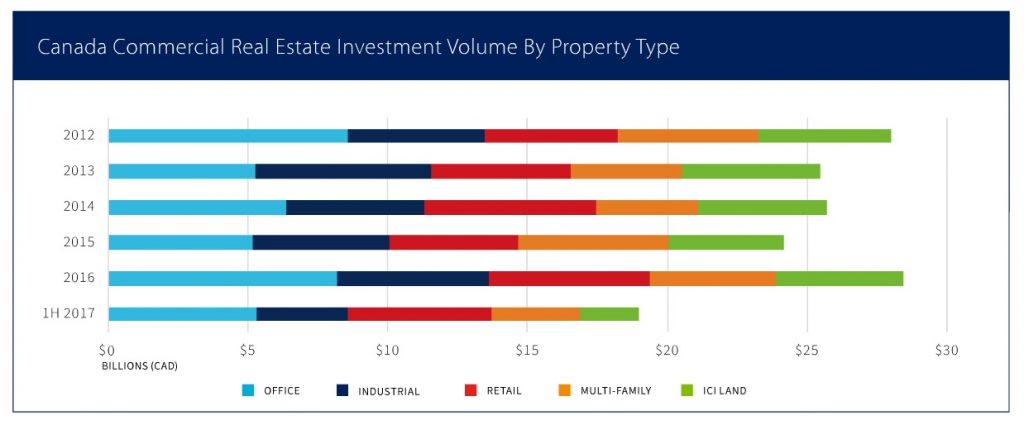
Investment in the Canadian commercial real estate sector is buoyed by a relatively healthy economy and a commercial property market that continues to see varying, but largely healthy fundamentals, reveals a new report by Avison Young.

Covering all investment activity in 54 markets, including Calgary, Edmonton, Montreal, Ottawa, Toronto, and Vancouver, the report shows that on a year-over-year basis, Canada recorded an increase in investment sales – up $4.3 billion, or 29 per cent compared with the first half of 2016 – in five of the six markets surveyed. Among the top-ranked transactions by dollar volume, office led the way, followed by retail and multifamily.

“The multifamily sector had a strong first half of 2017, accounting for nearly one in five dollars invested in Canadian commercial real estate,” says Bill Argeropoulos, Principal and Practice Leader, Research (Canada) for Avison Young. “This sector is probably the most restrained by scarcity of available product for sale – which has resulted in the lowest cap rates among all asset classes. Vancouver saw tremendous investment in the multifamily sector, leading the country. This is largely attributed to long-term owners taking advantage of peak pricing to sell their assets, and factoring in additional value based on properties’ redevelopment potential, given the limited supply of land – especially in downtown Vancouver.”

South of the border

Meanwhile, the U.S. market lagged slightly behind with 21 of 40 markets reporting reduced investment activity compared to last year. The survey shows that investors coveted U.S. office and multifamily product, while more capital flowed into the industrial sector compared with the same period one year ago.

“With record amounts of capital still seeking a home, investors continue to find ways to buy into Canada’s finite investable commercial real estate sector,” notes Bill Argeropoulos, Principal and Practice Leader, Research (Canada) for Avison Young. “Capital from domestic and foreign investors continues to be largely directed towards Vancouver and Toronto, while the other major markets are also seeing their share of activity.”

On the vendor side, Argeropoulos notes that capital recycling continues in order to reduce debt, upgrade asset quality and diversify investments geographically.

“Surplus capital that can’t be placed domestically often finds its way south of the border, as Canada has retaken its place as the primary source of foreign investment in U.S. commercial real estate,” he says. “Canadian institutional buyers, such as Ivanhoé Cambridge, Oxford Properties and the Canada Pension Plan Investment Board – on their own or in joint-ventures – were active during the first half of 2017 across major U.S. markets, including Chicago, Los Angeles, New York, San Francisco and Washington, DC, with office properties being the most notable assets purchased.”

Notable investment and multifamily market highlights:

  • Following a record $28.4 billion in commercial real estate investment sales in 2016, Canada’s six major markets had first-half 2017 sales of almost $19 billion – up $4.3 billion, or 29 per cent, compared with the first half of 2016. Investors coveted office and retail assets, which combined for more than $10 billion in trades, or 55 per cent of the first-half investment tally.
  • Vancouver ($7.8 billion/41 per cent share) outpaced Toronto ($6.5 billion/34 per cent share) with investment proceeds surging 75 per cent year-over-year as vendors sought to capitalize on strong demand and peak pricing. With the exception of Ottawa (which saw investment activity plunge  per cent), the remaining markets – Calgary, Edmonton and Montreal – all recorded increases year-over-year, and each exceeded the $1-billion mark.
  • Supported by notable $200-million-plus transactions, office was once again the top investment sector with $5.3 billion in sales, while the retail sector was a close second with $5.1 billion in transactions. This result was bolstered by tremendous interest in Vancouver, which saw its country-leading retail investment total nearly quadruple year-over-year to $3.1 billion. Toronto was a distant second, with $1.3 billion in volume.
  • The Canadian multifamily sector brought in $3.2 billion in first-half transactions (17 per cent share). Perhaps the most restrained markets by scarcity of available product, Ottawa and Toronto registered declines compared with first-half 2016; meanwhile, sales in Vancouver increased 146 per cent to more than $1.5 billion, leading the country.
  • In Toronto, multifamily properties were once again the least-traded asset class, and perhaps the most impacted by the lack of available product for sale while still commanding the lowest cap rates.
  • In Montreal, multifamily properties were the most-traded asset class, representing 30 per cent of the overall first-half 2017 dollar volume, with close to $501 million in transactions.
  • Average cap rates were marginally lower across all markets and all five asset types (with the exception of suburban class A office, which was flat) compared with one year earlier. Multifamily assets commanded the lowest yields – closely followed by retail – while overall rates showed the greatest compression year-over-year in Vancouver and Toronto.

A few notable 2017 apartment transactions:

  • 5999 Monkland Avenue, Ottawa – $46,400,000 ($272,941 per unit)
  • Edgewater on Jasper, Edmonton – $191,000,000 ($275,216 per unit)
  • Parkview Village Apartments, Calgary – $35,700,000 ($175,000 per unit)

For the full report, visit: www.avisonyoung.com


How to navigate lease extensions and renewals

That lease agreements are getting fatter is not a bad thing — quite the opposite, in fact, according to a recent panel of commercial leasing lawyers and a litigator. The rising page counts of these contracts reflect the addition of provisions made to prevent problems that have arisen in the past.

Clarity of leases was an over-riding theme in the session Renewal Options and Resets last week at the Real Estate Strategy & Leasing Conference in Toronto. The session had several takeaways for parties on either side of the table.

Here are five tips for commercial tenants as they review, negotiate and exercise lease extensions and renewals.

1. Distinguish between extensions and renewals

Melissa McBain, partner, Daoust Vukovich LLP, cautioned against using the words “extension” and “renewal” synonymously in lease agreements. This occurs frequently, because the options have much the same effect in continuing the relationship between the landlord and tenant. In the eyes of the law, however, an extension extends the existing contract, whereas a renewal creates a new contract — a subtle but important distinction.

For example, under an extension, the landlord can cite violations of the agreement that pre-date the current term as grounds to end the lease, as the contract continues uninterrupted. As another example, under a renewal, unless otherwise stated, the tenant bears no responsibility for defaults by a third party to which it has assigned its rights, thanks to the clean break between contracts.

“Obligations on the tenant to restore are theoretically triggered on a renewal,” added McBain, highlighting yet another example. “And while that’s interesting and theoretically true, it’s probably at odds with what the parties intended when they’re renewing the lease.”

2. Leave time to satisfy pre-conditions

Sonja Homenuck, partner, Dentons Canada LLP, recommended that tenants who plan to exercise an option to extend or renew their lease talk to their landlords as soon as they’ve made that decision. Tenants should leave themselves enough time to make different arrangements should the need arise, she said.

“Depending on the size and uniqueness of the premises you’re in, how long would it take you to find alternative premises?” Homenuck asked rhetorically.

Tenants should also leave enough time to address outstanding issues, ahead of the hard deadline for providing notice, in case the landlord asserts that its pre-conditions have not been met.

“You may not be able to exercise your option properly until you have complied with them,” said Homenuck. “In the worst-case scenario, you may have lost your option entirely.”

Common pre-conditions include that the tenant is in good standing, the tenant personally is exercising the option and the tenant is actually occupying and using the premises.

3. Define fair market rent upfront

Comparable buildings, geography and use are some of the qualifications to consider using to define fair market rent, said Yael Bogler, partner, Owens Wright LLP.

For example, she said, landlords may want to specify that buildings have to possess certain features, such as LEED certification or parking, to be considered comparable. Within comparable buildings, there’s the question of whether to look at deals for extending and renewing tenants, deals for new tenants — whose rates tend to be lower — or deals for both groups.

Added Bogler: “If, for example, the tenant has spent a great deal of their own money, and they’re not getting their tenant allowance and they’re the ones building out the space, they don’t want the landlord to use comparably improved premises in looking at comparables in fair market rent, because they’re then effectively paying twice — or paying interest on their improvements.”

As for geography, mapping out boundaries with street names is one way to create a common definition of the “area” between tenant and landlord. What constitutes a comparable use is also subject to interpretation without further refining, such as specifying “market rent for a financial institution.”

4. Avoid and expedite arbitration if possible

Some options to extend or renew a lease provide for arbitration if the tenant and landlord can’t agree on what is fair market rent. However, Sharon Addison, partner at McLean & Kerr LLP, said it’s advisable to avoid arbitration, citing the cost and time it takes to complete the process, as well as the potential strain it will put on the ongoing relationship.

Failing that, the litigator recommended a number of strategies for expediting the process. For one, agreeing to select one arbitrator instead of three arbitrators will simplify scheduling. For another, defining the geographic area that will be examined as each party builds its case as to what is fair market rent will narrow the distance between tenant’s and landlord’s positions.

“If you can come to agreement as to what your appraisers are going to look at — what area, streets — that helps,” said Addison. “You have them looking at apples to apples.”

5. Understand the alternatives to options

Lydia Pilch, partner at Goldman, Sloan, Nash & Haber LLP, said that in cases where a landlord does not provide an option to extend or renew a lease, tenants could ask for the right of first option or the right of first refusal. The right of first option requires the landlord to ask the tenant whether it’s interested in meeting the terms on which the premises are going to be offered before taking them back to market. The right of first refusal requires the landlord to give the tenant an opportunity to match any third-party offer for the premises.

“These are things you don’t see often, because tenants are typically getting renewal options and there’s a lot of business planning that goes around the timeframe that they’re prepared to stay in the space,” said Pilch.

The rarely used alternatives demand the same kind of clarity as clauses containing an option to extend or renew a lease. For example, a right of first refusal should set a deadline for the tenant to match a third-party offer.

“It all comes down to drafting … which is why leases have grown,” said Pilch. “There’s a horror story behind every little bit of expansion of language.”

Michelle Ervin is the editor of Canadian Facility Management & Design.

Why CMHC’s policy changes are positive for borrowers

This summer, the CMHC (Canada Mortgage and Housing Corporation) rolled out a series of policy changes that have changed the game in regards to mortgage loan insurance for multi-unit residential properties. Developed with a pragmatic approach, the changes are designed to make rental and affordable housing more accessible to more Canadians.

“Ultimately, CMHC amended their policy to generally come more in line with un-insured (conventional) mortgage industry standards,” explains Aaron Cameron, senior manager for Commercial Operations with First National.

Of course, he adds, changes of this magnitude are rarely straightforward and there is a lot of new information to digest: “The good news is that much of the policy transformation is beneficial to borrowers when it comes to both guarantee requirements and underwriting criteria.”

Here are some of the highlights:

borrowers

Guarantees

CMHC will now entertain alternative factors when determining the need for personal guarantees, including corporate guarantees, equity retention, replacement reserves, collateral security, etc. Previous CMHC policy required personal guarantees for any financing with a loan to value above 75%.

Standardized guarantee percentage. For existing rental properties, CMHC now requires only 40% guarantee of the outstanding loan amount owing under the mortgage. For construction loans, the guarantee amount is 100% until the borrower achieves stabilized rents, at which time the guarantee decreases to 40% of the outstanding loan amount.

Non-recourse threshold: The limit for a non-recourse loan has increased to 65% loan to value (up from 60%).

“Limiting the guarantee requirements means the borrowers have reduced exposure to potential issues,” says Cameron, adding, “In the event of default the borrower has less liability for losses that could potentially be incurred by the lender in a ‘worst case scenario’.”

Underwriting

Permitted non-residential space. The maximum threshold for permitted non-residential space has been increased to 30% (up from 20%).

Consideration of bulk lease revenue. The revenue garnered as a result of a bulk lease for a portion of the residential units will now be considered, where such arrangement is directly in support of affordable housing, housing in the north, housing for students, or housing for vulnerable groups.

Consideration of furnished suites. Furnished suites may now be considered, where the units are intended for long-term occupancy.

Retirement Homes and Student Housing. CMHC may now consider amortization periods of up to 40 years for these property types.

Premium Structure: This has been amended for new construction and affordable housing premiums. Slight changes have also been made for existing rental properties with loans between 70 – 75% loan to value.

FirstNational2

“The underwriting changes increase CMHC flexibility to incorporate more complex situations,” explains Cameron. “This flexibility is in line with their mandate to support the Canadian population and their housing needs. By including bulk leases or furnished suites, they are ultimately helping the individuals who reside in those types of units.”

In addition to these amendments, the CMHC has also implemented additional policies for rental achievement requirements for new construction, second mortgage maturity requirements, as well as new policies to simplify its affordable housing requirements.

Still, while the policy changes are positive and have created new potential opportunities for borrowers, there are a number of intricacies to dissect and understand. To that end, Cameron notes, “As the largest CMHC lender in Canada, First National can help. We work closely with CMHC to ensure our borrowers get the best product and we can benchmark each submission against other similar CMHC insured financings we have done. The best advice we can give apartment owners is to reach out to one of our Financing Advisors to help guide them through these significant policy changes.”

For more information and insurance expertise, visit www.firstnational.ca.

First National

Canada’s top sustainability leaders honoured at Clean50 Summit 7.0

“Canada’s Clean50” honourees were announced in late September, celebrating the accomplishments of 50 sustainability leaders in 16 categories. In the Building – Design, Development and Management category, Dan Rames, Director of Energy Management at CAPREIT was honoured for his sustainability efforts achieved through retrofits, individual unit metering, and tenant engagement.

Through energy investments in one building alone, a savings of more than 42,000 m3 per year in gas consumption was achieved, facilitating a first-place sustainability ranking (among 200+ buildings) on the Tower Renewal Benchmark. Under Rames’ leadership, water and recycling are ongoing priorities as well, with smart data technology earning the company a win in Toronto Mayor John Tory’s Towering Challenge. Dan’s work not only improves the tenant experience, but also builds on the company.

Almost 600 nominations were considered before the Clean50 and 10 Emerging Leaders were selected. Gavin Pitchford, the Clean50 Executive Director and Delta Management Group CEO observed: “While the contribution of some winners, such as Minister McKenna’s enormous contribution to protecting the environment, pricing carbon and pivoting Canada towards a much cleaner energy path are more high profile – every person on the Clean50 list has made substantive and significant contributions. Excellent examples include two of our R&D winners, who have made headlines in scientific circles around the world for the ground-breaking ways they capture carbon in algae, and return plastic to its virgin state.”

Mr. Pitchford went on say, “Selecting Clean50 winners becomes more exciting each year. We have the luxury of considering nominations from across the country with an amazing range of backgrounds. For instance, this year winners include tidal power pioneers from Nova Scotia, an Alberta oil company executive, a cricket farmer from Ontario, BC civic leaders who are revolutionizing our approach to waste, and scientists and CEOs from Quebec and Ontario who are capturing carbon.”

On September 28, over 110 Clean50 incoming and alumni members will gather in Toronto for the Clean50 Summit 7.0. Working sessions with 10 different groups of thought leaders will consider solutions to climate change related issues, seeking to speed collaboration on solutions that can be implemented before Canada’s 175th birthday. The sessions are followed by dinner and awards.

This year’s award winners will receive plaques fashioned in-part from the “Maple Leaf Forever” tree, reputed to have inspired Alexander Muir to pen Canada’s unofficial anthem in 1867.

Past honourees include Premiers Kathleen Wynne of Ontario, Phillippe Couillard of Quebec and Rachel Notley of Alberta, Vancouver Mayor Gregor Robertson, and Galen G. Weston of Loblaw.

The complete list of winners, their affiliations, locations and related information can be found at to http://www.clean50.comfor more information.


Study highlights Ontario rental supply shortfall

A new study by Urbanation warns of massive Ontario rental supply shortfall, which will continue to diminish unless at least 6,250 additional new rental units are built each year for the next decade, in addition to the expected level of new development.

The warning comes at a time when vacancy rates in the province have already fallen to critical levels – just 2.1 per cent across the province and 1.3 per cent in the Greater Toronto Area (CMHC 2016 Rental Market Survey).

The report, commissioned by the Federation of Rental-housing Providers of Ontario (FRPO), illustrates the rental supply crisis by highlighting  a number of cancelled purpose-built rental projects in the GTA.  Before the introduction of Bill 124 earlier this year, proposed rental projects were at a 25 year high with 28,000 units in the planning pipeline. Since then, at least 1,000 planned rental units have already been cancelled or converted to condos, including: The King Portland Centre and Parkway Square Condos at Sheppard Ave. East in Toronto

To address this problem, FRPO has launched its ‘Rent On’ campaign, which encourages Ontarians to ask the provincial government to take measures to allow for more housing choices for renters by introducing amendments to Bill 124.

“Ontario’s scarce rental housing supply combined with escalating house and condo prices have created a housing crisis in our biggest cities,” said Jim Murphy, president of FRPO. “The only solution is for Ontario to build itself out of this situation. This begins with our provincial leaders working with industry to identify and implement policies that create more purpose-built rental units, not less.”

As the study reveals, demographic trends in Ontario are leading to ever increasing demand for rental housing. Millennials, new immigrants, and aging boomers are all increasingly likely to rent, particularly given the high cost of home ownership.

The report notes that “projections indicate a substantial imbalance between rental demand and supply in the Ontario marketplace over the next decade, which could reach potentially crisis levels in the absence of a meaningful increase in new purpose-built [rental] development.”

Increasingly, Ontarians are choosing to rent for the lifestyle benefits and flexibility – especially among millennials and seniors. Kate Burkholder is one of the many millennials currently searching for an apartment. Having just moved back to Toronto, she was devastated that finding a rental was so hard. “Moving back to Toronto from Vancouver, I was excited to find a better cost of living. Needless to say, I panicked when I realized there are next to no rental options. I am now looking at buying a condo outside of the city so I can afford to maintain my lifestyle.”

‘Rent On’ is a public engagement campaign designed to educate Ontarians about the economics of rental supply in the province, its impact on the real estate market, and how more units can help. The end goal is to put pressure on decision makers to ensure there are adequate rental housing options. Ontarians can learn more at www.rent-on.ca and can join the conversation on Facebook, Twitter and Instagram using the hashtag #rentON.

“This study truly underscores the urgency of Ontario’s current rental housing supply situation,” added Murphy. “If our government leaders fail to act now to address this crisis in a meaningful and sustainable way, the results will serve to further impact Ontario’s economy, such as through additional strain on our cities’ transit infrastructure as people are forced to commute further and further to find more affordable housing options.”

To read the full Urbanation study, visit http://rent-on.ca/sites/default/files/frpo-urbanation_report.pdf.