


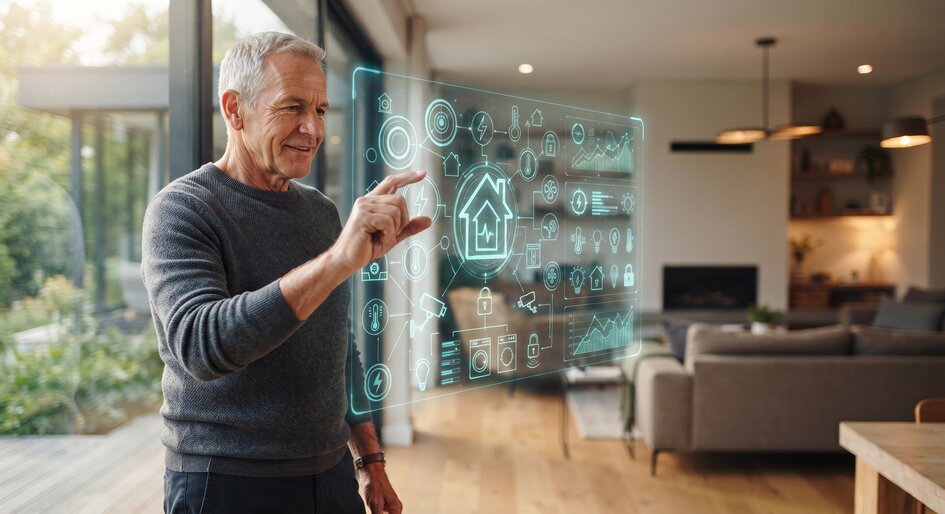
Emerging technologies are powering homes into active support systems that can monitor, predict and respond to the changing needs of older adults and boost their quality of life. However, challenges with affordability, ease of use, and interoperability remain prime barriers to widespread adoption within all types of housing.
This was a key theme during a recent webinar hosted by the Association for Smarter Homes and Buildings (ASHB), the National Aging in Place Council and Customized Aging. Aging in place has historically focused on preparing for emergencies such as fall detection, grab bars, emergency response buttons, and wheelchair accessibility, noted ASHB CEO Greg Walker. An evolving approach leverages smart technology to support wellness, sleep, indoor air quality, medication adherence, and independence.
Canadians aged 65 and older will make up nearly a quarter of the population by 2030 and the majority plan on remaining in their homes for as long as possible. Innovative tools like artificial intelligence (AI), sensors, voice technology and connected-home platforms can help this demographic live safely and comfortably, particularly amid a healthcare workforce shortage and impending caregiver crisis.
According to the Canadian Centre for Caregiving Excellence, “a perfect storm is brewing” when it comes to senior care. Demand is growing, caregivers are aging, the number of available caregivers is dwindling, and care needs are becoming more complex due to the aging population, higher rates of disability and mental health problems. Smart technology can perhaps ease some of these challenges.
Aging-in-place technology evolves
Elizabeth Parks, president and CMO of Parks Associates, a smart home technology research organization based in the U.S., sees growing demand among family caregivers for technology that supports their loved ones. She predicts smart TVs will become an important tool for older adults to communicate with their doctors or care providers.
“That’s going to be a really big deal for seniors because they’re very much used to the television. It’s a big screen, there are easy ways to interact as long as the software platforms are built well, and there’s a lot of integration that can go through the television operating system,” she said.
Personal emergency response system (PERS) devices, traditionally used as fall alert systems, are often stigmatized and rejected due to their association with growing older. Parks also sees promise in more innovative voice-connected wearables and hardware, which will improve accessible communication in the future. The challenge lies in developing products that are both affordable for consumers and financially viable for providers.
Jeffrey Gray, founder and CEO of AgeTech Connect, a U.S.-based hub for innovators, entrepreneurs, and organizations focused on the growing longevity economy, said the key to developing effective aging-in-place technology is understanding what seniors and their caregivers primarily need beyond the “nice-to-have products.”
“The biggest and most successful advancement in aging-in-place technology will be happening as soon as we have robots in the house that can help with real tasks and we’re super close on that,” he said. “Prices will come down, and I think there are a lot of people who would buy a $10,000 robot, a $15,000 robot, and finance it in exchange for the kind of help that device could render. I don’t see that price point being an obstacle because I think the device itself will be so desirable.”
Through his work, Gray has identified three main pain points among seniors and caregivers that new solutions should target: not having enough money, a lack of time, and difficulty navigating health-care systems. Addressing these challenges will help close the gap between innovation and real-world implementation.
Robert Lane, president and managing partner of Toronto-based Robert H. Lane & Associates, cautioned that smart-home products should also be designed with older users in mind. Small buttons, tiny text and complicated interfaces often undermine useful technology.
‘Living well at home,’ a new perspective
Adoption is expected to accelerate once tools are more adaptable and easy to use. As that happens, Cambria Jacobs, founder of Collaboration in Aging. believes technology should empower seniors to maintain the “respect and independence that they’ve earned and deserved.”
“Instead of aging in place, I really look at it as living well at home because that is the goal,” she said, suggesting that homes be optimized for wellness before crises. That vision can include improved lighting, acoustics, temperature control, flexibility, and indoor air quality, alongside emergency-response tools and sensors, which could solve problems much earlier.
Identifying patterns before emergencies occur
Research from Parks Associates underscores that today’s consumers rarely rely on one single smart solution, but are increasingly combining multiple devices, such as smart locks, video doorbells, activity sensors, fall detection, thermostats, and voice-enabled devices. By integrating these technologies, data can provide a more complete picture of what is happening in a home.
Taking that a step further, AI could identify patterns and flag changes before they morph into emergencies. “The key thing to remember is that you aren’t really selling AI; you’re selling solutions to these everyday problems that the caregiver or seniors are having,” said Parks. “Just remembering to take medicine is a great example of something that’s a daily challenge and where technology could play a huge role.”
According to AgeTech, sensor technology in the home typically meant a single pendant button or a motion detector wired to a call centre. But a new generation of ambient sensing platforms is incorporating passive monitoring capabilities throughout the living environment, “turning ordinary homes into continuous health observation systems that operate without requiring any action from the older adult.”
These platforms detect gradual pattern changes — a slower gait, disrupted sleep cycles, reduced time in the kitchen — that link to early-stage cognitive decline, medication non-adherence, and deteriorating chronic conditions. This is shifting the technology’s value from reactive safety to proactive care intelligence.
Further research from Parks Associates found a higher frequency of remote interactions through phone calls, apps, and different connected technologies. “There is this level of confidence that families want to have and that care providers want to have about that physical check-in without actually having to physically be there,” said Parks. “This is really unlocking incredible opportunities for remote monitoring platforms, proactive notifications, AI-generated insights and all of the different data that comes along with sensor-based technologies.”