





Articles Archive - Page 497 of 929 - REMINET
REMI

Toronto invests in shoreline protection infrastructure

In recent years, the increased frequency and intensity of extreme weather events have caused significant erosion and damage to shoreline protection infrastructure along Toronto’s waterfront, as well as substantial damage to the tree canopy. As such, the City has proposed the rehabilitation of shoreline infrastructures, waterfront parks, beaches, embankments, trails and pathways to mitigate further flooding, erosion, land loss, saturated soil and weakened trees and root systems.

By improving the shoreline resiliency and integrating tree canopy, the 19,335 people who live and work in the 9 km2 area will be benefit. The project will reduce the number of residents without essential services and it is expected to save over $6 for every $1 invested in long-term savings on recovery and replacement costs.

The Government of Canada is contributing over $11.9 million to this project through the Disaster Mitigation and Adaptation Fund. The City of Toronto is contributing over $17.9 million toward the remaining costs of the project.

“Extreme weather is becoming more severe, more frequent, more damaging and more expensive because of climate change,” said the Hon. Ralph Goodale, Minister of Public Safety. “By investing in the infrastructure that protects our neighbourhoods, businesses, and families, we are building communities that can withstand future natural disasters and thrive for generations to come.”

“The City of Toronto is proud to invest with the Government of Canada in protecting our shoreline and growing our tree canopy,” said John Tory, Mayor of Toronto. “We know this work will help keep our communities safe and better prepared for extreme weather. This project is another example of what can be accomplished when governments work together for the good of our residents and our city.”

The Disaster Mitigation and Adaptation Fund (DMAF) is a $2-billion, 10-year program to help communities build the infrastructure they need to better withstand natural hazards such as floods, wildfires, earthquakes and droughts. DMAF is part of the federal government’s Investing in Canada infrastructure plan, which is providing more than $180 billion over 12 years for public transit projects, green infrastructure, social infrastructure, trade and transportation routes, and rural and northern communities.
Elevated immigration fuels GTA rental market

A strong GTA rental market fuelled by favourable demographics lifted transaction velocity 8 per cent over the four quar­ters ending at mid-year 2019, according to a new report from Marcus & Millichap Real Estate Investment Services.

Citing widespread buyer activity and elevated interest in the areas of Etobicoke, York and Scarborough, the new report signals that only more good things are in the forecast for the back half of 2019.

“Due to the continued increase in home ownership values and the fact the market has priced out a lot of otherwise able purchasers, people have looked to renting as a necessity,” says Mark Paterson, Vice President and Regional Manager at Marcus & Millichap’s Toronto office. “This leads to increased demand in the rental market. ”

Robust investor interest

Healthy investor perceptions and high pricing expecta­tions compressed the average cap rate 10 basis points, remaining in the upper 3 per cent territory. Higher yields attracted investors to Oakville and Oshawa, where initial returns averaged above 5 per cent.

Robust investor interest led to a 9 per cent increase to the average price, rising past $277,000 per unit. Assets in the heart of Toronto changed hands at an average price just above $300,000 per unit. Greater affordability was found in Brampton, Scarborough and Oakville, with properties trading on a per unit basis in the low-$200,000 band.

As predicted by Marcus & Millichap, pent-up rental demand and strong rent growth will keep investors active this year, broadening their searches across the metro for remaining upside. A rollback of rent control regulations on new builds will boost demand for recently completed projects.

Access to tech talent spurs job growth; housing demand

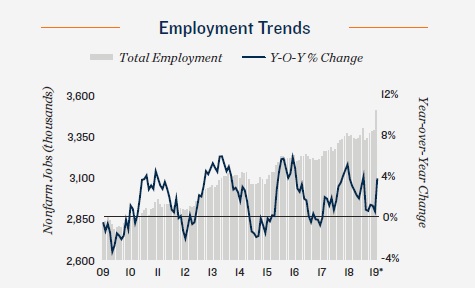
GTA rental market reportThe Greater Toronto Area recorded vigorous employment gains in the first half of the year with the creation of 81,600 jobs. Many of the new jobs are high-paying tech positions as more companies in the industry grow their Canadian workforce. Employment grew at a rate of 3.4 per cent year over year in June, a substantial rise from the 2.9 per cent pace posted one year earlier.


A less restrictive immigration policy in contrast to the U.S., coupled with a mature tech ecosystem backed by government incentives and world-class universities, has Microsoft, Amazon, Pinterest and many other global firms searching for talent in the metro. A healthy economy and labour market have been a boon for household formation, a key driver of apartment de­mand, contributing to a strong rental market over the last few years.

“Immigrants make up nearly half of the population in Toronto,” notes Paterson. “With Toronto being the centre for tech jobs, a multi-cultural city with world class education that has attracted immigrants from around the world as a place for success and stability, as long as we continue to embrace immigration and multiculturalism, this will continue to show steady growth.”

Housing affordability

Many prospective homebuyers remain unable to qualify for a mortgage in Toronto following the B-20 mortgage stress test in place since the start of last year. A single-family benchmark price of more than $875,000 in June compounds challenges to becoming a homeowner, pushing the monthly cost of ownership far beyond the cost of rental housing.

The average apart­ment rent in the metro was $1,370 per month at the end of 2018, a 4.7 per­cent increase from the prior year, still roughly $2,000 less than monthly payments on the single-family benchmark. A challenging housing market, particularly for first-time buyers, has led to rental demand far exceeding supply growth, holding the vacancy rate at a tight 1.1 percent last year.

Multi-unit housing starts

Exceptional rental demand and a perpetually tight market motivated de­velopers to add 2,900 apartments to the GTA rental market over the past four quarters, up from the 2,464 purpose-built units completed during the prior year.

Greater focus was placed on Central Toronto where 1,650 units were added to the rental stock over the past year, followed by York where 430 apartments were completed. Rental inventory is anticipated to increase at the greatest rate in more than two decades with more than 3,500 apartments scheduled for delivery this year, a rise from last year’s completion total of 3,230 units.

One of the largest projects set to open this year is the 569-unit King’s Club in Liberty Village, pictured above.

For the full GTA rental market report, visit https://www.marcusmillichap.com/research


RentSeeker.ca continues to disrupt the digital rental marketplace

Since Rentseeker.ca unveiled its newly revamped website in May 2019, marking 10 years as a leading Canadian online real estate listing platform, the award-winning marketing and technology company has been streamlining the apartment search experience for both renters and landlords alike.

Offering new and improved search functions reflecting the needs of today’s digital friendly population, combined with the integration of the ever-popular Facebook Marketplace, new opportunities for landlords to increase exposure and directly target qualified perspective renters abound.

As Canada’s population ages and becomes increasingly digital friendly, transitioning towards a digital rental marketplace is inevitable. In today’s reality, the process of searching for an apartment, connecting with property management, and even signing critical documents no longer requires in-person meetings, making finding the right apartment a smoother process for all.

“We’re proud of all our accomplishments over the past decade and look forward to bringing new options to renters while helping landlords fill their vacant properties,” said Chaim Rivlin, founder and CEO of RentSeeker.ca. “As the rental market continues to evolve along with the technology we use to find properties, we’ll continue to bring new options for the next generation of Canadian renters.”

rentseeker

At Rentseeker.ca, rental listing options are now available for the following markets: retirement homes; student housing; and short-term rentals, with additional options coming soon. By integrating with Facebook Marketplace, the social media platform’s 22 million Canadian users can now connect with landlords directly as they search for properties online. Marketplace features a revamped experience in the rentals category, including:

  • Custom filters for location, price, bedrooms, bathrooms, rental type, square footage, dog/cat friendly
  • A broader selection of rental listings from professional agents, landlords, and property managers
  • A map view to browse listings by location

Visit the all-new Rentseeker.ca today.


Vancouver Island building permits continue upward

Building permits across Vancouver Island continued on an upward trajectory, rising six per cent to $648.1 million in the second quarter of 2019 compared to the first quarter. Residential permits increased 19 per cent, while non residential dropped 25 per cent, according to the latest report by the Vancouver Island Construction Association (VICA).

“Residential permit activity was higher in most regional districts over the first quarter, led by a 94 per cent increase in the Nanaimo Regional District, followed by a 62 per cent increase in the Cowichan Valley,” said Rory Kulmala, CEO, VICA. “We also saw robust activity in Strathcona and Powell River with a 49 per cent and 31 per cent increase in residential permits, respectively.”

Major projects contributing to the increase in Nanaimo include construction of a 110-unit luxury condo building in Old City, valued at $64 million, and a 159-unit affordable housing development for seniors, valued at $27.8 million; both are mixed-used buildings with commercial space attached. In the Cowichan Valley, most permits issued were for Single Family Dwellings.

In contrast, non-residential permit activity slowed down by 25 per cent, with the greatest drop-off in institutional-government permits, which fell 54 per cent following a surge in the first quarter, according to Kulmala. Commercial permits held steady, while industrial permits declined 32 per cent from the previous quarter. Total investment spending on non-residential building construction in the Victoria Census Metropolitan Area (CMA) dropped four per cent in first five months of 2019 compared to the same period last year.

Island-wide a total of 36,100 persons were employed in the construction industry in the second quarter, an increase of 3.1 per cent over the first quarter.

“Although we are starting to see some highs and lows in our data, the region’s construction industry will remain strong throughout the rest of 2019,” said Kulmala. “Despite a 15 per cent slowdown in residential construction in the Capital Regional District, the residential sector should soon firm up Island-wide in response to lower interest rates and the upcoming federal housing incentive program.”

Non-residential construction will benefit from market conditions conducive to more investment. Total building permits in 2019 will ease back from 2018’s record high to around $2.25 billion, which would be well above historical averages and comparable to 2017’s level.


Q&A: Financial solutions for multi-res stakeholders

Residential property stakeholders face a broad range of cash management challenges. And while financial considerations are key, they can be hard to tackle without the right services, advice, and expertise.

CWBMatheosHere to discuss some common cash obstacles and available solutions is Nancy Matheos, Assistance Vice President and Deputy Manager with Canadian Western Bank.
What are among the most common cash management issues for property managers, owners, or board members?

CDIC [Canadian Deposit Insurance Corporation] coverage is certainly number one as they all have requirements to have all or a vast majority of their funds covered. Every property manager/ board we have dealt with has had the same concern keeping reserve funds separate from their operating and finding high-interest vehicles that can be separate, flexible, and offer some liquidity for reserve funds.
Another common challenge is being able to auto-debit renters or residents (in the case of condominiums) and pull one-off payments as needed, as well as deliver convenient and effective timing to deposit monthly where cheques are still collected.

What about on the regulatory side?

Regulations are always changing in this industry. Although they don’t always have to do with banking, property stakeholders need to stay on top of them. That’s where working with a third-party financial partner can be extremely helpful in staying on top of regulations and getting the best insights and advice.

What are the risks of not handling these cash management issues effectively?

The most obvious risk is financial loss, but there’s also the risk of losing tenants, whether they have been with you for years or recently moved in. Owners also risk receiving a Special Assessments to Owners if reserve funds are not managed well and a need arises.

How does one begin to address these challenges?

The challenges are common, but each property is unique. Ultimately, when we meet with new condo clients, we try to understand the whole picture, from the number of units they manage to what the long-term needs and goals are for the group. You need to do that high-level review of the whole business and the people, and not just the finances, so you can plan accordingly, optimize interest, and ensure the safety of your funds.

What financial products/services are available to assist with that?

Canadian Western Bank, Canadian Western Trust, and Valiant Trust can all hold funds covered under CDIC, providing property owners three times of insurance if used fully.

As for specific solutions, our business savings account has a very competitive interest rate with full liquidity and no monthly fee. We also offer Short Term GIC’s and our 93 Day Flex Notice Account with very competitive rates and the flexibility to lock it in for a short period of time – all of which can be renamed to reflect Reserve Funds to keep them separate.

As for the issues of auto-debit, CAFT is our EFT/Direct deposit system and can be tailored to fit the needs of the condo plan/association, whether that’s pulling monthly payments on an automatic schedule; having separate profiles for credit or debit; or the ability to separate profiles for regular fees/rent, utilities, manual payments, reimbursements, etc.

Lastly, we have services like our Remote Deposit Capture (RDC), which gives clients the ability to deposit cheques from the convenience of their office. Additionally, our Business Online Banking platform consolidates accounts to one login so that owners can see all property bank accounts on one platform.

Dealing with cash management issues is part of the job in property management. Nevertheless, busy schedules and knowledge gaps can make this aspect of the role a challenge. Herein, there is value in seeking financial partners who can look out for your best financial interests.

For more information, visit www.cwbank.com/find-your-focus.


Investors pad multifamily’s portfolio share

Multifamily assets have enjoyed the most growth in real estate portfolio share of any property type thus far in the 21st century. Data from the MSCI global property index shows that multifamily properties jumped from 11 per cent of investment allocation in 2001 to 17 per cent at the end of last year.

Conversely, allocations to office and retail properties each slipped by 7 per cent. Together, the two property types accounted for more than three-quarters of the capital value of the index in 2001, but have since dropped to a 63 per cent combined portion.

Bryan Reid, MSCI’s vice president, global real estate research, attributes the shift both to the dynamics of commercial real estate markets and to increasing allocations to the real estate asset class in general, which has prompted investors to diversify their holdings.

The recent see-saw trajectories of retail and industrial performance is well chronicled, with E-commerce fingered as a destabilizing force for retail and a driver of growth in warehouse/distribution space. The index allocation to industrial properties has also increased by 4 per cent since 2001, while 2 per cent growth in a grouping of property types collectively dubbed “other” is linked to investors’ search for yield and fervent competition for institutional grade real estate product.

“Student housing, childcare centres, healthcare facilities, data centres and hotels are examples of the more niche investments that have increased in popularity,” Reid notes.

Understanding Candida auris transmission

Candida auris (C. auris), a drug-resistant fungal infection, is spreading across Canadian hospitals. The U.S. Center for Disease Control and Prevention (CDC) has alerted laboratories and healthcare facilities of C. auris being found in laboratories, hospitals, nursing homes, and other types of healthcare environments.

The emergence of the virus
Discovered in 2009, the drug-resistant fungal infection severely sickens patients, typically, it causes chills and high fever.  Nearly 60 per cent of those who contract the disease die from it. Doctors become aware there is a problem when these symptoms persist even after antibiotics have been prescribed.

As of March 2019, there have been 617 cases in 12 U.S. states, according to the CDC. In Canada, a total of 20 cases from 2012 to June 2019 have occurred according to the Public Health Agency of Canada (PHAC).

A new study by researchers at Johns Hopkins Bloomberg School of Public Health suggests that global warming may have played a significant role in the emergence of C. auris.

“We think that C. auris may be the first example of a fungal species that has jumped the thermal barrier due to adapting to global warming,” said lead author Arturo Casadevall, MD, PhD, the Alfred and Jill Sommer Professor and Chair of the W. Harry Feinstone Department of Molecular Microbiology and Immunology at the Bloomberg School.

Who is at risk?
People who have recently spent time in nursing homes and have lines and tubes that go into their body (such as breathing tubes, feeding tubes and central venous catheters) seem to be at highest risk for C. auris infection. Limited data suggests that the risk factors for Candida auris infections are generally similar to risk factors for other types of Candida infections. These risk factors include recent surgery, diabetes, and broad-spectrum antibiotic and antifungal use. Infections have been found in patients of all ages, from preterm infants to the elderly. Further study is needed to learn more about risk factors for C. auris infection.

Why is it hard to treat?
Along with it being drug-resistant, large pharmaceutical companies are spending fewer resources on the development of new antimicrobial drugs that could potentially treat the disease and prevent deaths. This means there is little likelihood of a treatment coming any time soon.

“If there are no treatments, the only option administrators have is prevention, and that’s where detection and effective cleaning comes in,” says Brad Evans, CEO of OptiSolve, an imaging company that helps cleaning staff locate hidden pathogens on surfaces.

Exacerbating a lack of investment into finding a cure, those afflicted with the disease are often misdiagnosed because it is often hard to identify C. auris in lab tests.

What can the cleaning industry do to address C. auris?
Many questions remain unanswered about how to best detect C. auris and limit its spread within and between Canadian healthcare facilities. The fungus colonizes on a patient’s skin where it can transfer to surfaces of equipment, or from person to person.

A recent study published in The American Society for Microbiology revealed that patients with very high concentrations of the fungus on their skin also had a high level of the pathogen on their bed.

“This is where detection and effective cleaning comes into the picture,” adds Evans. “If C. auris is suspected in a facility, the first thing administrators and cleaning professionals must do is turn to imaging technologies to see if and where pathogens may be hidden on surfaces. With this uncovered, the next step is effective cleaning to remove the fungus.”

Cleaning professionals should continue educating staff to help lower the risk of infection. Understanding how C. auris is transmitted in healthcare facilities is essential for infection control.

Robert Kravitz is a writer for the professional cleaning industry.

Zandile Chiwanza is the online editor of Facility Cleaning and Maintenance and Canadian Property Management. 

Image courtesy of Centers for Disease Control & Prevention.

Tourism momentum tests Toronto and Vancouver

Researchers conclude that Toronto and Vancouver share traits with popular tourist destinations like Paris, Rome, Amsterdam and Barcelona. Regrettably, the similarities show up in urban constraints as well as enticements.

A new index of tourism-related economic development potential in 49 international cities plots the two Canadian contenders among nine cities that are experiencing pressure from a growing influx of leisure attraction seekers. Analysts from the World Travel & Tourism Council (WTTC) and JLL cite inadequate resources to accommodate visitors, particularly when attractions are crowded into a scoped area, as a potential brake on tourism momentum. That’s a scenario that’s also causing concern in San Francisco, Prague and Stockholm.

“City government and policy makers alike are increasingly realizing the need to shift from just destination marketing to take a more proactive and holistic destination management approach,” the accompanying report advises. “They also need to plan their growth, defining where they want to grow, and assign priority to tourism planning at the highest levels.”

The report assesses 10 North American cities, 13 in Europe, 18 in Asia/Pacific, four in South America and four in the Middle East/Africa based on 75 indicators of their capacity to attract, engage and sustain tourism activity. This includes attributes directly tied to tourism such as attractions, accommodations, convention space, government policies and special levies or subsidies, along with broader economic, social and environmental conditions.

For example, both Toronto and Vancouver rank in the top quartile for “urban readiness”, which includes indicators such air quality, accessibility, political stability, quality of health care, cost of living, traffic congestion and the risk of a natural disaster. Less flatteringly, they also make the top quartile for stressors, which includes hotel capacity, concentration of tourist activity, receptiveness to home sharing and the tally of negative reviews of attractions.

Toronto additionally sits in the top quartile for its business strengths, based on metrics for the size of its labour force, its share of business travel spending, GDP per capita, corporate status, office space inventory, and convention facilities. It slips to the lowest quartile for leisure indicators, pertaining to its share of leisure travel spending, number of Airbnb listings, visitor attraction ratings, seasonal airport arrivals, cruise passenger arrivals and heritage status.

Toronto and Vancouver are set apart from North American counterparts that are characterized as mature tourism markets — which include New York, Los Angeles, Las Vegas and Miami — and from Chicago and Washington D.C., which are viewed as more conventionally a destination for business travellers. Farther south, Mexico City is classified as an emerging tourism market.

Financial and Risk Management Standards and Requirements for Apartment Operators

Membership in the Certified Rental Building Program (CRBP) is an effective means of maintaining a high standard of quality when managing your building or working with tenants. When prospective or existing tenants see the familiar green CRB Program logo and checkmark on your property, they will immediately know that they can Rent With Confidence.

The CRB Program, North America’s only multi-residential certification program, was founded under six disciplines which all affiliated property managers must comply with in order to receive the certification for their buildings. In this six-part series, we will examine each of the disciplines in detail and explain their importance to the program.

Discipline 4: Financial and Risk Management

CRBP’s fourth discipline covers the important area of financial and risk management standards and requirements. Apartment building ownership can be as rewarding as it is profitable. However, like any business entity, ensuring you judiciously manage these two areas is vitally important to long term success. CRBP recognized this from the outset and created a number of sound corporate governance financial/risk management standards to provide key stakeholders (residents, employees, and investors alike) that CRB-approved denotes the best of the best in multi-res professional property management the industry has to offer.

Financial Management Measures

Ensuring a sound financial wellbeing for any business is key to its long-run survival and having a long profitable time horizon for its ownership and investors/unitholders alike. Notwithstanding this fact, financial prudence also plays a key role in the lives of the employees that work for the property management organization and for the residents that live in those apartment buildings. To that end, and with a focus on quality living for residents, CRBP financial standards include the following:

  • Financial statements are filed in accordance accepted financial practices
  • There is an annual operating budget
  • There is the existence of a capital management plan
  • Appropriate liability insurance/coverage
  • Evidence of tenant insurance requirements

Risk Management vs. Risk Mitigation

Professional property managers believe that one of the best ways of approaching a prudent risk management regime is to adopt a proactive approach. The more that is done to prevent risk at the outset, the easier it will be to avoid certain disastrous situations, such as resident slip and falls, electrical failures, instances of fires, etc. One misconception that often arises is risk mitigation versus risk management. The two could not be more different. Risk mitigation seeks to reduce the effects of an unfortunate event or circumstance that cannot be avoided. Risk management identifies potential areas of concern within your buildings and proactively addressing them before they can impact your residents’ (tenants’) quality of living.

Throughout the CRBP six disciplines, there are hundreds of instances where proactive risk mitigation is a requirement of many standards. Below are few examples for the reader to gain a better perspective.

  • Evidence of a snow removal requirement and respective logs
  • Daily/weekly/monthly building operations checks and logging of any unsafe areas of concern and related follow-up
  • Contracts with licensed professionals for elevators/HVAC/plumbing/electrical/maintenance and capital work, etc.
  • After hour 1-800 emergency contact number
  • CRB state of condition assessment covering all areas of the property/building alike
  • Annual suite inspection process
  • Strict adherence to all Fire Code requirements
  • Strict adherence to PIPEDA rules and resident privacy
  • Building emergency plan

There are countless more examples that could be easily provided to demonstrate CRBP’s commitment to ensuring its members are practising a prudent risk management regime throughout their organization and across their apartment properties. Being a CRBP member, and by extension, adherence to its many financial/risk management requirements, provides peace of mind to investors and unitholders. More importantly to employees and residents alike, it builds on the CRBP’s mantra of being well-run, well-managed, and well-maintained apartment properties.

For further information about the CRBP and how to apply for the certification, please contact the Federation of Rental-housing Providers of Ontario (FRPO) – Ted Whitehead, Director of Certification, or visit our website today at www.frpo.org.

Affordability worse for renting Canadians: Report

New data from Rentals.ca shows that affordability for low-income Canadian renters is worse than what was reported in mid-July by the Canadian Centre For Policy Alternatives (CCPA).

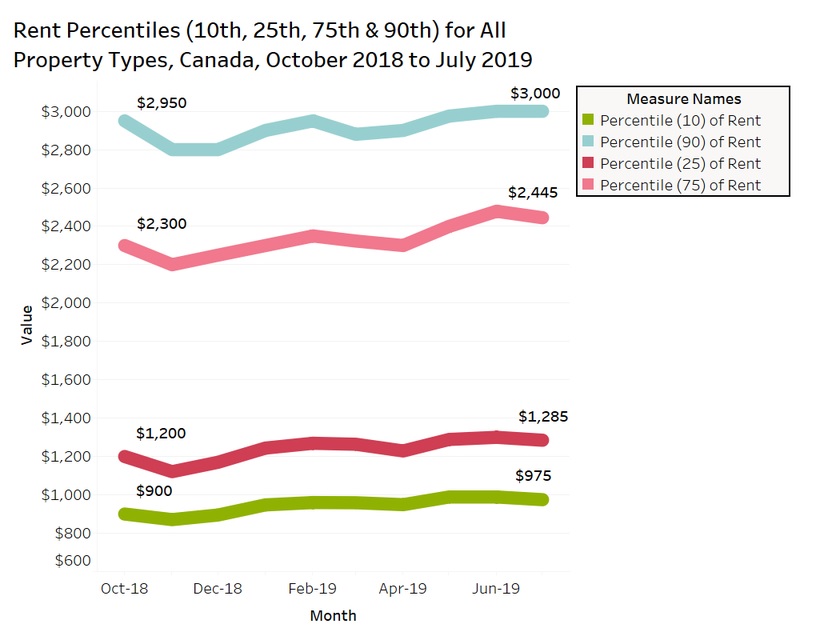
The August National Rent Report,  produced by Rentals.ca and Bullpen Research & Consulting, shows that a Canadian making $13 an hour would have to work 62 hours a week in order to afford the average lower-cost rental if he or she were to maintain the recommended 30 per cent rent to income ratio.

On the lower end of rental spectrum (the 10th percentile), if $975 per month equals 30 per cent of someone’s monthly income ($3,250) and the employee works 40 hours a week for four weeks (160 hours), that worker would need to make $20.31 per hour to afford that unit. This number has increased from $18.75 in October 2018, according to Rentals.ca data.

rent percentiles - Aug 2019

The CCPA’s “Unaccommodating – Rental Housing Wage in Canada” report uses data from the Canada Mortgage & Housing Corporation, which calculates rental rates on mostly all units, including those under rent control. The data from Rentals.ca comes from the asking price of landlords for vacant units, which CCPA points out are “almost always higher” than occupied apartments.

Rentals.ca data from October 2018 to July 2019 confirms this is true not only for unoccupied apartments, but also for all other vacant rental types. The rapid rise in rental rates over the last 18 months, brought on by increased immigration, solid job growth, and the mortgage stress test has impacted low-income workers the most.

As more than 250,000 new housing units are added to the Canadian market, the rent growth experienced since early 2018 should slow down. This is near the highest level of construction in the country in over 25 years.

July monthly rental rates

The national average monthly rental rates declined 1.3 per cent in July, following two months of increases. Toronto, Montreal, Winnipeg and Saskatoon all experienced monthly declines, while Ottawa, Vancouver and Hamilton experienced increases.

Toronto and Vancouver continue to lead all cities in average monthly rents. Toronto had the highest average monthly rent for a one-bedroom home at $2,259, but Vancouver had by far the highest average monthly rent for a two-bedroom at $3,089.

At the bottom of the list with the lowest average monthly rents were Fort Nelson, Saint John, St. John’s, Gatineau, Quebec City and Lethbridge.  All six of these cities had average monthly rents for a one-bedroom home under $1,000.

Other key takeaways from the August national rent report:

  • The Rentals.ca forecast for the 2019 rental market in Canada called for annual growth of 6%. The expectation was the average property for lease nationally would be $1,861 in December 2019, but at the end of July the market is already up 8.5% since December.
  • The most expensive rental condominium apartments in the Greater Toronto Area are The Heathview, L Tower, Yorkville Plaza, 38 Elm Street at Minto Plaza and Kings Club.
  • A tenant in Toronto would need to make $34.90 per hour to afford a one-bedroom unit in the 10th percentile based on monthly rent accounting for 30% of the tenant’s gross income, up from $29.17 in October. For the 10th percentile of two-bedroom units, a tenant would need to earn $39.06 an hour in July, up from $34.38 in October 2018.
  • In Ottawa, average monthly rents have increased over the past couple of months from $2,003 per month in April to $2,136 per month in July.
  • On a provincial level, Ontario had the highest rental rates in July, with landlords seeking $2,283 per month on average (all property types), a slight increase from June ($2,279). In British Columbia, the average asking rent was $1,889 per month, an increase of 2% month over month, following June’s 3% monthly increase. Asking rents in Alberta increased in July for the second straight month, following two months of decline.

B.C. organization calls on public to recycle safe

Recycle BC is warning residents in British Columbia to pay attention to the hazardous materials that are being placed in the province’s residential packaging and paper recycling.

According to the organization, B.C.’s major recycling collectors and processors have seen seven fires in 2019, with several of them having endangered lives and forced the temporary closure of facilities. In addition across North America, the industry saw a 26 per cent increase in the number of fires in waste and recycling facilities in 2018, with 371 unique incidents reported between February 2018 and January 2019.

The risk of fires or explosions is especially high for material collection vehicles and receiving facilities due to the presence of significant amounts of paper. The combination of easily flammable material, plenty of oxygen and large amounts of material sorted into piles where sparks can smoulder for lengthy periods of time undetected make the presence of hazardous material especially precarious.

The following materials should not be included in the residential packaging and paper recycling system:

  • Butane and propane canisters
  • Batteries (especially lithium-ion batteries)
  • Compressed gases
  • Ammunition
  • Knives
  • Sharps
  • Bear spray

“Earlier this month a resident put 58 rounds of live ammunition into their recycling,” explained David Lefebvre, director of public affairs for Recycle BC. “We need people to think before they put something that is potentially explosive and deadly into a recycling bin.”

“Hazardous materials have a significant impact on our staff. We are concerned about their safety and the potential for someone to be injured or worse,” explained Alisa Murray, Health and Safety Coordinator at Cascades Recovery.

“Sorting and recycling processes are fast-paced, with material constantly getting moved, compacted, and crushed,” said Oleg Vinokurov, industrial engineering manager at Green by Nature. “A recycling baler can develop pressures of hundreds of pounds per square inch. Compacted at these pressures, any compressed gas cylinder becomes a potential bomb for our employees.”

Residents should dispose of hazardous materials properly, which means many of these items should not only be kept out of the residential packaging and paper recycling system but also out of the waste system as well.

BOMI International appoints new board leadership

The BOMI International board of trustees has elected Nicholas E. Stolatis, RPA, to the position of board chairman on a two-year term from July 1, 2019 through June 30, 2021.

Stolatis, formerly the vice chairman, is vice president of EPN Real Estate Services, Inc. in Pleasantville, N.Y. He replaces Howard Arndt, RPA, president and CEO of Fieldstone Management in Regina, Sask., who will remain on the board as immediate former chairman, replacing Dave Fagone, RPA, President and COO of RM Bradley Management in Hartford, Conn.

“It is certainly an honour to carry on the tradition of excellence that Howard and Dave have supported so well,” Stolatis said. “BOMI is actively addressing the education and credentialing needs of the real estate industry, and I’m looking forward to helping lead that effort along with my fellow Board members.”

BOMI International elected Tim O’Donald, RPA, to the position of vice chairman. O’Donald is president of Harbor East Management Group, LLC in Baltimore. David Pogue, LEED-AP, BOMI-HP will remain as secretary/treasurer.

The following individuals are continuing on the BOMI International’s board of trustees:

  • Kimberly Brown, managing director, JRT Realty
  • Laurie Ell, RPA, CLO, general manager, REMS Colliers International
  • Trish Faidiga, RPA, FMA, BOMI-HP, president, Advantage Building & Realty Services, LLC
  • John Hajduk, ProFM, MBA, vice president of operations facility services, Sodexo
  • Jonathan “JJ” Jones, MBA, senior property manager, Crescent Property Services
  • Andrew Taylor, RPA, senior property manager, Woods Capital Property Management, LLC

BOMI International also recognized several trustees who retired from the board as of the end of June:

  • George Denise, RPA, FMA, BOMI-HP, CFM, CPM, LEED Accredited Professional
  • Greg Grainger, RPA, CPM, CCIM, president and COO, Younger Partners Property Services, LLC
  • Tyler White, CFM

“BOMI International owes a debt of gratitude to Greg, Tyler and George for their many years of outstanding service in providing guidance and leadership to our organization and the commercial real estate industry,” said BOMI International President Jeffrey Horn. “We wish George and Tyler well in their retirement and look forward to the great industry contributions Greg will continue to make through his leadership at Younger Partners in Dallas.”

RHF Accessibility Professional Network launches

The Rick Hansen Foundation (RHF) has launched an Accessibility Professional Network, a professional association developed to bring together the accessibility community in Canada. The network will connect like-minded professionals with a shared mission to improve accessibility in the built environment.  Members of this association will benefit from access to an industry job board, educational resources, professional development, and networking opportunities. This network is for:

  • Those interested in or working in the field of accessibility in the built environment;
  • Designated Rick Hansen Foundation Accessibility Certification (RHFAC) Professionals;
  • Students interested in the field of accessibility.

RHFAC Professionals have been trained in rating the accessibility of buildings and spaces using the Rick Hansen Foundation Accessibility Certification (RHFAC), a national program that rates the accessibility of the built environment based on holistic, meaningful access.

“The Accessibility Professional Network will bring accessibility professionals together to improve the meaningful access of places and spaces in which people live, work and play. Only through collective collaboration and action can we make Canada truly accessible from coast-to-coast,” said Brad McCannell, Vice President, Access and Inclusion at the Rick Hansen Foundation.

Currently more than 150 people have taken the RHFAC Accessibility Assessor course, and over 1,200 buildings have been rated in the program. The new Accessibility Professional Network will bring together this community.

“The number of accessibility professionals is growing across Canada, and there is a real need to bring this community together to share best practices and collectively improve the accessibility of Canada. The Accessibility Professional Network supports this goal,” said Stanis Smith, the executive vice president at Stantec and chair of the

RHFAC Advisory Committee. Membership to this association is free for the remainder of 2019. The Accessibility Professional Network will host its first annual conference on October 31 – November 1, 2019 at MaRS Discovery District, Toronto.


ISSA elects new board members for 2020

New members have been elected to the 2020 ISSA Board of Directors, which will be led by incoming ISSA President Ken Bodie of Kelsan Inc.

  • Vice President/President Elect: Steve Lewis, Golden Star Inc.
  • Executive Officer: Brendan Cherry, Bobrick Washroom Equipment Inc.
  • Manufacturer Director: Christine Vickers Tucker, Clorox Professional Products Co.
  • Distributor Director: Ailene Grego, Southeast Link
  • Director Canada: Amir Karim, Polykar.

Returning Board Members

  • Past President/International Director: Paul Goldin, Avmor Ltd.
  • Secretary: Roman Chmiel, Scrub Inc.
  • Treasurer: Jim Chittom Jr., Roman Chemical Corp.
  • Latin America Council Chair: Mauricio Chico Cañedo, Distribuidora Lava Tap, S.A. de C.V.
  • Europe Council Chair: Michel de Bruin, Greenspeed BV
  • Distributor Directors:
    • Paul Barrett, North American Corp
    • Nick Morris, Western Paper Distributors Inc.
  • Manufacturer Directors:
    • Tom Friedl, Hospeco
    • Andy Clement, Kimberly-Clark Professional*
  • Manufacturer Representatives Director: John Beers, Wind Associates
  • BSC Director: Matt Vonachen, Vonachen Group.

Outgoing Board Members

  • Ted Stark III, Dalco Enterprises Inc.
  • Mark Bevington, NSS Enterprises Inc.
  • Harry Dochelli, Essendant
  • Peter Farrell, Citron Hygiene LP
  • Terry Neal, Impact Products LLC.

ISSA members are invited to personally greet the new board members when they officially take office at the ISSA General Meeting, November 19, at 8:45 a.m. during ISSA Show North America 2019 at the Las Vegas Convention Center in Las Vegas.

PIP Global acquires Dynamic Safety

PIP Global Holdings Inc. (PIP Global), a leading supplier of hand protection and general safety products, has acquired DSI Safety Inc. (Dynamic Safety) headquartered in Laval, Quebec.

Dynamic Safety is a leading supplier of personal protective equipment in Canada and is a globally recognized manufacturer of hard hats, first-aid kits and other safety products.

“We are pleased that we can formally partner with the Dynamic Team and build a stronger foundation for our hand protection and safety business in Canada,” said Joe Milot, president and CEO of PIP Global in the press release.

Through this acquisition, PIP Global will gain “state-of-the-art manufacturing for hard hats and other safety products.”

“Joining with PIP was a perfect choice for us,” Claude Roberge, current president and founder of Dynamic Safety, added. “With gloves representing over 35 per cent of the safety market, we have strengthened our ability to provide a complete PPE portfolio to our customers in Canada.”

“While I intend to remain actively involved, this partnership is an excellent opportunity for my executive management team to move into new expanded leadership roles” Roberge concluded.

PIP Global’s Canadian headquarters and manufacturing plant will be located in Laval, Que where Dynamic Safety is currently based.

Province invests in youth welding camp

The New Brunswick government has partnered with Wabanaki Communities to run welding camp this summer. Middle school Wabanaki students will have the opportunity to learn welding and fabrication skills, associated math, and safety skills.

“Trade education provides students with experiential, hands-on learning,” said Education and Early Childhood Development Minister Dominic Cardy in the press release. “The camps provide students with an opportunity to learn new skills in an enjoyable and supportive environment.”

The department’s Office of First Nation Education previously partnered with the CWB Welding Foundation for the construction of the welding stations at Esgenoôpetitj and at Natoagenag (Eel Ground) First Nation.

A similar welding camp was offered last summer at both communities. The Office of First Nation Education continues to seek opportunities for partnerships in learning with Wabanaki communities across New Brunswick.

The welding camp at Esgenoôpetitj First Nation will take place from August 12 to 16. Students also had an opportunity to participate in a welding camp on Natoagenag (Eel Ground) First Nation in July.

Small market, big gains

The severe housing shortage in Charlottetown, Prince Edward Island, may continue to make life difficult for residents for a little while yet, but relief is in the pipeline according to the latest report on housing starts from CMHC.

In July, Canada’s smallest province recorded a 319 per cent increase in housing starts compared to a year ago as developers continue to contend with the near-zero vacancy rate that has plagued the island for some time.

By all accounts, construction is rampant. According to Statistics Canada, the value of multi-unit residential building permits almost doubled in PEI in 2018, and that upwards trajectory continues today. With its thriving economy bolstered by the emerging aerospace, bioscience and sustainable energy sectors, in addition to its mainstay industries of tourism and agriculture, employment opportunities abound. Since 2017, immigration has been steadily on the rise in PEI with more new Canadians choosing the tiny island province as not just a landing pad, but a permanent place to call home.

Meanwhile, graduating students and job-seeking millennials who once sought opportunity in Canada’s larger urban centres are suddenly finding that same opportunity on their doorsteps. The problem is, with so many baby boomers and satisfied residents opting to stay in place longer, it seems not everyone has a doorstep to call their own.

PEI housing shortage at “crisis levels”

Like Toronto and Vancouver, Charlottetown’s skyrocketing house prices and glut of affordable rental housing, combined with skilled labour shortages and ongoing legislative barriers, have resulted in the desperate need for more rental housing, particularly in the capital city. But even with this new wave of multi-unit construction underway, will it be enough to keep pace with the growing need?

“Multi-unit housing starts in Prince Edward Island reached record high levels in July, which combined with earlier efforts, should help to bring some relief to the area’s housing market in 2020 and beyond,” said Chris Janes, CMHC`s PEI Senior Market Analyst. “If the PEI economy continues to outperform the other Atlantic Provinces, driven primarily by increased capital project spending and growth in population, income and employment, this trend will likely continue.”

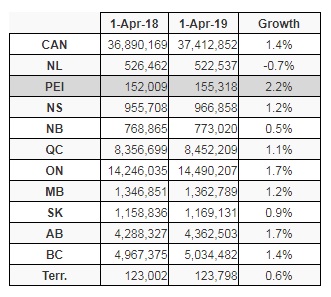
PEI Q1 GrowthIn June, Statistics Canada published its quarterly provincial population estimates, revealing that Prince Edward Island had reached 155,318 residents in Q1 2019.


This total represents a yearly increase of 3,309 persons, or a 2.2 per cent annual growth rate, putting it slightly ahead of Ontario which has sustained a similar growth rate throughout the past four years. As a whole, Canada’s growth rate is 1.4 per cent.

According to the PEI Statistics Bureau, international immigration to the province increased by 24.5 per cent in Q1 2019 compared to the previous quarter, and had jumped 11.2 per cent from the same period a year ago. At a rate of 3.5 per thousand, the province of PEI has just posted the highest quarterly immigration rate in the country.

Bill Ferreira, Executive Director at BuildForce Canada calls what’s happening on the small island “a construction boom” driven by continued growth in housing starts and peak levels of investment.

“Total residential construction demands could add close to 400 jobs to the PEI market by 2022 and remain at elevated levels throughout the decade,” he said. “With housing starts surpassing 1,000 units in 2018 and immigration levels expected to continue as they are, we’re predicting housing starts to exceed 1,300 units by 2021, before returning to current levels by 2028.”

Immigration key to labour growth

With the in-flow of immigration playing a key role in PEI’s labour markets, BuildForce Canada anticipates it will continue to be an important source of potential growth as the province is estimated to welcome 27,000 new immigrants between 2019 and 2028.

And feeding the local construction industry, more than 900 apprentices have been registered in PEI’s 14 largest construction programs throughout the last five years, with 450 completions recorded for that period. Of course, to ensure there are sufficient numbers of qualified tradespeople to sustain a skilled labour force over the long term, an ongoing commitment to training and apprenticeship development will be necessary.

But given Charlottetown is currently experiencing a vacancy rate of 0.2 per cent, making it the lowest vacancy rate out of the 37 regions analyzed by CMHC, ensuring that development keeps churning is the only viable solution.