Articles Archive - Page 460 of 928 - REMINET
REMI

Technology helps contractors work remotely

Many construction professionals are adjusting to the evolving COVID-19 landscape by practicing social distancing, having office staff work remotely, and hosting daily check-ins. The construction industry has a mobile and decentralized workforce, with projects requiring collaboration across multiple stakeholders, many of whom are only occasionally on a project’s job site.

Many businesses are turning to technology to assist with daily operations such as video conference calls.

Procore Technologies and Zoom Video Communications have partnered to support the construction industry during the coronavirus crisis. The Zoom technology will be merged directly into the Procore platform, allowing Procore users to quickly create video conference calls that can accommodate everyone on a project. The Procore and Zoom integration gives construction teams the ability to communicate and collaborate effectively while working remotely.

“Our mission is to connect everyone in construction on a global platform. In times like these, we see the power that technology can have to keep construction project teams connected and moving forward,” said Tooey Courtemanche, CEO of Procore. “We know that it is essential to move quickly in order to meet the demands of our users, and our partnership with Zoom is another way Procore is supporting the construction industry during this challenging time.”

Zoom allows project teams to visually share documents, discuss health-related updates and best practices, check-in regularly with large or small groups, and even allows project managers and engineers to view what field teams are seeing in real-time through video conferencing.

“We see a growing need for simplified business communications for on-site and remote teams. We believe that the integration with Procore will strengthen construction professionals’ ability to be productive, regardless of their location, by streamlining communication across teams,” said Eric Yuan, Founder and CEO of Zoom.

Through the Meetings tool in Procore, users can now add a Zoom Meeting as the medium for communication. When users view a meeting’s details on web and mobile devices, as well as when viewing a PDF export of meeting details, they can join the virtual conference call from the Zoom meeting hyperlink. This simplifies construction professionals’ ability to stay connected with their project teams.

Community mall operator unveils CRU relief plan

Small tenants in 12 of North American Development Group’s community shopping centres may be eligible to defer rent obligations for up to two months. The commercial real estate company, which manages more than $5 billion worth of assets through its subsidiary Centrecorp Management Services, will invoke the CRU relief plan beginning April 1.

“Small business owners are among the most severely impacted by COVID-19,” a newly released company statement acknowledges. “Qualifying small businesses who can demonstrate their need for financial assistance will be permitted to defer all or a part of their rental payments for up to two months, at which point, it is hoped this medical and economic pandemic is under control.”

The 12 malls include:

  • Agincourt Mall, Toronto, ON
  • Park Place Shopping Centre, Barrie, ON
  • Lynden Park Mall, Brantford, ON
  • Barrhaven Shopping Centre, Ottawa, ON
  • Shoppes at Fairwinds, Ottawa, ON
  • Orleans Garden Shopping Centre, Ottawa, ON
  • Faubourg Boisbriand, Boisbriand, QC
  • Carrefour de la Rive Sud, Boucherville, QC
  • Les Jardins Dorval, Dorval, QC
  • Les Promenade Bellerose, Laval, QC
  • Clayton Park Shopping Centre, Halifax, NS
  • Dartmouth Crossing, Dartmouth, NS

Help for landlords facing revenue loss

The rapid spread of the COVID-19 virus that has shuttered most of the world, closing borders and businesses and putting many citizens in financial distress, continues to wreak havoc as April 1st rent payments loom. Apartment owners and property managers aren’t just fearing heightened exposure to the virus itself, but the potential onslaught of rent defaults by the reams of tenants who’ve been forced out of work.

Robert Gentile, President of Quinte Region Landlords Association, says he worries about what will happen if tenants, landlords and policy-makers don’t work collaboratively to ensure financial safety nets are put in place so that rents get paid throughout the state of emergency.

“Small landlords rely on their rents to pay their bills, the largest ones being mortgages, taxes, and utilities. While some landlords, but not all, may be granted deferrals on some bills, they will still have to be paid in the end. So it is not realistic for rents to simply be waived without government financial assistance.”

Gentile points to the recent campaign by many tenant advocacy groups to dissuade renters from paying their rent. From Vancouver to Toronto, groups like ACORN have been calling for “rent breaks” and other extreme measures to protect the renting public. Since several provinces have placed a temporary moratorium on evictions, the ramifications of dwindling revenue could prove significant – for some landlords, even forcing them into a state of bankruptcy.

Fortunately, tenants and landlords received some positive news on March 25th when the federal government introduced the Canada Emergency Response Benefit (CERB).  Intended to quickly direct income support payments to Canadians whose incomes have been lost or severely reduced because of COVID-19, those who qualify for the program can now expect payments of up to $2,000 per month for potentially up to four months.

Joe Hoffer, Partner, Cohen Highley LLP Lawyers, says that the program could help considerably. “It means that many of the rent defaults landlords may experience on their April rent rolls could be resolved before the end of April and could stay resolved for at least four months.”

Since the crisis began, Hoffer has been advising landlords to work with tenants facing COVID-related income loss to come up with repayment plans unique to them. “Landlords are entitled to see some verification from tenants to support the claim of loss of income and its connection to COVID-19,” he said. “If the landlord is satisfied with that verification, then there is a good chance that the CERB program will supply funds to meet the tenant’s housing needs and avoid ongoing rent defaults.”

He also advises landlords to get familiar with CERB and other government assistance programs, recommending that they work with eligible tenants to incorporate the funds sourced from the programs into tenant repayment agreements. If the tenant refuses to cooperate with the process, or is simply not paying rent with the expectation the landlord has no remedy, Hoffer suggests issuing the N4 and following up with an eviction application; otherwise landlords will have no leverage to recover a judgment or repayment of arrears.

Applying for CERB

The application process for CERB is scheduled to open in early April, with individual income support payments amounting to $2,000 a month and delivery of funds up to ten days after processing. The money is intended to support tenants who have lost their jobs, become ill, or are under quarantine and/or have to stay home because of school closures. In addition, workers, contract workers and self-employed individuals who don’t meet the criteria for employment insurance (EI) will also qualify.

“The more familiar landlords are with access and eligibility for the program the better positioned they’ll be to assure anxious tenants their housing is secure while working with them to develop an effective rent arrears repayment agreement,” Hoffer said. “The bottom line for landlords is that the CERB program offers a lifeline to tenants who cannot meet their rental obligations. It also offers relief for landlords from the loss of rental revenue needed to operate their buildings in very difficult and demanding circumstances.”

Find out more at: https://www.canada.ca/en/department-finance/news/2020/03/introduces-canada-emergency-response-benefit-to-help-workers-and-businesses.html

COVID-19 resource for condo managers and boards

A webinar on the impacts that COVID-19 is having on condo communities across Ontario attracted more than 500 industry members last week.

After participating alongside other industry leaders, Jason Reid, senior advisor for National Life Safety Group, says it became evident that residents of high-rise buildings are well protected by both their boards and professional property managers who are keen on taking the right actions.

Many concerns were also raised about safety and security. To help managers and board members protect all occupants, staff and residents in their buildings, Reid has since compiled a document that guides condos through recommendations and considerations that are proactive and exercise due diligence.

To further contain the spread of COVID-19, the Ontario government ordered the mandatory closure of all non-essential workplaces. As of Tuesday, March 24, this closure will be in effect for 14 days with the possibility of extending this order as the situation evolves.

“Since then, National Life Safety Group has developed an industry leading collection of considerations in due diligence, with a focus on fire, safety and security, says Reid. “It’s time to share our work with all in Ontario—to benefit the entire community.”

Managers and board members can access the free resource here: COVID-19: Condominium Due Diligence Tracking – National Life Safety Group.


Hotels brace for steeply sliding RevPAR in Q2

Hotel sector analysts are projecting a 37 per cent decline in revenue per available room (RevPAR) across the United States in 2020, although that’s contingent on resurgent third and fourth quarters to pull up an expected 60 per cent slide over the course of April, May and June. A new report from CBRE Hotels Research assesses the likely fallout from the COVID-19 pandemic and concludes it will hit luxury, airport and resort properties particularly hard, along with a general wallop across large urban markets that are international business, tourism and/or convention hubs.

“At this point in time, the expectation is that the Canadian accommodation market performance will follow a similar trend line in terms of the decline and recovery,” notes accompanying commentary from CBRE Hotels Canada.

The second quarter will see the most dramatic dip in activity with U.S. RevPAR projected to be nearly 70 per cent lower than the comparable period in 2019. The report’s author, Jamie Lane, senior managing economist with CBRE’s advisory services, suggests U.S. occupancy levels, which hovered around 53 per cent as of mid-March, won’t bottom out, at slightly below 15 per cent, until late April.

Looking to other markets, Italian hotel occupancy fell to about 15 per cent earlier this month. In China, where the progress of the outbreak is estimated to be about seven weeks ahead of North America, occupancy levels are now nearing 20 per cent, climbing from below 10 per cent in early February.

In the midst of a still cresting scenario, Lane speculates that U.S. hotels will manage to draw business in the weeks ahead from a “significant base” of captive users such as airline personnel, designated essential workers and people self-isolating outside their family dwellings. As some hotels close temporarily or possibly convert to facilities for quarantine and convalescence, those remaining open will be positioned to capture a larger share of this base. Additionally, he points to the “unproven ability of the United States to enforce travel restrictions and inconsistent policies at the city and state level” versus more universally rigid control in China.

In plotting the downward and projected recovery curve, Lane draws both from Chinese and European COVID-19 related statistics, and from hotel market performance during previous economic downturns and other events undermining confidence in travel. “People avoid travel when they feel unsure about their future financial state (constraint #1) and when they feel afraid to make trips (constraint #2),” he observes.

While the COVID-19 outbreak has triggered the first constraint, the second constraint is termed “a broader and more complicated phenomenon”. With its pandemic status, COVID-19 also presents a more all-encompassing threat than earlier 21st century episodes of SARS, H1N1 or Ebola.

“Recovery will take longer from this event because of the interconnectivity of many countries and their reliance on each other for leisure and business demand,” Lane hypothesizes.

Already, it’s projected that the COVID-19 hit on hotels will be more severe than the combined losses following the 2001 terrorist attacks in the U.S. and the 2008 economic crisis, which saw sliding RevPAR of 6.7 per cent and 16.7 per cent respectively. As with the post-September 2001 period, mid-scale and economy properties have fared somewhat better thus far, registering a 20 per cent drop in RevPAR in recent weeks versus a 45 per cent decline across luxury, upscale, airport and resort venues. Still, Lane suggests that, like 2001, the latter properties could also enjoy an earlier rebound.

“If containment efforts are successful and people are permitted to begin travelling again by Q3, we expect a swift recovery as the fundamental reasons for travel remain strong and consumers of travel have pent-up demand to leave the house,” he projects.

In the longer term, RevPAR is projected to return to 2019 levels by 2022. That’s a very different picture than the view from a few months ago — equating to about USD $100 billion less revenue in the intervening years than pre-COVID-19 forecast plotted.

GPS tech can help businesses stay efficient

The COVID-19 pandemic has shifted the way we do business almost overnight. Social distancing and the new reality of smart health and safety policy in the workplace are changing business’ capacities to be productive. Across Canada most companies, institutions and organizations have been forced to send workers home and/or into isolation.

GPS technologies as a tool can help a business stay productive and be efficient. For instance, business owners with a GPS tracked fleet can afford to extend trust to their workers, and allow them to take company vehicles home. This allows employees to begin and end the work day at home, eliminating unnecessary contact with co-workers, in efforts to enforce social distancing and help contain the spread of COVID-19.

Allowing workers access to a company vehicle to take home can boost morale and encourage loyalty. Workers will no longer need to drive between a jobsite and the office, wasting time and fuel in the process. Instead they can do so directly from their residence, with the manager knowing what assets are moving, when and where.

Data is knowledge and location information provides many administrative duties automatically and can be provided via reports for immediate viewing, with one click.  GPS tracking can also play a key managerial role in businesses that rely on workers being at various offsite job sites. Managers/operators who are no longer in the office, through GPS tracking, can know exactly when workers leave and return from a jobsite. In fact, a manager can know the location of staff throughout the day and easily determine time and man hours spent on that work site, or delivery route, etc. Having that information can mitigate employees who are taking extended breaks or otherwise not being as productive as they need to be.

Safety and social distancing policy may require certain workers to work in isolation, which can become dangerous. If an accident does occur or a worker becomes stranded, GPS trackers can instantly allow co-workers and/or managers know the exact location of the party in distress. This way help can be dispatched quickly and accurately. GPS technology can also be used as a tool itself to help employers know if workers are in fact social distancing. They can make business decisions (routing, suppliers, etc.) to make sure employees are staying safe and away from areas where social distancing becomes difficult.

Depending on how long this new reality of social distancing and working from home lasts, we may see major changes to virtually all business operations worldwide. Being able to track workers and not having them coming to and from a central office, could result in mass downsizing. Businesses may see cost savings in less office space and less parking space. Perhaps smaller central operations will emerge and in some situations full closures of main offices that have become redundant.

Tools will help as today’s business are under many varieties of stress, given the current socio-economic environment and new approaches to business under a social distancing regime. It will become increasingly important for businesses to find tools, services and strategies to help cut costs, keep efficient and stay safe. GPS tracking for vehicles is one of those tools.


Mark Reilly is director sales and marketing at Trackem, which provides real-time GPS location services.

ON/AB: education property tax relief introduced

Alberta and Ontario are offering ratepayers temporary relief from the education portion of property tax bills. Earlier this week, Alberta municipalities were instructed to adopt education property tax rates as per usual, but to defer collection for six months, while the Ontario government has extended the deadline for municipalities to submit moneys owing to school boards until September 30, 2020.

“Deferring the June 30 quarterly remittance to school boards by 90 days will provide municipalities with the flexibility to, in turn, provide over $1.8 billion in property tax deferrals to residents and businesses,” states the newly released Ontario economic and fiscal update. “To ensure this does not have a financial impact on school boards, the Province will adjust payments to school boards to offset the deferral.”

In Alberta, the six-month deferral applies to an estimated $458 million in non-residential taxes owing. However, businesses that can pay now are urged to do so.

“The government encourages commercial landlords to pass on these savings to their tenants through reduced or deferred payments,” a statement from Alberta Treasury Board and Ministry of Finance submits. “This will help employers continue to manage their debts, pay their employees and stay in business.”

Killam Apartment REIT outlines COVID-19 response plan

Killam Apartment REIT issued a special statement outlining its Pandemic Illness Plan and the action steps it has implemented in response to COVID-19.

For residents, the plan includes: an increase in frequency and thoroughness of cleaning practices throughout all properties; the closure of amenity spaces to assist with social distancing; a ban on evictions for residents unable to make payments due to financial hardship caused by COVID-19; and a commitment to working with those tenants facing financial hardship to find flexible payment solutions on a case-by-case basis.

In addition, Killam Apartment REIT will be waiving the collection of recent rental increases and will suspend collection of further rental increases during this period of crisis, beginning with the April 1, 2020 rent payment.

In terms of action steps aimed at protecting and supporting employees during this crisis, Killam is providing assistance in a variety of ways, including limiting site staff to reduce exposure and the spread of COVID-19, and offering paid time-off for any employee required to self-isolate or who becomes ill.

“We are committed to providing necessary updates to our unit-holders and other stakeholders during the course of the COVID-19 Pandemic,” the statement said. “We have addressed many stakeholders’ questions through a question and answer (Q&A) document on our website and we will continue to update the Q&A on our website during this time of uncertainty.”

Will coronavirus change the future workplace?

Many companies have been forced to rethink traditional workplace structures in the past few weeks as physical office space quickly morphs into work-from-home situations for the time being. The length of time companies will be operating without a dedicated space hinges on the evolution of this public health emergency.

Some short-term impacts are already obvious—adopting virtual tools, maintaining team dynamics, coordinating work, committing to required investments as the economy shifts and finding the right work-life balance are just a few challenges the Colliers Canada Workplace Advisory Team is flagging.

More long-term changes are harder to predict, but some workplace strategists are already suggesting this current pandemic will likely alter the future workplace in a variety of ways.

“From a workplace perspective it’s an interesting experiment going on now—so many workers are working remotely,” says Kevin Katigbak, senior workplace strategist at Gensler. “A lot of people have been sort of apprehensive about ideas around mobility and work-from-home, but now we’re all forced to work in that way and it’s almost this forced trust—you have to trust employees to get their job done.”

As a result, remote working could become a more viable option for companies to offer employees, he says.

Meredith Thatcher is a certified facility manager, IFMA fellow, workplace strategist and co-founder of AgileWork Evolutions. She is also a long-time advocate for flexible work arrangements and believes this sustained exposure to work-from-home environments for millions of people will result in changes to workplace perceptions for both employers and employees.

“For some employers, we believe there will be a new level of tolerance for working at home and a much better understanding of what is needed to effectively enable a workforce,” she says. “We may see these same organizations shed real estate in future, while looking to offer a balance between work-from-home and an office environment.”

Other employers are likely to return to traditional ways of working; however, their employees may have other ideas.

“While we must recognize that working from home is not for everyone, there is something to be said about having the choice and flexibility to do so,” she says. “This crisis will expose employees to both what they like and don’t like about remote working. But most will eventually recognize that it’s a balance that is desired.”

The shift to remote work has been sudden. As with any workplace transformation, some employers will return to previous business practices, agrees Christine Weber, vice-president of workplace strategy and innovation, central and eastern Canada at Colliers Canada. Others, she says, will embrace this as a learning opportunity for what will become the “collective new normal.” Either way, the traditional office will still have purpose.

“Redefining that purpose is the opportunity in front of us,” says Weber. “Organizations will have a chance to reconsider how the work environment enriches their culture, enhances community and connection, and impacts business continuity. Enabling organizations with greater flexibility and long-term strategies, tactics and tools to enhance remote working will result. We can use this experience to test, refine and enhance distributed work strategies of the future.”

While it is difficult to predict if companies will go back to the status-quo or how employees will be changed as workers, a few key areas have current influence.

According to Colliers Canada Workplace Advisory Team, these include a heightened sense of community and responsibility, a stronger focus on employee health and wellness, and digital adoption. With everyone working in “hyper-learning mode,” this could change how people work together.

“This crisis has morphed into the world’s largest pilot program ever, Weber adds. “ We have a collective responsibility to learn from it, adopt new ideas, and evaluate how this will impact work, people and culture long term.”

Trust will be the biggest challenge to work through in the coming weeks and months, she says. Companies “will need to learn how to adapt expectations and learn new rules of engagement.” According to a 2018 study from job listings site Indeed, 62 per cent of Canadian employers offer their workers the chance to work remotely. Meanwhile, global statistics as of 2016 from Vodafone reveal 75 per cent of companies now have flexible working policies. More than half report these changes increased their profits.

“If you empower your employees to work in the way that is most effective for them, that shows a great deal of trust in the people that work for you and you work with,” says Katigbak. “If that’s not your culture, this is a good way to start looking at it through a different lens, to recognize that you can trust how people are going to work. At the end of the day, we’re all adults who have to get a job done.”


AgileWork Evolutions has compiled a Work@Home Checklist for Employers with change management strategies to help companies prepare for remote working.

Ontario long-term care sector receives funding

To contend with the ongoing health crisis, the Ontario government announced $3.3 billion in new funding toward the health care sector, including critically needed funds for Ontario long-term care providers.

Part of the “Ontario Action Plan: Responding to COVID-19”, the package includes $243 million for surge capacity in homes, as well as funding for 24/7 screening, supplies and equipment, and more staffing to support infection control.

“We are so impressed and thankful for how quickly this government has mobilized to look after Ontarians, especially seniors and other vulnerable populations who need our support now more than ever,” said Lisa Levin, CEO of AdvantAge Ontario.

“This added support is vital to our members’ efforts to safeguard residents from exposure to this virus. The nature of our sector is that staff are continually in close contact with residents and providing hands-on, personal care, so it is vital that we keep everyone safe. Funding for active screening, personal protective equipment, and added staff to help with care are our top priorities, so these investments are going right where we need them,” added Levin.

The government has also committed approximately $80 million to enhancing the quality of care and overall resident experience in long-term care homes, along with $23 million for a minor capital program for upgrades and repairs.

“Our long-term care homes need this added funding to maintain care levels and ensure that the buildings that residents call home remain in good condition,” said Levin.

According to the announcement, the funding also includes $120 million to increase home and community care capacity.

“The more we can bring care and services into people’s homes and keep them out of hospital, the better. This keeps seniors in familiar surroundings and frees up resources and space in hospitals to care for complex COVID-19 patients.”

“We will continue to work closely with the Ministry of Long-Term Care, the Ministry of Health, and our sector partners to tackle this pandemic. We know that the dedicated staff in our member homes are working their hardest to safeguard residents during this incredibly difficult time,” added Levin.

AdvantAge Ontario is a community-based, not-for-profit organization dedicated to supporting the needs of aging Canadians.

Smart buildings harnessed for pandemic response

With the growing threat of infectious disease, smart buildings will play an increasingly important role to help detect and control their spread, facilitate the remote operation of buildings in lockdown situations and interact with the grid to increase energy resiliency. Advanced applications, smart buildings and smart grids that offer transactive modes of generation and usage have the potential to increase safety and resiliency and increase the sustainable production and consumption of electricity.

The World Economic Forum estimates that the projected value to society in terms of cost savings for consumers and reduced carbon emissions surpasses any other individual digital initiative. As recent experience in China has demonstrated, there are also benefits in a pandemic.

Diagnostic and identification capabilities to limit spread of infection

Temperature sensing and imaging equipment that integrates intelligent video and artificial intelligence (AI) are becoming part of epidemic prevention and control. This has been deployed in China with the application of proactive surveillance to detect fever and rapidly diagnose infection.

High-performance infrared thermal cameras, installed at the entrances of major train stations and airports, could capture thermal images of the commuter flow in real time to rapidly detect people with an abnormal temperature. This also reduces the cost and potential exposure to infection associated with manual temperature checks. AI can establish the identity of any passengers registering high temperatures within the measurement area, making it possible to separate out people suspected to be infected and to identify who should be quarantined.

However, such technologies would more likely be viewed an infringement on privacy in North America and Europe. That’s already emerged in the United Kingdom with the Daily Telegraph’s attempt to install desk monitoring sensors and Barclays’ monitoring of the time employees spent at their desks. Both initiatives were scrapped due to pushback.

Many hospitals already use smart applications to monitor hygiene. They include white light disinfection LED technology and washroom sensors to track whether staff are washing their hands for a sufficient length of time. Humidity levels can also be programmed by building management systems (BMS) to create indoor conditions that will minimize the survival rate of viruses.

Facilitating social distancing and remote building operations

Smart technology can facilitate work, education and entertainment for people self-isolating in their homes. As also seen in China, it should be possible to create a telemedicine internet feed that enables residents to submit daily health status reports to a community worker, who is designated for a building or a district. The assigned health worker could then respond with a message, a phone call, or even a home visit as needed.

The city of Guangzhou launched such an application with an “I need” feature for quarantined residents to obtain daily necessities such as food and medications. As such technology becomes more commercially available, it could become a service that property managers could offer to tenants.

The analytic and diagnostics capabilities of smart building AI and building automation can enable self-supporting and remote operations, which can be valuable in a pandemic. With cloud-based information about the HVAC and lighting control systems, the building operator can monitor and control the building remotely for maximum impact on energy consumption maintain balanced thermal equilibrium in all seasons, no matter whether the building is fully occupied or almost empty.

Regardless of the current exceptional conditions, this can optimize occupant comfort, save money and reduce carbon emissions. A digital twin manifestation of the building can further extend the building operators capability to access all operational data remotely.

Aligning with climate change concerns and enhanced resiliency

While climate change may have slipped somewhat from people’s consciousness and priorities right now, it’s noteworthy that the pandemic and climate crises are both problems of exponential growth against a limited capacity to cope. In the case of the virus, the danger is that the number of infected people could overwhelm health care systems. With climate change, the concern is that emissions growth will overwhelm ability to manage consequences such as droughts, floods, wildfires and other extreme events.

A brief interval of emissions reductions due to COVID-19 related pullbacks or shutdowns of emitters will not stop other extreme weather events that are already in motion. It will be critical to build resilience on all fronts — and the smart grid and building-centred transactive energy can be part of that effort.

A smart grid is an electricity supply network that uses digital communications technology to detect and react to local changes in production and demand. The capability to respond to the changing conditions and “talk to the grid” requires a smart platform that is capable of supporting a wide range of applications, including: HVAC systems; electric vehicles; and distributed-energy and whole-building loads. Platforms such as VOLTRON are rapidly being developed and tested, providing the capacity to respond to occupants needs, produce and store energy, and communicate with the utility, the grid and other buildings.

The smart grid is seen as a means to more efficient transmission of electricity; quicker restoration after power disturbances; reduced operations and management costs for utilities; and, ultimately, lower power costs for consumers. Combined with renewable power and storage, a smart grid also offers resiliency, which increases the grid’s coping capacity in times of pandemic or other catastrophic events.

Jiri Skopek is an architect, planner and specialist in smart, green buildings and communities.

Six ways to help remote workers thrive

Closures of non-essential businesses in Ontario and Quebec have pushed hundreds of other companies into the remote workforce. Many employees are not accustomed to working from home everyday and might find the lack of traditional office space challenging.

“In order to balance our work-life, we still require social interactions to be happy and productive,” says Christine Weber vice-president of workplace strategy and innovation, central and eastern Canada at Colliers Canada. “Companies need to be cognizant to the fact that not all employees are comfortable working remotely, so the key is frequent connection in various ways.”

Here, Weber and other members of Colliers Canada Workplace Advisory Team, including Robyn Baxter, vice-president of workplace strategy and innovation, western Canada, and Sarah Bramley, associate vice-president of workplace strategy and innovation, western Canada, offer solutions for preserving unity in an office of remote workers.

Leaders stay connected

Each team member will need a differing amount of communication to find the balance of micro-managing vs. ignoring. This is very personal to each individual. The best way to know is to ask them what they need.

Maintain a connection at various levels (all organization down to team)

As an organization, organize structured virtual events, forums and webinars to avoid feeling isolated. Virtual Friday happy hour drinks, virtual lunches and remote coffee breaks keep teams engaged with each other during these times. As a team, connect as regularly as you can. Brainstorm ways to learn and connect on a personal level. A virtual “water cooler.”

Talk to each other

Without the quick hallway conversations, relationships start to lose energy and people can feel isolated. Everyone should be encouraged to connect by phone or through technology and have a chat about nothing in particular. Respect that the person you’re calling may be in the middle of something so open with the offer to chat another time. But connections remain important.

Open a team chat

Using your organization’s preferred instant messaging tool, set up a team chat page. People can ask a quick question or share a thought without interrupting everyone or waiting for the next huddle. It’s as close as you can get to sitting next to each other.

Don’t wait to connect

Don’t wait for something big; check-in with colleagues and employees regularly. Caution: be clear in behaviour, attitudes and conversation that this is an “are you ok, and how can I help?” call, and not a “are you really working?” check. Leaders and managers must create greater rigour around management and engagement during these times.

Recognition and celebration

Remember the importance of a personal thank-you, and when public acknowledgement of accomplishments should take place. This goes for the minor achievements and major milestones. Be cognizant of opportunities to recognize employees and colleagues. Keep it up.

Quebec regions most impacted by COVID-19

With Quebec currently Canada’s hardest hit province accounting for more than 1,300 cases as of March 25th, the government says the recent surge is partly due to a change in testing procedures, and that the spike in cases was anticipated.

Since March 22nd, the province has been accepting positive results from any hospital lab, instead of requiring them to be verified centrally before counting in the statistics. Another reason for the surge, according to Quebec Premier François Legault, is that the province’s spring break takes place at an earlier date compared to other provinces.

Quebec coronovirus

Among the most affected regions outside of Montreal, Granby, Bromont and other towns in the Eastern Townships have experienced a rise in COVID-19 cases. Reportedly, citizens along Granby’s residential streets have been hanging red cloths in their windows signalling the need for help. To curb the spread, “special, enhanced measures” have been implemented for the region.

Meanwhile, public health in the Eastern Townships announced that several residents of the Manoir Sherbrooke seniors’ home had been diagnosed with COVID-19, now bringing the tally of confirmed cases in that building to 11.

The Quebec government has enacted several measures to help mitigate the spread of the disease since the first cases appeared last month, including: the closure of schools, public spaces and non-essential businesses; mandatory quarantine for all returning travellers; the prohibition of all indoor and outdoor gatherings; and several others.

To help support those in containment, the Temporary Assistance Program for Workers in the Context of the COVID-19 Pandemic (PATT COVID-19) is available to workers who are not eligible for an income replacement program.

Building civic pride in wood

All levels of government in British Columbia (B.C.) are leading by example, showcasing what’s possible with wood construction and demonstrating the importance of sustainable building.

Through its Wood First Act, the province of B.C. encourages public institutions to consider using wood in construction where appropriate. Since the act was introduced about a decade ago, more than 50 B.C. municipalities have adopted wood-first resolutions, policies or bylaws — promoting locally sourced timber construction as a way to take action against climate change.

Wood has become the predominant structural and finishing material for fire halls, municipal buildings, police stations and libraries throughout the province. Wood harvested from sustainably managed forests has many inherent benefits; it’s a sturdy building material, a natural insulator, good for health and wellbeing, and fast and efficient for construction.

Former City of Surrey Fire Chief Len Garis said he wants people to see the many benefits and beauty of wood — and to understand that it’s a safe and durable material we can use with confidence.

“Living in British Columbia and understanding our connection both economically and socially around wood is really important,” said Garis. “It’s everywhere and it’s a large part of who we are.”

The Qualicum Beach Fire Hall on the east coast of Vancouver Island makes extensive use of wood-frame construction, demonstrating wood is fire-safe, resilient, and cost-effective — all considerations for the municipality. The building’s wood frame uses laminated veneer lumber (LVL) panels for its upper floor and roof systems; the use of LVL is estimated to have cut construction time by more than half compared to a conventional steel or concrete system. The vast majority of wood for the project, conceived by Johnston Davidson Architecture + Planning Inc., was locally sourced.

Richmond City Hall was one of the first major civic buildings in the province to prominently feature a wood and heavy-timber structure as its defining architectural statement. The building’s soaring galleria structure is a series of Douglas-fir glue-laminated timber (glulam) portal frames with heavy timber decking. The architect of record was DIALOG, and KPMB Architects was the associate architect on the project.

In the Okanagan, the Summerland RCMP detachment used traditional wood-frame construction with exposed solid-sawn lumber as both a structural and a finishing material. The glulam post-and-beam structure, design by KMBR Architects Planners Inc., also uses light-wood-frame construction for the walls. The eye-catching entrance canopy is built of nail-laminated timber (NLT).

wood construction

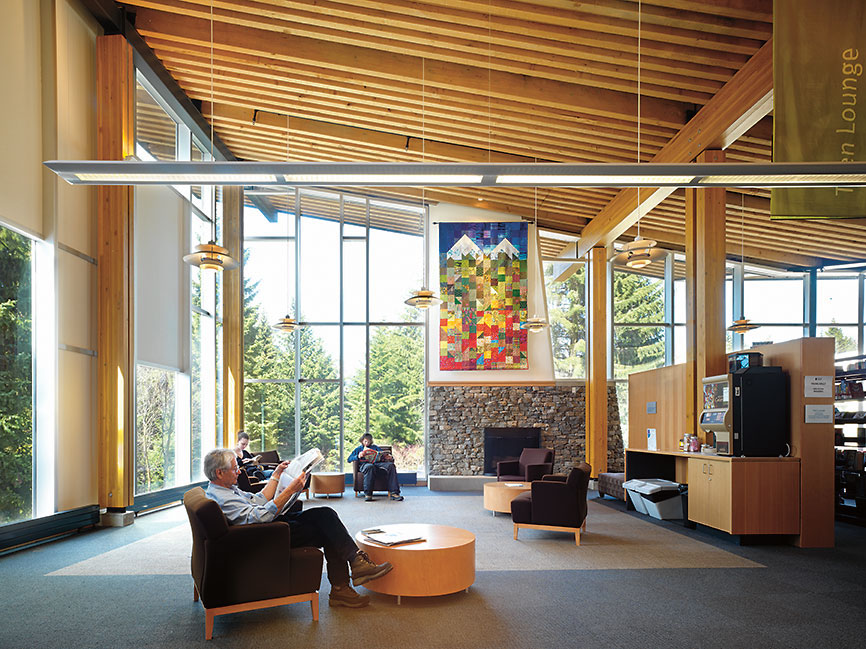
The form of Whistler Public Library makes good use of its site’s orientation to the sun, while reclaimed Douglas-fir millwork enhances the warm feeling of the interior. The solid wood roof system uses prefabricated panels made of solid hemlock. Photo: Martin Tessler

The Whistler public library is a fresh and modern structure that works within the resort municipality’s design guidelines. The HCMA Architecture + Design project features a solid-wood roof system composed of prefabricated panels made of solid hemlock members that span distances of up to 14 metres. Innovative use of hemlock in its construction demonstrates the commercial viability of the abundant, yet underused species. Reclaimed Douglas-fir millwork enhances the warm feeling of the interior.

These projects and others are featured in a newly released book, Naturally Wood, which showcases British Columbia’s cutting‐edge wood architecture and design. The beautifully illustrated, 160-page publication contains more than 65 innovative wood buildings and projects, including how wood is being used in public and institutional buildings.

Four continuing education units have been developed based on the book. They are recognized by the Architectural Institute of British Columbia and are available at naturallywood.com/naturally-wood-ceus.

Download the Naturally Wood e-book at naturallywood.com/nwbc.

ON/QC: access to key building services assured

Key building services remain among the now scoped number of enterprises still allowed to operate in Ontario and Quebec. Earlier this week, both provincial governments gave non-essential businesses a midnight March 25 deadline to shut down to reduce the risk of spreading COVID-19 infection. However, building owners, managers and occupants can be assured that life-safety systems, telecommunications, elevators/escalators and HVAC can be maintained and repaired as necessary, and that janitorial and security staff are permitted on-site.

Unlike Ontario and British Columbia, Quebec’s construction jobsites are now idled except if response to an emergency situation is required. In addition to building maintenance and on-site management, designated essential services of importance to the commercial and multi-residential sectors include:

  • production, procurement, transmission and distribution of energy;
  • electricians, plumbers and other trades for emergency services;
  • hazardous materials management;
  • insurance services;
  • rental equipment services;
  • garbage collection and residual materials management;
  • emergency building and fire inspections; and
  • snow removal and maintenance of functional road links;

Ontario landlords, tenants and homeowners will also be able to call on these services and some additional options. Notably, too, the list of essential provincial services explicitly includes “property management services” among the permitted “businesses that provide support and maintenance services, including urgent repair, to maintain the safety, security, sanitation and essential operation of institutional, commercial, industrial and residential properties and buildings.”

A list of essential environmental services goes beyond critical monitoring and response to hazardous materials/spills to include: environmental consulting firms; professional engineers and geoscientists; septic haulers; well drillers, pesticides applicators and exterminators; management of industrial sewage/effluent (e.g. for mining operations); and environmental laboratories.

Additionally, movers have been okayed to work in both Ontario and Quebec. Hotels remain open in both provinces.

The Quebec and Ontario governments continue to stress the responsibility of all employers and employees to follow Health Canada protocol and to take every precaution to protect the public and themselves.

“The stores and services covered by this list must ensure that the people in their establishments comply as far as possible with the principles of social distancing,” the Quebec government instructs. “It should be noted that all businesses can always engage in teleworking and e-commerce.”

“We call on workplaces that remain open to be vigilant and to enforce the highest possible standards of cleanliness and caution as we continue the fight together against COVID-19,” says Vic Fedeli, Ontario Minister of Economic Development, Job Creation and Trade.

Ontario adopts flat electricity rate

Residential, small business and farm customers in Ontario can count on a flat electricity rate of 10.1 cents per kilowatt-hour (kWh) for the next 45 days. That’s typically the off-peak cost under the provincial time-of-use pricing plan, which sees rates shoot up to 20.8 cents/kWh during the six designated peak hours in the morning and evening and sit at 14.4 cents/kWh for the afternoon.

The Ontario government announced the short-term discounted rates earlier today to recognize that homes are no longer empty during the work and school day. Since the government first issued its request for people to stay home as much as possible earlier this month, many residential customers had been racking up inescapable higher costs of consuming electricity during the daytime hours.

“During this unprecedented time, we are providing much needed relief to Ontarians, specifically helping those who are doing the right thing by staying home and small businesses that have closed or are seeing fewer customers,” says Premier Doug Ford.

“We thank the Ontario Energy Board and our partners at local distribution companies across the province for taking quick action to make this change and provide immediate support for hardworking people of Ontario,” adds Bill Walker, Ontario’s Associate Minister of Energy.

IDC CEO Tony Brenders stepping down

The Interior Designers of Canada (IDC) board of management has announced the resignation of CEO, Tony Brenders, effective May 31, 2020.

“The entire board is extremely grateful for having had Tony leading the association over the last four years, moving it forward on several fronts,” says Carol Jones, IDC president. “During his tenure, IDC has realized significant improvements to the IDC board and governance structures, seen the launch of IDC’s National Design Symposium, VODA and Legacy Awards, and the development of a very dedicated team of professionals.”

Jones went on to say, “The Canadian interior design community has been strengthened over the past four years, with Tony at the helm. The national and international reputation of Canadian interior designers has been advanced by Tony’s leadership and dedication to advocacy, on behalf of the industry.”

Brenders noted that “the past four years have provided a remarkable opportunity for change and growth that have furthered IDC’s efforts in support of the design profession and interior designers, across the country. My decision to leave, while difficult, is made easier knowing that IDC has a passionate and committed board, staff, and volunteer community in place, working tirelessly, on behalf of this wonderful profession.”

IDC has established a Recruitment Committee charged with carrying out the search for a new CEO.

As the national advocacy body, IDC represents more than 5,000 members including fully qualified interior designers and related professionals.