





Articles Archive - Page 461 of 928 - REMINET
REMI

COVID 19: construction legal Q&A

As the Alberta construction industry continues to deal with the evolving COVID-19 crisis, the McLennan Ross Construction Group is working hard to stay ahead of the legal challenges that this unprecedented situation poses to clients.

The group has prepared answers to the most frequently asked COVID-19 questions that affect the Alberta construction industry. Here are five:

Should I just shut my project down?

Shutting down the worksite (as opposed to just removing particular workers as described above) may put companies at risk of breaching various contractual obligations. For example, removing workers who carry no recognizable risk may result in financial loss to those workers and corresponding risk of liability to the party shutting down the site.

Fortunately for the construction industry, layoff and termination notice or pay in lieu of notice is not required under the Employment Standards Code for employees employed at the site of and in the construction, erection, repair, remodelling, alteration, painting, interior decoration or demolition of any building or structure.  However, office employees and maintenance employees are entitled to layoff notice and termination notice.  Layoff notice is required for 1 week if employed less than 2 years, 2 weeks if employed for 2 years or more, or if unforeseeable circumstances prevent such notice, then as much notice as practicable.  Termination notice may be required for office or maintenance employees up to 8 weeks (if employed more than 10 years).  Notice may not apply if unforeseeable or unpreventable circumstances make it impossible to give termination notice.

Employees employed for a definite term or task are also exempted from the group termination provisions of the Employment Standards Code.

On a unionized worksite, the collective agreements would govern in respect to layoff and termination obligations.

Every contract up and down the chain should be considered, to determine if shutting down the project can be legally justified – particularly in light of the provisions relating to delay and force majeure as well as the concept of frustration, all discussed below.  The decision to shut down the project without legal justification may attract liability for breach of contract.  However, it may be possible to amicably negotiate contract revisions where parties have a common interest in taking such actions.

Can contractors or owners claim delay damages or an extension of time as a result of COVID-19?

Most construction contracts expressly set out the relief for delay-related impacts, such as an extension of time to complete the work and possible recovery of costs and damages.  In many cases, delays caused by external factors such as COVID-19 will be excusable but not compensable to the contractor, but this may vary from one contract to the next.  The delay provisions likely require that the contractor mitigate any losses caused by the delay, and in any event the common law requires the parties to act reasonably if it is possible to reduce or avoid such costs.

Where you are party to multiple agreements related to the work or project (including but not limited to leases, development or financing agreements, subcontracts, supply contracts, and equipment rental contracts), it is important to assess whether you are protected against the consequences of any delays in respect of each contract, as they may not be aligned or consistent.  It is also important to take note and comply with all contractual notice requirements.

Will a force majeure clause relieve me of my contractual obligations?

A force majeure clause is common in certain construction contracts and normally frees the parties from liability or obligation when an extraordinary event or circumstance beyond either party’s control prevents one or all of the parties from fulfilling their contractual obligations.

Force majeure clauses are read very narrowly. The triggering event must clearly fall within the scope of the force majeure clause.  Further, the application of a force majeure clause requires that the triggering event is clearly beyond the control of the contracting parties; and the triggering event must render performance of contractual obligations impossible. Simple inconvenience or the fact that an event is beyond someone’s control will likely not be sufficient to render a force majeure provision applicable.

COVID-19 will certainly trigger some force majeure clauses; however, a case-by-case assessment is required.  As the impact of COVID-19 and legislative responses continue to evolve, it is prudent to ensure that you understand the specific nature of your contractual arrangements to determine whether a force majeure clause exists and may be relied upon in your particular circumstances.

Further contractual considerations can be found by clicking here.

Will the concept of frustration of contract absolve me of my contractual obligations on a project?

The doctrine of frustration may apply where the force majeure provisions in the construction contract are not met (or such provisions do not exist). The distinguishing feature of frustration is that it is not based on any provision of the contract, whereas relief for force majeure must be explicitly set out in the contract. The common law rule of frustration may apply to absolve the parties to a construction contract of their obligations entirely. The rule is applied narrowly where the obligations of the parties are truly impossible to perform because of a third party.  For example, frustration will not apply where the contract is merely more expensive or more onerous to perform, or where an alternative method of performance is possible. Unless you have a mass outbreak at the worksite, or the authorities shut the worksite down, it would likely be difficult to prove frustration.  This is not to say that a construction contract cannot be terminated for frustration as a result of COVID-19, but it is unlikely and will need to be assessed on a case-by-case basis.

If we are required to shut our project down, will losses be covered by business interruption insurance?

Business interruption coverage only applies if the loss is caused by an insured peril. COVID-19 is likely not a peril covered by the typical business interruption insurance carried by construction companies. There are several important restrictions on business interruption coverage and, like other types of insurance, the specific policy language must be reviewed to determine if there is coverage for pandemics or epidemics. An important consideration to keep in mind is that most business interruption policies will provide coverage only when physical loss or damage has been caused to the insured’s premises or property used in the operation of the business.

Some package policies from insurers may have some limited “outbreak expense coverage,” but this will most likely be for a nominal amount and only apply with respect to ”confirmed”, not ”suspected”, exposure.

Specialty coverage for disruption of business due to a pandemic does exist.  But the number of companies that have this type of coverage is limited, given that the coverage has always been expensive and limited in scope. It is important that you keep complete accounting and financial documentation, review your policy, and speak to your insurance broker to confirm whether you have insurance coverage in such circumstances.

More on business interruption insurance can be found by clicking here.


The above is excerpted with permission from McLennan Ross LLP. The full 10 construction industry Q&A can be found at here. For more COVID-19 updates, visit https://mross.com/law/covid-19.


SmartCentres offers free space for COVID-19 efforts

SmartCentres will be offering rent-free use of its space to help support governments and health care authorities across Canada who are on the front lines of the COVID-19 emergency. 

Up to one million square feet will be available in 200 shopping centres, including its land, parking lots and signage. 

Mitchell Goldhar, executive chairman of SmartCentres, said the properties can be used for an array of needs including, drive-through and/or walk-in assessment centres, clinics, social assistance, overflow hospital services, information centres, and/or other facilities that may assist Canada’s medical system.

“We are not just a Canadian company, we are Canadians,” said Goldhar. “The impulse to help each other is embedded in the DNA of our culture. We will use every means available to us to help each and every one of our fellow Canadians.” 

Lands separately owned in a partnership between Walmart Canada and Goldhar will be made available as well.

Construction industry urges best practices for safety

With construction recently designated an essential service by the Ontario government, industry members are promoting best practices to help sites operate safely.

“Safety has and always will be the industry’s top priority,” says Richard Lyall, president of the Residential Construction Council of Ontario (RESCON). “Site safety is the builders’ responsibility and they must work with sub-trades employers to ensure all on-site workers and work sites are safe.”

Patrick McManus, acting executive director with the Ontario Sewer and Watermain Construction Association, adds that workers can still refuse unsafe work, according to the Occupational Health and Safety Act.

“This long-standing workplace protection has not changed,” he says. “As a new normal emerges and the construction industry adapts, we recommend a case-by-case and site-by-site approach to new and enhanced safety protocols, rather than a blanket approach to construction by officials.”

For members who choose to continue working, the guide includes seven safety recommendations developed by health and safety experts in the industry and endorsed by labour and management representatives. They come from a document called “COVID-19: What you need to know about Health and Safety and Working On-Site.”

Best practices

  • Maintain good personal hygiene (construction or not): Everyone should avoid touching their faces with unwashed hands. Cough and sneeze into elbows or a tissue and wash hands often.
  • On-site Sanitation: This is paramount. All employers have an obligation to provide access to more handwash stations with soap and water, washroom facilities, commonly touched surfaces or areas (hoists, site trailers, door handles, equipment or residential units), and an increased cleaning schedule.
  • Practise physical distancing: Employers can stagger start times, breaks, lunches, total number of people on site and coordinate pinch points, including hoists and site trailers, to keep people safely apart (one metre away or more). Limit unnecessary on-site contact between workers and outside service providers – for example, cancel the coffee truck.
  • Communicate policies: Employers must ensure everyone on site has a clear understanding that their roles and responsibilities in health and safety are essential. COVID-19 policies need to be posted and communicated to all employees, contractors and trades, including sanitization practices, ensuring physical distancing and how work will be scheduled.
  • Protect your family and roommates: On-site workers should wash clothes as soon as they get home.
  • Report illness: Everyone should notify their supervisor and call public health immediately if they experience cold or flu-like symptoms. They must go home and self-isolate for 14 days. When home, complete the self-assessment on the Ontario COVID-19 website and follow instructions, or call telehealth (1-866-797-0000), your local public health unit or your family physician.
  • Track sick workers: This will allow employers to better inform public health partners if issues arise on site. In addition, keeping health and safety representatives, the joint health and safety committee and trade union representatives informed will increase transparency and the flow of communication.

Favoured lease horizons vary with economy

Commercial landlords may be looking differently at the mix of lease horizons in their buildings and across their portfolios than they did a few weeks ago. Particularly in booming markets like Toronto and Vancouver, shorter and soon-to-expire leases have claimed favoured status as a route to rent growth. For example, industry insiders participating in a panel discussion at the release of the Canada Property Index 2019 annual results earlier this winter noted that tight industrial vacancy rates are inhibiting some of that ability.

“When you are in a market that is so low (for vacancies), how are you capturing those rents that are double-digit? Being able to produce that into an income return takes some time,” reflected Christina Iacoucci, managing director with BentallGreenOak.

Now, big data underpins analysis from MSCI demonstrating that a higher weighting of long leases delivers better results in the face of a downturn. Niel Harmse, MSCI’s senior associate, global real estate research, recently summarized the findings, drawn from the United Kingdom Property Index and tracking periods following the 2008 financial crisis and the 2016 Brexit referendum.

“Looking back to 2008, longer-lease real estate assets provided a performance boost during declining market periods, since properties with a longer weighted-average lease expiry (WALE) were likely to be more insulated from negative reversionary potential,” he notes. “In the five-year period after the global financial crisis, long-lease properties in the UK delivered an annualized total return of 9.6 per cent, compared to the 5.2 per cent of shorter-lease properties.”

That scenario switched with  a resurgent UK economy. “From the first quarter of 2014 to the second quarter of 2016, shorter-lease assets stole the limelight,” Harmse observes.

Accordingly, he advises investors to consider a broader range of fundamentals —beyond asset type and market location — that data analytics now serves up for consideration.

“Fast-improving technology and the evolution of big data have meant that a higher volume of information can be processed more efficiently in helping investors understand risk and return drivers, and aid portfolio construction,” Harmse says. “Lease structures and the quality of tenants have often been among the key drivers of growth and resilience of cash flows. The ongoing global spread and negative impact of the novel coronavirus may be an example of a scenario where the significance of lease lengths could come to the fore.”

Rental market outlook: March 2020

As Canada and the world struggle to mitigate the spread of COVID-19, it’s hard to fathom that less than a month ago, the rental housing industry was virtually untouched by the extreme pressures now threatening to put many small landlords (and most businesses) in financial distress.

With March winding to a close and out-of-work Canadians unable to make rent payments, the world is suddenly a very different place. On the investment side, not much is happening given the uncertainty of how deep and long this recession could go on. Apartment sales like everything else have stalled.

According to Altus Group, major forecasters in Canada are starting to sharply reduce their outlooks for the economy, with the consensus changing day to day, but generally being that we’re headed for a technical recession, with some recovery in late fall but essentially no growth in real GDP for the year.

In Altus Group’s latest housing report, analysts are forecasting that Canada’s economy will advance by 1.8% this year and accelerate modestly into 2021. And while last year’s job growth will likely not be repeated, best estimates indicate above average growth of 230,000 net new jobs this year and 190,000 for next.

In terms of housing starts in 2020, Altus Group says Canada should match last year on the strength of Ontario, Alberta and Saskatchewan.

“While we recognize that the world has quickly changed, we feel it is important for our readers to understand that the solid fundamentals had put the housing sector on very solid ground before the recent shocks,” the report states. “In other words, the housing sector went into the current environment in as good a position as possible to be able to post a quick recovery once everyday life goes back to normal.”

A look back at the rental market: February 2020

Rentals.ca and Bullpen Research & Consulting recently released their monthly rental report, looking at rental statistics across Canada. According to the latest data, the national average rental rate dropped 3 per cent month over month and 3.4 per cent year over year in February.

Average monthly rent was down (or flat) for one-bedroom and two-bedroom homes in most cities, but a few municipalities bucked the trend including Brampton, Kingston, Burnaby and Quebec City.

Toronto had the highest average monthly asking rent ($2,322) for rental apartments, with Vancouver close behind ($2,155), while Saskatoon had the lowest ($985).

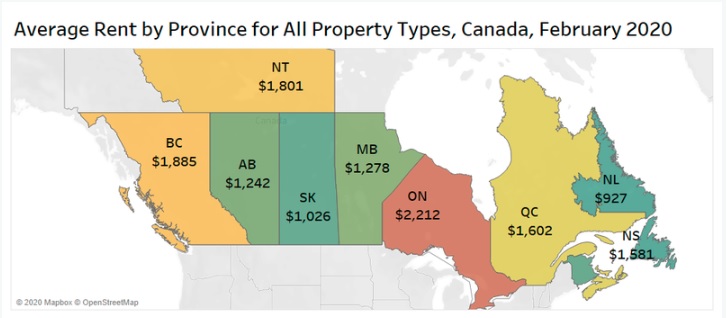
On a provincial level, Ontario had the highest rental rates in February, with landlords seeking $2,212 per month on average for all property types. British Columbia had the second highest rental rate at $1,885 per month, while Newfoundland and Labrador had the lowest at $927.  With the exception of Quebec, all provinces experienced a month-over-month decline in average rents between January and February.

rental market Feb 2020

Given the unprecedented events of March 2020, what will this month’s data look like?

“Following two years of high rent growth in Canada outside of the commodity-driven markets, rental rates have softened considerably in 2020,” said Ben Myers, president of Bullpen Research & Consulting. “In the face of a global health crisis, the number of people making major life decisions, like moving or changing jobs, will be significantly reduced and landlords will have to decide to either lower rents, offer incentives, or simply wait and hope for some return to normalcy in a couple of months.”

Tenants adhering to social distancing and self-isolation practices are required to remain at home for the foreseeable future, indicating we won’t be seeing the usual shift between tenancies that the spring months typically bring.

Additionally, immigration will temporarily grind to a halt while the borders remain closed throughout the state of emergency. Some young adults living at home, or who’d been planning a move for a job or school are now stuck, not knowing when school will resume and when, or if, their employment will start.

“We are going to see a drop-off of walk-in showings for apartments across Canada during the Covid-19 pandemic,” said Matt Danison, CEO of Rentals.ca. “Landlords and property managers will need to embrace virtual leasing as much as possible to keep their staff and potential renters safe during this difficult time.”

For the complete report, click here: https://rentals.ca/national-rent-report

Property funds possess stabilizing mechanisms

REALPAC’s recent survey of 15 Canadian open-end real estate funds offers insight into when and why fund administrators would suspend the ability for investors to redeem their holdings. It’s a step that some property funds based in the United Kingdom have taken as the COVID-19 outbreak triggers economic uncertainty and market volatility. Twelve of the 15 Canadian funds have the same ability to deploy redemption gates.

“The ability to gate or suspend redemption is an important mechanism that general partners have to address a possible max exodus at a time that may have long-term repercussions for the fund,” accompanying commentary from REALPAC states. “Redemptions can be suspended, and have been numerous times globally, for a variety of reasons including market closures, cyclones, cyber-security incidents or difficulties in valuation of certain assets at a time of significant redemptions.”

Most recently, U.K. based property funds also suspended redemptions in the days following the June 2016 Brexit referendum results. The 2008 financial collapse and the September 2001 terrorist attacks in the United States have similarly spawned suspensions.

“The use of this mechanism is often to curb a possible contagion in the affected sector and diminish the impact it may have on financial stability,” the REALPAC commentary clarifies.

The investor profile revealed in REALPAC’s survey results is one heavily weighted to institutional investors. That’s unsurprising since open-end funds — private investment vehicles that typically hold long-maturity income-generating assets and allow for contributions and withdrawals on an ongoing basis — are considered well matched to investors with long-term needs for stable, predictable returns.

The 15 open-end funds responding to REALPAC’s survey report a varying schedule for, and limits on. redemptions. However, conventionally, it’s not a routine practice for investors. Just six funds reported redemptions in the three years of 2016 to 2018.

Five funds provide a quarterly window for redemptions, while four funds allow monthly redemptions and three permit daily redemptions. Alternatively, two funds restrict it to a onetime annual opportunity, while the remaining fund applied the specifics outlined in the limited partnership agreement.

More than half of the Canadian funds set no threshold for the value of withdrawals. The other seven reported seven different formulas for allowable redemptions, including stipulated percentages of net asset value (NAV), assets under management (AUM) or the requesting limited partner’s own holdings.

Meanwhile, new analysis from Colliers Canada concedes that economic prospects have altered dramatically in the past few weeks, but concludes that real estate is better poised than many investment asset classes to weather the storm. Rather than fear of investors checking out, analysts expect to see them eventually migrate to the sector. They cite the recent slashing of interest rates, real estate’s track record as a stable asset in times of turmoil and heretofore Canadian market fundamentals as reasons for guarded optimism.

“In particular, weak expected returns in many other sectors should drive capital to commercial real estate (both direct investment and public real estate equity) and the low interest rates should allow investors to lock in favourable financing rates to expand their real estate portfolio,” the Colliers report projects. “Given the recent strength of the underlying fundamentals of the Canadian commercial real estate market, it is anticipated the effects of COVID-19 on the market will be temporary and significantly shorter than those of past financial credit crises.”

That said, some hurdles are foreseen in the interim. “First among the concerns are the short- and long-term impacts the pandemic could have on underlying property fundamentals and returns, including constraints in supply chain, consumer spending, business investment, hospitality and international trade,” the Colliers report tallies.

Senate of Canada Building wins Civic Trust Award

Diamond Schmitt Architects and KWC Architects have received the highest recognition from the Civic Trust Award for the Senate of Canada Building.

The award recognizes projects that make an outstanding contribution to the quality and appearance of the built environment. “Award level schemes demonstrate excellence in architecture or design, whilst being sustainable, accessible and provide a positive civic contribution,” the program said in a statement. The Senate is the only project in Canada to win the award.

The Senate of Canada Building opened in 2019 as the interim home to the upper house of Parliament while Centre Block is refurbished. Ottawa’s landmark Beaux-Arts central train station (1912) has been restored, renewed and reimagined to accommodate the Senate with a modern architectural language that both complements and contrasts the celebrated features of the original building.

“A bold re-use of an old building which recognises the gravitas of the original can be repurposed for social and environmental benefit, with a strong identity and a real architectural clarity,” remarked the judges in their comments.

“The historic fabric is refurbished and revealed and stands in comfortable juxtaposition with modern interventions. A breath-taking restoration project with highly refined new build intervention which knits into the existing architecture with serious skill,” they added.

Formerly the Government Conference Centre, the building required a complete overhaul of major building systems as well as compliance with seismic codes, accessibility, and life safety upgrades. Two committee rooms have been inserted into the monumental and finely detailed General Waiting Room while the Concourse now houses the Senate chamber. Offices and public space are added to a building that had largely been off limits to the public for 50 years.

“This project provided a remarkable opportunity to investigate and engage in a range of design innovations to introduce a new program in a historic building and to and convey Canadian identity through contemporary interpretations of landscape and iconography,” said Martin Davidson, principal, Diamond Schmitt Architects.

Ontario groups call for jobsites to stay open

The Provincial Building and Construction Trades Council of Ontario, the Construction Employers Coordinating Council of Ontario, the Council of Ontario Construction Associations and the Construction and Design Alliance of Ontario have issued a joint statement calling for jobsites to be kept open during the COVID-19 pandemic.

“With the ever-evolving situation concerning the Coronavirus also known as COVID-19, we are advising that construction worksites in the province of Ontario remain open and that the appropriate preventative measures be implemented and enforced on every construction worksite in the province,” the release stated. 

The four organizations call on the Ministry of Labour, Training and Skills Development to enhance its enforcement activities to ensure compliance with the requirements outlined below.

The following are preventative steps everyone should be taking now:

  • If you are feeling sick, do not go to work or if you’re at work and feel sick, go home
  • Don’t shake hands when greeting others.
  • Try to stay three to six feet away from others in gatherings, meetings, and training sessions.
  • Avoid contact with sick people.
  • Avoid touching your eyes, nose, or mouth with unwashed hands.
  • Clean your hands often by washing them with soap and water for at least 20 seconds or using an alcoholbased hand sanitizer that contains 60%–95% alcohol.
  • It is especially important to wash hands after going to the bathroom, before eating, and after coughing, sneezing or blowing your nose.

Construction industry employers should also:

  • Stagger work breaks (including lunch) to ensure social distancing in the workplace.
  • Provide access to soap and running water on all jobsites for frequent handwashing.
  • Provide the appropriate hand sanitizer when soap and running water are impossible. Plan for office staff to have the ability to work from home.

The IUOE Local 793 supports the call to keep jobsites operating. “A prolonged shutdown would have a negative impact on members’ benefits, pension and training funds, as they rely on contributions to be able to administer and provide the level of benefits we currently enjoy,” said Mike Gallagher, business manager of IUOE Local 793 in a statement.

“While a short ‘pause’ could be managed, any shutdown of our industry without corresponding government support of pension, benefits and training funds would inevitably lead to reduced benefits and training delivery. Our members’ health and safety are our first priority, and employers and the Ministry of Labour need to step up and enforce safe workplaces and best practices.”

Concern is growing across the country with reports that many construction sites are not following proper protocols on hand hygiene and social distancing designed by health authorities to try to slow the transmission of the virus that causes COVID-19 disease.

The decision to shut down (or not to shut down) the construction industry will be guided by Ontario’s Chief Medical Officer of Health in consultation with the appropriate government authorities, construction employers, and the Building Trades Council.


B.C. construction sites open but with restrictions

The B.C. provincial health officer has clarified that the order concerning mass gatherings during the current COVID-19 pandemic does not apply to industrial sites which include construction sites.

“For now, this means construction sites remain open with additional health and safety precautions in place,” said VRCA president Fiona Famulak, adding that the association is planning to host a conference call in the coming days for members to share the steps they are taking to keep their workers safe during this pandemic.

While this order does not apply to construction sites as a whole, the public health officer is directing employers to take all necessary precautions to minimize the risks of COVID-19 transmission and illness to themselves and their employees. This includes:

  • There should be no more than 50 people in the same space in any circumstances.
  • Where possible, employees should maintain a distance of two metres apart from each other.
  • Post signage that limits the number of occupants in any elevator to four people at a time.
  • Reduce in-person meetings and other gatherings and hold site meetings in open spaces or outside.
  • Increase the number of handwashing stations and post signage that identifies their location.
  • Maintain a list of employees that are currently working on sites and update this list daily.
  • All common areas and surfaces should be cleaned at the end of each day. Examples include washrooms, shared offices, common tables, desks, light switches and door handles.
  • Anyone with COVID-19-like symptoms, such as sore throat, fever, sneezing or coughing, must self-isolate at home for 14 days.

Section 4.85 of the Occupational Health and Safety Regulation does provide for a minimum standard around the provision of washrooms and hand washing facilities. Where plumbed facilities are impracticable, employers must provide access to portable washroom and hand-washing facilities. Those facilities must be maintained in good working order and must be provided with the supplies necessary for their use.

The Homebuilders Association Vancouver also received confirmation from the Council Of Construction Association of BC that WorkSafeBC is NOT contemplating shutting down worksites in B.C.

Employers should reassess their work environment every day and keep updated with the information posted on the Province’s website: www.gov.bc.ca/COVID19.


Realtors urged to consider open house alternatives

The Toronto Regional Real Estate Board (TRREB) is asking its realtors in the Greater Toronto Area to stop conducting in-person open houses for the time being and consider virtual alternatives.

“Realtors are reminded that there are alternative online and virtual marketing opportunities for sellers that can easily be accessed by buyers,”  said TRREB CEO John DiMichele. “We encourage members to use alternative marketing strategies such as video and virtual tours wherever possible, and to continue to follow directives and guidance being given by the government and public health agencies.”

TRREB will be suspending open houses on its Stratus MLS system and its public facing websites until it is safe to restore, and will also not enforce its MLS R-345 dealing with showings and inspections while the current government health advisories remain in effect. Property listings on the MLS system will not be suspended because a property is not available for showings or inspections, which is what the rule requires.

“We’re at a critical phase with this pandemic and we all have to do our part to be successful in confronting this challenge in order to protect the health and safety of realtors, their clients and the general public,” urged TRREB President Michael Collins.

To assist with best practices, realtors can access resources here.

REALPAC steps up as COVID-19 cultural influencer

A newly launched online portal will provide REALPAC members and the wider commercial real estate sector with resources and timely updates of Canada’s evolving policy response to COVID-19. Fittingly, a currently posted update points to Prime Minister Justin Trudeau’s plea for “cultural influencers” to get involved — a role REALPAC fulfills as an organization representing most of Canada’s largest real estate companies, funds and institutional investors.

“We thought it would be valuable to log an at-a-glance summary of daily major policy updates and briefings not just for our members, but for the general commercial real estate industry,” explains Minakshi Pai, REALPAC’s director of marketing and communications. “We publish updates multiple times a day and keep the page open to the public.”

Ontario landlords call for more support amid crisis

The Ontario Landlords Association (OLA) is calling for more support for rental housing providers as the COVID-19 state of emergency persists and the moratorium on evictions continues into the foreseeable future.

Adding to the growing list of landlord concerns, organizations such as ACORN are asking for a temporary rent-free period for all renters and an immediate freeze on all rent rates.

“Mortgage deferrals are great for homeowners, but what about tenants?” Marva Burnett, president of ACORN Canada, said in a statement. “We’re in the middle of the worst housing crisis in North America and now people are scared to work or get laid off. We need a rent break or families are going to end up homeless when this is over.”

But, as OLA points out, landlords aren’t seeing any reprieve from monthly mortgage payments either, given that investment properties do not meet the deferral criteria currently set out by lenders.

To address the issue, OLA has reached out to the Ford Government with several recommendations it feels would benefit cash-strapped landlords and renters equally: one being to expand Toronto’s rent bank to cover the whole province; another being to make social housing available to those who can’t make their rent payments.

Meanwhile in Toronto, Mayor John Tory is expected to announce new measures stemming from his discussions with large residential building owners and apartment industry advocates, as well as earlier talks with Toronto Community Housing Corp.

Stay tuned as we update this ongoing story.


Fragrance lobby touts role in COVID-19 response

The Fragrance Creators Association, representing developers and manufacturers of fragrances and scents used in cleaning products and sanitizers, is touting its status as an essential industry in the response the COVID-19 outbreak in the United States. The organization has appealed to federal, state and local officials for exemptions from any mandated business closures, arguing that the industry provides important support for effective cleaning procedures.

“Fragrance is a critical formulation input into cleaning and sanitizing products,” a recent statement from the association maintains. “In addition to imparting scents that encourage proper use, fragrance technologies also work to mask unpleasant odours that could discourage use.”

In a lengthy open letter to public officials, Fragrance Creators president and chief executive officer Farah Ahmed set out an argument for the industry’s continued full production, and outlined the protocols in place to safeguard health and safety of workers and the general public. Currently, the industry makes an estimated USD $22.4 billion annual contribution to the U.S. economy.

This comes with the plea: “That federal and state governments act expeditiously to coordinate a unified, clear, and public framework that clearly explains that fragrance and consumer goods manufacturers are exempted from the gathering bans and curfews that are starting to take effect. Moreover, that the employees working at these facilities should be clearly exempted and encouraged to continue to work while healthy.”

Steps for a solid concrete repair plan

As many condominiums built in the late 1980s near or surpass their 30th birthday, managers are facing issues related to failing roof slabs and garage membranes. Forecasting for repairs or replacements is usually included in the corporation’s reserve fund study, but that is only the first step toward a solid strategy that will streamline costs and minimize physical disruption.

Traditionally, dealing with leaks in an underground garage meant considering a plan for complete membrane replacement. Unfortunately, such work would involve removing everything above the membrane which, in all cases, would require the removal of landscape elements such as asphalt paving, concrete walkways, retaining walls, and all trees and shrubs. This can be a traumatic process for residents; one day they are looking out to a leafy courtyard filled with wildlife, decades-old trees, and dappled shade, and the next they’re staring into an empty and lifeless space. Moreover, any semblance of the existing hardscape might be lost due to the usable space being cordoned off for construction.

Preserving landscapes

More up-to-date methods of underground garage repair exist that can result in fewer disruptions and lower costs. For example, condo property owners/managers might consider hiring a membrane consultant who specializes in technology related to repair of the expansion joints of the original garage slab rather than the entire slab and membrane. They may also benefit from working with a consultant team that includes a landscape architect to develop short and long-term repair strategies over a 10- to 15-year period. This approach could see the preservation of existing landscape areas and an extended period of enjoyment before demolition is required.

And then, in some cases, it’s better to eliminate certain species of trees and landscapes that have been ill-maintained sooner than later. In the case of trees like Acer platanoides (Norway Maple), the root systems are notoriously bad for garage roof membranes and the garage slabs as well. Dealing with these fast-growing trees early into the process can pay off in the long run.

A master plan

When planning a concrete repair, it’s worthwhile to consider developing a long-range master landscape plan that includes replacement trees with root systems that will have less impact on the roof or garage slabs over time, as well as those which grow at a sensible rate, are sturdier in nature, and have higher aesthetic value for residents. Popular suggestions include Cercidiphyllum japonicum (Katsura tree), Quercus palustris (Pin Oak), and Pyrus calleryana (Callery pear).

Advanced planning to use hard surface treatments such as permeable concrete unit pavers are a sensible alternative to poured in-place concrete or asphalt. Unit pavers are manufactured to a very strong comprehensive strength which makes them easily removed, stacked, and re-installed, and they can last for decades. Permeable versions of these pavers are also a plus where surface runoff can be dealt with in part through vertical percolation of rainwater, rather than overwhelming catch basin and storm sewers during the new norm of torrential downpours.

Having a master plan is also the first step towards developing a set of working drawings that can be put out to tender. This can be done informally and in such a way that actual costs can be assembled for short and long budgeting. Reserve fund analysis can only go so far in assembling such budgets as the math used to arrive at line items in the Study are usually formulaic and subject to great variances.

Lastly, employing new membrane and roof slab waterproofing and drainage techniques will create new structures that will have a 30- to 40-year lifespan.

Preserving the view

Significant property repairs don’t always have to come at the cost of a nice view. Putting some forethought into the repairs and considering alternate approaches can ensure long-term value for your landscape and, in turn, your asset.

Kent Ford is founder and principal of Kent Ford Design Group Inc., a Toronto-based landscape design and project management firm (www.kentforddesign.com)

Sienna Senior Living issues COVID-19 statement

With Canada’s elderly citizens being most at risk of COVID-19 complications, Lois Cormack, President and CEO of Sienna Senior Living Inc. issued a statement regarding his company’s continued measures to keep occupants safe.

“Our top priority at this time is the health and safety of our residents, employees and families,” he said. “I am incredibly proud of our team’s dedication and extraordinary work at this unprecedented time. Sienna has no known COVID-19 cases presently, however, we know that this may change, given the rapid spread of the virus. We are taking extensive measures to navigate this situation and have implemented numerous safeguards to protect residents and team members.”

With respect to the business impact of COVID-19, Cormack says he expects that occupancy in Sienna Senior Living’s retirement portfolio could be temporarily impacted, however, the company fundamentals remain strong.

Highlights include:

• Sienna’s strong balance sheet, ample liquidity and healthy payout ratio are expected to continue to support the dividend payments to our shareholders;
• It is important to note that 56% of Sienna’s portfolio is long term care, which receives full funding for vacancies caused by temporary closure of admissions due to an infectious outbreak, including COVID-19;
• Sienna is working extensively with sector associations, peers and all levels of government agencies to navigate this situation together; and
• The Government of Ontario has allocated $50 million in emergency funding for long-term care and $5 million for retirement residences to help cover extraordinary costs related to the prevention and containment of COVID-19.

“I want to express my sincere admiration and gratitude to our team members and the many dedicated health care workers and all other essential workers who are going to work every day to meet the basic needs of our society, when the rest of the world is able to stay at home,” he said in closing.

Mainstreet CEO joins new Alberta advisory council

To cope with the economic fallout of COVID-19, the province of Alberta announced  that it has unveiled a new Alberta advisory council that includes former Prime Minister Stephen Harper and Bob Dhillon, CEO of Mainstreet Equity Corp, among other notable members.

Led by economist Jack Mintz, the 12-member panel will be advising Premier Jason Kenney on issues surrounding the province’s economic recovery as it grapples with a severe downturn caused by the rapidly spreading virus and slumping energy prices.

“I was honoured to join other Albertans, including former Prime Minister Stephen Harper in being appointed to Premier Jason Kenney’s Economic Recovery Council,” Bob Dhillon commented via Twitter. “We face a challenging time, but we believe Alberta will pull through this stronger than before.”

Other business leaders on the Alberta advisory council include:

  • WestJet co-founder Clive Beddoe
  • ATCO chief executive Nancy Southern
  • Mac Van Wielingen, founder of ARC Financial
  • Brent Blezberg, founder of TorQuest Partners
  • Chris Fowler, CEO of Canadian Western Bank
  • Kevin Uebelein, CEO of Alberta Investment Management Corp.
  • Bob Blakely of Canada’s Building Trades Union
  • Zainul Mawji, president of Telus Home Solutions
  • Peter Kiss, president and chief executive officer of Morgan Construction and Environmental

HVACR technicians adhere to health protocol

The Heating Refrigeration and Air Conditioning Institute (HRAI) is assuring Canadian consumers that they can count on service for critical building, business and home systems, and that technicians will strictly adhere to Health Canada protocol to protect the public and themselves. A newly released message underscores the role the industry plays in the viability of indoor environments and in safeguarding food, medical supplies, data and other strategic services.

“During this time of self-isolation, quarantining and increased hospitalization, it is critical that heating, ventilation, air conditioning and refrigeration systems continue to operate effectively to ensure that everyone has access to heating and cooling as well as food supplies and healthcare services,” it states.

It outlines the measures HVACR technicians will undertake to gauge the health safety of any host property before they enter it, and to ensure safe conduct and interaction while completing any installation or service call. Technicians will be required to wear masks and gloves while on site, stay at least two metres apart from others and to disinfect all surfaces before and after working on them. Fleet vehicles will also be regularly cleaned and disinfected.

In turn, all clients must provide information about any building occupant who has travelled outside of Canada within the previous two weeks, is experiencing symptoms or has come into contact with someone who has tested positive for COVID-19.

“Responsible contractors will work with their customers to ensure that all concerned are protected while restoring HVACR systems to proper operation,” it pledges. “HRAI is working with its members to ensure they are appropriately informed and prepared to address these situations as they occur.”

Meanwhile, the organization has cancelled all in-person training courses until at least April 17, but has rolled out a virtual classroom of online training and education opportunities. The biennial Canadian Mechanical & Plumbing Exposition (CPMX) originally slated for the Metro Toronto Convention Centre, March 25-27, has been postponed.