



Articles Archive - Page 354 of 928 - REMINET
REMI

North Vancouver home combines past and future

This North Vancouver home by Michael Green Architecture (MGA) combines the character and heritage of the past with the innovation and sustainability needs of the future. The owners of the craftsman bungalow, originally built in 1912, envisioned a home that reflected the history of its location and of their 20 years living there as a family, while being functionally and visually inspiring and highly energy efficient.

Over three years, the house was transformed by the MGA team into a modern, energy efficient home that retains its history and character. This was the first Passive House Plus certified home in the Lower Mainland of B.C., a standard which requires ultra-low energy consumption with up to 90 per cent reduction and is a step further than the internationally recognized Passive House standard. Meeting the requirements of Passive House Plus is a challenge, and in a renovation these challenges add another level of complexity to every aspect of the design.

The existing construction was restored to preserve the heritage and materials of the house, with elements of the original structure, façade, and wood windows conserved and improved to improve efficiency. Old growth fir from the deconstructed portion of the building was repurposed to create customized millwork, furniture and a striking feature chandelier.

A high-performance envelope, including triple-glazed windows, was hidden behind the heritage exterior of the north half of the house, while contemporary elements appear throughout with the south portion of the house, exemplifying dramatic, modern architectural design.

The new element of the house is a simple modern volume that reflects and complements the form and character of the existing bungalow. A dramatic cantilever of the roof provides a large covered balcony that wraps the master bedroom. This entire volume is clad in “shou sugi ban”, or charred cypress siding. This traditional Japanese method of treating wood creates a beautiful and rich texture and provides an inherent treatment to the material that increases the weather resistance and prevents rot and insects, while also reducing the need for additional finishes like paint or stain.

The interiors were designed to honour the character and history of the existing home and connect it with the new extension. A simple palette of natural wood and white materials was chosen, along with bespoke built-in storage and minimalist lighting to provide a ‘canvas’ for the owner’s collection of artwork, while an open plan layout and chef’s kitchen allow them to host large gatherings for family and friends.

The completed home sets an example of how existing structures can be preserved and updated and serves as a benchmark for future Passive House Plus projects.

Photos: Ema Peter 

HRAI report: heat pumps save money and lower GHGs

Heat pumps can provide significant cost savings in the effort to decarbonize Canada’s building sector. According to a report by Heating, Refrigeration and Air Conditioning Institute of Canada (HRAI), the technology can significantly reduce the cost of electrification. The study was done by Dunsky Energy + Climate Advisors, a firm with extensive knowledge of the North American energy marketplace.

“For many years, experts in the field have known that ground-source heat pumps (GSHPs) offer considerable energy cost savings to Canadians while reducing carbon emissions and contributing to Canada’s fight against climate change. This report clearly shows that, in addition to these savings, the technology has unique attributes that could deliver many billions of dollars in savings to the electricity grid,” said Sandy MacLeod, HRAI president and CEO.

The report found that a reasonably ambitious adoption rate of ground-source heat pumps over the next few decades could save Canadians between $49 and $148 billion in avoided electricity system development investment costs – investments that would otherwise be required as part of the country’s GHG emissions reduction plans.

The net benefit to the electricity grid (in avoided investment costs) will amount to approximately $40,000 per installed GSHP system. That number represents the societal benefit, over and above the household-level energy cost savings and after allowing for the initial costs of installation.

But while all Canadians will benefit from these savings, only a small fraction – those that choose geothermal for their homes and buildings – are asked to pay the up-front costs.

“Governments and utilities have every reason to invest in accelerating geothermal heat pump adoption,” said Philippe Dunsky, president of Dunsky Energy + Climate Advisors. “Our modelling finds that across the country, doing so can significantly reduce the cost of achieving our ambitious climate goals.”

The report recommends that, to realize these benefits, governments, utilities and electricity system planners need to implement policies that would counteract the misalignment of who pays and who benefits and support ground-source heat pump adoption.

The study finds that through an optimal mix of policies aimed at increasing GSHP adoption could create a triple-win situation for Canadians: lower costs, increased GHG reductions from space heating, and a better alignment of costs and benefits.

Edmonton’s Borden Park named Canada’s Best Restroom

Cintas Corp. has named the restrooms at Borden Park in Edmonton, Alta. as the winner of its Canada’s Best Restroom Award.

The award, which celebrated its 12 year this year, honours businesses that value hygiene and style and recognize the parallel between clean restrooms and customer retention.

The Borden Park facilities were designed as a single-level pavilion surrounded by highly reflective glass and feature a stainless-steel trough-style sink that prevents splashing, as well as hands-free fixtures to reduce the spread of germs.

The facility beat fellow nominees Toronto Zoo, Surrey Park, Red Deer’s Sweet Market Esso Station, and Calgary’s The ROOFTOP bar.

“Public washrooms play an important role for people who are on the go, but this contest proves not all facilities are created equal,” said Candice Raynsford, Cintas Canada marketing manager. “Borden Park prioritized providing a clean and inviting washroom, and the public showed their appreciation by voting them Canada’s Best Restroom.”

As the grand prize winner, Borden Park will receive a Cintas UltraClean® system and CAN$2,500 worth of services from Cintas as well as enshrinement in Canada’s Best Restroom Contest Hall of Fame.

The 2020 winner of Canada’s Best Restroom was also from Alberta: Westview RV Park.

To learn more, visit www.bestrestroom.com/canada.

BMO pledges $12 billion in financing toward affordable housing

BMO announced it will commit $12 billion in financing toward the development or refurbishment of housing that meets accredited affordable housing definitions in regions across Canada. This financing will help enable clients to purchase, develop, renovate and maintain affordable housing, social housing, community housing, shelters and housing for vulnerable populations.

“We’re proud to support CMHC’s vision while aligning strongly with BMO’s Purpose to Grow the Good by committing $12 billion to economic and social inclusion through affordable housing,” said Sharon Haward-Laird, General Counsel and Co-Chair of BMO’s Sustainability Council, BMO Financial Group. “Investing in housing for all Canadians means removing barriers that exclude so many from a better life.”

Part of BMO’s commitment will support the financing of affordable housing and infrastructure projects that increase access to housing and promote economic development for Indigenous Peoples, both on and off-reserve.

“We are truly pleased to have BMO join us in our efforts to create a new generation of housing in Canada. Safe and affordable housing is a basic need to create a more inclusive society,” said Romy Bowers, President & CEO, CMHC. “Governments alone cannot solve Canada’s housing challenges. The private sector also has a role to play in building strong, vibrant communities for all. I hope commitments such as this one from BMO today inspires more companies to help us achieve our goal of housing affordability for everyone living in Canada.”

BMO’s commitment will be managed by its Sustainable Finance Group, with eligible projects including lending, investing and underwriting solutions for retail, commercial and corporate clients involved in originating and funding affordable multifamily mortgages, as well as financing provided to affordable developments through BMO’s partnership with Options for Homes and other programs.

Increasing access to affordable and quality housing aligns with BMO’s commitment to build a more inclusive society. This ten-year commitment enhances housing accessibility in Canada and aligns with the bank’s prioritization of affordable housing in the U.S. through its Community Reinvestment Act funding that includes community development investments, community development loans and mortgage loans.

BMO’s Sustainable Finance Group brings together capabilities from across the bank to mobilize financing for a sustainable future. The Sustainable Finance Group is responsible for raising capital and providing finance for clients pursuing sustainable outcomes, offering advisory services, and managing BMO’s Impact Investment Fund.


VRCA celebrates 2020/21 Silver Award winners

The Vancouver Regional Construction Association (VRCA) is celebrating its finest member companies with its annual Awards of Excellence.

The VRCA has announced the 2020 and 2021 Silver Award winners in 15 categories , featuring industrial, commercial and institutional projects across the province.

“Judging the Awards of Excellence this year was an extraordinary experience,” said Bob Proctor, chair of VRCA’s Awards of Excellence Committee. “The pandemic brought endless challenges, affecting people and their livelihood, creating an unstable economy and causing the cost of materials to soar. Despite these challenges, our industry prevailed and delivered many remarkable projects.”

A total of 93 winners were selected by the association. For 2020, there are 43 Silver Award winners. For 2021, there are 50 Silver Award winners.

Submissions include hospital redevelopment and expansions; transit station upgrades; university and high school projects; infrastructure enhancements; and tenant improvements to restaurants, office, and retail spaces.

“The VRCA’s Awards of Excellence Committee is always impressed with the innovation and methodology behind the complex and demanding projects our members take on. The presentations we received this year are nothing short of amazing. We applaud the membership for incorporating sustainable materials and technologies that enhance the quality of projects and drive value to owners. Congratulations to both 2020 and 2021 Silver Award Winners!” said Proctor.

For 2021, winning projects include the Clayton Community Centre, Vancouver House, SFU Plaza Renewal, PH1 and McLoughlin Point Wastewater Treatment Plant.

VRCA

For 2020, winning projects include Penticton Regional Hospital, Joyce-Collingwood SkyTrain Station, North Surrey Sport and Ice Complex and Air Canada L4 Signature Lounge.

“On behalf of the association, it is my honour to recognize those in our industry who are going above and beyond for our community,” said Donna Grant, VRCA president. “These individuals and companies are passionate leaders committed to making a difference.”

All Silver Award winners will be recognized at the Awards of Excellence Gala October 19, 2021, at the Vancouver Convention Centre West. Gold Award winners in their  respective category will be selected from Silver Award winners and will be announced at the Gala.

The full list of winners can be viewed here. Look for coverage of the winners in the November/December issue of Construction Business.

Design contract awarded for Surrey riverfront park

A multidisciplinary consulting team led by space2place design has been awarded the design services for phase one of the Nicomekl Riverfront Park in Surrey.

Phase one includes the development of the Hadden Mill and Oxbow zones, which are on the south side of the Nicomekl River adjacent to King George Boulevard.

The Nicomekl Riverfront Park will be developed over multiple years as a multi-phased project. When complete, it will be a 3km long, 80-acre riverfront park incorporating ecology, heritage, public art, recreation, infrastructure and innovative adaptations to climate change and sea level rise.

The Nicomekl Riverfront Park is also one of 13 Surrey project components to be partially funded through the Government of Canada’s Disaster Mitigation and Adaptation Fund (DMAF), a program to help communities build the infrastructure they need to better withstand natural hazards such as floods, wildfires, earthquakes and droughts.

“Nicomekl Riverfront Park will provide Surrey residents with increased opportunities to get outdoors and enjoy nature while enhancing ecology and habitat connectivity and also addressing the impacts of sea level rise and climate change,” said Mayor Doug McCallum. “By investing in nature-based green infrastructure now, we are protecting our community, economy and environments from future flood risks. We thank the Government of Canada and the many partners who are supporting this important project.”

In 2019, the city secured $76.6 million in federal funding to supplement a series of projects to reduce Surrey’s coastal flood risk and adapt to sea level rise. $4 million has been allocated to the Nicomekl Riverfront Park project.

“As part of our collective actions against climate change, it is important that we invest to protect communities from extreme weather conditions, such as flooding and other natural hazards,” said the Honourable Catherine McKenna, Minister of Infrastructure and Communities.

“The Nicomekl Riverfront Park is a great solution to increasing Surrey’s resilience to flooding while also enhancing the area’s unique ecological features in response to the aspirations expressed through public consultations in 2018 and 2019 by local residents and First Nations.”


ARCSI Learning enjoying increased adoption

Less than a year ago, the Association of Residential Cleaning Services International (ARCSI) introduced its online learning and training portal, ARCSI Learning, for residential cleaning companies.

To date, the portal has successfully registered nearly 600 cleaning professionals to take ARCSI’s Professional House Cleaning (PHC) certification course, and over 230 now hold PHC certification from ISSA.

Due to high demand, ARCSI also now offers the certification in Spanish in addition to English.

“We’re thrilled to see the overwhelming support and excitement for this program from residential cleaning companies, their employees, and their customers,” said Erin Lasch, ARCSI Program Manager. “To succeed as a professional cleaning provider today, it’s essential to not only believe in the science behind cleaning, but to understand it and utilize that knowledge. We aim to continue growing this program to reach residential cleaning professionals around the world.”

The ARCSI Learning portal includes two key courses:

  • PHC certification
  • COVID-19: What House Cleaning Professionals Need to Know, approved by the Global Biorisk Advisory Council (GBAC)

Residential cleaning company owners have access to assign courses to staff, monitor their progress, and ensure completion. ARCSI also provides members access to regular educational webinars, as well as a library of previous webinars.

Additionally, ARCSI provides PHC-certified companies with a comprehensive marketing toolkit to help promote the achievement among its own staff members and to current and prospective customers.

“The way we approach cleaning has forever changed, so it’s important that our members invest in and showcase their skills,” added Lasch. “We look forward to helping more cleaning professionals reach their potential and help us change the way the world views cleaning.”

For more information about ARCSI Learning programs, visit arcsi.org/arcsilearning/.

Cleaning & disinfection reaping reward in consumer confidence

The enhanced focus on cleaning and disinfecting for health that has been brought on by the COVID-19 pandemic looks to have paid off when it comes to increasing consumer confidence.

That’s according to a new survey from GP PRO, which has found that almost half (48 per cent) of respondents began heading away from home to take part in various activities over the previous 60 days.

Of that group, who visited facilities like reopened retail shops, restaurants, and other businesses, one-third (32 per cent) cited the clear and obvious sustained efforts that businesses have made to provide a safe and hygienic environment as one reason they are more confident in leaving home.

RELATED: Providing cleanliness and confidence in the workplace

“Consumers are now taking to the streets with renewed confidence, and businesses deserve credit for making health and hygiene a priority and, as a result, playing a role in consumers re-engaging in the everyday activities they avoided for the better part of the past year,” said Michelle Auda, GP PRO senior director of insights.

The survey found that 61 per cent of respondents are participating in away-from-home activities at the same level as they were before the pandemic. Of that proportion, 31 per cent are still taking virus-related safety precautions such as wearing masks if required, while the other 30 per cent are taking such precautions whether required or not.

In the previous 60 days:

  • 74 per cent of respondents are doing in-store grocery shopping
  • 61 per cent have visited a drive-thru restaurant or coffee shop
  • 56 per cent are doing their retail shopping in-store
  • 50 per cent are socializing with close friends and family
  • 46 per cent have returned to indoor dining at a restaurant
  • 38 have gone to work in an office environment

RELATED: Canadians expect peak-pandemic cleanliness in the long term

This show a marked increase in confidence in returning to facilities.

In a similar survey GP PRO conducted in February, 15 per cent of consumers were avoiding activities such as shopping, going to a salon, or socializing with friends and family, compared to 7 per cent in the new survey. In addition, in the February survey, only nine per cent of consumers were participating in away-from-home activities with no safety precautions, and 19 per cent were engaging in such activities with precautions.

PoCo community centre on time, on budget

The new $132 million community centre in downtown Port Coquitlam is on track to be completed on time and within budget.

The 205,000-square-foot (19,000-square-metre) Port Coquitlam Community Centre (PCCC) is now in the final stretch of construction which began in 2017, with substantial completion planned for mid-September.

Built in phases to allow for continuous public service, the PCCC project has gradually replaced the aging recreation facilities and library in the city’s downtown with a vibrant community hub featuring new and enhanced amenities.

“It’s very exciting to finally be in the home stretch for this project – an incredible new recreation facility and community gathering place that will benefit our residents and serve our community for generations to come,” said Mayor Brad West.

“Since 2017 there has been a concerted effort to make sure construction of this important city asset has stayed on track and on budget, and we have achieved that despite the unprecedented challenge of a world-wide pandemic. It’s a testament to the hard work and focus everyone involved has brought to this project. I have no doubt that once fully open, with all of the amenities and services available, our community will be incredibly impressed.”

Phase 1 of construction, from spring 2017 to spring 2020, focused on the north half of the site and included two ice arenas, a leisure pool, state-of-the-art fitness centre, library, Wilson Lounge and kitchen, games room, multipurpose rooms, offices, reception and concession.

Phase 2, primarily focused on the southern half of the site and nearby roadworks, began in fall 2019 and is scheduled to wrap up by mid-September 2021. It includes: a third 790-seat arena; gymnasium, play rooms; north-side plaza and main entrance at Wilson Avenue and Mary Hill Road; south-side concourse with seating, lawn, multi-use sport courts, a spray park, playgrounds, walking path, outdoor fitness equipment and community gardens.

The city is constructing the project with design-build partner Ventana Construction and owner’s representative, Tango Management.

ASHRAE recognizes Canadian engineering students

Canadian engineering students are among the 33 winners of ASHRAE’s Society scholarships for 2021-22. The six recipients are pursuing studies at five different post-secondary institutions nationwide.

That includes two mechanical engineering students from Dalhousie University in Halifax. Erin Mackinnon received the USD $10,000 Willis H. Carrier scholarship, sponsored by Carrier Corp. and named in honour of the company’s founder. Hayley Knowles received the USD $5,000 Duane Hanson scholarship, established by Gayner Engineers, and similarly named for the company’s former president.

Yuna Oh, a mechanical engineering student at University of Waterloo, won the Lynn G. Bellenger engineering scholarship. The USD $5,000 award is specifically for a female undergraduate engineering student, and is named in tribute to and memory of ASHRAE’s first female president, who served in 2010-11.

Heather Ritter, an engineering student at University of Calgary, is this year’s Freshman scholarship winner, a USD $5,000 award for a student in the first year of engineering studies. Matthew Bigg, a student of Mechanical Engineering Technology – Building Sciences at Toronto’s Seneca College, received the USD $5,000 Engineering Technology scholarship.

Viktor Wozniak, an aerospace engineering student at Carleton University in Ottawa, received the $3,000 Ottawa Valley Chapter scholarship — one of four chapter-specific scholarships awarded in this round of announcements.

More than USD $2.25 million has been disbursed to more than 400 students through the Society scholarships over the past 30 years. Recipients must be fulltime students in a recognized program, meet a threshold grade point average, undergo an evaluation interview with an officer of the nearest local ASHRAE chapter and submit three letters of recommendation. Candidates are also assessed on financial need, leadership ability and work ethic.

Shift in priorities identified in new housing report

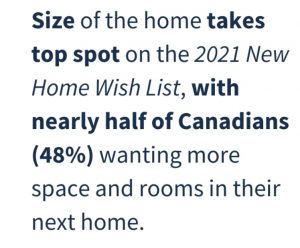
According to a new housing report from Finder, approximately 45 per cent of Canadians (14 million) are planning to buy or rent a new house or apartment in 2021 with millennials making up the majority (64%). Interestingly, more than a quarter of the Gen Z respondents (27%) said they intend to get a new rental this year, compared to just 1 in 10 Boomers.

In terms of what priorities and preferences are influencing Canadians as they consider their next housing move, the top five factors are: more space and rooms (48.3%); style and look of the home (48%); spacious backyard or outdoor space (43.8%); driveway or garage (43.7%); low-crime neighbourhood (38.1%).


“It’s understandable that with the unprecedented amount of time Canadians have spent in their homes, they are prioritizing factors like more space or rooms and outdoor space,” said Nicole McKnight, Canada PR Manager at Finder. “Other pandemic housing trends that will likely continue will be the desire for a home office.”

Other key findings from the housing report:

  • Millennials are most likely to want a bigger (52%) more stylish (49%) home with luxury details (23%) and they also care more than any other generation about having a home office (26%) and being near amenities (39%).
  • For Gen Z, it’s all about proximity to work (39%), transit (37%) and friends (35%).
  • Half of Boomers (50%) identified having a driveway or garage as the most important factor in their next home, while the other half (47%) said it’s living in a low-crime neighbourhood. About a quarter of Boomers (26%) also said they want to have a green or energy efficient home.
  • Gen Xers care more than any other generation about having a large backyard (47%).
  • Compared to men, women care much more about the style and look of the home (53% vs 44%), being in a low-crime neighbourhood (44% vs 33%) and having a spacious backyard (50% vs 38%).

For the full report, click here: 2021 New Home Wish List | Finder Canada

Who plays a role in managing vested interests?

Have you ever heard the director proclaim at the board meeting: “my son is an electrician and can do this job for free” or “I have a cousin who can do this for half price?”

What about situations where it is a little more complicated? For example, a stepson of the board’s president is a security guard working full time and the president has not disclosed this relationship to the board or otherwise. Should the president have disclosed it at all?

The board of directors for condominium corporations is accountable and responsible for millions of dollars in assets. Condominiums are lucrative investments, holdings and, for many people, their only homes. As a result, vested interests on the board of directors is a topic that often raises ire of many owners and prospective buyers. Stories of the “infamous three” who took control over downtown Toronto condos still plague the industry.

How do you resolve or mitigate such conflicts? Let’s break it down by role.

The role of the owner

Owners must always ask themselves what is in it for the director. Is there a potential direct or perceived conflict? Does it pass “the sniff test?”

With the amended Condominium Act, 1998 (the Act), owners have the right to request records with prescribed forms and deadlines. By regularly attending annual general meetings, owners are presented with the opportunity to receive updates on major renovation projects and ask questions.

Furthermore, the owners, if in doubt, should request the minutes of the meeting where such “conflicting” transactions were voted on. Has the director in question recused himself/herself from the vote and declared the conflict to the board at a duly called meeting? Section 40 & 41 of the Act clarifies the disclosure obligations for directors and officers of the corporation.

Lastly, and most importantly, owners should take the time and thoroughly acquaint themselves with the condo’s governing documents. If the conflict of interest on the board persists and the board does not meet the obligations under the Act, the owners should consider seeking professional legal advice, preferably from a lawyer well-versed in condo law.

The role of the condo manager

What If the manager discovers vested interests on the board? What steps can he or she take to facilitate a resolution?

Determine the client

Who’s the client? Is it the president who signed the management agreement and has a potential conflict of interest? Or is it the corporation itself?

Seek advice

When in doubt, the manager should seek advice of the supervising licensee or the principal condo manager. They can guide the board on their obligations under the Act and instill best industry practices to promote fairness and transparency.

Walk away

If the conduct of the board is of egregious nature, the manager should consider resigning and walking away from such conflict.

Ultimately, it is up to the manager to employ any of the above steps necessary to perform their fiduciary responsibility as agents acting in the best interest of the client—as long as they do so in accordance with the code of ethics outlined by Condominium Management Services Act, 2015 O.Reg. 3/18.

The role of the board

If a fellow member of the board is in a position of a conflict of interest, remaining directors should feel empowered to address the issue directly at a duly called meeting without personal repercussion. Any and all disclosure obligations must be met and recorded accordingly. If not, failure to do so may raise future accountability and liability issues.

To avoid this, the board should follow three simple guidelines:

1. Adopt a procurement policy for the corporation, which would list the proper bidding requirements.
2. If possible, engage a third-party minute taker to ensure that impartial record keeping is done. When in doubt, the board should consult the corporation’s solicitor on the disclosure obligations and compliance under the Act.
3. Exercise caution and awareness when the fellow director is an “industry insider” (e.g., regional manager of a major condo management firm, condo lawyer or developer’s affiliate).

Setting proper expectations for the “insider,” as well the board in general, reinforces the mandate that the board exists first and foremost to serve the best interest of the corporation and its owners.

In all cases, the mindset of equal vote and participation should be maintained.

Condos are complex entities. The mix of owners and boards is ripe for conflict and personal agendas. Perhaps one of the most valuable assets in maintaining this delicate balance between self and collective interests is the strength and integrity of the property manager.

A healthy board can only exist if fundamental practices in disclosures, procurement and transparency are maintained, and meticulous record-keeping is king.

Val Khomenko is the principal condominium manager for Regional Group, a full-service real-estate investment and management firm, based in Ottawa, Ontario. Val leads Regional’s condo team with 7+ years of experience in the condominium industry. He can be reached at 613-230-2100, Ext. 7409.


Can outdoor pests be sustainably managed?

Certain landscaping has implications on attracting or deterring pests and wildlife. How can condo corporations avoid choices that will apply pest pressures to their properties?

Ways to naturally deter pests

Landscaping creates ecosystems where different organisms interact and provides all the necessary resources for pests’ survival: food, water, and shelter. The goal is not to eradicate pest populations but to suppress them to lower levels, so pests don’t cause damage or become a nuisance.

  • Avoid planting trees or plants that produce bright coloured fruits such as berries, drupes, aggregates and seeds. When they ripen, the colours and aromas produced attract pests and small wildlife looking for food. When they fall and decay, it provides a breeding ground for flies.
  • Densely packed bushes, ground coverings and wall trailing vines at the base of your building invite unwanted pests with the promise of thick shelter. And, if you offer inviting shelter at the base of your building, cracks in the façade or any unsealed doors, windows or vents serve as entry points inside.
  • Install a one-metre-thick gravel strip, made up of one-centimetre pebbles, around the entire perimeter of your building to deter pests from taking shelter at the base of your building and finding a way inside. This is particularly important against ground-dwelling pests such as ants, centipedes, spiders, ground beetles and rodents that can burrow in building foundations.
  • Integrate pencil cedar mulch as much as possible instead of organic mulch, as cedar retains less moisture and naturally repels certain types of ants and subterranean termites.
  • Avoid planting brightly coloured and scented plants close to entryways or near pools, or recreation areas. When these plants bloom, they attract stinging insects or arthropods.
  • Inspect incoming landscaping materials, especially soils. Pests such as European fire ants, termites and other soil dwelling insects can be brought onto the property through landscaping supplies.
  • Select grasses that thrive in the appropriate climate of your building—cold or warm weather. This allows for pest-resistance with no significant pest damage.
  • Plant multiple species of grass to help offer diversity for both weather and pest resistances. Properly aerate your landscaping so plants can grow well and help shield against pests naturally.
  • A flower bed with dense shrubs or vines will attract rodents, wasps, birds, ants, beetles, aphids and wasps, as it offers shelter and food.
  • It’s imperative for all landscaping to be well maintained through proper pruning, lighting and watering so plants thrive, and pests will be deterred naturally.

Ways to maintain landscaping and hardscapes

Once you know what to plant and what to avoid, it is just as important to maintain it to continue relieving pest pressures from your building.

  • Ensure fountains and pools regularly circulate water to prevent insect breeding – still water is a magnet for insects like mosquitoes, midges, racoons, birds and skinks that need to actively drink water and bathe.
  • Change the water in bird baths or other water features at least once a week, and make sure patios and sidewalks have proper drainage to avoid water pooling.
  • Trim tree branches and shrubbery at least one metre away from all walls and windows to avoid creating a landscape bridge from trees and bushes to the building; make sure ornamental planters are not overwatered and well pruned.
  • Remove any tree branches that touch the roof of your building as carpenter ants, rodents, squirrels and raccoons will use these to climb.
  • Ensure grass stays mowed regularly as tall grass offers shelter to unwanted pests.
  • Monitor trees for insects. Trees can become damaged from too much pest activity, and if it is not caught quickly it is too late for the tree so proactive monitoring is crucial.

Using natural pest deterrents and proper maintenance of your landscaping will keep plants healthy so there will be less of a need to control pests with factors such as pesticides. Pollinators like butterflies and honeybees will thrive in these properly maintained natural ecosystems. When insecticides need to be used, your pest management professional will know how to apply them at the right times – when flowers are not in bloom, and at either dusk or dawn when bees and butterflies are less active. Educate tenants on what is being used and why to help address any concerns they may have on the matter. Post proper signage where applicable depending on the label requirements and local laws.

When managing your condo buildings, every detail should be considered. Landscaping choices can directly impact pest activity in and around your building, so it is important to always keep landscaping maintained as well as to know from the planning stages what plants may attract pests and which ones may help deter them.

Alice Sinia, Ph.D. is quality assurance manager of regulatory/lab Services for Orkin Canada, focusing on government regulations pertaining to the pest control industry. With more than 20 years of experience, she manages the quality assurance laboratory for Orkin Canada and performs analytical entomology as well as provides technical support in pest/insect identification to branch offices and clients. [email protected] or visit orkincanada.com.


Photo by Nataliya Vaitkevich

Consumers are still wild about disinfecting wipes

High demand for cleaning and disinfecting wipes has been a hallmark of the COVID-19 pandemic, and that demand doesn’t look like drying up any time soon.

More than a year after store shelves were empty of disinfecting wipes, the demand for wipes remains strong. A recently published survey by the American Cleaning Institute (ACI) found that 83 per cent of American households use cleaning, disinfectant, or antibacterial wipes at least once a week.

The online survey of more than 1,000 adults, conducted by international market research firm Ipsos on behalf of ACI in February, sought to determine if consumer cleaning and disinfecting practices established during the COVID-19 pandemic would continue.

The survey results found:

  • 92 per cent of respondents have used a cleaning, disinfectant, or antibacterial wipe
  • 29 per cent used a wipe product every day of the week
  • 52 per cent indicated they keep wipes in two or three locations around the house
  • 64 per cent cited effectiveness as the most important factor when deciding which type of cleaning wipe to buy
  • 62 per cent of respondents plan to continue pandemic-related cleaning behaviours for the health and wellness of others.

“Cleaning is caring,” said Brian Sansoni, ACI’s senior vice president of communications, outreach, and membership. “Proper use of cleaning and disinfecting wipes is a part of that process.

“Millions of Americans will continue to rely on these products as a part of their daily and weekly routines to help keep their households clean and safe. It’s important for wipe and cleaning product manufacturers to re-emphasize smart, targeted hygiene practices that focus on the safe, proper and beneficial use of their products.”

Other cleaning and disinfection practices popular during the coronavirus pandemic will likely remain for many Americans, found the survey. In particular, 50 per cent of respondents say they will continue to frequently disinfect high-touch surfaces.

“As we hopefully and eventually will put the pandemic in the rear-view mirror, it’s important for wipe and cleaning product manufacturers to re-emphasize smart, targeted hygiene practices that focus on the safe, proper and beneficial use of their products,” said Sansoni.

Amendments to the Residential Tenancies Act

Updates to the Residential Tenancies Act (RTA) are coming September 1, 2021, and Ontario landlords are advised to take note. The controversial Bill 184 — Protecting Tenants and Strengthening Community Housing Act, 2020 — came into effect in July 2020 to “modernize and streamline” the dispute resolution processes at the Landlord and Tenant Board (LTB) and keep vulnerable tenants in their homes during the pandemic. While some key changes were implemented last year, others will come into effect next month.

“Overall, the new RTA provisions will be helpful for small landlords when it comes to recoveries of utilities and financial losses,” observes Joe Hoffer of Cohen Highley LLP. “However, there is balance for tenants because remedies against non-compliant landlords have been greatly expanded.”

One significant change Hoffer points to is the ability for landlords to apply at the LTB for a judgment for arrears of rent owed by a former tenant up to one year after the tenant vacates the rental unit. Currently, an application of this type can only be made by way of Small Claims Court. “Landlords who wait until after September 1st to file for judgment can apply to the LTB,” Hoffer says, calling it “a less costly and more expeditious venue” in which to obtain the judgment.

New forms

Effective September 1, landlords will have just 30 days to integrate all new forms, including the L2 application needed to terminate a tenancy or evict a tenant. Hoffer urges landlords to make note of this important date to ensure the forms are fully operational by October 1.

“If a landlord were to apply for termination and eviction using the current L2 after October 1st, it’s possible the case would be thrown out,” he says. “L2s are of particular concern because the form is required when evicting a tenant for reasons beyond landlord’s own use, including conduct-based grounds like interference, illegal acts, impaired safety, and persistent late payment of rent.”

Additional requirements

As for N12s and N13s, applications to terminate for own use or repairs/renovations, soon the forms will come with additional requirements that landlords should be aware of.

“Beginning in September, applications must be submitted along with a statement by the landlord as to whether they have served any other N12 or N13 on any tenant with respect to any rental unit in their portfolio throughout the last two years,” Hoffer warns. “If the answer is yes, further details will need to be given—like dates, addresses, and tenant names, otherwise the application will be refused by the LTB.”

Hoffer says the Board may consider a landlord’s previous use of such notices in securing vacant possession. “It is our view that LTB members will by default infer a lack of bad faith in the issuance of such forms if the landlord is a frequent user of them and will therefore dismiss the application,” he says. “As such, landlords with applications going to the LTB based on the issuance of N12s and N13s should prepare a full disclosure of their use, and evidence of the good faith rationale for same. If the landlord can’t provide a justifiable rationale and evidence of good faith, there is a higher risk that the application will be dismissed.”

Recovering financial losses: the new L10

Landlords seeking to recover financial losses from former tenants, including losses from rent arrears, unpaid utilities, damage to the rental unit, or financial loss resulting from tenant conduct, will be able to do so via the “L10” form. However, unlike most applications at the LTB, the landlord rather than the Board will be required to serve it.

Furthermore, Hoffer notes that given the precise conditions won’t be known until the form is released in September,  landlords should retain records from rental applications and make every effort to secure forwarding addresses and email addresses of former tenants for the purpose of meeting the potentially difficult service requirements.

“With these changes to the Residential Tenancies Act fast-approaching, knowing what’s ahead will only help prudent landlords hit the ground running,” he says. “Be sure that all the changes are integrated into your operations by October 1, 2021, for best outcomes.”

For more information, visit: LTB | Backgrounder: Upcoming Amendments to the Residential Tenancies Act (tribunalsontario.ca)


GBAC launches Registered Tech & Programs

In what it calls an effort to help facilities around the world make it easier to vet the appropriate cleaning, disinfection, and infection prevention essentials, the Global Biorisk Advisory Council (GBAC), a Division of ISSA, has launched the GBAC STAR Registered Technology & Registered Programs.

The new offering allows manufacturers and other companies to have their cleaning, infectious disease prevention, or similar technology or programs designated as Registered. This, says the Council, will provide added assurance for facility managers and service providers who are dedicated to cleaning for health.

“With so many options on the market today, it can be overwhelming for decision-makers to select the best equipment, chemicals, or programs,” said Executive Director Patricia Olinger. “With GBAC STAR Registered, it’s clear which solutions and programs have been vetted by experts and meet a higher level of cleanliness and safety. This allows managers to better equip and train professionals so they can more easily and effectively uphold public health.”

Equipment, products, or programs that become Registered earn a stamp of approval that confirms safety and builds trust, similar to the GBAC STAR Facility Accreditation seal seen throughout accredited facilities. To be eligible, a Registered application must include a list of claims and problem statement the offering is addressing, evidence that the offering will make an effective contribution in preventing the spread of COVID-19 or any other diseases, and demonstrate an advantage over existing offerings in terms of efficacy, cost, health, and safety.

ISSA members will receive discounted rates for multiple technology or program registrations. Companies with registered technologies or programs can benefit from expanded marketing and brand reach, access to a referral program, use of materials in GBAC STAR Academy trainings, inclusion on the Council’s website, and more.

“GBAC STAR Registered participants not only benefit from GBAC’s stamp of approval, but they also provide a compliance path for their customers to become accredited,” said ISSA Executive Director John Barrett. “Whether it’s a building service provider that uses a GBAC STAR Registered chemical or a facility that incorporates registered equipment, this enables them to be one step closer to GBAC STAR Service and Facility Accreditation.”

Anna Murray elevated to new ESG leadership role

Anna Murray has been appointed to the newly created role of global head of ESG with SLC Management. She will also continue to lead the sustainable investment team with SLC’s real estate arm, BentallGreenOak, but has now been promoted to managing director and tasked with ensuring resilience, risk mitigation and environmental and social performance are entrenched across SLC Management’s broader investment activities.

As the institutional asset management business for its parent company, Sun Life Financial, the firm reported CAD $304 billion in assets under management as of March 2021. Murray will report directly to SLC president Steve Peacher, who underscores her credentials as a leading force in risk management and value creation through ESG initiatives.

Murray currently serves as co-chair of the United Nations Environment Programme Finance Initiative (UNEP FI) Investment Committee Property Working Group. She has been named to Canada’s Top 40 Under 40, Top 100 Women in Canada and Canada’s Clean50.

“Anna will deliver another compelling value proposition for our investors who are increasingly turning to their fiduciaries to lead the way on sustainable investing. She will also draw on her existing familiarity with our business to build bridges across our organization and work as part of a collective of ESG-committed leaders,” Peacher says.