Articles Archive - Page 355 of 928 - REMINET
REMI

Polygon Gallery wins RIBA International Award

The Polygon Gallery by Patkau Architects has been recognized with a RIBA International Award for Excellence 2021. The project is the only Canadian winner among 16 international recipients.

“The 2021 RIBA International Awards for Excellence are presented to an ambitious and diverse range of projects from a wide range of established and upcoming architects’ practices. It is particularly important to be considering excellence in architecture at this time – in this fast-changing world, where governments, clients and society need the skills and insight of architects,” said RIBA president Alan Jones.

The Polygon Gallery replaces a failing 1970s photography museum and finds its beauty in its usefulness. It carries forward the industrial language of its predecessor in its predominant cladding: an aluminum mesh of the kind used to make steps non-slip.

These panels are set diagonally in order to echo the sawtooth roof – another industrial echo referencing the history and character of the site, while allowing excellent north light into the galleries by means of clerestories and other high windows. Underneath the mesh is a rainscreen of polished steel so that the mesh produces lovely diffused reflections of the trees – beauty and fitness for purpose perfectly combined.

The building takes the form of two volumes: the largely solid upper storey containing the galleries space, administration and a flexible event space (because these days galleries have to work as event spaces as much as venues for art); and the lower transparent volume containing retail, reception, workshops, storage and technical areas, that connects the gallery to the waterfront and to the city of Vancouver across the Burrard Inlet.

Big cantilevers over the entry plaza and street add a sense of lightness to the building and provide generous indoor-outdoor public spaces. By night the full impact of relatively solid upper storeys floating above the fully-glazed lower floor comes into its own. And the whole building can become a light-box with the LEDs programmed seasonally.

The gallery is raised more than a metre above ground level to allow for rising sea levels. The compactness of the building form and systems are designed to reduce footprint and energy consumption.

The project has won multiple awards since it was completed in 2017. General contractor was The Haebler Group.

Edmonton Capital Line LRT extension gets funding

The Government of Canada is investing almost $400 million for the Edmonton Capital Line South Extension – Phase 1 LRT Project from Century Park to Ellerslie Road. This project will allow the rapidly growing Edmonton southwest access to the Light Rail Transit (LRT).

The Edmonton Capital Line South Extension will add a 4.5 kilometres extension of double-track from Century Park to Ellerslie Road and will include two new permanent LRT stations at Twin Brooks and Ellerslie, an underpass at the 23 Avenue crossing and a new bridge across Anthony Henday Drive.

The project also includes an operations, maintenance and storage facility, the purchase of 24 electrically-powered light rail vehicles, as well as the expansion and integration with the Heritage Valley Park and Ride Facility.

The extension project will help improve the capacity of public transit infrastructure, the quality and safety of existing and future transit systems, and access to public transit systems. It also aims to create more than 9,500 jobs, reduce greenhouse gas emissions by more than 269,000 tonnes by 2050, and will see 11.9 million fewer vehicle kilometres travelled in its opening year of operation.

The Government of Canada is investing up to $394.24 million toward this project, subject to the necessary federal due diligence and approvals process. The Government of Alberta and the City of Edmonton will provide the remaining project funding.

“Alberta’s government recognizes this is a critically important project, not just for Edmontonians, but for all Albertans. Alberta’s ongoing commitment to Edmonton’s LRT network will help to support Edmonton transit users and Alberta’s recovery from the COVID-19 pandemic by creating local jobs. By supporting this project, the Government of Alberta is laying the groundwork for the future of transit in the city’s fastest growing area,” said Rajan Sawhney, Minister of Transportation of Alberta.

The project was approved by Edmonton City Council on June 1, 2020.

GTA new condo market rebounds from COVID hit

The new condo market in the Greater Toronto Area has not only fully recovered from a pandemic slump, but reached record sales in the second quarter of 2021.

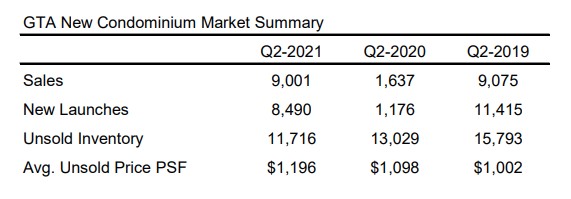
A new report from Urbanation found sales totaled 9,001 units, which is 5.5 times higher than sales during Q2-2020 (1,637 units) and nearly match the level in Q2-2019 (9,075), making it third highest quarterly total on record.

“The 905 continued to be a driving force as developers and buyers have shifted to more affordable locations of the region,” said Shaun Hildebrand, president of Urbanation. “With inventory approaching a three-year low, expect further upward pressure on new condo prices in the near-term.”

The 905 region of the GTA led new condo market activity with a 58 per cent share of sales in Q2-2021. A total of 8,490 new condo units were launched for presale during the second quarter, which achieved a record high absorption rate of 81 per cent.

The new units brought to market in Q2 were priced at an average of $728,160, or $1,110 per square foot (psf) based on an average unit size of 656 square foot. New condos launched in the City of Toronto were priced at an average of $834,504 ($1,276 psf) and units launched in the 905 region of the GTA were priced at an average of $661,537 ($1,007 psf).

Across the GTA, unsold inventory declined 10 per cent year-over-year to 11,716 units — an 11-quarter low and 23 per cent below the 10-year average (15,179 units). Average prices for unsold units available at the end of Q2 in the GTA rose 9 per cent from a year ago to a record high $1,196 psf.

condo market

Under construction in the GTA

The number of new condominiums under construction increased 11 per cent year-over-year to a record high of 86,346 units.

There was an additional 22,857 units in active projects in the pre-construction stage. An estimated 3,271 units were completed in the second quarter and 10,938 units were scheduled to reach completion during the second half of the year. This brings the total for 2021 completions to 18,157 units and represents a 19 per cent decline from the record high 22,473 units that were completed in 2020.

Resale market

In the resale market, the 7,790 units sold are a Q2 record, with annual growth of 148 per cent when compared to Q2-2020. The ratio of units sold to total listings during Q2 reached 73 per cent, up from 45 per cent and well above the 10-year average of 57 per cent.

Average resale condo prices grew 9 per cent year-over-year to $860 psf, reaching above $700,000 for the first time ($707,000). Annual resale price growth was strongest in the 905 region of the GTA at 14 per cent ($708 psf; $628,000), compared to 8 per cent annual growth for resale prices in the City of Toronto ($930 psf; $740,000).

Average condo maintenance fees rose 6 per cent year-over-year to $0.75 psf, or $617 per month based on an average resale unit size of 822 square foot in Q2-2021.


Photo by Roberto Nickson


Investors avidly pursuing industrial properties

Investors pursuing industrial properties can typically expect returns of 2 to 3 per cent in the current environment of scarce supply, climbing sales values and escalating land prices. CBRE reports continuing cap rate compression during the second quarter of 2021, with the national Class A rate nudging below 4.8 per cent and bottoming out at 3.25 to 3.75 per cent in Vancouver, Toronto and Montreal.

Market analysts anticipate more capital flowing into the sector as vacancies tighten and rental rates rise. Nationally, CBRE’s second quarter statistics peg the average industrial availability rate at 2.3 per cent, the average net rent at $9.82 per square foot, and the average sales price at $184.73 per square foot. Metrics for Vancouver and Toronto outperform the national benchmarks on all those fronts, with the average sales price hitting a chart-topping $400 per square foot in Vancouver. Ottawa surpasses the national average for rental rates and sales value, while Montreal, Waterloo Region and London, Ontario record below-average availability rates.

“We’ve never really seen lease rates and land move in such a quick accelerated manner on the industrial side, especially what we’ve seen over the last 12 to 15 months,” Werner Dietl, CBRE president and chief executive officer, observed during a recent webinar examining commercial real estate market dynamics. “In all of our major markets across the country we have a supply and demand imbalance. We’ve started creating some new models looking at where industrial leasing rates could go and we’re well into the ($) mid-teens per square foot net. If you factor that with where we see land going right now, we’re in uncharted territory. But we do think there is additional depth of demand just given how low our vacancies are.”

Quarter-over-quarter availability shrank 60 basis points (bps) in Vancouver, 50 bps in Montreal and 40 bps in Toronto to sub-1.5 per cent levels in all three markets. Halifax and Calgary registered even sharper quarter-over-quarter dips, as Halifax’s availability rate fell 130 bps to hit 3 per cent and Calgary’s dropped 120 bps down to 6.6 per cent. More than four million square feet of industrial space was absorbed in Calgary during the first half of this year, surpassing the combined total for 2019 and 2020, and representing the most uptake in two consecutive quarters since 2005.

About 27.1 million square feet of new industrial space is currently under construction Canada-wide, equivalent to about 1.4 per cent of the existing national inventory. Roughly one third of that space is slated for the Greater Toronto Area, where it will add negligibly to the 802 million square feet now comprising the industrial market. The rest is largely concentrated in Vancouver (5.5 million square feet), Montreal (4.5 million square feet), Ottawa (2.8 million square feet), Calgary (2 million square feet) and Edmonton (1.6 million square feet).

Earlier this summer, analysts warned that available space is nearing depletion in Vancouver, Toronto and Montreal if leasing activity continues at the recent pace. Diminishing supplies of zoned land and soaring construction costs further complicate delivery of new product and fuel foreboding about inflation.

“We don’t have enough space to accommodate business demand and can’t build new space fast enough,” Paul Morassutti, vice chair of CBRE’s valuation and advisory services, noted upon the release of Q2 2021 stats. “We’re at the beginning of a new cycle. What will businesses do and what will happen to prices for consumers when the supply of industrial space dwindles? We’re about to find out.”

Inflationary pressures apparent, but not necessarily lasting

Continuing that discussion during CBRE’s recent webinar, Benjamin Tal, deputy chief economist with CIBC World Markets, outlined potential precursors to an inflationary era. Those include: a looming post-pandemic spending surge as Canadian households and businesses find avenues for an estimated $230 billion in accumulated cash; rising costs for raw materials; supply chain disruptions that create extra costs; and rising wages as many service sector employers compete for labour. Already, inflation has surpassed Bank of Canada and U.S. Federal Reserve Board projections.

“On a month-over-month basis, prices are rising faster than expected,” Tal said. “That could be short-lived. Within six months it could have eased again. But there is a risk that it will last longer, and that’s the key risk facing the commercial real estate industry.”

Among factors favouring stability, he predicts commodity costs will moderate as world trade reopens and the supply chain smooths out, and that wage escalation may flag with the termination of the government’s COVID-19 relief programs. Tal also sees the Bank of Canada’s hints that it will begin to phase out pandemic-prompted quantitative easing in the second half of 2022 as a timely step to head off inflationary momentum. The greater threat, he suggests, is that more severe interventions could be necessitated at a later date, catching consumers and borrowers off guard.

“The issue is not inflation; the issue is high interest rates. To me, the number one risk is to what extent inflation will be sticky and not go down,” Tal asserted. “The focus should really be on the sensitivity of the consumer to high interest rates and the recessionary risk due to that.”

For now, Morassutti characterizes real estate market trends as upbeat, citing the 25 per cent gain for the TSX REIT index thus far in 2021, net asset values that are “absolutely going in the right direction” and strong activity in the capital markets. “If you look at the property level, fundamentals in virtually every sector in Canada are improving,” he said.

E-commerce is tagged as a continued driver for the warehouse/distribution and logistics sector, as CBRE projects about 100 million square feet of additional space will be needed globally within the next four to five years to accommodate online retailing needs. In Canada, Dietl speculated that developers will have to at least double their typical annual output to keep pace with demand. He also drew parallels with mounting pressures for housing supply.

“It feels like we have similar trends on industrial and residential now. We have a supply and demand imbalance across the whole country,” Dietl mused. “We can’t build it fast enough. We can’t seem to find ways to deal with the pricing on construction and land, and this is putting extraordinary pressure on lease rates and negotiations and how we’re going to solve for that in the short term.”

Meanwhile, as forecasted even in the most sluggish quarters of 2020, investors are now deploying capital with zeal — targeting both the obvious performers and emergent specialized asset classes.

“Every fund out there wants high-quality logistics and multifamily, but there’s not enough of it in the world to buy, and if you are buying in those sectors, you’re buying 2 and 3 per cent returns, which are not high enough for most funds,” Morassutti submitted. “That’s why we think, first of all, capital will go back into the office market, and why we think momentum in the alternatives will continue. The yields are better.”

Barbara Carss is editor-in-chief of Canadian Property Management.

Construction starts on major social housing project

One of Vancouver’s largest-ever social housing projects will soon break ground thanks to a unique partnership between the Government of Canada, Government of British Columbia, the City of Vancouver, and the Vancouver Chinatown Foundation.

Located at 58 West Hastings St. in Vancouver’s Downtown Eastside, the 10-storey project will provide a mix of supportive and affordable housing for people experiencing homelessness and low-income families. This project will have 120 supportive housing units, and will safely house over 230 individuals and families, focusing on the most vulnerable.

The project is receiving $45.8 million from the federal government and $33.6 million from BC Housing.

Kennedy Stewart, Mayor of Vancouver, announced that the City of Vancouver is providing the land through a 99-year land lease. This project was initiated and developed by the Vancouver Chinatown Foundation which is contributing $30 million through a community fundraising campaign.

“This extraordinary project will make a huge difference for our community and all who will call it home. It’s another great example of how we’re pulling together to tackle the housing crisis. A very special thanks to Carol Lee and the Vancouver Chinatown Foundation for whom this project has been a labour of love. This project shows just what can happen when the community leads and governments invest,” said Stewart.

The innovative project will include a new 48,500 square foot integrated health centre developed and operated by Vancouver Coastal Health. This facility will improve healthcare delivery in the neighborhood and provide easy access to a broad-spectrum of services, including for those in need of specialized mental health and addiction issues, home health, and seniors care.

“Vancouver Chinatown Foundation is excited to begin construction on this urgently-needed social housing project after years of careful planning and fundraising. In partnership with the federal, provincial and local governments we are proud to be creating a safe and welcoming space where residents have not only a roof over their heads but are part of a community with healthcare and other services,” said Carol Lee, Vancouver Chinatown Foundation.


CERS relief measures revised and extended

Relief measures will be more generous than previously announced for commercial tenants and owners/occupiers qualifying for the Canada Emergency Rent Subsidy (CERS). Exercising flexibility built into the enabling legislation, the program has been extended for an additional four weeks, taking it Oct. 23, 2021, while the subsidy ceiling for the Aug. 29 – Sept. 25 period has been lifted to 40 per cent of eligible expenses, up from the originally offered 20 per cent.

Finance Minister Chrystia Freeland announced the program revisions late last week, along with new rules for how businesses launched after March 1, 2019 can calculate revenue decline relative to the pre-pandemic period. Some of the latter group have been inadvertently excluded from receiving assistance because they did not generate revenue during prescribed reference months. Freeland also announced an accompanying extension of the Canada Emergency Wage Subsidy (CEWS) to Oct. 23.

“Our economies are safely and gradually reopening, but many small businesses and workers are still getting back to business. Extending these supports, which have been lifelines for many, is needed,” she acknowledged.

Recipients will now be eligible for CERS coverage for up to 20 per cent of qualifying property expenses, such as rent, mortgage interest, property tax and utility costs, for the Sept. 26 – Oct. 23 period. Top-up support for an extra 25 per cent of property expenses will continue to be available for businesses and not-for-profit organizations in lockdown situations.

As of mid-July, the Canadian government reports 200,600 distinct organizations had received $5.24 billion through CERS relief measures, breaking down to $4.45 billion in basic coverage and $785.4 million in top-up lockdown support. To that time, 1,352,190 applications had been received throughout the 11 four-week periods of the program and 1,307,305 had been approved.

Condo slated for Capitol Theatre revival 

Plans are moving ahead for the Capitol Residences—a tribute to the Capitol Theatre landmark in which it will rise 14 storeys in midtown Toronto.

Madison Group and Westdale Properties, along with Hariri Pontarini Architects and Turner Fleischer Architects are reviving the Toronto theatre in the YongeEglinton community at Yonge and Castlefield. The 145 suites will range from 425 to 1950 square feet.

Part of the theatre-turned-condo transformation will be preserving the original marquee and façade at the base three floors. The project will pay homage to the theatre’s rich history from its 1914 debut to its last curtain call in 1998 before becoming a popular event venue.

Especially valued during the Great Depression of the 1920s and 1930s, the theatre was home to screenings and shows including Annabella, Wings of the Morning, and Jane Eyre.

The design uses a palette that ties the building both to the existing context and to the original Capital Theatre facade, previously designed by John MacNee Jeffrey. The team selected a warm coloured sand cast brick and light coloured smooth stone finish for the main body of the building.

A few amenities are a speakeasy-inspired golf simulator and social club, automated parcel storage, an extensive outdoor lounge and dining area, a curated kids play area and pet spa.

Capitol Theatre

The residences themselves will feature extensive private terraces and oversized balconies. The tiered levels on the east side will bring in landscapes to the terraces, while the west side of the property will add new greenspace to the city with the conversion of a parking lot into a 3,700-square-metre park.

Studio Munge has created an interior experience characteristic of theatre and film as early as the 1920s. The original art deco marquee and façade compliment an elaborate porte cochère to usher residents into a lobby conducted by The Capitol Concierge. Suites will feature 10-inch ceilings and handpicked finishings.

Capitol Theatre

“Over the last century, the Capitol Theatre has been a staple in Toronto’s entertainment scene and we are honoured to bring new life to this highly historic venue through the launch of its namesake residences,” says Josh Zagdanski, vice president of high rise at Madison Group. “This mid-rise project will capture the nostalgic vibrancy of years past while adding a modern twist on the original style.”

Pricing start in the $900,000s.

Mixed-use plans for newly acquired Metrolinx site

Edenshaw Developments, along with Windsor Private Capital, recently acquired a 1.48-acre Metrolinx site adjacent to the Port Credit Mobility Hub.

The high-density, transit-oriented development infill site is located at 30 Queen Street East, Mississauga, with immediate access to the future Hurontario Light Rail Transit (HURLT) Station. The HURLT will connect riders to Brampton Gateway, and the Lakeshore West and Milton lines of GO Transit service. Union Station is an estimated 25-minute ride via the GO Train.

The Metrolinx site will be designed as the only underground station on the HULRT. A pedestrian-friendly, civic square component will complement the future multi-storey, mixed-use development that will include both residential and commercial elements.

“The entire Edenshaw team is thrilled to be embarking on this very significant development, and as a long-time Port Credit resident, it’s particularly meaningful to me, and the many Edenshaw staff who grew up in the neighbourhood, to be participating in the positive growth of our community,” said David McComb, president and CEO of Edenshaw. “We look forward to working with our partners, Windsor Private Capital and Metrolinx in bringing this prominent, landmark site to fruition.”

This development will mark Edenshaw’s fourth residential condominium in the waterfront community of Port Credit and the fifth condominium in the Mississauga Region.

We are excited to be a part of this landmark project in Port Credit and to be working again with Edenshaw, one of our trusted and experienced development partners. This project will be a tremendous addition to the community of Port Credit and the city of Mississauga,” said Rocco Marcello, chairman amd CEO of Windsor Private Capital.

Treasured for its protected port, marina, and abundant natural amenities, including the Waterfront Trail, Port Credit is a dynamic neighbourhood, with a walkable retail core, a vibrant arts scene, and numerous festivals and events year-round, making it a highly attractive and desirable place to live.

SICA creates Kelowna crane incident education fund

Through the Southern Interior Construction Association (SICA) Fund and in partnership with the Construction Foundation of BC, SICA is organizing the Kelowna Crane Incident Legacy Education Fund. This fund is a tribute to the individuals who tragically lost their lives from the Brooklyn site incident on July 12th, 2021. The funds raised through this fund will go towards supporting future post-secondary education for the children of the victims in this tragedy.

“We were deeply saddened to learn of the tragic crane accident in Kelowna on July 12.  Our hearts are grieving for the families, friends, and co-workers of those victims of this terrible event” says Scott Wild, CEO of SICA.  “We know this has sent ripples across the entire country as we have had many colleagues in the industry reach out to us with compassion for and solidarity with our community in grieving these losses.”

According to SICA, the fund is not intended to take any attention away from the current GoFundMe campaigns that have been established by the families. Rather, the campaign serves as an additional avenue and opportunity to be able to build a fund that will be able to cover the victims’ children’s education.

This fund is managed by the Construction Foundation of BC so that charitable donation receipts can be given and in hopes that the contributions can be invested and grown over the coming years.

“While there are no words we can say to offer comfort to the grieving families, we can instead come together as an industry and community to build a future for the families these men were working hard to care for,” says Wild.

The SICA Fund was established to support causes and initiatives that matter to their members. Past campaigns have raised thousands of dollars for the purchasing of tools, equipment, and technology for classrooms in the southern interior region.

Donations to this fund can be made on SICA’s website, https://staging.sicabc.ca/donate.

Key steps to reduce water consumption

Reducing water consumption has become an increasingly important concern for facility managers.

There are environmental sustainability factors at play, and recurring droughts across North America have highlighted why this is a growing need to address.

Facility managers have been learning from past mistakes, and significant strides have been made when it comes to technological solutions to reduce water consumption. But more work is needed, particularly when it comes to commercial facilities.

“Because a great deal of the water used in commercial facilities is used for landscaping, that’s the first place to start,” said Klaus Reichardt, CEO, and founder of Waterless CO., Inc.,

Recommendations to reduce water consumption for landscaping include:

  • Cataloguing all vegetation growing around the building and determine which plants/vegetation can be replaced with native plants that use less water.
  • Analyzing the land layout. Higher areas need more water than lower areas due to water runoff.
  • Switching to recycled water. Treated wastewater can be used at such places as golf courses and cemeteries, which can use a huge amount of water.
  • Irrigating only at night.
  • Installing water sensors to determine if irrigation is even needed and several water meters to monitor how much water is being used throughout the property.

However, Reichardt noted that if a facility is not landscaped then the focus should be placed on washrooms, where the most water is generally consumed.

Among the steps he suggests building owners and managers take are:

  • Installing aerators in all faucet
  • Identifying and fixing leaks.
  • Installing new urinals that consume less water per flush or transfer to waterless urinals that use no water, and are less costly to install and maintain.
  • Selecting toilets powered by “velocity.”

“Newer toilets use compressed air – velocity – to flush waste,” concluded Reichardt. “This technology is very efficient and reduces water consumption dramatically.”

Campus cleanliness now a core concern in college selection

In a world of heightened awareness of cleaning procedures and increased demand for validation of results, parents are far more concerned with college campus cleanliness than ever before.

That’s according to a study conducted by JLL Higher Education, which found that parents of prospective students now rank cleanliness and indoor air quality as top considerations in college selection decisions.

48 per cent of parents of high schoolers rank campus cleanliness and indoor air quality in the top three most important factors for selecting a college or university selection, behind only the quality of academics and affordability. 84 per cent say campus cleanliness and indoor air quality are either important or somewhat important.

RELATED: A year like no other for campus cleaning

“Proper indoor ventilation and air circulation occupied the spotlight across most industries in the height of the pandemic, with 59 per cent of parents never even considering campus air quality prior to COVID-19,” said Ron Gregory, JLL Higher Education executive vice president North America. “As people are more aware of their surroundings that impact their health and safety with greater reason, we can expect that students and staff on campuses will continue to demand transparency and the highest standards around cleanliness and air quality.”

42 per cent of parents said their value of campus cleanliness and indoor air quality increased as a result of COVID-19. 86 per cent rank the look and feel of campus as either important or somewhat important when it comes to college selection, and 88 per cent said the physical condition of buildings was either very important or somewhat important.

“From simple fixes like upgrading lightbulbs to harnessing new technologies across a campus, preventative maintenance is key for schools empowering vibrant campus experiences—before the physical condition of buildings becomes a turn-off to prospective students,” said Kevin Wayer, JLL Public Institutions president. “Savings generated from preventative maintenance can go back into facilities upkeep, creating an overall better, cleaner and more modern experience for students.”

Environmental sustainability has also emerged as a major factor, with 21 per cent of parents saying they became more interested in a school’s commitment to sustainability than they were before the pandemic.

The added value of cleaning audits in sanitary maintenance

Sanitation quality controls are vital in facility cleaning and maintenance. In other words: how to monitor and measure the quality of cleanliness. Since sanitary maintenance is changing at a rapid pace, it is very important to have the tools that will allow you to conduct thorough and valid audits.

The ongoing health crisis has greatly contributed to changing attitudes and standards of cleanliness. While visual cleanliness used to be acceptable, today we aim for true cleanliness, even in the invisible. We must now clean for health, nothing less!

The three main types of audits that are readily available and feasible are visual inspection, fluorescence audits, and ATP audits. These are not in competition with each other, as they complement each other perfectly and provide different information on the quality of the work performed.

Visual inspection

Visual inspection relies on assessing and evaluating the cleanliness of a room, an object, or a surface and detecting deficiencies in sanitary maintenance. Obtaining a good rating on a visual inspection is the foundation of cleanliness.

However, visual inspection is an introduction: it is very subjective and limited only to what we can see and does not tell us about the level of contamination of the surface. The quality of sanitary maintenance is an unstable result that can vary greatly over time, and it is therefore important to verify it continuously. Visual inspections should be done on a regular basis throughout the year.

Fluorescence audits

These audits are very interesting because they also distinguish genuine service providers[1] from amateurs.

First of all, what is a fluorescence audit? It is a process to verify if a surface has been cleaned by applying a fluorescent marker product on the surface. This marker is invisible to the naked eye but becomes fluorescent under a UV lamp. Surfaces that are cleaned daily are coated with this product before the service provider comes to clean. Once the cleaning is complete, we return to check with our UV lamp to see if the fluorescent marker is gone or still present on the surface. If it is present, in whole or in part, the service provider did not clean the object properly. If it is gone, we can assume that the surface has been properly cleaned. The result is definitive and rarely negotiable. Although the fluorescence audit does not tell you whether the surface is contaminated or not, it does at least tell you whether the surface was indeed scrubbed.  It is ideal for toilets, countertops, sinks, door handles, etc.

How does this type of audit distinguish genuine service providers from amateurs? Take the example of a toilet seat. A professional service provider will train their staff to clean all toilet seats on a daily basis, whether they are visually clean or dirty. Since germs are invisible, a visually clean toilet seat is not necessarily germ-free! Instead, to save time and money, amateurs will encourage their staff to check first and clean only those toilets that are visually dirty. At this point, they assume the role of inspectors rather than cleaners.

ATP audits

It is becoming increasingly important to add ATP audits to a quality control program.  ATP audits are the superior mark of quality as they measure the amount of organic matter and living microbes on a surface using Adenosine Triphosphate, a molecule present in all living cells. This measurement is recognized in the environment as the relative quantity of germs in general. ATP is a widely used control method in the food industry.

A surface may be clean on visual inspection, the fluorescence audit may show that it has been cleaned, but only an ATP audit can confirm that the cleaning technique used by the service provider is effective in removing invisible soil from surfaces. This is proof that your service provider is cleaning for health.

What is the added value? The benefits of clean environments go far beyond general well-being and safety. A clean environment directly affects your health and the effects on absenteeism and infection control are found right there: where our eyes cannot see. In fact, it is the confirmation that the sanitary maintenance techniques used remove soils rather than moving, rearranging, or scattering them. An ATP audit assures you that the surface is invisibly clean and that germs no longer have food to multiply.

To summarize, here is what you must remember about these most popular audits:

  • Visual inspection measures the quality of the appearance of cleanliness.
  • Fluorescence audits ensure systematic cleaning of surfaces.
  • ATP audits confirm the quality of your service provider’s sanitation techniques.

Experience ValkarTech’s expertise

Audits and quality controls are often mistakenly viewed as a staff evaluation tool, with some people even fearing disciplinary consequences. When quality management is an integral part of your facility’s culture, audits are excellent tools to allow for continuous improvement and to engage your workforce in achieving well-defined goals.

When you conduct audits on a regular basis, you demonstrate the importance that is placed on the role of your housekeeping teams and this also represents an opportunity for you to highlight or recognize their efforts.

Dare to raise your standards a little, for your health and that of your employees, and add ATP audits to your quality control programs.

Nathalie Thibault is the Training Director of ValkarTech, a Canadian consulting firm that guides, supports, and advises its clients on ways to optimize the operational performance of their organizations in terms of building hygiene and sanitation. For more information, please email [email protected], visit https://en.valkartech.com/ or call 514 316 6723.

[1] Service provider is used here to refer to either the sanitation maintenance company or your in-house maintenance staff.

SAIT partnership builds new zero carbon cottage

A new Zero Carbon Cottage is now under construction in CottageClub at Ghost Lake, Alberta. When completed, the cottage will be used for educational tours on building green as part of an innovative partnership with cottage owners, the Jenkins family, SAIT’s green building technologies team and Lamont Land Development Inc., the developers of CottageClub at Ghost Lake.

The SAIT / developers partnership seeks to explore and improve energy efficiencies in new homes built in the CottageClub community. To encourage sustainable building, the developer pays for up to 10 hours of planning time with the SAIT team as part of every developer lot sale. SAIT is providing CottageClub owners with affordable ways to achieve net zero energy construction and reduce utility bills as well as innovative options for high performance building envelopes, mechanical systems, advanced energy monitoring and renewable energy.

The SAIT green building technologies research group was formed 11 years ago, providing energy and emissions reductions advisory, education and applied support for building products, services, design and construction. SAIT provides technical input in the development and application of green building systems. A full range of services is offered to owners beyond the initial planning, including analyzing cottage energy requirements; cottage orientation to maximize passive solar and solar PV options; identifying requirements for geothermal heating/cooling systems; identifying eco-friendly material selections and operating options to reduce carbon footprints.

The project is aiming to develop a carbon emissions-free home through low energy and water use to zero-carbon materials, such as building a wood basement in place of concrete.

The home is also being built at a price point similar to a typical stick-frame constructed cottage. Managing the build is Plaid Shirt Projects, a new partnership formed to provide hands-on project and construction management for residential and commercial builds and renovations, in particular those connecting the demand for quality and creativity to the values of sustainability and healthy environments.

“The start of construction of the Zero Carbon Cottage is a milestone for CottageClub and another step forward in our vision of building an enviro-conscious community. Having the SAIT green building technologies team involved, with its many years of experience in net zero energy construction adds innovation, design and validity to the project,” says Don Stengler of Lamont Land Development.

Shifting behaviours influence home designs

The demand for goods and services in the home industry has never been greater. Since March of 2020 we have found ourselves in a pandemic frenzy of navigating a shift in consumer behaviour, psychology, and focus. And for many design firms, this shift also came with managing a rapid business growth to serve our clientele. In 26 years of business, our firm has never been so busy.

There is no question the events over the past 18 months have had a direct influence over the business of the home and I am always surprised how similar we all are in wanting to create comfort and safety for ourselves. As the pandemic forced us all to retreat to our small bubbles and the time spent at home increased, many people directed their passion for travel, art and social gatherings to redecorating, renovating or building new.

Time and money were limited for us to spend outside the home, so why not invest in your home? Projects were on the uptick in the beginning and then by mid pandemic – we were finding ourselves scrambling to keep up. It was a roller coaster in the opposite spectrum of what some other industries were facing.

Through this time period we found a delicate, underlying emotional need that led most of our clients to subtly request that the finished product evoke a feeling of comfort and security. They asked for timeless designs which would provide a feeling of reassurance and not overwhelm the senses.

Designers of all products, including kitchen and bath design as well as soft furnishings answered that need by creating a balance of functionality and expression by using healing, earthy colours, minimalist forms, softer shapes, and tactility which appeal to the senses and tend to reduce or ease anxiety and stress.

Palettes

2021 brought in warm and nature inspired palettes. Iridescent green hues of pine, sage, kale especially paired with warm woods created spaces that felt harmonious, healing and renewed. Using these tones would also help us bring the outdoors in, creating a Biophilic sense of connection to nature. Alongside green, other plant-based tones of amber and oatmeal have and will continue to take the place of stark white and grey.

For the more bold and brazen clients, mixing these colours with dark elements brings a theatrical mood and strength. Dark carbonized woods or stones are rich and moody with an elemental simplicity that heighten the senses.

Materials

The blending of materials is encouraged using woven materials, raw fibers, and mixed metals with contemporary silhouettes. Matte brushed metals and handmade textural tiles, fabrics, and furnishings all will see a spread in use as the sense of touch is important in these tactile products.

The Curve

And finally, we have the massive resurgence of one of the biggest trends from the 1960s – the curve. The continuing softening of interiors with curved shapes and organic rounded edges is everywhere from architectural design, kitchen and bath millwork, lighting and plumbing fixtures, staircases, right down to sofas, rugs, and pillows.

Humans are naturally drawn to rounded designs, which create a great comfort and safety in their softness and general happiness in the circular shape. The curve makes me think of the simple yellow smiley face invented in 1963 by the late Harvey Ross Ball, an American graphic artist and ad man. Ball produced the image in 1963 when he was commissioned to create a graphic to raise morale among the employees of an insurance company after a series of difficult mergers and acquisitions.

So, as we’ve all been facing this unprecedented situation together, the use of the curve is very appropriate, leading all of us to feel more optimistic for the future to come.


Jennifer Heffel is principal and owner of HB Design Consultants in Vancouver. She is also the current president of the Interior Designers Institute of B.C.


Photos: L – Barry Calhoun Photos; R – Kristen McGaughey Photography


Quantum Algorithms Institute receives $2.2M

The Quantum Algorithms Institute at Simon Fraser University’s (SFU) Surrey campus, will receive $2,210,000 million in federal funding from Western Economic Diversification Canada (WD). The funding will help it accelerate the innovation and commercialization of quantum technologies.

The institute will also use the funds to renovate its state-of-the-art physical hub to facilitate engagement activities such as hosting collaborative events between industry and academia, organizing quantum technology conferences for local and international players, and promoting collaboration between existing quantum companies and potential new customers.

In addition, this funding will help the institute train and grow a world-leading talent pool for this emerging industry.

“On behalf of the Institute, SFU and all partners, I would like to thank Western Economic Diversification Canada for their generous support,” says Dugan O’Neil, SFU’s vice-president of research and international. “This funding will further contribute to the mission of the Institute in bringing academia, industry and government together, and raise awareness of the province’s flourishing reputation as a leader in quantum computing.”

Quantum technology is a new generation of optical and electronic devices that use quantum effects to significantly enhance the performance over that of existing technologies.

For example, quantum computers will be able to solve problems that the largest classical supercomputers would take thousands of years to solve, but in a fraction of the time.

This technology will have significant impacts across many sectors including manufacturing, natural resources, finance, engineering, healthcare, defense, transport, telecommunications and life sciences.

“When the new facility opens in spring 2022, the institute will offer a regular schedule of training opportunities, industry workshops and events, and open collaborative research seminars,” says Brad Lackey, senior principal researcher from Microsoft, and chair of the Quantum Algorithms Institute’s board of directors. “In addition to providing a key venue for fostering academic-industry collaboration, it will enable all the cross-disciplinary interaction needed to prepare our students for entering the quantum technology workforce.”

New Edgewood Park opens in Surrey

Edgewood Park is now open in Surrey, the city’s newest neighbourhood park, situated on 165 Street in South Surrey. Edgewood Park features a multi-tiered playground with an unprescribed play circuit, zip line, multi-sports court, and ping pong tables.

“Investing in neighbourhood parks, like Edgewood Park, helps support our vision of being a thriving, green and inclusive community,” said Mayor Doug McCallum. “By giving residents access to more green spaces, social spaces and active spaces, we are investing in the wellbeing of our residents.  This new park is just one project under our Surrey Invests program, a series of capital and improvement projects that will improve the lives of hard-working, middle-class families across our city.”

Edgewood Park’s playground includes accessibility play which features a roller table, a universal spinner, a dish swing and wide slide. Many of these elements encourage co-operative play that engages one or multiple children. Edgewood Park’s multi-sports courts accommodate both basketball and hockey.

Other features include a grassy field, walking loop, a wildlife corridor and pollinator garden providing an opportunity for park users to learn about the city’s biodiversity. Native species were chosen for diversity, character, and drought-tolerance.

“Just as the city invests in its roadways and transportation networks, ensuring that we advance our green infrastructure is top of mind for City Council,” said Councillor Laurie Guerra, chair of the  parks, recreation and culture committee. “The park opening demonstrates the city’s commitment to provide high quality parks and facilities, so that every Surrey resident has an opportunity to enjoy nature and recreation close to home.”

6 evolving supply chain and distribution trends

Due to the ongoing effects of the COVID-19 pandemic, most prognosticators were uncertain what trends we might see in 2021 regarding supply chain management.

While industries and economies across Canada have been slowly but surely reopening, COVID-19 is still raging and has significantly impacted many sectors, including supply chains.

But now, as we inch past the pandemic, we are starting to see specific supply chain trends evolving.

Gretchen Friedrich, with AFFLINK, notes that some trends “appear to be long-lasting” and will likely become core to supply chain management in the future.

Agility

Traditionally, distributors have not planned for major unforeseen events. Now, looking beyond COVID-19, manufacturers and distributors must become much more agile, willing, and able to make changes quickly so that they can respond to disruptions promptly.

Sustainability

Green logistics is here to stay; it benefits the environment and proves to be a cost saving while also promoting goodwill and brand loyalty. “Millennials look for companies that promote sustainability, and there are even studies suggesting sustainability-focused brands grow faster than those that are not,” notes Friedrich.

Blockchain

Blockchain technology is evolving, it is helping manufacturers and distributors deliver products faster and eliminate waste and fraud. Further, it is cost-effective and transparent. Supply chain managers find they can detect issues quickly using blockchain technology. This can be a significant cost saving and can improve customer satisfaction tremendously.

Internet of Things

“IoT is just starting to play a big role in distribution,” says Friedrich. It is being used in manufacturing and distribution to monitor products during shipment, send alerts when equipment needs maintenance, and track the speed, safety, and fuel efficiency of trucks.

Machine Learning

Related to IoT is Machine Learning. This refers to the ability of machines to read, identify, and replicate procedures and patterns. It eliminates the need for employees to perform repetitive tasks, performing them faster with fewer errors.

Engagement

With Blockchain, IoT, and Machine Learning, it may appear that the role of the individual and specifically the distributor is likely to be ending.

However, notes Friedrich, “we see just the opposite happening. Distributors proved themselves during the pandemic. End-customers relied on them more than ever before. We see this continuing.”