

Across the country, Indigenous Nations and organizations are leading some of the most ambitious multi‑residential housing projects, reshaping urban centres, strengthening communities, and demonstrating what culturally grounded development looks like at scale. Notable developments rising from coast to coast to coast range from large apartment communities to multi‑building supportive housing campuses where culture, safety, sustainability, and belonging are foundational components.
According to the 2021 Census, more than 171,000 Indigenous Peoples living off reserve in urban, rural, and northern areas are in core housing need. While federal programs such as the Housing Accelerator Fund, Rapid Housing Initiative, and Build Canada Homes have helped accelerate development, the true force behind these transformative builds is the leadership, vision, and governance of Indigenous communities themselves.
Launched in December 2022, the National Indigenous Collaborative Housing Incorporated (NICHI) represents more than 130 housing and service providers, supporting new capital builds, repairs and renewals of existing stock, and organizational capacity development to scale Indigenous housing delivery. Since then, the national collective has moved funding quickly and directly to communities, supporting 77 Indigenous‑led projects and contributing to 3,800 units and beds, improving housing outcomes for more than 6,000 Indigenous Peoples.
“We are seeing real momentum across the country, with projects moving from concept to construction,” said Jocelyn Formsma, Chair, NICHI Board of Directors. “When we talk about housing, we’re not just talking about units. We’re talking about security. We’re talking about health. We’re talking about the well‑being of families, of individuals, of women, men, and children who need a safe, affordable, and culturally appropriate place to live.”
Support for NICHI and other Indigenous‑led initiatives reflects the federal government’s commitment to addressing the social determinants of health and advancing self‑determination in alignment with the United Nations Declaration on the Rights of Indigenous Peoples, particularly Articles 21 and 23.
With this growing momentum, and renewed investment flowing directly to Indigenous housing providers, Nation‑led development is accelerating at a rate not seen before.
The following projects represent just a small sample of what’s underway and illustrate how Indigenous communities are redefining the future of residential construction through sustainability, long‑term community ownership, and enduring connection to land.
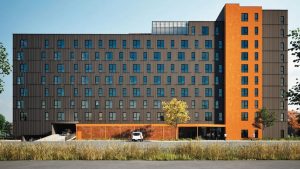 Endayaan Omaa – Treaty One Nations
Located in Winnipeg on the historic Naawi Oodena lands (formerly the Kapyong Barracks), Treaty One Nations are advancing one of the largest Indigenous‑led urban housing projects in the city’s history. Endayaan Omaa is a cornerstone of the Nation’s long‑term vision to reclaim and redevelop the 160‑acre site into a vibrant mixed‑use community.
“Naawi Oodena is about Nation building in action. We have reclaimed these lands with the intention of leading development,” said Chief Gordon BlueSky, Chairperson for Treaty One Nations. “First Nations are creating strong economies, generating opportunity, and building healthy communities. Endayaan Omaa is part of a broader economic vision that creates stability for families, opportunity for our people, and shared success for all Manitobans.”
The development includes 260 residential units designed for Indigenous families, elders, and individuals seeking culturally safe housing. Supported by a $91‑million federal investment, construction is now underway with a workforce that is 60 per cent Indigenous. The design incorporates Indigenous architectural elements, community gathering spaces, and access to future commercial and educational amenities planned as part of the broader Naawi Oodena redevelopment.
Katzie First Nation Multi‑Building Housing Campus
Katzie First Nation recently completed a three‑building, 40‑unit affordable housing campus in Pitt Meadows, B.C. The development emphasizes community connection through shared lounges, a commercial kitchen, and dedicated spaces for elders and cultural programming. Funding was provided through an $18.2‑million partnership between CMHC and BC Housing. Katzie’s model is notable for its integration of wraparound services within a multi‑building residential environment — an approach increasingly adopted by Indigenous housing providers across Canada.
“These are not just buildings behind us,” said Chief Grace George at the ribbon‑cutting ceremony in March. “They are places where life will be rebuilt, where young people will find stability, where families will reconnect, where elders and others will return home — a place where our people will feel safe, supported, and at home.”
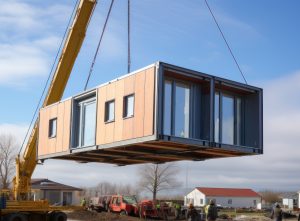 Kitchenuhmaykoosib Inninuwug First Nation – Modular Housing Expansion
Responding to severe overcrowding and aging housing stock in the Northern Ontario fly‑in community of Kitchenuhmaykoosib Inninuwug, the First Nation is undertaking a major modular housing deployment consisting of 35 new homes.
Built off‑site and transported into the community, modular construction shortens timelines and minimizes weather‑related delays, both critical advantages in remote Northern regions where conventional construction is often slowed by climate, logistics, and limited seasonal access. Once complete, the project will create a multi‑unit cluster that expands residential capacity quickly and efficiently, providing stable housing in a community accessible primarily by air and winter road. Funding for the project is provided through Indigenous Services Canada and the Rapid Housing Initiative.
NeeKeeNan Residential Community – Fort Albany First Nation
Located in Timmins, Ontario, Fort Albany First Nation is advancing a transformative multi‑residential initiative designed to support women and children fleeing violence. The NeeKeeNan Residential Community spans more than 100 acres, with future phases envisioned to add additional multi‑unit residential buildings and expanded community services.
The first phase includes an emergency shelter and a seven‑unit transitional housing division offering stays of up to 24 months. Residents receive counselling, cultural programming, and structured pathways to permanent housing — an approach that centres on safety, stability, and cultural connection. Funding is provided through a multi‑partner collaboration involving NICHI, CMHC, and Indigenous Services Canada.
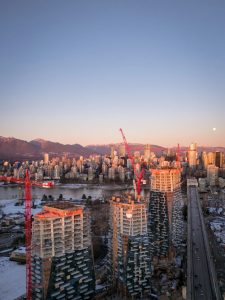 Sen̓áḵw – Sḵwx̱wú7mesh Úxwumixw (Squamish Nation)
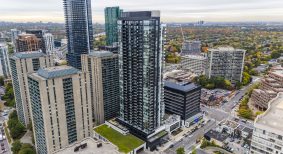
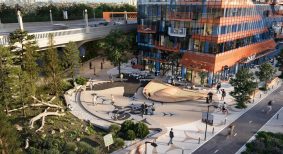
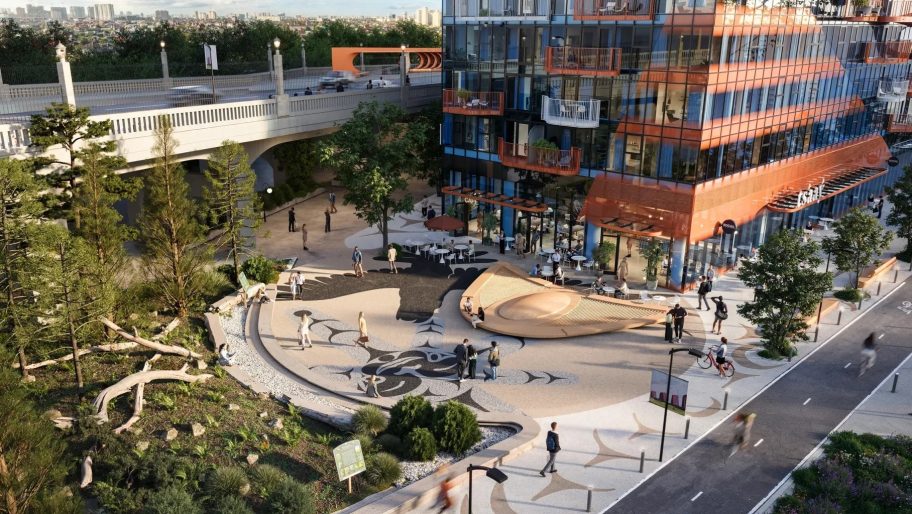
As one of the largest Indigenous‑led residential developments in Canadian history, Sen̓áḵw represents a transformative project in both scale and cultural meaning, reshaping a prominent gateway into Vancouver. The development features several high‑density residential buildings currently underway that will anchor the community and establish the architectural tone for the full 6,000‑unit buildout. Crews are actively advancing vertical construction, installing sculpted concrete forms and façade elements that reflect Coast Salish design language.
A defining feature of the project is the integration of cultural expression directly into the building form. Tower silhouettes, balcony geometries, and façade screens incorporate Squamish Nation artistry — motifs drawn from crescents, trigons, salmon movement, and longhouse architecture. The result is a development that restores cultural identity to land that once held the original Squamish village.
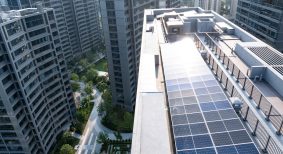
Sen̓áḵw is also achieving major sustainability milestones. Its district energy system, designed to eliminate operational carbon, is being installed alongside the residential structures, marking one of Canada’s first large‑scale deployments of sewer‑heat recovery for a master‑planned community. The simultaneous build‑out of housing and climate infrastructure signals a new model for urban development.
To learn more, visit: The Location | Sen̓áḵw | A Landmark Indigenous-Led Rental Community Rooted in Place