Articles Archive - Page 629 of 929 - REMINET
REMI

Kwa’lilas Hotel tells a unique story

Traditional sculpture and art of the Gwa’sala-Nakwaxda’xw nation are at the heart of the new Kwa’lilas Hotel in Port Hardy, B.C. Local indigenous artists submitted their work to a selection committee of nation Elders, and the selected works were then incorporated by Vancouver based Inside Design Studio to create a truly unique boutique hotel.

The traditional art combined with modern, clean hospitality design provides balance and contrast with stunning results. Traditional colours are set against earth tones creating a synergy between the art of the Gwa’sala-Nakwaxda’xw nation and the function of a modern boutique hotel. Copper, a traditional material used by the Gwa’sala-Nakwaxda’xw people, was used to create the large installation in the lobby. The stunning piece depicts village life and the passage of time and gives the hotel a strong identity, closely tying it to its location.

The concept was to design a modern boutique hotel to support international tourism to the unspoiled north of Vancouver Island. The Hotel is a for-profit venture of the Gwa’sala-Nakwaxda’xw nation and provides a sustainable venue for the nation to present their cultural stories and artwork to visitors.

In guest rooms, blankets with traditional designs and colours are used to accent crisp white bed sheets. Symmetrical animal carvings are incorporated into headboards and highlighted with subtle lighting.  In the king suite, a modern, round, cedar carving was chosen as the centrepiece for the bathroom.

Every piece of art was created for a specific location within the hotel and has been set against a simple background to allow the art to be the room focal point. Screens within the guest rooms, for example, made with laser cut aluminum, illustrate traditional art using a contemporary material. They are positioned in the rooms to cast moving shadows from the large windows.

The resulting design delivers the comfort and spatial expectations of a modern boutique hotel while incorporating the unique traditional art and sculpture to tell the story of the hotel’s location and the history of its native people. The Kwa’lilas Hotel has 85 guest rooms and is now open.


Conducting video surveillance of properties

Surveillance cameras’ value as deterrents to criminal activity is well-known. However, in order for organizations to use video surveillance, certain requirements concerning reasonableness, consent, purpose and notice must be met.

In Alberta, use of video surveillance by private organizations is subject to the Personal Information Protection Act (PIPA). Under PIPA, organizations such as corporations, associations and individuals acting in a commercial capacity, may not collect, use or disclose an individual’s personal information without the consent of the individual. This includes surveillance images of an identifiable individual.

Reasonableness

The collection, use and disclosure of personal information can only be for reasonable purposes and only to the extent reasonably required to meet those purposes. Surveillance for the purpose of deterring crime and maintaining security in a building will likely meet this “reasonableness test” and relevant images could be used and disclosed in the event of an incident, such as property damage. However, irrelevant images containing personal information may not be used or disclosed.

Consent

PIPA requires that organizations obtain individuals’ consent for the collection, use and disclosure of their personal information. While an individual will typically provide consent in writing or orally, an individual may be deemed to consent to the collection, use or disclosure of their personal information where they voluntarily provide the information and it is reasonable that they would provide that information.

Practically, what this means is that organizations may be permitted to use surveillance cameras without obtaining an individual’s written or oral consent. This will depend largely on the intended purpose of the collection, use or disclosure and whether certain notice requirements have been met.

Purpose and Notice

When using video surveillance, notice must be provided before or at the time of collection. Such notice must set out the purposes for which the information is collected and the name of a representative who is able to answer questions on behalf of the organization about the collection. Signs with appropriate wording located at access points to the premises are typically sufficient to meet these requirements.

Importantly however, if an individual has been deemed to consent to the collection, use and disclosure of their personal information, it is not necessary to notify the individual of the purpose of the surveillance or organization’s representative. In order for consent to be deemed, the particular purpose of the surveillance must be reasonably understood. This will typically not be an issue where surveillance cameras are used for deterrence and security purposes.

Where the purpose is understood to be the deterrence of crime, notice that surveillance is taking place is likely still required. If there is notice or the individual is aware that there is surveillance, then by entering the premises, that individual is deemed to consent to the collection, use and disclosure of their images as they will have had the option of not entering the premises.

For example, if an individual chooses to visit a residential condominium despite having notice that surveillance is taking place on the premises, consent may be deemed and an explanation regarding the purpose of the surveillance would likely not be necessary. This is because the purpose of such surveillance would be reasonably understood to be the deterrence of theft, vandalism and criminal acts.

Conversely, if the reason for the surveillance is not clear from the location in which the surveillance occurs, then signs or other sufficient forms of notice, explaining why the surveillance is necessary will be required. This is because when the purpose of the surveillance is unclear, an individual cannot be deemed to consent.

For example, installing security cameras in a locker room at a workout facility in order to deter theft and vandalism would likely require a sign explaining why the surveillance is necessary because the purpose of the surveillance is not easily understood. Similarly, using the residential condominium example, those collected images could not be used for purposes unrelated to building security, such as for enforcing condo bylaws, if no explanation was provided because those purposes would not be clear in the circumstances.

Recommendations

In summary, while the use of surveillance cameras on commercial premises will likely be permitted under PIPA in order to deter crime and promote security, other purposes may not be permitted so organizations should exercise caution. Organizations should also consider whether a less privacy-invasive alternative is available.

If surveillance is used, the field of vision of the camera should be as limited in scope as possible, the camera should not be aimed at areas where there is a heightened expectation of privacy and sound should not be recorded if it is unnecessary. Organizations should also establish business reasons for conducting video surveillance and develop a policy on the use of video surveillance. Organizations should be aware that individuals can request to have access to their personal information as well.

Colin Lipsett is partner and Daniel Yereniuk is associate at Dentons Canada LLP based in Edmonton.


Where the in-crowd lives

Rated as the Number 1 place to visit in 2017 by The New York Times and Lonely Planet, it’s fair to say the global spotlight on Canada has never been brighter. This year marks the 150th birthday of our prodigious nation, and cities like Toronto and Vancouver are getting the world recognition they deserve. It’s not easy to top global lists of “best places to live” while making headlines for real estate growth. That said, as housing prices continue to overwhelm, a recent Statistics Canada report confirms that more people are opting to move to surrounding regions and neighbourhoods that have favourable amenities and commute times.

In the Durham Region of Ontario, for instance, Ajax has experienced a population growth of 9.2 per cent over the last five years. Recently the community has been undergoing active revitalization, including an overhaul of Pat Bayly Square. Vision, a new purpose-built rental development comprised of six buildings ranging from nine to 25-storeys, is due to open this summer, giving future Ajax residents direct access to the commercial and retail space, bike paths, public transportation, and Highway 401. Lake Ontario and the new civic centre will also be steps away.

“There is a continued shortage of housing, and specifically rental supply, and we are excited to be nearing completion of our first purpose-built tower at Vision at Pat Bayly Square that will cater to young families, professionals and couples seeking more affordable housing options,” said Medallion’s Director of Residential Property Management, George Espinola.

The new mixed-use development will offer a total of 1,743 residential units—a first of its kind for the Durham Region, and Espinola’s hope is that it will help Ajax meet a growing demand for new rental accommodation.

Other hot rental markets that are attracting millennials in 2017:

Waterloo, Ontario 
Waterloo is often referred to as the Silicon Valley of Canada, and lots of tech-driven millennials live in the North-Central neighbourhood of this fast-growing city. The area is gaining global recognition as a hub for developing tech professionals and the high-tech industry is shaping the region. Being accepted into the University of Waterloo is a big deal, and it’s widely regarded as one of the most cutting-edge universities in North America. University of Waterloo is situated in the North-Central neighbourhood. Combine its student population with neighbouring Wilfrid Laurier University, and Waterloo has a young, professional culture that’s hard to find anywhere else.

Market outlook:
“The Waterloo Region is one of the fastest growing areas in Ontario. Its proximity to major North American markets and transportation networks, its diverse ethnic makeup, and its excellent education, health, cultural and recreational facilities make this a great home for families and businesses.” – CMHC

Downtown Calgary 
While Calgary has experienced its share of economic struggles since 2015, things appear to be on the upswing for the city of 1,392,609 people. According to Statistics Canada, the census metropolitan area of Calgary increased by 14.6 per cent since the last census in 2011 while the population of Alberta increased by 11.6 per cent. Of those, many millennials are choosing to live in the centre of the city or in the southern most suburbs, in places like Auburn Bay and Mahogany. Home to both university students and young professionals, Calgary is not only one of Canada’s largest metropolitan areas, but it is steadily growing for reasons that include its close proximity to Banff.

Market outlook:
“Calgary’s economy peaked in 2014 with the spike in oil prices. Since then the Calgary economy has declined. The outlook calls for growth to begin this year…but the jobs lost during the recession are not expected to fully return to Calgary before 2019.”
– Calgary.ca, official website of The City of Calgary

Byward Market, Ottawa
As our nation’s capital, some may not consider Ottawa a very hip and trendy place to live, but the ByWard Market neighbourhood will challenge any notion that Ottawa isn’t cool. Home to extensive campuses for University of Ottawa students and government workers, the neighbourhood offers an eclectic mix of old-world charm and new urban development. More than 20 per cent of Ottawa’s housing options were built after 1990, which is another huge draw for young people.

Market outlook:
“A strong local economy with a mix of stable public sector jobs and a strong private sector contribute to high consumer confidence in the city. Ottawa’s emerging technology sector is also expected to continue to grow and lead to additional demand for housing in Canada’s capital.”
– REMAX Housing Market Outlook, 2017

Saskatoon Proper
For years, Saskatoon has been topping lists of the best places to live in Canada for things like access to health care, ease of walking, biking and taking public transit. Saskatoon is also known as one of Canada’s youngest cities, with millennials now outnumbering seniors. Employment opportunities include agriculture, oil, potash, food processing, biotechnology, information technology, lifestyle and environmental sciences, and more. With its low cost of living, friendly neighbourhoods, stable economy, multiculturalism and beautiful scenery, it’s easy to understand why so many young people are choosing to call “The Paris of the Prairies” home.

Market outlook:
“We forecast the Saskatchewan economy to return to positive growth both this year and next, with activity rising 1.8% and 2.3%, respectively. This follows two years of negative growth including an expected 1.8% drop in 2016. The contraction last year largely reflected weakness in both energy and non-energy mining.”
– RBC Provincial Outlook, March 2017

Kelowna, B.C.
To be able to live on (or a bike ride’s distance to) Lake Okanagan is a dream come true, and to say the neighbourhood is beautiful doesn’t do it justice. For many millennials who are living the West Coast dream, Kelowna is one of the only affordable options as the cost of Vancouver rent is staggering, even in the suburbs. As a result, for many young people it’s “Kelowna or Bust,” and for a city of just under 200,000, it’s getting quite the reputation.

Market outlook:
“A significant increase in multiple-family housing starts along with steady construction of single-detached homes will result in a higher number of total housing starts, with some moderation in 2017 and 2018. Population growth is expected to remain steady while employment is expected to pick up, supporting housing demand.” – CMHC

Boucherville, Quebec
This neighbourhood in Quebec is much more than just a Montreal suburb. Topping the MoneySense list of best places to live in 2015, and referred to as Canada’s best-kept secret, Boucherville is perhaps the place in Quebec for millennials to settle down and start families. Boucherville has one of the lowest unemployment rates in Canada, and with its reasonable housing prices and lower-than-average cost of living, it’s easy to understand why so many young couples are moving to Boucherville.

Market outlook:
“Quebec’s unemployment rate fell from 6.9% in July, 2016, to 6.2% in January, 2017—the lowest level in the province since Statistics Canada began publishing the statistics in the current format in 1976. Also notable is the fact that Quebec’s employment rate (the share of the working-age population that is employed) has risen to nearly 61%, which matches Ontario’s rate for the first time ever.”
– RBC Provincial Outlook, March 2017

New Westminster, B.C. – Canada’s next hot market?

According to research from the Real Estate Investment Network (REIN), New Westminster is poised to become the next hot market in Metro Vancouver as young professionals and families seek affordability outside the expensive city core. The report finds New Westminster is growing in several key indicators on the REIN Long-Term Real Estate Success Formula and forecasts the city is just beginning a strong economic upward trend.

With its planned revitalization of the waterfront and historic downtown, and its close proximity to the Trans-Canada highway, U.S. border crossings and the Vancouver International Airport, New Westminster is a prime location for industrial and transportation businesses. The city is also taking action towards a vibrant future with planned infrastructure developments, including upgrades to the hospital, secondary school and the Pattullo Bridge.

“Throughout history, there have been cities that seem to miss out, or lag, while the surrounding regions boom. This used to be the story of New Westminster; however, it is no longer true,” said REIN’s senior analyst Don R. Campbell. “Homeowners and investors who have been paying close attention over the last few years have done very well to position themselves in this transportation hub city. Vacancy rates have dropped, demand has increased for home and condo purchases and we are, in fact, just witnessing the beginning of a strong upward demand curve.”

REIN research predicts opportunities exist for strategic investors as New Westminster revitalizes key areas, establishes its status as a transportation hub, and becomes an area on pace with growth in Metro Vancouver. Even with New Westminster now on the “demand radar”, diligent and creative real estate investors who want to stay ahead of the economic and demographic trends may still find cash flowing properties in the city today.

RentSeeker.ca is an award-winning Canadian real estate search and real estate marketing website. Follow @RentSeeker on Twitter or visit www.rentseeker.ca

Engineering firm Entuitive opens Vancouver office

Canadian consulting engineering firm Entuitive has announced the opening of an office in Vancouver. It will be located at 1205, 789 W Pender Street in downtown Vancouver.

Entuitive’s other locations include Toronto, Calgary and Edmonton in Canada, London and Edinburgh in the UK and New York in the U.S. The Vancouver office is part of an overall team of 200 engineers, building envelope specialists, technologists and staff.

“Vancouver is an important market for the design, engineering and construction industry in Canada,” says Brock Schroeder, managing director at Entuitive. “Our firm brings a new perspective, backed by decades of experience. It’s in our DNA to collaborate closely with clients and leverage innovations in engineering to creatively solve design and construction challenges.”

The leadership team in Vancouver includes Mike Lembke (principal, building envelope) and Julien Fagnan (principal, structural engineering). Both Lembke and Fagnan have garnered considerable experience in the industry and bring a wide portfolio of notable project work.

“I am truly excited that we are now next door to our clients in Vancouver,” said Lembke, who has more than 17 years of building envelope consulting experience with projects completed across Canada, the U.S. and the UK. “We are now officially part of the Vancouver community and I look forward to bringing the Entuitive experience to our clients in the city.”

Fagnan brings more than 25 years of structural engineering experience in Vancouver. His portfolio includes the Richmond Olympic Oval Roof, Mountain Equipment Co-op Head Office, CIRS at UBC, Surrey City Centre Library, and the 3 Civic Plaza mixed-use development and SFU’s new Sustainable Energy and Environmental Engineering building in Surrey.

Iconic 57-storey Vancouver tower approved

A new 57-storey tower in West End Vancouver has been approved by city council. The project, a partnership between the First Baptist Church and developer Westbank, consists of a residential tower and redevelopment of the 107-year-old church.

Comprised of the church and its four lots on Nelson Street, the large scale redevelopment of the site at Burrard and Nelson, is designed by local architecture firm Bing Thom Architects (BTA).

Designed to reflect the special relationship the church has with the city, the unique cylindrical shaped tower takes inspiration from church pipe organs, and there will be open common gardens on each level to provide opportunities for residents to interact with their neighbours.

The development will include below-market rental housing, new childcare facilities, and expansion of existing programs for seniors, youth, new immigrants, and the homeless shelter that the church has run for almost two decades.

The project redevelopment includes significant seismic and code upgrades to the A-listed heritage building, restoration of the adjacent two-storey Pinder Hall and an additional 45,000 square feet of new institutional space. This space includes a new galleria, gymnasium, multi-purpose rooms, counseling centre and a 37-child daycare space with outdoor area, effectively doubling the church’s current infrastructure.

Housed within a new seven-storey social housing building, owned and operated by the church, will be 61 rental units – 20 market and 41 below-market rental – replacing the current 32 on-site market rental units contained in older houses and an apartment building.

Construction will take place in two phases, slated to begin in May 2018. Completion is anticipated for late 2022. During construction, a temporary space will be found for regular worship and ensure that the services of First Baptist Church continue through the redevelopment.

The development is the first project between Westbank and Bing Thom Architects. It is the first major downtown Vancouver condominium project for BTA, well-known in Vancouver for the Chan Centre at the University of British Columbia, the Central City Tower and City Centre Library in Surrey, Sunset Community Centre in South Vancouver, and the Aberdeen Centre in Richmond.

ISSA Canada targets facility service providers for membership

ISSA Canada is targeting building service contractors and facility service providers (FSPs) across the country to become members of the world’s cleaning industry association.

“Being part of ISSA Canada provides FSPs access to an abundant network of education and certification programming, as well as tools to support business operations,” said ISSA Canada Executive Director Mike Nosko in a press release. “The result is increased professionalism, better trained staff, and ultimately profit growth.”

ISSA Canada, created this year in a merger between ISSA and the Canadian Sanitation Supply Association, was formed to better serve the Canadian cleaning and janitorial community.

Members have direct access to training materials, educational workshops and improvement tools, and certifications that are recognized around the world. ISSA’s Cleaning Management Institute boasts three different certifications with all types of knowledge and credentials from health safety to sustainable practices. The ISSA Cleaning Industry Management Standard, (CIMS) which was created for FSP organizations’ management structures, and performance systems and processes, is one of the other many benefits.

“This is an extremely exciting time for ISSA Canada as it evolves to the next level of unifying and professionalizing the Canadian cleaning industry,” Nosko said. “ISSA Canada is determined to ensure that all industry sectors are represented, and aware of the vast amount of tools and programs available to them through this great association.”

To ensure that the voice of Canadian facility service providers is heard, Nosko said that ISSA Canada intends on forming a Canadian FSP Council. Made up of five or six key industry representatives, the Council will provide first-hand input to enlighten ISSA Canada on the sector’s needs, issues that it faces and resources, which could aid in business success.

“Facility service providers are the individuals on the front-line of the industry and it is of great importance that we hear, first-hand, about the issues they face in their day-to-day processes and procedures,” Nosko said. “The FSP Council will provide constant guidance to ISSA Canada, and assist us in planning relevant educational programming, services, and products to make the business operations of the FSP sector function more professionally and efficiently.”

Outdoor Maintenance Projects to Tackle this Summer

Summer is the perfect time to deal with outdoor maintenance projects. Here are some tips from an expert on where to start.

What kind of first impression do you want your building to create? Having an attractive building exterior adds to the property value and can create an impression that may help determine how much you can request from a tenant. Now that we’re well into the summer season, it’s the perfect time to tackle any outdoor maintenance projects you may have been putting off. Your tenants (and bank account!) will thank you!

Mike Benteau, president of paint contractor Elite Trade Painting, explains where you should start.

Create a timeline

The first step is knowing how often you’ll need to complete exterior maintenance. If the structure is:

  • Wood-based: maintain every five to 10 years
  • Metal- or concrete-based: maintain every 10 to 12 years
  • Newer buildings: maintain up to every 10 years
  • Older buildings: maintain every five to six years

If your building is wood-based, the frequency of maintenance can be higher depending on your building’s location and what maintenance has been completed in the past. If your structure is metal or concrete, you can stand to wait longer as these materials are sturdier and can withstand a lot more abuse than other common building materials. However, no matter what your building is built from, don’t wait too long.

“The reality is, if [a potential tenant] looks at your building and it looks terrible on the outside but nice inside, it still creates a bad first impression,” says Benteau.

Although it’s currently summer, new options in paint don’t limit you as far as when you would like to tackle new projects and beautify the exterior of your building.

outdoor maintenance

“Paint has changed in the last 15 years. We now have paint that’s good to as low as four or five degrees Celsius. We’re painting houses outside in a lot of regions in December. In most areas in Canada, you’ll find that one of the best times to paint is September or October, because the temperatures are better, the structures are drier and obviously the workers perform better than in high heat,” says Benteau. “Our company does tons of exteriors in September and October; it’s probably one of our busiest times.”

Managing your costs

“If you complete a regular maintenance program by making sure your building is painted and caulked property, you don’t get the major repairs, like having to replace shingles or decks,” says Benteau. “Only when people let things degrade by not protecting them do they end up having to replace them.”

Benteau says it can cost up to 10 times as much to replace a poorly maintained part of your property than it does to maintain (depending on the part that requires replacement). He believes age is just a number when it comes to buildings.

“There are lots of 100-year-old buildings that have been properly maintained and have lasted,” he says.

To help moderate the hit on your wallet, consider a timed approach to your maintenance strategy. “To even out costs, one side of the building should be done each year so they’re not facing a huge bill every five years, making it easier to pay for it,” says Benteau. He adds that this strategy allows an owner to anticipate when a large maintenance bill will be due, so they can plan out costs ahead of time.

Projects to tackle

“As with anything, sometimes the colour of the building becomes more of a problem than anything else and people want a fresh look or a change,” says Benteau.

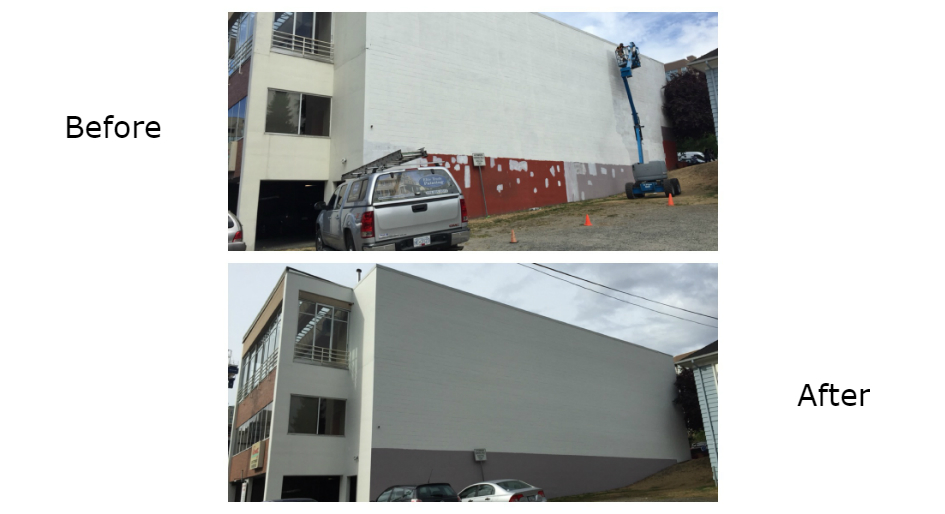
Painting the exterior of a building involves several steps: most buildings must be pressure washed to remove mould, dirt, grease and grime, and then any loose or peeling paint must be removed. The next step is very important: repairing the caulking along windows and trim to ensure no water is getting inside. Finally, it’s time to prime and then paint.

outdoor maintenance

“If you skip one of those steps, you diminish the amount of time the building is going to last. If you don’t pressure wash the building first, you’re painting over surfaces paint doesn’t adhere to, for example,” says Benteau.

Other projects you may want to tackle during your summer maintenance may vary, depending on whether you are working on a small residential building or a large residential or commercial structure. Benteau finds that larger buildings are more concerned with maintaining doors, parkades and other high-traffic areas.

“A parkade probably gets painted every 20 years,” says Benteau. “Doors and frames are probably painted every three to four years because if they’re busy, they get beat up. A general rule of thumb for most people is that you should probably be doing some exterior maintenance every two to three years and there’s always something to do for these large commercial buildings.”

Finally, don’t overlook your building’s steps and decks, which are an extremely high-traffic area and must be maintained more often than any other part of your building.

“The reality is that there are no products out there that will hold up over long term. Steps and decks must be maintained every three years, maximum. There’s not a paint product out there that will last any longer than that and if you don’t maintain your decks, you’re definitely replacing them, and that’s certainly costlier to do,” says Benteau. “Bottom line, instead of lasting five to 10 years, your maintenance is lasting two to three, or sometimes even less. It’s not that much more expensive to do it right.”

For more information, please contact Elite Trade Painting.

Elite Trade Painting

Edmonton welcomes new modular apartment

Edmonton’s first modular apartment made entirely of shipping containers is opening this month at 95th Avenue and 163th Street. Known as Westgate Manor, the three-storey, 20-unit multifamily development will bring much needed affordable housing to the area.

Constructed with an innovative all-steel modular building technology that uses surplus shipping-containers as its structural core, the apartment modules are fabricated in the Ladacor factory in Calgary, then transported to the infill site to be installed. In total the process takes three months, with less than a month needed to erect the modules for the apartment block on site.

Westgate Manor features a mix of two-bedroom and one-bedroom units, all with balconies and patios, attractive landscaping, modern design, and extensive parking.

“The re-purposing of the shipping containers is both an environmental consideration, as well as providing a far superior steel structure,” said AJ Sliviniski, President of Step Ahead Properties.  “Offering schedule savings and less site disruption to the area, the non-combustible, durable steel versus wood material leads to higher public safety, and overall higher quality and lower execution risk with factory manufactured predictability. By the time the project is finished it is indistinguishable from conventional construction.”

Finished with fibre cement siding, the new walk-ups will be a blend of the 1960s-era apartments already on the property, and should be welcoming tenants in the coming weeks.

Ladacor and Step Ahead Properties said they plan to continue their partnership on further apartment projects. Ladacor is also working on various projects for private and institutional developers for apartments, seniors’ lodges and affordable housing. Current projects include a multifamily apartment in Banff and a seniors’ lodge in Hythe, AB.

B.C.’s Pacific NorthWest LNG project cancelled

The Pacific Northwest LNG megaproject in Port Edward, B.C. has been cancelled due to market conditions.

Malaysian energy giant Petronas and its partners have scrapped plans for the proposed natural gas export facility after careful reviews of the project and the state of changing market conditions including low LNG prices.

“We are disappointed that the extremely challenging environment brought about by the prolonged depressed prices and shifts in the energy industry have led us to this decision,” said  Anuar Taib, chairman of the PNW LNG board.

“Petronas and its North Montney Joint Venture partners remain committed to developing their significant natural gas assets in Canada and will continue to explore all options as part of its long-term investment strategy moving forward.”

The Pacific NorthWest LNG project was touted as a major opportunity to grow the B.C. economy. The project represents one of Canada’s largest resource development projects with a total capital investment of up to $36 billion when accounting for upstream natural gas development.

Petronas’ decision to scrap its plan to build the facility is a tough blow for the B.C. construction industry, according to the president of the Independent Contractors and Businesses Association (ICBA).

“We are deeply disappointed that PNW will not go forward, as it means thousands of construction jobs will not materialize,” said ICBA president Chris Gardner.

PNW would have created 4,500 construction jobs, 330 long-term operations positions, and up to $1.3 billion per year in government revenue.

“No jurisdiction does energy extraction in a better, cleaner, more socially responsible way than Canada,” said Gardner. “This is a significant lost opportunity that would have brought many benefits. Canada has to act faster to seize the opportunities that our responsible resource development industries can deliver.”


Vancouver echoes Toronto’s proposed short-term rental rules

City of Vancouver staff earlier this month proposed to City Council short-term rental rules that are markedly similar to rules proposed in Toronto.

If adopted, the proposed rules are projected to legitimize 70 to 80 per cent of the short-term rental activity that is now occurring illegally in Vancouver, according to a City of Vancouver news release. The activity would be permitted to occur in the principal residences of owners and tenants for stays of up to 29 days.

As currently proposed, Toronto’s contemplated rules are projected to legitimize a similar proportion of the short-term rental activity occurring in its jurisdiction, likewise limiting the activity to principal residences, with the difference of a day: stays could stretch up to 28 days. Also similarly to Toronto’s proposed rules, which would require short-term rental hosts to register with the city and platforms to be licensed, Vancouver is looking at requiring short-term rental providers to obtain a business license for a “low fee.”

The move by Vancouver to legitimize certain types of short-term rentals under new regulations comes as listings have surged amid rising housing affordability pressures and rock-bottom rental vacancy rates.

“We received a lot of feedback that reflected both the positive impacts and the serious challenges associated with short-term rentals,” said Kaye Krishna, general manager of Development, Buildings and Licensing at the City of Vancouver. “A lot of residents are concerned about noise, safety and security, while others — homeowners and renters alike — told us they rely on the extra income to support their families and offset their cost of living.”

A public hearing on the proposed rules will occur this fall, with the roll out of regulations slated for next spring. Short-term rentals remain illegal in Vancouver in the meantime, unless they are occurring in properly zoned and licensed hotels and bed-and-breakfasts.

Peter Milczyn named Ontario’s new housing minister

Peter Milczyn, MPP for Etobicoke-Lakeshore, was sworn in as Ontario’s housing minister at a Queen’s Park ceremony this morning as part of cabinet changes announced today by Premier Kathleen Wynne, according to a Government of Ontario news release.

Milczyn’s promotion to cabinet, where he will advance Ontario’s Fair Housing Plan, comes as outgoing housing minister Chris Ballard becomes minister of the environment and climate change, filling a vacancy created as Glen Murray resigns the post.

Murray, MPP for Toronto Centre, is due on Sept. 5 to take the helm of the Pembina Institute as its executive director, the think tank announced today in a  news release.

Advanced sub-metering digs deep

Facility operators and management are beginning to recognize the opportunity to combine granular-level sub-metering with software that analyzes energy data in real time.

Historically, it was typical to install utility meters that captured the total energy consumption for an entire facility. Some facilities would make limited use of sub-meters to measure key pieces of equipment.

More involved sub-metering systems were installed in high-value manufacturing facilities, where the high cost of the sub-metering solutions could be justified. That’s because substantial cost savings could be attained by avoiding additional and unnecessary maintenance costs and preventing equipment shutdowns.

Sub-meter use has grown over the past decade as its functionality expanded beyond industrial applications into the entire green building sector. Now, a completely new generation of sub-meter technology is emerging in the market.

Its cost has come down enough to be economically deployed at the circuit level. These advanced sub-metering systems are designed to scale and address the needs of entire portfolios of buildings. They also have the ability to drill down and meter the individual circuit or piece of equipment.

Combining real-time communication with cloud-based, big-data energy analytics, this new Internet of Things (IoT) technology has the ability to break down energy usage data to the exact location and time that energy is wasted.

Managing energy in real time

Economically generating raw energy-use data and converting it into useful information is at the heart of an effective energy management strategy. Understanding the trends that real-time data highlight can help to pinpoint electrical waste right at the circuit level. With this information in hand, building owners and managers can make data-based decisions about building operations optimization, carbon reduction and potential capital investments.

Consider the case of a compressor that is operating efficiently but begins to experience wear and tear. With benchmarks and thresholds in the software, and real-time notifications, management can be informed at precisely the point in time when it wants to either schedule maintenance or plan to replace aging equipment. Without this knowledge, building managers will see increasing power consumption, and possibly equipment failure at a time that has costs and/or inconvenience to building occupants.

Using only the energy that is required minimizes a facility’s carbon footprint, making real-time energy management increasingly attractive in business environments where cap and trade or carbon pricing is being established. And in many of these environments, financial incentives are being conceived to encourage and accelerate the roll out of real-time energy management solutions, making green initiatives even more attractive.

Applying big data analytics

Big data analytics is allowing companies to become “leaner” in an ever-competitive market by showing them where they can trim costs and use energy dollars more efficiently. This data can be parsed across an entire portfolio or used to pinpoint an individual circuit, and the benefits are numerous.

Deep energy metering can reveal patterns of energy waste, pointing to smarter ways of using energy dollars. Eliminating unnecessary energy consumption and changing operational procedures are just two of the areas where coupling continuous tracking and data analytics can yield a sustainable return on investment.

As an example, significant savings can often be attained simply by turning off equipment that shouldn’t be on. Detailed energy usage data comparing real time with historical data can reveal errors in control system setup or a lack of attention by personnel having control over the on/off function. And using real-time notifications can ensure that if or when the situation reoccurs, it is caught immediately, leading to a “continuous energy audit” capability.

Energy analytics at the circuit level facilitates the broad use of benchmarking, which will increase productivity and lower operating costs. Historical data can be used to set performance benchmarks for individual pieces of equipment. Real-time notifications based on exceeding those recommended benchmarks can alert facility managers and operators that a piece of equipment may be running sub-optimally which, if not corrected, results in wasted energy and increased operating costs.

Precise, ongoing measurement is mandatory in net zero and net positive buildings. The goal there is to minimize energy demand and avoid higher capital costs associated with the energy-generating side of the equation.

Equipment benchmarking, precision maintenance and carbon/greenhouse gas reporting are just three of the many strategies this big data analytics technology brings to commercial, industrial and institutional facilities.

Reducing operating expenditures

Energy profiling at the individual equipment and circuit level can help facility managers identify ways to create value through changes in their operational strategies. A prime example for facilities is when identical production lines have significantly different energy profiles resulting in greater operational costs from one facility or production line to the next.

The benefits of this analysis — reduced operating expenditures — can be applied across all sectors. That includes municipalities implementing energy efficiency programs in public buildings and private sector companies looking to optimize operations, lower energy costs and reduce their carbon footprint.

As an energy data-gathering tool for a facility’s equipment and systems, sub-meters can improve a building’s bottom line by giving greater visibility to its overall energy footprint. Circuit-level sub-metering can measure the energy data from every load in a facility, straight from the circuit- breaker or motor control centre. Some of these advanced, multi-circuit sub-metering systems process the energy data in real time and send a full range of power data, including volts, amps and power factor, to safe server locations where it is integrated into real-time energy-management information systems and sophisticated energy analytics software platforms.

In net zero and LEED-certified buildings, energy profiling provides the detailed data, both historic and real time, that enables facility managers to optimize energy resources and minimize the investment in new generation equipment. After all, energy efficiency is the lowest cost energy resource.

As advanced sub-meter technology with integrated real-time energy-analytics software platforms becomes more economical, it is poised to play a major role in helping facility managers use energy more efficiently. Energy efficiency gains can be achieved through continuous monitoring at the circuit level, with smarter energy management for the entire built envelope.

Paul Mertes, president and CEO of CircuitMeter Inc., has led the company since 2014. For the past 10 years, Paul has focused on the cleantech sector, where he served as CEO of CleanEnergy, a geothermal company, and as a business advisor to the MaRS Cleantech Practice. Paul has a B.A.Sc. (Mechanical Engineering) from the University of Waterloo and an MBA (Finance) from the Schulich School of Business at York University.

Countdown on to roll out of condo law reforms

The countdown to the roll out of changes to Ontario’s condo laws is on.

In just over a month, board directors and unit owners will be able to call or email the newly established Condominium Authority of Ontario (CAO) to ask questions. The non-profit corporation will on Sept. 1 receive its designation as the entity established to provide dispute resolution, education and information services as part of legislative reforms that are due to be phased in starting this fall.

“It’s anticipated the public will seek information from the CAO about common condo issues, including smoking, noise and pets,” Minister of Government and Consumer Services Tracy MacCharles said at a press conference last week. “In addition, it will likely be handling inquiries from condo board directors regarding issues with owners.”

With the volume of inquiries it will receive difficult to predict, the CAO is planning to add people to its start-up team as it prepares to launch a customer service centre.

“One of the concerns that we’ve identified and are addressing is we want to get off to a good start, and in order to do that, you have to be able to respond in a reasonable amount of time,” said Tom Wright, chair of the CAO, who was on hand at the press conference last week. “We’re not 100 per cent sure what the demand is as of yet, so we’re now looking at how can we staff without hiring permanent people necessarily in order to deal with that perhaps initial group of requests that we’re going to be receiving or information requests that we’re going to be receiving.”

The CAO will be looking for trained adjudicators with “experience in the condo community” for its tribunal, which will hear certain types of disputes if they remain unresolved after parties access online self-help tools and mediators. These dispute resolution services will become available through the CAO Nov. 1, as will director training, which will be mandatory for board members elected from that date onward. Director training will take the form of a free, online course, which breaks down three hours of material into seven to 10-minute modules.

The press conference provided an update on the status of legislative changes contained in the Protecting Condominium Owners Act, which was passed into law in late 2015 but has yet to take effect. The bill overhauled the Condominium Act and introduced the Condominium Management Services Act, which will regulate the condo management industry. Although the press conference provided some new details, it mostly reiterated information that has become available over the past several months as proposed regulations and fees have been released for public comment.

The CAO’s operations are expected to be funded partly through a monthly fee of roughly $1 per unit, which will be collected from unit owners and remitted by condo corporations annually. The prorated fees for the last four months of this year will come due Dec. 31.

The CAO is also proposing user fees for dispute resolution services that, if adopted, would max out at $200.

William Stratas, managing director of Eagle Audit Advantage Inc., said after the press conference that he thinks the proposed user fees are too low, citing the need to balance the deterrence of vexatious complaints with the recovery of the tribunal’s costs. But he added the true test of the tribunal will be the caliber of both the complaints that are filed and the tribunal’s decisions, which will be shaped by the members who sit on the tribunal.

“If the CAO tribunal is staffed with industry insiders, or persons who carry a prejudicial set of agendas, it’s going to be a disaster for condo owners,” said Stratas. “If they staff it fully eyes open, in a fair and objective way, with members willing to take the time to truly understand the underpinnings of this industry and the areas and sources of conflict, then there’s hope that good precedents will be established in the tribunal’s initial decisions that will serve as solid foundation for future decision-making.”

When its services become available Nov. 1, the tribunal will hear only disputes relating to records, but its scope could expand based on public input to include other types of disputes.

Also on Nov. 1, the Condominium Management Regulatory Authority of Ontario (CMRAO) will be designated as the entity established in new legislation governing the industry as licensing requirements roll out.

The non-profit corporation is expected to fund its operations through proposed annual licensing fees of $607 for condo managers (less for limited licensees) and a base rate of $799 for condo management companies, as well as $350 for every manager it employs.

Whether management companies will offer to cover the $607 licensing fee for its managers, in addition to the $350 they will have to pay per head, remains to be seen, Robert Weinberg, president of the Association of Condominium Managers of Ontario (ACMO), said after the press conference.

“For the largest companies, I believe it’s almost a quarter of a million dollars they would have to come up with a year for both the manager’s fee and their portion of the fee,” said Weinberg. “In this industry, which has about a 10 per cent profit margin, that’s $2.5 million worth of contracts just to profit to pay for that, so that might be difficult.”

Licensing fees are not the only new costs management companies will face as condo law reforms roll out. Condo corporations will be obligated to increase the frequency of their communication with owners through mandatory information certificates, which will add to administrative workloads.

With management companies likely to hire dedicated administrators to perform this new duty, Weinberg said some providers are considering charging a “disbursement fee” for information certificates to offset the associated expense.

More changes are on tap in 2018, with a code of ethics and discipline and appeals committees slated to be established by Feb. 1, at which point complaints about licensees will be subject to review by the registrar. Still to come are new disclosure requirements for developers and new reserve fund rules for condo corporations.

Condo lawyer Chris Jaglowitz, a partner at Gardiner Miller Arnold LLP, said after the press conference that right now his focus is on getting familiar with the changes as the regulations become available.

“There are new regulatory provisions for almost every new amendment to the Condo Act and we don’t yet know what they all mean and we don’t know how they will apply to every possible situation,” he said. “For simple situations, applying the new regulations should not be terribly difficult, but we often get situations that are unusual, or are partly from column A, and partly from column B, and so how will these new provisions apply in those unusual situations?”

This will take time for condo managers and boards to work through with their legal counsel, said Jaglowitz, adding that confusion over when different requirements take effect is likely to linger until the roll out of the legislative reforms is complete.

Michelle Ervin is the editor of CondoBusiness.

ASHRAE seeks feedback to reduce Legionellosis in building systems

ASHRAE is seeking public comment on Guideline 12-2000, Minimizing the Risk of Legionellosis Associated with Building Water Systems, which is now open for a 45-day public review until September 11.

The guideline will provide essential information and guidance to assist in the control of legionellosis associated with building water systems. It also gives users direction in implementing ASHRAE Standard 188: Legionellosis: Risk Management for Building Water Systems, considered a prime resource an effective water management program to prevent legionella infections.

ASHRAE Guideline 12, developed by the ASHRAE Standing Standard Project Committee (SSPC) 188, is intended for building owners of human-occupied buildings and those involved in the design, construction, installation, commissioning, management, operation, maintenance and service of centralized building water systems and components.

“Our goal with Guideline 12 is to have a strong companion document that works in tandem with ASHRAE Standard 188,” says Michael Patton, member of ASHRAE SSPC 188. “We invite all interested and affected parties to review and comment on Guideline 12 during its public review period. Doing so will help ASHRAE and SSPC 188 create better resources that help building owners minimize the risk of legionellosis.”

According to the Public Health Agency of Canada, the average number of reported cases of Legionnaires’ disease is generally less than 100 per year, but the actual number of cases is thought to be much higher. Bacteria that causes Legionnaires’ disease can be found in various building water systems in all types of facilities. Over the past month, the bacteria was found in apartment buildings in Ontario and Nova Scotia.

Those interested in reviewing and commenting on the guideline can do so at www.ashrae.org/publicreviews. 


Investors peg Dublin as a Brexit beneficiary

Dublin emerges as an investor favourite in recent surveys of the European and global commercial property markets. Second quarter 2017 results from the RICS occupier and investment sentiment indices rank the city as a top projected Brexit beneficiary, poised for both rental and capital value growth.

“The vast majority of respondents in Dublin — 67 per cent — feel market conditions are consistent with the middle stages of an upturn, suggesting growth has further to run,” RICS (Royal Institution of Chartered Surveyors) economist Tarrant Parsons observes in an analysis of the Euro area economy and property market.

In part, Dublin’s market is still climbing out of the deep rut of the financial crisis. Even now, capital values are pegged about 36 per cent lower than they were 10 years ago. Other cities also seen as contenders to accommodate a Brexit-triggered outflow from London are at different stages of their market cycle. More than 50 per cent of survey respondents believe that Frankfurt is at its peak, while about 15 per cent suggest it is already in a downturn.

“Across Germany, a significant 76 per cent of respondents sense valuations are stretched relative to fundamentals,” Parsons reports. “Capital values across Germany as a whole are now 78 per cent higher than prior to the onset of the crisis.”

Since 2016, Germany has surpassed the United Kingdom as Europe’s most active investment market. Approximately 85 per cent of survey respondents defined German markets as “expensive”, while upwards of 30 per cent offered that assessment about the UK and fewer than 20 per cent applied it to Ireland.

“Feedback from London suggests momentum remains subdued. Neither occupier demand nor investment enquiries posted any meaningful growth over the quarter, while 51 per cent of contributors perceive market conditions to be consistent with a downturn,” RICS Q2 Global Commercial Property Monitor states.

“Brexit remains a cloud hanging over the market with 55 per cent of respondents expecting some business relocation away from the UK over the next two years,” says RICS chief economist Simon Rubinsohn. “The biggest beneficiaries of this trend at this stage appear to be Amsterdam and Dublin.”

Allied to acquire half interest in Westbank Vancouver office project

Allied Properties Real Estate Investment Trust (Allied) is acquiring a 50 per cent interest in a Westbank office project in Vancouver at 400 West Georgia Street.

Westbank is planning 345,000 square feet of gross leasable area (GLA) for the building, with completion in early 2020. Located between Homer and Richards Streets, the overall property makes up 20,922 square feet of land. It is between Allied’s Yaletown and Crosstown portfolios, close to the expanding downtown core.

“In addition to deepening our relationship with Westbank and ultimately expanding our Vancouver GLA by 60 per cent, this transaction will enable us to generate an accretive return on our investment from the outset,” said President and CEO Michael Emory. “It will also enable us to acquire an undivided 50 per cent interest in a distinctive urban office property, giving rise to a high levered yield, material accretion and significant value creation.”

Building maintenance provider ABM acquires GCA Services

ABM, a provider of building maintenance and facility services across Canada and the United States, is acquiring GCA Services Group (GCA) for about $1.25 billion.

GCA provides custodial and janitorial services in the U.S., specializing in facilities maintenance, janitorial services, grounds management, vehicle services and outsourced workforce solutions.

The transaction is expected to be finalized by September.

“This transformative and accretive acquisition will accelerate our 2020 Vision by creating a broader platform upon which we can grow profitably and further distinguish ABM as an industry-focused solutions provider,” Scott Salmirs, president and chief executive officer of ABM Industries. “We look forward to gaining insights from GCA, a well-established industry leader with top talent. GCA’s client-centric goals and philosophies align closely with those of ABM, and we are excited about the value this combination will bring to our clients, our employees and our shareholders.”

“We are excited to be joining the ABM family, which will allow us to better serve our clients with more services and greater reach,” added GCA President and CEO Bob Norton. “We believe our combination with a company that shares our vision for profitable growth will lead to significant long-term value for all stakeholders.”