



Articles Archive - Page 530 of 929 - REMINET
REMI

Proactive, Preventative Maintenance

New or old, every building will require repairs at some point. Whether it’s a state-of-the-art office tower equipped with the latest high-efficiency systems, or a dated apartment complex with an envelope 60 years old, no property owner will be spared unwanted capital expenditures indefinitely. But there is something that can be done to lessen the cost and seriousness of those hits: regular preventative maintenance.

Simply put, it means taking a proactive approach to monitoring the condition and components of a building. It means identifying potential trouble spots before they spiral into costly repairs. Think of the car owner who sticks to a regular service regimen: the expense of replenishing coolant from time-to-time is significantly cheaper than installing a brand new radiator. Similarly, a corroding pipe in a building’s plumbing system caught early could thwart a catastrophic flood.

Paul Fritze, a technical engineer and associate at RJC Engineers, is all-too familiar with the problems that can arise from deferred maintenance, neglect, or even from factors beyond an operator’s control—like staffing limitations, building restrictions or budget constraints.

“A building has so many components,” he says. “Unplanned expenditures and resulting deferrals to offset costs are a reality all property managers must accept. But it’s about the ability to minimize those costs and make educated decisions in how to best spend available budgets. It’s also about understanding that each building system has a service life, but to get that full service life requires investment in the form of maintenance.”

As an example, Fritze points to underground parking garages and the mitigation of repair costs that can be achieved through early detection of corrosion. “Because de-icing salts create aggressive environments for concrete garage structures, waterproofing systems are installed on the surface of the suspended slabs to protect against the inevitable decay,” he says. “But as the system wears and deteriorates over time, leaks form allowing the de-icing salts into the slabs. Naturally, the rate of deterioration grows at accelerated rates if left unaddressed.”

In this scenario, the proactive approach would be to locally repair the garage waterproofing system on a timeline that least impacts business. “One of my clients owns a heavily used pay parking garage in downtown Toronto,” Fritze explains. “To minimize overall costs, reduce construction time, limit stall closures and keep the work contained to slower periods, the client uses an annual phased garage waterproofing repair plan versus waiting for a large-scale problem to arise.”

Heading off problems before they grow and spread across many systems is the goal, he says. Better still, is to avoid them altogether by planned maintenance.
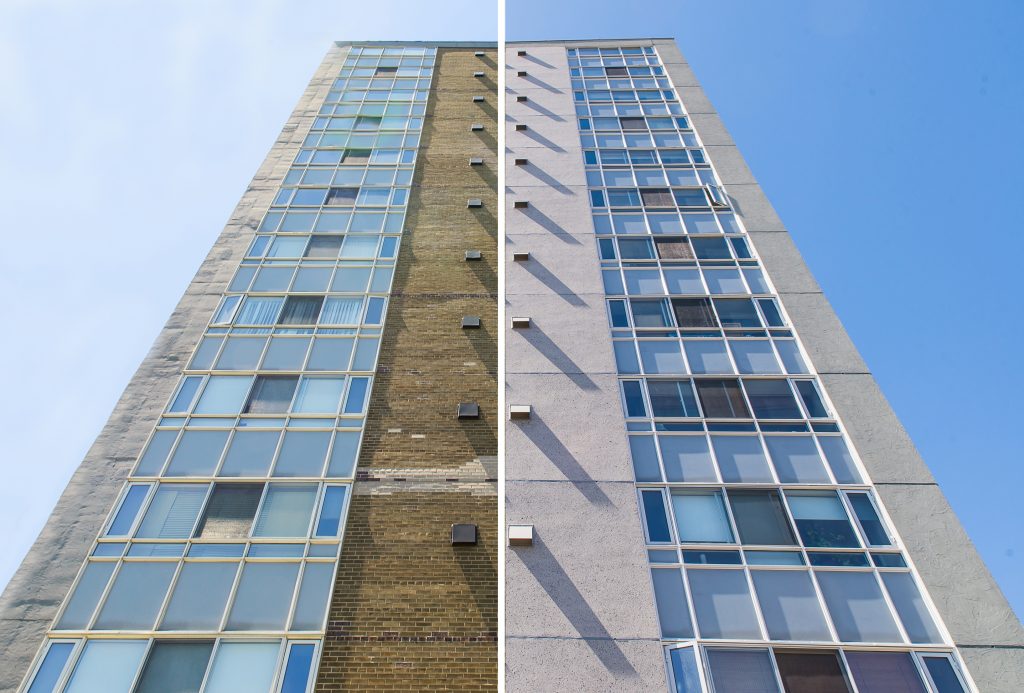
RJC exterior restoration

Incorporating best strategies: it all begins with a BCA

When it comes to creating a building maintenance strategy, Fritze recommends beginning with a good Building Condition Assessment (BCA) and Capital Plan. This is a financial planning tool developed by an engineering consultant (or team of consultants) in order to provide a “snapshot” of your building at the time of the assessment.

The intent of the assessment is to:

  • Create an inventory of and describe the existing building systems;
  • Provide the systems’ ages, general condition and estimated remaining life;
  • Provide estimated repair or replacement costs over a defined timeline. (This can be anywhere from 5 to 25 years);
  • Flag signs of concern warranting immediate action or further investigation.

The scope can also include compliance with various codes and high-level performance evaluations of the systems, as well as provide budgets for soft costs like engineering services and permits. Capital Plans specific to building systems carrying high replacement costs can also be implemented (i.e. roofs, parking garages, asphalt parking, mechanical/electrical equipment, windows and cladding).

In short, an assessment of this type allows owners to develop an expenditure schedule, so costs can be spread out as best as possible and budgets set in advance. It can also assist the owner in timing the performance of project scopes, so related expenditures can be combined to realize cost savings.

In addition to an assessment, Fritze recommends building owners seek consultation before undertaking any large project—up to a year prior to construction. “This will help to refine the construction cost estimates in the BCA, incorporate construction execution factors (i.e. hours of work, phasing, etc.) and define the project scope of work,” he says. “Any consultants you’ll want to hire will understand your business, values and needs. They are trusted advisors who are strategic business partners working with you to deliver a successful project.”

Guiding principles for property managers: steps for early prevention

Aside from seeking a detailed condition assessment, there are other valuable steps property managers can take to proactively maintain their buildings, and these can be done regardless of experience or technical savvy.

“Having a general understanding of the construction process, a feel for when to start a project, how long a project will take and the effects it will have on regular operation of their facility is helpful,” says Fritze.

He also recommends property managers perform regular building walkthroughs with facility maintenance staff and communicate often with tenants and clients to identify potential problems.

Finally, Fritze says it never hurts to develop a strong relationship with the contractors and consultants who’ve become familiar with your building. “Given all the factors that are beyond our control—from contractor availability, to time of year and tendering climate—the more property managers can do to thwart those costly building repairs, the better.”

Learn more about preventative maintenance and ways to extend the life of your building at: www.rjc.ca. For more information on building repairs, please contact Paul Fritze.


Single Canadians hesitate on home purchases: survey

As Canadians’ household debt ratio climbs higher, single Canadians that are interested in purchasing a home on their own are not the ones to blame for the increase. According to a RE/MAX survey conducted by Leger, although 26 per cent of respondents are interested in purchasing a home on their own, nearly half (43 per cent) have less than $5,000 in debt, making it less than likely that debt is impacting their decision to purchase a home.

For more than half of single Canadian respondents (52 per cent), the reason they’re unwilling to buy a home at this time comes down to economic uncertainty and expensive home prices. Meanwhile, 81 per cent of singles that are interested in purchasing a home say they have the ability to do so and finance a property on their own. Thirty-seven per cent of respondents said they will use a loan or mortgage, while 35 per cent already have the savings available to make the down payment.

“It’s concerning to see qualified buyers showing hesitancy toward home ownership. Price and economic factors aside, the additional unnecessary layers of government intervention have left many feeling pushed out of the market, or uncertain of it,” said Christopher Alexander, executive vice president, RE/MAX of Ontario-Atlantic Canada, in a press release.

Thirty-eight per cent of single Canadians who are interested in buying a home agree that it is a good investment, especially for those living in urban regions (51 per cent). Meanwhile, 27 per cent of respondents agreed that the decision to purchase a home is widely hinged on the fact that they will have more flexibility in their living space.

“Purchasing a property alone often reaps great long-term benefits from an investment perspective,” added Elton Ash, executive vice president, RE/MAX of Western Canada. “There is a great opportunity for asset growth, particularly as home prices continue to increase in cities like Toronto and Vancouver, pushing the average sales price up in all surrounding regions as well.”

The survey also found that 12 per cent of single buyers are most interested in purchasing a single-detached home over other property types. Men are twice as likely to say they are considering purchasing a home on their own, as 37 per cent agree, compared to 17 per cent of women surveyed. The survey also found that single Canadians living in urban areas are more hesitant to purchase a home on their own, compared to singles in suburban regions, due to high home costs (48 per cent, compared to 43 per cent).

Design revealed for SickKids’ new Patient Support Centre

Designed by B+H Architects, the new Patient Support Centre (PSC) is a 22-storey development located on The Hospital for Sick Children (SickKids) campus. According to a press release, it’s set to create “a new precedent for healthcare workplace design in Canada.”

The PSC will be the first project to comply with Toronto’s ­Tier 2 Building Standards. It will feature terraced green roofs contribute to the building’s sustainability and offer physicians and hospital staff further opportunities to engage with the city. The PSC will also house a café and retail atrium at the ground level.

“The design of the new Patient Support Centre provides an important architectural framework for a workplace environment designed to transform the way SickKids works,” says Patrick Fejér, project lead and senior design principal at B+H in a statement. “The PSC is being designed to create an inspiring environment that supports the needs of health-care providers, fosters collaboration and helps to accelerate innovation.”

Led by B+H’s Center for Advance Strategy, the workplace strategy for the PSC is being designed to act as a support system for collaboration, inspiration, and engagement to help strengthen talent performance and foster a thriving organizational culture.

“I’m really excited about this new environment, which will facilitate cross-disciplinary collaboration. It supports our mission to create an innovative workplace that will retain and attract the best talent possible,” Peter Goldthorpe, vice-president, transformation, SickKids.

PRSM releases best of janitorial practices report

According to the Professional Retail Store Maintenance Association (PRSM) – the authority on retail, multi-site facilities management – janitorial expenses represent 13 per cent of annual retail maintenance costs.

“Janitorial is one of the retail industry’s largest expenses,” said Bill Yanek, CEO, PRSM. “In fact, according to PRSM 2017 Retail Facilities Maintenance Industry Overview, janitorial expenses are the third largest expense for retail brands.”

In its newest publication, 2019 Best Practices: Janitorial, a collection of PRSM’s most actionable and dependable case studies that support facilities management professionals  – the 12 best practices featured provide insights into the different aspects of a janitorial program such as: developing the scope of work, establishing a cleaning schedule, how to maintain different floor surfaces and in-house versus out-of-house programs.

The case studies include:

• Self-Performing vs. Third-Party Service Delivery in Floor Care and Janitorial Trades
• Consolidating a Locally Managed Janitorial Program into a Corporately Managed Program
• Janitorial Program Management – Self-Perform / Subcontract / Both
• The Importance of Quality Assurance
• Attendance Tracking by IVR or Geotag/Geofencing
• Hours-Based vs. Performance-Based Contract
• Cleaning Service Bundling: Increased Results & Efficiency
• Floor Care Scheduling
• Keep Floors Inviting and Clean—No Matter the Type
• Hard Floor Care That Makes Retail Shine—A Holistic View
• Extending the Life of Your Carpet
• Creating a Standardized Cleaning Chemical Program.

Available to members, the report aims to illustrate to retailers on how to reduce expenses and operate more efficiently as they develop and execute janitorial programs.

Multifamily assets post value increase in 2018

Multifamily assets performed well for institutional investors again last year. Newly released 2018 annual results of the MSCI/REALPAC Canada Property Index peg the total return at 11.5 per cent across 394 directly held residential properties. That’s both an improvement over the sector’s 10.3 per cent total return in 2017 and well above the 7.4 per cent all-property total return for 2018.

Capital growth drives that number. Residential was the only sector that could boast rising values in every Canadian market where index participants own properties — ranging from a 12.2 per cent jump in Toronto to a 1.4 per cent gain in Edmonton — while an average income return of 3.9 per cent is in line with continuing low cap rates.

“Residential yield has nicked down,” observed Simon Fairchild, executive director with the index producer, MSCI, as he unveiled the results in Toronto late last week. However, he also noted that “record low yields and record high prices” currently characterize the Canadian investment property market in general.

The 45 portfolios participating in the Canada Property Index collectively hold 2,424 assets, comprising more than 522 million square feet of space and valued at approximately CAD $160.7 billion. Multifamily properties account for a roughly $17.5-billion share or almost 11 per cent of the index’s capital value.

Multifamily assets delivered the strongest returns in the best performing markets — capital growth of 8.6 per cent in Vancouver, 5.5 per cent in Ottawa, and 5.3 per cent in Montreal, in addition to Toronto’s double-digit tally — but were also a rarer source of capital growth in the weaker markets of Halifax, Edmonton and Calgary. Participating on a panel of industry insiders tasked with providing on-the-spot feedback on the 2018 investment results, Steven Marino, senior vice president, portfolio management, with GWL Realty Advisors, credited multifamily as a major contributor to Calgary’s climb back to a 1.4 per cent total return after two years in negative territory.

“I think office is still very different than multifamily and industrial,” he said. “The residential market has certainly recovered.”

Among the four property sectors, industrial posted the strongest Canada-wide total return for 2018, at 13.8 per cent, representing an upward surge from 10.2 per cent in 2017. Office properties modestly surpassed the all-property average, registering a total return of 7.8 per cent, an improvement from 6.2 per cent in 2017. Retail bottomed out the chart with a total return of 4.4 per cent, slipping from 5.3 per cent in 2017.

“Industrial and residential tend to be strong wherever you look,” Fairchild said. (Industrial properties in Edmonton and Winnipeg were the exception, as they lost 1.1 per cent and 0.8 per cent in value, respectively.)

That’s also reflected in where investors are putting their money. Last year, index participants channelled about $1.3 billion into residential properties, representing nearly 19 per cent of their collective net investment. That’s up from $554 million, or 10 per cent of net investment, just four years earlier. Spending on industrial properties was even more generous, at nearly $1.5 billion, up from about $613 million in 2014.

The seven property funds participating in the MSCI/REALPAC Canada Property Fund Index have always offered a more even property mix with less weight given to retail, in particular, than is found in the directly held portfolios represented in the Canada Property Index. Yet, the funds, too, register increasing residential and industrial exposure. As of yearend 2018, residential properties account for 20.3 per cent of the Property Fund Index, up from 16.8 per cent three years earlier. Industrial’s share has gone from 18.4 to 19.7 per cent in the same period.

“Certainly, there is an active shift going on with the funds toward these two (residential and industrial) sectors and efforts to balance portfolios,” Fairchild said.

On the new construction front, activity has also picked up from earlier in the decade. In 2014, for example, just $47.5 million or 2.4 per cent of index participants’ development expenditures went to residential. “We are seeing a lot more of our peers move into the development space,” Marino reported.

B.C. wood design awards nominees announced

Wood WORKS! BC has announced the nominees for the 2019 Wood Design Awards. There are 103 nominations in 14 categories, all of which recognize excellence in contemporary design and building with wood.

The winners will be announced at the 15th annual Wood Design Awards evening, to be held on Monday, March 4th at the Vancouver Convention Centre (West), where they will be recognized for their leadership and innovation in wood use. More than 400 design and building professionals, including architects, structural engineers and project teams along with industry sponsors will be attending the highly anticipated evening event.

Submissions this year are from many locations in B.C. as well as the US and Asia, with international projects in China, Korea and Tajikistan. A diversity of projects of all types and sizes demonstrating outstanding architectural and structural achievement using wood are among the nominees, which include a research laboratory, an energy facility, a winery, First Nations structures and mid-rise projects.

The panel of four judges were: Ethan Martin, PE, Northwest regional director – WoodWorks, Portland, OR; Kimberly Johnston, Architect AIBC, MRAIC, LEED AP, Principal, Johnston Davidson Architecture + Planning, Vancouver; Angelique Pilon, Director, Urban Innovation Research, UBC Sustainability Initiative, University of British Columbia, Vancouver; and Trevor Hedstrom, Design Manager, Winton Homes & Cottages, Prince George.

“We are impressed by the calibre of nominations as well as the variety of building types and sizes of structures using wood. In addition to some very innovative and distinctive buildings, there are more projects this year that are focused on building performance and construction efficiencies, which are two key benefits of using wood. This is exciting as we are celebrating a milestone of 15 years of Wood Design Awards in B.C.,” stated Lynn Embury-Williams, executive director of Wood WORKS! BC.

The Wood Design Awards are presented by Wood WORKS! BC, the Canadian Wood Council and its member associations with funding support from Natural Resources Canada and Forestry Innovation Investment.


Photo: UNBC Wood Innovation Research Laboratory, Prince George by Stantec Architecture Ltd., Vancouver, is nominated in the Environmental Performance category.


Crestpoint and Anthem acquire Victoria’s Tillicum Centre

Crestpoint Real Estate Investments and Anthem Properties have purchased the Tillicum Centre in Victoria for $110 million.

According to a press release, the shopping centre less than five kilometres from downtown Victoria with more than 40 stores including Lowe’s, Save-On-Foods, London Drugs, Winners and Cineplex. Its central location, strong anchors and community amenities make it a regional shopping destination for the Capital Regional District.

“This is an excellent acquisition for us,” says Kevin Leon, President of Crestpoint in a press release. “Greater Victoria has emerged as one of the most desirable markets in Canada due to its growing population, diversified regional economy and strong fundamentals in the commercial real estate market. This situation is evident in the strong performance of the key tenants at Tillicum.”

Tillicum Centre was originally built in 1982 and was recently renovated in 2016. Crestpoint and Anthem will work together to ensure the shopping centre continues to evolve to meet the growing needs of Greater Victoria and its residents.

“Tillicum Centre is a tremendous asset that adds meaningfully to our diversified portfolio,” says Eric Carlson, CEO of Anthem in a press release. “We have remained invested in the Greater Victoria market for decades and this addition reinforces our real estate strategy.”

Study reveals hand hygiene adherence among paramedics low

Compliance with hand hygiene in emergency medical services seems to be “remarkably low,” according to an observational study of ambulance staff practice published in Emergency Medicine Journal.

The study finds that compliance with basic hygiene standards – such as keeping short, clean nails (83 per cent); hair short or tied back (99 per cent), and no jewellery worn (62 per cent) – is high. However, in all 1344 hand hygiene triggers recorded during this period, compliance with hand hygiene was “poor”. The researchers also suggest over-reliance on the use of gloves indicates that these staff may be more aware of their own infection risk rather than that of their patients.

Compliance with World Health Organization (WHO) guidelines on the five triggers for hand hygiene using either antiseptic rub or soap and water was assessed. These triggers were: (1) before touching the patient; (2) before any ‘clean’ procedure, such as an injection or cleaning a wound; (3) after contact with bodily fluids/wounds; (4) after touching the patient; and (5) after handling the patient’s belongings or anything in the immediate vicinity, such as the stretcher harness.

When broken down separately by triggers, compliance was just three per cent before touching a patient and two per cent before any ‘clean’ procedure. This rose to eight per cent after contact with bodily fluids, 29 per cent after touching the patient, and to 38 per cent after touching belongings, etc.

Paramedics used gloves in just over half (54 per cent) of the recommended instances, with new gloves worn before touching patients around half the time (48 per cent), but in only 14 per cent of ‘clean’ procedures. There was a tendency to wear the same pair of gloves throughout different indications-for example, after touching a contaminated site and touching the patient for the first time (21 per cent) or before a ‘clean’ procedure (64 per cent).

Gloves were also worn when there was no obvious need-no risk of bodily fluids, for example. And hand hygiene was less likely when gloves were worn. Proper hand hygiene was observed in two per cent of such instances, and in nearly a third of the indications (30 per cent) when no gloves were worn, suggesting an over-reliance on gloves to ward off the risk of infection, say the researchers.

Compliance rate varied substantially among the four countries, with paramedics in Denmark topping the league table.

The researchers wanted to assess how well paramedics in different countries complied with recommended hand and basic hygiene standards, including the use of gloves, to protect themselves and their patients from the risk of infection.  Despite concerted efforts to tackle the prevalence of healthcare-associated infections (HAI), the risk remains high, affecting up to one in 10 patients in developed countries.

The study was conducted in Finland, Sweden, Denmark and Australia. Overall, 240 hours of observation occurred between December 2016 and May 2017 during which time 77 paramedics dealt with 87 patients.

Tricon expands multifamily development program

Tricon Capital Group announced it has expanded its Toronto multifamily development program, Tricon Lifestyle Rentals (or “TLR”) to over 3,000 units with the addition of its seventh project in downtown Toronto.

The new mixed-use development built in partnership with TAS is located at 7 Labatt St. in Toronto’s downtown east submarket on a 1.3 acre site that is fully zoned for a 560,000 square foot building.

The addition of the project at 7 Labatt brings Tricon’s multifamily development pipeline to over 3,000 units with an estimated total cost of approximately $1.2 billion and targeted development yields of 5-6 per cent; Tricon’s average ownership stake in this portfolio is approximately 30 per cent. The seven projects are expected to be completed over the next three to four years.

“Tricon has committed to building a market leading purpose-built rental platform in Toronto and continues to execute on this plan with the addition of its latest project in the thriving Corktown neighbourhood,” said Tricon’s President and CEO Gary Berman. “Even in the context of a competitive land market, we have been able to secure compelling sites at an attractive land basis by partnering with strategic developers and institutional investors seeking long-term cash flow.”

“Toronto continues to support extremely compelling rental economics with immigration in excess of 100,000 each year, a diverse economy, high quality of life, and growing status as a global city,” he continued. “During 2018, year-over-year rental growth topped 10 per cent and vacancy remained very constrained at less than 1 per cent, according to UrbanRental. Tricon is at the forefront of providing class-A multifamily rental apartments within the most sought-after locations across the city, and is leveraging 30 years of development experience to pursue strong investment returns for our investment partners and shareholders.”

Tricon properties  

The project at 7 Labatt is immediately south of the Regent Park re-vitalization, a 69 acre master plan that has been transformed to a vibrant, family-oriented urban community. The site is in close proximity to cultural, community and state of the art athletic amenities, and offers convenient access to three downtown streetcar lines as well as the Don Valley Parkway. The project will include approximately 600 residential units, expected to be split evenly between rental and for-sale condominium units. Tricon’s interest in the project site was acquired from TAS, a community-centric mixed-used developer, and the project will be developed in partnership with TAS with construction expected to commence in mid-2020 and completion anticipated in late 2023. The total equity commitment for the project is approximately $60 million (~C$80million), with 30% from Tricon, 50 per cent from an institutional investor, and 20 per cent from TAS.

The Selby, located at Bloor and Sherbourne streets, commenced initial leasing in December 2018. Interest in the building has been strong across multiple demographic cohorts, with leasing activity picking up into the new year and per-square-foot pricing well above underwritten assumptions. Leasing activity is expected to accelerate as upper floor suites are released and additional amenities are opened including an Oliver and Bonacini restaurant, the mansion, spa, and pool. In addition, the launch of The Selby marks the introduction of the Tricon House operating brand, which brings customer-focused and lifestyle-oriented apartment living to Toronto. Tricon House buildings are defined by architecture and design excellence, exceptional amenities and common areas, service levels that simplify our residents’ lives, and a commitment to resident community.

The Taylor at 57 Spadina Ave., commenced construction in Q1 2018 with the demolition of the existing retail building and has materially completed site excavation. The Entertainment District submarket where the project is located has sustained above-average rent growth as it continues to be one of the most sought-after rental neighbourhoods in Toronto for renters. Average rents in this node were C$4.10 per square foot as of Q4 2018, according to Urbanation, which is meaningfully above Tricon’s underwritten rents. Meanwhile, 40 per cent of construction costs have been awarded and are in line with budgeted expectations.

Tricon Lifestyle Rental’s other developments, including Scrivener Square in the Rosedale/Summerhill neighborhood, two sites at the West Don Lands adjacent to the historic Distillery District (in partnership with Dream Unlimited Corp. and Kilmer Group), and 8 Gloucester in the Yonge & Bloor neighborhood, are all currently in the design stage with construction projected to start in 2019-2020.

Tricon U.S. multifamily development projects

In the U.S., Tricon is pursuing an orderly exit of its two multifamily development projects. Both buildings are expected to be sold in 2019 with the net proceeds used primarily to reduce Tricon’s corporate debt. Going forward, Tricon intends to only invest in businesses where it can obtain scale and hold a leadership position, and aims to increase its exposure to investments with predictable rental income and cash flows which may include multifamily investments.

At The McKenzie, adjacent to Dallas’ affluent Highland Park neighbourhood, construction of the 183-unit rental building was substantially completed during the fourth quarter of 2018 and lease-up is progressing well. The building is being actively marketed for sale. At The Maxwell in Frisco, construction of the 325-unit rental building continued as planned and is expected to be substantially completed in early 2019, while lease-up is currently in the early stages.

Quadrangle forms partnership with UK-based BDP

Building Design Partnership (BDP), a major UK-based international firm of architects, designers, engineers and urbanists, has made a strategic investment in Toronto-based architecture and interior design firm Quadrangle. Quadrangle will lead Canadian operations and BDP’s North American expansion. Quadrangle is now owned by a group that includes BDP as its most significant investor, holding a minority stake.

“Quadrangle supports our strategy to grow operations in the Canadian marketplace and greatly enhances our expertise and resources. The addition of a 200-strong studio in one of North America’s largest cities will not only provide exceptional opportunities for our people, it will also enable both BDP and Quadrangle to expand our services into new regions,” said John McManus, chief executive officer of BDP, in a press release. “BDP’s collective grouping of professions design with a progressive outlook and a sensibility towards the creation of a sustainable and human environment. We are confident that our culture and ethos will be greatly enhanced by the addition of Quadrangle. We are also delighted to welcome four of Quadrangle’s principals to the BDP Group Board.”

“We are incredibly excited to join BDP,” added Anna Madeira, executive principal at Quadrangle. “This partnership infuses our business with greater expertise, services and resources that we can offer to our clients, and it enables us to provide our staff with increased opportunities to work on diverse projects.”

Quadrangle’s portfolio includes work in commercial, mixed-use, multi-unit residential, content media and retail markets, as well as specializations in master planning, accessibility, sustainability and adaptive re-use. Quadrangle’s team of over 200 architects, interior designers, technologists and support staff will continue to operate under the Quadrangle name, at the direction of Quadrangle’s principals.

Quadrangle’s current projects include Yonge-Sheppard Centre, a large mixed-use development in North York; 80 Atlantic Avenue, Toronto’s first wood-frame office building in over a century; and Downtown Markham, a large-scale mixed-use development that includes retail, housing, office and hospitality in an urban setting.

BDP is a multi-disciplinary practice that provides architecture, interiors, engineering, lighting, acoustics, landscape and urban design services. The UK-based firm also has studios in China, India, Ireland, the Middle East, Netherlands and Singapore. BDP’s portfolio includes work in the education, healthcare, heritage, residential, cultural, retail, science and research, transportation, sport, office and urbanism sectors. The firm has over 1,000 employees.

BDP’s current work includes providing full interdisciplinary design services to restore and protect the future of the Palace of Westminster. In Toronto, its portfolio includes a three-level retail podium for RioCan at The Well, a large mixed-use commercial development that is currently under construction.

Ontario aims to modernize real estate laws

For the first time in 15 years, the Ontario government is reviewing the Real Estate and Business Brokers Act, 2002 by seeking public input in an effort to modernize real estate laws. The Act regulates real estate and business brokerages and the individual brokers and salespeople that are employed by a brokerage.

“It has been almost two decades since the last comprehensive review of the Real Estate and Business Brokers Act. The market has dramatically changed since then,” said Bill Walker, Minister of Government and Consumer Services, in a press release. “Our government is looking for input from the public, including homeowners, renters and real estate professionals, about strengthening the legislation so people are better served.”

The government will be reviewing the rules of the Act during consultations and review to determine how best to modernize.

Ontarians can fill out a survey at Ontario.ca/RealEstateAct. The government is also accepting feedback on a consultation paper posted to the Ontario Regulatory Registry. Both the survey on modernizing real estate laws and feedback on the consultation paper will close on March 15, 2019.

“We need to make sure the rules governing real estate professionals, and the brokerages that employ them, are efficient, fair and up-to-date with modern realities,” added Walker. “This review is part of our government’s plan to strengthen consumer protection, increase transparency and make life better for the people of Ontario.”

“The rules governing Realtors were set 16 years ago,” said Tim Hudak, CEO of the Ontario Real Estate Association, in a statement. “The industry has changed tremendously since then. It’s time for the legislation, as well as enforcement and education, to catch up with the modern real estate market. Updating the rules will increase professionalism in our industry, which is what Realtors want and what home buyers and sellers deserve.”

B.C. and Ontario to lead construction growth

British Columbia and Ontario are projected to lead construction growth in Canada, according to the labour market forecast released by BuildForce Canada.

“British Columbia is projected to lead construction growth in Canada, propelled by the start of a liquefied natural gas terminal, and transportation and infrastructure construction,” says Bill Ferreira, executive director of BuildForce Canada. “Ontario also continues to grapple with record levels of construction project activity and recruiting challenges. However, labour demands are projected to plateau or recede in most other provinces.”

BuildForce Canada’s 2019-2028 Construction and Maintenance Looking Forward nation report forecasts construction employment in Canada will strengthen modestly through 2020, as demands driven by major energy, public transportation, and other infrastructure projects rise to a near-term peak, offsetting a continued softening in housing starts.

While employment in the Canadian construction industry will see little change over the next decade, adding approximately 44,100 workers, or rising a mere four per cent, when coupled with the anticipated retirement of more than 261,000 workers, the country’s construction and maintenance industry will need to recruit an additional 300,200 workers by 2028.

For the first time since 2009, employment demand is projected to ebb after 2021, once peak project requirements are met. Slower population growth limits construction expansion nationally over the latter half of the 2019–2028 scenario period, although a period of moderate growth is expected to follow in most provinces to 2028.

Labour demands in the non-residential sector will exceed demands in the residential sector over the next 10 years.

At the end of the decade, non-residential employment is expected to increase by 35,700 jobs – an overall increase of six per cent, with gains in maintenance, and industrial, commercial, and institutional (ICI) building construction offset by modest declines in engineering construction.

Industry retirements will be an important national labour story over the coming decade. Canada’s construction industry must face the challenge of the retirement of more than 261,000 workers – 22 per cent of the current labour force. Based on historical trends, Canada’s construction industry is expected to draw in an estimated 221,300 first-time new entrants aged 30 and younger from the local population. Much of the expected entry of young workers will depend on industry’s ability to keep youth interested in the trades.

The development of skilled tradespersons in the construction industry takes years, and often requires participation in a provincial apprenticeship program. An ongoing commitment to training and apprenticeship development will be necessary to ensure there are sufficient numbers of qualified tradespeople to sustain a skilled labour force over the long term.

Building a sustainable labour force will also require the construction and maintenance industry to increase recruitment from groups traditionally underrepresented in the current construction labour force, including women, Indigenous Canadians, and new Canadians.

“Maintaining capacity to meet construction labour force needs will require focused efforts on recruiting, training, and retaining young workers, even under a slower-growth scenario,” says Ferreira. “Even if the full potential of interprovincial mobility is realized, industry will likely still need to expand recruiting efforts for new workers from local sources of labour, from other industries, and from new immigrants to meet the industry’s long-term needs.”

Renovating your apartment: Is it worth it?

Renovations or retrofits to an investment property that increase rents and/or decrease operating costs may also increase a property’s value. Cost and value, however, are not synonymous, and not all renovations are as profitable as one might expect.

The term ‘retrofit’ is a fairly broad term that includes capital expenditures that:

a) Extend the useful economic life of the property (i.e. replacing the roof, boiler, etc.);
b) Reduce operating costs (i.e. utilities, water, insurance, etc.); and/or
c) Add new features or amenities to the property (i.e. dishwashing machine, in-suite laundry, etc.).

In theory, a retrofit should be completed when the incremental value created by the retrofit exceeds the present value of its cost. Let’s break this down.

How do we estimate value?

There are three primary approaches to estimating value of commercial properties, such as multifamily apartments:

1) The Direct Comparison Approach;
2) The Cost Approach; and
3) The Income Approach.

For multifamily apartment building valuations, the Direct Comparison and Cost Approach are typically used as secondary methodologies to test the reasonableness of the value derived from the Income Approach. In its simplest form, the Income Approach is based on the following formula:

Value = Net Operating Income (NOI) / Overall Capitalization Rate (Cap Rate)

The correct application of the Income Approach requires matching a stabilized NOI estimate with a corresponding cap rate. Changing either of these variables results in a change in the value of the property, as shown below:

Property Value Increases when: a) NOI increases; and/or
b) Cap rate decreases.

Property Value Decreases when: a) NOI decreases; and/or
b) Cap rate increases.

Investors often make the mistake of thinking the cap rate and NOI are two independent variables that can be estimated in isolation of one another. In reality, the relationship between the two is a complicated one. For example, a capital expenditure, like a new roof, might enhance the economic life of a building although it may do little to increase rents. If the NOI doesn’t change as a result of the new roof, does that mean the property’s value doesn’t change either?  In all likelihood the cap rate would be adjusted downward to reflect the incremental value added by the new roof, but by how much should the cap rate be adjusted downward?

How do I calculate the present value of the retrofit costs?

It seems simple enough—add up the all invoices and voila, there’s the total cost of your renovation project. Calculating the true cost of a renovation project, however, may involve further considerations:

  • Are there any financial incentives being offered by government or industry that can potentially offset your up-front costs? Are these incentives paid in a lump-sum up-front payment or are they received over time in future years?
  • Have you included a management fee to reflect your time and expertise in executing the renovation project (i.e. obtaining permits, obtaining quotes, hiring trades, managing trades, etc.)?
  • Has lost rent throughout the renovation project been accurately accounted for?

To renovate or not: A simplified case study

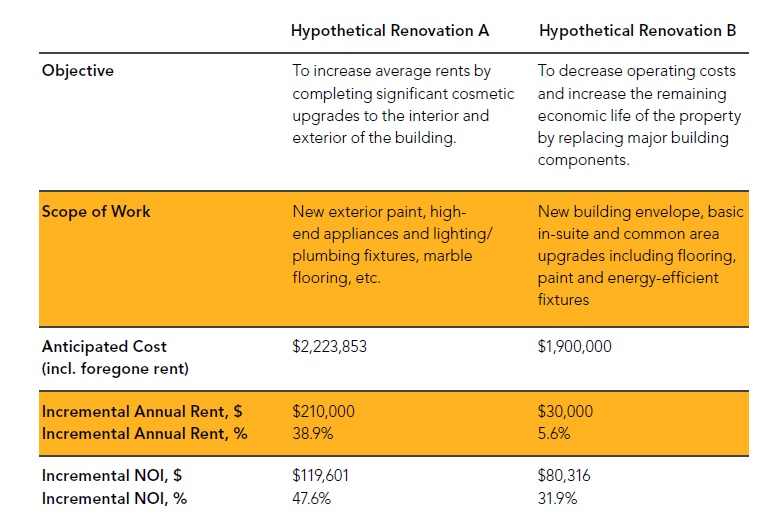
Let’s assume you own a 50-unit apartment building built in the 1960s. The property has an excellent location and despite dated interior and exterior finishings, the property has operated at full occupancy in recent years. You are currently debating completing one (or neither) of the following renovation projects:

renovating your apartment

You have researched your property’s competitive positioning within its market and based on this analysis, and the scope of each retrofit project, you have estimated Hypothetical Retrofit A will result in greater incremental annual rent and NOI, albeit at a slightly higher anticipated cost. What should you do? Some (but far from all) of the considerations you should keep in mind include:

  • Are there rent controls that may limit how much and when you can increase rents?
  • How will your property assessment, and hence property taxes, be impacted?
  • How will your property’s post-retrofit average rent and operating costs compare to the broader market?

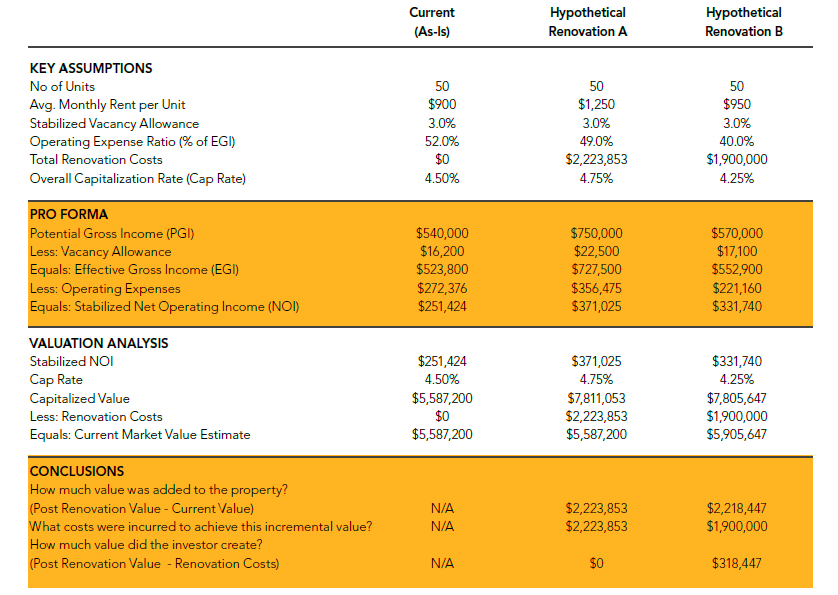
The following analysis compares the property’s current ‘as-is’ value against its ‘as-renovated’ value based on Renovation A and B. Note the average rents and operating costs are different in each scenario, as is the cap rate. In short, a higher cap rate for Renovation A reflects the added risk of targeting the small ‘high-end’ segment of the market whereas the cap rate for Renovation B accounts for the relative safety of having rents at current market levels, plus the expectation of no major capital expenditures over the near term.

renovating your apartment2

Both Renovation A and B increase the value of the property but only Renovation B results in an increase in value. In other words, the value added to the property in Renovation A equals the cost of Renovation A, meaning there is no excess cash (profit) left for the investor (assuming no fees are included in the renovation cost). Would you invest $100 to receive $100 in return? Probably not.

On the other hand, Hypothetical Renovation B created over $300k in value. Should the investor undertake this project? What if the investor created $200k in value, should he or she still undertake this renovation project? The answer to this question depends on internal factors specific to the property and external factors related to the broader market. In the end, spreads between cost and value provide investors with opportunities to make profitable investment decisions. Understanding how and why cost and value may be different is, in large part, what differentiates successful investors from the rest.

JT Dhoot is a Chartered Business Valuator (CBV) and Accredited Appraiser (AACI) with over 10 years’ experience in valuations, real estate development, and private equity. He can be reached by email at [email protected], or by visiting his website: www.omnisvaluations.com

Homes not so sweet for people with disabilities

Accessibility is already a major determinant of where approximately nine million Canadians choose to spend their money, and it is projected to continue gaining market influence. Just 14 per cent of respondents to a recent survey — conducted by the Angus Reid Institute on behalf of the Rick Hansen Foundation — express no concerns about mobility, hearing or vision impairments either now or within the next 10 years, while 64 per cent recognize the possibility they’ll face a new or worsening ailment in the coming decade.

A representative randomized sample of 1,800 Canadians were asked about their experiences and perceptions relating to barriers in the built environment, and policies and programs to support accessibility. The findings (considered an accurate societal snapshot with a 2.3 per cent margin of error, 19 times out of 20) depict generally greater confidence in public spaces than the private realm, with shopping malls receiving the best rating for ease of access.

“This research demonstrates the increasing prevalence of disability across our nation and the growing importance of ensuring the places we live, work and play are accessible for people of all abilities,” says Rick Hansen, founder of the Rick Hansen Foundation. “It also outlines a significant consideration for businesses and service providers in planning accessibility infrastructure. Having universal standards that measure where we’re at and provide a road map on how to move forward is critical.”

Underscoring issues and opportunities for residential developers, rental housing landlords and condominium boards, one third of survey participants acknowledge that their homes could be problematic for residents or visitors with a disability. More than one quarter of those who currently report a disability are planning to move — double the number who will renovate or make alterations to their existing dwellings.

“While one in three Canadians currently say they have issues getting around their own home, a full majority say they are anticipating challenges moving around at home in the future,” reports Shachi Kurl, executive director of the Angus Reid Institute.

Half of the survey respondents who report neither challenges of their own, nor connections to people with disabilities, nevertheless indicate that it would be appealing to move into a new home that has attained certification for accessibility. That percentage jumps to 78 per cent among those who currently experience a mobility, hearing or vision limitation.

Fully 90 per cent of survey respondents place a priority on accessibility, although 37 per cent maintain that cost feasibility should be considered. New construction is tagged as the most obvious place for that to happen. More than two-thirds of respondents endorse universal accessibility in new buildings, while that expectation drops to 31 per cent for existing buildings.

Influencing spending decisions

Upwards of 81 per cent of respondents who have an impairment or are likely to be accompanying someone with a disability report that malls, large chain stores, large chain restaurants, public buildings and medical offices are not difficult to enter or navigate. Fewer than 50 per cent offer the same assessment of other people’s homes.

Smaller independently owned stores and restaurants are also deemed less welcoming. Respondents who identify as “affiliated” with people with disabilities actually have a somewhat more negative view of these venues than respondents who have disabilities themselves.

Forty-five per cent say small restaurants are “difficult” spaces and 48 per cent say the same of small stores, whereas 40 per cent of respondents with disabilities say small restaurants are “difficult” and 43 per cent give that rating to small stores. An equal and sizeable percentage of both groups — 23 per cent — apply the label, “difficult”, to movie theatres.

An observer with lived experience theorizes that friends and family may simply be more shocked at circumstances they encounter less frequently. Regardless, it’s a group with economic clout.

“People with disabilities are often used to facing barriers in their lives as it’s something we encounter daily,” reflects Brad McCannell, vice president, access and inclusion, with the Rick Hansen Foundation. “There are many more caregivers than there are people with disabilities, and they are also making many of the decisions about which places to frequent or avoid. So this has significant implications.”

Notably, 531 respondents, representing nearly 30 per cent of the total database, report they try to avoid properties they know or suspect to be inaccessible. Absence of elevators or too many stairs is the most common deterrent, which 56 per cent of this group cites as a reason for staying away. Other noted barriers include: doors that are difficult to open; absence of ramps; narrow doorways and/or corridors; inaccessible washrooms; and lack of accessible parking.

Schools and workplaces get a generally positive review, with 83 per cent of respondents with a disability reporting that these venues are easy to enter and navigate. However, the survey designers caution those results may be somewhat skewed.

“It’s worth noting that the question was only asked of those who are currently working or going to school,” the accompanying report states. “Anyone with challenges significant enough to prevent working or seeking education outside the home may have a different perspective on the accessibility of a typical school or workplace.”

Barbara Carss is editor-in-chief of Canadian Property Management.

How to handle an influx of packages

Consumers are increasingly turning to online shopping. It’s quick, easy and can be accessed around the clock from the comfort and privacy of home. As the volume of online purchases grows, the need for an effective parcel delivery system is vital. This is especially true for people living in condos since the parcel is received by the security guard or concierge on duty.

As such, now is a good time for property managers and condo boards to evaluate their current delivery processes and to prepare themselves for higher volumes of online purchase deliveries. A disorganized or poorly managed parcel delivery system can present unnecessary and avoidable challenges. Just one lost package can easily cost the corporation money, tarnish its reputation and create a dispute with owners.

What can condo boards and managers do to prepare for package deliveries? What is their current process? And should it be updated?

Here are some key points to consider:

Tracking

No one wants to deal with lost or stolen packages, so having a reliable tracking system in place is a clear priority.

It’s important to record the receipt of all received parcels, including details such as time of delivery and recipient. This information should be saved in a searchable database for accessibility and accountability. It’s also important to ask for and keep a record of signatures when parcels are released to owners as evidence that the parcel was delivered.

The system should be appropriate for the scale of the condo. Smaller condos may be able to manage with a paper-based system for accepting parcels. However, larger condos likely to see higher volumes of deliveries will likely require a more sophisticated system.

Just as technology has facilitated online shopping, it has facilitated digital package-tracking systems that automate these critical processes.

Storage

Often overlooked, storage is another key aspect of a condo’s package-receiving system. Organizing parcels requires space and a Tetris-like strategy to maximize available space and enable quick retrieval.

Here are a few tips to establish a well-functioning storage room:

  • Log a brief description of the parcel in the tracking system so that it’s easier to find.
  • Write the unit number clearly on the front of the parcel. (Placing parcels numerically along the shelf will also make them easier to find.)
  • Organize by parcel size; large parcels should be stacked on lower shelving, and medium to small parcels should be placed on middle to top shelves.
  • Place envelope-type parcels that do not fit directly into the mailbox into a filing cabinet or drawer and organize them by unit number.

Starting with these few small changes will help achieve a more organized and useful storage room quickly.

Parcel waivers

Parcel waivers are an extremely important tool to manage risk when accepting parcels on residents’ behalf. If the corporation doesn’t have a parcel waiver system in place then it’s liable for anything lost or damaged.

Policies and approaches to this topic vary between condos; while some condos forego the waiver process and accept the associated risks, others will not accept parcels for a resident without a signed waiver on file. Each board must decide for itself what level of risk it is willing to accept.

If a board does require a waiver, knowing which residents have signed a waiver and which ones haven’t is extremely important. Having a reliable waiver-tracking system, which can also be digitized, helps ensure parcels are accepted only for those who have signed a waiver.

Notifications

Most residents that make online purchases want their parcels as soon as possible, so they want to be notified as soon as it arrives. Most condos put a sticky note onto a residents’ mailbox to let them know, but notes can go missing, fall off, etc. There are newer ways to alert residents to the arrival of their parcels. Tech-savvy residents may prefer to receive an email, text or in-app push notification, while not-so-tech-savvy residents may prefer to receive notifications via voicemail or digital screen in the mail room.

parcel delivery

Identification and signatures

Identification and signatures should be checked and gathered upon release of any parcel. Ensuring the parcel is being released to the rightful owner is vital to residents’ privacy and security. It is also a way to record that the parcel was indeed picked up by the right person and not lost or misplaced by the corporation.

Record

Record all vital touch points of a parcel’s journey, from the moment it is received to the moment it is collected by the resident. This will ensure supporting documentation is available if a resident enquires about a lost parcel. Residents can come back 30, 60 or even 90 days later to inquire about a missing parcel so it’s important to be able to respond with reliable records of whether or not the parcel was received and/or collected.

Periodic audits

Periodic audits are a great way to check records against storage inventory and give management an opportunity to address any anomalies promptly. Audits should be conducted by a member of the security team on a regular basis; most professional security companies do this monthly. Having a good auditing system in place will not only assist in conducting audits more efficiently, it will assist in determining whether there are any areas of the receiving/delivery system that may need fine tuning.

As the holiday season approaches, condo boards and managers can prepare for the influx in parcel deliveries by reviewing their processes with these key points in mind. The best solutions are simple and scalable, and as a result can be quickly adopted by residents in the condo. And happy residents will make for a happier holiday season for everyone.

Brian Bosscher is the president and founder of Condo Control Central, a leading Toronto-based company that provides web-based communication, management and security cloud solutions for condominiums of all sizes. He is also a former board member, having served more than 12 years as both treasurer and president. He can be reached by phone at 647-557-8479, or by email at [email protected].

New name for GVHBA emphasizes homebuilders

Greater Vancouver Home Builders’ Association (GVHBA) is rebranding to Homebuilders Association Vancouver (HAVAN), complemented by a new brand identity. The change is a sign of progress, and a reiteration to the association’s commitment to better express its goals and connect resources to consumers, while strengthening benefits to its members.

The new name emphasizes the association’s core focus on homebuilders, with the addition of the descriptor association positioning members as leaders within the residential construction industry, and the use of Vancouver acting as an iconic term for the greater region.

“Our goal remains the same – to help build the homes, and shape communities where people aspire to live. Homebuilding is at the heart of what our members do. Placing an emphasis on homebuilders makes sense. We’re excited for the opportunity to empower our members to better connect with consumers,” said Bob de Wit, HAVAN’s CEO.

“Homebuilders Association Vancouver is a simple yet strategic name change, which allows us to quickly convey a clear message across all platforms to the public. The abbreviated acronym HAVAN is a memorable word, easily said, and one which plays off the idea of, ‘home as one’s haven.”

The new name is supported by a complete redesign of company graphics, owned assets and communication platforms, including HAVAN.ca. The bold new logo reflects the association’s position of leadership, with representation across all levels of government and Metro Vancouver municipalities, offering a complete suite of consumer and member resources, for all housing forms relating to home building, buying, and renovation.

Be part of Canada’s next generation of affordable rental housing

The affordable housing crisis is hurting many Canadians, from the country’s most vulnerable populations to middle-class people who can no longer afford to live in the communities they work in.

Currently, around 1.7 million Canadian families don’t have a home that meets their basic needs and that they can afford. Renting can be a good option, but only if there are units available in the right places and price ranges.

Experts agree that having a stable supply of rental housing is critical to our nation’s housing future. That’s where the Rental Construction Financing initiative (RCFi) comes in.

Part of the National Housing Strategy (NHS), the RCFi provides low-cost loans to encourage the construction of rental housing which is affordable to middle-class Canadians across the country. The initiative has a total of $3.75 billion in loans available to encourage the construction of more than 14,000 new rental housing units.

affordable housing crisis“Canada’s middle class will benefit from the construction of new rental housing,” states David Charron, National Director, Multi-Unit Affordable Rental at Canada Mortgage & Housing Corporation.
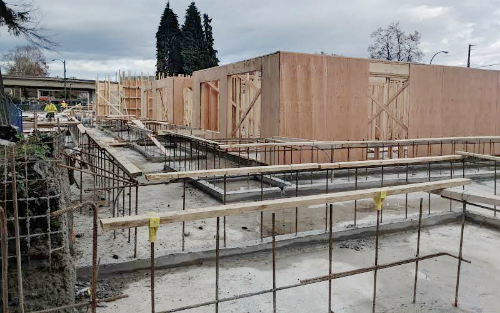
“As part of Canada’s first-ever National Housing Strategy, this initiative provides low-cost loans to support new construction projects, relieving pressure in rental markets that are experiencing low vacancy rates and high rents,” he continues. “It will allow more middle-class Canadians to spend more time with their children by living closer to public transit, schools and services.”

By supporting construction and early operations with low-cost loans, the initiative will help expand the number of housing developers, non-profit organizations and municipalities able to access financing for rental housing projects. The focus is on supporting sustainable apartment projects in areas where there is an acute need for additional rental supply.

The goal of the initiative is to prioritize standard apartment projects that meet or exceed certain requirements for financial viability, affordability, energy efficiency and accessibility, and those that support vibrant, socially inclusive neighbourhoods, are close to public transit, and are developed through partnerships or collaboration. Projects that are closer to breaking ground are also more likely to be prioritized.

“We are very proud to have had our project selected to participate in the CMHC Rental Construction Finance initiative. This innovative new funding will allow us to focus more attention on building affordable, super energy efficient housing in our markets,” said Peter Polley, Founder and President of Polycorp Properties Inc.

Image 4“The RCFi was instrumental in allowing us to achieve our guiding principle for this development—to establish a living environment that addresses rent affordability, accessibility, inclusiveness and community-building by providing an area that promotes a comfortable and sustainable lifestyle,” said Keith Merkel, President of EdgeCorp Developments.


To be eligible, projects must include at least five rental units, respond to a demonstrable need for rental supply, and have zoning in place, a site plan in process and a building permit available.

Projects must decrease energy use and greenhouse gas emissions at a level at least 15 per cent below requirements in the 2015 National Energy Code for Buildings or the 2015 National Building Code. In addition, at least 10 per cent of the project’s units must meet or exceed accessibility standards and have barrier-free common areas as regulated by local codes.

Loans for projects that meet the eligibility requirements are offered on a 10-year term at a favourable, fixed interest rate that is locked in at first advance for greater cost certainty. They can be amortized up to 50 years, and are insured by CMHC at first advance.

A stable supply of rental housing is critical to ensure that more Canadians have access to housing that meet their needs. There’s still time and money to submit an application for the construction of new affordable rental housing. Learn more about the RCFi, its eligibility requirements and how to apply online at cmhc.ca/financinginitiative. Loan commitments are available through March 2021.

National Housing Strategy

CMHC