Articles Archive - Page 475 of 928 - REMINET
REMI

McMaster scientists invent self-cleaning surface

Researchers at McMaster University have made a self-cleaning plastic surface that can repel all forms of bacteria, preventing the transfer of antibiotic-resistant superbugs and other dangerous bacteria in settings ranging from hospitals to kitchens.

The new surface – a treated form of conventional transparent wrap – can be shrink-wrapped onto door handles, railings, IV stands and other surfaces that can be magnets for bacteria such as MRSA and C. difficile.

The treated material is also ideal for food packaging, where it could stop the accidental transfer of bacteria such as E. coli, Salmonella and listeria from raw chicken, meat and other foods, as described in a paper published by the journal ACS Nano.

The research was led by engineers Leyla Soleymani and Tohid Didar, who collaborated with colleagues from McMaster’s Institute for Infectious Disease Research and the McMaster-based Canadian Centre for Electron Microscopy.

Their co-authors on the paper include Sara M. Imani, Roderick Maclachlan, Kenneth Rachwalski, Yuting Chan, Bryan Lee, Mark McInnes, Kathryn Grandfield and Eric D. Brown.

Inspired by the water-repellent lotus leaf, the new surface works through a combination of nano-scale surface engineering and chemistry. The surface is textured with microscopic wrinkles that exclude all external molecules. A drop of water or blood, for example, simply bounces away when it lands on the surface. The same is true for bacteria.

“We’re structurally tuning that plastic,” Soleymani, an engineering physicist, said in a press release. “This material gives us something that can be applied to all kinds of things.”

The surface is also treated chemically to further enhance its repellent properties, resulting in a barrier that is flexible, durable and inexpensive to reproduce.

“We can see this technology being used in all kinds of institutional and domestic settings,” Didar said. “As the world confronts the crisis of anti-microbial resistance, we hope it will become an important part of the anti-bacterial toolbox.”

The researchers tested the material using two of the most troubling forms of antibiotic-resistant bacteria: MRSA and Pseudomonas, with the collaboration of Brown and his colleagues at McMaster’s Institute for Infectious Disease Research.

Grandfield helped the team verify the effectiveness of the surface by capturing electron microscope images showing that virtually no bacteria could transfer to the new surface.

The researchers are hoping to work with a commercial partner to develop commercial applications for the wrap.

Photo courtesy of McMaster University


Hamilton deploys waste bins for safe needle disposal

Hamilton is placing disposal containers for sharps waste in select locations around the city to help reduce the number of improperly discarded needles and promote safe disposal in public spaces.

Sharps waste includes any device or object used to puncture or lacerate the skin. Such a bin is used to safely dispose of needles and other sharp medical instruments.

The installation of sharps disposal bins is a proven harm reduction effort that increases public safety. Hamilton is attempting to address issues related to drug use and addictions and to support harm reduction, one of the four pillars identified in the Hamilton Drug Strategy.

Based on a targeted approach, the Parks Department and Public Health Services worked together to identify eight city parks where sharps disposal bins will be installed:

When should founders retire from the cleaning industry?

Many mom-and-pop contract cleaning companies that started years ago are now large corporations. In many cases, the founders of these companies are considering retiring and passing the company on to younger family members.

However, according to Ron Segura, president of Segura & Associates, who has worked with many cleaning contractors in this situation, the timing is crucial.

“The company founders do not want to stay too long, nor should they leave too soon,” he says. “Both scenarios can be bad for the company.”

To help find the best time to retire, Segura suggests company founders in all jansan organizations ask themselves the following:o

Are you still finding fulfillment in the job?

The excitement once felt for the company will diminish over time, but top executives should still be excited about their companies and the role they play. “If not, it is time to consider leaving.”

Are there personal reasons to retire?

“What I have witnessed is that often these top people enter a new phase in their lives and want to start something new. If that is the case, yes, they need to start transitioning the company.”

Is the industry changing so fast you cannot keep up?

This is a pervasive issue today. “For decades, the jansan industry changed slowly. However, now everything is changing very fast. It the founders find they cannot keep up; a change in leadership may be due.”

Have you been offered a new opportunity?

Older executives are often in demand to teach, take a government position, or join another company in an entirely different field. “Many older executives find they cannot resist these offers. Money is typically not the reason. It is the opportunity to serve and give back to their community that pulls them forward.”

Has a succession plan been worked out?

Founders need to start selecting family members that best fit leadership roles in the company and grooming them early. “I suggest the mentoring process start at least five years before the transition.”

Another situation Segura says he often encounters is founders want to leave after reaching a significant milestone.

“Some wait until they secure a major new customer, for instance. They want to leave the company when its strong and have something proud they can pass on to younger family members.”


Aramark announces new 2025 sustainability plan

Aramark announced a new 2025 sustainability plan, Be Well. Do Well.

Be Well. Do Well. Aims to source responsibly, operate efficiently, and to effectively manage food waste, packaging, emissions and other activities that could adversely impact the environment and planet. It also prioritizes people.

With respect to the environment, Aramark is focused on several initiatives, including climate change. The company is working to reduce greenhouse gas emissions by offering more vegan and vegetarian meals, sourcing responsibly, operating more efficiently, minimizing food waste, and reducing packaging.

The company is opening access to opportunities that will improve the well-being of the company’s employees, consumers, communities and people in its supply chain. Building on current work, Aramark continues to help people develop careers and livelihoods; access, choose and prepare healthy food; and grow communities, businesses and local economies.

“Aramark strives to do our part with respect to environmental, economic, social and ethical considerations,” said Kathy Cacciola, Aramark’s vice-president, enterprise sustainability. “Be Well. Do Well. focuses our efforts to help people and our planet, as we serve our client partners, employees, shareholders and other stakeholders.”


Selecting the best e-training technology

Online learning systems are becoming a popular training option in the cleaning industry. These cost-effective tools provide janitorial workers with easy access to a broad range of courses that, when taken, can improve their level of performance, elevate their role and enhance their career potential.

But with so many online learning platforms now available, how do employers determine which is the best investment for their custodial team?

Quite simply, ask questions.

Cleaning equipment, products and technology are constantly evolving, so training must be revised to reflect those changes. Find out how frequently course content is updated and the platform’s method of continuous improvement.

Employers should ensure workers can obtain important training information anywhere,  anytime, including in the middle of a job, if necessary. The best online learning programs can be accessed from any electronic device, including desktop computers, laptops, tablets and even smart phones.

Ease of access is also important. If workers aren’t comfortable using the program, they’re not going to engage with the training software. Establish whether the platform is geared to the ‘tech-savvy’ or a wide range of people with different levels of online comfort.

Make sure the program includes the option to review past courses, document training and provide recommended learning pathways to workers, too. Without this function, workers aren’t accountable for completing courses and, as a result, may be less motivated to continue taking them. Eventually, training will fall by the wayside.

Individually paced online training programs work best when there’s a testing component, so look to see if one is incorporated at the end of each course. This helps with the learning process and workers are more inclined to take the course seriously. Some newer programs allow users to provide course feedback, further engaging them in the training platform.

The Art of Motivation

Once an online learning platform has been selected, it’s time to put it to good use.

To set workers up for success, employers should create a designated workstation where online training can be completed. Keep in mind that age may influence workers’ engagement preferences. If some learn better in their own environments, it might be beneficial to provide access to the online platform from home or via personal mobile devices.

In addition to ease of access, a little encouragement will go a long way to motivating training participation. Offer incentives for course completion, such as gift cards, pizza parties, executive recognition, opportunities for advancement and even paid time off. Newer online learning programs have partnered with certification organizations to provide even more resources for users, including the option to attain specific trade-focused certifications. These programs have the added benefit of a built-in incentive for workers to embark on the learning pathway. Upon completion, they will achieve a tangible item: certification.

Another way to spur participation is to encourage healthy competition. Some online learning programs have a tracking feature built into their platforms, allowing teams to monitor their course completion progress against others. This not only serves to motivate workers but also helps build collaborative teams.

Premium Blend

There’s never quite a substitute for hands-on training in any field, particularly when new processes and equipment are involved. However, it’s not always possible to continuously offer one-on-one training to each member of a custodial team. Coordinating group training can also prove difficult. Employers must find and secure appropriate space, and then coordinate multiple schedules to ensure everyone can participate. In some instances, entire areas within a building may need to be shut down or core workers taken off duty to accommodate the training session, which may not be viable.

A combination of hands-on and online training through a learning platform offers increased flexibility, greater engagement with learning materials and improved knowledge retention. The end result is higher performance and productivity levels across workers. Adopting a blended approach to training also encourages workers to take ownership of their learning and development, which provides greater employee satisfaction.


Jennifer Meek is director of marketing at Charlotte Products Ltd., a leading manufacturer of sustainable cleaning products. She has been involved with the green and professional cleaning industries for more than 13 years. Charlotte recently launched an online learning platform that combines product and process-specific training with ISSA’s Cleaning Management Institute (CMI)-verified certification courses to provide a comprehensive, on-demand course catalogue for custodial teams. Jennifer can be reached at [email protected].


On the move with B.C. wood

B.C. forest products are a predominant structural and finishing material for a wide range of transit infrastructure throughout the province.

Architect Peter Busby oversaw the Brentwood Town Centre Station in Burnaby, which he points to as an example of wood’s durability. The iconic SkyTrain station was the first in a series of innovative transit station designs.

The station on Metro Vancouver’s Millennium Line has stood the test of time.

“It’s now 17 years old, and the glulam and nail-laminated wood ceiling is in perfect condition,” he said. “The steel has been repainted three times. So when somebody says wood won’t last, we take them out there and say, ‘Well, it lasts a lot longer than painted steel.’”

The station’s sleek, canoe-like design has two curved nail-laminated timber canopies, supported by glue-laminated (glulam) timber ribs. The SkyTrain station is a forerunner to other stations Perkins and Will designed that incorporate wood, including Canada Line stations Richmond Brighouse, Aberdeen, and Landsdowne.

United by similarities in structure, glazing, and roof elements, these three stations contain prefabricated modular roof panels constructed from Douglas-fir. The roof-deck is made up of dimension lumber solidly packed together on edge, thin enough to achieve its curvilinear form. Each required only about a week and a half to install.

In Kelowna, The Queensway Transit Exchange is a gateway to the Okanagan city’s downtown core. Envisioned by VIA Architecture, the station has an impressive 60-metre-long curvilinear roof span with an arc inspired by the nearby rolling hills and waves on Okanagan Lake. The span is achieved through the use of two engineered glulam beams supporting nine-metre-wide decking panels.

wood

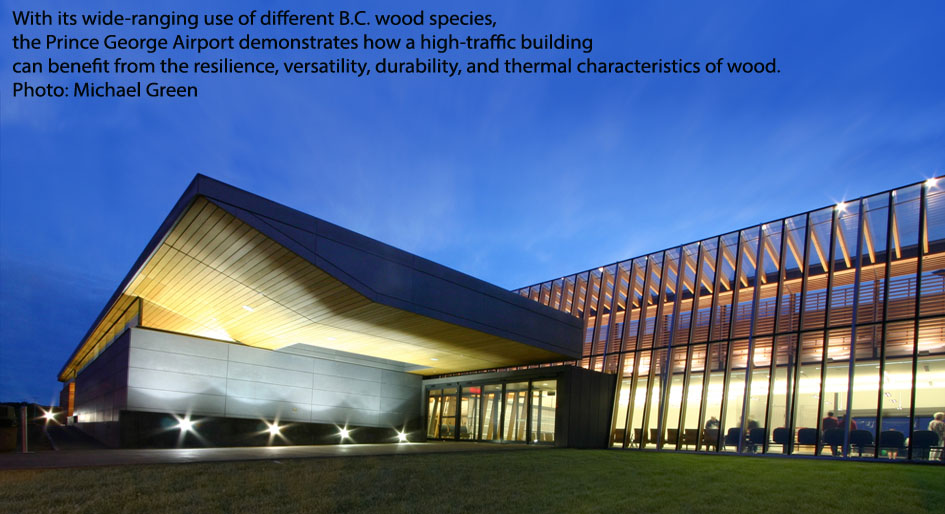
A variety of wood species were used by Mcfarlane Green Biggar Architecture + Design in the expansion of the Prince George Airport. Located in a city prone to cold winters, the structure needed the resilience, versatility, durability and thermal characteristics wood provides. On the outside, the structure uses Douglas-fir glulam columns and ceiling planks. Inside, maple is used to create seating in the departure lounge. The use of exposed wood offers a contemporary and tranquil aesthetic for travellers.

The spectacular Kuskanax Creek Footbridge in the Village of Nakusp, developed by Omega Engineering, carries foot traffic and those on horseback 36 metres across the scenic West Kootenay tributary. The timber components were manufactured off-site to cause less disturbance to the natural surroundings. The steel understructure provides load-bearing support to a solid Douglas-fir wood deck, posts, railings and an overhanging roof. Much of the materials, labour and construction expertise were sourced locally.

These projects and others are featured in a newly released book, Naturally Wood, which showcases British Columbia’s cutting‐edge wood architecture and design. The beautifully illustrated, 160-page publication contains more than 65 innovative wood buildings and projects, including how wood is being used in transportation.

Four continuing education units have been developed based on the book. They are recognized by the Architectural Institute of British Columbia and are available at naturallywood.com/naturally-wood-ceus.

Download the Naturally Wood e-book at naturallywood.com/nwbc.

Condo forms delegated to Condominium Authority of Ontario

The Ontario government has recently tabled the Rebuilding Consumer Confidence Act, which aims to strengthen consumer protection and ensure stronger oversight of several administrative authorities, including the Condominium Authority of Ontario. As a result, there are long-awaited changes on the horizon.

It is now confirmed that condo corporations will be able to better access and use required forms under the Condo Act. The Ontario government is handing over delegation to the Condominium Authority of Ontario, starting January 1, 2020.

CAO says it has already added the first 17 digital forms and is starting to explore solutions for using an interactive question and answer approach for users during the completion process. There will also be consultations with owners and members of the condo community to find out which forms should be a priority and how they can be improved. More details on that should emerge soon.

Expanding scope of disputes heard by Condominium Authority Tribunal

The Ministry of Government and Consumer Services will soon be consulting with the public on expanding the scope of disputes that can be heard by the CAO’s Condominium Authority Tribunal.

The CAO is preparing for this possible expansion with enhancements to its digital online dispute resolution system, the Condominium Authority Tribunal – Online Dispute Resolution (CAT-ODR) system. Recruitment for additional part-time CAT members (who conduct mediations and adjudications in Stage 2 and 3 of the CAT’s dispute resolution process) is currently underway.

More consultations in 2020

There will also be consultations to seek stakeholder input on other areas impacting condominium communities in Ontario, including:

  • Requiring the CAO to develop a condo guide for buyers and require developers to provide it at the point of purchase;
  • Changing the amount of interest that would be owed to a purchaser, who makes deposits and other payments on a purchase into pre-construction condo projects, by the developer, if a condo project is cancelled and in other circumstances;
  • Establishing guidelines or standards that will govern how condo corporations are to procure goods or services;
  • Clarifying how interim occupancy fees are handled by developers;
  • Establishing a process whereby condo corporations could add charges to an owner’s common expenses (condo fees), under certain circumstances;
  • Clarifying how contributions are made to reserve funds, how the money held in reserve funds can be used, and how reserve fund studies can be conducted; and
  • Clarifying the processes for mediation or arbitration between condo corporations and owners.

Code recognition urged for rainwater harvesting

Proposed changes to the National Plumbing Code could ease the process and cost of installing rainwater harvesting systems in most types of building occupancies, but would prohibit non-potable water supply to toilets and urinals in health care facilities. The measures address silences in the current code and are part of an expansive package of proposed changes that the Canadian Commission on Building and Fire Codes (CCBFC) released for public review earlier this fall.

Expressly stated requirements for rainwater harvesting should simplify the steps to attain permits. This would replace the more unwieldy alternative solution process, which requires third-party validation, that prospective proponents now undertake in jurisdictions where there is an extra burden of proof for technologies not referenced in the code. The CCBFC estimates those consulting services can add $1,500 to $8,000 to the cost of installation.

The initiative also responds to advice from the Provincial/Territorial Policy Advisory Committee on Codes (PTPACC), which supports it as a means to meet the code’s water efficiency objective. “In some provinces, there is legislation to encourage the reuse of water or the use of collected rainwater in public buildings. Code requirements decrease the cost of implementation,” the CCBFC rationale states.

As proposed, statements added to the code define applicable rainwater as “storm water discharged from an above-ground roof surface” and harvesting systems as a storage tank and associated pumps, pipes and fittings that must be connected to a plumbing system. Stand-alone rain barrels are specifically disallowed.

Systems will have to be capable of treating collected water “to appropriate provincial or territorial requirements” and system design will be expected to have regard for the environmental conditions of the roof area where rainwater is collected. Contaminants and other compromising factors must be considered and mitigated.

“Contaminants of concern include industrial and urban traffic emissions and pesticides and other agricultural chemicals,” the text of the proposed code change states. “Other factors that can influence the levels of contaminants in the delivered non-potable water include the building’s geometry, and prevailing winds and seasonal activity in the local area.”

Harvested rainwater can only be supplied to fixtures where “food consumption, drinking and food preparation are unlikely”. Even so, the potential for chemicals or pathogenic micro-organisms in harvested rainwater underlies another proposed code change to specifically prohibit non-potable water to supply toilets and urinals in health care facilities.

This will eliminate the possibility that patients with weakened immune systems could be exposed to risks via non-potable water. However, health care facilities managers observe that it’s largely a redundant precaution since such systems are unlikely to be acceptable under internal infection control protocols in hospitals or long-term care homes.

The CCBFC will be accepting comments on all proposed code changes until December 23, 2019.

City of Vancouver opens artist studios downtown

Howe Sound Studios, a 10,800-square-foot artist production facility, located in downtown Vancouver is now open. 221A, a Vancouver non-profit cultural organization, will operate the studio as a shared artist production facility for more than 20 artists. It is Vancouver’s first city-owned studio space.

The new cultural space will be used predominantly for visual arts production. Designed by Merrick Architecture, it includes two kiln compatible studios, and two sound-isolated studios designated for audio practices.

“221A’s vision for the facility is to support the re-emergence of viable working spaces for artists within Vancouver’s downtown core, with a focus on artists who have traditionally been disadvantaged from access to public resources,” said Brian McBay, director of 221A. “Earlier in the season, 221A convened a Peer Assessment Committee to assess applicants on the basis of economic need, material suitability, as well as quality and contribution of the tenants’ artistic work in the field and the city.”

This new facility was developed and provided to the city as an in-kind Community Amenity Contribution (CAC) by Howe Street Developments Limited Partnership, as part of a mixed use development that includes a 41-storey residential building. CACs play an important role in the delivery of public amenities and infrastructure, such as affordable housing, childcare, parks, cultural facilities, and community facilities, accommodating growth while ensuring the city’s livability.

“Howe Street Developments is proud to provide the City of Vancouver with this much needed artist studio space as part of our Tate Downtown project,” said Tracy McRae, vice president development of Bonds Group of Companies. “We look forward to watching the local art community flourish in this rare and innovative studio production facility for years to come.”

Artists occupying the studios are in commercial sublease agreements for a 3-year rental term, with options to renew through the peer assessment process.

An artwork by Germaine Koh has been commissioned for the interior façade called Set Pieces. It features a series of theatrical curtains and scrims made of materials typical to the neighbourhood: domestic curtains, office blinds, construction mesh, fishing nets, and a green screen backdrop. The various layers are mechanically raised and lowered in a changing interactive display, animating the daily activities at Howe Street Studios, visible from inside and out.

Five policies that could affect the housing market

Immigration figures into the Real Estate Investment Network’s (REIN) list of five policies that are likely to affect the housing market in the wake of a post-federal election minority government.

The forecast responds to REIN’s analysis of campaign platforms and various government promises. REIN compared the platforms that specifically relate to investors from Liberals, Conservatives, and the New Democratic Party (NDP) to identify the most likely coalitions on various policies.

According to the report, all three parties assessed converge on the same platform of increasing immigration. So, Canada could see an influx of immigrants and changes to that policy, which would significantly boost rental demand. There could also be lower vacancy rates and higher property values.

“An increase in the influx of migrants amounting to over one million people in three years is tantamount to increasing rental demand,” says Jennifer Hunt, vice-president research for REIN. “This is good news for rental housing providers as migrants have higher tendencies to rent property rather than to purchase their own homes, especially within the first four years of settling in Canada.”

Recommendations are also likely for policies in support of increasing housing supply, such as rental building programs. Findings also indicate a possible increase in income taxes for households belonging to higher tax brackets as well as corporations.

The report also reviews other key housing-related political topics that point to increased housing taxes for foreigners and non-Canadian residents, some form of anti-money laundering task force, no changes to the current amortization program and the maintenance of a stress test.

The CMHC First-time Home Buyer’s Incentive Program is also forecasted to stay put. The report suggests watching for a potential increase of the FTHBI’s purchase price limit to nearly $800,000 in high-priced markets in line with the Liberal campaign platform.

Yves Béhar is IDS20 Guest of Honour

The 2020 Interior Design Show (IDS20) is welcoming San Francisco-based Swiss designer, entrepreneur and humanitarianism Yves Béhar as its International Guest of Honour.

Recognized for advocating the value of design in business, Béhar is the founder and chief designer of fuseproject, a multidisciplinary industrial design and branding firm; co-founder of August Home, the leading provider of smart locks and smart home services; and co-founder of Canopy, a boutique co-working enterprise.

Béhar believes that integrated product, digital, experience design and brand design are the cornerstones of any business. He has collaborated with renowned partners such as Herman Miller, Movado, Samsung, Puma, Issey Miyake, Prada, SodaStream, Swarovski, Canal+, Nivea and many others, receiving international acclaim.

His humanitarian work includes One Laptop Per Child, which has given 2.5 million laptops to children in developing countries and See Better to Learn Better, which distributes 500,000 free corrective eyeglasses to schoolchildren in Mexico and California every year. For each of these, he was honoured with the INDEX Award, making him the only designer to receive the award twice.

Béhar’s works are embraced in permanent museums collections, including the Museum of Modern Art, the San Francisco Museum of Modern Art, the Centre Pompidou and the Art Institute of Chicago.

He was named a Top 25 Visionary by TIME Magazine and was recently named “Most Influential Industrial Designer in the World” by Forbes.

The contemporary design fair takes place January 16-19, 2020 at the Metro Toronto Convention Centre.

Allied purchasing mixed-use complex in Montreal

Allied Properties is purchasing a mixed-use complex in Montreal for $276 million.

Located in the International Quarter, 747 Square-Victoria Street features 519,574 square feet of rentable office space, 43,015 square feet of retail and 858 underground parking spaces. There is also potential for extra office and retail space if common areas are transformed. The goal is to help serve companies in sectors like tech, advertising, media and information.

The building, currently 90.7 per cent leased, was completed in the early 1990s, and now takes up a large part of a city block. It integrates heritage structure along Saint-Antoine and Saint-Jacque streets, with new structure along a historic laneway (Ruelle des Fortifications) that extends the length of the block from Saint-Pierre to Square-Victoria.

The laneway rises to a glass canopy along the roofline of the united structures to form an atrium that allows access to the many retail and office uses within the complex.

747 Square-Victoria is located in close proximity to (and is essentially connected with) Allied’s 700 de la Gauchetière Street West and 425 Viger Avenue West. Allied said the proximity and connectivity will make it easier to coordinate and enrich the user experience at all three buildings over time.

Accessibility tracks sustainability trajectory

Market pressure and industry competitiveness could propel accessible commercial real estate in the coming decade, much the way those complementary forces have already bolstered energy efficiency and low-carbon footprints. Speaking at the inaugural Accessibility Professional Network Conference earlier this fall, an industry advocate and an early adopter of Rick Hansen Foundation Accessibility Certification (RHFAC) drew parallels between sustainability’s progress and potential wider commitment to accessibility.

“There is the beginning of awareness among our members that accessibility is good for business, and that’s not unique to our industry,” Benjamin Shinewald, president and the chief executive officer of the Building Owners and Managers Association (BOMA) of Canada, told the gathering in Toronto. “We are at early stages, which is an exciting moment, but a moment that shows how much work we still have to do.”

“We’ve been into sustainability for 15 years, but we have not been talking about this until quite recently,” concurred Laura Malley, director of property management for Triovest Realty in British Columbia and property manager of Marine Gateway, a Vancouver mixed-use complex and co-winner of the BOMA Canada Rick Hansen Accessibility Challenge Award, which was added to slate of BOMA Canada National Awards for the first time in 2019. “We do care, but we have not had the resources to figure out what we should be doing.”

That’s changing with the 2017 arrival of RHFAC and BOMA Canada’s affiliation with the program, providing guidance on inclusive design and measures to enhance how people of all abilities use, move through and interpret what’s occurring within built space. The new Accessibility Challenge Award recognizes the BOMA member building achieving the highest RHFAC score, and building owners/managers are encouraged to consult the recently released Accessibility Guide, available as a free download.

As of April 2019, the BOMA BEST assessment and benchmarking tool for existing buildings also awards innovation points aligned with RHFAC criteria — a step Shinewald foresees will help push the issue into more owners/managers’ consciousness and onto budgetary priority lists. “I am very confident that is going to work because people in my industry are super competitive,” he submitted.

Split responsibilities for space create challenges

Yet, he cautions that constraints and challenges inherent to commercial real estate, and particularly in existing buildings, could temper positive intentions. Structurally, older buildings can be literally fraught with obstacles, while, conceptually, commercial space is something of a collection of fiefdoms. Owners/managers have clear authority over common spaces, but little flexibility to impose non-contractual conditions in tenants’ premises.

The latter reality could cause confusion where landlords attain RHFAC certification in their controlled domains, but occupants and visitors encounter less welcoming situations in tenants’ spaces. Alternatively, tenants may have accessible suites, but occupants and visitors could face encumbrances in common areas along the way.

“It is extremely complicated in our industry, where people rent space and just want to be left alone, to instigate this conversation,” Shinewald observed.

Looking to sustainability comparisons, Malley noted that tenants’ openness to green lease conditions has been nurtured and achieved gradually over several years. However, accessibility efforts could benefit from experiences of implementing  sustainability measures that have proven to be cost-effective, contribute to productivity and boost buildings’ profile in the marketplace.

“I do think there is going to be market pressure and market pressure will wake the industry even more,” Shinewald predicted. “As with sustainability, you can do small things for free that aren’t capital plan items. To call it ‘retrofit’ is almost too grand of a word because that sounds complicated and expensive.”

Marine Gateway leverages RHFAC guidance

Stepping into the newly completed Marine Gateway in early 2016, Malley took on a wide range and full agenda of tasks in overseeing 255,000 square feet of office space, 245,000 square feet of retail and 466 units of housing in two residential towers — all connected to a hub of Vancouver’s public transit system that channels approximately 2.5 million commuters through the property every year.

accessibility momentum“It’s a really unique and beautiful complex in Vancouver,” she asserted. “And it’s a very busy development.”

Early promotion of RHFAC, related to the B.C. government’s commitment to fund up to 1,100 accessibility assessments in commercial, institutional and multi-residential buildings from the fall of 2017 to March 2019, aligned with her professional concerns and reignited youthful memories of Rick Hansen’s 1980s-era Man in Motion world tour.

“I’m a Gen X-er,” she said. “I signed up so fast, I actually spelled our company’s name wrong.”

Findings from that accessibility audit proved particularly insightful to explain and address why a residential tenant had fallen while in the outdoor plaza. The RHFAC auditor pointed to the changing surface slope, which pedestrians with visual impairments would find difficult to detect. Since then, money has been budgeted to install tactile tiles that provide another kind of cue.

Visual fire alarms to notify people with hearing impairments — another absent feature the RHFAC auditor identified — have also been installed. Other improvements undertaken or added to the capital project list include: reshaping handrails with rounded rather than blunt endings; ensuring that common area seating has armrests to support balance as users stand up or sit down; eliminating sharp edges in bicycle racks; and installing mirrors in elevators so users can better see potential hazards inside when the doors open.

“Now that these issues have been brought to my attention, I see things everywhere,” Malley reported.

Since taking on her relatively new role as Triovest’s B.C. director with associated responsibility for a 5-million-square-foot portfolio, she also plans to attain RHFAC designated professional standing so she can apply the knowledge in decision-making and guide staff and contracted service providers. She counts Ryan Bragg, principal of Perkins + Will Architects, among the enthusiasts.

“He is absolutely going to enfold the lessons we learned from Marine Gateway 1 into Marine Gateway 2,” Malley affirmed.

Prompts and aids for accessibility momentum

Looking at how and where the pace of progress could pick up, Shinewald and Malley outlined a few mutually reinforcing possibilities, including government intervention, technology and peer pressure. Institutional investors and their associated real estate ventures have typically been leaders in environmental, social and governance (ESG) policies and practices, and Shinewald foresees they may introduce new job functions for accessibility, similar to forging the sustainability manager job category 10 to 15 years ago.

“I am not aware of anyone in the industry who has a fulltime position managing accessibility currently,” he said. “Sooner or later, this will be a leadership moment.”

“Smart buildings are the new buzzword. I can see a connection with accessibility and smart buildings,” Malley added. “Coming in with an app for accessibility would probably be a very savvy move.”

As always, governments hold carrot-and-stick powers. They could offer incentives, impose regulations or enact a combination of the two. Especially in office space, governments also figure in market demand.

“They are big customers of ours,” Shinewald said. “So they can just be demanding customers.”

Barbara Carss is editor-in-chief of Canadian Property Management.

Ontario plans to fix Tarion home warranty

Ontario says its going to repair the Tarion home warranty program with new legislation tabled last week.

If passed, the changes would bring more balance to Tarion by reducing the influence of developers and focusing the program on protecting future home buyers.

Minister of Government and Consumer Services Lisa Thompson announced the Rebuilding Consumer Confidence Bill in the wake of 32 recommendations made by the auditor general who revealed critical oversights at Tarion in her special audit this past October.

“Our government recognizes that Tarion has not done nearly enough to fulfill its responsibilities to protect buyers of new homes,” said Thompson, in a press release. “It is why we are rebuilding the program from the ground up, focusing on consumer protections, transparency and access to information, and governance.”

The province is also proposing changes to improve on the single administrator model for warranties and protections delivery, provide a better dispute resolution process and deliver new measures to promote better built new homes, such as providing the warranty administrator with greater ability to scrutinize builder applications and conduct inspections before a homeowner moves in.

This news comes a week after the second reading of the Trust in Real Estate Services Act, which also plans to strengthen consumer protections for home buyers.

Squamish Nation approves housing development

The Squamish Nation has voted to move forward with a development under the Vancouver Burrard Street Bridge in partnership with Wesbank Projects Corp.

Members approved the project, voting 87 per cent in support of the land designation. According to the Nation, the development of the 11.7-acre parcel of reserve lands at Sen̓áḵw represents the single largest development on First Nation lands in Canada.

“The Squamish Nation Council is thrilled with the outcome of this referendum, which was approved by a landslide. This is truly a landmark moment in our Nation’s history. The Sen̓áḵw Project will transform the Squamish Nation by providing immense social, cultural, and economic benefits to Squamish Nation members for generations to come,” said Khelsilem, Squamish Nation councillor and spokesperson.

The Nation plans to build 11 towers at the south end of the Burrard Bridge near Vancouver’s False Creek, with the tallest being 56 storeys high.

The project sits on reserve land so it is not required to go through any of the City of Vancouver’s approval processes or follow its restrictions, such as height and parking. For example, just 10 per cent of the homes will be provided with parking stalls, well below the municipal standard, to lower construction costs and encourage the use of sustainable modes of transportation.

Construction on the first phase is expected to begin in 2021. Once complete, the $3 billion project will bring approximately 6,000 new units into the Vancouver housing market, with 70-90 per cent of those being market rental units.

Chris Ballard named new Passive Canada CEO

Chris Ballard has been appointed as Passive House Canada/Maison Passive Canada (PHC) CEO, replacing Rob Bernhardt who announced in early 2019 his intention to step down.

“After an extensive executive search for a new CEO, Chris’s commitment and experience working with industry, consumers, government and not for profit organizations made him an excellent choice for the CEO position” said board chair Deborah Byrne, who was also a member of the CEO Recruitment Committee “We count ourselves lucky to have him joining the organization.”

Ballard has a history of supporting environmental and land use causes, most recently as the Ontario’s Minister of Environment and Climate Change implementing the government’s plan for a clean environment and a sustainable economy.

He also served as the Minister of Housing and the Minister responsible for Ontario’s Poverty Reduction Strategy and Member of the Treasury Board. Ballard is a past executive director of the 60,000 member Consumers’ Association of Canada (Ontario) and a founding board member of the Consumers Council of Canada.  His leadership in journalism, communications and public affairs includes terms as president and board member of the Public Affairs Association of Canada.

“The opportunities Passive House Canada offers to make a difference at this pivotal time are tremendous – and create a responsibility to get it right. I am excited by the prospect of working with such an amazing team in collaboration with industry, government and consumers.” said Ballard.

“I also want to acknowledge Rob and his extraordinary tenure with PHC. He has made an immense contribution during the past four years and has been central to the organization’s success. I am delighted that Rob will continue to advise and support PHC on key projects.”

In 2016, founding CEO Bernhardt was given the mandate to create a professional, national association, and is credited with growing the organization’s presence across Canada, advocating at all levels of government, building membership and delivery programs. Bernhardt will continue as an advisor to the organization during the transition and assist with special projects.

CAPREIT acquires substantial Halifax portfolio

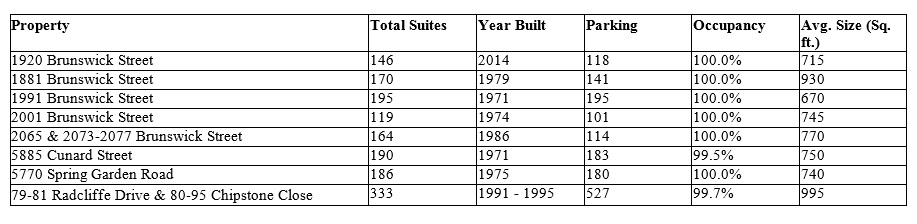
CAPREIT announced plans to move ahead on the acquisition of a substantial Halifax apartment portfolio comprised of eight properties containing fourteen apartment buildings and 1,503 rental suites. The buildings are well located throughout the downtown core and surrounding the Halifax metro area.

The properties have been well maintained and all are close to key amenities including the Halifax waterfront, the city’s Central Business District, schools, universities, public transport, shopping, walking trails, entertainment, and other attractions. A number of the properties contain retail components to better serve residents.

“With this purchase, we will significantly increase the size and scale of our Halifax portfolio, capturing strong economies of scale and operating synergies across our asset base in the city,” commented Mark Kenney, President and CEO. “Once completed, our Halifax portfolio will grow to over 3,100 residential suites, transforming CAPREIT into one of the city’s premier providers of quality rental accommodation.”

Occupancy for the total portfolio currently stands at 99.9 per cent. CAPREIT will pay approximately $391 million for the portfolio, satisfied by the assumption of approximately $109.1 million in mortgages with a weighted average interest rate of 1.94 per cent and a weighted average term to maturity of 1.25 years, with the balance in cash from its Acquisition and Operating credit facility.

A breakdown of the Halifax apartment portfolio can be found here:

CAPREIT Halifax