





Articles Archive - Page 476 of 928 - REMINET
REMI

Multi-suite market sweet for landlords

Canada’s multi-suite market performed at a healthy level for landlords and investors in 2019, according to the latest Economic Outlook Report from Morguard. This outcome was largely driven by economic growth and ongoing demographic trends supporting strong rental market conditions in Canada’s major cities throughout the year.

Increased demand from downsizing baby boomers and families looking to rent due to the high cost of home ownership in major cities was a key driver in the sector’s performance. Canada’s strong record as a draw for international migrants and students also had an impact on the rent demand cycle, with Morguard anticipating that the national average vacancy rate will close the year off at around 3.0 per cent.

Meanwhile, conditions in cities like Toronto and Montreal have been markedly tighter where the supply gap is making life difficult on prospective renters. Generally speaking, metros with emerging technology sectors and high concentrations of highly skilled young workforces have registered the highest rent inflation. Morguard does anticipate that new supply activity, which is expected to increase over the near term, will dampen rent growth levels to some extent in some of these markets in the future.

In Toronto, it was certainly a landlord’s market throughout 2019, with record low vacancies making the hunt for quality rental accommodations a challenging one for tenants. As we close out the year, GTA’s average vacancy rate continues to range below the 2 per cent level, with landlords benefitting from the large renter pool while facing minimal competition from the rental condominium sector. For investors, the sector continued to register “largely stable and positive characteristics.”
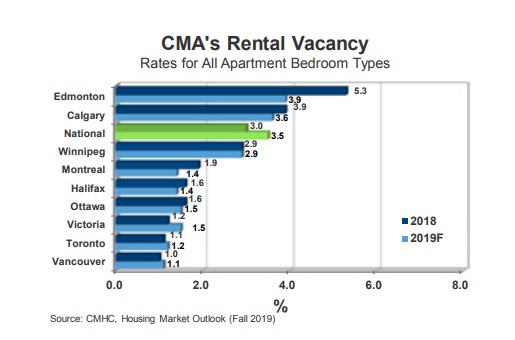
2019 rental vacancyVancouver, meanwhile, continued its sustained period of imbalance with the market average vacancy rate resting just above 1 per cent, driven by a strong economy, high population growth, and the high cost of homes. Prospective renters in this region were faced with few available options and the highest rents in the country.

In Montreal, the vacancy rate continued to decline, as rental demand outpaced supply. The current market average vacancy rate of 1.9 per cent is expected to hold into 2020, making life difficult on the region’s renting population.

Multi-suite residential sales

multi-suite sales 2019In terms of transactions, multi-suite residential rental property sales volumes totalled $4.0 billion in the first half of 2019, which was slightly below the record annual high pace of 8.3 billion in 2018. All-in-all, multi-suite residential rental properties were highly coveted assets by investors, leading to aggressive bids and vendor price expectations that were generally met.

Other commercial real estate sectors performed well throughout most of Canada, too, including industrial and office, which saw investment sales activity continue at a record pace in 2019.

“Commercial real estate remained one of the most attractive and stable long-term investments in 2019 and will continue to attract interest from investors in 2020,” said Keith Reading, Director of Research at Morguard. “The real estate industry, along with the Canadian economy, continued to expand in 2019 despite the global trade dispute and challenges in the oil and gas sector impacting domestic business confidence.”

The full 2020 Economic Outlook Report, including analysis for the real estate markets in Halifax, Montreal, Ottawa, Toronto, Winnipeg, Regina, Saskatoon, Calgary, Edmonton, Vancouver and Victoria is available at morguard.com/research.


SAPL launches new doctoral design program

The School of Architecture, Planning and Landscape (SAPL) at the University of Calgary is launching the first doctoral program in Canada that’s specifically focused on practicing architects, planners, and landscape architects.

The Doctor of Design (DDes) provides a platform for established practitioners to leverage their existing expertise into new areas of innovation. The doctoral degree is open to mid-career professionals with at least five years of work experience.

“The climate crisis, social inequality, and the digital revolution of smart cities, computational design, and robotic fabrication are rewriting the way cities are being designed, built, and operated,” says Dr. John L. Brown, SAPL dean. “This creates enormous opportunities for architects, planners, and landscape architects to expand their practice, increase their value to clients, and make a bigger and more positive impact in the world.”

DDes graduates will use the knowledge generated through their research to open new areas of innovation, create competitive advantages, and more clearly articulate their value proposition to clients and the broader public. The Doctor of Design also provides an appropriate terminal academic credential for design professionals interested in applying for post-secondary teaching positions.

The DDes is very different from traditional PhD programs because the research is practice-focused and design-based, with students developing a work-integrated research program centered around a unique inquiry emerging from their experience and insights in practice. Students remain fully engaged in their working life while pursuing a research program in an intense and rigorous format that is distinct from, but parallel to, their professional work.

Three required courses offered in a blended distance-learning format help guide students through the early stages of their research. Twice a year, all DDes students gather for a four-day research symposium to present the progress of their research work in a “studio-crit” format and receive feedback from their supervisors, fellow students, and a cohort of invited critics.

In between symposia, students work remotely with their supervisors to continue developing their projects. The degree is completed with a written thesis document, gallery exhibition, and public defence conducted during one of the research symposia.

“The structure of the program allows students from around the world to complete the degree while remaining embedded in their professional offices,” says Brown. “The semi-annual symposia, held in Calgary over long weekends in the spring and fall, are important and exciting opportunities for students to share their work and learn from each other.”

Applications are now being accepted for fall 2020 program start; the deadline for applications is Feb. 1, 2020. Applicants are encouraged to apply early. Significant professional experience will be considered in lieu of a graduate academic degree.

For more information visit: sapl.ucalgary.ca/ddes.

Multifamily asset class wins lender confidence

Lenders to the Canadian commercial real estate industry aren’t losing much sleep over their allocations to the multifamily asset class. Newly released results of CBRE’s annual survey finds the highest level of confidence attached to multifamily rental housing with only 2.2 per cent of respondents reporting it causes concern. In contrast, Class B suburban office topped the worry list of 17 different property types, with more than two thirds of surveyed lenders expressing concern about its prospects.

That sentiment looks likely to hold moving into 2020 when more than 39 per cent of survey respondents expect to increase their multifamily budget. That’s on par with the commitment to increase allocations for industrial properties. Seniors housing and hotels are also seen to be on an upward trajectory. Across all asset classes, 56.5 per cent of surveyed lenders expect to maintain their real estate exposure in 2020, while 41.3 per cent are poised to increase it.

“The strong desire for apartment buildings is backed by G7-leading population growth and ongoing housing affordability issues that leave Canadians with few options besides renting,” CBRE analysts observe.

Conclusions are drawn from 32 questions posed to lenders across a range of institutions including domestic and foreign banks, credit unions, insurers, pension funds, private debt capital and trust companies. In addition to picking preferred asset classes, they also weighed in on geographic locales.

“Lenders expressed strong appetite for assets located in Toronto, Ottawa, Vancouver and Montreal,” the report states. “The biggest mover overall was Hamilton, which jumped four spots in the rankings, reflecting strong demand for the Greater Toronto Area and the surrounding region.”

A significant majority of surveyed lenders — 71.7 per cent — do not expect a recession in 2020 and many expressed greater optimism than in 2018. For example, although respondents commonly expressed hesitancy about Class B suburban office and regional malls in secondary markets, the level of concern has actually subsided since last year when 70 per cent of surveyed lenders suggested those asset classes could be problematic.

Confidence also picked up in retail power centres since 2018 when 60 per cent of surveyed lenders called it a cause for concern. Alternatively, some of the best perceived assets classes, such as industrial, Class A office, grocery-anchored retail and seniors housing, nevertheless lost a bit of lustre since lenders were surveyed last year.

While not expecting a recession next year, surveyed lenders generally peg commercial real estate as late in its cycle. For now, 45.7 per cent say the risk of economic recession could exert strong sway on lending decisions in 2020. The state of retail and Canadian housing values are seen as the next most influential factors macro economic factors, while the price of oil and level of Canadian household debt are deemed least influential.

Tricon Capital Group acquires Nashville portfolio

Tricon Capital Group announced that it has acquired a portfolio of 708 homes located in Nashville, TN, through its single-family rental joint venture, TAH-JV1 (“JV”). The high-quality portfolio is fully stabilized with approximately 97 per cent occupancy, an average vintage of 11 years, and has been renovated and maintained to a high standard by its previous owner and operator, Invitation Homes. The portfolio purchase price of approximately $210 million was funded by a combination of JV equity and debt under the JV’s existing credit facility.

Tricon initially entered the Nashville market in Q1 2019, attracted by its strong housing fundamentals and growing local economy. This acquisition increases Tricon’s Nashville portfolio under management to approximately 850 homes and provides economies of scale and diversification to Tricon’s single-family rental business. Nashville now represents approximately 4 per cent of Tricon’s overall managed portfolio of homes.

“We are excited to add such a high-caliber portfolio to our single-family rental business and gain immediate scale in Nashville, one of the fastest-growing cities in North America,” said Gary Berman, Chief Executive Officer and President of Tricon. “The portfolio is a compelling fit with our middle market strategy and consistent with the acquisition objectives of TAH-JV1, which has now deployed more than half of its committed capital. We anticipate a smooth integration of the acquired homes onto our platform and we look forward to welcoming many new Nashville residents and Invitation Homes employees to Tricon.”

Tricon is a residential real estate company primarily focused on rental housing in North America, with approximately $7.9 billion (C$10.5 billion) of assets under management. Tricon invests in a portfolio of single-family rental homes, multi-family rental apartments and for-sale housing assets, and manages third-party capital in connection with its investments. Since its inception in 1988, Tricon has invested in real estate and development projects valued at approximately $22 billion. More information about Tricon is available at www.triconcapital.com.


Avison names new principals to grow services

Neil Lacheur has been appointed as Avison Young principal and executive vice president of Real Estate Management Services in Canada. In this newly created role, Lacheur will lead the strategy to grow the Avison Young property management business.

“Neil’s experience in entrepreneurial and institutional business environments helps us deliver exceptional value to customers and clients through a disciplined, principled approach to property management,” said Mark Fieder, Avison Young principal and president in Canada. “His passion for excellence builds on our commitment to delivering consistent, high-quality services to clients across the country.”

Lacheur’s customer-centric mindset with strong governance, exceptional team talent, and a commitment to sustainable operating practices, will help meet the growing demand for strategic direction from property managers across Canada.

“This is an exciting time to join Avison Young as it continues its ambitious growth trajectory in Canada and globally,” added Lacheur. “I am energized by the commitment of our leadership to exceptional service and value for clients and customers.”

Lacheur joins Avison Young from QuadReal Property Group, where he had been since its founding, leading the firm’s customer service strategy and culture. He holds a degree in Economics from University of Victoria and is a LEED-GA.

Avison also announced new principals Ken Williamson and Carl Pedersen in Edmonton. As industry leaders, Williamson and Pedersen will grow the company’s expertise in energy markets throughout Alberta.

The addition of Williamson and Pedersen continues the momentum of the firm’s other recent investments in commercial real estate services in the region. In June of this year, the firm launched a multi-family practice to meet the growing property needs of clients in the prairies. With this investment in energy markets and tertiary communities, Avison Young helps grow its services for clients not just in Edmonton and Calgary, but in markets throughout Alberta.

Williamson and Pedersen bring to Avison Young a combined 37 years of commercial real estate experience. Williamson was a senior vice president and Pedersen was an associate vice president with Colliers International in Edmonton.

Art installation lights up Galleria on the Park site

As the Galleria Mall site undergoes transformation to become Galleria on the Park, one of the largest master-planned communities in Toronto, a 60-foot-tall, dated brick pylon that once displayed the mall’s old signage has been transformed into a public art installation.

Toronto-based artist Thrush Holmes’ mixed-media piece features distinct components including: an illuminated Galleria sign, vibrant neon bars, and Holmes’ signature neon artwork, including a Love me Till I’m Me Again sign and a massive red heart that shines atop the pylon. Splashes of bright green, red, blue and yellow paint add a playful element throughout.

The artwork was commissioned by developer ELAD Canada to animate Toronto’s West End and serve as a temporary centrepiece for the site.

Dupont West has become a vibrant and creative arts scene as it shifts from the city’s industrial past. Dotted with numerous studios, art galleries, and artisanal restaurants and cafés, the redesigned pylon perfectly captures where the area is now.

“This art piece is an homage to the Dupont West neighbourhood,” said Holmes. “I’ve passed by this Galleria pylon countless times, so having the opportunity to contribute to my community’s transformation through art is truly special. From the start, it’s been a very collaborative process with ELAD Canada to bring this creative vision to life.”

ELAD Canada has now moved into Galleria 02, the second phase of the Galleria on the Park master-planned community. Galleria 01, which launched this fall along with the brand-new eight-acre Wallace Emerson Park and the 95,000-square-foot Wallace Emerson Community Centre, saw overwhelming sell-out success.

CORE Architects is designing Galleria 02, with interiors by U31. Galleria 02 echoes the industrial character of Galleria 01, connected by the same heavily-articulated podium with double-storey retail at the ground level.

Residents of Galleria 02 will benefit from family-friendly amenities, including an expansive co-working space that doubles as an event space opening out to a wrap-around outdoor terrace, an outdoor pool and a fitness centre. At 24 storeys, Galleria 02 will offer family-sized suites with south-facing views overlooking the downtown skyline, as well as the community’s multi-use public spaces, including the extensive park and community centre, which doubles the size of the current facility.

“The response from the market and our local community to the first phase of our Galleria on the Park master-planned community has been tremendous,” said Rafael Lazer, CEO at ELAD Canada. “On the other hand, this new art piece is a great fit for the neighbourhood, celebrating the site’s transformation and symbolizing Dupont West’s exciting future.”

BCIT Health Sciences Centre breaks ground

British Columbia Institute of Technology (BCIT) held an official groundbreaking for a new 107,000 square-foot Health Sciences Centre on Dec. 3.

The new centre will be a four-storey, net-zero carbon emission building. The centre will accommodate and provide learning spaces to approximately 7,000 students, including part- and full-time students. It will house a number of health-sciences programs, including cardiology, sonography, nursing, pediatric and nuclear medicine.

It will also be the most sustainable building on campus, targeting WELL Gold certification.

“This new state-of-the-art building is going to be a game changer for healthcare students at BCIT,” said Melanie Mark, Minister of Advanced Education, Skills and Training. “It will be more than just a building. It will be the training grounds for the next generation of highly-trained health specialists. It was designed with students and the environment in mind and fits squarely within our government’s CleanBC plan.”

The new Health Sciences Centre will replace existing simulation space and will replicate the work environments for a variety of hospitals and laboratories. This centre will enable students to learn in an innovative, cohesive space that improves their quality of education.

“Stantec is proud to celebrate the groundbreaking of the BCIT Health Sciences Centre. Our design blends immersive technology, a range of low to high fidelity rooms and collaboration spaces, connected via a continuous ribbon of social spaces to support a variety of learning modalities and experiences for students, faculty and staff. This building is also pursuing aggressive sustainability and social inclusivity targets, making it a one of a kind in British Columbia,” said Stantec architect Eleonore Leclerc.

The province of B.C. is spending $66.6 million of the project’s $78.3 million budget and completion is expected by late 2021.

Leaders win Builders Code Champion Awards

Six employers in B.C. were recognized with the inaugural Builders Code Champion Awards for supporting tradeswomen, workplace diversity and positive worksite culture.

The British Columbia Construction Association (BCCA) and Minerva B.C. hosted the inaugural Builders Code Champion Awards at a ceremony on Nov 28 in Victoria to recognize the B.C. companies for their work to implement the code.

The award categories and winners were:

  • Recruiting & Hiring Champion: RAM Consulting Ltd. (Vancouver);
  • Workplace Culture Champion: Scott Construction Group (Vancouver) and Kinetic Construction (Victoria);
  • Community Champion: Westcana Electric (Prince George);
  • Initiate of the Year: Durwest Construction Management (Victoria); and
  • Contractor of the Year: Westcana Electric (Prince George) and Chinook Scaffold Systems (Nanaimo).

To be recognized as a Builders Code Champion, individuals and organizations must have demonstrated their commitment, leadership, and action towards advancing and retaining women in their company and achieving the provincial goal of 10 per cent tradeswomen by 2028.

“On behalf of everyone at BCCA, Minerva BC and all our Builders Code partners, I want to thank our winners for their support of the Builders Code and congratulate them for creating and maintaining outstanding workplaces that support the safety and protection of all employees,” said Chris Atchison, president, BCCA. “As an industry facing a serious labour shortage, the retention of tradespeople, and especially tradeswomen, in our sector is critical. By demonstrating their commitment to their workforce, our winners have distinguished themselves as outstanding role models in the construction industry.”

Nomination applications were accepted from May to November 1, 2019, with winners selected by a judging panel comprised of Minerva BC, the BCCA and the Builders Code Governance Committee.

Museum retrofit safeguards precious artifacts

While museum relics are meant to be cherished and preserved long-term, the building systems that protect them are not.

At the Textile Museum of Canada, which holds a collection of 13,000 fabrics, garments, carpets and beadwork that are up to 2,000 years old, aging and inadequate infrastructure had put the delicate artifacts at risk of damage or theft. With its mechanical systems due for an upgrade, the museum engaged its operations and solutions consultant to evaluate the building equipment and develop a plan to improve efficiency, increase security and ensure its collection would be protected for many more years.

Improper mechanical systems can pose a range of problems for facility managers. It may become difficult to control the temperature in different parts of a building, making visitors and employees uncomfortable. Delicate materials may be damaged by light or humidity. Poor security measures could result in thefts or safety issues.

The Textile Museum faced all of these threats. With its operations and solutions consultant, the museum developed a three-phase retrofit plan, which focused first on updating building heating, ventilation and air conditioning (HVAC) systems, and then on improving security and lighting.

Three steps to a successful upgrade

During the first phase, all major HVAC equipment was replaced with new high-efficiency options to help improve comfort and overall performance. Disparate systems also made way for a new building automation system. The system integrates and automates core building functions like HVAC operations, and provides real-time centralized monitoring and control for operators. It also allows operators to set temperature and humidity control for specific sections of the museum, then alerts personnel if levels exceed their limits. Changes can be made remotely, even after business hours – a particularly useful feature for nighttime or holiday events.

With the new system, the museum schedules its equipment operations to maximize efficiency. For example, it can adjust heating and cooling levels based on the time of day to reduce energy use. Detailed graphs chart individual equipment performance and trends for auditors. This allows the museum to address potential issues, such as high humidity levels, before they become problematic for an exhibit.

During the second phase, the security system was overhauled. The team installed closed-circuit television and more than 20 dome cameras throughout the museum. In addition to added security, these motion-sensing cameras also contribute to the facility’s conservation efforts by reducing energy use if no movement occurs. Video is captured and stored in a scalable, IP-based system that allows personnel to easily access video files. The system is integrated into the building automation system for easy monitoring.

Beyond surveillance, the museum also wanted to implement card access and asset locator systems. Artifacts were equipped with security tags that will trigger an alarm if they are moved outside set parameters. Standard card readers throughout the facility help control access and allow the museum to schedule door lock and unlock times. All new equipment ties into the museum’s integrated automation system for easy monitoring.

The final phase of the retrofit focused on lighting. The facility’s 20-year-old light fixtures, tracks and dimmer switches were inefficient and unevenly illuminated museum exhibits. The building also needed to comply with Canadian Conservation Institute (CCI) requirements for preserving Canadian heritage collections.

Top of the list of priorities was a move from traditional incandescent lighting to energy-efficient LED bulbs. The team also needed to ensure new lighting complied with CCI requirements for colour, brightness and temperature. A new integrated dimming system allows lighting to be adjusted throughout the museum using the automation system. The lighting improvements helped the museum qualify for $26,000 in energy efficiency incentives through the former Ontario Power Authority’s Save on Energy program.

Back to the future

Right away, the museum began to realize the benefits of lower energy use and less time spent managing and maintaining antiquated building systems. The much-needed retrofit not only fixed existing problems but it also positioned the museum for the future. As technologies develop, it will be able to adapt to take advantage of new methods of safety, security and energy efficiency.

Beyond protecting its own treasures, the changes also provided increased confidence that the museum could safeguard artifacts from the many travelling exhibits it hosts each year. It now has greater ability to expand its exhibits and program offerings.
With these updates, the museum can continue to preserve its historic textiles while keeping an eye toward the future as it realizes the long-term benefits of the project.

Lane Brennan is vice-president and general manager of Honeywell Building Solutions, Canada. Honeywell was the operations and solutions consultant for the Textile Museum of Canada’s retrofit project.

A Property for All Seasons

It’s never too early to test climate resiliency

Determining a property’s ability to withstand the elements is best done before it’s put to the test. And yet, for many property managers and owners, climate resiliency remains low on their list of priorities.

“The awareness is there, but it’s not high on people’s radars,” says Duncan Rowe, Associate with RJC Engineers (RJC). “In my experience, climate resiliency is something people only become aware of after an event like a flood or storm. A majority aren’t planning for those factors well in advance, but the reality is you want to be well prepared so you aren’t panicking during an actual disaster and you will have less of a headache with insurance.”

In short, you don’t want to learn about climate resiliency the hard way. For example, 2014’s Toronto ice storm left many tenants without power for days, and the wildfires in Fort McMurray caught many off-guard and left thousands displaced for prolonged periods of time. And while property owners and managers did all they could to secure the safety of their tenants and their assets, those who took measures to plan ahead and take steps towards climate resiliency benefited from faster recovery times and less costly restorations.

“The goal of climate resiliency is to give your building a better chance of standing up to environmental conditions, as well as to give tenants the ability to stay in their building for longer periods of time while the power is off. It’s about buying time for a building and its occupants to bounce back from whatever catastrophic event it’s dealing with,” says Rowe.

climate resiliency

Climate resiliency also helps properties stand up to environmental changes. Call it climate change or not, but the reality is weather patterns across the globe are shifting, exposing buildings to conditions they were not initially designed to withstand.

“Many of today’s buildings were built for specific wind pressures and a certain amount of heating and cooling days. All of those factors were are based off of average temperatures from the past 100 years, but now that these ‘normals’ are changing rapidly, those numbers are becoming outdated,” says Rowe, explaining, “Now, we’re dealing with structural concerns from increasing wind loads and risks to building envelopes due to more frequent storms. You may have a building that made it through maybe two or three days of extreme heat in the summer, but now needs a chiller because it’s being exposed to high heat for weeks at a time.”

Recognizing these challenges is one thing, responding to them is another. For its part, RJC has been consulting with clients across Canada on how to best prepare for specific regional factors, whether it’s rain level variances in the west, extreme wind conditions in the east, or fires in the prairies. More recently, RJC conducted a building condition assessment for the City of Toronto in which it was asked to factor in the resiliency of its buildings.

In all cases, bringing climate resiliency to the fore has not only helped protect properties against future events, but contributed to their overall life-cycle.

“When you make retrofits like better windows and more resilient systems, you also end up with a more durable and sustainable building,” says Rowe.

Nevertheless, Rowe acknowledges that investing in climate resiliency is not always an easy sell given the misconceptions about cost and climate change. For the former, Rowe says resiliency investments pay off over the long-term, and that costs can be included in capitol plans so that when items come up for renewal during their regular life cycle, they can be upgraded with resiliency in mind.

Speaking to the latter, however, Rowe notes, “Whether you believe in climate change or not, that’s fine. What we say to clients is that it’s good practice to make sure your building can withstand today’s environmental realities, because if you’re the building that’s able to get back up and running after an event faster than the others, you’re going to be a more attractive option for tenants. It just makes good business sense.”

“Ultimately, when you go down the path of climate resiliency, you end up with a better building. I don’t think anyone would say that’s a bad idea,” he adds.

Duncan Rowe is an Associate with RJC Engineers’ Building Science and Restoration. Learn more about RJC’s Building Science practice at rjc.ca. 

Integrating cleaning robots into the workforce

Cleaning robots have gone from the wave of the future to the must-have tools of today. Companies across North America have been testing autonomous cleaning solutions for the past few years but the turning point may have been last fall, when Walmart announced it would roll out an autonomous floor scrubber at 360 of its U.S. stores.

The conditions spurring companies to seek reliable cleaning solutions with low labour requirements – growing worker shortage and ever-increasing pressure to boost productivity while cutting costs – are expected to continue, bringing major growth in the use of cleaning robots. According to a 2018 market research report, the cleaning robot market will more than double in the next few years, reaching $4.34 billion US by 2023.

No driver, no problem

Cleaning robots, or autonomous cleaning equipment, are machines that don’t require the constant attention of an operator. Although autonomous equipment is being developed for all types of cleaning, floor care equipment, particularly floor scrubbers, represent the current biggest application of the technology.

Autonomous floor scrubbers use an array of cameras, sensors and lasers, along with powerful computer processors, to perform the same functions as a ride-on scrubber, just without the operator. The most advanced machines employ intelligent navigation so that they’re able to recognize unknown obstacles in their path and provide safe use in congested spaces. Modern features include the ability to map a specific cleaning path for replicable results, cleaning flexibility without special mapping and manual mode for ad hoc cleaning.

Smart savings with A.I.

For facility managers and building service contractors, autonomous cleaning solutions provide an opportunity to save time and money on cleaning tasks. This is a major advantage for cleaning companies and their clients, as labour can account for between 55 and 90 per cent of cleaning costs. Autonomous machines can handle repetitive tasks, as much as doubling productivity, which means cleaning staff can focus on higher value activities.

Terry Zerwas, director of buildings and grounds for the St. Michael-Albertville School District in Minnesota, has found their autonomous floor scrubber has saved significant labour hours each day.

Walmart predicts its machines will save two hours of employee time per location, per day.

As the technology advances and more robots become available, the potential savings will multiply. Industry experts estimate 40 per cent of the total professional cleaning market could eventually use autonomous solutions.

Cleaning robots can also provide a level of quality and consistency that human operators often struggle to achieve. Once a machine is programmed for a cleaning path, it will follow that exact path every time, adjusting for obstacles when necessary, which guarantees replication perfection. The equipment can also be set to automatically adjust water and detergent levels to reduce chemical usage and help companies achieve sustainability goals.

Cleaning robots also enhance the health and safety of cleaning staff by eliminating the ergonomic challenges associated with some manual equipment, as well as the risk of repetitive stress injuries.

Learning to love robots

Integrating autonomous equipment into the cleaning process requires careful planning and execution, and because the technology is so new, it may take some extra time to become accustomed to. However, there are three things that will go a long way to helping ensure a seamless transition.

First, use state-of-the-art equipment. Most major cleaning equipment manufacturers have autonomous solutions available but they’re not all created equal. Features to look for include: flexibility of use; advanced sensing and navigation technology, which provides high-quality cleaning in challenging areas, such as around obstacles and close to walls and corners; an intuitive interface (required for employees’ acceptance of the machines); and operational data collection and management that companies can leverage to analyze and optimize their cleaning capabilities.

Next, assure cleaning staff that the robots aren’t there to take their jobs. One of the fears many people have surrounding any type of automation is that their roles will become redundant. In the case of cleaning equipment, this is typically not true. Most cleaning companies are understaffed or have trouble retaining employees, and their goal in adopting autonomous machines is to enhance, not replace, their current workforce. In fact, robots can improve human cleaning technicians’ job satisfaction by taking over the most boring, repetitive tasks.

Last, but certainly not least, provide training. Autonomous solutions don’t need a lot of training since operators aren’t required for use. But there are some functions, like defining a cleaning path, that do rely on operator input, at least at the beginning. For machines that can also be used in manual mode, training is needed for ad hoc cleaning tasks.

Matt Fussy is director of product management, connected autonomous solutions, at Nilfisk, a supplier of professional cleaning equipment in the industrial, commercial and consumer markets.

FRPO honours industry leaders at 2019 MAC Awards

On December 5th, 2019, FRPO welcomed over 1,200 guests to the 2019 MAC Awards, a sold-out celebration of innovation, commitment to quality and everything that goes into promoting the brand of rental housing. Canadian Apartment Magazine would like to extend a warm congratulations to all the nominees and award recipients for their outstanding achievements in 2019.

Best Property Management Website
Rhapsody Property Management Services in Partnership with Riocan Living
www.ecentralliving.com

Advertising Excellence for a Single Campaign
Hollyburn Properties Limited – #MyHollyburn

Advertising Excellence – Social Media
Hollyburn Properties Limited

Best Lobby Renovation
Starlight Investments – 1475 Bloor Street, Mississauga

Best Curb Appeal
DMS Property Management – 145 Wellington St West, Aurora

Best Suite Renovation under $20,000
QuadReal Property Group – 6550 Glen Erin Drive, Mississauga

Best Suite Renovation over $20,000
Minto Apartments – 61 Yorkville Avenue, Toronto

Rental Development of the Year
Tricon Capital Group and OP Trust – The Selby: 25 Selby Street, Toronto

Amenities Excellence
Rhapsody Property Management Services – 25 Montgomery Avenue, Toronto

Outstanding Community Service
Greenrock Real Estate Advisors

Environmental Excellence
Sifton Properties Limited

Leasing Professional of the Year
Laura Bkhet – MetCap Living

Property Manager of the Year
Gemma Melchior – Melchior Management 777 Corporation

Resident Manager of the Year
Laura McNabb- Skyline Living

Customer Service Award of Excellence
Oxford Properties Group

Company Culture Award of Excellence
Greenrock Real Estate Advisors

Marvin Sadowski Memorial Award for Certified Rental Building Member of the Year
Melchior Management 777 Corporation

Pictured above: Homestead’s Brit Smith receives the Lifetime Achievement Award from FRPO President Tony Irwin.

McGill study reveals toxicity of artificial turf crumb rubber

Scientists at McGill University used chicken embryos, a model of higher vertebrate development, to assess the toxicity of environmental pollutants contained in leachate from crumb rubber, found in infill for artificial turf fields and playgrounds

The new study, published in the journal PNAS, by a team of scientists from McGill’s Department of Chemical Engineering and Redpath Museum and Health Canada, is the first to use chicken eggs as a comprehensive model system for testing environmental toxins.

Nathalie Tufenkji, co-senior author of the new study and a professor in McGill’s Department of Chemical Engineering, said the use of a “higher vertebrate” testing model has the advantage of being able to measure system-wide effects of environmental toxins, something for which previous models used to test the toxicity of crumb rubber – such as algae, water fleas, zebra fish and mammalian cell cultures- fell short.

“We were curious to understand what impact the crumb rubber might have on the environment and wildlife in general,” Tufenkji said. “Precipitation on outdoor fields containing crumb rubber might lead to leaching of chemicals into the environment and how those chemicals may interact with vertebrate development and health are unknown.”

This multidisciplinary effort demonstrated that the early development of chicken embryos is compromised when eggs are exposed to small amounts of water in which rubber crumbs soaked for seven days. When directly injected into the egg yolks, this leachate caused mild to severe malformations, including impaired development of the brain and the cardiovascular system.

Hans Larsson, a professor at McGill’s Redpath Museum, says that their new chicken embryo model will provide useful information about how toxins disrupt embryo development of such a complex animal.

“Chicken eggs are, relatively speaking, closely related to mammals, including humans,” said Larsson, the study’s other co-senior investigator. “Their genome, anatomy, and development are closer to ours than the other standard models, so using them as a test system for environmental toxins may be the most efficient way to explore how these toxins might potentially affect human health.”

Tufenkji and Larsson’s teams now plan to further assess what kind of chemicals are released from crumb rubber under natural conditions in different environmental scenarios.

“We would like to test leachate from naturally weathered crumb rubber and track its potential effects on chicken embryo development,” said Tufenkji.

“Artificial turf infill associated with systematic toxicity in an amniote vertebrate” by Elvis Genbo Xu, Nicholas Lin, Rachel S. Cheong, Charlotte Ridsdale, Rui Tahara, Trina Y. Du, Dharani Das, Jiping Zhu, Laura Peña Silva, Agil Azimzada, Hans C.E. Larsson, Nathalie Tufenkji is published in PNAS, a peer-reviewed journal.


Fungal growth degrading buildings: study

Microorganisms growing inside aging buildings and infrastructure are more than just a health issue, according to new research from UBC Okanagan.

The research, coming from the School of Engineering and biology department, examined the impact of fungal mould growth and associated microbes within structures on university campuses. The study focuses on the observed biodeteriorative capabilities of indoor fungi upon gypsum board material (drywall) and how it affects a building’s age and room functionality.

Assistant Professor Sepideh Pakpour says fungal growth significantly affected the physical (weight loss) and mechanical (tensile strength) properties of moisture-exposed gypsum board samples. In some cases, tensile strength and weight of some boards decreased by more than 80 per cent.

And she notes the issue of fungal growth, intensified by climate change, is two-fold.

“Increasing flooding and rainfall related to climate change is aiding fungi to grow more rapidly, causing degradation of the mechanical properties of buildings and infrastructure,” she says. “Not only are the fungi breaking down the integrity of our buildings, but their proliferation is increasing health hazards for the people who live and work in these buildings.”

The researchers also looked at other factors that can impact microbial growth including temperature, humidity, dustiness and occupancy levels—the more people, the quicker it can grow

According to the study, drywall experienced a significant effect on its mechanical properties when microbes were present. If the microbes were bolstered by moisture, the drywall’s ability to withstand breakage when under tension dropped 20 per cent. Older buildings, on average, exhibited higher concentrations and types of fungi in the air, leading to higher mould coverage and biodeterioration on the drywall.

“Our findings would suggest a critical need towards multi-criteria design and optimization of next-generation healthy buildings,” explains Pakpour. “Furthermore, we hope this study will enable engineers, architects and builders to develop optimal designs for highly microbial-resistant building materials that will decrease long-term economic losses and occupant health concerns.”

The inter-disciplinary research was overseen by UBCO Biology Professor John Klironomos, Professor Abbas Milani, director of the School of Engineering’s Materials and Manufacturing Research Institute, and Pakpour, who supervised the microbial and material degradation analyses conducted by their doctoral student Negin Kazemian.

The researchers plan on turning their attention next to the exposure levels of airborne microorganisms and possible remedies.

The latest study, partially funded by a Natural Sciences and Engineering Research Council of Canada grant, was published in PLOS One, a peer-reviewed, open-access scientific journal.

The tech-savvy resident

It’s a content-streaming, always connected, on-the-go world of online entertainment, and condo residents expect nothing less.

No matter their location or accommodations, the fact is Canadian condo seekers are favouring accommodations with high-speed connections, cutting-edge entertainment, and the tools to connect with friends, family, and co-workers across the globe.

“Canadians have the same expectations for their internet, TV, and phone services regardless of where they live,” says Greg Stokes, Director of Sales with Rogers Communications. “They want fast, reliable, and top-quality access to their networks – and they want it on their terms.”

Certainly, the days of basic cable and landline services have passed. And to meet today’s tech-savvy demands, the telecommunication industry is forging stronger inroads with multi-residential owners/managers to bring industry-leading internet, phone, and TV services to Canada’s multi-res communities.

For example, says Stokes, “Our network is already 90% hybrid fibre-coaxial, which allows us to maintain more than one-gigabyte speeds through our Ignite internet service. That translates to 4K residents want, but what they are coming to expect.”

Connectivity and control

Internet Protocol television (IPTV) is among the technologies that are redefining home entertainment. The technology uses lightning-fast internet speeds to deliver 4K visuals, crystal-clear audio, and reliable streaming entertainment.

Moreover, says Stokes, IPTV is being used in concept with advanced applications and systems to provide consumers with greater customization and control over their internet and entertainment services: “The advance of streaming, cloud-based platforms, and mobile technologies has opened up so many ways for customers to get content, but it can be overwhelming. Customers want those options, but they also want them to be streamlined, user-friendly, and available when and where they prefer.”

To that end, Rogers has designed its services like Ignite TV provides to facilitate what it calls an “effortless TV experience.” Features that have proven popular with its customers include user-friendly search interfaces (including Netflix and YouTube); voice-activated controls; mobile streaming apps; and advanced parental controls.

Part of that control also means enabling residents to enjoy their content on their terms, whether within the comfort of their condo or on the go. Herein, Stokes says mobile streaming apps; download & go functionality; and cloud PVR capabilities are also gaining in popularity: “Customers are becoming accustomed to tailored, mobile, and on-demand service in all aspects of their lives, so it’s no surprise they expect that level of control over their home entertainment.”

To each their own

Multi-residential communities may share the same expectations for internet and TV, but individual unit owners’ needs will always vary. As such, it’s important to offer choices when it comes to packages and pricing.

“There are no cookie-cutter solutions; it all depends on the customer’s needs,” agrees Stokes. “A family with three teenagers is going to have different needs than that of a single professional, which is why we always make sure to determine who is using the service, how often they intend to use it, how many devices they may require, and even when they plan on using it the most. That way we can advise them on what packages might work best and cater a solution – and price – for them.”

It doesn’t matter where Canadians call home. Expectations for fast, reliable, and consistently exceptional internet, TV, and phone service is universal. And as those expectations evolve, it pays to align with telecommunication partners who can keep pace.

Greg Stokes is Director of Sales with Rogers Communications. For more information, visit www.rogers.com or call 1-888-764-3771.

—

Saskatchewan rolls out workplace injury initiative

Saskatchewan is rolling out a three-year strategy to reduce the number of workplace injuries and fatalities in four key areas including, asbestos exposure, work-related motor vehicle crashes, firefighter cancer exposure and falls from heights.

The Fatalities and Serious Injuries Strategy will focus on priority industries and occupations where the greatest number of injures to workers are reported. About 2,400 Saskatchewan workers are seriously injured each year and from 2010-2018 the WCB reported 354 fatalities for workers who died on, or as a result of their job.

“Workplace injuries and fatalities are absolutely unacceptable and leave a devastating impact on loved ones,” said Labour Relations and Workplace Safety Minister Don Morgan. “I’m pleased that we have been able to work together with a number of stakeholders to develop a strategy with concrete actions that will help to reduce the number of workplace fatalities and injuries.”

This is the product of WorkSafe Saskatchewan, which is a partnership between the Saskatchewan Workers’ Compensation Board (WCB) and the Ministry of Labour Relations and Workplace Safety.


MUHC celebrates second LEED Gold certification

The McGill University Health Centre (MUHC) and the McGill Healthcare Infrastructure Group (MHIG) are celebrating a second LEED Gold certification, a first in Quebec.

The Canada Green Building Council (CaGBC) awarded the LEED Gold for Existing Building (EB) certification to the new MUHC Glen site, which opened in 2015 in Montreal. The site previously obtained a LEED Gold for New Construction (NC) certification in February 2016.

“The CaGBC congratulates McGill University Health Centre on this achievement, made even more impressive given how complex and significant the energy, ventilation and patient care requirements are for a 24-hour medical care centre,” said Thomas Mueller, president and CEO of the CaGBC and GBCI Canada. “The Health Centre leveraged LEED Coach Canada to assist them throughout the project to determine optimal strategies to achieve their sustainability goals and to create the healthiest environment for their patients.”

Some of the ways in which the facilities at the MUHC Glen site were designed to be as eco-friendly as possible include:

  • Implementation of energy-efficient initiatives resulting in less energy consumption than for the average standard Canadian hospital, resulting in savings of approximately $2.5 million per year;
  • Reduced light pollution as a result of adapted lighting fixtures and an emphasis on natural light;
  • Low-flow faucets that decrease potable water consumption by at least 40% in relation to comparable buildings;
  • A bicycle path linked to the City of Montreal’s network and more than 400 parking spaces for cyclists;
  • Showers for cyclists;
  • 79 charging stations for electric vehicles;
  • A waste management centre to recycle paper, cardboard, electronic waste, glass and plastic;
  • Decreased heat island effect thanks in large part to the maintenance of green spaces consisting of trees, perennials and shrubs that do not require any watering, and to the presence of highly reflective materials.

“Thanks to the tireless efforts of an accomplished team of employees from Johnson Controls Quebec Ltd. and SNC-Lavalin, we have reduced the structure’s environmental footprint by 3,365 tonnes of equivalent CO2 per year, which could be compared to 20 million kilometres driven by a car,” said Jean-Pierre Dumont, President of MHIG. “We’ve also succeeded in building a hospital complex that ranks among the greenest in North America.”

A new Sustainable Development Committee has also been created, according to Pierre-Marc Legris, director of technical services of the MUHC, with the goal of improving the hospital’s sustainable operations for the future.
