Articles Archive - Page 423 of 928 - REMINET
REMI

New Nova Scotia art gallery final designs revealed

The three final conceptual designs for the planned new art gallery and waterfront arts district in Halifax have been unveiled.

The designs are the result of a six-month, international design competition – the first of its magnitude in Nova Scotia.

The three teams participating in stage two of the design competition are Architecture49 with Diller Scofidio + Renfro and Hargreaves Jones; DIALOG, Acre Architects, Brackish Design Studio and Shannon Webb-Campbell; KPMB Architects with Omar Gandhi Architect, Jordan Bennett Studio, Elder Lorraine Whitman (NWAC), Public Work and Transsolar.

An exhibition of the designs at the Art Galley of Nova Scotia will run until late October and features 3D models, renderings and detailed submissions by three shortlisted design teams. As part of the public engagement process, Nova Scotians will have an opportunity to share their feedback on each of the design approaches and concepts.

“A new gallery and waterfront arts district reflects the importance of art and culture to our communities and our lives,” said Leo Glavine, Minister of Communities, Culture and Heritage. “This gallery belongs to all Nova Scotians, and I encourage everyone to visit the exhibit in person or online and share their feedback.”

Public feedback gathered during the exhibition will be considered in the development of the project. Following the selection of the winning team, further community engagement will take place across the province.

“The three design teams have delivered concepts that reinvent the idea of an art gallery and arts district. We hope that all Nova Scotians will engage with us throughout this process to ensure that we have a space that is reflective of all communities in our province,” said Nancy Noble, director and CEO, Art Gallery of Nova Scotia.

The winning submission will be chosen in October by a qualified jury of professionals, including architects, a landscape architect, artists and museum professionals. The public can view and comment on the submissions online at https://artgalleryofnovascotia.ca/artsdistrict.

Team selected for Kicking Horse Canyon final phase

Kicking Horse Canyon Constructors will design and construct Phase 4 of the Kicking Horse Canyon Project near Golden, B.C.

The preferred proponent team selected by the province consists of Aeon Group, Inc., Parsons, Inc. and Emil Anderson Construction. Phase 4 is the final part of the remaining 4.8 kilometres of a narrow two-lane highway up to a current four-lane, 100 km/h standard.

Phase 4 will realign and widen the final section of the canyon to four lanes with median barrier and snow avalanche and rock fall hazard protection to improve safety, capacity and reliability. Limited early works, such as geotechnical investigations and preliminary clearing, will begin this fall prior to the final contract award later this year. Traffic impacts during this period are expected to be minimal.

The request for qualifications was posted through BC Bid on Sept. 5, 2019. On Dec. 13, 2019, the shortlisted proponents were invited to respond to the request for proposals. The project is being delivered through a design-build model.

Transportation Investment Corporation (TI Corp) is leading delivery of Phase 4 on behalf of the Ministry of Transportation and Infrastructure. The project will be delivered under a Community Benefits Agreement (CBA) and BC Infrastructure Benefits is responsible for implementation of the CBA and will be the employer of the majority of skilled workers on the project.

The project has a total budget of $601 million with $386 million from the federal government and $215 million from the Government of B.C. Completion is expected in 2023-24.

In 2003, the Kicking Horse Canyon Project was launched to improve safety and mobility over approximately 26 kilometres of narrow, winding two-lane highway.

Three phases of work have been completed. The fourth and final phase, to transform the remaining section of about 4.8 kilometres, is being prepared for a construction start in fall 2020.

Tallest tower in Mississauga’s M City begins ascent

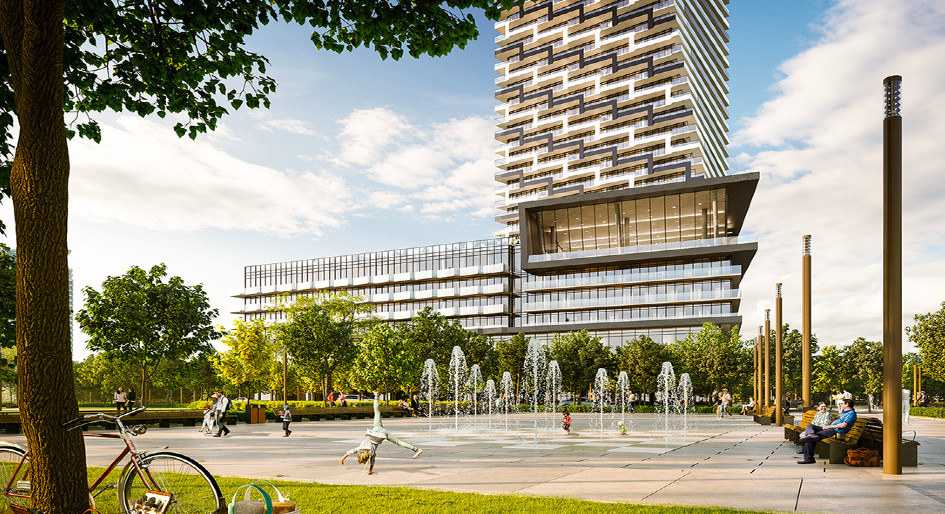
Developers behind M City have broken ground on what will be the tallest tower in Mississauga and the third to rise in the eight-tower, 15-acre, 4.3-million-square-foot master-planned community,

Canadian firm IBI Group designed the 81-storey building to feature a subtle twist at the lower and upper parts of the tower and a dramatic sloped crown at the top. Featuring about 900 units, ranging from 480 to 1,000 square feet, the design is rooted in the context of Mississauga’s downtown.

To define the façade, sawtooth balconies create a black and white diagonal pattern up the building, providing scale, texture and materiality. A sloped and stepped top complements the diagonal balcony pattern and creates terrace units. M3 will also provide close access to abundant green spaces as well as grade-related retail along Burnhamthorpe, and about 20,000 square feet of office space. The building’s design allows for an extensive amenity pavilion that includes an indoor pool and gymnasium, with views of the neighbouring park.

M City

M3 will bring two acres of public parkland onto the site.

M City was designed by urban designers Cooper Robertson of New York, to reflect the city’s own vision for a new downtown and introduce two acres of public parkland onto the site.

“Mississauga’s stature has only grown since we first announced M City, which is a validation of our unwavering belief in this city and our continued commitment to deliver cutting-edge design that resets expectations of what Mississauga should look and feel like,” said John Anderton, vice-president and treasurer of Rogers Real Estate Development.

M City

Dirty carpet impacts public opinion of long-term care facilities: survey

Clean carpet matters in long-term care facilities, including nursing homes, skilled nursing facilities and assisted living facilities, according to a new survey.

Conducted online by The Harris Poll on behalf of Whittaker, the leader in low-moisture carpet care, from September 9-11, 2020 among 2,059 U.S. adults ages 18 and older, the survey found that 54% of Americans would question the quality of care a long-term care facility offers after seeing dirty carpet at the facility.

“Because they are home to older Americans, including some with compromised immune systems, long-term care facilities should prioritize cleanliness from the ground up,” said Joe Bshero, Director of Technical Services at Whittaker. “Proper carpet care is essential, as it has a positive impact on cleanliness and the way a facility is perceived not just by residents and employees, but the families that visit and have high expectations of the care their loved ones receive.”

The survey also revealed additional American actions, perceptions and assumptions that would result from seeing dirty carpet in a long-term care facility, including:

• More than half (54 per cent) would complain to management
• Forty-eight per cent would question the facility’s commitment to resident and staff health
• Nearly half (46 per cent) would assume the facility is not properly cleaned
• Forty-four per cent would consider an alternative facility for themselves or a family member to reside in
• Two in five (40 per cent) would tell friends, family or other residents about the lack of cleanliness
• Nearly one in three (30 per cent) would complain to the local Department of Public Health
• Nearly one in five (19 per cent) would write a negative review online

Older Americans (those 65+) are also more likely than their younger counterparts to be influenced by dirty carpet, with 77 per cent noting they would complain to management or the local Department of Public Health vs. 57per cent of those ages 18-64. Sixty-four per cent of older Americans would question the quality of care the facility offers vs. 43 per cent of those age 18-44, and nearly three in five of those 65+ (59 per cent) would consider an alternative facility for themselves or a family member to reside in vs. 36 per cent of those age 18-64.

“The novel coronavirus pandemic has put added pressure on long-term care facilities to keep residents safe, healthy and happy,” added Bshero. “Facility managers should view carpet care as a necessary strategy for removing unwanted soils, keeping flooring looking like-new and upholding brand reputation.”

SOURCE: WHITTAKER

Time is right for a construction career

When COVID 19 took a wrecking ball to Canada’s economy, it swung in every direction. The pandemic decimated major sectors; grounding airlines, shuttering stores and restaurants and shelving many promising careers. While the timing seems terrible for job seekers, that’s only because they’re wearing blinders. The reality is, there’s plenty of opportunity to land a career that offers good pay, job security and a chance to advance. That’s what makes the construction trades the ideal career choice for these uncertain times.

No one can blame job seekers for feeling discouraged. Students and graduates are launching into the labour market during Canada’s worst economic meltdown. Job interviews have been cancelled and co-op programs cut, after companies across virtually every industry laid off three million Canadians at the height of the pandemic. And many won’t get their jobs back, given predictions that up to 100,000 businesses will close for good.

When the economy turns, the impact can be lasting, especially for those just starting their career. A report by the Royal Bank on the long-term consequences of graduating in a recession, found that those with university educations are less likely to wind up in management positions and more likely to work part-time in jobs below their skill level. With a vaccine some time away, Canada isn’t about to shake off the effects of this global pandemic anytime soon. All the more reason for job seekers to get realistic and focus on where the opportunities are.

That’s why the Progressive Contractors Association of Canada (PCA), with the support of its member companies and like-minded organizations, recently launched “Opportunity Knocks.” The campaign is aimed at putting the construction trades on the radar of more job seekers, especially those who find themselves in career limbo. It encourages anyone starting out in the labour market, or making a change, to consider what construction has to offer: rewarding, high demand, life-long careers that can start right away.

Deemed an “essential service” throughout the pandemic, the construction industry has been more resilient than most during the COVID-19 lockdown. Our workers were on the front lines, maintaining critical infrastructure, from energy plants to hospitals. Construction workers kept our water running, ensured our homes were powered and our broadband up to speed. Without question, the pandemic has brought the importance of the construction trades into greater focus.

We also know the skilled trades will matter even more in the future. According to Skills Canada, nearly 40 per cent of jobs created in Canada this decade will be in the skilled trades, yet only about 26 per cent of young people aged 13 to 24 are considering this career path. That’s the problem. There simply aren’t enough skilled workers to meet the growing demands of industry and our economy. As demographics shift, the skilled trades shortage is becoming more dire each year, resulting in project delays and billions of dollars annually in lost economic activity.

According to BuildForce Canada, the construction industry will need to attract more than 300,000 construction workers this decade. That’s to counter the retirement of roughly one quarter of Canada’s construction industry in the next 10 years. For industry, this is a huge challenge. For job seekers, it’s a huge opportunity, especially for women, youth and Indigenous peoples, who are still vastly underrepresented in construction.

The opportunity is there, and so is the pay. According to Statistics Canada, most of those with apprenticeship certificates earn more than college or high school graduates. Apprentices also have the advantage of earning while they learn and graduating with no school debt. That’s a big advantage, given that many of today’s university graduates are saddled with thousands of dollars in student loans, and no job prospects.

It’s about time parents, guidance councillors, and students snapped out of the dated mindset that a university degree is somehow worth more than an apprenticeship and skills training. Alberta Premier Jason Kenney gets it, and others should too.

“Apprenticeship learning has every bit as much value as academic learning, and skilled trades have every bit as much value, merit and worth as a university degree,” he said when announcing a 13-point “Job Skills for Alberta’s Economy” plan. It’s aimed at putting the skilled trades where they belong: on equal footing with all other academic pursuits.

Attracting investment and keeping our economy competitive, requires far more than a post-secondary system that turns out accountants and people who write code and create apps, especially now. As Canada recovers from the pandemic, it needs construction tradespeople more than ever to rebuild the economy.

When I was in school, I also worked in concrete form fitting and carpentry. I earned extra money and gained skills that I put to use as recently as last weekend, tearing down siding, framing, and putting up dry wall. Mastering a skilled trade is a life skill. It’s something to build on and be proud of. That’s what educators should be telling more students: make the skilled trades Plan A, not a fallback if another position doesn’t work out.

Anyone weighing their career options, should be strongly encouraged to pursue the construction trades as their very first choice. This is where the career opportunities are right now, and well into the future.


Paul de Jong is president of the Progressive Contractors Association of Canada (PCA). To learn more about the Opportunity Knocks Campaign, go to: opportunity-knocks.ca.


Fitwel Viral Response module launches

The Center for Active Design (CfAD) has formally launched its Fitwel Viral Response module, which provides annual, third-party certification of policies and practices informed by the latest public health research on mitigating the spread of contagious diseases.

The announcement comes as real estate organizations including BentallGreenOak, Brookfield Properties and Nuveen Real Estate commit to adopting the module

Fitwel’s Viral Response module requires that companies follow a set of baseline strategies—actions that are necessary to mitigate the spread of infectious respiratory diseases such as COVID-19. These minimum requirements cover indoor environments, behavioural change, and building occupant trust. They get as detailed as specifying the chemicals that are needed in cleaning products. Fitwel and its advisors intend to update the module annually in accordance with the evolving science.

Joanna Frank, president and CEO of CfAD, says the module represents an evolution of Fitwel’s efforts to promote health and wellness in the built environment. It was developed to set the industry standard in response to COVID-19.

“Fitwel was initially created to optimize built environments for chronic disease prevention,” she said. “Companies can chart their own course within Fitwel Certification to address these long-term issues without minimum requirements. However, infectious disease mitigation is quite different, and the science shows there are baseline requirements that companies absolutely must follow to effectively reduce infectious respiratory disease transmission in buildings.”

Fitwel’s two-step certification process enables companies the flexibility to establish and implement viral response policies at scale. Users establish policies to cover any portfolio, selection of assets or individual tenant spaces that have consistent operational practices, then submit to have these policies certified by CfAD in a six-week, double-blind review process.

Once Viral Response certification is achieved, companies can demonstrate application within specific assets. This step verifies that the strategies have been put into practice, and CfAD recognizes this achievement with a plaque that companies can use to convey to occupants that their spaces are optimized for viral mitigation.

“BentallGreenOak’s role as industry advisor and early adopter of the Center for Active Design’s Fitwel Viral Response module provides us with an industry leading response to COVID-19 to better serve our tenants and community stakeholders, while equipping our property management teams with clear and informed guidance for implementation across our managed portfolio,” said Anna Murray, managing director, global head of ESG, BentallGreenOak.


A charming residential renovation

When Fredrik Orling and Julie Wu bought a charming 1959 five bedroom, one bathroom bungalow style home in North Vancouver from the original owners, they had plans to complete a major interior renovation.

Fredrik and Julie worked with Scott & Scott Architects for the redesign of the interior of their home. The design savvy pair, owners of luxury bedding company Sömn Home, did the interior design themselves with an eco-first perspective.

Coming from Europe, where homes are rarely torn down, Fredrik and Julie knew they wanted to renovate rather than rebuild. It was important to them that they maintained the home’s exterior look to contribute to the cohesiveness of the neighbourhood.

charming renovation

Key elements of the renovation included a complete overhaul of the plumbing, electrical and heating in the home, plus updating all of the windows from single to triple glazing. The kitchen was updated with state of the art appliances and a fresh look that maximized storage and functionality. They also redesigned the basement to allow for both an In-Law suite and an area accessible to them while the suite is in use.

With white oak floors throughout the home, each room is thoughtfully designed. Fredrik and Julie’s design style prioritized ensuring their home was functional, practical and minimal while incorporating updates that brought everything up to code.

Sustainability is important to them personally and also a key pillar of their business. This commitment to renovating versus rebuilding allowed them to take a sustainable approach to creating a home that is their sanctuary.

The now four bedroom, four bathroom home renovation project was completed in two years.

Canada announces new Rapid Housing Initiative

The federal government has announced a new Rapid Housing Initiative (RHI) to help address the urgent housing needs of vulnerable Canadians, while simultaneously creating employment in the housing and construction sectors.

Delivered through CMHC, the $1 billion initiative will cover the construction of modular housing, as well as the acquisition of land, and the conversion of existing buildings to affordable housing. The initiative is expected to facilitate the rapid creation of up to 3,000 new affordable housing units across the country while helping support Canada’s economic recovery.

“We know that Canadians experiencing homelessness are at heightened risk of contracting COVID-19,” said Adam Vaughan, Parliamentary Secretary to the Minister of Families, Children and Social Development. “That’s why it is so important that we continue to ensure that communities have the resources they need to support those who are experiencing homelessness. I believe this renewed investment in Reaching Home and new funds for supportive housing will go a long way to effectively support those who need it most.”

In addition to this substantial investment in housing, the Government of Canada will provide $236.7 million through Reaching Home: Canada’s Homelessness Strategy to help extend and expand the emergency response to the COVID-19 outbreak.

This funding is in addition to the $157.5 million announced in April 2020 to help communities address the immediate impacts of the pandemic. This new investment will enable communities to extend the emergency measures that have been successful in reducing the risk of potential outbreaks among people experiencing homelessness, as well as provide them the flexibility to deliver affordable housing solutions.

While the funding profile for the NHS spans a 10-year timeframe, the RHI is a rapid response to emerging pressures from COVID-19.  It is expected that all funds will be committed by March 31, 2021. Additional details about this initiative and the application process will be announced shortly.

Vancouver’s BC Place first Canadian stadium to achieve GBAC STAR accreditation

BC Place Stadium has strengthened its commitment to the health and safety of its staff, clients, and guests, by becoming the first stadium in Canada to achieve Global Biorisk Advisory Council® (GBAC) STAR™ accreditation for outbreak prevention, response, and recovery. GBAC STAR is the gold standard of prepared facilities and provides third-party validation that facilities have rigorous protocols in place for thorough response to biorisk situations.

GBAC STAR is an industry accreditation focused on ensuring a clean, safe, and healthy environment in public and commercial facilities of all sizes. The program outlines best practices, protocols, and procedures to control risk factors associated with infectious disease, including SARS-CoV-2, the virus responsible for COVID-19. The program is administered by GBAC, a division of ISSA, the worldwide cleaning industry association.

“The wellbeing of our guests, our team members, and the community has always been our highest priority,” said Patricia Jelinski, general manager of BC Place Stadium. “To be the first stadium in Canada to achieve the internationally-recognized GBAC STAR accreditation through ISSA further demonstrates our team’s commitment to ensuring the health and safety of everyone at our facility.”

To achieve GBAC STAR accreditation, facilities must follow specific performance and guidance criteria to show compliance with the program’s 20 elements, which range from standard operating procedures and risk assessment to personal protective equipment (PPE) and emergency preparedness and response measures. The program is ideal for facilities of all sizes including, but not limited to offices, restaurants, hotels, airports, stadiums, and other public venues.

About BC Place Stadium

BC Place is the largest multipurpose venue of its kind in the province of British Columbia, hosting sport, exhibitions and live entertainment, in the heart of Downtown Vancouver. BC Place is the home of the BC Lions Football Club, Vancouver Whitecaps FC, the Canada Sevens and the BC Sports Hall of Fame. Each year, BC Place welcomes more than one million guests to events ranging from professional football, soccer, and rugby, to amateur and high school sports, consumer shows, cultural gatherings, carnivals, film shoots, special events, and world-class concerts. Events hosted at BC Place generate more than $120 million per year in economic benefit within the province, while also generating significant cultural and community benefit for the people of British Columbia.

SOURCE: MEDIAEDGE360

Calgary’s historic City Hall rehabilitation complete

After undergoing an extensive three year heritage rehabilitation, Calgary’s 109-year-old City Hall has completed renovations.

Approved by council in 2015, the $34.1 million project kicked off in 2016 with site stabilization work. By spring 2017, the building was fully under wraps for three years to protect the sandstone and exposed building elements year-round while work was underway.

EllisDon undertook the project. Scope of work included rehabilitation of the building envelope, structural reinforcement, heritage recording and material conservation work, site servicing and landscaping.

“It’s a once in a lifetime project for a construction professional,” said Joanne Foster, sr. project manager, EllisDon. “Calgary does not have very many historic buildings, especially of this nature. “Being able to work on a historic sandstone masonry building that has not had this type of rehabilitation since the time it was originally built is a true honour and privilege.”

Although a pandemic emerged while the project was underway, delays were largely mitigated, and the project team met their target occupancy-ready date of September 2020.

“The comprehensive scope of work we’ve completed will provide improved safety, prolong the building’s life and preserve its extraordinary heritage value,” said Darrel Bell, acting director of facility management.

Historic City Hall is a National, Provincial and Municipal Heritage Resource and its restoration has been one of the most substantial heritage projects underway in Canada since 2016.

In addition to preserving the building’s heritage value, the project provided an important boost to Calgary’s construction industry.

“The rehabilitation of Historic City Hall created 233 full-time jobs over the last four years,” said Bell. “The work it’s provided for professions such as stonemasons, carpenters, electricians, construction managers and many others has been significant.”

Originally constructed between 1907 until 1911, historic City Hall was once used as a police station, a court and a jail.

BILD awards celebrate industry excellence

The Building Industry and Land Development Association (BILD) handed out awards during a virtual event last week celebrating 40 years of building excellence, architectural design, marketing savvy, customer service, and industry leadership.

A group of 39 judges from across North America determined the winners from 947 submitted entries. Among the 44 categories, Great Gulf Homes was a big winner, taking home both Home Builder of the year Low-Rise and Home Builder of the year for Mid/High-Rise. This is the first time since 2016 when Home Builder of the Year was divided into two categories that the same builder garnered both awards.

Concert Properties Ltd. took home the prestigious Stephen Dupuis Humanitarian award for its unique approach to corporate social responsibility. For more than 30 years, Concert has given back to the communities where they work, live and build. Through Concert Community Works, this BILD member, is involved in charitable activities and events like Covenant House, Youth without Shelter, Scotiabank Toronto Waterfront Marathon, Bubble Hockey for Sick Kids Foundation, Ride to Conquer Cancer, the Scott Street Mission and pledged $1 million to George Brown College’s Centre for Construction and Engineering Technologies.

The People’s Choice Award, determined by members of the public through online voting, was awarded to Acorn Developments for their Lookout on the Knoll project. Situated on the highest peak of the Oak Ridge, the master-planned community borders a greenbelt reserve with tree-lined boulevards and parkland. Acorn Developments also won Best Semi-Detached/Townhouse Design for Lookout on the Knoll, The Cedar, and Green Builder of the year, Low-Rise.

“The People’s Choice Award is a unique honour because it is the public that decides the winner,” said BILD President and CEO Dave Wilkes. “5,496 people cast votes for projects that competed for the best in city building. These projects demonstrate how the industry is providing a wide range of housing options for home buyers in GTA.”

The Green Builder of the year has become quite popular as the building industry understands the importance of energy efficient homes. This year, Tridel came out on top for the Green Builder of the year Mid/High-Rise. Tridel also took home Best High-Rise Building Design for Tridel at the Well and Best Customer Care award.

Brightwater, a new community located along the shores of Lake Ontario in Port Credit, won Best New Community, Planned/Under Development. This development is a joint project by BILD members Diamondcorp, Dream Asset Management Corp., Fram Building Group and Kilmer Nostrand’s.

The Best Mid-Rise Building Design went to Alterra Group of Companies for 321 Davenport and the award for Best Overall Marketing Campaign went to the team of Empire Communities and Pureblink for their Empire Life Reimagined campaign.


Cities call for a united front to end homelessness

Mayors and city officials from across the nation have formed an alliance to tackle homelessness, a crisis it says has intensified since the onset of COVID-19. Called the Right to Home Municipal Working Group, the alliance is drawing much-needed attention to Canada’s inadequate housing supply and demanding solutions as the pandemic rages on.

“The Government of Canada has recognized housing as a human right, as has the City of Toronto” says Toronto Deputy Mayor Ana Bailão. “It’s important that in these unprecedented times we continue to work together with this as our mutual commitment moving forward.”

After three months of meetings, and with the situation becoming more dire as the effects of the pandemic continue to impact residents, the Right to Home Municipal Working Group has issued an urgent call to action for all levels of government to seize the transformational moment offered by COVID-19 to generate permanent, sustainable solutions under a cohesive national strategy.

Municipalities are at the front lines of the homelessness crisis, which has been further exacerbated by the economic fallout of the pandemic. Municipalities are attempting creative approaches, such as the acquisition strategy adopted by Toronto and Vancouver, and mini-cabins built in Kitchener. But the Municipal Working Group says cities need federal and provincial leadership to address the growing inequality in their communities, and overcome the jurisdictional issues that have hampered progress.

“Cities feel the pressure to end homelessness and it’s our residents who are suffering and dying early deaths, but we don’t have the funds to actually make housing a real, experienced human right” says Vancouver city councillor Jean Swanson. “The federal government needs to provide the funds and capacities we need to implement their human rights goals.”

Under the Right to Home Call to Action, the group urges all levels of government to work together on a national strategy to:

  • end the indignity of homelessness on an urgent basis;
  • enhance the protection of renters facing arrears and possible eviction, as well as small landlords disproportionately affected by economic hardship;
  • assist people who have incurred household debt as a result of COVID-19 who may have trouble paying rent;
  • increase social assistance rates to cover the cost of living;
  • examine existing real estate regulations to curtail predatory practices by institutional investors; and
  • finally communicate broadly that housing discrimination in any form is illegal

“As cities, we are here to do our part with the federal and provincial governments because we know that preventing and ending homelessness is good for everyone in our communities – from those living in encampments, to those living around them, and to our local businesses” says Victoria Mayor Lisa Helps. “The Right to Home Call to Action puts forward an optimistic view of the future where the right to housing is realized and everyone has a safe, secure, and affordable place to call home.”


BCIT set to build mass timber student housing

British Columbia Institute of Technology (BCIT) will more than double its student housing capacity with the construction of a new mass timber student housing project.

The B.C. government is investing $108.8 million and BCIT is contributing $6 million towards the $115 million project. The plan includes a BC Student Housing Loan Program for public post-secondary institutions that provides access to funds to help finance student housing projects over six years.

This project will be the first investment in new student housing beds at BCIT in 38 years.

The 464-bed, 12-storey student housing project will be designed to reflect Indigenous culture in the region, and to support Indigenous learners by providing community spaces on the ground floor.

“This investment will allow BCIT students to access sustainable on-campus housing to support their journey to a new or expanded career through an industry-relevant applied education. This new mass timber housing project is a key component of BCIT’s commitment to support the future social and economic prosperity of the province in a way that respects our spectacular natural environment,” said Kathy Kinloch, president, BCIT.

B.C. is a leader in the use of mass timber as an innovative way to reduce the carbon footprint of the building sector. Mass timber is a sustainable product that is cost effective, quicker to build and has a lower carbon footprint compared to traditional concrete construction.

“Mass timber is key to diversifying and creating a more resilient forest sector as we work to transition to high-value over high-volume production,” said Ravi Kahlon, Parliamentary Secretary for Forests, Lands, Natural Resource Operations and Rural Development. “It’s great to see the ripple effects from the expanded use of sustainably harvested, low-carbon wood products in B.C. buildings. It helps combat climate change and brings people back to work in forestry-related jobs, while this project creates housing for hundreds of future BCIT students.”

Edmonton’s Stanley A. Milner Library officially opens

The Edmonton Public Library (EPL) has officially opened the $84.5-million revitalized Stanley A. Milner Library.

The 180,000 sq.ft. downtown library was closed in late 2016 to undergo a major renovation, including removal of the existing library facade and installation of new cladding and curtainwall system. The project also involved mechanical and electrical upgrades. Clark Builders was the general contractor for the Milner Library.

The design for the renewal, by Teeple Architects and Stantec, was conceived to reimagine and reshape the existing library building as a physical expression of EPL’s forward-thinking values and civic role. The renewed building actively supports the library’s position as a key social and creative hub, enhances EPL’s goals of openness and welcoming in the community, and takes advantage of the building’s prominent location in Edmonton’s city centre.

“We are proud and happy to have been involved with the Edmonton Public Library in the transformation of this building and look forward to the Edmonton community embracing it as an exciting and vibrant library in the city’s downtown core.  We hope the public find it to be a place that is open and welcoming, where there is always something new to discover, and offers a compelling read,” says design principal Stephen Teeple.

A key feature of the renewed building is the multi-storey interior atrium which creates a variety of inspiring spaces, intuitive and accessible circulation paths, and improved sightlines with dynamic views between areas.

The updated interiors also provide much needed 21st century library amenities including large galleria spaces, a café, a multi-functional children’s library, a large makerspace, teaching kitchen, meeting spaces, and EPL’s main administrative offices. As an important part of EPL’s commitment to reconciliation, an Indigenous gathering space was designed in consultation with local Cree elders and communities to form the spiritual heart of the building. Additional upgrades include a high-performance envelope and new building systems that will significantly improve energy performance.

“We know Edmontonians are extremely eager to see what we’ve been working on for the past three years,” said Pilar Martinez, CEO of EPL. “While there have been some mixed reactions on the exterior of our building, we’re extremely proud of our revitalized library and all that we’ve accomplished inside and out. We can’t wait for everyone to experience it for themselves.”


Circadian lighting improves seniors’ daily routines

Circadian lighting plays a special role in facilities management as long-term care homes and schools increasingly look to enhance wellbeing among seniors and children with Autism Spectrum Disorder (ASD) who all rely on daily routines.

In The Power of Routine, the Illuminating Engineering Society’s (IES) first ever virtual webinar, Connie Samla, a lighting specialist with the Sacramento Municipal Utility District’s (SMUD) Energy Education and Technology Center, discussed how correlated colour temperature changes throughout the day can reinforce  routines and ease transitions between activities. She also highlighted recent commercial and residential research projects that support this finding.

A “primary synchronizer”

Since light is a “primary synchronizer” of humans’ circadian rhythms—a natural process that regulates the sleep-wake cycle and is tied to a person’s 24-hour body clock—using light in human-centric design can have profound effects on people’s day-to-day lives. It can jumpstart the human system to stay awake or be used to relax and fall asleep. Hormones control much of this internal rhythm.

As Samla pointed out, the deepest sleep happens at 2 a.m., with sleep hormone melatonin secreted at night and stopping sometime in the morning. Serotonin sets in as the day hormone, with alertness at its height by 10 a.m.—“a good time for meetings.” The idea is that these two hormones coincide on a regular basis to optimize one’s best self.

“Light changes colour throughout the day—we have beautiful sunsets and sunrises—but then during the day, it’s very blue, and it does change colour temperature, so why not take that inside?” she asked. “We don’t have to be under a stagnant colour of light all day long.”

The advancement of LEDs has helped to achieve this feat, specifically tunable white LED lighting fixtures that are capable of adjusting colour temperature and intensity, from very warm to very cool.

According to SMUD, the appearance of light sources is measured and described using a metric called Correlated Colour Temperature (CCT). This system uses degrees in Kelvin as the units of measure. Lights that appear warmer have lower CCTs (i.e. 2700 K). Cooler lights have higher CCTs. Warmer tones are recommended in the evening and higher CCTs for the morning.

Improving seniors’ daily lives

Pilot studies beginning in 2015 exemplify the power of tunable white light in long-term care facilities. One such project involved residents in their eighties at the ACC Care Centre in California, many of whom had severe forms of dementia and were wheelchair bound. A key to circadian lighting is that it be installed where people spend the most time. The project involved relighting corridors and resident rooms using automatic controls for day-to-day changes, as well as the nurses’ station which operated on manual controls.

Lighting was programmed for daylight (5000 K to 6000 K) in the morning, white light (4000 K) in the afternoon, and dimmed warm light in the evening (2700 K) to the point where the areas were only 20 per cent lit.

The lighting routines, despite not always attaining the optimum circadian stimulus or melanopic response, proved to be quite helpful. They reinforced wake-up and bed times and offered a sense of stability. For instance, when seniors needed to use the washroom in the middle of the night, amber night lights tied to motion sensors turned on automatically beneath the bed and also in the washroom.

“In the bathrooms, since they have handrails anyway, why not incorporate LEDs dimmed low on a motion sensor into those handrails,” said Samla. “It didn’t take up any more space, it was clean and it gave them enough light to see what they needed to do.”

In the past, residents would lose their night vision upon turning on a washroom light and have trouble making their way back to bed. Most falls occur at this time because residents are no longer “dark adapted” and can no longer see furniture in the middle of the room. The researchers found the use of low-level amber lighting does not affect night vision.

As the light slowly increased for wake-up time, consequently, residents were more alert and awake during the day and slept better and longer throughout the night—a time when the body heals itself. There was also a reduction in sleep and dementia medication. Samla pointed to one resident who, after six to eight months, was taken off her dementia medication completely. The lighting was “helping her body to recuperate and restore itself night after night after night.”

“And there was a reduction in behaviours—of yelling, agitation, crying—and what that did was it really had a ripple effect,” said Samla. “Once a resident is yelling, all the residents can hear it, and it affects them,” she said. “And, of course, it made the nurse’s job a little easier because they weren’t spending as much time with a certain resident.”

Circadian lighting for the spectrum

Children with special needs also depend on daily routines. Beginning with an elementary school in 2018, researchers installed and tested tunable white LED lighting systems in three classrooms, since the school board was already looking to revamp its lighting fixtures across the board. Two classrooms were used for teaching students with ASD, while a fifth grade classroom taught students without ASD.

Original lighting averaged 570 to 910 lux at desk level, compared to new lighting that averaged 300 lux at desk level—much less stimulating and easier on the eyes.

Twenty-four 2 x 4 recessed fluorescent luminaires were switched up for twelve 2 x 2 recessed tunable white LED luminaires that moved from 2700 to 6500 K. The teacher could also use a touchpad controller to manage the light for calming students. It was discovered that the lighting system offered an improved working and learning environment. The dimming colour tuning offered an effective cue to get students’ attention, while instantly changing the whole dynamic of the room.

Children with ASD often suffer from sensory overload, Samla added. Lights bring too much glare, sounds bring too much noise, and some can’t stand the touch of water. Meltdowns often ensue. Teachers being able to dim the lights to a warm colour helped reduce those meltdowns and allowed children to transition into the daily activities.

Newest study called Lighting for the Spectrum

Lighting for the Spectrum, a more recent study completed last year, saw the installation of these lighting systems in the homes of students with ASD. After all, circadian rhythms are 24-hour cycles, not just school-hour cycles. Behavioural specialists at the UC Davis Mind Institute were on hand to clarify best practices and work alongside parents.

The primary goals of the project were to help children and their parents or guardians sleep better, reinforce routines and transitions, avoid exposure to blue-white light at night and provide lighting for safe nighttime navigation. Over the course of 29 weeks to six months, it included 33 families with children aged five to 10 years old, living in both apartments and large single-family homes.

Researchers discovered that the families used either too much light or no light at all. There were various dimmers and daylight colour light bulbs in the child’s room and bathroom. Meanwhile, since many children with ASD are sensitive to different smells, some parents would place colour-changing aromatherapy diffusers next to their child’s bed, exposing them to white, blue and green light changes throughout the night. Exposed light bulbs in fans and other fixtures also brought too much glare.

Replacing these items was a circadian routine, including time-based light with customizable scheduling. The temperature would range from 6500 to 6600 K at wake up and slowly dim down to 2200 K for night-time navigation, as many children were scared of the dark, which caused bed-wetting at night.

Equipment, including tunable light bulbs, fixtures and light-strips, and wireless dimmers, switches and motion sensors, all created various types of routines catering to different children.

For one child where bedtime was often a battle, the lighting was programmed to turn a warm amber colour half an hour before bed, in a spot where he would typically play. Once the lighting cued, he would get ready for bed, and eventually started falling asleep within five minutes. In another home, where dinner was prepared under fluorescent lighting in the kitchen, the child would often isolate himself in his bedroom to avoid glare.

“Relighting the kitchen allowed everyone in the family to dim the lighting enough to see what they were cooking, without it being harsh on the child’s eyes. They were able to become a family again.”

Overall, families in the study reported significant improvements in daily routines, behaviours and activities, including sleep, with 77 per cent of respondents saying the lighting system was “high impact” to “life changing.” The time it took children to go to bed trended downward and stayed that way, albeit for some rough patches here and there.

For Samla, in the beginning, it was “alarming to see how anxious the children were all the time.”

“Many were non-verbal, but they were very audible; so they’d be making noises to express themselves and some would express themselves physically,” she noted. “And they’re young, so they’re just learning how to do that.”




Ontario adds two-month reprieve for rent arrears

Commercial tenants in rent arrears could qualify for an extra two-month reprieve in Ontario in certain COVID-19-related circumstances. The provincial government has tabled legislation to extend the temporary prohibition on commercial evictions enacted last spring until October 30.

The proposed amendment to the Commercial Tenancies Act is part of a package of measures tabled yesterday in Bill 204, the Helping Tenants and Small Businesses Act, which also includes a year-long freeze on residential rents for 2021, and stricter parameters for controlling the number of attendees at public gatherings. In contrast to the vast number of residential tenants and landlords covered in the proposed legislation, provincial intervention in the commercial sector is limited to tenants who meet the prerequisites for Canada Emergency Commercial Rent Assistance (CECRA), but whose landlords have not applied for the relief.

In such cases, the amendment would keep the prohibition on eviction in place if landlords’ writs of possession are based on rent arrears, and prevents landlords from seizing tenants’ property during the same period. It also clarifies that landlords must restore tenants’ property if it was seized in the period after the initial eviction ban expired on August 31.

CECRA has now been extended for a sixth month, to include September, and new relief initiatives are widely expected once the federal government launches a new parliamentary session next week. “We would not be surprised if the successor program allowed small businesses to directly apply, without going through the landlord,” says Michael Brooks, chief executive officer of REALPAC, which represents many of Canada’s major commercial landlords.

“We partnered with the federal government to provide commercial rent relief and so far over 50,000 tenants have received support,” reports Ontario Finance Minister Rod Phillips. “Unfortunately, COVID-19 isn’t behind us. That’s why we are working with our federal partners to explore opportunities to ensure small businesses continue to receive the support they need.”

JLL Canada adds property management executives

JLL Canada is expanding its property management ranks with the addition of Allan Yearwood as executive vice president and Blair Reeve as senior vice president. Together, they bring nearly 55 years of experience in commercial real estate.

Yearwood was previously senior vice president, real estate management services, with Colliers Canada, where he was responsible for more than 30 million square feet of assets valued in excess of $8 billion. Reeve was vice president, business development, in the same Colliers division.

“I am excited to welcome Allan and Blair to our expanding property management team,” says Alan MacKenzie, chief executive officer of JLL Canada. “They both bring a wealth of experience and reputation that will help us continue to expand our best-in-class property management services nationally at a time of unprecedented change in the industry.”