




Articles Archive - Page 359 of 928 - REMINET
REMI

Canadians expect peak-pandemic cleanliness in the long term

As restrictions continue to ease across the country, Canadians have high expectations that the levels of cleanliness and maintenance of facilities and public spaces seen during the peak period of the COVID-19 pandemic will be maintained for the long term.

That’s according to a new national survey conducted by Leger Marketing on behalf of Nocospray Disinfection System.

The survey found that more than half (51 per cent) of Canadians expect public spaces to continue to clean and disinfect at the same rate as they did during the peak of COVID-19.

However, only 13 per cent of respondents believe that public spaces are currently being disinfected at a level similar to what was being seen at the height of the pandemic.

Additionally, over eight-in-ten (84 per cent) feel that public spaces have a moral obligation to improve their disinfection practices for post-pandemic life to protect the health and safety of our community.

Consumers look to businesses to lead

While preserving the overall health and safety of the community is a joint effort, the survey reveals Canadians are looking to businesses to take the lead when it comes to maintaining high standards of cleanliness.

In fact, ahead of the government (88 per cent) and citizens (86 per cent), Canadians feel businesses (89 per cent) are most responsible for preventing the spread of disease and expect public spaces to continue enforcing cleanliness measures post-pandemic, such as providing sanitizers (72 per cent) and disinfecting their spaces and surfaces (67 per cent).

When choosing their disinfectant tools and services, eight in 10 Canadians want businesses and public spaces to prioritize effectiveness (83 per cent), far ahead of credibility and certification (49 per cent) or sustainability (45 per cent).

Confidence in disinfection low

Three-quarters (76 per cent) of Canadians surveyed are confident that disinfectants can help prevent the spread of COVID-19, but only 13 per cent believe that public spaces are currently being disinfected at a high level.

Over a quarter (28 per cent) feel disinfecting is currently not being done well, indicating there is room for improvement when it comes to how businesses are being maintained.

For non-essential businesses, the link between cleanliness and confidence will be more important than ever in determining how and where consumers spend their time and money.

The survey reveals one-third of Canadians (33 per cent) are not likely to visit shopping malls and restaurants if they are unsure of their disinfectant practices. Only two in five (40 per cent) would be likely to go on public transit while only a third would be likely to go to a gym (34 per cent) or place of worship (33 per cent) if they were unsure of the level of cleanliness.

Communication is key

Seventy-eight per cent of respondents agree that they would feel safer if businesses clearly communicated which services, tools, or technology they are using to protect the health and safety of their visitors. Meanwhile, three-quarters (75 per cent) would feel safer if they knew that hospital-grade disinfectants were being used in public environments.

“These survey results show that people are concerned and that confidence in cleanliness will be directly linked to a quick bounce-back for businesses,” says Philip del Buey, President, A.M.G. Medical Inc., distributors of Nocospray Disinfection System.

“After 18 months on edge, everyone wants to feel at ease and safe when they return to their place of work or favourite indoor spaces. Businesses will want employees and customers to feel comfortable that they are going to a clean, safe environment. It’s really in the best interest of all businesses to communicate the steps they take to reassure staff and customers that they are valued.”

Enhanced personal hygiene practices to persist

In addition to public spaces elevating their cleanliness standards, the majority of Canadians plan to maintain strict personal hygiene practices, even after restrictions ease.

The survey reveals that eight in 10 respondents use hand sanitizers more often now than they did prior to the pandemic (79 per cent), while three-quarters indicate they intend to continue using hand sanitizers even post-pandemic. More than half have started using disinfectant wipes more often since the pandemic (54 per cent) and three in five intend to use this product even post COVID-19 (60 per cent).

The survey was conducted by Leger for the Nocospray Disinfection System, which has been helping prevent the spread of disease and deadly pathogens in hospitals across Canada. The survey was based on an online survey of 1,500 Canadian aged 18+.

Average rent in Canada rises for 2nd straight month   

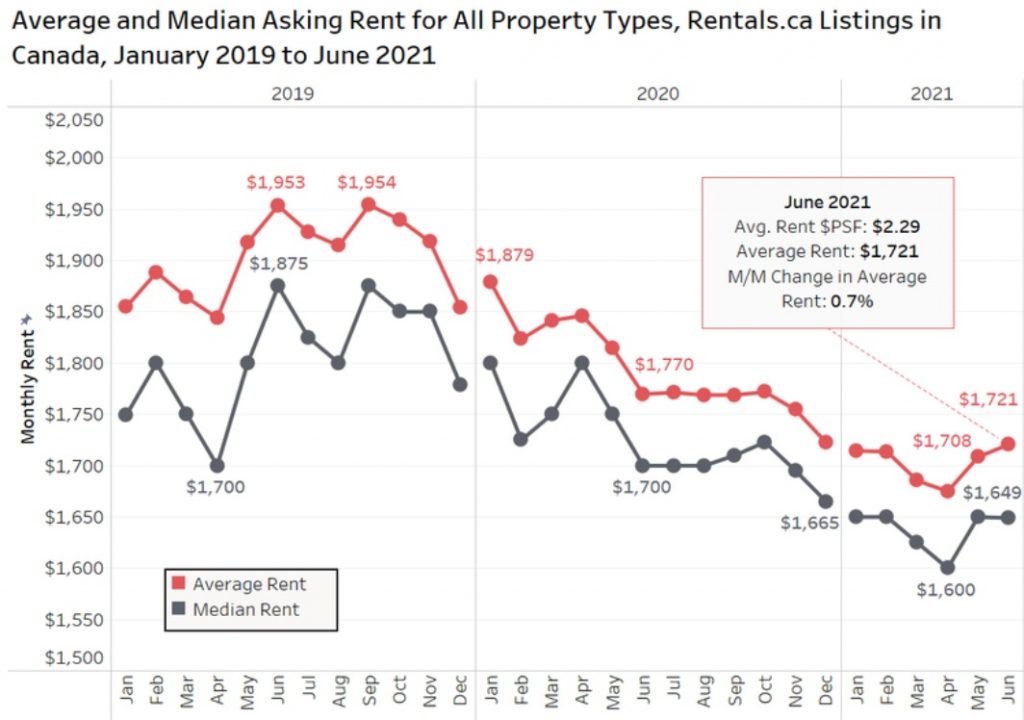
Average rent in Canada increased for the second month in a row, rising to $1,721 after six straight months of decline, according to the June National Rent Report.

“After unprecedented declines during the pandemic, the domestic rental market is in recovery mode with many of Canada’s largest cities seeing rent growth accelerate in June,” said Ben Myers, president of Bullpen Research & Consulting. “Unit showings are picking up, vacancies are declining and tenant demand is strong again in major downtown markets. However, it still could take eight to 15 months before most markets get back to their peak rent levels from late 2019.”

As the country begins to fully reopen, tenant demand is expected to pick up with further growth predicted into 2022 when most COVID restrictions are lifted, in-class learning resumes, offices are up and running, and immigration is back to pre-pandemic levels.

Unit types and sizes

On a national basis, large units continue to outpace smaller units in terms of rent growth as many tenants anticipate they will be working from home for longer, while others anticipate a permanent remote set-up.

The single-family rental market remains strong, and apartment rents are now above pre-pandemic levels. The average rent for condos has started to turn up, but remains below peak levels as the high-end downtown markets have yet to fully recover.

Single-family homes have experienced the sharpest increase in average rent since the start of 2021, from $2,214 per month to $2,553 per month, up 15 per cent. On an annual basis, the average rent in June for single-family homes is up 5.5 per cent over June 2020.

The average monthly rental rate for condo and rental apartments have also experienced increases since the start of 2021, but to a lesser extent than single-family homes.

Condo apartments moved from $1,983 per month in January up to $2,032 per month in June (plus 2.5 per cent), but are still down 8.3 per cent year over year.

On an annual basis, average monthly rent for apartments is up 3.1 per cent over June of 2020.

Key markets

Vancouver continues to lead the list of 35 cities for highest average monthly rents at $2,056 for a one-bedroom home and $2,765 for a two-bedroom home. Toronto finished second with average rents coming in at $1,836 and $2,502 respectively.

Year over year, average monthly rent in Toronto is down between 11 per cent for a one-bedroom unit and 7 per cent for a two bedroom.

Montreal came in 22nd for one-bedroom homes at $1,432 and 16th for two-bedroom homes at $1,880. Year over year, rents in Montreal declined by 2.6 per cent.

Halifax experienced the largest month-over-month increase in average rent for June, up 6.7 per cent to $1,731, as many former Nova Scotians have moved back to Halifax with the intention of keeping their out-of-province jobs.

Ontario cities and areas with month-over-month rent increases include: Oakville, 4.2 percent; Markham, 3.8 per cent; Burlington, 3.3 per cent; Windsor, 2.9 per cent; Vaughan, 2.8 per cent;  Richmond Hill, 1.5 per cent; Toronto, 1.5 per cent; Brampton, 1.4 per cent; Kitchener, 1.3 per cent; Ottawa, 0.4 per cent and London, 0.2 per cent.

Hamilton average rents were down 2.7 per cent monthly, and Mississauga rents were down 0.5 per cent.

British Columbia cities with month-over-month rent increases were Victoria at 2.9 per cent; Vancouver at 2 per cent, and Burnaby at 0.2 per cent.

In Alberta, Red Deer (3 per cent); Calgary (2 per cent) and Edmonton (1.4 per cent) had monthly average rent increases.

Average monthly rents were also up in Regina by 2.1 per cent and in Saskatoon by 1.1 per cent. Winnipeg’s average monthly rents were up 0.2 per cent.

For the complete report, visit: National Rent Report.

Nova Scotia invests $96.5-mil in long-term care facilities

Nova Scotia is investing $96.5 million in new long-term care beds and facilities, with plans to renovate, repair or replace aging infrastructure across the province.

As part of a multi-year plan, the province will add 264 new beds in the central health zone and replace 1,298 beds at 14 nursing homes and three residential care facilities. The first project is expected to be completed by 2026-27.

Of the 17 facilities, a few include: Harbourview Haven in Lunenburg; Melville Lodge in Halifax; Carefield Manor in Sydney; and the 45-year-old Roseway Manor in Shelburne.

“A new, modern home will provide great benefits for all who live and work at here,” said Roseway Manor Administrator Nancy Jones. “Our communities are celebrating with us, knowing their loved ones can now live and be cared for with dignity and respect in a beautiful, inviting, modern home.”

The province allocated $615,000 to procure bed vacancy management and infrastructure management systems, $405,000 to assess facilities that are more than 25 years old, and $792,000 to hire nine permanent full-time employees to oversee and support the projects.

Facilities will be built, repaired or renovated according to space and design standards that put the needs of residents first, with private bedrooms and washrooms, and more focus on infection prevention and control. They will also include workplace safety elements like ceiling lifts to ensure staff are supported to safely provide the best quality care.

Previous long-term care commitments were announced in January when the government declared funding for 236 new long-term care beds, the replacement or renovation of seven long-term care facilities, and an increase to the annual budget for capital repairs and equipment upgrades available to all long-term care facilities.

“These are more than bricks and mortar facilities – they are people’s homes and we respect that,” said Premier Iain Rankin. “This support will help rejuvenate the sector, ensuring our loved ones are well cared for today and into the future.”


Debunking the immunity myth around cleaning

What really is cleaning’s relationship with immunity?

It has been posited in the past that overly enthusiastic cleaning can threaten immunity against disease; that over-protecting people, particularly children, can prevent the necessary build-up of antibodies against infectious illness. There is a theory that exposure to germs is helpful, even necessary, for a robust immune system.

The ongoing COVID-19 pandemic and the way in which cleaning and disinfection has shifted as a result of the last 16 months has placed a renewed spotlight on that hypothesis.

Is the world becoming “too” clean?

Not so, according to new research.

A study published in The Journal of Allergy and Clinical Immunology and conducted by researchers at University College London (UCL) and the London School of Hygiene and Tropical Medicine countered that theory with four key conclusions:

  1. Most of the microorganisms found in a home, school, or other building are not the ones that humans need for immunity.
  2. In addition to protecting individuals from the infection that they target, vaccines help strengthen people’s immune systems. Therefore, people do not need to risk death by being exposed to dangerous pathogens.
  3. Concrete evidence now exists that the microorganisms found in the natural environment are particularly important for human health. Domestic cleaning and hygiene have no bearing on people’s exposure to that natural environment.
  4. Recent research demonstrates that when epidemiologists find an association between cleaning and health problems, such as allergies, this is often not caused by the removal of organisms but rather by exposure of the lungs to excess cleaning chemicals.

“Exposure to microorganisms in early life is essential for the ‘education’ of the immune and metabolic systems,” said Graham Rook, study lead author and professor at UCL. “Organisms that populate our guts, skin, and airways also play an important role in maintaining our health right into old age: so throughout life we need exposure to these beneficial microorganisms, derived mostly from our mothers, other family members and the natural environment.

“But for more than 20 years there has been a public narrative that hand and domestic hygiene practices, that are essential for stopping exposure to disease-causing pathogens, are also blocking exposure to the beneficial organisms.”

Diligent home cleaning won’t remove beneficial microorganisms

The key takeaway from the study was that cleaning in the home and maintaining proper hygiene does not affect immunity by limiting exposure to the natural environment and its beneficial microorganisms. Recent research shows that cleaning the home also does not have a connection to allergies because of the removal of organisms.

“Cleaning the home is good, and personal cleanliness is good, but to prevent the spread of infection, it needs to be targeted to hands and surfaces most often involved in infection transmission. By targeting our cleaning practices, we also limit direct exposure of children to cleaning agents,” Prof. Rook adds. “Exposure to our mothers, family members, the natural environment, and vaccines can provide all the microbial inputs that we need. These exposures are not in conflict with intelligently targeted hygiene or cleaning.”

4 tips for reopening facilities

Facilities across the United States and Canada are continuing to formulate plans for reopening safely and welcoming back occupants. The challenges of maintaining a safe building have evolved dramatically over the last 16 months or so, and many buildings managers will be seeking expert advice.

Thankfully, help is out there.

For one, commercial cleaning company OpenWorks is offering four tips for reopening facilities based on expert advice and insights.

These plans will of course vary a bit as regulations differ from place to place, but all business reopening plans should include the following four elements:

1. Create a cross-functional team that will oversee ongoing reopening efforts.

It’s essential to appoint leaders across all departments to oversee ongoing reopening efforts. Including at least one person from each team helps avoid conflicts and ensures everyone knows what is expected. The group’s roles should include monitoring local and state updates, developing a communication plan for employees and customers, and designating reopening tasks. The team should have regular check-ins to discuss progress and next steps along the way.

2. Prepare facilities for re-opening by first understanding the needs of employees and customers.

Conducting a survey is a great way to understand employee and customer expectations for cleaning, social distancing, and other safeguards. According to OSHA, employers should also implement engineering controls to isolate employees from workplace-related hazards.

In the case of COVID-19, measures include:

  • Installing high-efficiency air filters.
  • Increasing ventilation rates in the work environment.
  • Installing physical barriers, such as clear plastic sneeze guards.
  • Installing a drive-through window for customer service.
  • Specialized negative pressure ventilation in some settings, such as for aerosol-generating procedures (e.g. airborne infection isolation rooms in healthcare settings and specialized autopsy suites in mortuary settings).

This is also a good time to reevaluate cleaning and disinfection procedures. Review the CDC’s guidelines, and research any specific recommendations for the business type.

It’s also important to consider how to accommodate social distancing. Is there sufficient PPE, disinfectant, hand sanitizer, and other materials? Planning ahead will prevent any confusion or mishaps on reopening day.

3. Set policies and procedures that will dictate who will return to work and when.

Many companies are operating under a staged reopening process with split shifts of remote and in-person work to prevent crowding. It’s important also to communicate policies on travel, guests, and at-risk groups and caregivers.

In the event of a COVID-19 incident in the workplace, how will employees be expected to communicate? How will the office be evacuated and disinfected? Have a plan in place for what will be done and how long employees will remain out of the office following an incident. A qualified commercial cleaning company will be able to disinfect the space from top to bottom so employees can return safely.

4. Prepare customers by adding signage that makes them aware of safety requirements.

Customers will be excited to return to business as usual, and it’s important to help them do so safely. Continuously monitor local guidelines to maintain compliance. Communicate the steps being taken and consider adding signage to help customers understand expectations. Employees should also be aware of requirements and what to do if customers aren’t following them.

Essity joins UN to address antimicrobial resistance

Hygiene and health company Essity has expanded its partnership with the United Nations (UN) Foundation by joining a cross-industry group that brings together corporate experts in the fight against antimicrobial resistance.

Antimicrobial resistance (AMR) occurs when bacteria, viruses, fungi, parasites, and other microorganisms change in ways that make medication ineffective and infections persist in the body. The main causes of AMR are lack of clean water and sanitation, inadequate infection prevention/control, and antibiotic misuse.

Established in 2020, the UN’s council is a first-of-its-kind international group composed of private sector AMR experts and organizations involved in antimicrobial stewardship. Essity will collaborate with other group members to develop global policies and best practices, share research and technology, and highlight the role of business in achieving health security goals.

The World Health Organization’s (WHO)2 outlines reduction of the incidence of infection through effective sanitation, hygiene, and infection prevention as one of the key measures in tackling AMR. Essity research shows that 73 per cent of the general public agree that AMR is a threat to global health and 47 per cent are worried or very worried about AMR.

“To preserve lifesaving antibiotics for current and future generations, we need to take action on a global level. As a hygiene and health company with sales in 150 countries, Essity addresses issues where hygiene and health are part of the solution. Working together with the public sector and other companies makes it possible to accelerate change with higher impact in the fight against AMR,” says Magnus Groth, President and CEO of Essity.

Essity’s works towards fighting AMR via improved hand hygiene solutions.

“Essity’s expertise and experience from driving antimicrobial stewardship will be a great asset to this group of companies that will contribute policy and practical input to the United Nations-led efforts to fight antimicrobial resistance,” says Kate Dodson, Vice President, Global Health Strategy, UN Foundation, which hosts the cross-industry working group through its Business Council for the UN.

Stantec creates sustainable centre of excellence

Stantec has established a cross-disciplinary centre of excellence to provide sustainable, climate smart, and equitable infrastructure design services.

The centre is in response to the need for an immediate transition to a low carbon economy to limit global temperature rise, and that communities must prepare to better respond to and recover from the increasingly frequent and severe natural disasters related to climate.

The firm’s buildings and transportation will jointly lead the effort, bringing extensive experience in sustainable design.

The integrated group will work to identify and execute modern, sustainable, and resilient infrastructure design, construction, and operational solutions that protect valued environmental resources, while supporting clean economic growth and social inclusion.

The Sustainable Infrastructure Centre of Excellence will:

  • Help clients develop policies to programmatically embed sustainability and resiliency principles into their planning, design, procurement, and project delivery processes.
  • Unlock solutions for holistically incorporating project specific sustainability frameworks across the asset’s entire lifecycle.
  • Utilize the scientific knowledge from globally recognized infrastructure sustainability frameworks to create actionable, accessible, and feasible solutions for projects of all types, sizes, and geographical locations. These frameworks including but are not limited to: Envision, Greenroads, GreenMarine, Infrastructure Voluntary Evaluation Sustainability Tool (INVEST), and the Civil Engineering Environmental Quality Assessment and Awards Scheme (CEEQUAL).
  • Support the selection of materials and designs that offer the lowest carbon footprint by completing infrastructure specific life cycle assessments (LCAs) and developing low carbon material procurement specifications.

Two new sustainable infrastructure team leaders, Brad Moore and Mina Papic, will work together supporting clients in implementing sustainability best practices across a range of infrastructure types. They will also advance sustainable infrastructure practices at Stantec by leading in-house training and education around sustainable infrastructure.

Moore is a civil engineer specializing in sustainable infrastructure design. He has worked on projects across Western Canada including major roadways, roundabouts, urban renewals, water utilities, and wastewater treatment systems. His emphasis on sustainability throughout design and construction has been recognized by the Institute for Sustainable Infrastructure (ISI) with the first Envision Award for Sustainable Infrastructure given to a project in the Province of Alberta.

Papic has a background in mechanical engineering with a master’s degree in Applied Sustainability. As a member of Stantec’s Carbon Impact Team, she works across engineering disciplines to provide technical support for implementing sustainability strategies on a variety of infrastructure projects.

Post-pandemic space configurations on view

Ottawa-based Colonnade BridgePort is offering virtual tours of optimal post-pandemic space configurations. Working with the furniture distributor, NUA Office, the real estate services provider has developed a four-part primer to help companies welcome back their workforces and acclimatize to new levels of awareness and concern about healthy indoor environments.

Brent Arseneau, director of office leasing with Colonnade Bridgeport, which manages approximately 6.3 million square feet in the Ottawa market, describes the endeavour as a “deep dive” into the latest return-to-work research. A wide range of factors — from ergonomics to biophilia — that can support a productive transition back to formal office settings are discussed and visually plotted into a digital model suite that’s now open for online, interactive tours.

“It allows us to proactively help new or existing tenants find the office space that will be best suited for their return-to-work strategy,” Arseneau says.

The virtual office is based on a 4,200-square-foot space in Colonnade BridgePort’s downtown office building at 81 Metcalfe Street, and offers insight and design tips for accommodating social distancing, enabling collaboration and incorporating mood-boosting elements.

Re-visiting office ergonomics for a safe return

The growing number of vaccinated Canadians is generating much excitement, especially because it might mean getting back to normal. But when that happens, will everyone go back to the office?

In the last year, with millions of office workers transitioning to work remotely at home, many workstation set-ups and work environments have been less than optimal, resulting in the awkward postures and the development of poor health habits.[1] Poor postures, lack of movement, and long workdays have also led to individuals experiencing new discomforts and injuries or aggravating pre-existing ones.[2]

Early surveys and assessments conducted by ergonomists anecdotally suggest there are higher numbers of workers reporting low back, upper back and neck, shoulder, and wrist discomfort due to poor workstation set-ups and lack of movement.[3] Additionally, a significant number of employees are reporting severe eye strain and headaches, likely a function of hours spent on the computer viewing at fixed distances and minimal breaks away from the computer.[4]

Many have speculated that there will be a variety of approaches when returning to normal. For office workers, employers are considering: [5,6,7]

  • Keeping employees permanently working from home
  • Returning full-time to the office, and;
  • Developing a hybrid model—working part-time at the office and part-time at home.

Each of these approaches has their own opportunities and challenges. In this article, we are going to focus on the last one.

Ergonomics of the hybrid model

For those encouraging a hybrid model, employers will likely have workspaces that are shared rather than dedicated to one worker. To support this model, shared workstations will need to be adaptable to the varying needs of multiple employees. Variances in size and stature and differences in how tasks are carried out must all be considered when setting up a hybrid work model. To meet the diverse needs of workers, the employer will likely have to provide a height-adjustable workstation, adjustable monitor supports and an adjustable chair.

For employees transitioning daily between different workstations, management may want to standardize equipment so employees can easily learn how to adjust equipment and not have to relearn each workstation type. Standardization of chairs may be somewhat difficult, especially if you have smaller or larger persons sharing the same workstation. However, most chair models today come in a range of sizes to help minimize the need to learn a variety of lever adjustments.

Keep education and training simple, make it interactive, and provide it through multiple mediums, such as short lunch and learns, online learning, and review of key equipment adjustments (short videos or pamphlets). Returning to the office for many will be exciting, but could still be very overwhelming for a multitude of reasons.

Regardless, if an employer is moving to a hybrid model or returning full-time to the office, it will be important to revisit ergonomics education and training on how to adjust workstations, chairs, and monitors. In many cases, individuals who have adapted to poor equipment setup at home will need to be educated on proper positioning of the monitor (height and distance) especially if they have worked off a laptop. If the staff member has sat at a dining room table with a dining room chair, they have likely developed very poor postures and may have forgotten what good posture is and looks like.

Reviewing key principals of ergonomics and educating staff on equipment adjustment and workstation setup can go a long way in helping staff regain good working postures. Education should also include the importance of incorporating regular movement and postural change— two principles that have likely been overlooked since transitioning to home.

Recently, the Conference Board of Canada suggested that many employees were working longer hours with fewer breaks resulting in long periods spent in a seated posture. Reinforcing the importance of movement breaks and incorporating reminders to get up and move may need to be considered since individuals could have developed habits of not getting up on a regular basis, eating lunch at their desk, or even being afraid of moving from their workstation to common areas.

If the employer has provided a sit-stand workstation, consider education on proper sitting and standing posture. Encourage individuals to slowly start developing a tolerance for standing, especially if they have been primarily sitting at home. Finally, educate employees on the importance of rotating between sitting, standing, and moving every hour.

Linda Miller, OT (c), OTD, CCPE, is president and certified ergonomist for EWI Works International Inc., Clinical Associate Professor, Faculty of Medicine and Dentistry, Department of Preventive Medicine, University of Alberta. Linda also recently became a part of WELL’s global concept advisory on movement. She can be reached at [email protected].

References

  1. https://www.inc.com/sophie-downes/remote-work-home-ergonomics-stress-back-pain-health.html
  2. https://www.ctvnews.ca/health/working-from-home-causing-an-increase-in-foot-pain-injuries-experts-say-1.5271135
  3. https://www.hrreporter.com/focus-areas/culture-and-engagement/ergonomics-challenge-many-remote-workers-survey/332022
  4. https://www.cbc.ca/news/canada/montreal/protect-your-eyes-from-strain-1.5776459
  5. https://globalworkplaceanalytics.com/how-many-people-could-work-from-home
  6. https://usefyi.com/future-of-remote-work/
  7. https://www.mckinsey.com/featured-insights/future-of-work/whats-next-for-remote-work-an-analysis-of-2000-tasks-800-jobs-and-nine-countries

Avenue Living doubles Edmonton portfolio

Avenue Living Asset Management announced it has recently acquired $275 million in assets in the Edmonton market, doubling its Edmonton portfolio, which now accounts for 25 per cent of the company’s multifamily properties.

“We’re focused on a particular segment of multifamily — workforce housing,” said Anthony Giuffre, Founder, Chief Executive Officer and Executive Chairman, Avenue Living Group of Companies. “We’re still owners and operators. Our laser focus on operations has led to a platform that is built to scale and absorbs assets efficiently. We have a tech-forward, vertically integrated model that was built over 16 years to focus on managing the ‘hard to manage’. We now have the ability to buy and integrate an upper scale product at an incredibly attractive rate.”

The company’s buying strategy revolves around existing, high-potential, low-density assets that target a specific resident demographic. Since 2006, Avenue Living has grown from 24 to 12,500 units using what it calls “a methodical investment strategy” which includes detailed research into the markets in which it operates. The company has undergone substantial growth since the pandemic began last March, expanding its overall AUM by over 80 per cent, from $1.5 billion to $2.8 billion today.

The company says the recent acquisitions in Edmonton were opportunistic investments that captured an ideal resident base in a promising market.

“Edmonton is unique,” Giuffre said. “We want to continue to strategically grow our portfolio in this market and will continue to explore future opportunities. Everything is about price, customer, and location. We have found remarkable success in this market, and our recent $275 million investment in Edmonton is a testament to this.”

For more information, visit: Avenue Living Asset Management (avenuelivingam.com)

Nexii Building Solutions acquires Omicron Canada

Nexii Building Solutions has announced the acquisition of Omicron Canada. Omicron will become a subsidiary of Nexii, continuing to serve existing clients and providing services under the Omicron brand, while also supporting Nexii business development and project delivery.

The merger will combine Nexii’s project operations with Omicron’s integrated project delivery platform, enhancing the business offerings of both Omicron and Nexii to existing and future clients.

Nexii and Omicron have worked as partners since February 2019, when Omicron became one of the early shareholders and adopters of Nexii technology, followed by a range of project collaborations across both teams.

Collaborations include engineering and design assignments for plant operations, manufacturing, and specific product design for Nexii’s Squamish, Hazelton and Vancouver Island plants. Their most recent work together was on the Courtyard by Marriott hotel in Nanaimo, currently under construction.

“Omicron and Nexii have been collaborating in several key areas of mutual interest for the last two years, with the shared aim to tackle the construction industry’s main challenge; how to change the way we build in the face of climate change,” says Stephen Sidwell, CEO of Nexii. “We are excited to join together to achieve better outcomes for our clients and for the environment.”

The leadership of both companies will be unchanged: Sidwell remains as CEO of Nexii, and Bill Tucker will continue to lead the Omicron team as CEO. Tucker will also officially step into the role of executive vice president operations, A&E and assembly at Nexii to help align processes, teams and key operations.

“Omicron was one of the early shareholders to understand the potential of Nexii and invest in the company because we recognized the power of their innovative technology,” says Tucker. “We take our valuable partnership one step further, combining our teams and processes to deliver faster, greener, more efficient projects for all our clients.”

Both companies will retain their business names and separate office headquarters in Vancouver and will continue to service existing clients and projects to completion.

EllisDon appoints new vice president for Calgary

Sean Dekoning has been appointed vice president and area manager for EllisDon in Calgary. His new role will be overseeing and leading the entirety of EllisDon Calgary’s buildings group.

“Sean is a talented and proven natural leader who upholds our EllisDon values in everything that he does,” said David McFarlane, senior vice-president, Western Canada, EllisDon. “Sean and I are excited about the horizon for the Calgary buildings group and he has my full support along with our other Western Canada buildings’ leaders.”

Dekoning  graduated from the Civil Engineering Technology program at SAIT and joined EllisDon in 2004 as an estimator. Two years later he made the move out of the office and became a project manager before being promoted to senior project manager in 2011. As senior project manager, Dekoning helped lead teams on some of EllisDon Calgary’s most complex projects including the $1 billion South Health Campus and the Schulich School of Engineering Redevelopment at the University of Calgary.

Dekoning returned to estimating in 2017 when he was promoted to chief estimator for the Calgary area, overseeing and providing leadership on a variety of projects in Alberta.

“I am truly ecstatic and humbled at the opportunity to lead the strong and talented team of professionals that we have here in the Calgary area,” said Dekoning. “Looking forward to the future, I have no doubt we will achieve many great things together and continue to drive EllisDon’s success.”

IICRC seeks nominations for People’s Choice Award

The Institute of Inspection, Cleaning, and Restoration Certification (IICRC) is now accepting nominations for its 2021 People’s Choice Award.

The institute’s annual award recognizes the outstanding work of IICRC-approved instructors.

All IICRC members are encouraged to visit iicrc.org/peopleschoiceaward/ through July 30 to nominate their favourite instructor.

The winner will be announced at the Annual Instructors Meeting (AIM) Awards Ceremony, which will be live-streamed on IICRC’s Facebook page on September 25. They will also receive a plaque and have their name enshrined in IICRC Hall of Fame at the institute’s global resource center in Las Vegas.

For additional information and to submit your nomination for a People’s Choice Award, visit https://iicrc.org/peopleschoiceaward/. For questions, contact the IICRC Strategy and Communications Department at [email protected].

RELATED: IICRC publishes revised water damage restoration standard

The IICRC is a global standards developing organization (SDO), accredited through the American National Standards Institute (ANSI), as well as a credentialing body that certifies individuals in 20+ categories within the inspection, cleaning, and restoration industries. With more than 40,000 certified technicians and 6,000 Certified Firms in 22 countries, the IICRC, in partnership with regional and international trade associations, represents the entire industry.

For more information, visit www.iicrc.org.

CPP’s Peter Ballon appointed ULI global chair

Peter Ballon, global head of real estate for the Canada Pension Plan Investment Board (CPP Investments) is the new global chair of the Urban Land Institute (ULI). His two-year voluntary term coincides with the rollout of the not-for-profit education and research body’s three priority missions to position the built environment for a low-carbon and inclusive future. Those are:

  • decarbonizing the real estate sector and targeting net zero;
  • educating the next generation of diverse real estate leaders; and
  • increasing housing attainability in communities around the world.

“Peter’s insights and guidance will be invaluable to ULI as we continue with our global expansion and explore new ways to make an impact in communities worldwide,” attests Ed Walter, ULI’s global chief executive officer. “The three mission priorities will help us deliver the mission by focusing our collective efforts on tackling a few well-defined real estate challenges where we can make a significant and measurable difference.”

Among those efforts, ULI will champion an industry-wide target to reduce carbon intensity by 50 per cent relative to 2009 levels, ultimately aimed at achieving net-zero carbon by 2050, and plans to deliver five guidance resources every year to support decarbonization in cities. It will also dedicate efforts to increase housing permits and starts in select global cities in order to develop replicable strategies that all cities can apply, and it will aim to connect with 50,000 students and young professionals over the next three years.

Peter Ballon, CPP Investments“ULI needs to focus on the greatest challenges and opportunities of the day and concentrate on where we can have the greatest impact,” Ballon concurs. “I am honoured to follow in the path of many leaders in the real estate industry and serve as ULI’s global chair. I will focus my efforts on delivering our mission and shaping our programs in the way that our members want to see them implemented.”

New owner for long idle Ford assembly plant site

Broccolini has purchased a 622-acre industrial tract in southwest Ontario, which was formerly host to a Ford assembly plant. The vast site has been idle since the plant closed in 2011, but is strategically located near the city of St. Thomas in Elgin County with proximity to Ontario’s 400 series highway network and the north shore of Lake Erie.

“Broccolini intends to renew the area’s legacy by redeveloping these lands and introducing new uses that reflect the modern industrial real estate landscape,” advises James Beach, vice president of real estate development with the construction are real estate company. “We are honoured and excited to take stewardship of this iconic industrial land, which for many decades was home to one of the largest automotive assembly plants in the country.”

With the sale, one of the largest available tracts of industrially zoned land in Canada comes off the market. It was officially listed in the spring of 2019 with an asking price in excess of $26 million. That followed a failed proposal from solar power producers earlier in the decade.

The new owner has now begun preparatory work, including grading and soil decontamination, in advance of redevelopment.

“I am very proud to have worked with the various municipal partners to obtain the provincial approvals in environment, transportation and energy, in order to see this deal finalized,” states Jeff Yurek, the local member of provincial parliament for Elgin-Middlesex-London and Ontario’s former Minister of the Environment, Conservation and Parks.

Improving disinfection in four steps

Veteran cleaning company Pegasus recently introduced a multi-step disinfection program that leverages data to create and maintain healthy and safe work environments.

“This SuperiorClean program was designed to really bring together what we already do best across the various verticals we serve,” says Jeff Becker, CEO of Pegasus. “We are just happy we get to keep facilities healthier and help people feel safer. That’s at the root of why we are in business.”

Pegasus offers four key steps that facilities can take to create a safer and healthier workplace as building occupants continue to transition back to work:

1.    Inspection

An inspection is a critical first step in the development of the reopening plan. It helps assess the current state and occupancy levels of the facility and what the best next steps would be for the facility in ensuring the long-term health and safety of facility occupants.

  • Assess current state of the entire facility
  • Identify reopening goals, occupancy transition levels, and locations with client
  • Perform a thorough walkthrough using an electronic reopening checklist that can be easily shared with teams
  • Present and communicate findings, including all relevant photos and recommendations that are best suited for the specific facility
  • Create an action plan

2.    Preventative decontamination

Before COVID-19, surfaces cleaned were limited and industry standards focused on multipurpose cleaners. Today’s environment demands more. To further the reduction of pathogens on surfaces, a more advanced methodology can greatly reduce the health risks.

Hydrogen peroxide spray fogging is a highly effective method that safely and quickly eliminates pathogens, including COVID-19. This method should be performed in intervals based on your facility needs and in case of a COVID-19 outbreak.

3.    Enhanced disinfection
Creating healthy and safe indoor environments demands a more robust disinfection approach that is beyond routine cleanings used before the pandemic. Facilities should incorporate a high-touch disinfection method to thoroughly disinfect door handles, elevator buttons, pantry areas, seating areas, and routinely visited locations like restrooms, common areas and office areas.

Disinfection services should include EPA-registered disinfectants that have been proven to eliminate emerging pathogens, as well as microfibre products that optimize disinfection effectiveness. The disinfection teams should be fully trained and follow all CDC guidelines and proper use of PPE.

4.    Leverage data

Knowing where and when an area has been cleaned last and scheduled to be cleaned next provides peace of mind during and in post-pandemic times. The implementation of a workflow and scheduling platform is highly effective in creating visibility around the disinfection process, putting building occupants at ease, and provides measurable insights to facility owners and managers.

Condos feel the lows of high deductibles

How are higher insurance deductibles affecting condo corporations?

Gone are the days of condominium corporations enjoying low deductibles on their mandatory property insurance policies. A high frequency of water damage losses, coupled with a hardening of the general insurance marketplace has led most insurers to demand much higher minimum property deductibles. There is typically a separate deductible that applies to water damage claims, which will often start at a minimum of $25,000 for multi-storey buildings. However, it is far more common to see $50,000, $100,000 or higher water damage deductibles where a condo has had claims in the past few years.

How do corporations handle losses that are below their deductible?

If loss or damage occurs that is insurable, the condominium has the same responsibility to repair or replace property, regardless of whether or not they submit an insurance claim. For insurable losses, the condominium is responsible for the cost to repair the common elements and the units, but not any improvements made to the unit.

Unit owners may elect to use their own personal insurance policies to pick up where the condominium’s repair responsibility leaves off. Unit owner policies cover damage to their contents, betterments and improvements made to the unit, costs to live elsewhere while the unit is repaired, and possibly the charge-back of the condominium’s applicable insurance deductible. It is common that the condo corporation insurance must work together with unit owner insurers to determine who is paying for what.

If the damage event is below the condo corporation deductible it will be up to the board of directors and property management to handle the situation, work with unit owner insurance adjusters, and determine the proper allocation of costs. It is recommended to speak to your insurance broker, even for losses below the deductible, as they may be able to provide guidance and assistance with these situations.

How has this been affecting unit owners this past year?

With higher condo insurance deductibles, it is critical for condo unit owners to be aware of what their corporation’s property deductibles are and the exposure that those deductibles could present to them.

The Condominium Act of Ontario allows for corporations to charge an owner up to the corporation insurance deductible for certain property damage situations that are caused by a unit owner’s act or omission. This can also be further clarified and modified by an insurance deductible bylaw. So, even if an accident happens in an owner’s unit that causes damage to corporation property, they could be faced with a charge-back of up to the condo corporation deductible amount.

With larger corporation deductibles, unit owners must make sure that they align their own unit owner policy with the corporation insurance policy to avoid gaps. If a unit owner does not have enough coverage for the corporation deductible charge-back, they could face significant out-of pocket-costs. For condo corporations, it is important that the board of directors and property management promptly communicate any change in corporation insurance policy deductibles to unit owners.

For unit owners, it is strongly recommended that they select a broker and insurance company that can provide them with the level of coverage that they need for their particular condominium and minimize the exposure they have to out-of-pocket expenses.

Tom Gallinger is the vice-president of Atrens-Counsel Insurance Brokers, a brokerage that specializes in managing insurance programs for condominiums, unit owners and property management professionals. Tom has been in the insurance industry for over 16 years in various underwriting, brokering and management roles. As a specialist in condominium insurance, Tom strives to deliver a high level of service by managing the long-term insurance needs of his clients.