




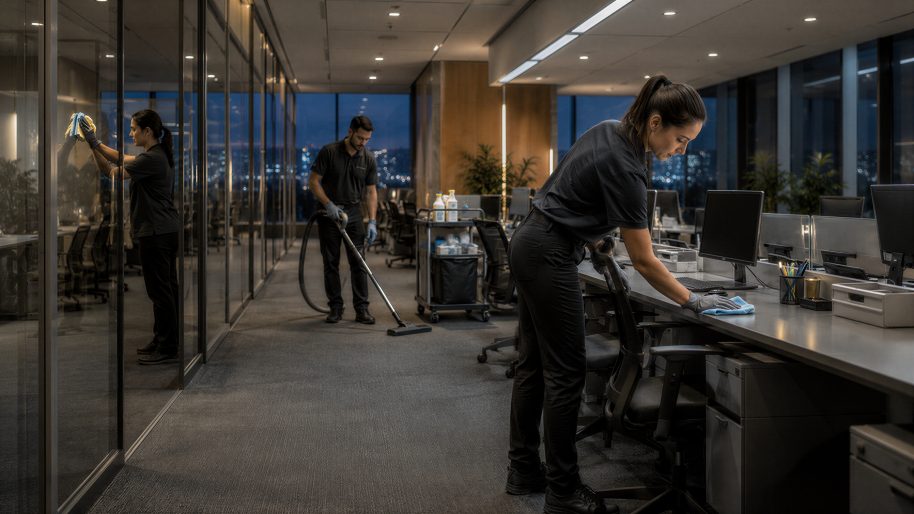
A facility manager responsible for one building can walk the property, know the cleaning team, and quickly spot a service problem. Add 10, 50, or 100 locations across multiple markets, and visibility changes dramatically: one location looks great while another generates complaints, a restroom is serviced one way in one city and another way in another, and one team may interpret “high-touch cleaning” differently from another.
In multi-site commercial cleaning, consistency is rarely created after service begins; it’s designed before the first shift. The first challenge is deceptively simple: everyone needs to agree on what successful service looks like.
A scope that says “clean lobby daily” leaves room for interpretation. Does that include interior glass, door spot-cleaning, elevator tracks, furniture, or periodic hard-floor care? Multiply small ambiguities across dozens of properties and service variation become almost inevitable.
A strong scope sets measurable expectations for each space type while recognizing legitimate differences among locations. A suburban office, downtown high-rise, and distribution facility may belong to the same organization, but standardization means creating consistent outcomes, not pretending every building is the same.
Audit the sites before finalizing the scope
Auditing sites before finalizing the scope is one of the most important steps in building a multi-site program. Square footage helps, but it doesn’t tell the entire story: two 50,000-square-foot buildings can require very different service depending on occupancy, flooring, operating hours, restroom counts, and visitor traffic.
Before implementation, identify exceptions: buildings that operate around the clock, secure areas, loading docks, cafeterias, high-traffic public spaces, and unusual access restrictions. Finding these differences before service begins is far easier than discovering them through complaints.
Create one playbook with room for local reality
Once you understand each facility’s needs, translate them into one operating playbook. It should define the portfolio’s non-negotiables: service standards, inspection processes, communication protocols, escalation procedures, safety expectations, and reporting requirements.
The playbook should also show where local adaptation is appropriate. Weather is a simple example: a facility dealing with winter salt and snow needs different seasonal floor care than one managing sand and heavy rain, even when the expected outcome stays the same.
Establish accountability before problems occur
Facility managers should know exactly how an issue will move through the system before the first complaint arrives: who receives a service request, how quickly it’s acknowledged, who owns the resolution, when it is escalated, and how the manager is informed that the problem has been corrected.
Without that process, multi-site management can quickly become a maze of emails, phone calls and local contacts. Centralized oversight helps because facility managers should not have to manage dozens of independent service relationships simply because their portfolio spans multiple markets.
Train to the standard, rather than the task
Most cleaning professionals know how to clean. The challenge in a multi-site account is ensuring teams understand how the client expects its facilities to be maintained, so onboarding and education must extend beyond technique.
Teams need to understand the scope, security requirements, site-specific protocols, reporting procedures, and client priorities. Supervisors should be aligned on the same standards so inspections don’t become subjective from one market to another and expectations survive personnel changes.
Measure patterns across the portfolio
One advantage of managing multiple locations is the amount of operational information available. Inspections, service requests, and customer feedback shouldn’t be viewed only at the individual building level; they should reveal portfolio-wide patterns.
Are several locations experiencing the same restroom issue? Are floor complaints increasing in one region? Does a service consistently require follow-up? A single complaint may require a correction; a pattern may reveal a problem with the scope, onboarding, or process itself.
Consistency is built upstream
When a multi-site cleaning program struggles, the instinct is often to increase inspections. Inspections matter, but they cannot compensate for unclear expectations, inconsistent standards, or a poorly designed scope; by the time someone is inspecting the work, most of the decisions that determine consistency have already been made.
Successful multi-site cleaning and disinfection partnerships begin well before anyone picks up a mop, vacuum, or microfibre cloth. They begin with understanding the facilities, defining the standard, establishing accountability, and giving local teams a clear operating framework. Hence, a visit to headquarters or a location 1,000 miles away feels like it belongs to the same organization.
When that happens consistently, it’s rarely an accident: it’s designed that way.
Darren Williams is the Master Franchise Owner for Anago of Washington, D.C., part of the Anago Cleaning Systems brand, supporting more than 1,800 franchises across the U.S. and Canada. For more information about Anago of Washington, D.C., visit www.AnagoCleaning.com/Washington-DC.