Articles Archive - Page 70 of 928 - REMINET
REMI

Top-floor venue at Scotia Plaza elevates tenant amenities

KingSett Capital and Oliver & Bonacini (O&B) announced the grand opening of a 20,000-square-foot meeting and event space overlooking Toronto’s financial district from the top floor of Scotia Plaza.

SixtyEight dedicates 10,000 square feet to both office tenants and outside parties and a 10,000-square-foot exclusive tenant amenity area. A ballroom will accommodate up to 250 guests reception-style and 200 seated for corporate gatherings, galas, weddings and town halls.

The tenant-only amenities are designed to support the evolving workplace, blending service with function and flexibility. They include a café and bar managed by O&B and a variety of meeting rooms for work, connection, casual socializing, and chef-driven dinners with views of the CN Tower and Toronto skyline.

William Logar, chief asset management officer at KingSett Capital, said the Scotia Plaza venue sets a new standard for office amenities and public events in Toronto’s financial district. “The opening of SixtyEight highlights our ongoing focus on improving our assets and providing tenants with extraordinary experiences,” he said.

Barrie declares State of Emergency over homelessness

The City of Barrie has declared a state of emergency in response to a worsening crisis of homelessness, public safety concerns, and unaffordable housing. Mayor Alex Nuttall made the announcement on September 9, citing a surge in encampments and related incidents of violence, drug use, and environmental degradation.

“This is about reclaiming our streets, our parks, and our sense of safety,” said Nuttall. “Barrie residents have had enough. If you refuse help, you cannot stay in these encampments.”

The emergency declaration enables city staff to prioritize dismantling high-risk encampments and coordinate with Simcoe County and provincial agencies to offer shelter and support. However, the lack of affordable housing remains a major obstacle.

According to the 2024 Simcoe County Homelessness Enumeration, 1,080 individuals were experiencing homelessness on the night of October 8, 2024. Of these, 70 per cent were in sheltered environments, while 30 per cent were unsheltered—a significant increase from previous years. In Barrie specifically, 219 people were counted as homeless in 2022, with 62 per cent experiencing chronic homelessness.

The crisis is compounded by rising rental costs. As of 2023, the average rent for a one-bedroom apartment in Barrie was $1,430, while a two-bedroom averaged $1,612. Vacancy rates remain low, hovering around 2.8 per cent for one-bedroom units.

Simcoe County has made strides in affordable housing, creating 3,692 new units since 2014, including 220 mixed-income units approved in Barrie in 2024. Yet, officials acknowledge that demand far exceeds supply.

The emergency order follows troubling incidents, including a double homicide at an encampment and widespread drug use. Cleanup efforts at sites like Dyment’s Creek are expected to cost millions.

While the declaration aims to restore public order, advocates stress the need for compassion and legal safeguards. Ontario courts have ruled that evictions without adequate shelter options may violate Charter rights.

Barrie now faces the dual challenge of addressing immediate safety concerns while investing in long-term housing solutions and mental health support to prevent further displacement.

BOMEX 2025 rising in the east

BOMEX 2025 will kick off with some informed cross-border perspective, as David Cohen, former United States Ambassador to Canada, delivers the opening keynote address to Canadian commercial real estate professionals attending the annual conference. This year, the Building Owners and Managers Association (BOMA) of Canada takes the event to the host city of Halifax, home base of one of 11 vibrant regional BOMA associations that will congregate under the national umbrella from September 15 to 17.

“At this pivotal moment in Canada-U.S. relations, we are honoured to welcome Ambassador David L. Cohen to BOMEX 2025,” says Benjamin Shinewald, president and chief executive officer at BOMA Canada. “His breadth of experience in diplomacy, corporate leadership and civic engagement brings a unique perspective to our discussions on the future of commercial real estate in a rapidly changing global economy.”

Lisa Baroldi, president and chief executive officer of BOMA Edmonton and North, will lead the discussion, drawing out Cohen’s insight from both his 2020-2025 ambassadorial term and a distinguished business and legal career. Just prior to his appointment to Canada, he was a senior executive and the inaugural chief diversity officer with the Fortune 50 global media and technology company, Comcast NBCUniversal.

Cohen comes to his BOMEX audience with a deep grounding in government and regulatory affairs, public policy, corporate real estate and security and community impact. As Ambassador, he played a pivotal role in fostering Canada-U.S. relations during the Biden administration, further honing his relationship-building skills around issues of trade, infrastructure, climate action and cross-border security. He also has a track record of service in the non-profit sector, as a corporate board member and in local government.

Anne Belliveau, chief customer experience with Cirque du Soliel will deliver the closing keynote, focusing on finding new possibilities in times of changes. She’ll illustrate that topic with insight on Cirque’s transformation from under the Big Top canvas to a larger canvas of digital and physical performances, while drawing on her own experience as a triathlete, community leader and advocate for the arts.

Belliveau’s outlook and expertise were additionally shaped in her previous tenures as chief marketing and revenue officer at Tennis Canada, where she oversaw both unprecedented revenue growth and an elevation of the organization’s global brand. Her career trajectory also includes serving as chief marketing officer for the Just For Laughs Group and as vice president, business brand and marketing communications, at Telus.

Other highlights on the BOMEX schedule include the debuting Women in CRE Breakfast and roundtable discussion and the venerable Executive Roundtable. BOMA’s Emerging Leaders will again provide assurance that the industry’s future is in good hands, presenting a panel discussion and a deeper delve into findings from BOMA Canada’s survey of the cohort’s ambitions, needs and skillsets on offer.

Jeff Douglas will keep all proceedings rolling as conference host. That’s a role he likewise fills with CBC radio in Halifax, as host of afternoon show, Halifax Mainstreet. He’s also known as the actor behind Joe Canadian — first emerging as a popular figure at the turn of the millennium and more recently returning to the national stage to offer encouragement for the current times.

Three days of BOMEX learning and networking will again culminate with a celebration of the Canadian commercial real estate industry’s accomplishments at the National Awards Gala. Retailer and floral designer, Neville McKay, proprietor of My Mother’s Bloomers, will serve as master of ceremonies.

Tork launches Inclusive Hygiene Playbook for facility leaders

A new professional guide, The Inclusive Hygiene Playbook, was recently introduced by Tork, an Essity brand and the global leader in professional hygiene. This first-of-its-kind resource provides research-backed tips for facility managers to improve hygiene in one of the busiest spaces in a facility: the restroom. This builds on the ongoing efforts by the Tork Coalition for Inclusive Hygiene, launched earlier this year, to explore and help solve the hygiene barriers that people face in public restrooms. These barriers arise from a mismatch between a person’s abilities, needs or circumstances and their environment.

According to a recent survey from Tork, only one in five public restrooms meets users’ hygiene and cleanliness expectations, and in office buildings – where people spend a significant portion of their day – restrooms account for over 45 per cent of building complaints.*

And when public restrooms fail to meet users’ needs, it directly impacts the overall experience, business reputation, and, depending on the facility type, revenue.

This is because a significant number of people face barriers to hygiene in public restrooms that often go unknown to the people who own, manage or operate public restrooms. Some of these barriers are visible; others are not. For example, a barrier can include anything from soaps that use harsh chemicals that aggravate a person’s skin condition, loud air dryers that overwhelm neurodiverse individuals, or faucets and paper towel dispensers that are difficult to operate for those with limited hand mobility.

Research shows that 54 per cent of venue visitors contend with some form of physical or cognitive challenge* and 44 per cent of people feel anxious about using public restrooms and often plan their days around access to proper hygiene.**

“The Inclusive Hygiene Playbook was designed to help facility managers reevaluate the role of restrooms — not just as operational necessities, but as strategic assets that can elevate the user experience and drive business results,” said Amy Bellcourt, VP of Communications at Essity. “Backed by over 50 years of professional hygiene expertise and informed by ethnographic research conducted in 20 cities across North America, this playbook delivers actionable insights to transform public restroom spaces into business advantages.”

The playbook outlines the following three key design principles and recommendations for addressing hygiene barriers and driving inclusive hygiene in public restrooms:

1) A clean and safe environment is paramount to encouraging return visits and boosting business performance

2) Put the “rest” back in restroom: design a comfortable and private space to increase user satisfaction and promote a better work environment.

3) The restroom should feel cared for: signal care with communications that showcase your business values.

To learn more and take actionable steps toward improving the restroom experience, download the Inclusive Hygiene Playbook here: https://www.torkglobal.com/us/en/about/inclusive-hygiene#playbook

Sources:

*Statista: North America; Average across 2017 to 2021; 185 respondents; Building service contractors / commercial cleaning providers.
**Tork Insight Survey 2024, conducted in US, UK, Germany, France and Mexico among 6000 end-users and 900 businesses

New name for Calgary’s Arts Commons theatre

The theatre at the heart of the Arts Commons Transformation project in Calgary officially has a new name: the Osten-Victor Playhouse.

The 1,000-seat theatre was recently named after local philanthropists Al Osten and Buddy Victor, who gifted $12 million toward the arts centre’s expansion in downtown Calgary. The pair met in 1957 as members of doo-wop group The Rover Boys, who even performed on The Tonight Show and iconic venues such as Radio City Music Hall in Manhattan.

“The Osten-Victor Playhouse is a testament to the power of generosity and the belief that arts and culture are essential to a vibrant city. Thanks to this exceptional gift, we’re building a world-class venue, and we’re honouring a legacy of love, partnership, and passion for the performing arts. This is a defining moment for Calgary’s downtown and our cultural future,” said Mayor Jyoti Gondeck.

The Osten-Victor Playhouse, intended to host medium-sized productions, will fill an existing hole in Calgary’s roster of performing arts venues when it opens in 2028. Prioritizing flexibility, inclusivity, and accessibility, the theatre’s automated lift system will allow for the easy reconfiguration of seating to host a broader variety of performances and productions.

Beginning in fall 2025, Arts Commons will officially be renamed Werklund Centre in recognition of entrepreneur Dave Werklund’s own $75 million contribution to the project.

The Arts Commons Transformation and Olympic Plaza Transformation projects are being led in partnership by Arts Commons, Calgary Municipal Land Corporation, and The City of Calgary.

In addition to the Osten-Victor Playhouse, the Werklund Centre expansion will add a 200-seat studio theatre space, adding two new essential venues to Calgary’s
future vibrancy. The design of this new building will integrate with the new Olympic Plaza and the renovation of current facilities for a modern, accessible cultural campus.

The design team is KPMB Architects in association with Hindle Architects and Tawaw Architecture Collective.

The Arts Commons Transformation Expansion project has also been shortlisted for a 2025 World Architecture Festival award. Winners will be announced in November.


WorkSafeBC: protect workers from wildfire smoke

With wildfire activity increasing in B.C., WorkSafeBC is reminding employers to take steps to protect workers from the health risks associated with wildfire smoke.

Heavy smoke from ongoing fires has been a significant hazard for much of Western Canada recently, with air quality warnings issued as health index ratings hit 10 at times.

Wildfire smoke contains fine particulate matter, which can penetrate deep into the lungs and cause serious health effects — particularly for workers with underlying medical conditions or those doing physically demanding work outdoors.

“Exposure to wildfire smoke can lead to both short- and long-term health impacts,” said Todd McDonald, head of Prevention Services at WorkSafeBC. “Employers need to assess the risks associated with wildfire activity, implement effective controls, and involve workers every step of the way.”

Conducting a risk assessment
Employers must assess the risk of wildfire smoke exposure in their workplaces and take steps to minimize harm. When conducting a risk assessment, consider:

  • The worksite’s location and local weather conditions.
  • The types of tasks workers are expected to perform.
  • Emergency preparedness and response plans, including site-evacuation procedures.
  • Input from workers on wildfire smoke risks and changing conditions.

Wildfire smoke can travel far beyond the fire zone. Employers should review the risk assessment each day before work begins — and again throughout the day — as air quality conditions may change rapidly, requiring adjustments to the plan.

Control measures for outdoor workers
Depending on the severity of smoke and the nature of the work, employers should consider:

  • Monitoring local air quality advisories and alerts.
  • Relocating or rescheduling work to avoid peak smoke conditions.
  • Reducing physically demanding tasks when air quality is poor.
  • Assigning alternate work to those more sensitive to smoke exposure.
  • Providing appropriate respiratory protection, such as N95 respirators, where needed — ensuring they meet standards and are properly fit-tested.

Control measures for indoor workers
Employers should also take steps to reduce smoke exposure indoors, such as:

  • Inspecting HVAC systems to ensure they are functioning properly and using clean filters.
  • Temporarily reducing outdoor air intake (in consultation with a qualified HVAC technician or ventilation engineer).
  • Using portable air cleaners with high-efficiency filters in smaller indoor spaces.
  • Advising workers who drive as part of their job to keep vehicle windows closed and use the “recirculate” setting on air conditioning systems.


Waste heat stretches district energy capacity

Waste heat from some of the largest district energy customers in downtown Toronto can now be recaptured to further stretch the system’s capacity and reduce peak electricity demand. Toronto’s district energy provider, Enwave, has commissioned an expansion and substantial overhaul to its existing downtown energy plant, enabling a switchover from reliance on steam to an electric heat pump.

Through this technology, waste heat from the data centres, hospitals, scientific research facilities and laboratory spaces currently hooked into Enwave’s deep lake water cooling (DLWC) network will be reconstituted for other customers in the system. Once fully operational, the plant will be able to produce up to 3,600 tons of cooling and 62 million British thermal units (Btu) of heating per hour, and will reduce greenhouse gas (GHG) emissions by up to 11,600 tonnes of carbon dioxide equivalent (tCO2e) annually compared to the steam alternative.

“The commissioning of the new Enwave Green Heat Plant marks another step forward in providing low-carbon heating to more people in Toronto, leveraging the existing district energy system,” observes Toronto Mayor Olivia Chow.

The project, which commenced construction in 2023, draws on funding from the Canadian government’s Low Carbon Economy Fund. As well, Enwave secured a $600-million loan from Canada Infrastructure Bank, which has supported various investments throughout its portfolio, including the new green heat plant, wastewater heat recovery technology at Lakeview Village in Mississauga, Ontario, and geoexchange technology at the Etobicoke Civic Centre in west Toronto.

“Our investment is paying dividends — helping to make urban communities greener and more sustainable, while also supporting the delivery of reliable, cost-effective energy solutions that benefit residents and businesses alike,” maintains Ehren Cory, chief executive officer of Canada Infrastructure Bank.

Clean restrooms drive loyalty, repeat visits, and revenue

Recently, Bradley Company released its 16th annual Healthy Handwashing Survey™, tracking how public restroom expectations shape consumer behaviour. The 2025 results confirm a powerful truth: restrooms aren’t just functional spaces – they’re a mirror of a facility’s management, brand, and values. Whether they fall short or exceed expectations, the impact on customer perception, loyalty, and spending is immediate.

Bradley’s nationally representative survey finds:

  • 84 per cent of guests say an unclean or poorly stocked restroom damages a business’s image
  • 75 per cent of people will think twice before returning after a bad restroom experience
  • 71 per cent of consumers are more likely to return to – and spend more at – businesses with clean, well-maintained restrooms

“A restroom is a very memorable space – good or bad,” said Jon Dommisse, vice president of business development and strategy at Bradley. “Because we’ve conducted this survey for 16 years, we can show exactly how consumer expectations have risen over time — and what facility teams can do right now to meet and exceed them.”

From complaints to solutions

Since 2009, the survey has consistently identified the same top frustrations: clogged or unflushed toilets, unpleasant odours, and restrooms that look outdated, dirty, or unkempt, with women more likely to observe unclean restroom conditions. These issues don’t just create discomfort; they signal to users that cleanliness and care aren’t priorities.

To turn these pain points into positives, consumers say the most impactful improvements are:

  • Increased cleaning and restocking: This has been the top request for the past decade
  • Paper towels as an option, even with dryers: 60 per cent use them to avoid touching restroom surfaces
  • Touchless fixtures throughout: Nearly 80 per cent say they’re important and provide a better restroom experience

These preferences represent a permanent shift in public expectations. Over the past ten years, and especially in the wake of COVID-19, their importance has surged with the most dramatic gains between 2020 and 2022. Today, cleanability, hygiene, and convenience are no longer extras; they’re the baseline for earning customer trust.

“Our past research shows that more than 90 per cent of Americans associate a high-quality restroom with a high-quality business, and 70 per cent have chosen a business specifically because its restrooms are cleaner and better maintained,” Dommisse noted. “It’s clear that these upgrades deliver measurable business returns, driving satisfaction, loyalty, and repeat visits. Simply put, the restroom is now a revenue-impacting asset, not an afterthought.”

A business case built over time

Bradley’s surveys pinpoint lasting restroom trends and help identify which design and maintenance tactics drive business results. Key recommendations for meeting rising expectations include:

  • Design for hygiene and maintenance: Sleek, seamless surfaces and fingerprint-resistant finishes improve both appearance and cleanability
  • Go touchless: From faucets to towel dispensers, no-touch fixtures are essential for user convenience and ease of cleaning
  • Integrate handwashing: All-in-one, sensor-activated soap, water, and drying improves user traffic flow and reduces water mess
  • Smart monitoring of supplies: Maintenance indicators and top-fill, multi-feed soap systems cut downtime and labour

“Clean, functional, and thoughtfully designed restrooms send a powerful message; they show guests, customers, and staff that they’re valued, while also delivering measurable business benefits,” Dommisse added. “Our long-term data proves these spaces can boost satisfaction, strengthen loyalty, and drive repeat visits, turning restrooms into both a point of pride and a performance asset.”

Best and worst by category

Survey participants rated facilities according to the best and worst kept restrooms. The results showed: hospitals/clinics (43 per cent), hotels/resorts/conference centres (43 per cent), and restaurants (37 per cent) have the most appealing restrooms in 2025. Drug stores (15 per cent), gas stations (15 per cent), and schools (10 per cent) ranked at the bottom of the list, with a clear opportunity for improvement.

For more information on the survey results, visit www.bradleycorp.com/handwashing.

Enhancing a townhome landscape in Markham

Swan Lake Village in Markham, Ontario, was conceived as a seniors-oriented development, with a hybrid of assisted and independent living low-rise apartments and detached, semi-detached and row townhouse units.

The community was first governed by independent condominium corporations, which later saw amalgamation, and has been built in phases since it broke ground in the late 1990s. At the time, down-sizers were moving into townhomes because they offered an alternative to mid and high-rise living. These condo owners now revel in their ability to step outside, to sit, barbeque, garden and chat with neighbours.

Along with this desire for townhome living comes the need to upgrade. Even the best developers assign ground-floor condominium units with the most basic of landscaping. Minimum width walkway and steps, tiny patios, vertical downspouts directed at foundation walls and typically a sparse smattering of plant material that by species choice is boring at best.

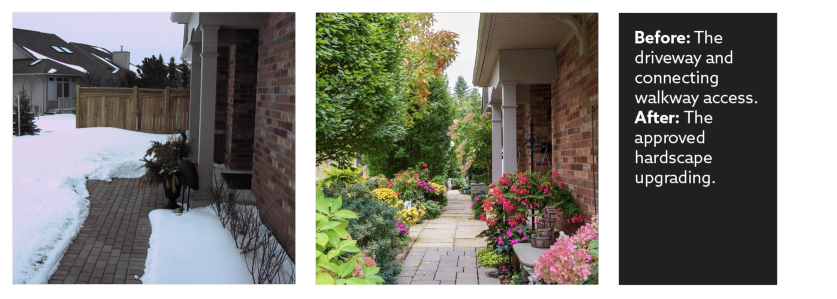
With the assistance of professionally drafted blueprints, a corner unit at 13 Sanctuary Way in Swan Lake Village was divided into separate outdoor dining, lounging and garden rooms. Existing walkways and steps were replaced and widened. Concrete was clad with natural stone. Hand railings, seating, lighting and irrigation were all detailed.

townhome

While all exterior landscape space is condominium common element, in the case of this corner town unit, the length of the dividing fence panels between units also defined what would become common element exclusive use space, which was to be maintained by the owners at their expense.

Property managers need to follow a basic check list of procedures with such owners that will lead to approvals and protections that benefit both sides. This includes:

Added design elements: All condominium declarations are different but must typically enforce existing rules for what owners want to add or upgrade, including BBQs, patios, decks, pergolas/gazebo structures, water features and bird feeders.

New upgrades requiring an alteration agreement: These include awnings affixed to the structure, hand railings affixed to existing landings/steps, HVAC units and hose bibs.

Checking off these procedures will help the owner improve their use of exterior space, allow the condominium to enjoy potential reduced common element maintenance costs, and avoid costly damage and repairs to underground utilities.

The author’s parents, Doug and June Ford, have owned their town unit since 2008. Their newly landscaped yard brings daily joy, physical and mental stimulation, increased connection with neighbours and a happy retirement life.

Kent Ford is a landscape architect and founder of KFDG Inc., a Toronto-based design and project management firm. He can be reached at [email protected] , @kentforddesign or at 416-368-7175.

Photography by fiftyeightfordphotography. www.fiftyeightford.com

Net-zero paramedic station rising in Scarborough

A net-zero paramedic station is now under construction along Highway 401 in Scarborough, Ontario. At 90,000 square feet, the two-storey facility will house up to 40 ambulances and 20 emergency response vehicles once its complete in 2029.

The city broke ground on Toronto Paramedic Services Multi-Function Station 02 last week, with plans for a logistics and equipment services area, administrative offices, and a home for Toronto Paramedic Service’s Education and Development team.

Designed by Diamond Schmitt and gh3, the project, located at 300 Progress Ave, was developed using net-zero strategies as a direct response to the specific energy requirements of building type and site. There will be a mass-timber structure to reduce embodied carbon, an innovative solar wall, geothermal heating, and a photovoltaic roofscape that is anticipated to generate more than 1,000,000 kilowatt-hours annually to completely offset the building’s electricity demand.

Combined with an all-electrical mechanical system, triple pane glazed windows, high-thermal resistance walls and roofing, the facility aims to meet the city’s net zero standards. “For some, net zero is an aspiration—not a literal fact, but not so for Station 02,” said Michael Leckman, principal at Diamond Schmitt. “With rooftop PV which makes as much energy as the building consumes, and its dramatic south-facing solar wall that preheats cold winter air, Station 02 is truly a Net Zero Energy Building.”

“As our city continues to grow, and the demands on our Service increase, this new multi-function station reflects our ongoing commitment to innovation and improved emergency response to Toronto’s residents and visitors,” said Toronto Paramedic Services Chief Bikram Chawla.

The project previously earned an Award of Merit from the 2021 Canadian Architect Awards for its innovative, net-zero carbon and energy design.

Residential rent prices continue to slide

Average residential rent prices in Canada have fallen for the 11th consecutive month in August, according to the latest National Rent Report from Rentals.ca and Urbanation. The national average dropped 2.3 per cent year-over-year to $2,137, the longest stretch of declines since the early pandemic era.

Despite the downward trend, rents remain 1.0 per cent higher than they were two years ago, suggesting that long-term pressures—such as inflation and housing demand—are still influencing the market.

“Rents have decreased in Canada on an annual basis for almost a year now,” said Shaun Hildebrand, President of Urbanation. “However, rent reductions have been mild for the most part, with the steepest declines found in Vancouver, Toronto, and Calgary, where rents are high and new apartment supply has been growing quickly. Conditions should continue to favour renters in the coming months as the market enters its slower season.”

In August, purpose-built rentals experienced the smallest annual decline among housing types, dipping just 0.4 per cent, while condos fell 3.7 per cent and houses or townhomes dropped 6.0 per cent. Over a three-year span, purpose-built rents surged by 22.6 per cent, significantly outpacing the modest 4.3 per cent increase for condos and the 0.4 per cent decrease for houses and townhomes.

Studios stood out as the strongest-performing segment, with a 1.1 per cent annual rise and a 20.7 per cent gain over three years. Within the purpose-built category, three-bedroom units saw a notable 3.5 per cent increase, reaching an average asking rent of $2,772. In contrast, condo studios recorded the steepest annual decline across all unit types, plummeting 7.7 per cent.

Provincial and city-level trends

  • Alberta led the provinces in annual apartment rent declines (-3.5%), followed by B.C. (-2.7%), Ontario (-2.5%), Nova Scotia (-2.2%), and Quebec (-0.2%).
  • Saskatchewan topped growth charts with a 3.2% annual increase and a 28.7% rise over three years.
  • Manitoba posted a modest 1.2% gain.
  • Vancouver saw the sharpest annual drop in apartment rents at 9.5%.
  • Calgary followed with a 6.6% decline, then Toronto (-3.4%) and Ottawa (-1.0%).
  • Montreal dipped slightly (-0.5%), while Edmonton rose 0.9% and led three-year growth at 25.5%.

For the full report, click here: www.rentals.ca


New $40M health campus opens in Nelson

A new $40 million health campus has opened in Nelson, featuring a 75-bed long-term care facility and a health services centre.

“This new health campus is a powerful example of how investing in infrastructure strengthens communities,” said Minister of Infrastructure Bowinn Ma. “By bringing modern, culturally inclusive health-care facilities to Nelson, we’re not only improving access to care for people of all ages, we’re also creating good local jobs and supporting the long-term well-being of the region.”

Located on the old Mount St. Francis hospital site, the Nelson community health campus features a new building with two towers designed to better serve residents: Fairview Gardens, a 75-bed long-term care home, and the Community Health Services Centre, which provides a wide range of community-based health services.

“The Nelson community health campus brings together long-term care, community programs and culturally safe services in one welcoming space, making it easier for people to get the supports they need,” said Minister of Health Josie Osborne. “This facility helps to ensure people in Nelson and the surrounding region have care they can count on, in a place rooted in connection and community.”

Nelson Fairview Gardens features a modern, resident-centred design with private rooms, cosy “neighbourhoods” named after local trees, and safe outdoor spaces where residents can feel comfortable and cared for.

The Community Health Services Centre provides a wide range of community-based health services, all within a modern, welcoming facility. Services such as public health, home care, early childhood development and mental-health support are now in one convenient location, making it easier for people to get the care they need.


Non-profit organizations tapped for big reveal

Industry, trade and professional associations, condominium corporations and other entities that Canada Revenue Agency (CRA) classifies as non-profit organizations may be called on to report more information about their finances, activities and leadership beginning with filings for the 2026 tax year. The Canadian government is currently accepting public comment on draft amendments pertaining to several tax measures first outlined in the 2024 Fall Economic Statement, including new efforts to enumerate a segment of the tax-exempt sector that has been largely unquantified.

Proposed amendments to the Income Tax Act would lower the threshold that triggers when non-profits are obligated to file an annual information return with CRA, and would introduce a new “short form” of required information for all entities not captured in the first case. The 2024 economic statement allocates $28 million between 2025-26 and 2029-30 to implement this initiative, with $11 million of that expenditure earmarked for this fiscal year.

Knowledgeable observers theorize the new reporting criteria are tied to a broader agenda than just traditional concerns that organizations could be holding undue cash stockpiles that have grown via tax-free interest. There’s now a thrust for closer monitoring.

“The 2024 Fall Economic Statement also announces the government’s intent to launch interdepartmental dialogues with non-profit organizations to deepen awareness, enhance communication and better combat money laundering, terrorist financing and sanctions evasion risks,” it states.

Under current rules, non-profits that accumulate more than $10,000 in passive income in a fiscal period or hold total assets surpassing $200,000 in value must file an information return with details about:

  • revenues earned;
  • assets and liabilities;
  • remuneration paid;
  • organizational activities; and
  • record-keeping practices.

It’s proposed that they would additionally have to report if their total gross revenues surpass $50,000 per year.

“Canada Revenue Agency has the Charities Directorate, but the not-for-profit sector doesn’t have a specific oversight body within the CRA that has a sole mandate, like the Charities Directorate with respect to registered charities, to ensure this sector’s money is properly used and not misused or subverted,” explains David Tang, a partner who specializes in charities and not-for-profit law with Miller Thomson LLP. “There would be greater transparency with these proposed new filings to allow Canada Revenue Agency to look into these organizations if there is any need for investigation or enforcement.”

Redundant reporting for condominium corporations

However, drilling down to the sub-sector of condo corporations, some accountants characterize both the existing and contemplated enhanced requirements as burdensome duplication for incorporated entities that are already mandated to file annual tax returns. Stephen Chesney, a partner with YalePGC Chartered Professional Accountants, confirms more than 50 per cent of the roughly 700 condo corporations for which his firm provides auditing services currently file annual information returns with CRA. That would jump to more than 99 per cent under the proposed new reporting threshold.

“A lot of non-profits, if they’re not incorporated, do not have to report to the government now so that’s likely why they are looking for this information,” Chesney speculates. “We file a corporate tax return for every condo. So why do they need this?”

Nor does he see much differentiation between the proposed elements of the new short form and what’s currently required in the information return. “To me, it looks like it’s a new long form,” he observes.

Notably, the existing information return does not ask for details about an organization’s directors, trustees or officers, but both the 2024 Fall Economic Statement and the government’s recently released consultation document list this information as an element of the proposed new short-form document for non-profits with more modest revenues and asset holdings. That may also be a hint of future modifications to information requirements for wealthier entities, which would be a new information-gathering exercise for accountants serving the condo sector.

“Condos in Ontario already report the names and addresses of their boards of directors to the Condominium Authority of Ontario (CAO) and that information has to be updated annually,” Chesney says. “So it would be more duplication, but it would also be more work for the people preparing the CRA forms because they would have to put all those names in.”

Specifications for tax-exempt status

Non-profits are defined in the Income Tax Act as clubs, societies or associations that are organized and operated for reasons other than making profit, such as social welfare, civic improvement or educational, cultural and recreational pursuits. Tang notes that such organizations are expected to largely “run flat” with incoming revenues balancing out their operating expenses. Beyond that, there is a stipulation that the income a non-profit generates cannot flow through to the organization’s members as direct payouts or other kinds of financial benefits.

There are separate rules to govern registered charities and charitable foundations, which, like corporations, are required to file annual tax returns. A more rigorous level of oversight is associated with providing donors and federal and provincial/territorial governments that grant tax credits with assurance that charitable organizations are fulfilling their missions, whereas non-profits that aren’t incorporated and don’t meet the current threshold for submitting an annual information return are essentially invisible to CRA.

“The proposed new reporting requirements create the capability to understand that part of the sector,” Tang says. “For example, the simplified form will identify who the directors and trustees of these organizations are because, otherwise, there’s not necessarily any way to know at all.”

It’s proposed the new short form for smaller non-profits would also ask for: the organization’s name, mailing address and business or trust number; its total assets, liabilities and annual revenues; a description of its activities and whether those occur solely within Canada or further afield; and other potential information that might be prescribed in the future.

“We don’t know yet, but presumably there’s not going to be any real enforcement activity for really, small informal organizations that don’t conduct enough business to warrant a business number,” Tang muses.

On the flipside, many of Canada’s more prominent industry, trade and professional associations are incorporated and most will already be submitting the annual information return. Some may also earn significant revenue from membership fees and other programming products, but this is where the second prong of tax-exempt status — prohibition on flow-through financial benefit to members — comes into play, as revenues are invested back into operational activities.

“Associations do a whole lot of things, including setting standards, undertaking research and providing education so that the members of an industry or profession can deliver a higher level of service, knowledge and professionalism that is a benefit to the public,” Tang says. “That’s the idea behind the tax-exempt status — that this is a benefit not just to members, but to society as a whole.”

Enforcement mixed messaging

Meanwhile, Chesney suggests that philosophy has not been so clear-cut in the condo sector, where tax-free revenues are often applied to offset operating expenses that condo fees would otherwise have to cover. This can be construed as a financial benefit to unit owners and an unfair advantage over single-family homeowners who would have to pay tax on similar types of income.

To date, CRA has conveyed mixed messages about the fairly ubiquitous ways condo corporations generate extra revenue, through rents from rooftop telecommunication installations, guest suites and party rooms, or even from the sale of common space, such as a superintendent’s unit. Following a past random audit of non-profit organizations, Chesney recalls that numerous condo corporations received cautionary letters about identified inappropriate income, but there was no follow-up action.

“I am not aware of any condo corporation in this country that has ever been assessed any type of penalty for earning income that it shouldn’t be earning,” Chesney says. “I get dozens of calls from my clients every year asking about the tax implications of these kinds of things and whether it will affect their non-profit status. My answer is: I don’t know because that’s never happened yet. It seems the only thing CRA has used the information returns for is to fine condo corps when they don’t file them on time.”

The public can submit comments on the proposed new reporting requirements until Sept. 12, 2025.

Vernon arts and culture centre breaks ground

Construction of the new arts and culture centre in Vernon has officially launched after a ground-breaking ceremony in August. The Greater Vernon Cultural Centre (GVCC) will be a downtown attraction, providing much-needed space for community cultural, art, and historical events and activities.

The new 31,000-square-foot facility will be a dynamic cultural hub for the region, home for the Vernon Public Art Gallery, Greater Vernon Museum, and a valuable 150-seat performance and presentation venue for the Vernon and District Performing Arts Centre. Designed by Revery Architecture with construction managed by Sawchuk Developments, the facility will provide state-of-the art spaces to attract world-class travelling exhibitions and performances.

The Regional District of North Okanagan (RDNO) received a $500,000 grant from the Government of Canada’s Canada Cultural Spaces Fund. This program is committed to providing funding opportunities that reflect the many perspectives of Canada’s cultural life. It supports the improvement of physical conditions for arts, heritage culture, and creative innovation.

“We are grateful to the Government of Canada for this generous contribution”, said Bob Fleming, chair of the Greater Vernon Advisory Committee and Director of Electoral Area B. “This funding has been instrumental in helping move forward a project that will serve as a vibrant and inclusive space for creativity, learning, and connection. The support affirms the importance of investing in cultural infrastructure that reflects and celebrates the diverse voices of our community. We’re excited to see this vision come to life and thank our federal partners for helping make it possible.”

The RDNO has also applied for an additional $6.86 million through two other federal and provincial grant programs, which are still under review.


CAO announces departure of founding CEO

Robin Dafoe, the inaugural CEO and registrar of the Condominium Authority of Ontario (CAO), is stepping away from her position after years of leadership.

Dafoe stewarded the CAO in its legislated mandate to deliver cost effective, efficient, and innovative services to the condo sector. This included dispute resolution services through the Condominium Authority Tribunal, for which gave the CAO a model status for timely and affordable dispute resolution. She also received the Gold Award for Innovative Management from the Institute of Public Administration of Canada and IBM for launching the CAO’s suite of digital services.

“Ms. Dafoe has been a transformative figure in the condominium sector,” Allison Scanlan, chair of CAO’s board of directors, said in a press release. “This included founding the CAO in 2017 along with her work launching the Condominium Management Regulatory Authority of Ontario (CMRAO). During her tenure, she built a high performing team that supports condominium living and strengthens consumer protection in Ontario. The Board thanks Ms. Dafoe for her exemplary leadership and contributions to the sector,”

With Dafoe stepping down, the CAO announced that Rana Khurram Manzoor will continue as chief financial and digital operations officer and Emilee Escobar as chief corporate and public affairs officer. The leadership team will also report to a new oversight committee of the board of directors that will oversee the organization until the new permanent CEO is selected.

“The condo sector in Ontario is experiencing rapid changes on multiple fronts, which present unique challenges for the condominium community,” the consumer protection agency stated in a press release. “The CAO will continue its work to fulfil its mandate to serve Ontarians in a changing condo landscape throughout this transition and into the future.


Homebuyers optimistic about fall market

Home seekers across Canada have been waiting for the right time to step into the market. The upcoming fall season could entice them to take that plunge with improved affordability and higher inventory levels, according to REMAX Canada’s 2025 Fall Housing Market Update.

Fifty-four per cent of Canadians believe this fall is a good time to buy, as REMAX Canada expects the average national price to decrease by 6.5 per cent. National home sales are also expected to decline by five per cent through the remainder of 2025.

“Canada’s real estate landscape paints a complex picture of resilience and caution, influenced by regional nuances and continued economic uncertainty,” says Don Kottick, President of REMAX Canada. “From seller-driven markets across much of Atlantic Canada and the Prairies, to buyer-friendly conditions in Ontario and BC, the nation’s housing market reflects a delicate balance.”

The firm’s brokers and agents have recorded a year-over-year decline in home sales in 62 per cent of markets analyzed between January 1 and July 31, 2025. Meanwhile, residential price trends varied regionally, rising across Atlantic Canada and the Prairies, while declining in major urban centres in Ontario and British Columbia.

Compared to a lack of inventory in 2024, there are many more listings in Ontario and British Columbia, signaling a shift to a buyer’s market. The Prairies and Atlantic Canada, on the other hand, seem to be favouring sellers. With tighter inventory.

Shifting influence

Families, new Canadians and retirees are driving the bulk of sales activity in 2025. A Leger survey found seven per cent of Canadians intend to buy their first home within the next year. This group is trending older, with many now entering the market in their late-20s to 40s, reflecting both broader affordability challenges and the increasing complexity of entering the market.

The Leger survey also reveals that today’s first-time homebuyers are entering with strong savings or relying on more creative strategies. Twenty-eight per cent of those planning to buy their first home in the next 12 months say they have saved at least 20 per cent for their down payment, while 33 per cent have saved 15 per cent or more.

While 12 per cent of Canadians plan to purchase a home in the next year, many are watching the market closely. Among this group, 68 per cent say a five- to 10-per-cent drop in property prices would make a meaningful difference, while 64 per cent say they’d feel ready if interest rates fell by 0.5 to one per cent.

“These insights paint a picture of first-time buyers who are older, more financially prepared in some cases, but still navigating significant headwinds and waiting for the market to meet them halfway,” says Kottick. “The good news is inventory levels are rising in most regions, giving buyers more choice, negotiating leverage and more time to make purchasing decisions.”

Sellers’ realism and confidence

With home prices expected to dip even further by the end of 2025 and pent-up demand reverberating in many markets across the country, conditions look healthy for well-prepared sellers.

Brokers and agents are urging them to align their expectations with what buyers are willing to pay in today’s more balanced market. This means realistic pricing, smart staging, and a solid understanding of local market conditions.

Eight per cent of Canadians plan to sell their home in the next year, and among them, confidence is strong. According to the Leger survey, 63 per cent believe they’ll be able to secure their asking price.

“Our Fall Housing Market Update illustrates a dynamic market shift, with brokers reporting a 25-per-cent surge in conditional sales across 33 of 37 regions surveyed, and growing buyer confidence fueled by improved affordability,” says Kottick. “This is a pivotal period, where informed, well-timed decisions will make all the difference for Canadians navigating a shifting market.”

Consumer sentiments

Canadians are reporting a growing sense of stability, with 46 per cent of survey respondents anticipating that the economy will hold steady over the next six months and 38 per cent viewing the current economy as strong. Despite certain challenges, 92 per cent of Canadian homeowners view their homes as a solid long-term investment, reflecting unwavering confidence in real estate as part of their investment strategy.

According to Leger survey insights, 46 per cent of Canadians are hopeful that the federal and provincial governments’ renewed commitment to building more housing will enhance affordability within the next three to five years.

Regional market insights

According to year-over-year analysis of their local market between January 1 and July 31, 2025, brokers shared their estimated outlook for fall 2025. According to their insights, 26.4 per cent of housing markets are expected to favour sellers this fall, and 38.2 per cent sitting firmly in buyer’s territory.

Most Ontario housing markets experienced an increase in listings, ranging from four per cent to upwards of 20 per cent. Exceptions include Sudbury, Niagara Region, Grand Bend and Simcoe County, which experienced a decline. In terms of average price, Ontario is equally split between regions on the rise and those in decline, moving through the fall.

As Ontarians navigate the market, there is evidence of an increase in sales that are conditional on the sale of an existing home, with brokers reporting the growing presence of guarantors and financial assistance from family, for buyers entering the market.

​Regions where prices are expected to decline this fall include North Bay, Brampton (each by two per cent), Toronto and Windsor (each by four per cent), Grand Bend, Kitchener-Waterloo and Durham (each by five per cent), and Kingston by one per cent. Markets that could experience a price increase include Sudbury (five per cent), Hamilton-Burlington and Simcoe County (each by four per cent), Mississauga and Niagara (each by two per cent), Ottawa (1.5 per cent), York (1.3 per cent) and London (one per cent).

Looking ahead, BC markets are expected to see further price declines, while Alberta, Saskatchewan and Manitoba anticipate modest gains supported by affordability and steady demand.

The Ville Mont-Royal area of Montreal and Atlantic Canada remain comparatively stable heading into fall 2025. There was a 4.4-per-cent year-over-year price gain in ​Ville Mont-Royal. Demand for well-priced, move-in-ready homes continues to drive multiple offers. Buyers are increasingly cautious to enter the market. Meanwhile in Atlantic Canada, prices rose in every major market, led by Greater St. John’s (11 per cent), Saint John (9.5 per cent) and Fredericton (7.8 per cent), with steady sales activity reflecting ongoing affordability and migration trends.


CWC and CISC form steel-timber hybrid committee

The Canadian Wood Council (CWC) and the Canadian Institute of Steel Construction (CISC) have announced a strategic partnership to accelerate the adoption of steel-timber hybrid structural solutions in Canada.

“By working together, we aim to provide the industry with the resources it needs to deliver innovative, cost-effective, and sustainable building solutions,” said Robert Jonkman, vice-president, engineering, Canadian Wood Council.

Steel-timber hybrid construction is emerging as a sustainable and efficient approach to modern building design. By combining the strength and durability of steel with the renewable, low-carbon benefits of wood, hybrid systems—such as steel-timber composite floors—can deliver superior structural performance, improved cost efficiency, and faster construction timelines. These benefits are particularly valuable for larger and taller buildings where structural demands are greatest.

To advance this opportunity, CWC and CISC have established a joint Technical Steering Committee. This committee will oversee the strategic use of funds contributed by both organizations to maximize industry impact. Its primary mandate is to support designers, engineers, and builders by developing technical guidance, best practices, and publications that will enable practical, code-compliant solutions for hybrid systems.

“This partnership reflects our shared commitment to advancing construction practices that meet today’s affordability and performance challenges,” added Logan Callele, director of engineering, Canadian Institute of Steel Construction.

Further details on upcoming resources, publications, and industry engagement opportunities will be shared in the coming months.