Articles Archive - Page 64 of 928 - REMINET
REMI

PEI sets 2026 rent increase at 2%

Prince Edward Island landlords can prepare for a modest rent adjustment in 2026, as the province has announced a 2 per cent allowable increase for all rental units, effective January 1. This applies across the board—from heated and unheated apartments to mobile home sites—offering a uniform guideline for property owners navigating rising operational costs.

The 2 per cent cap was set by the Director of Residential Tenancy, who “took multiple factors” into account before finalizing the rate, including written submissions from landlords about escalating expenses and tenants voicing concerns about affordability and housing availability. The annual change in PEI’s All-Items Consumer Price Index (CPI) was also considered in determining the new rate.

A reminder that landlords must provide tenants with a minimum of three months’ written notice before raising their monthly rent. Additionally, rent can only be increased once every 12 months, and landlords must follow the 2 per cent guideline unless they apply for an above-guideline increase through the appropriate channels.

If a property has undergone significant capital improvements, or if operating costs have increased beyond what the 2 per cent cap can reasonably accommodate, an above-guideline rent increase may be possible.

See here for more info: 2026-Allowable-Rent-Increase.NewsRelease.Final_.pdf

New phased upgrade plan for Iona Island WWTP

Metro Vancouver has redefined the scope for the Iona Island Wastewater Treatment Plant, cutting $4 billion from the original cost.

The Iona Island Wastewater Treatment Plant Projects plan has been updated to encompass a smaller scope of work, with a new cost estimate of $6 billion, compared to the previous $9.9-billion plan approved in 2022.

Rather than building an entirely new facility, Metro Vancouver will rehabilitate the existing primary treatment plant and deliver phased upgrades to achieve compliance for secondary wastewater treatment. This approach is possible in part thanks to more space-efficient wastewater treatment technology.

“Over the past year, Metro Vancouver has carefully examined options to deliver secondary wastewater treatment as quickly as possible, while ensuring cost sustainability for our region,” said Metro Vancouver board chair Mike Hurley. “In the past year, we’ve selected a technology that has given us an opportunity to rescope the Iona project to something we can deliver for $6 billion, a reduction of almost $4 billion compared to the previous project over the same time period. This is a great opportunity for us to keep annual rates as low as possible for residents, while still ensuring we’re protecting human and environmental health.”

In July 2024, Metro Vancouver awarded a contract for preliminary design work and to explore alternative options to deliver the upgrades. As part of this work over the last year, the technology for secondary treatment was selected and several condition assessments of the existing primary plant were conducted. This work provided a basis for the recommendation to the Board for an alternative approach for the Iona Projects.

The new proposed approach will:

  • Add incremental secondary treatment to the existing plant to improve effluent quality sooner.
  • Rehabilitate the existing primary plant and replace it as a future project.
  • Focus on the delivery of project components that will help meet regulatory compliance.
  • Reprioritize and defer sub-projects not required for secondary compliance.

“The updated approach is an innovative way to make sure we’re meeting our regulatory requirements, protecting the health of the environment, and being mindful of what residents are able to contribute financially to this important project,” said Liquid Waste Committee chair Malcolm Brodie. “While we understand that deferring projects is never ideal, we had to make an important decision about what we could afford to do all at the same time.”


Can buildings be truly net zero?

Corporate and government commitments to sustainability and net zero targets have increased significantly over the years. Scaling sustainability and pushing the boundaries of energy-efficient, financially viable, and high-performance building design are important goals. But despite best intentions, claims of achieving net zero targets on projects are often false due to a misunderstanding of the underlying science or outright greenwashing.

According to Guido Wimmers, dean of BCIT School of Construction, there are many misconceptions of what is net-zero. During the 2010s, net zero and sustainability were not clearly defined and widely misunderstood.

“We’re using these terms very lightly, without a clear definition, and especially in the field of net zero, we are clearly contradicting the second law of thermodynamics, and we were claiming to do something which we weren’t. There are good projects, but there are also projects which completely misused these terms. I think that’s still ongoing…and that we have to be careful in how we use these words,” he said, arguing that buildings that have been celebrated for being net zero were far from being actually net zero.

He noted all the awards and certifications for those buildings “threw us back about a decade by not focusing seriously on what net zero or sustainability means.”

“Net zero doesn’t mean anything as long as it’s just a mathematical exercise,” he said, during a ULI BC webinar on shifting the narrative on sustainability. “In the past, specifically with energy and carbon, our accounting systems have been creative. Not necessarily being truthful.”

So what is actually net zero?

The lack of a consistent definition and substantial variation in standards set by industry certifications has meant confusion and misleading claims.

“There are so many different types of definitions possible. You can define it for carbon, you can define it for greenhouse gas emissions, for operational energy, for climate impact,” said Wimmers.

Misconceptions about net zero are slowing down decarbonization at scale and meaningful climate action. Wimmers identified four big misconceptions including: it is easy, it can be achieved by ignoring the basics of physics and it is cost prohibitive. One of the biggest misconceptions is that net zero means eliminating all emissions.

“Net zero does not equal energy efficient,” he stated. ”The net zero narrative, at least currently used in industry, doesn’t guarantee that you have a net zero building or anything physically in front of you, because we allow all kinds of different offsets…essentially making it less transparent.”

To make net zero targets viable, there needs to be a fundamental shift – a different approach from the construction industry as well as the education system.

“Construction is operating in silos, so is the education system,” he said. “We need to create a far more integrated approach. We have to change how we teach and what we teach.”

Wimmers believes there is a better understanding of net zero today but the question is: how to achieve it in a meaningful way.

Redefining Sustainability

Marpole Community Centre

A Vancouver project that aims to change the narrative on sustainability is the new Marpole Community Centre. Vancouver city planner Forest Borch discussed the city’s approach to net zero civic buildings and the ambitious goals set for the centre.

The new 42,000 square foot centre will be “the most inclusive, forward-thinking, and high-performing facility that the city has ever built,” said Borch. The design aims for near-zero operational emissions, significant embodied carbon reduction, and high accessibility.

For this project, the city is applying a holistic approach to emissions reductions, targeting a 40 per cent reduction in embodied carbon. The centre will get close to net zero on the operations side by using a 100 per cent electric design and achieving Passive House certification for high energy efficiency, and LEED Gold certification. It will also be the first city-owned community centre built to achieve Rick Hansen Foundation Accessibility Certification (RHFAC) Gold.

“This project is set to achieve the 2030 embodied carbon target of the City of Vancouver of 40 per cent, showing that it’s possible to do that today, and it can do that pairing cost savings,” said Borch.

He spoke about the economic, social, and environmental trade-offs that were made throughout the project. Keeping the project within budget required phasing the project and reducing parking.

“By phasing this project and delaying the pool construction, we were able to support delivering a community centre that was not compromised on program or size,” he said. “We reduced the parking from around 210 stalls to 98 stalls…which had impacts on the project’s embodied carbon, and also saved the project $3.5 million.”

The project is designed for a 100-year life cycle with consideration for maintenance and operations. “We know how to get to very close to net zero on the operations side,” said Borch.

Sen̓áḵw

Another transformative Vancouver project that has lofty sustainability goals is the Sen̓áḵw multi-phased development, located on 10.5-acres of Squamish Nation land. It is the “largest net zero operational carbon residential project in Canada.”

“It’s a very complex project. Lots of complex partnerships, complex financial arrangements, complex construction, a difficult site,” said Graeme Silvera, principal of G. Silvera & Associates. “We’re just wrapping up Phase 1 right now with the first tower approaching occupancy in December.”

The four phase development will feature 11 towers, providing approximately 6,000 housing units and more than 1,200 affordable units.

“Sen̓áḵw is more than just about low carbon, more than just about energy efficiency and using sustainable materials. It’s really a broader definition of sustainability, and it’s built on the foundation of the nation, bringing the historic village of Sen̓áḵw back to life,” said Silvera.

He highlighted how the project is about a broader definition of sustainability that focuses on four key pillars: the built environment, carbon footprint, transportation and culture.

For example, heating and cooling will be produced by a new 10MW district energy system fed by waste heat from Metro Vancouver’s adjacent sewer infrastructure.

“We are extracting heat out of that sewer line, and using it to heat the buildings, and chilling the buildings using electric chillers, for an overall net-zero operational carbon development,” he explained.

Other carbon reduction initiatives include: integrated bike share program, a design to adapt to sea level rise, and use of mass timber.

For Silvera, the biggest misconception is that net zero is all about using less carbon.

“Net zero is future proofing your asset against future energy shocks,” he said. “Carbon is going to have to be priced properly at some point on the worldwide market. And when that happens, if you do not have a project that is future-proof to lose less carbon, you’re going to have a massive shock to the system in terms of operational costs.”


Cheryl Mah is managing editor of Construction Business.

 

Condo communication missteps under scrutiny

In a series of recent legal cases, condo boards, unit owners and property managers have been grappling not only with disputes but the complex nuances of communication. This extends to how residents and board members interact and what constitutes harassment or unacceptable conduct.

Three cases this year, one heard by the Condominium Authority Tribunal (CAT) and two by the Superior Court of Justice, showcase the distinction between legitimate grievances and abusive behaviour.

As condo lawyer Sonja Hodis recently noted while discussing the cases during an event hosted by CCI Huronia, it’s not just the content of communication, but the tone and manner in which it’s delivered. “Be careful how you talk,” she said. “If you’re in a situation where things are heated and becoming personal, step back. Maybe have someone else do the communicating so they have that fresh, third perspective.”

In the most recent case, Peel Condominium Corporation No. 96 v. C.L., decided in June 2025, the Superior Court acknowledged that while a unit owner may have had a valid concern, conduct that is abusive, harassing, threatening or intimidating crosses the line. Over a 10-month period, the owner had sent more than 119 emails to the board, property manager and condo lawyer—most of them marked with hostility and personal attacks. As a result, the court granted a compliance order limiting the owner’s communication.

A CAT case from April 2025, TSCC 2510 versus Sharma, involved a board member accused of engaging in harassing conduct toward fellow board members, property management, and others. The corporation alleged Mr. Sharma was violating the governing documents and rules, such as the condo’s harassment rule. He was creating a toxic environment, and abusive in the way he communicated through disparaging and aggressive remarks made during meetings and visits to the management office, where he often refused to leave. This behaviour ultimately caused the manager to resign.

In the end, the tribunal found that his behaviour amounted to harassment, annoyance, and disruption. “They referenced his repeated emails, multiple complaints to the CMRAO, overtaking others at board meetings, and they upheld that he breached the rules,” said Hodis, noting the CAT was also cautious about granting a restriction sought by the corporation.

“Instead of having an order that says you shall cease all harassing, annoying or disturbing conduct—which is a very broad order—they suggested that the board consider options that might assist in self-governance,” she explained. These include appointing a single board member as liaison between the board and management outside of the meetings and establishing a code of board conduct, enshrined in a bylaw to hold members accountable.

“This case is interesting because the kind of communication style that Mr. Sharma obviously engaged in was harassing and an annoyance and a breach of the rules,” she added. “But in terms of the end result, even having an order that says you shall not do this, may not stop that behaviour.”

While the CAT awarded this corporation with $200, the Superior Court awarded a corporation in another similar case with full indemnity costs of more than $26,000. In TSCC 1644 v. Chinese Muslim Association of Canada and Zhu, May 2025, the condo corporation alleged a breach of section 117 of the Act. A unit-owning board director embarked on a “campaign of harassment”, targeting the board, management and security staff; however, video evidence played a pivotal role in this case.

“There is nothing that can beat evidence when you actually have something recorded,” noted Hodis. “I know there is a cost to having video surveillance in common areas, but it can definitely be very helpful in dealing with these types of situations. It takes out the he-said she-said nature and lets the decision maker see what is happening.”

In the end, the pattern of harassing, bullying and threatening behaviour cost the owner a lot of money. “[The Superior Court] acknowledged that while the unit owner may have had a legitimate complaint about the condo corporation it’s the manner in which he was communicating those complaints that got him in trouble.”

Thoughtful communication goes both ways. Hodis emphasized that boards and property managers must handle grievances against owners and tenants with care, even when the complaints have merit.

Navigating what can and cannot be said

Boards must also be mindful of how they communicate internally, specifically when determining what information can be shared without causing conflict or breaching confidentiality.

While the Condo Act requires that owners are kept informed in a timely and transparent manner, this often leads to frequent email exchanges among board members. This raises questions about what should be created as a record and what should be shared or not shared, said condo lawyer Patricia Elia. A derogatory comment about an owner, for example, has no place in an email thread and should remain private.

She also highlighted how property managers can summarize informal discussions and email a final resolution to board members, which can be addressed at the next meeting. This ensures confidentiality and preserves proper decision-making protocol at duly constituted board meetings.

“Boards cannot and should not share with unit owners information at their disposal,” Elia noted. “There is no obligation on a board to share emails that are sent between board members in relation to discussion about operational matters with unit owners.”

Delicate issues arise at AGMs. What to do?

The delicate balance of how to best communicate also plays out at the Annual General Meeting—an important platform, which can sometimes spur conflict if owners raise legal or personal issues.

Legal counsel can help navigate sensitive topics or defer them to a more appropriate time, Elia suggested. She advises board chairs to remind attendees that unit-specific concerns should be addressed privately through property management, keep AGM discussions general and avoid the trap of gossip or heated discussions.

“Take the high road; don’t do it. It’s in the minutes and it can cause further problems,” she said. “How you communicate and what you communicate at an AGM is very important.

Modular condo project launches in Toronto

The Ontario government is partnering with the City of Toronto and Habitat for Humanity GTA to build 33 modular homes in a six-storey condo building at 355 Coxwell Avenue.

This site was identified by the City of Toronto under the Ontario-Toronto New Deal, an initiative to transform surplus properties into affordable, attainable modular housing. Lessons learned through this project will shape the province’s evolving approach to modular construction.

“Ontario is continuing to take action to build more homes faster and help people find a home that meets their needs and their budgets,” said Rob Flack, minister of municipal affairs and housing. “This innovative project will help drive forward our plans to support Ontario’s modular homebuilding industry and make use of surplus government lands to get more shovels in the ground.”

Home prices at 355 Coxwell Avenue will be set to reflect amounts that are attainable for households with income between the 60th and 70th percentile in the City of Toronto. Homes will be sold at fair market value with a maximum purchaser contribution of $500,000 in 2025, indexed to future annual inflation levels.

“Homes need to be more affordable,” said Mayor Olivia Chow. “That is why the City is investing more than $4.8 million to build 33 modular homes and keep expanding affordable housing across Toronto. This partnership with Habitat for Humanity and the province shows what we can achieve when we work together.”

Preparations for construction are currently underway at the site. Sales are expected to begin early next year, with the homes ready for occupancy by mid 2027.

Primaris REIT to acquire Montreal regional mall

A $565-million deal will see Primaris Real Estate Investment Trust (REIT) acquire Promenades St-Bruno from Cadillac Fairview Corporation. The 1.1-million-square-foot regional mall in suburban Montreal occupies about 11 per cent of a 154-acre site that’s flagged for potential higher-density mixed-use development.

The transaction, comprised of $320 million cash and a combination of series A and exchangeable preferred units, is slated to close later this week. The mall will come into the Primaris portfolio as its third largest, based on all-store annual sales volume of more than $271 million or $917 per square foot.

“There is significant NOI growth potential, including leasing up vacant and temporarily tenanted space and optimizing former department store space,” maintains Patrick Sullivan, Primaris’ president and chief operating officer.

The latter includes 130,600 square feet that Hudson’s Bay Company exited earlier this year. Remaining large-format tenants include Simons, Winners, Sports Experts and Marks.

The mall joins than $3.3 billion in acquisitions Primaris has made since 2021, including more than $1.5 billion worth thus far this year.

“We have materially expanded and enhanced the overall quality of our enclosed shopping centre portfolio since 2021, driving the portfolio’s proforma annual same store sales productivity to $791 per square foot,” says Alex Avery, Primaris’ chief executive officer. “All these acquisitions offer strong NOI growth potential and significant excess land.”

ISSA elects 2026 board members

ISSA, the worldwide cleaning industry association, elected members to its 2026 ISSA board of directors, which will be led by ISSA President Laurie Sewell of Servicon:

  • Vice President/President Elect – John Swigart, Spartan Chemical Co. Inc.
  • Executive Officer – Matthew Urmanski, Essity Professional Hygiene
  • Manufacturer Director – Rob Posthauer, Rubbermaid Commercial Products
  • Distributor Director – Mike Cusick, Staples Inc.
  • Canada Director (BSC) – Michael Kroupa, United Services Group

In addition to Sewell, the following board members are returning from the 2025 board:

  • Secretary – Rachel Sanchez, Prestige Maintenance USA
  • Treasurer – Adam Camhi, Sunbelt Rentals
  • Manufacturer Representative Director – Mark Presho, Access Partners
  • BSC Director – Ricardo Regalado, Rozalado Services
  • Distributor Director – Nick Lomax, S.P. Richards Co.
  • Distributor Director – Debbie Sardone, Speed Cleaning
  • Manufacturer Director – Fabio Vitali, Sofidel
  • Manufacturer Director – Bill Simpson, Ecolab

The following individuals will complete their service on the board in 2025:

  • Laura Ann Craven, Imperial Dade
  • Tom Friedl, Hospeco Brands Group
  • Matthew J. Schenk, Midlab
  • Brock Tully, Bunzl Canada Inc.

“ISSA’s strength is the breadth of our community,” said ISSA Executive Director John Barrett. “The 2026 Board reflects that diversity of roles and experience, enabling us to champion member success across all segments while advancing cleaning as a critical investment in health and performance.”

ISSA members can greet the new board members when they officially take office at the ISSA General Business Meeting on Nov. 13, from 9:00 a.m. to 9:45 a.m. PT, during ISSA Show North America 2025 at Mandalay Bay Convention Center in Las Vegas.

Cooling rents signal shift in housing landscape

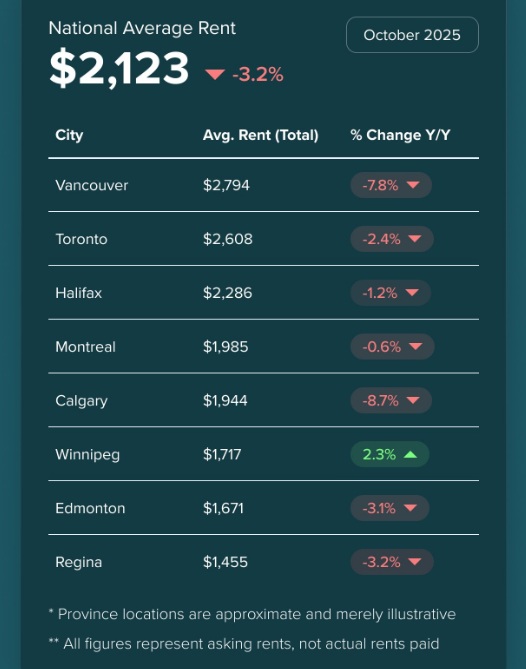
Canada’s housing landscape is undergoing a shift, as evidenced by the cooling rents in most urban markets. In September, residential rents declined 3.2 per cent year-over-year  to $2,123, marking the 12th consecutive month of annual rent decreases, according to the latest National Rent Report from Rentals.ca and Urbanation. This follows a 38-month stretch of rent increases between August 2021 and September 2024, and represents the first two-year decline in average asking rents since January 2022.

“Renters in many parts of Canada are experiencing the best levels of affordability in two years, with the most expensive markets in Vancouver and Toronto seeing rents at their lowest in nearly four years,” said Shaun Hildebrand, President of Urbanation. “This is the result of new rental supply outstripping demand, which is unlikely to persist for long as supply from secondary market sources such as condos tightens and demand drivers such as population growth and employment stabilize.”

Rents declined across all property types compared to a year ago, with purpose-built rentals down 2.1 per cent, condo rentals falling 3.0 per cent, and houses and townhomes declining 5.5 per cent. Over two years, rents in the secondary market fell more sharply, with condos dropping 4.7 per cent and houses/townhomes down 8.3 per cent, while purpose-built rental rates increased 3.3 per cent and 18.3 per cent over three years. Among bedroom types, one-bedrooms posted the largest annual rent drop at 4.1 per cent to $1,836, followed by two-bedrooms (-2.6 per cent), studios (-2.4 per cent), and three-bedrooms (-1.3 per cent).

Three-bedroom apartment rents increased 0.9 per cent annually to $2,755 for purpose-built units and 2.4 per cent to $2,923 for condos. At the other end of the spectrum, studio condo rents fell 8.7 per cent year-over-year to $1,708 — the largest decline across all unit types.

At the provincial level, apartment rents declined the most in B.C. and Alberta, both down 5.5 per cent annually. Ontario followed with a 2.7 per cent drop, while smaller declines were recorded in Nova Scotia (-2.2 per cent), Quebec (-0.5 per cent), and Saskatchewan (-0.3 per cent). Manitoba was the only province to record rent growth, increasing 2.6 per cent year-over-year. Over three years, apartment rents rose most significantly in the Prairie provinces, led by Manitoba (+27.1 per cent), Saskatchewan (+26.5 per cent), and Alberta (+20.5 per cent).

All six of Canada’s largest cities posted annual rent declines in September. Vancouver led with an 8.2 per cent decrease to $2,776, followed by Calgary (-7.4 per cent), Toronto (-2.9 per cent), Edmonton (-2.3 per cent), Ottawa (-1.3 per cent), and Montreal (-0.5 per cent). Vancouver and Toronto rents were also down on a three-year basis, falling 10.5 per cent and 8.6 per cent, respectively. Edmonton, by contrast, saw the strongest three-year growth among major cities at 18.3 per cent.

Among bedroom segments in major markets, the sharpest annual declines occurred in three-bedroom units in Calgary (-9.7 per cent), two-bedroom units in Toronto (-7.0 per cent), and one-bedroom units in Vancouver (-6.4 per cent). Montreal and Edmonton recorded rent increases for three-bedroom units, rising 7.6 per cent and 1.1 per cent, respectively.

The average asking rent for shared accommodations across four provinces fell 6.6 per cent annually in September to $943, returning to the same level as two years ago. Rents declined 7.4 per cent in B.C., 7.1 per cent in Alberta, 6.9 per cent in Ontario, and 3.7 per cent in Quebec. Vancouver saw the steepest annual drop at 14.7 per cent to $1,268, while Ottawa posted the strongest growth at 16.2 per cent to $1,108. Rents remained flat in Toronto and inched up 0.5 per cent in Edmonton.

For the latest National Rent Report, visit: www.Rentals.ca

Multifamily food waste output spurs intervention

With plans to soon roll out compulsory food waste recycling to all multifamily buildings, the City of Montreal is exploring how to encourage compliance. A two-year pilot project with newly announced funding from the Canadian government will test various “behaviour change interventions” aimed at convincing more apartment dwellers to discard their food waste in a common bin for collecting organics.

Montreal began phasing in its brown bin program for food waste and organics in 2023, but has left multifamily buildings with more than eight units until the final stages of that process. Citywide implementation was initially planned to be complete by the end of 2025, although that may now be pushed into 2026.

Under program rules, food waste recycling is mandatory once brown bins are distributed and municipal pickup becomes available. However, actual participation is considerably lower. As of 2024, only about 30 per cent of food waste generated in multifamily buildings with more than eight units was diverted from landfill.

Four other Canadian municipalities also received research and capacity building grants from the federal fund, which is aligned with Canada’s efforts to reduce methane emissions from landfill. Collectively, they each address a different food waste challenge through programs targeting: the industrial, commercial and institutional (ICI) sector; public spaces and events; remote and northern communities; and communications to promote food waste reduction.

Food waste is estimated to account for about 57 per cent of the average household’s solid waste output and the largest share of all waste sent to Canadian landfills. There, it is a primary source of methane emissions, which have a global warming potential 84 times greater than carbon dioxide (CO2) over a 20-year period. Methane contributed 16 per cent of Canada’s total greenhouse gas emissions in 2023, and is deemed to be responsible for about 30 per cent of the global rise in temperature to date.

Using on-demand cleaning talent to support seasonal and emergency contracts

Ongoing staffing challenges in the cleaning industry are an unfortunate reality of an industry plagued by high turnover and often complex operational hurdles. Seasonal surges, unexpected employee absences or emergency contracts can quickly strain or even reduce a workforce, which jeopardizes service quality and impacts client satisfaction. However, once considered a contingency plan, on-demand cleaning talent can, in fact, be a welcome solution. When approached strategically, it offers a flexible, scalable remedy for common staff fluctuations.

RELATED: Attracting and retaining skilled cleaners in a competitive labour market

Here are six ways you can strategically leverage on-demand talent in your cleaning business:

Understand your seasonal and emergency needs
Identifying seasonal and common patterns in your business is the first step. Know which times of year bring increased demand, such as holidays and large events, and understand seasonal fluctuations in industries like schools and retail. Similarly, determine potential emergencies, like sudden staff shortages or last-minute client requests. Mapping these periods allows you to proactively plan for on-demand staffing rather than reacting to surprises in the moment.

Build a reliable on-demand talent pool
Quality on-demand staff are only useful if you can access them quickly and you know they’re dependable. Invest in platforms or staffing solutions that vet candidates for experience, reliability and background checks. Having a curated pool of pre-qualified professionals ensures you can deploy staff immediately when needed, without compromising service standards.

Train for consistency
Hold temporary staff to delivering the same high-quality results as your regular team. Provide clear onboarding materials, checklists and standard operating procedures to ensure consistency. Consider using digital tools and mobile apps that can track training completion and skill levels to make it easier to match the right personnel to each assignment.

Automate scheduling and communication
On-demand talent thrives on flexibility, but only if operations are seamless. Designated software solutions can manage shifts, track availability, and send instant updates. Automating these processes reduces scheduling conflicts, ensures coverage, and keeps both your clients and staff informed.

Monitor performance and feedback
Even temporary staff can impact your reputation. Collect feedback from clients and conduct routine quality checks to identify strengths and gaps. Take advantage of data-driven insights that allow you to refine your on-demand staffing approach, ensuring reliable service even during high-demand periods.

Leverage on-demand talent for growth opportunities
Beyond covering gaps, on-demand workers can enable your business to take on more contracts and expand into new markets without the overhead of hiring full-time staff. This flexibility not only reduces operational risk but also positions your company to capitalize on short-term revenue opportunities.

While long-considered a stopgap, in reality, on-demand cleaning talent is a strategic tool for maintaining service quality and agility. By planning ahead, vetting the right staff, and leveraging technology for scheduling and training, cleaning businesses can handle seasonal spikes and emergency contracts while protecting their brand reputation with confidence.

Archie Heinl is President of Janitorial Manager, a cloud-based janitorial software designed to streamline cleaning operations and reduce costs. Learn more at www.janitorialmanager.com.

M City’s M3 tops off as Mississauga’s tallest tower

Rogers Real Estate Development and Urban Capital celebrated the topping off of M City’s third tower, M3, an 81-storey skyscraper that is now the tallest building in Mississauga.

Since launching in 2018, the tower, designed by Arcadis, has been taking shape with a slender profile featuring a subtle twist at its base and crown. Inside, an extensive amenity program, designed by Cecconi Simone, will include an indoor infinity pool, fitness centre, chef’s kitchen, private dining, kids’ zone and playground, screening room, outdoor sundeck, splash pad, and dining and lounge areas.

In another first, M3 incorporates Canada’s largest tuned mass damper, providing stability against wind sway for residents living at high altitudes.

M CityFive towers are now complete or under construction in the 15-acre community. The M1 and M2 towers, finished in 2023, are fully occupied. M4, launched in 2021, has already risen to 12 storeys, while M5, launched in 2022, has climbed to seven storeys..



City representatives, consultants, and project team members joined a topping-off celebration on Tuesday, October 7. On the 77th floor, artist Kathleen Fu began a live illustration that will evolve into larger piece, set to be permanently installed in M3’s lobby once complete.

John Anderton, vice president and treasurer at Rogers Telecommunications Limited, said M3 marks a powerful addition the city’s skyline, made possible through extensive teamwork across the project. Mark Reeve, partner at Urban Capital, furthers M City’s role in “positioning Mississauga at the forefront of global development.”

Once complete, M City will deliver more than 6,000 new homes across eight towers, accommodating more than 10,000 residents. The 4.3 million-square-foot community includes nearly 85,000 square feet of retail, public art installations, and flexible mixed-use space. More than two acres of new parkland create connections to the neighbouring John “Bud” Cleary Park and the Mary Fix multi-use trail.

B.C. introduces long-awaited prompt payment legislation

The British Columbia Construction Association (BCCA) welcomes the provincial government’s introduction of prompt payment legislation, a long-awaited and critical reform necessary for the construction industry.

This legislation follows decades of advocacy by the BCCA and industry leaders across the province.

“This legislation is a long-overdue and critical first step toward securing payment certainty and is a positive development for all of B.C.’s construction industry. It will help owners by reducing payment disputes that can stall or disrupt projects, keep work moving as planned and ensure our collective focus remains on building, not battling over payment,” said Chris Atchison, president of the BCCA.

Chronic delays in payments have created financial hardship for many construction businesses, especially small and medium-sized contractors, and put stress on workers and their families. The new prompt-payment legislation will:

  • set clear timelines for payment on construction projects;
  • establish a fast-track adjudication process to resolve payment-related disputes; and
  • improve cash flow and stability across the construction industry.

The proposed system is based on models used in other Canadian jurisdictions, including Ontario and Alberta, where prompt-payment laws have delivered real benefits for businesses and workers. The new adjudication process will allow disputes to be resolved quickly by an independent adjudicator, providing an alternative to lengthy and costly court proceedings.

“Construction workers, contractors and subcontractors build the infrastructure that communities rely on – schools, hospitals, roads, housing and more,” said Minister of Infrastructure Bowinn Ma. “By making sure they are paid promptly and fairly, we are helping projects move forward smoothly and supporting good jobs for people throughout the province.”

Once passed, the legislation will come into force after a transition period. This will allow time to establish an adjudication authority and to support industry through outreach and education, so businesses of all sizes understand their rights and responsibilities under the new system.

Prompt-payment rules will apply broadly to both private- and public-sector projects in B.C., including government contracts, unless specific exemptions are set out by regulation.

“This is not the finish line — it’s the starting line. To build a strong, reliable system of payments and adjudication, regulations must be responsible, appropriate, with legislation applicable to all of industry, sectors, and owners. We look forward to continuing to work with the provincial government to ensure the legislation is swiftly enacted and in regular consultation with industry,” added Atchison.


First condos break ground at Pickering City Centre

Construction has begun on the first two condominiums at Pickering City Centre, with site servicing underway for new roads, utilities and a park across from City Hall to accommodate future phases of the 55-acre mixed-use community.

Developer CentreCourt said the towers will reach 40 and 45 storeys, bringing 974 homes to the downtown core. Once fully developed, the community will feature 6,000 homes spread across more than 10 towers, alongside a revitalized shopping centre that has already welcomed new leases from various retailers like Sephora and Lululemon.

The development will also include new street-level retail and extensive public spaces that extend into the residential community. The park, replacing an existing parking lot, will offer year-round amenities like winter skating, summer splash pads, and cultural event spaces.

The progress was made possible by the City of Pickering and Region of Durham’s innovative development charge deferral policy, which helped advance the initiative. Under this policy, CentreCourt will pay development charges at first occupancy rather than at the time of building permit issuance.

“This policy has been instrumental in allowing construction to begin at a time when many projects across the province are stalled,” adds Mitch Gascoyne, partner and senior vice-president of development. “By collecting fees at occupancy, the City and Region are maintaining fiscal responsibility while accelerating the delivery of much-needed housing. It’s the kind of smart, collaborative approach our industry needs right now.”

Architecture firm Diamond Schmitt designed a connected network of wide streets, green spaces, and urban plazas, anchored by a landmark 55-storey tower, the tallest building in Pickering. Direct links to City Hall and the Go Station will add to the transit-friendly vibe.

“Pickering City Centre represents an unmatched opportunity to reimagine a beloved community hub as a modern downtown destination,” said Gavin Cheung, Managing Partner and President of CentreCourt. “ We’re proud to be part of this transformation, delivering a complete community that blends exceptional residential, retail, commercial, and public spaces for residents and visitors alike.”


Funding approved for new UVIC student housing

More than 500 new student beds are coming to the University of Victoria (UVic), with funding approved by the B.C. government for student housing designed for upper-year undergraduate and graduate students.

Once complete, the 510-bed residence building, with a proposed location behind the Tower Residence, will have a high-rise wing with 360 beds (90 quad units) for upper-year undergraduates, and a mid-rise wing with 150 studio apartments for graduate students. This will bring the university’s total student-residence capacity to more than 3,500.

“The new student residence will be transformative for our upper-year undergraduate and graduate students, many of whom face challenges finding affordable housing near campus,” says Dr. Robina Thomas, acting president and vice-chancellor. “The new units will also play a pivotal role in relieving pressure in Victoria’s rental market, while ensuring more students can live and learn in a supportive community.”

The new student residence will enable more students to live on campus, building the campus community and providing students with greater access to on-campus supports and resources. It will also expand housing options for upper-year undergraduate and graduate students. For those who apply in time, first-year UVic students are currently guaranteed housing to help ease the transition to university.

The new building will include:

  • a highrise tower with 360 beds in 90 four-bedroom apartment-style units for upper-year undergraduate students;
  • a seven-storey adjacent wing will contain 150 studio apartment units for graduate students;
  • amenities for students to connect, including a student lounge, outdoor and multi-purpose spaces, and a community kitchen; and
  • secure athletic storage for sports equipment and bicycles.

Delivering a fully electric, zero-carbon building designed to achieve LEED Gold certification supports the objectives of CleanBC and UVic’s climate and sustainability action plan. The building will serve as a model of climate-resilient design and demonstrates the province’s commitment to a more sustainable future.

The estimated capital cost of the project is $178 million, with $121 million coming from the province. Construction is expected to start in spring 2026, with estimated completion in fall 2029.


AI literacy gaining prominence in CRE skill set

Lazy thinkers, not evil geniuses, could ultimately be the most menacing force that artificial intelligence (AI) enables. Enthusiasts and more cautious adopters alike underscore the continuing role for informed human override as AI delivers up computations, conclusions and corollaries.

“I do see a use for it in many mundane tasks that we don’t want people to have to do, but, if you depend on AI without understanding the basics of what is being interpreted, do you have the ability to do critical thinking?” Judy Wall, president of East Port Properties, mused during a panel discussion at the Building Owners and Managers Association (BOMA) of Canada’s recent annual national conference. “I worry about using less and less of our brains and then, when it’s needed, it’s like you’ll have to go fire up the coal furnace to see if you still remember how to think.”

As is customary for the BOMEX event’s signature executive roundtable, Wall and two other prominent peers were tasked with weighing in on issues that gripped and galvanized the commercial real estate industry over the past year and are expected to hold sway into the future. AI led that list.

Michael Bansil, senior vice president, business excellence and innovation, with GWL Realty Advisors, and Ben Young, president and chief executive officer of Southwest Properties, sketched out their companies’ experience and AI adoption approach thus far, and — similar to Wall — voiced some reservations along with an acknowledgement that the technology is steadily and rapidly becoming entrenched in the day-to-day functioning of society.

Understanding eases implementation

Early implementation efforts have largely focused on optimizing building systems, augmenting employees’ work procedures, alleviating labour-intensive tasks where appropriate, and collecting, managing and analyzing data. Bansil identifies “AI literacy” as a building block for all those objectives, and the starting point for corporate adoption. In GWLRA’s case, initial exploratory consulting helped it recognize what it could not, or did not need to do, and gave direction to its strategy.

The company sidestepped the costs, logistical complications and threat of obsolescence inherent in developing its own in-house AI tool and, instead, opted for plug-in devices and existing apps for building and energy systems. All employees are actively encouraged to use Microsoft Copilot’s summary, comparison, analytical and content creation tools in their work.

“That’s the one thing that we are really trying to drive,” Bansil reiterated. “Understanding how to use AI is going to be so important for adoption once an organization gets to the point of full blown implementation. You have to keep pace with it. You can’t start from nothing and all of a sudden expect that you can deploy AI into a solution.”

“I think the biggest risk is not embracing it,” Young concurred. “The adoption of new technology is happening so fast now that you have to get out in front of it.”

For Southwest Properties, a developer/owner/manager of a Halifax-based multifamily portfolio, emergent AI capabilities have been well matched with the city’s post-COVID population growth and residential building boom. AI now performs much of the traditionally time-consuming task of floorplate configuration, quickly producing a first draft from inputted instructions for the size and number of units and required common area components like elevators and staircases. However, human designers and decision-makers then refine it from there.

“You can start to manipulate the data in real time — for example, tell it that you want to shorten the hallways or add more one-bedrooms — and really use the tool,” Young explained. “But it is just a tool and should be used as a tool. It gives you something that is close, but you still need to dissect and look at every inch of that layout if you want to maximize it.”

Similarly, he suggests managers and operators could gain new and more fulsome insights as they become more familiar with AI’s data resources.

“I think it allows people to be curious,” Young hypothesized. “You can gather data; you can look at data; there’s so much more information available. Curiosity leads to innovation; it leads to improvements; and it leads to better deliverables.”

Resistance and vulnerabilities

On the flipside, some degree of resistance and skepticism is almost preordained within organizations. Bansil noted that the effectiveness of the technology is just one element of fostering uptake. Expert technological support, from either the AI provider or a third party consultant, and a competent in-house implementation team are also part of the formula.

“Our (management and operations) teams don’t necessarily believe the capability itself in some of the AI technologies out there,” he conceded. “But that’s okay because I think that gap will be bridged at some point. If you have tried AI, you know it’s not perfect, but the capability is there. At some point, it’s going to get to where the solutioning for us is going to be pretty rock solid.”

For now, there’s little evidence that AI is yet replacing human workers on a mass scale. Most commercial real estate firms are still in the early stages of adoption where, if anything, extra human resources and effort may be required to navigate the learning curve. However, the panellists do have a sense of what roles may be vulnerable.

“You have to ask yourself: Do I have a job where I do the exact same thing every day? If you do, that could be a potential for replacement,” Bansil speculated. “If you have a job where you might do something different every day, it is much more difficult to replace roles like that.”

Young warns that human intervention will still be needed — and should remain accessible — behind any chain of AI service provision.

“We really try to focus on that customer-facing experience, and there’s a point where they want to talk to somebody,” he said. “That is where you shut the technology and put the person in play who is going to be the one to figure it out. The companies that stray too far from that will lose the customer service touch.”

There’s also the risk of what Bansil calls “cut-and-paste syndrome” with users too often unquestioningly relying on AI conclusions or even duplicitously passing off AI-engendered content and analysis as their own. Wall stressed the importance of critical thinking and suggested that schools, post-secondary institutions and industry-focused continuing education may all need to pay heightened attention to it.

“As we use it, we need to be curious and inquisitive,” she asserted. “If that happens, I am all for AI.”

Meanwhile, the cut-and-pasters may just be fooling themselves. “In the end, if you rely totally on AI to be your decision-maker, you still own that decision,” Bansil observed.