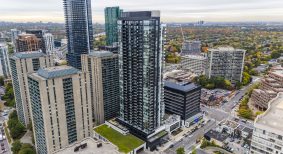





With plans to soon roll out compulsory food waste recycling to all multifamily buildings, the City of Montreal is exploring how to encourage compliance. A two-year pilot project with newly announced funding from the Canadian government will test various “behaviour change interventions” aimed at convincing more apartment dwellers to discard their food waste in a common bin for collecting organics.
Montreal began phasing in its brown bin program for food waste and organics in 2023, but has left multifamily buildings with more than eight units until the final stages of that process. Citywide implementation was initially planned to be complete by the end of 2025, although that may now be pushed into 2026.
Under program rules, food waste recycling is mandatory once brown bins are distributed and municipal pickup becomes available. However, actual participation is considerably lower. As of 2024, only about 30 per cent of food waste generated in multifamily buildings with more than eight units was diverted from landfill.
Four other Canadian municipalities also received research and capacity building grants from the federal fund, which is aligned with Canada’s efforts to reduce methane emissions from landfill. Collectively, they each address a different food waste challenge through programs targeting: the industrial, commercial and institutional (ICI) sector; public spaces and events; remote and northern communities; and communications to promote food waste reduction.
Food waste is estimated to account for about 57 per cent of the average household’s solid waste output and the largest share of all waste sent to Canadian landfills. There, it is a primary source of methane emissions, which have a global warming potential 84 times greater than carbon dioxide (CO2) over a 20-year period. Methane contributed 16 per cent of Canada’s total greenhouse gas emissions in 2023, and is deemed to be responsible for about 30 per cent of the global rise in temperature to date.