Articles Archive - Page 607 of 929 - REMINET
REMI

International engineer award for Brock Commons

Brock Commons Tallwood House in Vancouver has earned an international award for innovation from the Institution of Structural Engineers. Winners of the Structural Awards 2017 were honoured in London, UK. The Structural Awards are held each year to celebrate the role of structural engineers as innovative, creative design professionals and to showcase the world’s cutting edge engineering projects.

The Construction Innovation Award is presented to projects that demonstrate structural engineering excellence in the innovative use of construction materials or processes. Fast + Epp worked with the design team, that included Acton Ostry Architects and Seagate Structures, to simplify the structure to deliver the world’s tallest mass timber tower in record time. Located on the UBC campus, the 404-bed student residence building officially opened in July 2017.

The judges praised the engineers, Fast + Epp, on the development of an innovative solution to deliver a highly economic and sustainable alternative to more traditional construction methodology. The new hybrid system sets a new precedent for what can be economically achieved in predominantly timber structures.

The 18-storey building consists of five-ply cross laminated (CLT) floor panels, point-supported by glued-laminated timber columns, all resting on a concrete transfer slab at level two. Two full-height concrete cores provide lateral stability.

Winners were chosen from a shortlist of 45 pioneering global projects which showcased the ingenuity and expertise of the engineers behind them. A diverse range of structures, from temples to tourist attractions, were recognized across 14 categories.

Last year, Fast + Epp took home The Supreme Award for Structural Engineering Excellence for the Grandview Heights Aquatic Centre in Surrey.

2017 FRPO Mac Awards winners

The 2017 FRPO Mac Awards gala was held on Thursday, November 30th at the Metro Toronto Convention Centre. This year, the prestigious industry event set a new attendance record with over 1,000 guests, and drew a record number of submissions. The MAC Awards provide the opportunity for the Ontario rental housing industry to celebrate innovation, a commitment to quality, while recognizing everything that goes into promoting the brand of rental housing.

The 2017 FRPO Mac Awards winners include:

Lifetime Achievement Recipient: Tom Schwartz, CAPREIT

Best Property Management Website: Hollyburn Properties Ltd. – www.hollyburn.com

Advertising Excellence for a Single Campaign: Skyline Living – Harris Place Phase I & II

Advertising Excellence – Social Media: Greenwin Inc.

Best Lobby Renovation: Hollyburn Properties Ltd. – 103 Avenue Road, Toronto

Best Curb Appeal: Greenrock Property Management Ltd 40,50 Alexander Street & 55 Maitland Street, Toronto

Best Suite Renovation under $12,500: Preston Group – 2 Secord Avenue, Toronto

Best Suite Renovation over $12,500: Metcap Living Management Inc. – 201 Sherbourne Street, Toronto

Rental Development of the Year: Sifton Properties Limited – West 5 Townhomes, London

Amenities Excellence: Minto Properties Inc. – 185 Lyon Street North, Ottawa

Outstanding Community Service: Starlight Investments

Environmental Excellence: Sifton Properties Limited

Leasing Professional of the Year: John Burns, Greenwin Inc.

Property Manager of the Year: Theresa Lapensee – Sifton Properties Limited

Resident Manager of the Year: Linda & Fernando DaSilva, Greenwin Inc.

Customer Service Award of Excellence: Minto Properties Inc.

Marvin Sadowski Memorial Award for Certified Rental Building Member of the Year: Hollyburn Properties Ltd.


Réseau Sélection acquires three Montreal retirement homes

Réseau Sélection announced it has acquired three retirement homes in Montreal, all of which were previously owned by Prével Retraite and the Fonds immobilier de solidarité FTQ. This transaction brings the number of Réseau Sélection residences in operation, or under construction, to more than 40 and reinforces the company’s presence in the Greater Montréal area.

“This transaction is important to us because it brings the number to more than 40 residences as we already are the leading player in Canada in the private sector,” said Réal Bouclin, founding President and Chief Executive Officer of Réseau Sélection. “This being said, year after year, we maintain an excellent satisfaction rate of 95 per cent from our clients. And we are very proud of it! As a living environment creator, our priority is the satisfaction and the well-being of our clients and our employees.”

Réseau Sélection will welcome some 1,000 new residents who live in the 710 apartments in the three residences into its family as well as one hundred employees.

“Réseau Sélection has an excellent reputation for being focused on customer satisfaction. We believe that residents and employees in these three residences will continue to have a positive experience in their living and working environments” said Jonathan Sigler, Prével’s co-President.

“The previous transaction we concluded with Cambridge in 2013 went well and gave us confidence for this current deal,” concluded Normand Bélanger, CEO of Fonds immobilier de solidarité FTQ. “It is with great pleasure that I welcome our new colleagues and residents in the Réseau Sélection’s family.”

Cherbourg I and II

The Cherbourg I and II, which are both located on the banks of the St. Lawrence River, offer an ideal and inspiring lifestyle for active retirees. The common areas, which include an indoor pool, spa, sauna, exercise room, billiard room, cinema, library, dining room and bistro, outdoor gardens, walking trails and shuffle board, were designed to promote residents’ health and well-being. Residents also have access to a hair salon, convenience store, indoor parking and a pharmacy.

Le Graham

Le Graham, which is located in the renowned Town of Mount Royal, is a luxurious complex that has everything to enjoy, starting with a gourmet restaurant that food enthusiasts will love. Its proximity to local services enables Le Graham residents to remain active and enjoy their surroundings. Common areas and facilities include a large indoor pool, fitness centre, health centre, beauty salon, event room, café-bistro, living room with fireplace and library, outdoor terraces and a cinema.

Five-year plan 2015-2020

“With this acquisition, we are closing the loop with Prével, which began when we acquired Le Cambridge in 2013,” said Richard Nadeau, Réseau Sélection’s Senior Vice-President and Chief Financial Officer, who led the transaction. “The addition of these three new retirement homes is a continuation of our $2 billion, five-year investment plan that we announced in 2015, for which we have already committed more than half of our commitment.”


Ontario to reinvest energy savings into patient care

Ontario is investing in improving the energy efficiency in hospitals and reducing greenhouse gases, and plans to reinvest those energy savings into patient care across the province.

The province is investing $64 million this year in the Hospital Energy Efficiency Program, which will help hospitals save energy and encourage the use of more renewable energy technologies.

“Ontario’s actions to help hospitals fight climate change and improve energy efficiency will reduce greenhouse gas pollution, increase patient comfort and redirect savings into patient care across the province,” said Chris Ballard, Minister of the Environment and Climate Change, in a press release.

This year, Ontario is funding 180 projects at 98 hospitals around the province, including the Hospital for Sick Children, which is receiving $1.5 million for 10 energy-efficiency projects. The projects that are part of the Hospital Energy Efficiency Program include 117 heating, ventilation and air conditioning projects, 35 lighting projects and 28 projects that address other energy efficiency needs.

With these and other energy efficiency improvements made, it is predicted that nearly five megatons of carbon dioxide equivalent gases will be eliminated from the environment by 2050. This is the equivalent of taking about 40,000 cars off the road. By 2020-21, it is estimated that over $60 million will be generated in yearly energy-related savings.

The Hospital Energy Efficiency Program is an initiative of the Climate Change Action Plan and uses proceeds from Ontario’s carbon market to modernize facilities, including hospitals, universities and heritage buildings.

Mississauga boosts efforts to mitigate invasive insects

Mississauga will be implementing an aerial spray program next spring to mitigate gypsy moths and cankerworms on both City and private property in specified areas forecasted for severe defoliation.

The 2018 Gypsy Moth and Fall Cankerworm Mitigation Program highlights how spraying is an additional mitigation measure to help with infestations of invasive insects. The City plans to spend $1.6 million on the project to help protect its assets and control the expected increase in insect population.

“Last year, we experienced an unprecedented infestation of cankerworms across Mississauga,” said Laura Piette, director of parks and forestry. “The infestation put a lot of strain on many of our older hardwood trees such as oak, elm and maple. We also need to address the growing gypsy moth population to ensure the long-term health of our trees in Mississauga. This will avoid putting more stress on our already fragile tree canopy in the identified area.”

Fall cankerworm caterpillars emerge in the spring and often strip trees of their leaves as they feed. This makes trees more susceptible to disease and damage from other insects and extreme weather.

The gypsy moth data forecasts severe tree defoliation in the identified areas. Cankerworm data is being collected now and will help define a more exact aerial spray area.

“Data models and forecasted growth populations suggest we’re going to see a spike in both cankerworms and gypsy moths over the next year,” said Jessica Wiley, forestry manager. “We are using a Bacillus thuringiensis (Btk) spray program. It’s an approved product by Health Canada that is used to help control both gypsy moth and cankerworm infestations; however, it’s safe for humans and all other wildlife. We’ve used Btk in the past and have seen success spraying it roughly 10 years ago to manage gypsy moth infestations across the city.”

Staff recommended that Zimmer Air, an experienced Thunder Bay-based company with specialized equipment be procured to conduct the spray. Zimmer Air also successfully carried out the City’s 2006-2007 aerial spray and has been used by other local municipalities. A communication plan is being developed to ensure residents in the area receive timely information.

IICRC seeks input on new standard

The Institute of Inspection, Cleaning, and Restoration Certification (IICRC) is seeking volunteers to serve as non-voting section committee members on the consensus body for BSR-IICRC S400 Standard for Cleaning, Maintenance, and Restoration of the Commercial Built Environment.

The standard will focus on the commercial built environment and define tasks, frequencies, production expectations, goals and results. It will also look at processes to clean, maintain and restore the built environment, which is defined as materials, building assemblies, structures, furniture, fixtures and equipment located inside a building envelope.

Those interested in submitting an application should download and complete the application form, and email to IICRC Standards at [email protected].

ISSA reports work on the standard will begin by the end of 2017 and should be completed in about two years. Nearly all meetings will be held online and via conference calls.

Artis REIT sells Alberta office properties

Artis Real Estate Investment Trust has sold its Quarry Park Portfolio, consisting of three office properties located in Calgary, Alberta, and entered into an unconditional agreement to sell Millennium Centre, an office property located in Red Deer, Alberta.

The Quarry Park Portfolio comprises three office properties located in the Quarry Park commercial/residential area of Calgary, totaling 282,327 square feet of gross leasable area. The portfolio was sold for $98.0 million ($347 per square foot).

Millennium Centre is a 148,871 square foot office property located in Red Deer. The sale price for this property is $33.0 million ($222 per square foot). This transaction is expected to close on December 1, 2017.

“The sale of these assets further reduces our exposure to the Alberta office market, which became a strategic initiative for Artis since the downturn in oil prices,” said Armin Martens, president and Chief Executive Officer of Artis.

“These sales are at prices that compare well to our internal fair value of approximately $15 per unit, and will provide us with capital to recycle into newer generation real estate in our other target markets, further improving the diversity and resiliency of our overall portfolio.”

Including all dispositions completed and announced year to date, Artis has sold 15 properties totaling over 1.4 million square feet of leasable area for an aggregate sale price of $350.0 million. With these transactions, Artis has completed its strategic plan of reducing its Alberta office weighting to under 10 per cent.

Artis is a diversified Canadian real estate investment trust investing in office, retail and industrial properties. Since 2004, Artis has executed an aggressive but disciplined growth strategy, building a portfolio of commercial properties in British Columbia, Alberta, Saskatchewan, Manitoba, Ontario and select markets in the United States.

B.C. will lead provincial economic growth in 2018

While Alberta’s economy is set to lead the country this year, with robust economic growth of 6.7 per cent, British Columbia will once again take over in 2018 as the provincial growth leader, according to The Conference Board of Canada’s Provincial Outlook: Autumn 2017.

“Thanks to rising oil production and a swift turnaround in drilling levels, Alberta surged out of recession this year. But, the rebound has been unsustainably fast, implying the pace of recovery will moderate in 2018,” said Marie-Christine Bernard, director, provincial forecast, The Conference Board of Canada. “Next year, with strength in many sectors, British Columbia’s economy is poised to outpace all other provinces and will be one of only three provinces with growth above 2 per cent.”

Several sectors in Alberta came out of recession in 2017, but it was the swift pickup in drilling and solid oil production that led economic growth. The domestic economy also performed well, as consumer demand picked up, boosting retail sales and housing construction. But the booming growth is not expected to last, with Alberta’s economy forecast to grow at a more sustainable 2.1 per cent in 2018. However, recent strength in oil prices could help maintain the momentum in drilling and push economic growth higher over the near term.

The report notes that British Columbia is forecast to enjoy real GDP growth of 3.2 per cent this year. And, while slightly weaker growth of 2.7 per cent is anticipated for 2018, B.C. will still outpace all other provinces in economic growth.

One of the factors behind the slowdown next year is the cooling off in the housing sector. Measures implemented to cool demand and continued challenges related to housing affordability have led to a small decline in housing starts this year and they are forecast to remain virtually flat next year.

The cooling off in the housing sector will trickle down through the economy and lead to slower growth in employment, income, and, most significant of all, consumer spending. Meanwhile, the province’s forestry sector is expected to be either flat or negative over the next five years due to ongoing problems with the mountain pine beetle infestations and duties imposed by the U.S. on Canadian softwood lumber imports.


Workplaces send subconscious signals: research

Ever question why some places charm and delight, while others make people feel as if there’s a hidden hand shooing them away? Ever stop to wonder why office workers seek out smaller, more contained spaces to focus and concentrate, while the expanse and openness of, say, the boardroom or large spaces offsite are where colleagues can reliably come up with important new ideas? Is it possible that people think and act differently depending on the building or the room they’re in?

A new body of scientific research has emerged on how the brain registers its surrounding environments. Leveraging insights from several fields — psychology, anthropology, linguistics, and neuroscience — a new understanding of how people live and think in the world has emerged based on “embodied cognition.”

“This paradigm,” writes Sarah Goldhagen in her book Welcome to Your World: How the Built Environment Shapes our Lives, “holds that much of what and how people think is a function of our living in the kinds of bodies we do.” Not just conscious thoughts, but non-conscious impressions, feedback from the senses, physical movement and even split-second mental simulations of forms and shapes factor into how people respond to a place, Goldhagen argues. And in turn, places nudge people to think or behave in certain ways.

Most excitingly, this knowledge can now be leveraged in a practical way to subtly but profoundly shape and alter office environments for the better. Through research with corporate workplace clients, figure3 has uncovered some consistent requirements that persist, regardless of the nature of the business.

They’re the things that need to be designed into the space that, for most part, are seen. The fact of the matter is the net effect of the designed environment is (often) invisible. It’s the collective whole that influences people. Designers are concerned with elevating what the designed environment makes possible, what it affords, as well as considering the aesthetic.

The seven things designers need to afford people in work environments again and again, though in unique ways depending on the context, constraints and culture of an organization, include the abilities to:

See people and behaviours

Gone are the days where people come to the office to access equipment or physical resources. In the knowledge economy, people continue to co-locate because interacting with others — with all their non-verbal body language and communication — is valuable. Working with people face-to-face is more effective.

And increasingly, people know that socialization is as important a work attribute as any other. By ‘seeing people’ — in both formal contexts, such as meetings, and informal contexts, such as the happy little interactions that happen in the corridor — people feel more connected to each other, strengthen the quality of their communications and collaborations, and are happier at their jobs.

See work/work in progress

Designing multiple ways for people to visually share their work with others not only increases the chance that colleagues will see people and see ideal behaviours, but it also enables further connection to each other. Making work visible, when a person is physically there and when that person has since moved on, creates the conditions for collaboration and further strengthens working teams.

See choice and variation

Though a simple idea, this might be the most overlooked. People no longer come to work and do the same activity all day, every day. Work is varied.

One moment a person is deep into a focused task. The next a person is collaborating with colleagues. Yet another has a person engaging in a challenging creative thinking. Enabling choice and variation not only allows people to work in environments that best suit their needs at any given moment, it also provides a sense of control and autonomy that is crucial to good work.

See opportunities for movement

It’s taken for granted, but most conventional environments create the conditions for sedentary work lives. Getting up, moving and using the physical body contributes substantially to happier, healthier, more productive work.

See purpose and culture

Employee engagement is the Holy Grail for great organizations. Connecting people to the purpose of their work — why the group exists, why it goes out of its way to co-locate and interact — increases their sense of engagement significantly. The culture of an organization should physically manifest itself in the environment.

What people think about themselves and each other, how they act, what they value, and how they interact with one another is very much influenced by design decisions. Doing so consciously and intentionally is table stakes for good design.

See nature

It’s a simple idea: people are more productive, healthy, energetic and happy when exposed to nature, natural views, and natural variation. Biophilic design has caught on in the design industry for a reason.

See me

Coming full circle, people not only need to see other people, people need to feel others see them (including their superiors and organizational leaders).

By reframing the job to be done by design through what people need to be afforded functionally and psychologically, it’s possible to reframe what’s conventionally considered to be the role of design, rethink what needs designing, and ultimately transform what kinds of experiences people have within workplaces.

Tyler Gilchrist is VP of design research & strategy at figure3.

When can condos enter bulk telecom contracts?

Many condominium corporations enter into bulk contracts for telecommunication, and other services. Under these agreements, the condo corporation will purchase a service in bulk (for all owners and the common elements) from a supplier and will then add the cost to each owner’s common expenses (in accordance with each owner’s proportionate share).

Using television services as an example, if the corporation enters into a bulk agreement, each unit owner will pay more in common expenses each month for the bulk service; however, he or she will not need to arrange for his or her own television service, and could save money as the expense may be lower than if the unit owner acquired the services independently, due to economies of scale.

What authorizes the condo to enter into these bulk agreements? Is notice of the change required? A recent court decision reviewed these issues.

In Zordel v. MTCC No. 949, the court reviewed the authority on which a condo corporation may rely in entering into a bulk services contract with a telecommunications provider. The court also reviewed the applicable notice requirements imposed on the condo corporation in relation to such a contract.

Metro-Toronto Condominium Corporation No. 949 (MTCC 949) was constructed in the 1990s and has, since the beginning, contracted for television services through a bulk services agreement. The charges for these services were passed on to the unit owners as a common expense and each owner paid his or her proportionate share.

In June 2016, MTCC 949 entered into a new bulk services agreement that expanded the scope of the services to be provided to occupants to include both television and internet. Since the cost of the television and internet services was considered a common expense, unit owners were not able to opt out of paying their proportionate share of these expenses.

The applicant owners in this matter argued that MTCC 949 did not have the jurisdiction to enter into the bulk services agreement and pass the charges on to the owners through the common expenses without giving the unit owners the option of opting out. The applicants also argued that MTCC 949 was required to provide notice to the unit owners and/or involve owners in the decision, prior to entering into the 2016 agreement, because it constituted a change in services.

If certain conditions are met, condo corporations can enter into bulk purchase agreements

The basis of a corporation’s ability to enter into bulk purchase agreements originates from the 1998 version of the Condominium Act. Under section 2 of the act, “common expenses” are defined as expenses related to the performance of the responsibilities of a corporation and expenses that are specified as common expenses in either the act or in the declaration. If a condo corporation’s declaration confirms that the costs of a particular service constitute a common expense, the corporation can enter into a bulk agreement for that service.

In Zordel, Schedule “E” of MTCC 949’s declaration contained a list of specific expenditures to be included as common expenses. One of the listed expenditures was cable television. The applicants argued that the reference to cable television was to authorize the corporation to provide the service on the common elements, not within the individual units.

The court found that the reference to cable television in Schedule “E” meant “the provision of cable television services to units.” The basis of this finding was that cable television was included in the same list as water and electricity services. The court found that if cable television was not intended to be provided to each individual unit, and was instead only intended to be provided on the common elements, this intention would have been expressly stated in the declaration.

The applicants also argued that the expanded scope of the agreement to include internet services was beyond what was contemplated in the declaration. MTCC 949’s general bylaw gave the condo corporation authority to “enter into a bulk telecommunications agreement.” The applicants argued that such a bylaw was contrary to the act, and thus MTCC 949’s decision to acquire internet services on a bulk basis was invalid.

The court found MTCC 949’s decision to enter into a bulk agreement for television and internet services was valid. The judge found the explicit wording in the general bylaw and the declaration gave the corporation the necessary authority to enter into the agreement for both television and internet services.

The judge found that MTCC 949 met the notice requirements in the act

Under the act, a corporation must notify unit owners of changes to common elements or assets if certain conditions are met. The relevant provisions are contained in section 97 of the act. In Zordel, the applicants argued that MTCC 949 should have notified the unit owners of the change and/or sought approval from the unit owners before signing the bulk services agreement. The applicants argued that the new agreement used a different technology to deliver television service, and/or the increase in cost for the new service triggered the notice requirements under the act.

The court found that MTCC 949 met the notice requirements. First, the court found that “a different technological delivery method … does not change the service itself.” Second, it was held that the increase in fees as a result of the new bulk services agreement did not trigger the notice provisions of the act.

The court confirmed that when assessing whether notice to the owners is required, the cost of the change itself (and not the total cost of the project or agreement) is the relevant cost to be assessed pursuant to section 97 of the act. In Zordel, this meant that the cost associated with the internet services only was the cost to be considered under section 97 of the act, not the entire cost of the new bulk telecommunications agreement.

Important guidance from Zordel

For condo corporations that are interested in entering into a bulk services agreement for telecommunication services, Zordel identifies important considerations that corporations should keep in mind when making the necessary arrangements. In particular:

  1.  If the act or declaration lists telecommunications as a common expense, and does not explicitly state that the expenditure relates only to the common elements, the corporation can enter into a bulk agreement for both the common elements and the units.
  2. The corporation’s declaration and bylaws can be relied on to support a condo corporation’s authority to enter into bulk agreements.
  3. Consideration must be given to the notice requirements under section 97 of the act when undertaking a change to the common elements or the services being offered to the owners.
  4. However, when assessing whether notice is required under section 97 of the act, only the cost of change is relevant, and not the total cost to be incurred.

Cheryll Wood is an associate at Davidson Houle Allen LLP, and has been practicing condominium law for five years. She represents condominium corporations, their directors, owners and insurers throughout eastern Ontario.

David Lu is an articling student at Davidson Houle Allen LLP.

Negotiating a tenant’s restoration obligations

One of the many issues commonly negotiated between landlords and tenants is the condition of the state of repair that the premises must be in at the expiry of the lease. Typically, a standard form lease will require that the tenant return the premises to the landlord in the same condition as that which it is required to maintain during the term of the lease, and to remove certain tenant improvements. While these restoration clauses can be more or less complex or onerous depending on the nature of the property (i.e. industrial, retail or office), one common thread is that tenants will try to negotiate that their restoration obligations be subject to a “reasonable wear and tear” exception.

This language is regularly agreed to by the parties based on a mutual understanding that the tenant should not be required to deliver the premises in perfect condition at the end of the term or to eliminate all signs of aging to the premises. But this begs the question: how broadly will a court interpret a reasonable wear and tear exception in the event of a dispute?

The decision of the British Columbia Supreme Court (BCSC) in Griffin Holding Corporation v. Raydon Rentals Ltd., 2016 BCSC 2013 serves as a reminder of the legal interpretation given to the words “reasonable wear and tear” when considering a tenant’s restoration obligations in a commercial lease.

The Legal Test for “Reasonable Wear and Tear”

The common law defines reasonable wear and tear as “the reasonable use of the premises by the tenant and the ordinary operation of natural forces”. In Griffin, the BCSC confirmed that the following legal test applied when considering reasonable wear and tear in the context of a tenant covenant to restore leased premises:

(a) the landlord must prove that the premises were not in as good repair and condition at the end of the lease compared to the repair and condition at its commencement, and once proven, the burden shifts to the tenant to prove that the deterioration in condition falls within any “reasonable wear and tear” exception in the lease;

(b) what will amount to reasonable wear and tear is to be considered in light of the purpose for which the premises were leased, the nature of the business carried out thereon, the age of the building, and the length of the lease; and

(c) if a court accepts that the premises have been damaged beyond reasonable wear and tear, the landlord is entitled to the cost to restore the premises to the same state of repair as they were in at the commencement of the lease, regardless of whether the landlord ever intends to incur the cost of those repairs.

In Griffin, the salient facts were as follows:

  • in 2006 (prior to the lease being entered into), Griffin retained a commercial concrete polishing company to restore and resurface the concrete slab of the leased premises;
  • Griffin Holding Corporation (“Griffin”) leased commercial premises in North Vancouver to Raydon Rentals Ltd. (“Raydon”) for a term commencing in October, 2008 for the purposes of selling, renting and servicing new or used equipment for industrial, residential or farming operations;
  • the lease contained various clauses relating to Raydon’s maintenance and repair obligations, including a covenant from Raydon to restore the premises to the same condition as existed at the commencement of the lease, except for reasonable wear and tear;
  • in 2015, the lease was terminated in accordance with its terms, and at the end of the tenancy, Griffin found that the floors were damaged with paint, oil and rust stains and were embedded with holes and bolts; and
    Raydon took certain measures to remedy the condition of the floor, but eventually took the position that the condition of the floor reflected “reasonable wear and tear” (which Griffin disagreed with).

The BCSC ruled in Griffin’s favour, primarily on the basis of the evidence provided by each party. Griffin provided first-hand accounts of the 2006 concrete polishing, which convinced the BCSC that the premises were in good condition at the commencement of the term. Accordingly, the burden shifted to Raydon to convince the BCSC that the reasonable wear and tear exception applied, but Raydon was unable to provide satisfactory evidence to the court.

Takeaways

Landlords and tenants should pay close attention to the tenant’s restoration obligations upon termination or expiry of the term (particularly with heavy users) to ensure that their expectations are aligned. Landlords and tenants are also well advised to conduct joint inspections at the commencement and expiry of the lease (and to record such inspections with notes, videos, photographs and other records which confirm the state of repair of the leased space) to ensure that there is adequate evidence in the event of any dispute.

Chad Travis is a member of the Real Estate Group at Lawson Lundell LLP where he assists clients with all aspects of real estate development, commercial leasing and municipal planning. Contact him at [email protected].

Jada Tellier is an associate in Lawson Lundell’s Real Estate Group. Her practice focuses on assisting clients with all aspects of real estate development, commercial leasing and municipal planning. Contact her at [email protected].

This article originally appeared in Lawson Lundell’s Real Estate Blog.

High-tech security depends on best practices

All facilities should provide a productive environment for their occupants while maintaining a commitment to safety and security by following the standards established by municipal and regulatory bodies.

As many facilities open their doors to welcome new employees, customers and visitors every day, security must remain a priority. The continuous flow of people entering and exiting a facility, dispersed across multiple floors and annexes, all with different access permits, complicate safety and security efforts.

Occupied buildings present an additional challenge to building managers as they strive to stay compliant with building system testing requirements without disrupting occupants.

Though technology is rapidly advancing, the simplest, yet most effective preventative measures stem from rudimentary security fundamentals — objective risk assessments, preparedness plans, communication and education. Investing in the latest security technology will ultimately fall short if not coupled with basic security best practices.

The following is a guide to help facility managers improve the safety and security of their occupants and buildings:

Understanding security needs

Starting with a risk assessment of current processes and programs helps facility managers ensure that all technologies and systems are fully operational and comply with regulations. These assessments can be conducted through research, surveys, test phases and other methods.

Objective assessments identify vulnerabilities and evaluate consequences of those gaps. The findings of a risk assessment can range from inefficient security to protect restricted areas to an inadequate fire preparedness plan.

Along with increasing safety, risk assessments can help identify how to reduce costs, increase operational efficiencies and improve the overall productivity of a facility and its occupants. For example, properly using integrated systems and strategically positioning cameras within a facility enables 24/7 remote surveillance to keep eyes on multiple high-traffic locations at once.

Recognizing potential threats

To maximize the safety and well-being of occupants, it’s critical to have a response plan in place for emergencies. All potential threats, including active shooters, natural disasters and fires, must be assessed.

Ensuring all employees are aware of potential threats and safety procedures helps prepare occupants, including visitors unfamiliar with the facility, in the event of an emergency. Scheduling annual training events and drills helps keep safety in mind for all, not just those who oversee security or operations.

Investing in leading-edge technology further secures key assets and safeguards against potential threats. If, for example, access management is a priority, facilities should stay abreast of emerging solutions in this area, such as near-field technology, which enables facilities to use cell phone Bluetooth technology for door access via a card reader, provided with the right credentials.

Communicating during emergencies

Real-time emergency communication systems are essential for high-occupancy buildings. To guide occupants to safety and combat chaos, mass notification systems (MNS) inform occupants of an emergency, and provide them with actionable direction about what to do or where to go, depending on where they are located within the facility.

Mass notification systems with an integrated voice-enabled fire alarm system can be programmed to select exactly which speakers are used and what message is played during an emergency. Messages can be tailored to specific facility buildings, floors and stairwells.

These systems can be particularly useful in common areas such as cafés, lobbies and individual offices or floors, allowing facilities to broadcast information to occupants in situations that require different information to be shared based on specific area or floor. For example, during a fire it may be safer for occupants on one floor to shelter in place, while others must evacuate.

While many people associate a text alert with MNS today, mass notification systems that incorporate multiple modes of communication, including audio and/or visual notification from a fire alarm system, email notifications, automated phone calls and visual messaging boards, optimize occupant safety. MNS can also be used to provide occupants with less critical information, such as parking notifications, facility closures or weather conditions.

Prioritizing maintenance

Fire and life safety systems require regular maintenance, as per NFPA regulations, to ensure performance. The cadence of testing varies by facility, but it is advised that facility managers look for a Canadian Fire Alarm Association Registered Technician to conduct full system maintenance to ensure regulatory requirements are met.

Third-party testing helps to ensure fire and life safety systems are in proper working order and can function in the event of an emergency. Notification appliance self-testing can be conducted with minimal disruption to staff and other facility occupants, and can help to make certain that the system is ready to perform in the event of an emergency.

Coordinating with local experts

A facility’s employees can further understand threats in and around their building by coordinating with local security and law enforcement resources, such as police, fire, and government offices. Each party has their own area of expertise where they excel, whether it be security, EMS, prevention, or public affairs.

In the face of an emergency, all parties must work together and function as one for the good of the occupants, community and facility. Many facilities, especially those of a smaller scale, can only accomplish so much with in-house resources, but all can increase safety by leaning on outside resources to build collaborative plans for responding to issues when they arise.

The preceding guidelines are just some of the ways in which facility managers can help to ensure the safety and security of their building occupants throughout the year as solutions continue to evolve.

Bill Maginas is area VP and GM, Canada, Johnson Controls.

Winners announced for NAIOP Calgary REX Awards

NAIOP Calgary held its inaugural Real Estate Excellence (REX) Awards on November 22, 2017 where six teams and two individuals were honoured.

Cadillac Fairview Corporation won Office Development of the Year for Calgary City Centre. Opened in 2016, the Centre is a 36-storey, 853,000 square foot office complex occupying a four acre city block at 2nd Street SW and 3rd Avenue SW.

The tower is built to LEED Platinum, Core and Shell standards and is immediately adjacent to the Bow River parkway system and linked to the Plus 15 walkway via two bridge connections.

The REX Awards is a premier awards dinner, which highlights and celebrates the achievements of groups and individuals active in the office, industrial, retail and mixed use real estate industry in Calgary.

The awards criteria focus on results (quality and performance), skills, (teamwork, collaboration, innovation and creativity) and values (community and environmental awareness).

The winners were:

OFFICE DEVELOPMENT OF THE YEAR
Calgary City Centre
Cadillac Fairview Corporation

OFFICE LEASE OF THE YEAR
Intact Place
QuadReal Property Group
Intact Insurance Company
Avison young

INDUSTRIAL LEASE OF THE YEAR
GE Shnier Expansion
Triovest Realty Advisors

INDUSTRIAL DEVELOPMENT OF THE YEAR
Icon Business Park
Hungerford Properties

INVESTMENT DEAL OF THE YEAR
Centennial Place & Eau Claire Tower
CBRE Limited
Oxford
CCPIB
RBC

RETAIL/MIXED USE DEVELOPMETN OF THE YEAR
Lido by Battistella
Battistella Developments

LIFETIME ACHIEVEMENT AWARD
Randy Remington
Remington Development Corp.

DEVELOPING LEADER AWARD
Stephanie Bird
Colliers International


Ivanhoé Cambridge invests $200-mil into Place Ville Marie

Ivanhoé Cambridge will invest $200 million into revitalizing the Place Ville Marie esplanade and its commercial offerings. The aim to infuse more vibrancy into the heart of downtown Montreal.

This is part of Ivanhoé Cambridge’s one billion Projet Nouveau-Centre initiative to renew downtown Montreal. Work has already been completed on Fairmont The Queen Elizabeth and Maison Manuvie, with renovations on Montreal Eaton Centre continuing until 2020.

“The Esplanade will be one of Montreal’s major urban gathering locations,” said Bernard Poliquin, senior vice president, office, Quebec, Ivanhoé Cambridge “The Esplanade will be programmed with cultural and experiential activities rivalling those of the great international metropolises.”

Montreal firms Sid Lee Architecture and Menkès Shooner Dagenais Létourneux Architectes will be working on the project.

“Our primary goal is for this civic space to be a catalyst for downtown social activity,” said Jean Pelland, architect and senior partner, Sid Lee Architecture. “Given the importance of this iconic space, we sought additional exposure to urban activity, making it more accessible and usable. Our major architectural interventions are in line with this desire for great openness.”

To keep the project aligned with its historical context, the Ivanhoé Cambridge teams met with one of the original architects, Henry N. Cobb. Cobb said he is happy with how this work will enhance civic life, a vision he first perceived when designing the architectural gem.

Four growing commercial hubs in Toronto

The Greater Toronto Area (GTA) is expected to be Ontario’s fastest-growing region over the next 25 years, one factor that will fuel commercial development in major transit nodes now being built.

A new report by Avison Young titled Transit Nodes of Tomorrow: Development Opportunities in the Greater Toronto Area, singled out four areas that will see major growth as the population rises and the provincial government invests more in transit infrastructure. They include East Harbour, Vaughan Metropolitan Centre, the Pearson Transit Centre and the Hurontario Light-Rail Transit corridor.

Back in 2014, The Ministry of Infrastructure made the largest investment in Ontario’s history, with more than $160 billion over 12 years, 51 per cent of which is tagged for improving roads and transit. Meanwhile, as residential and commercial demand intensifies in these four locations so do investments from private developers. Doing so will also help accommodate an expected 9.6 million people by 2041.

“With so much planned development on the drawing board and funding in place, this is a time of opportunity for forward-looking commercial property owners and occupiers,” said Bill Argeropoulos, principal and practice leader, research (Canada) for Avison Young.

From east to north, opportunities to capitalize on this growth are plentiful. As cited in the report, here are some ways landlords and real estate investors stand to benefit.
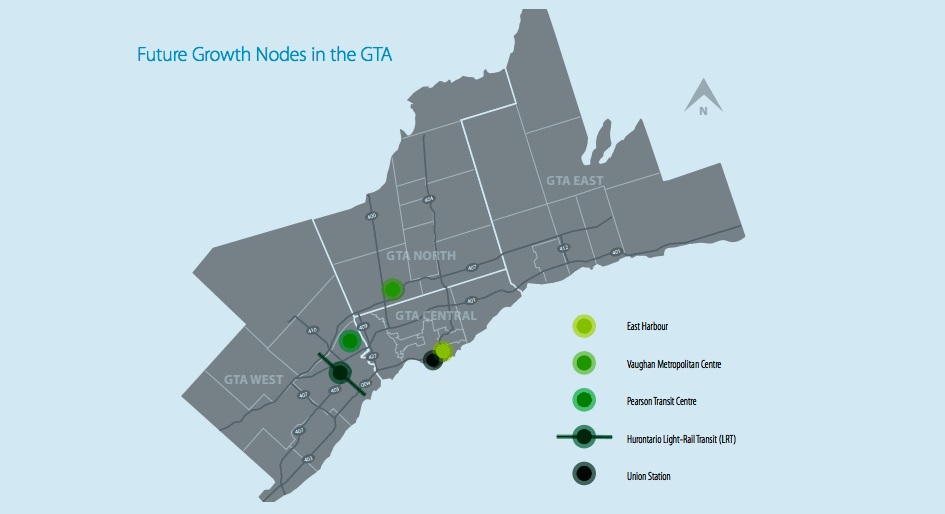
commercial hubs

Courtesy of Avison Young

East Harbour

Toronto’s core is expanding beyond its traditional downtown boundaries, now moving eastward to underutilized lands along the shore of Lake Ontario. What were once industrial areas, including the East Bayfront district, Port Lands and First Gulf’s 60-acre East Harbour site, are poised to experience massive mixed-use development, integrating together to create new neighbourhoods.

Development is already underway on projects along Queens Quay east of Yonge Street with additional projects in the planning stages extending all the way to the Don River. The East Harbour site, located north of Lake Shore Boulevard on the east side of the river, is positioned to be the next phase of this development trend.

The East Harbour proposal, currently under review by the City of Toronto, is designed to provide a commercial centre linking the surrounding areas, increasing the city’s office space to accommodate more people.

Developers are planning 10 million square feet of office space and two million square feet of shops, restaurants, institutional space, parks and public spaces, along with a major new transit hub connecting existing and proposed GO subway and streetcar lines. This will provide transit connections for the estimated 50,000 workers who could be employed there. Pedestrian, bicycle and automobile routes will connect East Harbour with new and existing communities.

Tenants will see a greater supply of options for commercial space near downtown, providing relief to what is already a tight leasing marketplace. Meanwhile, investors and owners in surrounding areas stand to gain from enormous value adds.

commercial hubs

East Habour, by First Gulf

Vaughan Metropolitan Centre

Located north of Toronto, the 400-acre Vaughan Metropolitan Centre (VMC) will bring the urban to the suburban as SmartCentres transforms 100 of those acres into a live-work-play development.

The City of Vaughan’s new downtown will be a mixed-use haven for a growing population. Amenities to residents and visitors include public and event spaces, entertainment, recreational trails, residences, community programs, green spaces and a proposed nine-acre central park spanning the entire site.

The first new building to rise is the KPMG Tower, a LEED Gold-certified class A building. Construction has also started on a mixed-use tower with professional services firm PwC as the lead office tenant. This building will be home to a flagship YMCA with childcare, fitness and aquatic facilities and a City of Vaughan library and studio space.

The majority of the land within the VMC is privately owned, however, the municipal government is encouraging development with its adoption of the Vaughan Metropolitan Centre Secondary Plan, which includes flexible, developer-friendly zoning rules. Various infrastructure projects, mainly related to transportation, are under construction.

Set to open December 2017 are the TTC’s Toronto-York-Spadina subway extension, York Region Transit’s SmartCentres Place Bus Terminal and VIVAnext’s Highway 7 rapidway. The rapidway will create a bus rapid-transit link between Markham and Vaughan and eventually to Brampton.

The ability to commute by mass transit allows for the creation of high-density commercial and residential properties.Increased property values will likely result along the transit lines and in the surrounding areas. A location on the subway line commands top rents and increased building valuations.

Pearson Transit Centre

In preparation for more growth, The Greater Toronto Airports Authority (GTAA) recently purchased the five-building Airway Centre, with plans for a multibillion-dollar transit hub at Pearson International Airport.

Dubbed “Union Station West,” The Pearson Transit Centre would help relieve pressure when the airport reaches capacity by 2030. The hub would connect many existing and planned local and regional modes of transportation and would include a large surrounding mixed-use business park featuring office, retail, hotel and other commercial spaces.

Pending regulatory approval, the Pearson Transit Centre will increase the airport area’s ability to attract and retain tenants and offer occupiers access to a larger labour pool. Tenants will enjoy the benefits of urban-style transit infrastructure in the suburbs with the added bonus of having a direct international airport connection.

Constructing modern class A office buildings could attract top-quality tenants and command higher rents. Commercial development in surrounding areas could also spark the construction of low- and mid-rise residential projects. Developments surrounding the airport are subject to height restrictions; however, current facilities offer more than adequate height and presence to appeal to quality tenants.

Hurontario Light-Rail Transit

The proposed Hurontario light-rail transit (LRT), anticipated for completion by 2022 with a $1.4 billion investment from the province, is expected to increase capacity and commute times along the Hurontario corridor.

The corridor, which could carry more than 22 million people a year by 2031, passes through several commercial office nodes, such as Brampton and Mississauga where population and employment figures are projected to rise.

Avison Young’s report cites several benefits the LRT could bring to business and investors as residents and employees move through the corridor. First, implementing it would encourage more people to become less car-dependent and improve walkability and wellbeing. Land previously slotted for parking could be used for better uses. There would be more opportunities for denser, mixed-use developments, which could encourage the development of new commercial spaces that require lower parking-space ratios.

Future new office space along the corridor will compete with existing space in traditional suburban nodes, while landlords may find opportunities to redevelop underperforming properties based on reduced parking requirements and increased employee density, or to accommodate a new mix of uses.

Landlords may also experience increased demand for space, resulting in higher rental rates and valuations for real estate assets. Tenants may be willing to absorb these higher rents if they can accommodate additional employees in their premises without exceeding their parking capacity.


Employers tap into tech talent clusters

Four of Canada’s largest cities and one regional player offer the top five homes for tech talent based on CBRE’s 2017 analysis of key market factors. Toronto, Ottawa, Vancouver, Montreal and Waterloo are deemed to provide the best dynamic for nurturing the workforce and fostering innovation in cost-competitive space. Calgary, Edmonton, Halifax, Winnipeg and London, Ontario round out the list of surveyed cities.

Tech firms notably accounted for 30 per cent of office leasing activity in the third quarter of 2017 and clearly have growing impact and clout as a tenant group. About 5 per cent of the Canadian workforce is currently employed in the sector — equating to approximately 776,000 jobs — and 130,000 of those positions have been created since 2011.

“Landlords are competing for tech tenants and are most successful when leasing existing character-filled, brick-and-beam buildings,” states the 2017 Scoring Tech Talent Report. “As supply dwindles, landlords are increasingly defixturing office towers to fashion desirable office space in amenity-filled neighbourhoods.”

CBRE analysts identify a city’s current concentration of tech labour as a leading indicator of its growth potential because existing successful tech hubs are seen as a magnet for similar businesses. Pools of skilled labour then draw other businesses that further spur innovation, collaboration and new enterprise.

Toronto ranks first in this category, which measures the city’s share of the national tech workforce and tech’s prominence in relation to other types of employment. More than one quarter of Canada’s total tech workforce is now located in Toronto, where it represents more than 7 per cent of the city’s employment base. Montreal is home to next greatest allocation of the national tech workforce, at 16 per cent. Ottawa employs about eight per cent of Canadian tech workers, who make up nearly 11 per cent of the city’s labour force.

Waterloo is home to about seven per cent of the country’s tech talent, but the region’s momentum is unparalleled. The 7,400 tech jobs the region gained between 2014-16 equate to nearly 54 per cent growth in the city’s tech sector. Toronto gained 29,400 jobs in the same period, which was a 16 per cent jump in tech employment.

The report links Waterloo’s trajectory to its status as “a tech innovation and start-up hub for the country”, which is also reflected in the salaries Waterloo-based tech workers command — more than double the region’s average non-tech earnings. Elsewhere, Toronto, Vancouver and Montreal are leveraging their size and other strengths of a more diverse economy.

“As all sectors of the economy expand their technological capabilities, markets that have experienced the most tech employment growth have the most momentum and likelihood of expanding their pool of tech talent,” the report hypothesizes. “While being amongst the highest cost tech labour markets, Waterloo Region also offers the highest concentration of quality tech talent. Toronto and Vancouver offer a good balance between quality and cost.”

All 10 surveyed cities surpass the national average for residents’ attained level of education, with a chart-topping 45 per cent of Ottawans aged 25 to 64 holding at least a Bachelor’s degree. In addition, Canada’s educational infrastructure has been an impetus for tech clusters.

“Top tech markets distinguish themselves with the presence of tech clusters, which typically form around pre-eminent universities allowing for improved access to a constant flow of new talent,” the report observes. “Many universities in Canada have created partnerships with incubation labs to help foster the development of tech communities, creating a strong link between the industry and the labour force.”

CBRE analysts suggest tech companies view real estate more as a cost of business than as a major influence on choosing locations. However, office rents and housing affordability no doubt combine with other factors in the decision making process.

“Vancouver has the highest average gross rents, followed by Toronto and Edmonton. Despite being the second largest city by population, Montreal has the fifth highest office rent, which provides the city with a competitive advantage equal to midsized cities like Ottawa,” the report notes.

Although tech talent typically enjoys higher-than-average salaries, those earnings stretch farther in some of the surveyed markets. In Montreal, the average tech worker would spend just less than 12 per cent of income on apartment rent, while tech talent in Vancouver would spend 18.5 per cent of earnings.

Rental supply shortages fuel demand

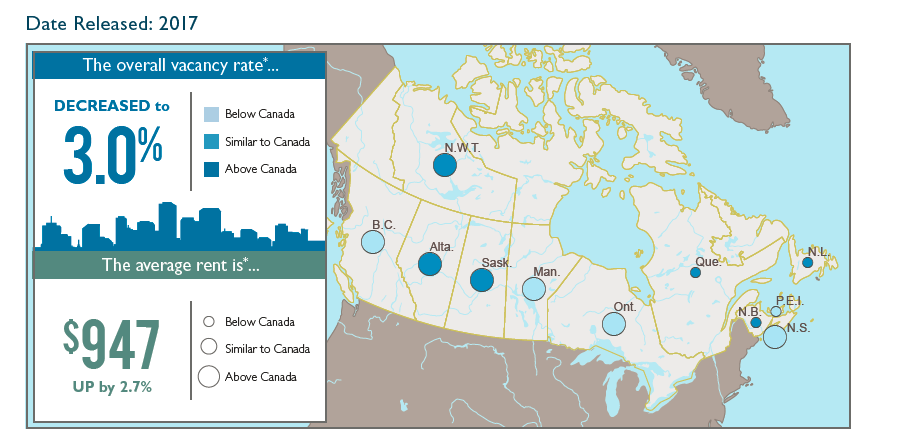
According to CMHC’s 2017 Rental Market Survey, the average vacancy rate for purpose-built rental apartment units across all surveyed centres decreased from 3.7 per cent in October 2016 to 3.0 per cent in October 2017. During the same timeframe, the number of purpose-built rental apartments increased by approximately 23,000 units, or 1.2 per cent. This represents a significant slowdown in the growth of supply when compared to the roughly 40,000-unit increase registered between October 2015 and October 2016.

“Nationally, increased demand for purpose-built rental apartment units outpaced growth in supply, leading to a decline in the vacancy rate and a reversal of the trend we’ve seen over the last two years,” said Gustavo Durango, Senior Market Analyst at CMHC. “Demand for purpose-built rental apartments can be attributed to historically high levels of positive net international migration, improving employment conditions for younger households and the on-going aging of the population.”

As mentioned, new international migrants are a key source of rental housing demand because they have a strong tendency to rent during the first few years of their arrival, when compared to non-migrants and migrants who have been in Canada longer. While Canada saw a decline in the number of net new immigrants over the first half of 2017 compared to the same period in 2016, 2016 saw a near-record high level of new immigrants. As a result, the level of net international immigration to Canada remains well-above historical averages, thus providing a strong level of support for rental demand.

Younger households and aging Canadians are also affecting rental demand. While younger households tend to have lower incomes and are more likely to gravitate towards renting, the growing aging population is contributing to the increase in occupied rental units.

CMHC 2017 Rental Market Report

Provincial highlights

Rental housing demand increased in most regions of Canada, including the oil-producing province of Alberta, which saw a meaningful decline in its vacancy rate following two years of sharp increases in the wake of the 2014 oil-price shock. In a sign of economic recovery, the vacancy rate in Alberta has declined to 7.5 per cent from 8.1 per cent a year ago.

Most provinces saw an increase in demand for purpose-built rental apartments, as indicated by increases in the number of occupied units between October 2016 and October 2017. The largest gain in the number of occupied rental units was reported in Ontario, followed by Quebec. These provinces also saw some of the strongest gains in the supply of new purpose-built rental apartment units, but this was outpaced by demand growth.

In Ontario, the vacancy rate fell from 2.1 per cent in October 2016 to 1.6 per cent in October 2017, while Quebec registered a decline from 4.4 per cent to 3.4 per cent over the same period. Ontario and Quebec have both seen improvement in employment conditions so far in 2017, including growth in the employment of 15- to 29-year-olds. They also continue to receive relatively high levels of international migrants, despite registering a year-to-date decline from levels in 2016.

In the Atlantic region, generally modest employment growth and relatively high levels of net international migration supported growth in rental demand. This led to declines in vacancy rates in Prince Edward Island (from 2.1% in October 2016 to 1.2% in October 2017), Nova Scotia (from 3.0% to 2.6%) and New Brunswick (from 6.6% to 4.1%). Newfoundland and Labrador was the only province that registered essentially no growth in the number of occupied units.

Manitoba and Saskatchewan saw relatively modest gains in the growth of occupied units that nonetheless outpaced growth in supply. On balance, this led to a very slight 0.1 percentage point decline in the vacancy rate in both provinces, from 2.8 per cent to 2.7 per cent in Manitoba and from 9.4 per cent to 9.3 per cent in Saskatchewan.

Average rents

The average rent across all surveyed centres for two-bedroom apartments in structures common to both the 2016 and 2017 surveys rose by 2.7 per cent. By comparison, inflation in Canada was 1.4 per cent during this 12-month period.

The largest increases were registered in British Columbia, led by Kelowna (8.6%), Victoria (8.1%) and Vancouver (6.2%). Strong increases were also recorded in Ontario, mainly within the Greater Golden Horseshoe region.

Turnover rates

Turnover rates represent the share of units in a purpose-built rental apartment structure that were rented to new tenants in the past 12 months (at the time of the survey). Across surveyed centres, the average turnover rate stood at 20 per cent, essentially unchanged from the rate of 20.2 per cent recorded in October 2016. Turnover rates were above the national average in Saskatchewan, Alberta, Manitoba, New Brunswick and Nova Scotia and below the national average in British Columbia, Ontario, Quebec, P.E.I., and Newfoundland and Labrador.

Major market facts

  • Toronto’s primary vacancy rate reached a 16-year low at 1.0 per cent. Homeownership affordability concerns kept more households in rental.  Supply of new private purpose-built rental units was insufficient to meet growing demand. Condominium apartments continued to act as the de-facto new rental accommodation supplier.
  • Despite record construction of new units in Vancouver, strong demand for rental accommodation kept the vacancy rates below 1 per cent for both primary rental apartments and rental condominium apartments. The rapid increase in entry-level home prices and higher migration to the region have contributed to rental demand.
  • Due to strong demand, the vacancy rate in the Montréal area decreased in 2017 to 2.8 per cent. The change in the average rent was about 2 per cent.
  • After increasing for three consecutive years, the apartment vacancy rate in Calgary declined in 2017 to 6.3 per cent. In Edmonton, it remained unchanged at 7 per cent.
  • Kelowna and Abbotsford-Mission (both at 0.2%), Victoria (0.6%) and Vancouver (0.9%), Kingston (0.7%) and Toronto (1.0%), have the lowest purpose-built rental vacancy rates.
  • Saskatoon (9.6%), Regina and Edmonton (both at 7.0%) and St. John’s (7.2%), have the highest purpose-built rental vacancy rates.

For the complete CMHC 2017 Rental Market Survey, visit: https://www.cmhc-schl.gc.ca/en/hoficlincl/homain/stda/