Articles Archive - Page 593 of 929 - REMINET
REMI

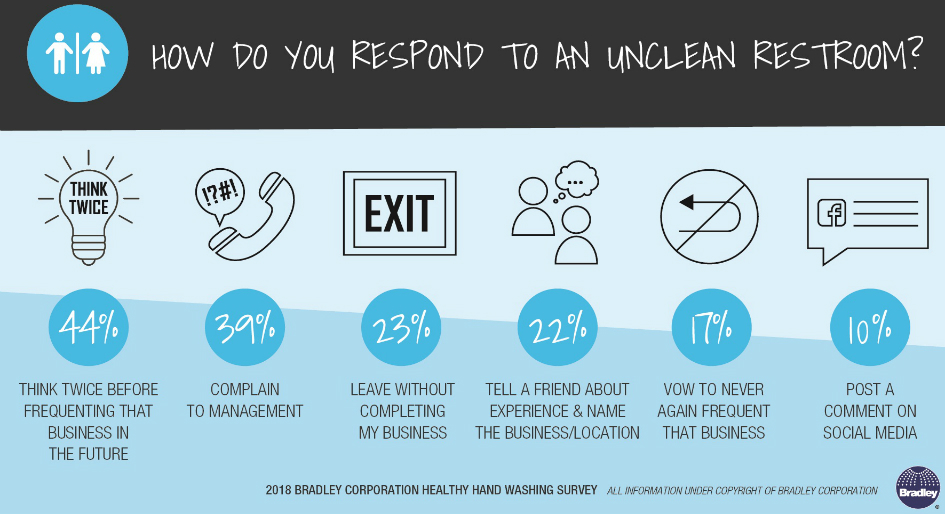
More spending at businesses with clean restrooms

Almost half of Americans are planning to spend more money at a business that has clean, well-maintained restrooms, according to Bradley Corporation’s annual Healthy Hand Washing Survey.

The survey, which reached 1,035 Americans, also found that when businesses let restroom maintenance slip, they are at a high risk of jeopardizing customer satisfaction and sales. Almost 60 per cent of respondents said they make a conscious decision to visit a specific business because they know it has nice restrooms.

“The inherent correlation between restroom conditions, businesses and customers extends even deeper than we realized,” says Jon Dommisse, director of strategy and corporate development for Bradley Corp. “Our survey has previously highlighted how well-maintained restrooms increase patronage; learning that people also reward these businesses with their spending power was further confirmation of how consumers respond positively to clean restrooms.”

Over the past three years, the number of Americans with unpleasant restroom experiences has steadily increased from 59 per cent to 70 per cent.

Their biggest problems are toilets that are clogged or not flushed, empty or jammed toilet paper dispensers, unpleasant smells, partition doors that don’t latch and an overall dirty appearance. Top frustrations are walking across a wet floor, reaching over someone to access soap and waiting in line for a hand dryer. Many respondents are unlikey to return to the establishment.

Response to Unclean Restroom_20182

For restaurants, the judgment surrounding the condition of restrooms is especially tough, as 82 per cent think a restaurant with dirty restrooms is “extremely” or “fairly” likely to have a dirty kitchen. Further, out of all types of facilities, restaurants and health care establishments cause Americans the most concern about workers not washing their hands.

The survey, conducted between January 2 and January 5, also delved into perceptions about this year’s pervasive flu season. Almost 60 per cent of Americans are concerned about contracting a new or particularly resilient strain of the flu. This elevated concern appears to prompt more diligent hand washing, as 65 per cent say they wash their hands more frequently or more thoroughly to avoid getting germs or transmitting them to others.

Avoiding Germs in Restrooms_No Gender_20181

FRPO announces departure of two key staff members

The Federation of Rental Housing Providers of Ontario has announced the departure of two key staff members: Jim Murphy (President and CEO) and Paul Fogolin, (Vice-President Government and Industry Relations).

Both Jim Murphy and Paul Fogolin joined the FRPO team in 2017. At the moment, no reason has been given for their departures from the association.

“On behalf of our Board of Directors, we wish to thank you for your ongoing support of FRPO and the work we together do to improve the rental housing industry in Ontario,” the announcement stated. “Our strength is our membership and our continued effort to work together with one consolidated voice. Collectively, we have unparalleled experience and wisdom which we need to share with policy-makers.  We will continue to proactively advise them accordingly as we move towards the election in June.”

Acting as Interim President & CEO will be Daryl Chong, who will continue his role as President & CEO of the Greater Toronto Apartment Association while FRPO hunts for a permanent solution.


New industrial rebates for energy savings in Alberta

Alberta has added several industrial-specific rebates to its Energy Efficiency Alberta’s Business Non-Profit and Institutional (BNI) Energy Savings Program.

The BNI program is already helping organizations reduce their energy use and greenhouse gas emissions by replacing outdated and inefficient equipment with new energy-efficient technologies. Most industrial facilities that are not large final emitters qualify for the program.

Industrial businesses, including small-to-medium sized oil and gas industries, are now eligible to receive rebates on products such as:

  • Pump-off controllers for pump jacks;
  • Variable frequency drives for combustion air fans;
  • Steam trap survey and retrofit;
  • Retro-commissioning for economizers and fresh air dampers;
  • Pneumatic to electric instrument conversion;
  • Compressed air leak detection and repair;
  • No-loss drains (compressed air);
  • Chiller tune-up;
  • Loading dock door and pit seals;
  • Valve repair – chilled water / hot water;
  • Process exhaust filtration.

Organizations purchase products and once installed submit product information and proof of purchase online to receive the rebate. Many contractors do this on behalf of their customers when they complete the installation.

As of December 2017, more than 1,200 organizations have participated in the BNI program, receiving a total of $3.5 million in rebates or an average of $2,600 per project.


Photo: Minister Shannon Phillips and Energy Efficiency Alberta CEO Monica Curtis listen to ideas from business leaders on energy efficiency at the Calgary Chamber of Commerce.

Post-construction cleaning offers fresh start

The debut of a new office is extremely important. A tremendous amount of time, money and effort goes into new builds and remodels, so having them shine, when completed, is critical.

But it isn’t just aesthetics that are important. Post-construction dust can be harmful to the health of the building’s occupants and settles on furnishings, carpet, wall hangings, windows and fittings, sanitary fittings, walls, hard surfaces and tile floors. The residue left after construction is hard to remove, requiring special equipment, products and expertise.

Despite even the best efforts of the contractor, construction dust will make its way into a building’s ductwork, which, according to the Centers for Disease Control and Prevention (CDC), can exacerbate lung conditions such as asthma. Additionally, materials that contain fibers, such as fiberglass composite materials or insulation, can irritate the skin, eyes and respiratory tract when dispersed in the air. Also, if left untreated, these particulates can have an impact on all building occupants during flu and allergy seasons.

For all of these reasons, contractors usually rely on professionals that offer post-construction cleaning services. Post-construction cleaning professionals will scope the job properly and use the required equipment and products, which typical janitorial staff may not have on hand, to remove the dirt and residue completely and provide a clean and safe environment for the building’s occupants. Post-construction cleaning professionals are also required to carry insurance in case there are any issues.

In most instances cleaning would include high-powered vacuuming with a backpack in order to remove drywall dust from the premise, carpet cleaning, glass cleaning and damp wiping of walls and other surfaces with microfibre clothes. If new vinyl tile was installed, it may need a coat of wax. Therefore, it is important to scope the work properly to ensure that the proper tasks are completed.

A construction environment is one of constantly changing schedules, so it is important that cleaning takes place quickly and efficiently in order to meet critical timelines for the project. In some cases, cleaning is required periodically throughout the project; therefore, coordination or adaptive scheduling with the other trades and quick turn-around service is imperative.

What to expect

Exterior cleaning requirements

Depending on the extent of a renovation project, or with a new build, exterior cleaning services may be required. Walkways, entryways and outside common areas are the first thing that visitors will notice. Sweeping, power washing and wipe downs of all exterior fixtures are essential for creating a great first impression.

Interior cleaning requirements

Construction dust and residue hides in many unknown places. It’s important to find these areas and quickly restore carpets, floors, windows and other surface areas through thorough and detailed cleaning procedures. Tasks should include:

  • High-level dusting
  • Cleaning and sanitizing air diffusers and ducts, light fixtures, restroom fixtures, windows and fittings, walls and hard-surface areas
  • Vacuuming and full restoration cleaning of carpets
  • New hard-floor finishing or pre-existing floor refinishing
  • Removal of debris and hazardous materials

When the dust settles

Whether an organization is considering an office renovation or is in the middle of one, post-construction cleaning should be a key project consideration. Post-construction cleaners will work with the construction contractor to keep the job site clean throughout the renovation process, or, depending on the extent of the project, they can come in when the trades have completed their work.

Construction and renovation projects can shut down an office or other commercial space for months at a time, which can negatively impact business. A professional cleaning will make a space spotless and improve indoor air quality for employees, tenants and customers as quickly as possible to prevent any further disruption to the operation of a company.

Gavin Bajin is director of business services at ServiceMaster of Canada. He and his team support 70 franchises, delivering janitorial, commercial carpet cleaning and specialty cleaning services from coast to coast.

The pros and cons of community-building efforts

In some condominium communities, everyone is a stranger. In others, everybody knows one another by name. While there are factors which impact this that are beyond the control of the board, such as the total number of residents within the community, directors can take steps to further encourage — or discourage — fostering community.  In determining if it is worthwhile to make the effort, it may be helpful to consider the pros and cons of trying to transform a condominium corporation into a true condominium community.

Pro: The comforts of knowing one’s neighbours

Certain comforts can be taken from knowing fellow residents within the condominium community. For example, it may be easier for residents to work together to prevent strangers from inappropriately accessing the property; particularly as some residents may be hesitant to speak up alone when a stranger tries to “tailgate” (enter the premises behind them).

A neighbourhood watch-like camaraderie amongst community residents can only truly be developed if they know one another. Further, it may be more enjoyable for a condominium dweller to feel that they are part of a community in which they can borrow a cup of sugar from a neighbour.

Con: Gossip — knowing too much about one’s neighbours

It may be human nature to observe, yet when one considers this tendency within the context of a condominium — where people come together to live or work — many find that they end up learning more about their neighbours than their neighbours may care to share. It’s common for fellow condominium residents to be exposed to aspects of their neighbours’ lifestyle, love lives or recreational activities that some may have preferred to keep to themselves.

When one considers that different people come together to form a community, getting to know one another too well may give rise to conflict. If for no other reason than a sense of resentment over lost privacy or feeling judged.

Pro: Feeling heard

While it is ultimately the board of directors who is empowered to make decisions that impact the community as a whole, there can be a significant difference when those who are affected by decisions feel that they were considered in the course of deliberations versus being ignored. Directors attempting to foster community often invite communication — actively taking an interest in learning the views, concerns and feedback of those who form the community. This can help everyone feel as though they have a voice, and that their voice is important.

Con: Toxic apathy

It can be discouraging for a condominium director to get the sense that no one appreciates the efforts that he or she makes. Putting in time to encourage community-gathering ice breakers only to have few turn up can lead boards to resent those who do not seize the opportunity to get to know their neighbours.

In some circumstances, those who do participate may feel that in doing so they have more influence over the decisions before the board than others. This can lead to rifts between active and non-active community members, or put property management in an awkward position whereby an active resident or owner feels that they should be treated specially rather than equally.

Pro: Feeling accounted to

The board of directors of York Region Condominium Corporation No. 798 — the Toronto & Area Chapter of the Canadian Condominium Institute’s “Condo of the Year” — prides itself on being open with information and communications. Stephen Pollishuke, who serves on the board, believes that this approach prevents surprises at owners’ meetings or fallout from decisions made by the board.

While he appreciates that conflict will inevitably arise from time to time, as everyone will not always see things the same way, he finds that being transparent and open prevents conflict from escalating unnecessarily due to speculation, assumption or misunderstanding. This approach sends the message to everyone in the community that the board feels accountable to them.

Con: Crossing boundaries

The writer knows of a condominium community where directors only identify themselves at the Annual General Meeting (AGM) if they are seeking re-election that particular year. That is, every director who is not up for re-election at any given AGM does not sit at the head table at the yearly owners’ meeting or otherwise draw attention to themselves; they either hide as just another face in the crowd or skip out on the meeting altogether.

Why? Because while the directors serving this community enjoy their role, they do not enjoy what they view as the “baggage” that comes with it.

This community happens to have a history of residents crossing what their directors’ view as the line when it comes to interactions with the board — perhaps a failure to appreciate that the directors are fellow residents, too. As a result, the board tries to exist in the community without being easily identified to avoid receiving unsolicited knocks on their door or being interrupted as they walk the dog or return home with their groceries.

Is it worth it?

The positives that come with fostering community within a condominium community would seem useful to virtually every condominium. However, it may be important to recognize that no two condominium communities are the same.

The success rate of attempts to foster community can vary, as can the degree of impact of the potential positive and negative consequences of doing so. Committed condominium directors should certainly consider the benefits of fostering community at their own condominiums and how best to structure the effort to accomplish the desired result.

At the very least, opportunities may exist to minimize or re-direct some of the potential negative consequences, such as by setting boundaries with residents. This is particularly the case in view of some of the opportunities this presents in better managing the conflict that will inevitably arise from time to time in the condominium context.

Marc Bhalla holds the Chartered Mediator (C.Med) designation of the ADR Institute of Canada, the nation’s most senior designation available to practising mediators. Marc leads the CONDOMEDIATORS.ca team, manages MarcOnMediation.ca and serves as the 2nd Vice President of the Toronto & Area Chapter of the Canadian Condominium Institute.


Clearing the Clutter: 5 Benefits to Eliminating your Paper

Paperwork can pile up fast in the facility management industry. Between invoices, release forms, contracts, tenant messages, and other communications, property stakeholders will often spend a bulk of their day collecting and processing a high volume of paper. This not only reduces the focus from more meaningful tasks, but the time and space required to manage the abundance of documents ultimately makes document retrieval inefficient.

Cutting through this clutter is key to making the most effective use of a property manager’s time. While many solutions have promised to do just that, few have proven more effective than going digital.

“Adopting scanning technology to digitize documents of all types is becoming an increasingly popular way for facility managers to overcome the clutter to increase productivity,” says Steve Oblin, Senior Marketing Manager at Fujitsu Canada.

  • Process Automation: Scanning and uploading documents into central cloud-based storage allows property stakeholders to organize and retrieve specific documents quickly, without the need for manually sorting and searching.
  • Mobile Friendly: Through technology like Fujitsu’s own iX100, users have the flexibility and convenience of scanning and accessing documents wherever they are.
  • Data Security: The ability to store scanned images in the cloud reduces the risk of loss or damage that would otherwise threaten physical documents in storage, or while in transit.
  • Easy to Share: Going digital provides facility managers with the ability to share information and documents easily between their clients and colleagues.
  • Room to Move: Scanning technology reduces the need for physical storage space and goes a long way towards trimming down office clutter.

FujitsuWhile the benefits of adopting scanning technology may be clear, some are still reluctant to learn a new technology. As with many modern office innovations, however, scanning technologies are designed with the user in mind.


“It’s important for us that anyone, no matter their technical skills or experience, are able to easily learn and use this technology,” says Steve Oblin. “With the ScanSnap, all you need to do is put your pages into the automatic feeder, press scan, and then send it to your preferred cloud storage provider. It’s an easy process – which is important when you’ve got a full day.”

Scanning technologies have a large role to play in the fight against office clutter. More importantly, however, is the role they can also play in bringing greater efficiencies, accuracies, and on-the-go document management capabilities to the facility management field.

Discover Fujitsu’s ScanSnap iX100.

Visit www.fujitsu.ca for more info.

First Smart Building Analytics Living Lab to open at Ryerson

Schneider Electric Canada has partnered with Ryerson University to build the Smart Building Analytics Living Lab, the first laboratory of its kind in Canada.

The new lab will provide Ryerson students in engineering, architectural science and computer and data science programs with access to tools to develop, test and optimize modern technologies and approaches in building management. It will be used to demonstrate savings in energy consumption and in capital and operating expenses for buildings of all sizes. Schneider Electric donated $1 million in kind to Ryerson to design and build the new lab.

“Our partnership with Ryerson University and the building of the Smart Building Analytics Living Lab reflects the need for advancement of data analytics and the use of Internet of Things technologies to lower energy use in urban areas by providing higher building efficiencies,” said Juan Macias, senior vice president of digital energy solutions/prosumer at Schneider Electric, in a press release. “The research done here will benefit buildings and their owners in Canada and throughout the world. We are proud to be partners with Ryerson University on such an important initiative.”

As Canada looks to achieve its energy- and carbon-reduction goals in alignment with the COP21 outcomes, the laboratory will help increase knowledge and experience in key areas, including improved understanding of emerging HVAC systems; the optimization and performance improvement of existing HVAC systems; and new data analytics algorithms, predictive models and machine learning approaches to support building performance improvement in real time, with both human effects and environmental conditions taken into consideration.

The Smart Building Analytics Living Lab will be used as a direct connection into real world applications of building management systems and energy management. From the laboratory, the Ryerson team will connect to building control systems using Schneider Electric’s EcoStruxure Building software platform, which includes access control, lighting control, security, energy and HVAC systems.

“The convergence of Information Technology and Operational Technology means bringing together applications and devices in innovative ways, and tying together systems that have primarily operated in isolation,” said Susan Uthayakumar, Country President, Canada, Schneider Electric. “Along with growth in numbers of devices and increased functionality, bringing these systems together introduces integration on a new scale. The Ryerson lab is a great forum to test these new integration possibilities.”

By introducing new technologies and integrating the IoT into new and existing designs, both Schneider Electric and Ryerson will be able to test these new technologies in real-world applications, in real time.

“The new Ryerson University Smart Building Analytics Living Lab will be a one-of-a-kind space for our faculty and students. Using the latest data analytics and IoT technologies, it will help them understand energy use in buildings like never before,” said Dr. Mohamed Lachemi, President and Vice-Chancellor of Ryerson University. “The lab will become a powerful tool in helping to reduce energy use in urban areas and combat climate change here in Canada and around the world. We are glad to work with Schneider Electric in this endeavour and look forward to what we can accomplish together.”

The laboratory will be located at Ryerson’s 111 Bond St. building in Toronto and is expected to open in late 2019.

Pictured from left to right: Adrian Thomas (VP, Buildings), Tom Duever (Dean, Faculty of Engineering and Architectural Science, Ryerson University), Jenn McArthur (Assistant Professor, Department of Architectural Science, Ryerson University), Juan Macias (SVP Digital Energy Solutions / Prosumer), Dr. Mohamed Lachemi (President and Vice-Chancellor of Ryerson University), Steven Liss (Vice-President, Research and Innovation, Ryerson University), Ian Mishkel (Vice-President, University Advancement and Alumni Relations, Ryerson University), Alan Fung (Associate Professor, Mechanical and Industrial Engineering, Ryerson University) and Bala Venkatesh (Academic Director, Centre for Urban Energy, Ryerson University)

M Real Estate unveils new office space, The M Coach House

Greater Montreal-based real estate agency M Real Estate recently opened The M Coach House, its fourth office location in Quebec.

Located in Montreal’s downtown core on the corner of Drummond and Sherbrooke, The M Coach House was converted into a contemporary office space from the stables (or “coach house”) of the historic Reid-Wilson house, which was first constructed in 1882.

“When The Coach House location was brought to our attention, it was an obvious choice. Positioning ourselves in the prestigious Golden Square Mile was a statement not only about how far our brand has come in such a short time, but also sets the tone for what’s ahead,” said Justin Comeau, president of M Real Estate, in a press release. “Styled to the nines and finished with the highest-grade materials, The M Coach House is a place where our team can host clients and work together in a collaborative and open environment.”

The two-storey, 4,000 square-foot space was designed by Italo Di Pietro of Anonymous Concepts to honour the evolution of open-concept and collaborative work spaces. The office features original wooden beams that were discovered during the renovations, a slab floor, glass and natural brick walls to complement the open-concept atmosphere.

The main floor was designed to create a lounge vibe and features an eight-seat workstation, bar and lounge area that can be used for staff to relax or to accommodate meetings with clients. The second floor features a 12-seat workstation, seven enclosed offices and two enclosed conference rooms that are walled in with glass.

“Designing The M Coach House was such an adventure,” added Di Pietro. “Our biggest challenge was keeping the beauty of this historical building and marrying the modern and contemporary style that M Real Estate reflects.”

M Real Estate’s other offices are located in Pointe-Claire, Gatineau and Hudson.

Victoria’s vibrant rental market lures investors

According to a new report from Colliers International, Greater Victoria’s purpose-built rental market experienced strong, positive market conditions throughout 2017. The market witnessed heightened investor appetite from a range of local, regional and national buyers, as well as low vacancy, increasing rents and tightening cap rates, underpinned by strong market fundamentals and continued population growth.

A number of key trends in the region combined to influence these favourable conditions for investors. As reported by Colliers:

• Historically low vacancy rates rose only marginally from 0.5% to 0.7% at year end, as estimated by CMHC;

• Rental rates across all unit types increased due to strong tenant demand and limited new supply;

• Despite the Bank of Canada increasing its key interest rate in response to Canada’s stronger-than-expected economic performance, interest rates remained low, allowing investors to accept compressed returns on multifamily product;

• The majority of sales in 2017 were off-market transactions, with the prime motivator for many owners being the premium prices offered by investors;

• The region experienced an increase in popularity as a destination for the in-migration of new residents.

Victoria Q4 2017

Victoria’s purpose-built rental market: 2017 supply and demand

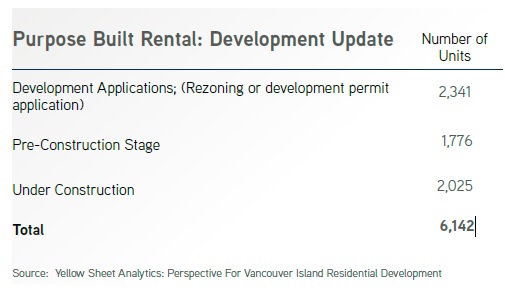
The most recent Yellow Sheet Analytics Report, which measures residential development for Vancouver Island, confirms that there are over 6,000 new units in various stages of planning and development coming into Victoria’s purpose-built rental market.

The published vacancy rate for rental units in the Greater Victoria Region, according to CMHC’s most recent survey, increased marginally from 0.5 per cent at year-end 2016 to 0.7 per cent at October 2017. With over 1,900 purpose-built rental units under construction in Greater Victoria, this will apply modest upward pressure to regional vacancy levels; however, there are a number of market dynamics that will offset increased vacancy levels, such as the following:

Victoria is currently experiencing an estimated 3.4 per cent unemployment rate, the lowest in Canada, which is attracting job seekers to the region, many of whom are typically renters. A large portion of these employment positions are being filled in the tech sector by Millennials who typically rent in the downtown area.

Demographics are playing a part in the demand for rental with more ’empty nesters’ choosing to relocate and rent accommodations to take advantage of the climate and lifestyle amenities offered by the South Island.

The rapidly increasing cost of housing means that many first-time buyers are challenged by affordability issues and are choosing to remain in rental accommodations as they save for increased down payment requirements.

The B-20 mortgage rule changes, which included increasing stress test criteria that took effect January 1st, 2018, will keep many uninsured buyers out of the market with the result that they will continue to occupy their existing rental units.

With a very tight rental market, turnover rates for rental units are at historical lows, leaving a very competitive environment for the remaining vacancies. The scarcity of the available supply allows landlords to charge a premium leaving budget renters more limited choices.

With the demand increasing for lower priced housing, combined with rental restrictions either in place or under consideration by the new NDP provincial government, and rising construction costs, some developers who had been contemplating construction of new rental buildings are now considering conversion to strata/condos as a more attractive economic development alternative.

For the complete report, including a list of all rental market transactions (over $1 million) to the end of 2017, click here: http://www.collierscanada.com/en/commercial-property-research/

Cleaning schedules revisited in open offices

Cleaning in open work spaces invariably must be done while people are still using the office. The main reason for this is that, along with tearing down walls and partitions, the old worker “time-clock” system has been torn down as well. Some staff members may start their day at 7 a.m., or 10 a.m., and there are those that prefer the swing and even graveyard shifts.

This can cause complications for cleaning workers who typically prefer to have the work space to themselves when cleaning.

It can slow them down if people are still in the office when they are cleaning. Often they must stop mid-task, such as vacuuming, because someone is on the phone. (This is called the ‘wave off,’ a term used when office staffers wave off the cleaners to come back later.)

Safety becomes a bigger issue when more people are using the office; this is mainly due to the fact that people are coming and going, resulting in doors being left unlocked that should be locked.

And cleaning needs are amplified. More people using the same space means more areas must be detail-cleaned and disinfected. Disease can spread much faster in an open office, and effective cleaning is one of the primary ways to prevent this.

So, how can cleaning workers get around these realities of the open work space?

Adjust cleaning times

One way to tackle many of these problems is to adjust the time when an open office is cleaned. Office facilities are traditionally cleaned in the evening, often starting around 5 p.m. Depending on the location and the industry, an open office may have a very high density around 5 p.m., with many people still at work and using the office at this time.

Because no two open office workspaces are necessarily the same, the building manager should determine the best time for the cleaning workers to come in. This is so important, it should be written into the scope of services and requests for proposals. In some cases, the contractor will have to pay workers more to come in at odd or unusual hours, and this added cost will need to be reflected in their bids.

While no two locations are necessarily the same, very often it works best to have the bulk of the cleaning performed in the early-morning hours. There are often fewer occupants then, and the facility can be freshly cleaned before many workers start their work day.

Set a schedule

Let’s say that cleaning the space early in the morning is not an option and that managers prefer that the open space office is cleaned after 5 p.m. The only way this will work is for the cleaning staff to set a work schedule and hold the office staff to it.

Such a work schedule might look like this:

  • From 5 p.m. to 7 p.m., distinct sets of restrooms will be cleaned; this ensures restrooms are always available to building users, but also notifies them when specific restrooms will be closed for cleaning.
  • From 7 p.m. to 8 p.m., trash will be collected.
  • From 8 p.m. to 9 p.m., food service areas will be closed for cleaning.
  • Also from 8 p.m. to 10 p.m., all desktops, counters, shared workstations and shared electronics will be cleaned and disinfected.
  • At 10 p.m., vacuuming and hard-surface-floor cleaning begins.
  • The remaining time would be allocated to special cleaning projects performed on a weekly or monthly basis (high and low cleaning, floor scrubbing, floor polishing, etc.)
  • During these set times, if cleaning workers are given a wave off, they should be instructed to tell office workers they will come back one more time, but if they cannot clean then, the area will not be cleaned that night.

Promote program success

There are three keys to the success of such a program.

First, everyone using the facility, cleaning crew and office workers, must be thoroughly aware of what areas are being cleaned and when.

Second, such a program requires a degree of flexibility. Too much flexibility and the cleaning program will lose all structure and essentially fall apart. However, there may be occasions when large groups of office workers are meeting at specific times and need certain areas available to them. In such cases, cleaning workers will need to be flexible, and adjust their schedules accordingly.

Third, and possibly foremost, the entire program needs a high degree of courtesy. Both office workers and cleaning workers must understand they both have a significant role to play. Kindness and courtesy among all the players ensures that cleaning is performed efficiently and with minimal disruption.

Open space offices have resulted in many changes for both building managers and cleaning workers, requiring them to work together, as partners, to keep facilities clean and staff healthy.

Ron Segura is president of Segura Associates. His company works with large organizations to streamline their cleaning and building operations as well as promote sustainability and healthier cleaning strategies so that facilities function more effectively and efficiently and realize cost savings. 

ICBA survey forecasts construction wage increase

Wages for B.C. construction workers are expected to increase nearly 10 per cent over the next two years, according to the Independent Contractors and Businesses Association (ICBA).

ICBA president Chris Gardner highlighted results of the 2018 Wage and Benefits Survey at ICBA’s annual CEO Breakfast held at the BUILDEX tradeshow in Vancouver.

“With such strong demand for workers, construction wages are growing more than twice as fast as inflation,” said Gardner. “The need is intense. Every single glass company we surveyed this year said they needed more glaziers. For pipefitting companies, 93 per cent said they needed more help; sheet metal workers, 91 per cent; electricians and plumbers, 89 per cent. The message is clear: if you want to work in construction, there’s a job out there for you.”

Construction in B.C. now employs more than 225,000 people and contributes nearly 10 per cent of the provincial GDP. This year, survey respondents said they expect to give their workers a 4.5 per cent raise; in 2019, they expect another 5.1 per cent increase.

The ICBA Wage and Benefits Survey also looks regionally at how optimistic companies are about adding more work in 2018. Fully 96 per cent of construction companies expect business in 2018 to be as strong or stronger than 2017:

  • Interior: 43 per cent of contractors expect more work in 2018 than last year; 82 per cent say they are short of workers, especially labourers, carpenters and framers.
  • North: 60per cent of contractors expect more work in 2018 than last year; 80per cent say they are short of workers, especially carpenters, truck drivers and drywallers.
  • Vancouver Island: 49per cent of contractors expect more work in 2018 than last year; 76per cent say they are short of workers, especially carpenters, labourers and framers.
  • Lower Mainland-Fraser Valley-Whistler: 55per cent of contractors expect more work in 2018 than last year; 82per cent say they are short of workers, especially carpenters, labourers and plumbers.

“Our findings bode well for opportunities in construction and its $19 billion annual contribution to provincial GDP – as long as we can continue to get to and stay at ‘yes’ on major projects and otherwise maintain a competitive business climate,” said Gardner. “We must do more to attract investment into British Columbia, ensuring that we continue to build the infrastructure and harness our resources responsibly.”

The LED lighting revolution

Lighting trends are constantly changing, but something that isn’t going away is LED technology, so here are some quick facts to help choose the right fixture for your next project.

Although it feels like LED is a recent development, it has actually been around for quite a long time. The red LED diode was discovered first, back in the 60s, and the green shortly thereafter, but it was the invention of the blue LED in 1992 that finally allowed us to begin incorporating it into products like televisions and electronic devices.

When LED first hit the consumer market, it was in those bright and very blue Christmas ‘icicle’ lights. Before the technology could be applied to the residential lighting market, a solution had to be found to make the LED more tolerable, as well as dimmable. When looking at an LED diode, there a yellow dot, but that is not actually the light source, it is a coating of yellow phosphor over the blue diode. The thickness and strength of the phosphor coating is what determines the colour temperature: a very thin layer will give cool whites and a very thick layer will give warm yellows and burnt oranges.

The lighting industry is most excited about LED as it allows the design of fixtures to be smaller, more appealing to the consumer and more energy efficient. Building codes are being updated to include stricter regulations on energy consumption, to the extent that some cities and municipalities are passing codes that require all new-build lighting to be LED. The 100, 75 and 60 watt lamps are banned from use and this is only the beginning, soon medium based sockets in general will be a thing of the past.

Traditional incandescent lighting uses resistors to allow the metal filaments to build up heat to the point that they glow burning hot. To do this, they require a lot of electricity (wattage). LED uses semi-conductors so they conduct electricity instead of resisting it, and therefore require much less energy to produce light. They also emit less heat by using what is called a ‘heat sink’ to help dissipate the heat, usually hidden behind the LED board.

Currently, an LED light source can be incorporated into lighting fixtures in one of two ways: with after-market LED lamps or by choosing fixtures that use ‘integrated LED’, where the light source is built right into the fixture. LED lamps come in just about every type from medium-base PARs and A19s (usual screw-in lamps) to tiny bi-pins for use in low-voltage pendants. They can range in colour temperatures from a warm 2700K to a bright white 5000K and beyond. They are energy efficient and are rated to last much longer than incandescent lamps (25,000 hours versus 2,500). Manufacturers are learning how to incorporate LED diodes into lamps in the most incredible ways – everything from vintage squirrel-cage Edison-style lamps to fluorescent plumen-style lamps in LED versions.

However, it is integrated LED that is truly the future of LED lighting. Building the LED right into the fixture allows for two things: assured energy efficiency (as there is no way to change out the lamp to a higher wattage) and freedom of design. Modern, contemporary styles are leaning towards integrated LED because they can create sleek, minimalist lines and designs by using LED tape light. Traditional and vintage styles are starting to use integrated LED by building around small modules and LED boards that can be recessed into the fixture.

Currently there are two types of integrated LED lighting: AC LED and DC LED. AC electricity is what runs in every electrical grid in North America and powers homes and buildings. DC electricity is what is used in smaller electronics that sometimes require battery power, like laptops and video game consoles. DC LED requires a driver to convert the AC electricity to DC, and this driver is usually located in the canopy, or is sometimes hidden in the body of the fixture. Often DC LED is low voltage as well, so it will require a transformer in addition to the driver, to convert the 120V electricity to 12V.

AC LED is both driverless and is 120V, so there is no need for a transformer. It is the most revolutionary LED technology we have to date and allows for smaller canopies and back-plates, easier install and slimmer profiles. It is dimmable, available in a myriad of colour temperatures and boasts a CRI of 90+ in most applications. AC LED is being incorporated into commercial, institutional, as well as residential lighting applications. The elimination of remote components and advances in the technology has brought the price level down to be on par with incandescent fixtures using after-market lamps. Most importantly, integrated LED fixtures are rated to last for 15 to 20 years, so just like any other large appliance in the home, maintenance is almost non-existent.

Integrated LED lighting has come a long way, with many styles like chandeliers, flush mounts, wall sconces, outdoor lighting and exterior bollards. Available in warm colours with soft finishes, integrated LED that will create a comfortable, well-lit and environmentally friendly space for clients.


Brittney Hayes has been a lighting manufacturer’s representative with Nuvo Sales Group for eight years, and four of those years have been spent working directly with the design community on residential, commercial, and institutional projects all across western Canada. She specializes in training architects, engineers and designers on new and emerging lighting technologies. www.nuvosales.com

Reliance Properties break ground on Burrard Place

The Offices at Burrard Place by Reliance Properties has officially broken ground. It will be the first major office building to complete in the next cycle of commercial developments in downtown Vancouver.

Opening in early 2020, the office complex is the first office complex to be built by Reliance Properties from the ground up in its 50-year history. A hot market prompted Reliance to proceed without preleasing because, it says, office space can’t be built fast enough to meet demand.

“Vancouver wasn’t shortlisted for Amazon’s second headquarters, but the tech giant leased an additional 150,000 square feet of office space and is waiting for another large piece,” said Jon Stovell, president and CEO of Reliance Properties. “Space to meet the growth projections of large companies currently doesn’t exist in Vancouver. This is an era when developers like Reliance can build offices without any prelease agreements.”

According to Colliers International, downtown Vancouver’s office vacancy is the second tightest in North America at 5.2 per cent, with rents increasing as much as 20 per cent in the past year and expected to climb.

“Large companies have an extremely limited number of options. An average tenant in the downtown core looks for approximately 5,000 to 6,000 square feet of office space, but today’s demand is driven by tenants looking for multiple floors, with some needing as much as 150,000 square feet,” said Maury Dubuque, managing director of Colliers Vancouver, the brokerage leasing The Offices at Burrard Place.

The 13-storey office is the last commercial building designed by the late world-renowned architect Bing Thom. It is part of the $500 million Burrard Place, which at one million square feet is the largest development currently underway in downtown.

The development will include two residential high-rises – one of them to be Vancouver’s third tallest building. The office qualifies as AAA, the most prestigious office classification as determined by location, quality, and surrounding amenities. Office tenants will also have access to 30,000 square feet of luxury amenities at the 60-storey residential building, One Burrard Place.


Spire Landing delivers Passive House rental units

When completed in the fall of 2018, Spire Landing in Vancouver will be one of Canada’s largest multi-unit Passive House developments. Located at Fraser Street and East 57th Avenue, the project is part of the city’s Rental 100 program, which allows Spire Development to bring the project to the market at below market rental rates.

This high-performing six-storey rental building will consist of 95 rental units and features numerous amenities including shared common rooms, roof-top terrace, and bike spaces.

Designed by Cornerstone Architecture, the building combines increased insulation values with high quality air barrier materials and detailing.  The mechanical system consists of multiple heat recovery ventilation (HRV) systems, each unit providing multiple suites with fresh air. Windows and doors are triple glazed, passive house certified and south facing openings have exterior sun shading to assist with solar heat gain.

“The Passive House concept originated in Europe, and we are extremely excited to bring this technology to Vancouver,” says Lawrence Green, president of Spire Development.

Pete Rackow, co-founder of Spire Development, adds, “The cost of Passive House construction is more expensive than constructing a traditional building; however, the final product is much superior in terms of air quality, noise reduction, and carbon footprint. With the city’s support, we now have the perfect opportunity to revolutionize the rental experience for Vancouverites, especially given our current housing crunch.”

Spire Landing is strategically placed in South Vancouver with easy access to downtown Vancouver and YVR. The neighbourhood features a diverse mix of nearby restaurants, cafes, parks, and retail options.

QuadReal names senior VP residential

Vancouver-based QuadReal Property Group has announced the appointment of Dean Holmes as senior vice president of residential operations. Holmes will be responsible for QuadReal‘s national property operations, with emphasis on property management, marketing, leasing, resident services and overall portfolio performance.

“Dean has demonstrated experience in all aspects of the residential business, including acquisitions, operations, new development and dispositions,” said Anthony Lanni, QuadReal senior vice president, residential. “He will be an immediate and key contributor to the growth of our residential business, supporting the more than 300 professionals across Canada on our residential team – a team dedicated to delivering peerless service to our residents.”

Holmes has more than 25 years of experience working with some of the best residential operators in the United States and Canada.

Prior to joining QuadReal, Holmes was senior vice president of operations with Campus Apartments, where he oversaw operations for the firm’s national student housing portfolio. Previous to that, he was CEO with Madison Apartment Group, where he oversaw the firm’s national multi-family platform. Earlier, he served as division vice president with Berkshire Property Advisors, where he led operations in multiple U.S. markets.

Holmes holds Bachelor of Science and Master of Science degrees from the University of Maryland, and is a veteran of the United States Air Force. He is a certified property manager candidate with the Institute of Real Estate Management. He is also a member of the Multifamily Advisory Board for TransUnion and a member of the National Multi Housing Council.

“I am pleased to be joining QuadReal‘s team, especially at such an important milestone in the company’s history,” said Holmes.  “I look forward to complementing the team’s great work across the country as we build trusted relationships with our more than 20,000 residents.”


Lean construction conference set for Vancouver

Lean Construction Institute of Canada (LCI-C) announced that its 2018 training day and conference will be held in Vancouver April 24 – 26. The first 100 to register will receive a copy of Transforming Design and Construction: A Framework for Change which is described as “a foundational Lean project ‘bible’ compiled by many Lean project delivery practitioners leading the way in the U.S.”

This year’s training day includes some sessions – Advanced Lean Boot Camp, Choosing by Advantages as well as Value Stream Mapping / Target Value Delivery – from previous years, but this year’s AGC Lean Construction Education Program session focuses on units 3 (Lean Workstructuring) and 4 (Last Planner System). Also new this year is the Dojos to Lean Leadership / unConference track. The morning’s Dojos session uncovers why most organizations fall short of becoming Lean while afternoon’s unConference uses an unconventional format to let participants shape and lead the event.

This year’s conference theme is Reducing Waste and Working Smarter. When asked why people should attend, Murray Guy, an LCI-C Council member and a consultant who has worked on Lean projects such as the Mosaic Centre and the Okanagan College, said: “It might change your life! That’s the kind of profound effect that Lean can have. There’s so much waste, there’s so much opportunity to use Lean.”

The conference features 20 sessions run on two tracks, so the attendees can mix and match sessions. There is also an owners’ panel and two keynote speeches. New to this year’s conference portion is an exhibit where attendees can demo different products and talk to company representatives.

Find out more information on the LCI-C conference and training day from lcicanada.ca/events.

Alberta ensures apprentice training on public works

Alberta has introduced a new bidding policy for construction contractors that will ensure apprentice training on all major publicly funded infrastructure and transportation projects.

Beginning this month, proponents on large-scale, public infrastructure projects will be required to utilize apprentices in the 11 construction-related trades. The new policy requires apprentices to participate on major public projects valued over $15 million, or those that will require at least two years to complete.

The trades subject to the new requirement are: carpentry, crane and hoisting equipment operations, electrical, elevator construction, gas-fitting, heavy equipment technician, ironworker, plumbing, refrigeration and air-conditioning mechanics, sheet metal and welding.

The majority of an apprentice’s training is completed on the job and the new requirement means Albertans will have increased opportunities to access work-site training.

“Apprentices will tell you that real-world experience and mentorship are invaluable to their training and development. This is an important initiative that recognizes the value of supporting apprentices and apprenticeship training on publicly funded projects,” said j’Amey Bevan, chair, Alberta Apprenticeship and Industry Training Board.

In addition, sub-contracts of $500,000 or greater will also be required to comply with the new requirement and employ at least one apprentice.

As of Dec. 31, 2017, there were about 50,000 registered apprentices in the province in more than 50 designated trades and occupations.

About 80 per cent of an apprentice’s training is conducted on the job under the supervision of a certified journeyperson or qualified individual. Approximately 20 per cent of an apprentice’s training is done in class or in a lab setting through an approved training provider.

“As our economy recovers, we’re doing everything we can to get Albertans back to work. We are very fortunate that Alberta’s industry has played such a key role in delivering on-the-job experience, and this requirement is another way for our industry partners to continue their leadership and mentorship of apprentices,” said Marlin Schmidt, Minister of Advanced Education.