Articles Archive - Page 472 of 928 - REMINET
REMI

Excellence honoured at B.C. contractor awards

The contractors behind some of British Columbia’s most important transportation and infrastructure projects in 2019 were recognized with the B.C. Highways Contractor Awards in December. The B.C. government announced winners in various categories including bridges and structures, grading, paving, road and bridge maintenance, and community service.

Bridges and structures

The award of excellence for bridges and structures in 2019 went to Formula Contractors Ltd. for replacing the Bowlder Creek culvert on Highway 97 near Chetwynd with a 30.5 metre, two-lane bridge and new highway approaches. The project also included stream channel stabilization work and environmental management.

Grading

MacKay Contracting Ltd. was presented the top award for grading for the Highway 1 Donald to Forde Station Road four-laning project near Golden. Work included widening 2.5 kilometres of Highway 1 to four lanes and improving access to the commercial vehicle safety enforcement inspection station. They exhibited excellent traffic management, adjusting well to changing conditions throughout the project, which was completed on time, without incidents and minimal traffic disruptions to this busy corridor.

Paving

The top honour for paving went to BA Blacktop Ltd. for its work on the Highway 11 Harris Road to Mission Bridge resurfacing project near Abbotsford. This corridor sees approximately 43,000 vehicles per day. As the only crossing over the Fraser River within the Fraser Valley, it was critical to complete the project in a timely manner.

Road and bridge maintenance

The award for road and bridge maintenance went to Yellowhead Road & Bridge (YRB) Vanderhoof, which is responsible for approximately 1,500 kilometres of roads and 41 bridges across the communities of Vanderhoof, Fort St. James, Fraser Lake, Fort Fraser and Endako.

Community service

Selkirk Paving Ltd. is this year’s winner for its dedication to community service. It donated funds to the Rossland Skatepark, donated time and materials to the Nelson Tennis Club and the Nelson Nordic Ski Club, and donated a pathway to the City of Nelson Hall Street Project in spring 2019. In June, Selkirk Paving contributed to the well-being of its community by engaging families in the “Dig with Dad” event. This free interactive event brought together children, parents and the Selkirk Paving team.

Steady office and industrial momentum foreseen

About 6.3 million square feet of new office space is due for completion in major Canadian cities in 2020 with much of it coming onto the market in Toronto, Vancouver and Montreal. However, Avison Young’s analysts foresee relatively static vacancy and rental rates over the coming year. A newly released forecast suggests the national office vacancy rate will continue to hover just below 10 per cent, while the Canada-wide average rent, which sat at $32.36 per square foot at the end of 2019, could rise slightly.

Those national averages mask market-to-market variation with Vancouver and Toronto enjoying landlords’ markets as Calgary and Halifax continuing to struggle. The latter are among the small minority of surveyed markets where office vacancies are expected to rise in 2020.

In contrast, Vancouver posted the Canada-low vacancy rate of 3.4 per cent at year-end, along with the highest average gross asking rental rate of $52.75 per square foot. Toronto followed with a vacancy rate of 5.3 per cent and average asking rents of $43.02 per square foot.

“The growing technology sector is carving out a larger slice of the leasing pie and, in many cases, driving innovation in traditional businesses,” Avison Young’s newly released national forecast observes. “Vancouver, Toronto, Montreal and Ottawa are becoming prominent global technology hubs, pushing occupancy levels to near-record highs.”

Industrial market dynamics are expected to be similarly consistent and optimistic after 2019 ended with a record-low national vacancy rate of 2.3 per cent. That record is projected to slip incrementally lower over the course of 2020 as the pace of newly completed space drops somewhat from 22 million square feet added to the market in 2019.

“Scarcity of product is evident in single-digit vacancy rates recorded across 10 of the 11 markets surveyed. Closing out 2019, Toronto (0.7 per cent) and Vancouver (1.6 per cent) were among the tightest industrial markets in North America and expected to hold the position in 2020,” the 2020 forecast states. “Given the supply-demand imbalance, the consensus is that rents will rise further.”

Across the surveyed markets, Vancouver posted the highest average industrial rents, at $17.32 per square foot, last year, but four other market also boasted averages above the national average of $13.61 per square foot. For 2020, vacancies are expected to nudge up marginally in Edmonton and Regina, stay flat in Montreal and drop in all other major markets. In what’s typified as a “supply-starved” scenario, about 13 million square feet of the anticipated 19.4 million square feet of new national inventory is set for the Greater Toronto Area.

“Canada’s industrial sector will continue to thrive, benefiting from high occupancy levels and strong leasing rental rate spreads, especially on renewals, in the major markets of Vancouver, Toronto and Montreal, as well as Calgary, which serves as a distribution hub for much of western Canada,” Avison Young projects.

With Calgary’s office vacancy rate projected to surpass 24 per cent over the coming year, that growing profile as a distribution hub offers some counterbalancing positive momentum. Avison Young predicts the industrial vacancy rate will drop to about 6 per cent in 2020. After adding six million square feet of new industrial inventory over the past two years, none is slated to come onto the market in Calgary this year.

Gateway Casino to merge with Leisure in $1.5B deal

Vancouver’s Gateway Casinos & Entertainment Limited has agreed to merge with Leisure Acquisition Corp, a New York-based special purpose acquisition company. The deal is valued at C$1.5B.

Once the deal is successfully completed, the new business entity will be a subsidiary of GTWY Holdings Ltd, the Canadian gambling giant’s existing holding company.

Marc J. Falcone, director at leisure will become the chief executive officer of the new entity once the deal is sealed. Gateway’s current CEO, Tony Santo, will retire from his positions once the merger is completed.

Santo will continue as an advisor to the board of directors and Falcone for three months following his retirement in order to assist with an orderly transition.

“I am excited to enter this new role as CEO of Gateway,” commented Falcone. “I am grateful for the confidence placed in me by Gabriel, HG Vora and the leadership of Leisure. I believe the Canadian gaming market offers unparalleled growth opportunities and Gateway has always been a platform that I found to be highly-compelling. I look forward to creating significant shareholder value alongside the rest of the Gateway management team.”

With 25 properties across British Columbia and Ontario, Gateway has significantly expanded its footprint, while diversifying and expanding its product offering to include well-known proprietary casino and restaurant brands.

Tackling the challenges of urban growth

As rents continue to climb in Canada’s major metropolitan areas, “creative” and “collaborative” solutions will be needed to tackle the challenges of urban growth. This is the general consensus among the 16 housing professionals and experts consulted by Rentals.ca as part of the 2020 Rental Market Predictions report.

With average rents at the national level expected to climb 3 per cent, affordability and low vacancy rates will continue to make life difficult for Canada’s renting population. In 2019, the crowded rental market was mostly made up of millennials seeking ideal locations and favourable amenities; immigrants finding their way in a new country; and baby boomers retiring, downsizing and selling their homes to capitalize on the equity.

But they aren’t the only groups influencing the market. “As more families continue to rent as opposed to buy, we see renters for larger homes are willing to sacrifice their ability to take transit or walk to get their groceries in favour of being located near a quality school,” observed Vincent-Charles Hodder, CEO of Montreal-based Local Logic. “We expect the rental markets to perform very strongly in areas close to schools in 2020.”

According to forecasts, rents will continue to be highest in Toronto and Vancouver, where vacancy rates hover around an unhealthy 1 per cent. Most surrounding cities of the GTA and Greater Vancouver are also seeing rising rents as more people opt to trade in the higher costs of big city rents for cheaper locales with longer commute times.  Rents are also increasing in Montreal, Ottawa and Halifax, where vacancy rates are under 2 per cent.

Veteran housing analyst Ben Myers, president of Bullpen Research & Consulting, is calling for all sides of the housing debate to “do a bit more reading on solutions that have actually worked and more research on what policy changes have not worked.”

In the report, Myers points to the mortgage stress test, expanded rent control, changing AirBnB legislation, rapid population growth, and record rental housing construction as the main factors that will continue to disrupt the balance between supply and demand nationally. “We expect the market to continue to be undersupplied overall in Canada in 2020,” he said.

Here are some of the housing trends he predicts for this year:
• More renovations of older run-down apartments, as rent growth has been high enough to justify those investments;
• More rental apartment starts, with a greater focus on smaller units, more affordable units and more shared amenities;
• More alternative rental options like laneway suites, tiny homes, co-living developments;
• And, more buildings sold as condominiums to individual owners who agree to lease all suites in the building in a pooled rental arrangement (popular in university towns).

Myers also stated he “wouldn’t be surprised” if corporations started buying condominiums to ensure they have close-by housing for their incoming graduates. “It would be a great recruiting tool to have properties available within walking distance of their offices.”

In addition to these trends, housing analysts will be closely tracking experimental and innovative projects, such as Sidewalk Labs in Toronto and the Squamish Nation development in Vancouver as more creative developments emerge to tackle the challenges of urban growth.

Supply constraints

Don R. Campbell, senior analyst with the Real Estate Investment Network and the president of Cutting Edge Research, believes the landlords’ market we’re seeing in many regions across Canada won’t be changing anytime soon, citing “government at all levels vilifying independent, real estate investors and entrepreneurs” as a major reason.

“It seems the narrative that surrounds the terms ‘real estate investor’ and ‘entrepreneur’ in Canada has been changed from ‘thank goodness we have them’ to ‘they are the problem in this world,” he said—adding that elected officials “gain political points” while putting a burden on housing providers with more taxes, regulations and tighter rules on rental property financing.

And while we are seeing an increase in purpose-built apartment buildings in most city pipelines, it’s simply not enough to match the growing need. In a recent study from Ryerson University’s Centre for Urban Research and Land Development , Toronto grew by more than 77,000 residents by the end of July 2018. That was more than the next three cities combined: Phoenix, AZ; San Antonio, TX and Fort Worth, TX.

Tony Irwin, president of the Federation of Rental-housing Providers of Ontario (FRPO) sees Toronto’s lack of available rental housing as dire. “We are in a housing crisis. We have to do things that are extraordinary. And, we need to do things with immediate impact.”

Some of his suggestions include:
• Developing “Unicorn Sites”, properties with one or two towers that have room for a third or even a fourth;
• Streamlining the city’s development approval process;
• Engaging with communities — NIMBYs and tenants’ groups — sooner in the development process;
• Bringing Toronto’s outdated zoning codes up to date, such as considering rental-only zoning as done in Vancouver, and more as-of-right zoning.

Meanwhile, Vancouver City Councillor Jean Swanson has a different take on what’s needed to improve her city’s affordability issue. A supporter of rent control, she believes that restricting landlords from raising rents when a unit changes tenants takes the profit motive out of evictions.

“We would have fewer evictions, and rents would be lower,” she said, adding that the real construction push should be for non-market housing. She also acknowledged that she would like to see the city zone for rental only. “This might lower the property values, but we could build co-ops, and that’s what people want — cheaper land and cheaper financing,” she said.

Like Swanson, Rich Danby, owner of Rich Ottawa Investments and ROI Construction, sees housing affordability as the biggest issue in his city but has other solutions in mind. For starters, he points to the stress test. “The stress test for mortgages is crushing the first-time homebuyer market and is having a negative impact on the trade-up market, as well.”

In addition to changes to the stress test, Danby said he would like to see new policies in Ottawa that would consolidate and simplify the process of new construction. Currently, when a buyer closes on a building, he or she has to pay the Harmonized Sales Tax (HST), then apply for a rebate through the Canada Revenue Agency (CRA). The HST combines the federal goods and services tax (GST) with the provincial sales tax (PST) into a single value-added sales tax.

“It doesn’t make sense to pay HST and then get a rebate,” Dandy said. “It should just be a reduced tax-rate or rolled into the price and financed as part of the transaction.”

Click here to download the complete 2020 Rental Market Predictions Report.

Open-end real estate funds open up

Open-end real estate funds wield considerable clout in the Canadian investment landscape. Recently released results of REALPAC’s inaugural open-end fund survey show that 15 funds, under the auspices of 13 organizations, collectively held more than CAD $143.1 billion in assets under management at the end of 2018. That compares to a market cap of CAD $112.7 billion for TSX-listed real estate companies on the same date and CAD $40 billion in assets under management reported by 22 participants representing 50 funds in REALPAC’s 2018 non-listed closed-end fund survey.

“REALPAC’s continued commitment to transparency and professionalism in the real estate investment market has informed its decision to undertake the 2019 open-end fund survey to build on the market information obtained from its closed-end fund surveys over the last three years,” states accompanying commentary from the organization representing many of Canada’s largest real estate companies, funds and institutional investors.

The defining features of open-end funds — private investment vehicles that typically hold long-maturity income-generating assets and allow for contributions and withdrawals on an ongoing basis — are well matched to investors with long-term needs for stable, predictable returns. In contrast, closed-end funds have a specific investment period, set timelines for distributing all cash flows, and typically a higher proportion of value-added assets — all making for a more volatile mix that can yield impressive or more disappointing payouts depending on market conditions on the termination date.

Seven of the surveyed open-end funds report net asset value (NAV) in excess of $1 billion, with highest NAV surpassing $6 billion. A NAV of $16-million bottoms out the scale, but it falls well below four funds reporting NAV in the $251- to $500-million range at the next rung up.

Data collected between August and late November last year reveals open-end fund contributors heavily weighted to institutional investors, while fund managers generally favour multiple asset classes and are more wedded to core strategy — based on stabilized, fully-leased income-producing assets — than their peers overseeing closed-end funds. While one fund reported a predominantly non-core focus in excess of 90 per cent of investment, the greater majority — 13 of 15 — have core investment in the 76 to 100 per cent range.

“It’s not surprising that a core strategy is employed by a majority of the open-end funds because of the stability of the assets, which provide reliable cash flow and better liquidity for investors,” the survey commentary notes.

Other distinguishing differences emerging from REALPAC’s two-track surveys include: open-end funds’ greater propensity to invest outside North America, with 55 per cent of investment allocation in Europe compared to a European stake in the 24 per cent range for closed-end funds; and a lesser reliance on leverage, with most funds setting a maximum threshold in the 31 to 40 per cent range versus the majority of closed-end funds with maximum thresholds between 51 and 75 per cent.

Open-end fund managers can also typically draw on a long record of deal-making. Five funds report they have made between 51 and 75 investments; two have made between 76 and 100 investments; and three have made more than 100 investments.

“With the characteristic of open-end funds being long-term vehicles and the fact that some of the participating funds are a few decades old, it is not surprising that the number of investments made fall on the higher end of the scale,” the commentary notes.

Fund managers typically steer the interests of a greater number of investors than in a closed-end fund scenario. Eight of 15 surveyed funds tallied more than 100 investors, with the largest pool topping out at 1,662. Six other funds reported between 11 and 75 investors, while just one fund counted fewer than 10.

Corporate pension funds were the most predominant investor type — represented in eight of the 15 funds, with a contribution stake ranging from 4 per cent to 63 per cent across those funds. In most cases, though, corporate pension contributions equated to less than 50 per cent of investment.

Public pension funds were the sole investor type in three of the funds, while contributing to a total of seven of the funds at levels ranging from 100 per cent to 4 per cent. Endowments and foundations were also active investors, represented in seven funds, but with a contribution stake below 50 per cent in six of those cases.

Insurance companies, funds of funds, direct contribution pensions, investment banks and fund managers themselves add to the institutional investor mix, along with the assorted “other” category, defined as “high-net-worth investors, corporations, foreign charity, trusts, group retirement solution platforms and general institutional investors”.

Meanwhile, retail investors figured in six of the funds, at levels ranging from 95 per cent to 0.3 per cent. Although only three of the 15 funds report any foreign capital investment, one of those is 100 per cent subscribed by foreign investors.

Nine of the surveyed funds are targeting new development, which is generally in sync with sector-wide trends. MSCI’s historical overview shows development as a growing component of capital value across the Canada Property Fund Index over the past decade, hitting a high of 9.5 per cent in 2019, up from a low of 3.9 per cent in 2012.

Five funds appear to be sticking in that range with targets of five to 10 per cent, while the remainder are poised more aggressively, including three with targets in the 16 to 20 per cent range. That aligns with challenges fund managers report facing, including “the competitive landscape for product, which results in a challenge to find institutional grade real estate in Canada.”

Currently within Canada, Ontario, British Columbia, Alberta and Quebec capture the vast share of open-end fund investing, which is largely directed to the industrial, office, retail and multi-residential asset classes. All 15 funds report holdings in Alberta, but more investment occurs in Ontario and British Columbia despite the slightly lower participation of 14 funds. Notably, 11 funds hold upwards of 40 per cent of their portfolio in Ontario, while no fund has a similarly sized share in Alberta.

Outside the big four, Atlantic and prairie provinces host a modest level of fund activity. Nova Scotia tallies the highest number — five — while New Brunswick receives the highest level of investment from any one fund, at 12 per cent. Open-end funds are entirely absent from Prince Edward Island, Yukon, Northwest Territories and Nunavut.

Funds show varying commitments to the four predominant asset classes, but office and industrial capture both the highest number of funds and the largest share of their investment. Fourteen of 15 funds channel 86 per cent to 3.8 per cent of total investment into industrial properties. Thirteen of 15 funds invest in office, with allocations ranging from 71 per cent to 15.3 per cent of their total investment.

Land, hotels and seniors residential projects make up a tiny fraction of a minority of open-end funds’ holdings. There is no investment in student housing.


$70M upgrade for Kelowna International Airport

Kelowna International Airport (YLW) has announced the next phase of its capital development program to meet unprecedented levels of passenger growth.

Kelowna City Council approved $67.3 million for the construction of YLW’s expansion, its largest expansion to date. As part of the Soaring Beyond 2.5 Million Passengers program, YLW will invest the most ever in its 72-year history – $69.9 million back into the airport over the next three years. Funded through Airport Improvement Fees, this capital development program has no impact on taxation.

In 2018, passengers totaled a record-breaking 2,080,372, a 31 per cent increase or more than 486,700 passengers since 2015—becoming the 10th busiest airport in Canada.

“With this investment, we can begin construction in the spring of 2020 to better serve more passengers,” said Sam Samaddar, airport director.

As part of the expansion, YLW will complete the following projects:

  • Expand the terminal by doubling the size of the existing departures area, expand security screening, and provide more retail, food and beverage options.
  • Addition of essential airside equipment, including equipment to clear snow from the apron, taxiways and runway.
  • Design of apron expansion to accommodate larger and more aircraft.
  • Design for upgrades to airside lighting and supporting infrastructure.
  • Consultation on a self-serve bag drop.

Starting in March 2020, terminal expansion construction is expected to begin and continue until 2023.

Workplace trends impacting office design

Major workplace trends are creating the impetus for more sustainable, adaptable and productive places of employment. The push to reduce real estate costs and carbon footprints; the increase in telecommuting, hotelling and mobility; and the focus on establishing an employee experience that can rival that of the consumer world have led to a whole new way of looking at the workplace.

Simple ways to cut costs

In most cities, real estate, construction and maintenance costs are at a premium. This has made it critical for facility managers to understand how their space is being used and find ways to optimize it. Forward-thinking facility managers are applying analytics to space and asset usage to gain insight. Armed with this information, they can rethink and redesign space to meet the changing needs of office workers.

Optimizing space is not just a good business decision, it’s the green thing to do. Buildings are responsible for approximately 39 per cent of carbon dioxide emissions, so using space more efficiently can help support sustainability goals.

Data collected from IoT building sensors can be used to project lighting, heating and energy usage. Based on business projections, hiring needs and space utilization data, predictive analytics can also anticipate changing space and real estate requirements, helping facility managers make better, faster decisions.

In addition to measuring utilization, facilities managers are using smart space usage tools to reduce wasted space and energy, such as eliminating ‘no-shows:’ room and desk bookings that people fail to claim. Collaboration and productivity suffer when spaces that appear fully booked cannot be used by those who need them. Then there is the hidden cost of carrying space that is not fully utilized.

New rules of talent management

The increase in telecommuting, hotelling or hot desking, and a mobile workforce has prompted companies to seek out more flexible options when leasing commercial workspace. According to a study by International Workplace Group, 62 per cent of businesses worldwide have a flexible workspace policy and 80 per cent of people, when faced with two similar employment offers, would turn down the one that didn’t offer flexible working.

As the war of attracting talent rages, organizations are striving to embrace working practices that offer greater choice in when, where and how work gets done. New technology can facilitate this flexibility. For example, using resource scheduling technology is an easy, intuitive way for staff to request – and facility managers to manage and analyze – space, resources and assets regardless of location and from any device. This expedites collaboration, increases productivity and avoids wasted time tracking down resources or getting to a meeting room only to find that another group has already booked it.

Enhancing the employee experience

The workplace of the future is where workers choose to be when it suits them. Facility managers must help provide a stimulating and fit-for-purpose experience in the office that workers can’t get elsewhere.

Studies suggest activity-based working is becoming a dominant model for workplace design. Employees are not tied to a specific spot but have a range of spaces for individual, quiet work, ad hoc and formal meetings, phone calls and creative work. This provides them with greater freedom, making them more active stakeholders in the workplace.

As well, a study by Swedish office design solutions firm Kinnarps found that nearly 70 per cent of employees enjoy working in an activity-based working environment as it gives them greater energy, helps them achieve better results and is more stimulating.

A bigger role for managers

Evidence is mounting that talented workers expect greater autonomy and a more engaging workplace experience than ever before. Facilities managers have a fundamental role to play in creating these conditions, from which peak performance emerges. This is made possible by adopting new processes and tools, including predictive analytics driven by machine learning, smart space utilization platforms and consumer-grade mobile functionality.

John Anderson is CEO of Smartway2, which provides next-generation workplace scheduling solutions for institutions and enterprises. He can be reached at [email protected].

Mark Gifford named CEO of REFBC

Mark Gifford has been named the Real Estate Foundation of BC (REFBC)’s new chief executive officer. The appointment was made after a comprehensive hiring process overseen by REFBC’s board of governors.

“The board of governors is very excited to announce this appointment,” says Ramona Faust, REFBC board chair. “Mark brings an impressive track record of leadership in the philanthropic, public, and community development sectors. His knowledge, experience, and relationships will help propel REFBC forward.”

Gifford will step into the role in February 2020, as longtime CEO Jack Wong prepares to retire at the end of March 2020.

Gifford’s background includes more than 20 years of executive and philanthropic leadership experience. He has a deep understanding of how non-profits operate and a passion for supporting and creating inclusive and sustainable communities. Currently, Gifford is the executive director at the Kiwassa Neighbourhood House in East Vancouver. Previously, he was the director, grants and community initiatives at the Vancouver Foundation and the director, fund for children at the Philadelphia Foundation.

Additionally, Gifford serves as a trustee and past chair of the New Westminster Board of Education, is a former chair of Environment Funders Canada (formerly known as the Canadian Environmental Grantmakers Network), and has served on many community boards throughout his career. He holds a Bachelor of Arts in Geography and Latin American Studies from Simon Fraser University and a Master of Arts in Urban Studies from Temple University in Philadelphia, PA.

“It’s an honour to join the Real Estate Foundation of BC, an exceptional organization renowned for its commitment to supporting resilient, healthy communities and natural environments across British Columbia,” says Gifford.  “There’s never been a more important time in our province for its mission, and I’m looking forward to engaging with board, staff, and partners to grow our impact.”

Northland Properties buys Grouse Mountain Resort

Grouse Mountain Resort in North Vancouver has been purchased by Northland Properties Corp from CM (Canada) Asset Management Co. Ltd. Northland owns a number of properties which include Revelstoke Mountain Resort and Selkirk Tangiers Heli Skiing in British Columbia.

“With our strong family and company roots in Vancouver, we are excited with the opportunity to make this acquisition,” said Tom Gaglardi, president & CEO of Northland Properties Corporation. “We look forward to working closely with the existing team and leadership group, as well the community to ensure we maintain and evolve the iconic Grouse Mountain experience for all of our visitors.”

Grouse Mountain is Vancouver’s number one natural attraction. Welcoming 1.3 million guests each year, the resort is the premiere year-round destination in the Lower Mainland offering a variety of outdoor adventures, exceptional cultural and educational experiences and the best in local snow sports.

“Since our acquisition in 2017, Grouse has made significant strategic investments in management, sales and marketing, facilities and infrastructure, adventure offerings, and technology capabilities to bolster its value-add for guests,” said Kenny Zou, managing director of CM. “We are delighted to have partnered with such a collaborative management team and achieved impressive growth. Looking ahead, joining one of Canada’s top hospitality groups will be highly beneficial for Grouse Mountain’s guests, employees, and partners.”

Northland Properties Corporation is a Canadian company, 100 per cent privately-owned by the Gaglardi Family with headquarters in Vancouver. The transaction is expected to close in January 2020.

“We welcome the opportunity to join Canada’s fastest growing hospitality group,” said Michael Cameron, president of Grouse Mountain Resort. “As a leader in the hotel and restaurant industry, Northland Properties has shown tremendous growth and innovation across their diversified group of companies. We look forward to working together, recognizing the accomplishments that the Grouse Mountain Resort and its team have achieved over the years and continuing to build on that success.”

Ryerson Innovation Zone to open in Brampton

Ryerson University is building an innovation zone in downtown Brampton, modeled after the school’s Zone network, a set of spaces where people from different industries come together and create start-ups and brainstorm.

The Ryerson Innovation Zone, as it will be called, will focus on scaling new businesses in Brampton, in turn, attracting and retaining local talent and expanding creative industries, digital hospitality, intelligent transportation and tech-enabled health services.

It’s expected the zone will open early this year, adding to the city’s innovation district that already houses the Rogers Cybersecure Catalyst, for instance.

Home prices to hit “new heights” in 2020

Condominium prices across Canada rose to an average $487,525, a 3.3. jump year-over-year in the last quarter of 2019, according to the new Royal LePage House Price Survey.

Condos remain the fasting appreciating housing type, mainly found in the country’s largest urban centres where most of this data is gathered from.

Prices vary from region to region. In Q4, the Greater Toronto Area experienced the highest increase, where the average price reached $565,919, up 7.8 per cent since the same time in 2018. The Greater Montreal Area condos reached an average 338,148, while the Greater Vancouver area saw a year-over-year drop of 3.4 per cent to $645,607.

The price gap between detached homes and condos is tightening. So, detached homes are looking more attractive, especially for millennials looking for more space for their growing families.

Still, in areas like the GTA, all home prices are heating up as demand outdoes supply. In 2020, the average home price in Canada is expected to rise to $669,800. As of Q4 last year, that average stood at $648,544.

This rise is expected as more buyers have returned to the market after waiting to see the potential impact of the government’s mortgage stress test. Buyers were said to be “waiting on the sidelines” in the beginning of the year after adjustments were first proposed in 2018.

“The federal government has signaled that changes could come to the mortgage stress test mechanism in 2020,” said Phil Soper, president and CEO, Royal LePage. “The stress test pushed people out of real estate markets across Canada temporarily. For the most part, buyers have adjusted, yet it still represents a significant hurdle as families pursue the dream of owning their own home.”

.”

Wellness benefits with wood

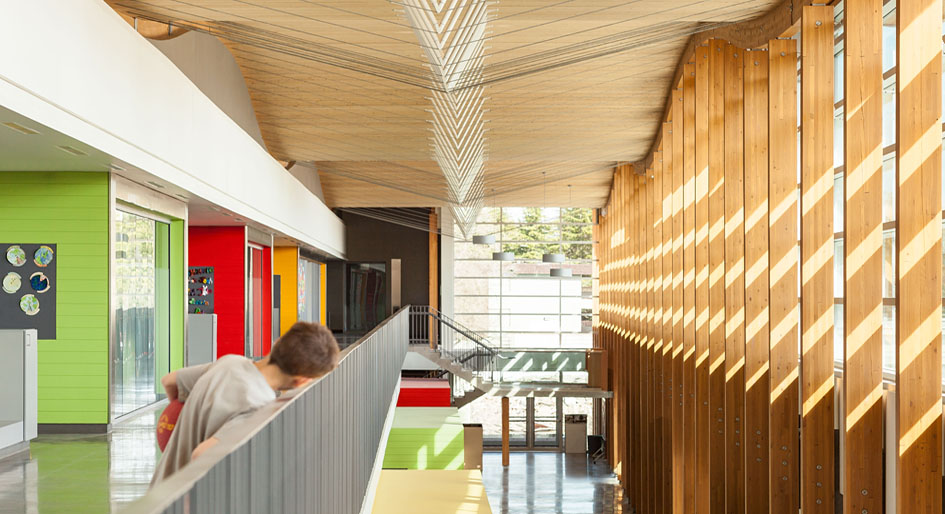
Built over twenty years ago, the Forest Sciences Centre at the University of British Columbia —with its soaring, timber-framed atrium and tree-like wood columns supporting a massive skylight—is the closest thing you’ll find to an indoor forest canopy. David Fell, former research leader at FPInnovations, sees this building designed by DGBK Architects as “the ultimate relaxed environment, where people come from all over the campus to study.”

The popularity of the almost entirely wood space, filled with natural light and finished with Douglas-fir and bigleaf maple veneer, inspired Fell to dig a little deeper. In 2010, he launched a study to investigate the health benefits of wood in the built indoor environment. In the last few decades, studies have shown that exposure to nature can lower blood pressure, heart rate, and stress levels, while cognitive performance, concentration skills, and even creativity are seen to improve. Nonetheless, Canadians spend as little as 6 percent of their time outdoors.

We compensate by bringing plants and greenery into our homes and workplaces. Research reveals that the presence of nature indoors can reduce the human perception of pain, as well as thermal discomfort. For Fell, this measurable influence of natural elements like indoor plants on human well-being suggests that exposed natural wood might also provide the same benefits. “People don’t notice changes in temperature if there are plants in the room,” he says. “If we can prove this for wood in interior applications, it could have profound implications for sustainability by reducing the carbon load of the operation of a building.”

To test the effects of wood and natural materials in the built interior environment, 119 students were assigned to either wood or non-wood rooms.  The researchers continuously monitored heart rate and skin conductivity, which both fluctuated in response to stressful thoughts or stimuli. The study had three distinct time periods.  In the first period students were left alone in the room to measure anxiety or anticipation-type stress reactions.  In the second period students completed a stress-inducing mathematical task to measure their reaction to a direct stressor.  Finally, students spend a third time period in the room alone to observe their stress recovery.wood

Increasingly, education, health-care, and other public buildings incorporate wood for its biophilic benefits, such as Samuel Brighouse Elementary by Perkins and Will located in Richmond.  Photo: Perkins and Will Canada / © Andrew Latreille

The results: students who spent time in rooms featuring natural wood exhibited lower stress reactivity. During all three periods of the study, stress, as measured by sympathetic nervous system activation, was measurably lower on average in the rooms featuring wood than in the non-wood office.

These early results are promising. We’ve long used wood in the interiors of our homes for its warm and calming qualities, and for these same reasons we are increasingly seeing wood used in office, health-care, and retail environments. “Wood is an insulator,” explains Fell. “It feels warm to the touch. This is a prized relationship.”

The precise nature of this relationship is difficult to quantify. “From a psychoevolutionary perspective, there are certain things in nature that gave us an evolutionary advantage,” says Fell. “For most of our evolution, humans have had a close relationship to trees and wood, so it’s only natural that its visible presence has a positive effect on our well-being. This is not a learned reaction,” says Fell, “it is an innate response. We are wired to recognize things in nature that benefit us.”

Fell draws attention to the concept of “biophilia,” which suggests that humans possess an innate tendency to seek connections with nature. “In the early nineties we focused on improving a building’s environmental performance, but we weren’t necessarily always focused on improving the health of its occupants,” says Fell. “These days, the conversation has turned to the health of the occupants, and wood has a really great story to tell.” And while more research is needed, science is beginning to confirm what folk wisdom has taught us—that wood, and nature, is good for our health. Something we’ve intuited since time immemorial.

Articles like this are featured in a newly released book, Naturally Wood, which showcases British Columbia’s sustainable forest management, cutting‐edge wood architecture, design and technologies.

Four continuing education units have been developed based on the book. They are recognized by the Architectural Institute of British Columbia and are available at naturallywood.com/naturally-wood-ceus.

Download the Naturally Wood e-book at naturallywood.com/nwbc.


REMI Network wins 2 Canadian Online Publishing Awards

REMI Network editors captured awards at the 11th annual Canadian Online Publishing Awards (COPA) last night. Silver accolades in the Best Company Feature and Best Branded Content categories make for the third consecutive year the REMI Network has taken home honours from the event, which recognizes editorial and design excellence across Canadian digital publications.

REMI Network has been a COPA award finalist in every year since its 2013 launch, and has previously won the 2017 gold in the Business-to-Business division for Best Website and the 2015 silver for Best News Coverage.

“Once again, it’s an honour not only to be nominated, but to bring home two COPA awards,” says Kevin Brown, president of MediaEdge Communications Inc. “We are proud of our website and the quality content our editors work hard to deliver. Winning these awards is a great way to kick off the new year.”

2019 COPA Awards For 2019, editor-in-chief Barbara Carss received the silver for a feature about Rick Hansen Foundation Accessibility Certification and its potential value for the commercial and multi-residential real estate sectors. This follows silvers for the Best Investigative Series in 2018 and the Best Industry Feature in 2017.


Executive editor Erin Ruddy won the silver for her ongoing RJC series delving into the complex world of structural engineering. She was also a key member of the editorial team contributing to the earlier awards for best website and news coverage.

REMI Network was also a 2019 finalist for the best Business-to-Business website.

Photo: Barbara Carss, editor-in-chief; Erin Ruddy, executive editor; Rick Evangelista, web designer; Rebecca Melnyk, editor. Missing: Cheryl Mah, editor. 

Setting a new standard at Ken Soble Tower

Like many post-war rental apartment towers across Canada, Hamilton’s Ken Soble Tower provides much-needed affordable housing for vulnerable people. But with mechanical systems nearing end of life, inadequate ventilation and other issues, the 50-year old building was in critical need of an upgrade.

So CityHousing Hamilton (the non-profit agency that oversees Hamilton’s affordable housing) commissioned a feasibility study in 2016 to weigh their upgrade options: sell, rebuild, capital repair and rehabilitation or retrofit.

Support and financial incentives
The study revealed that the building was structurally solid but the envelope and HVAC systems were severely distressed. According to the report, the municipality could revitalize the tower for about half the cost of building new. Based on these findings, the project was given the green light in 2018.

As part of the retrofit, the project team leveraged free technical assistance and financial incentives offered by Enbridge Gas’s Savings by Design program. The program is designed to guide, assist and reward project teams to improve energy and environmental performance of buildings in new construction and major renovation projects.

Up to $60,000 value
Savings by Design starts by covering all the costs of an Integrated Design Process (a $30,000 value), bringing together architects, engineers and other decision-makers early in the design stage to explore opportunities to save energy, model energy usage and finalize recommendations for implementation.

Buildings that meet their specific energy performance target are later eligible for performance incentives up to $30,000.

For the Ken Soble Tower, the project team was able to improve on a model than surpassed building code requirements. Among the many improvements they came up with: modernizing the ventilation system with new air handling units and ductwork, installing a centralized HVAC system and adding new overcladding with rock wool insulation, energy-efficient windows and a high-performance rain screen system.

Better comfort and control
Residents of the refurbished tower will enjoy improved comfort and control of their indoor environments, plus dramatically improved building resilience (the ability to withstand extreme climate events).

The project team used 2050 temperature projections to test thermal comfort in all seasons, and in case of system failure, the building will have the capacity to stay warm in winter for up to two days (compared to two hours in a conventional building) and stay cool in summer for up to four days (compared to half a day in a conventional building).

From lackluster to landmark
When complete in 2020, the tower will become a landmark building in Hamilton’s West Harbour waterfront redevelopment, a vibrant new community hub.

And it won’t be a lone example of ultra-low energy use for long: CityHousing Hamilton is also planning to redevelop two 91-unit townhouse complexes and five new buildings to the same ultra-low energy standard.

For more information, visit Enbridge’s website: savingsbydesign.ca.

Project highlights
94% GHG reduction
23.8 kWh/m2/year heating savings
2.4 kWh/m2/year cooling savings
$30,000 design assistance

Article sources:
www.cityhousinghamilton.com/page1.aspx?page=MacNabPropDev&tab=6&menu=672

www.eraarch.ca/project/ken-soble-tower-transformation/

New Vancouver urban park breaks ground

The Smithe & Richards urban park in downtown Vancouver will break ground in January 2020.

The 0.8 acre urban park was designed by Dialog’s planning, landscape architecture, structural engineering, and mechanical engineering teams after extensive public engagement and consultation sessions with area residents. The end result of that community-focused process was a unique, multi-faceted, and artistic oasis in an urban environment.

The sloping site, which is currently being used as a parking lot, is located near Vancouver’s downtown business district and is bordered by high-rise towers.

It will feature three terraced activity spaces and play areas of varying sizes for visitors to enjoy. Stretching over top of the park from the north end to the south is an elevated, zigzagging pedestrian bridge that will allow people to stroll the length of the park and enjoy a different vantage point of the neighbourhood.

The south end of the bridge is cantilevered out over Smithe St., providing an elevated view of this part of the downtown core. Multiple access points will allow people to get on or off the bridge wherever they choose.

There are plans to place hammocks and interactive installations on the underside of the bridge to animate the space. Several large metal sky frames will also be installed over top of the bridge to help illuminate the park at night, and provide options for hanging various art installations.

A café will be located at ground level at the south end of the park, adjacent to the end of the bridge, and will open out into a community plaza area designed for larger public gatherings. The entire park will be filled with extensive plantings with native species; existing mature trees on site will be retained where possible.

Dialog was initially selected to design the park in 2015 and the original concept was approved in 2016. Construction for the park is expected to take approximately one year. Smith Bros. & Wilson (BC) was awarded the contract in December 2019.

Setting a new standard at Ken Soble Tower

Like many post-war rental apartment towers across Canada, Hamilton’s Ken Soble Tower provides much-needed affordable housing for vulnerable people. But with mechanical systems nearing end of life, inadequate ventilation and other issues, the 50-year old building was in critical need of an upgrade.

So CityHousing Hamilton (the non-profit agency that oversees Hamilton’s affordable housing) commissioned a feasibility study in 2016 to weigh their upgrade options: sell, rebuild, capital repair and rehabilitation or retrofit.

Support and financial incentives
The study revealed that the building was structurally solid but the envelope and HVAC systems were severely distressed. According to the report, the municipality could revitalize the tower for about half the cost of building new. Based on these findings, the project was given the green light in 2018.

As part of the retrofit, the project team leveraged free technical assistance and financial incentives offered by Enbridge Gas’s Savings by Design program. The program is designed to guide, assist and reward project teams to improve energy and environmental performance of buildings in new construction and major renovation projects.

Up to $60,000 value
Savings by Design starts by covering all the costs of an Integrated Design Process (a $30,000 value), bringing together architects, engineers and other decision-makers early in the design stage to explore opportunities to save energy, model energy usage and finalize recommendations for implementation.

Buildings that meet their specific energy performance target are later eligible for performance incentives up to $30,000.

For the Ken Soble Tower, the project team was able to improve on a model than surpassed building code requirements. Among the many improvements they came up with: modernizing the ventilation system with new air handling units and ductwork, installing a centralized HVAC system and adding new overcladding with rock wool insulation, energy-efficient windows and a high-performance rain screen system.

Better comfort and control
Residents of the refurbished tower will enjoy improved comfort and control of their indoor environments, plus dramatically improved building resilience (the ability to withstand extreme climate events).

The project team used 2050 temperature projections to test thermal comfort in all seasons, and in case of system failure, the building will have the capacity to stay warm in winter for up to two days (compared to two hours in a conventional building) and stay cool in summer for up to four days (compared to half a day in a conventional building).

From lackluster to landmark
When complete in 2020, the tower will become a landmark building in Hamilton’s West Harbour waterfront redevelopment, a vibrant new community hub.

And it won’t be a lone example of ultra-low energy use for long: CityHousing Hamilton is also planning to redevelop two 91-unit townhouse complexes and five new buildings to the same ultra-low energy standard.

For more information, visit Enbridge’s website: savingsbydesign.ca.

Project highlights
94% GHG reduction
23.8 kWh/m2/year heating savings
2.4 kWh/m2/year cooling savings
$30,000 design assistance

Article sources:
www.cityhousinghamilton.com/page1.aspx?page=MacNabPropDev&tab=6&menu=672

www.eraarch.ca/project/ken-soble-tower-transformation/

Richmond set to build new Canada Line station

The City of Richmond will be getting a new Canada Line station following the transfer of $28 million in developer-supported funds from the city to TransLink.

The Capstan Station will be built in the area of No. 3 Road and Capstan Way in Richmond, between the existing Bridgeport and Aberdeen stations. Its construction results from a 2012 agreement that would see a new station added to the Canada Line to support growing development in the area once funds were raised.

“This is an excellent example of how the City of Richmond works with developers and partners such as TransLink to build strong communities,” said City of Richmond Mayor Malcolm Brodie. “Parks, trails, recreation facilities and even green spaces are often created by developers who are building higher density communities in urban areas. Now, through a shared vision and this precedent-setting agreement, we have an important transit location as well.”

With more than 6,000 residential units being built in and around the Capstan Village area, the community will benefit enormously from the transit access the new Canada Line station will bring, as it will provide an accessible, sustainable mode of travel to support urban lifestyles.

“The Canada Line has been a tremendous success story for this region, with around 90,000 people now using the system each weekday,” said TransLink CEO Kevin Desmond. “Strong ridership growth has spurred on an astonishing amount of property development, so partnering with the City of Richmond and leveraging developer dollars to help fund a new station is an important model for transit infrastructure enhancements.”

Work to explore concept design options for the station commenced in 2017 with the transfer of $1.1 million from the City of Richmond to TransLink. Further work will now be undertaken to finalize the station design. The project is expected to be complete around mid-2022.