





Articles Archive - Page 473 of 928 - REMINET
REMI

Code changes fine-tune Ontario condo soundscape

Requirements for gauging the condo soundscape are evolving in Ontario now that new amendments to the provincial building code have come into force. As of January 1, developers will no longer have to meet a challenging standard for the comprehensibility of voice communications systems, and they can take an alternative approach to calculating sound transmission between dwelling units that’s considered a more accurate evaluation of how sound reaches and affects building occupants.

Code specialists predict the latter amendment, opening up the option for the Apparent Sound Transmission Class (ASTC) rating, will one day become the mandated method. This accounts for what’s known as flanking — sound associated with shared building systems and components, such as ducts and pipes, or anything that might be attached to a partition between rooms or units. For now, though, the incumbent Sound Transmission Class (STC) rating, which is a simpler measurement of a wall, floor or ceiling’s ability to muffle sound, continues to be recognized.

“In future, I think they will want to go totally with the ASTC,” Alek Antoniuk, consulting architect with CodeNews Consulting Corp. and the former manager of code development for Ontario’s Ministry of Municipal Affairs and Housing, recently told seminar attendees at The Buildings Show in Toronto. “It’s more complex than a straight STC, but that’s the way the world is going.”

ASTC debuted in the 2015 edition of Canada’s model national building code. In support, the National Research Council developed a software tool to help builders and designers calculate direct and flanking sound transmission, which is freely available online.

The move to adopt ASTC and a plethora of other amendments into Ontario’s code reflects an ongoing agenda to harmonize the national and provincial codes as much as possible. Still, Ontario’s code has always varied to some extent from the national model and has often been seen as a leader in accepting innovation and/or introducing more stringent performance requirements.

The most recent changes, outlined in a regulation published in May 2019, are in lieu of an expected 2018 edition of the code, which had been prepared but not yet adopted prior to that year’s provincial election. Instead, the new government invoked a host of amendments tallying to 1,220 replacement pages in the 2012 code.

“It practically replaces the whole code, but is still an amendatory code,” Antoniuk said.

An amendment rescinding the requirement that voice communication systems perform at 0.70 on the common intelligibility scale (CIS) responds to widespread failure to meet that score. The benchmark — which equates to the average listener being able to comprehend 80 per cent of words and 95 per cent of sentences delivered through the system — was added to the 2012 Ontario code following its introduction in the 2010 national code.

“It was found to be an unachievable target,” Antoniuk reported.

Future residents of newly constructed condo and apartment buildings may also notice a quieter gush of water from bathroom taps. As of January 1, the maximum flow rate for lavatory faucets in residential occupancies has been reduced from 8.35 to 5.7 litres per minute.

AE appoints new VP transportation

Associated Engineering (AE) has appointed Kent Eklund, P.Eng., MBA, as vice president of transportation. He succeeds Bryan Petzold, P.Eng., MBA, who has retired after more than 14 years with the company.

Eklund will join Alan Emery (senior vice president, transportation) and Don Kennedy (vice president, transportation structures) in leading the overall transportation practice. His responsibilities will include supporting and expanding services in transit systems, transportation planning, traffic engineering, intelligent transportation systems (ITS), and roadways and highways design.

“I look forward to working with our leadership team to realize our vision to deliver creative solutions that connect communities, support economic growth, and help shape a better world for future generations,” said Eklund.

Eklund has almost 30 years of experience specializing in client and project management, planning, public consultation, stakeholder engagement, design, and construction of new, rehabilitation, and maintenance projects ranging up to $1 billion in construction value.

“I’m pleased to welcome Kent to our leadership team. He brings valued expertise in transit systems and transportation planning to our staff and clients across Canada,” said Martin Jobke, president & CEO of the AE group of companies.

Eklund joined the Edmonton office in 2014 where he helped to grow the transportation division, overseeing the delivery of key projects including Edmonton’s Capital Line LRT Extension, St. Albert Transportation master plan, St. Albert Transit Centre and Park & Ride, and Alberta Transportation’s Highway 43 Functional Planning and Design.

Aecon Group awarded three large contracts

Aecon Group has been awarded three contracts, in  Alberta, British Columbia and Ontario, worth an aggregate value of $690 million. Aecon’s share of the projects is valued at $420 million.

In Alberta, SA Energy Group, a 50/50 joint venture between Aecon and Robert B. Somerville Co. Limited, has been awarded a contract by Trans Mountain Corporation to execute pipeline construction on Spread 1 of the Trans Mountain Expansion Project. The scope of work includes construction of 49 kilometres of pipeline around Edmonton.

Construction started in the fourth quarter of 2019 and substantial completion is expected by the end of the third quarter in 2020.

SA Energy Group was also previously selected to execute pipeline construction on Spreads 4B and 6 near Clearwater, Alta. and Chilliwack, B.C.

The British Columbia contract is for the Highway 91/17 Upgrade Project. Pacific Gateway Constructors, a consortium comprised of Ledcor (40 per cent), Aecon (35 per cent) and BEL Contracting (25 per cent), was awarded the highway contract by the British Columbia Ministry of Transportation and Infrastructure for work in Delta.

The scope of work includes the design and construction of improvements to the existing Highway 91 at Nordel interchange, the Highway 91 Connector at Nordel Way, and the Highway 91/17 Connector.

Construction is expected to commence in the first quarter of 2020, with expected completion in 2023.

In Ontario, the firm has also been awarded a contract (100 per cent share) by NOVA Chemicals for the Area 100/200 Mechanical and Piping Installation in the Sarnia-Lambton region. The scope of work includes structural steel erection and piping.

Construction is expected to commence in the first quarter of 2020, with expected completion in the third quarter of 2021.


Floor care tips for the winter

Ice, snow, moisture, mud and ice melts can damage floors if facility managers are not prepared.

Here are several ways to protect floors and ensure safety for building occupants, according to Rick Vanerkoy, president of Secure Clean, a contract building service company in the United States.

Build up the Floor’s Finish

Apply a floor finish. Many managers believe the purpose of a floor finish is to add a shine to the floor. While it will produce a shine, the real purpose of the floor finish is to protect the floor.

Entry Mats

High-quality floor mats should be installed at all building entries. Along with high-quality mats, according to the American Institute of Architects, the length of the mat is key to its effectiveness. For instance, they report:

  •   Five feet of matting captures 33 per cent of debris entering a facility
  •   Ten feet of matting captures 52 per cent
  •   Twenty feet captures 86 per cent
  •   Twenty-five feet captures 100 per cent

“We recommend that our clients install at least 15 to 20 feet of matting at key building entries,” says Vanderkoy.  “Another benefit is that it can help reduce cleaning costs.”

Floor Maintenance

With these steps in place, the most effective ways to protect building floors during the winter months is with proper and effective floor maintenance.

Routine maintenance: The custodial workers should expand their floor cleaning duties during the winter months. Cleaning the lobby floor two or three times during the day, may be necessary.

Interim maintenance: More thorough cleaning calls for auto scrubbers. Just as the name implies, these machines scrub the floor automatically as they are moved over the floor. This step removes larger debris and soils that can harm the floor’s finish, and with it, the floor below.

Restoration: The process involves stripping all the finish off a floor, rinsing the floor, and then applying three or more thin coats of finish to the floor. But, if all the steps mentioned have been implemented, refinishing cycles may be delayed throughout the winter months. Floor care is labour-intensive, costly, not always environmentally friendly and can be disruptive to building users.

Study finds how employers can retain casual workers

Employers who help casual workers find meaning on the job may have an easier time retaining them, according to a new University of Waterloo study.

“Managers can use job enrichment to make work more engaging and to develop a bond between staff and the organization,” says David Drewery, a PhD candidate in Waterloo’s Department of Recreation and Leisure Studies. “Job enrichment aims to design work conditions in ways that maximize meaning, responsibility and knowledge.”

The study surveyed 124 seasonal student workers who had just completed a four-month-long summer job to find out whether they intended to return the following year, and the motivations behind their intentions.

It found that positive feelings about work and a psychological attachment to the organization accounted for a strong desire to return to the job. Both work engagement and organizational commitment were higher when students perceived that their jobs were enriched.

“Commitment was particularly important, which means that simply making work ‘fun’ is not enough to retain staff,” said Drewery. “Staff need to find their work meaningful, and must feel a deep connection to the organization.

“Retaining contingent staff is a key management issue because turnover is very expensive,” Drewery said. “We already know that job enrichment can have great benefits for full-time employees, but this is the first study to show that part-time and casual frontline staff also benefit from job enrichment.”

The research did not study the role of compensation in job retention, but rather other motivations of employees who were at the beginning of their careers.

“These results show that managers need to set clear expectations, remind frontline staff of the positive impact they have on their clients, give staff the tools they need and then trust them to use them appropriately,” said Drewery. “These are the building blocks of job enrichment.”

The study, Retaining contingent frontline staff through job enrichment: the case of seasonal student workers, was authored by David Drewery and published in Managing Sport and Leisure.

Lifetime launches Liberty Market Tower

A 16-year redevelopment project in Toronto’s Liberty Village has entered into its final phase with the launch of Liberty Market Tower condos.

The building will complete Lifetime Developments’ six-acre Liberty Market Complex, which includes Liberty Market Building and Liberty Market Lofts.

The 28-storey tower will feature 281 luxury residential suites and seven floors of commercial space – all with connectivity to the existing Liberty Market Building.

More than 12,000 square feet of indoor and outdoor amenity space make up the eighth floor of the building, featuring a fitness studio, entertaining rooms, business centre, outdoor dining and views overlooking both south of the city and Lake Ontario.

Multidisciplinary artist Anthony Ricciardi has been commissioned to create murals and sculptures that will be integrated within the communal living environments.

Canada’s top cities for bed bugs in 2019

Larger cities and travel centres saw significant bed bug sightings in 2019, according to Orkin Canada’s third annual list of top bed bug cities.

Infestations were prevalent across the country, from federal buildings to private homes. Orkin reports in the past twenty years the pests have gone from a rarely experienced irritant to a major problem, thriving in both clean and dirty homes.

The findings are based on the number of commercial and residential bed bug treatments carried out by the company between the period of January 1 – December 31, 2019.

This year’s top ten bed bug cities are:

  1. Toronto
  2. Winnipeg
  3. Vancouver
  4. St. John’s
  5. Ottawa
  6. Scarborough
  7. Halifax
  8. Oshawa
  9. Sudbury
  10. Hamilton

Bed bugs can be identified by noticing tiny dark coloured stains, cast skins or live bugs. The most effective places to look for bed bugs is on mattress tags and seams, under seat cushions, behind headboards, creases of drawers, buckling wallpaper and carpets.

Careful examination of bags and clothing, drying potentially infested bed linens or clothing on the highest heat setting and inspecting all second-hand furniture before bringing it into your home are ways to prevent hitchhiking bed bugs.

Building on the desire for a better country

The buildings and design sectors are again represented in the newest slate of members of the Order of Canada. Governor General Julie Payette released the list of 120 honourees in late December, including: developer, Mitchell Cohen; urban planner and theorist, Ken Greenberg; and architectural glass artist, Sarah Hall.

“The Order honours people whose service shapes our society, whose innovations ignite our imaginations, and whose compassion unites our communities,” the announcement affirms.

Cohen, president of the Toronto-based development firm, The Daniels Corporation, is cited “for his contribution to urban development and commitment to community building.” During his 35-year tenure with the full-service firm, which designs, builds and manages residential and commercial projects, he has been an advocate for affordable ownership housing, a proponent of development that integrates with the existing community while supporting economic growth, and a supporter of local enterprise, non-profit organizations and charities.

Among its noted cultural projects, Daniels developed the TIFF Bell Lightbox, accommodating the headquarters of the Toronto International Film Festival, and Daniels Spectrum, a 60,000-square-foot arts and community venue in Toronto’s Regent Park neighbourhood. Earlier in 2019, the company received the Ernest Assaly Award from the provincial new homeowners’ warranty agency, Tarion. In 2018, it won BILD (Building Industry and Land Development Association) GTA’s Stephen Dupuis Humanitarian Award, which recognizes philanthropy and community involvement.

Greenberg, principal of Greenberg Consultants, is cited “for leading large-scale projects in various cities across Canada and as an urban designer, teacher, writer and environmental advocate.” In a career spanning more than 40 years, he has served as the City of Toronto’s Director of Urban Design and Architecture and was a founding partner of the renowned planning consultancy, Berridge, Lewinberg, Greenberg Ltd, later renamed Urban Strategies.

His expertise and accomplishments in the revitalization of downtowns, waterfronts and neighbourhoods, and planning new communities and campuses, are anchored in a strategic, consensus-building approach to growth and urban design. An advocate of sustainability, affordability and walkability, he is the co-founder and vice chair of Ryerson University’s City Building Institute and author of two recent books: Walking Home, the Life and Lessons of a City Builder; and Toronto Reborn, Design Successes and Challenges.

Hall, principal of Sarah Hall Studio, is cited “for her contributions as an architectural glass artist and her innovations in glass production.” Based in Ontario’s Prince Edward County, she has designed large-scale art glass and solar projects for a worldwide list of clients including embassies, cathedrals, schools, colleges and universities.

She has been an innovator of building integrated photovoltaic (BIPV) solar art glass — striking examples of which can be found in Cathedral of the Holy Family in Saskatoon, the wind tower at the Regent College library in Vancouver and the Harbourfront Centre Theatre in Toronto — and bird-friendly glass. Her work will be featured as part of the Public Art in Glass exhibition, January 11 to March 22, at the Canadian Clay and Glass Gallery in Waterloo, Ontario.

The newly named Order of Canada appointees will be invested at a ceremony at Rideau Hall later this year, where they will receive the distinctive six-point insignia bearing the inscription, Desiderantes Meliorem Patriam. The Order’s motto translates to: They desire a better country.

U of T unveils plans for new graduate residence

The University of Toronto (U of T) has unveiled plans for a 10-storey residence building on Harbord Street that would provide housing for more than 200 graduate students and expand living, social and study spaces on the St. George campus.

With a brick exterior and unique window cutouts, the proposed Harbord Residence envisions a mix of dormitory-style and single-occupancy rooms that would help meet the rapidly growing demand for graduate student housing options.

The proposed residence would also feature a bridge connecting it to neighbouring Graduate House, with the two buildings sharing amenities including an event space, food court, lounges and study rooms.

The project is being designed by Los Angeles-based Michael Maltzan Architecture and would be executed with Toronto’s architectsAlliance.

Anne Macdonald, U of T’s assistant vice-president of ancillary services, said the proposed building would be a welcome addition to campus since current demand for graduate student housing is more than double the number of available spaces.

The upper levels of the proposed building would consist of residential space and smaller lounge spaces for the exclusive use of residents of both Harbord Residence and Graduate House.

The second and third floors would host common lounges, meeting spaces, residence life offices and quiet study rooms. And the ground floor would accommodate a food court and retail space, acting as the interface between the building and the surrounding Huron-Sussex neighbourhood.

“One of the things we wanted the architect to do for us was to have the ground plane be a more welcoming place for the broader community – for our neighbours and other U of T community members to come in,” said Macdonald. “As you go up the building, there are different levels of community-building, with shared spaces and private spaces upstairs.”

The design of study spaces in the building would take into account students’ evolving study habits, with an increased emphasis on rooms that facilitate group work.

The proposal, anticipated to enter the university’s governance process in 2020, follows last year’s announcement of an agreement to build a 23-storey resdience tower at the corner of Spadina and Sussex Avenues. That building, which will house more than 500 students, is expected to be completed in 2021.

Canadian universities rank high for sustainability

Some Canadian universities are celebrating their recent standings in the 2019 UI GreenMetric World University Rankings, which measure campus sustainability around the globe.

University of Sherbrooke once again retained the top spot in Canada and ranked 22nd in the world among 780 post-secondary institutions that took part. The school was previously praised for energy and climate change management and its many ongoing initiatives, like its solar park, to reduce greenhouse gas emissions.

Second in Canada is Carleton University, which placed 35th in the world – as well as first in Ontario. The university has been undergoing many environmental and sustainable improvements with its operations and research, such as upgrading its co-generation facility to lower demand on the local hydro grid and its innovative food court recycling program.

Carleton created recycling stations and realigned consumer packaging with less wasteful material, resulting in a waste diversion rate of 90 per cent, up from 12 per cent, in less than a year.

Another initiative there is the Advanced Research and Innovation in Smart Environments (ARISE) Building, specifically designed for multidisciplinary research partnerships with governments and the private sector. ARISE will be the headquarters of Carleton-led national networks such as the new Canadian Permafrost Research Network, the recently launched Canadian Accessibly Network, and Efficiency Canada — a national voice for energy efficiency advocacy.

Universities participating in the world ranking were evaluated on six indicators: setting and infrastructure, energy and climate change, waste management, water, transportation and education.

Also ranking in the top five in Canada were McMaster University in 51st place globally, York University in 62nd and Trent University following in 66th place.

Average rents in Canada expected to rise 3 per cent

After two years of unprecedented rent growth, real estate analysts are predicting that average rents in Canada will continue to increase in 2020 despite an increase in purpose-built rental construction and legislative changes impacting development.

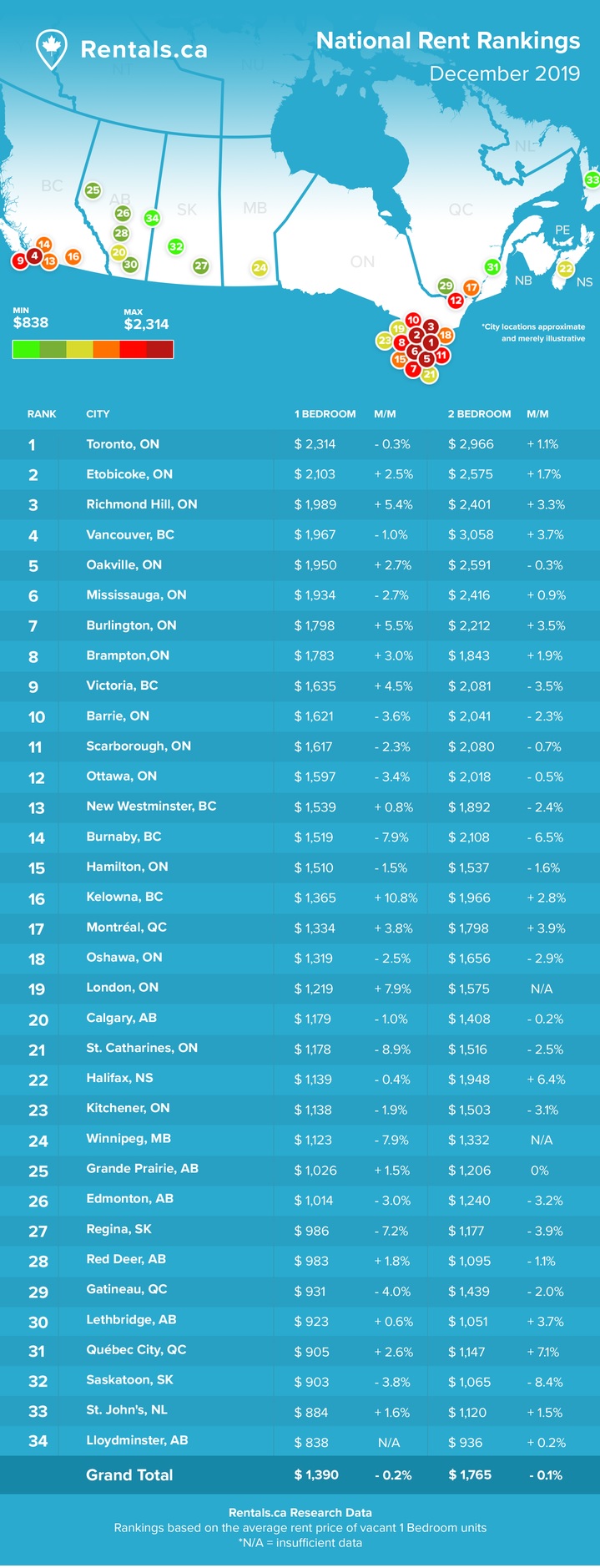
In the December National Rent Report, Rentals.ca and Bullpen Research & Consulting are forecasting that average monthly rents in Canada will increase by 3 per cent, with some cities experiencing more significant hikes.

Specifically, Toronto will see rents potentially rise by 7 per cent; Montreal by 5 per cent; Ottawa by 4 per cent; Vancouver by 3 per cent; while Calgary and Edmonton will likely see a small decline of 1 per cent.

Average rents in Canada: 2019

According to Rentals.ca listings data, the average rent for Canadian properties in November was $1,918 per month — representing a decrease of 1.1 per cent monthly, but an increase of 9.4 annually. Toronto remains the priciest city for renters for a one-bedroom home with average monthly rents coming in at $2,314, while Vancouver has the most expensive average monthly rents for a two-bedroom topping the $3,000 mark at $3,058.

The impact of the changes to the mortgage stress test have started to fade as developers and investors look to increase rental supply to offset the increase in rental demand brought on by the decrease in mortgage credit and the recent spike in population.

“After years of focusing on the ownership housing market, the media has focused more attention on the rental market as the mortgage stress test, expanded rent control, changing AirBnB legislation, rapid population growth, and record rental housing construction continues to disrupt the balance between supply and demand nationally,” said Ben Myers, president of Bullpen Research & Consulting. “We expect the market to continue to be undersupplied overall in Canada in 2020.”

At the end of the third quarter, the Canada Mortgage & Housing Corporation reported almost 72,000 rental units were under construction throughout Canada, the highest rate the country has seen in over 30 years.

Rentals.ca data indicates that Hamilton and Scarborough top the list of municipalities in need of additional rental supply with year-over-year rent growth of 25 per cent and 23 per cent respectively. Meanwhile, two of Canada’s most affordable rental markets—Quebec City and Winnipeg—have also experienced significant jumps in year-over-year rent to the tune of 22 and 21 per cent.

On the other extreme, municipalities in Alberta and Saskatchewan, including Red Deer, Calgary, Regina, Saskatoon, Edmonton and Fort McMurray, are seeing average rents for apartments decline from November 2018 to November 2019. The declines ranged from -1 per cent to -7 per cent annually.

Provincial data

On a provincial level, Ontario had the highest rental rates in November, with landlords seeking $2,339 per month on average (all property types), up from $2,334 in October, and 9.1 per cent annually from $2,144 in November of 2018.

In Saskatchewan, the average monthly rent declined 9.7 per cent annually, while average rents in Alberta are down 3 per cent.

“After two years of unprecedented rent growth, which included several markets where average rents increased by 20 per cent or more, we do expect some moderation in 2020,” noted Matt Danison, CEO of Rentals.ca. “There should be some supply relief in the Greater Toronto Area in 2020, but Rentals.ca and Bullpen expected average rental rates for all property types in Toronto and Mississauga to increase by 7 per cent to 8 per cent next year.”

One continuing trend seems to be that developers are looking to cater to more affluent renters, including those shut out of the ownership market by increasing prices, younger renters choosing to be tenants for lifestyle reasons, and boomers and empty-nesters trading down from a larger dwelling.

Here is a detailed breakdown of average rents in Canada for December 2019:

December 2019 Rentals.ca

New residential lands pegged for Vaughan Metropolitan Centre area

SmartCentres and Penguin, owned by Mitchell Goldhar, have teamed up on a 15.48-acre site next to the Vaughan Metropolitan Centre.

The joint venture will also relocate an existing Walmart, which will open up land near the VMC, close to the TTC VMC University line and York Region Bus Terminal.

Once the old Walmart moves in 2020, SmartCentres will redevelop the land for mixed-use density creating space for at least six more residential condos and/or purpose-built rental towers. This move will also provide lands needed to complete the 55-storey Transit City 1 and Transit City 2 condominium towers and the 225,000-square-foot, mixed-use tower that now houses PwC’s new offices.

The total mixed-use density available from the old Walmart store lands is expected to exceed 4.5 million square feet.

“We see this as a tremendous opportunity to unlock significant value for us on the lands beside the VMC subway station,” said SmartCentres President and CEO Peter Forde. “At the same time, we are able to provide Walmart with a new prototype store with great visibility, highway and transit access and proximity to this urban centre of Vaughan and provide convenient access to food and general merchandise to this new community, which is expected to have an additional 40,000 to 50,000 residents when complete.”

USask scientists find potential toxicity of LCDs

A team of toxicologists at the University of Saskatchewan have discovered that chemicals used in smartphone, television and computer displays are potentially toxic and were found in several samples of household dust.

The international research team, led by USask environmental toxicologist John Giesy, is raising awareness about liquid crystal monomers—the chemical building blocks of everything from flat screen TVs to solar panels—and the potential threat they pose to humans and the environment.

“These chemicals are semi-liquid and can get into the environment at any time during manufacturing and recycling, and they are vaporized during burning,” said Giesy, Canada Research Chair in Environmental Toxicology at USask. “Now we also know that these chemicals are being released by products just by using them. We don’t know yet whether this a problem, but we do know that people are being exposed, and these chemicals have the potential to cause adverse effects.”

Published in Proceedings of the National Academy of Sciences on December 9, 2019. Giesy’s research team assembled and analyzed a comprehensive list of 362 commonly used liquid crystal monomers gathered from 10 different industries and examined each chemical for its potential toxicity.

The team also further tested the toxicity of monomers commonly found in six frequently used smartphone models.

The researchers found the specific monomers isolated from the smartphones were potentially hazardous to animals and the environment. In lab testing, the chemicals were found to have properties known to inhibit animals’ ability to digest nutrients and to disrupt the proper functioning of the gallbladder and thyroid—similar to dioxins and flame retardants which are known to cause toxic effects in humans and wildlife.

To understand how common these monomers are in the environment, researchers tested dust gathered from seven different buildings in China—a canteen, student dormitory, teaching building, hotel, personal residence, lab, and electronics repair facility. Nearly half of the 53 samples tested positive for the liquid crystal monomers.

“Ours is the first paper to list all of the liquid crystal monomers in use and assess their potential to be released and cause toxic effects,” said Giesy. “We looked at over 300 different chemicals and found that nearly 100 have significant potential to cause toxicity.”

Ninety per cent of the monomers tested had concerning chemical properties. They either accumulate in organisms, resist degradation in the environment, or are easily transported long distances in the atmosphere. Nearly one quarter of the chemicals tested had all three troubling characteristics.

“There are currently no standards for quantifying these chemicals, and no regulatory standards,” said Giesy. “We are at ground zero.”

LCD panels are almost exclusively produced in three Asian countries: China, Japan, and South Korea. It’s estimated that 198 million square metres of liquid crystal display were produced last year—enough to cover the entire Caribbean island of Aruba. For many years, huge amounts of globally produced e-waste—including LCD displays—have been dismantled, disposed of, and introduced into the environment.

“Right now, there are no measurements of these monomers in surface waters. Our next steps are to understand the fate and effect of these chemicals in the environment,” added Giesy.


Morguard expands presence in Chicago, Illinois

Morguard North American Residential REIT announced it has completed the acquisition of the luxury residential complex, the Marquee at Block 37, located in Chicago, Illinois.

The REIT has acquired the remaining 51 per cent from Morguard’s investment partner with whom the property was developed in 2016. Morguard Corporation will now operate the property on a 50/50 joint venture basis with the REIT.

The contemporary high-rise apartment building features studio, convertible, 1, 2 and 3-bedroom apartment homes. Each suite features upscale finishes, natural light spaces and unique lake and city views right from the heart of the Loop. The superb downtown location at Block 37 offers tenants instant access to a variety of retailers, restaurants and theatres.

Concurrent with the acquisition, the REIT and Morguard completed a mortgage financing on the property in the amount of US$165.0 million for a 10-year term at an interest rate of 3.27 per cent.

As both owner and manager of the 1,953 apartment suites, the acquisition represents a significant expansion of Morguard’s footprint in the Chicago area. In addition to the Marquee at Block 37, other high-rise multi-suite residential assets in the city include: Alta at K Station and Coast at Lakeshore East, also located in the Loop area.

For more information, visit morguard.com

Fraser Crossing Partners selected for Pattullo Bridge

Fraser Crossing Partners has been selected as the preferred proponent for the Pattullo Bridge Replacement Project in B.C.

The construction team, headed by Aecon and Acciona, and the province are currently undergoing final negotiations for the contract to design and build the new bridge, provide partial financing during construction and demolish the existing bridge.

The contract award is anticipated for early 2020. The project will be delivered under the province’s controversial Community Benefits Agreement (CBA).

“Aecon looks forward to playing an important role in connecting the communities of New Westminster, Surrey and the surrounding area,” said Jean-Louis Servranckx, president and Chief Executive Officer, Aecon Group Inc. “This selection illustrates Aecon’s recognized reputation as a partner-of-choice for large-scale, critical infrastructure projects and further expands our solid, diverse presence in Western Canada.”

The new Pattullo Bridge, a four-lane, toll-free crossing that will replace the existing Pattullo Bridge, connects Surrey and New Westminster, B.C. The new bridge will provide important improvements including:

  • A safer crossing for all bridge users with modern, wider lanes, separated by a centre median barrier
  • Dedicated walking and cycling lanes, separated from traffic by a barrier on both sides of the bridge
  • Better connections to, from and near the bridge.

The project, for which the RFP was released earlier this year, shortlisted three teams for the bridge replacement: Fraser Community Connectors, Flatiron/Dragados/Carlson Pattullo JV and Fraser Crossing Partners.

The $1.4 billion Pattullo Bridge Replacement Project is scheduled to open in 2023. Once the new bridge is open, the existing bridge will be removed. Pre-construction work will start in the coming months.

Lynn Hughes named partner at SSDG Interiors

Long-time associate Lynn Hughes has been named the newest partner at SSDG Interiors, one of Vancouver’s largest interior design firms, effective April 1, 2019.

Continuing the SSDG legacy has always been important to the leaders of the company, and they are proud to announce this next transition in the succession plan. Hughes will join SSDG Interiors’ leadership team which has three other partners including Julie Campbell, Susan Steeves and Kenna Manley.

Hughes has been with SSDG for more than a decade, starting as a student and quickly growing to the talented designer and strong leader she is today. She has a strong background leading large complex projects, as well as, internal initiatives relating to standards, process and protocols. Her skill set will complement the leadership team well, ensuring SSDG continues to grow and prosper for years to come.

“Being a partner brings big responsibility both carrying on the legacy of the company, as well as providing strong leadership for SSDG and we have the upmost confidence that Lynn has the experience, determination and motivation to succeed,” said SSDG partner Campbell.  “She loves teamwork and collaboration, has a strong desire to learn and grow, and is very focused on understanding the goals and gaining the trust of her clients.”

Partner Steeves added, “It’s exciting to be part of a company that has evolved and thrived for more than 40 years. Lynn knows us as partners and as a company. Her passion to retain the company’s reputation for quality and design excellence and genuine care for co-workers and clients will make this transition seamless for our clients and partners.”

Construction of unique childcare centres underway

Construction is underway for two childcare centres in Vancouver on the rooftops of Gastown parkades, which will provide 74 much-needed childcare spaces.

The innovative developments will increase the number of quality childcare spaces serving the downtown and Downtown Eastside areas.

The city will own and maintain the two centres, with the YMCA of Greater Vancouver appointed as the non-profit operator. The city will lease the centres to the YMCA at a nominal rate to support sustainable operations and to support affordability for families.

“Due to the increased shortage of viable childcare sites in the downtown Vancouver area, we need to capitalize on existing city-owned land and infrastructure to provide new facilities for children to learn and play,” said Mayor Kennedy Stewart. “The creation of child care facilities on these two Gastown parkade rooftops is a great example of how the city and province are collaborating to take an innovative approach to increasing access to childcare spaces for Vancouver families.”

Located at 150 Water Street and 151 West Cordova Street, the two single-storey centres will provide 37 childcare spaces each, with combined areas of approximately 10,000 sq. ft of indoor space and 11,000 sq. ft of outdoor space, connected by pathways and a footbridge.

The centres are designed to achieve LEED Gold certification and Passive House Standard Certification with a focus on net zero energy and low carbon systems. In addition to energy efficiency this design promotes healthy indoor environment and occupant comfort. Photovoltaic panels will be incorporated into the project in response to the zero emissions policy.

The construction of the two centres is estimated to cost around $17 million, which is being funded through Community Amenity Contributions (CACs) from developers such as Bosa Development and Westbank, and $1 million Major Capital Grant from the Province of BC and the Union of BC Municipalities.

The cost of this project is unique compared to other centres due to the additional construction requirements needed to build on a parkade rooftop, as well as Passive House requirements.  Construction at the parkade location is made possible by the City of Vancouver’s Property Endowment Fund.
