Articles Archive - Page 471 of 928 - REMINET
REMI

Licenses needed for short-term rentals in Vaughan

The City of Vaughan is regulating its short-term rental market after a bunch of public consultations that started in 2018.

Homeowners, tenants and lessees can now offer short-term rentals (no more than 29 consecutive nights) as long as a license is obtained. Business, such as Airbnb and Expedia, must also apply for a license and renew it every year.

Before sending in an application, necessary documents and a fee, owners must first register for a Municipal Accommodation Tax number. Application forms and user guides are available online and at the By-law and Compliance, Licensing and Permit Services counter at Vaughan City Hall.

Once a license is obtained, a number of rules must be followed, such as making sure the home complies, at all times, with the Ontario Building Code and Ontario Fire Code, including maximum occupancy.

Visit vaughan.ca/ShortTermRentals for more information.

Halifax Stanfield prioritizes accessibility

Halifax Stanfield International Airport has attained a Certified Gold rating through Rick Hansen Foundation Accessibility Certification (RHFAC), making it Nova Scotia’s first Certified Gold facility. This complements ongoing investments in modernization at Atlantic Canada’s busiest airport, which serves more than 4.3 million passengers annually.

“Last year, we engaged a Rick Hansen Foundation Accessibility Certification Professional to rate our facility and reaffirm our commitment to accessibility and inclusion,” says Joyce Carter, president and chief executive officer of the Halifax International Airport Authority. “We’re all very proud of this milestone.”

The Gold rating arises from accessibility features such as:

  • Customer care program (The Stanfield Way) that emphasizes supporting passenger needs;
  • Volunteer programs focused on a positive passenger experience (Tartan Team, St. John Ambulance Therapy Dogs);
  • Autism Aviators, a program that gives individuals on the Autism Spectrum a chance to experience the airport first-hand;
  • Versatile seating areas offering numerous options;
  • Parkade facility with colour-coordinated parking and easy-to-use parking machine payments;
  • Ample accessible parking in all parking lots, including the parkade;
  • Covered, well-lit pedway connecting the parkade and terminal building;
  • Pet relief areas for assistance animals;
  • Clearly marked signage and wayfinding;
  • Automated doors at all entrances and throughout the terminal;
  • Automated External Defibrillators (AEDs) and emergency phones throughout the terminal building; and,
  • Universal washrooms with accessible features such as emergency call systems

“With record numbers of passengers travelling through Canada’s airports, it’s critical that we create a country where everyone can go everywhere,” asserts Rick Hansen, founder of the Rick Hansen Foundation. “Many congratulations to Halifax Stanfield International Airport. I hope your leadership inspires others across Canada to innovate and become more accessible so everyone can fully participate in society.”

Photo: Kevin Murphy, MLA & Speaker, Nova Scotia House of Assembly; Joyce Carter, president & CEO, Halifax International Airport Authority; Sarah McCarthy, vice president, Rick Hansen Foundation; Ross Sampson, RHFAC professional. Photo by @RileySmithPhoto.

GTA condo market tightens since 2018

Tighter condo market conditions were reported over the past year, with new condo listings diving by 11.9 per cent at the end 2019, compared to Q4 2018, says the Toronto Real Estate Board (TREB)

As for sales, GTA realtors accounted for 5,367 condo sales, up 3.8 per cent.

“Condominium apartments provide a relatively affordable entry point into the home ownership market for first-time buyers, who account for a substantial portion of demand each year,” noted Toronto Real Estate Board President Michael Collins.

Strong growth was also reported in average price, which stands at $616,591, an almost $60,000 difference compared to the end of 2018.  Year-over-year price growth in Toronto, which accounted for 71 per cent of transactions, was similar to the GTA as whole, at 10.3 per cent, resulting in an average price of $660,379.

“Tighter market conditions in the GTA condo market translated into increased competition between buyers and an accelerated pace of price growth,” said Jason Mercer, TREB’s chief market analyst. “TREB continues to urge policy makers to develop strategies to bring more ownership and rental supply online, so that balanced market conditions and a moderate pace of price growth can be sustained over the long term,”

Free program helps BC landlords save energy, water and money

As CEO of Gateway Property Management, Scott Ullrich is responsible for managing a diverse portfolio of rental apartment buildings in BC. Like most property managers, he knows maintenance, controlling operating costs and keeping clients and tenants happy are cornerstones of the business.

So when he heard about FortisBC’s Rental Apartment Efficiency Program, he recognized how it could help Gateway with those ongoing challenges, and at no cost. The program offers landlords and property managers of apartment buildings with nine or more units in BC an energy assessment of their building conducted by a professional consultant and free installation of water-efficient showerheads and faucet aerators in each unit. Buildings in FortisBC’s electricity service area in the Southern Interior can also get up to 10 LED light bulbs installed in each rental unit.

The program helps owners of rental apartment buildings—which are often older and less energy efficient—save water and energy. More than 40 Gateway buildings have already received energy assessments and had old fixtures replaced with free upgrades. Ullrich reported that residents particularly like the new showerheads, which have pressure-compensating technology that saves water while offering good water pressure.

“Our residents were quite happy with the water and the new fixtures. Our clients were exceptionally happy about the cost benefits of their energy savings and their water consumption,” said Ullrich. He has already signed up more Gateway buildings to participate in the program.

The on-site energy assessment helps identify further energy-efficiency improvements that could be made, and property managers and building owners can access continued support and rebates from FortisBC. “The program allowed us to make energy-efficiency improvements much sooner than would have happened otherwise,” said Ullrich. “We were also able to have larger upgrades of our boilers and water heating systems. We received support from start to finish, from the team at FortisBC, and the contractors.”

It’s easy to get started

Join Gateway Property Management, along with hundreds of other rental apartment buildings in B.C., in saving energy, water and money with the Rental Apartment Efficiency Program. Watch the short video at fortisbc.com/landlord to learn more and get full details on eligibility criteria and program terms and conditions.

Special sign-up bonus offer

If you’re a landlord or property manager, apply before February 15, 2020, and receive a $100 Amazon® gift card for each apartment building you sign up for the program.

For more information, call 1-877-327-6137 or email [email protected].


Electronic voting still met with resistance

Opponents of electronic voting are scared. They’re scared electronic voting is going to expose the archaic and flawed system of proxy voting for what it is: unnecessary and obsolete.

They’re also scared because they know that it is largely through proxy voting that some people have been able to maintain and secure their positions for extended periods, giving them years – sometimes decades – of unchallenged control and all the benefits that come with it. So, while the rest of the world has already adopted electronic voting or is moving quickly to embrace it, we see self-interested pockets of resistance in Canada trying to hang on to the status quo.

The first telling observation is that these pockets of resistance are not condominium owners themselves. If that strikes you as strange, it should. Ask any owner who has used electronic voting, and they will tell you the inescapable truth – they love it. They get to cast their own vote, using an encrypted email link that connects with a secure online voting site. They vote at their convenience and in private. Furthermore, they participate in the voting process and express their personal preferences, which are free from the self-interested influence or interference of others.

None of this should come as any surprise. Owners are no different than any other consumer; they expect the same seamless and easy-to-use digital experience in their condo living as they experience in all other areas of their life. So the very notion that an owner should need to use a proxy – whether electronic or paper – to give someone else the right to cast their vote in this day and age of the internet must seem like a quaint holdover from the Victorian era.

Putting proxies in the past

It’s easy to see why electronic voting is now the norm in over half the states in the U.S. and spreading rapidly. It’s also easy to see why some states, like Arizona and Florida, have passed legislation which prohibits proxy voting, and other states are in the process of doing the same (more on that in a moment).

Condominium owners are not the only ones who love electronic voting. High-performing condo directors, boards, and managers who are motivated by the best interests of their unit owners also love it. Electronic voting dramatically increases unit owner participation, frequently, up to levels of 90 per cent or more. Unit owners engage in the voting process and express their opinion because it’s easy to do. Just one “click” and they’ve voted. Boards have clear mandates as a result.

The increased participation also ensures that quorum is easily obtained weeks, and at least days, in advance of a meeting. Electronic voting translates into owner participation, which itself translates into accountability. High-performing condo directors, boards, and managers welcome this kind of accountability as it means affirmation and recognition of a job well done. It’s only poor performers, or those taking advantage of their position for personal gain or conducting themselves inappropriately, who fear the loss of control that occurs when electronic voting makes proxies irrelevant.

Looking stateside

It’s worthwhile to look south of our border at Arizona, Florida, and the US experience, where electronic voting is steadily leading to the extinction of the proxy. Arizona, the sunny retirement state with one of the highest densities of condominiums in the US, prohibits proxy voting after the developer’s control of the condominium has ended (which is to say, for most of the condominium’s life).

Similarly, Florida, another high-density condominium state, prohibits proxy voting for the election of directors. Illinois provides that once a condominium adopts electronic voting rules and regulations, proxy voting is no longer allowed for board elections. Lastly, New Jersey recently allowed condos to use electronic voting and, at the same time, passed a law that prohibits condos from offering proxies to owners unless they also allow owners to cast absentee ballots, effectively rendering proxies meaningless.

Why are these states passing laws to prohibit or severely curtail the use of proxies? The answer is simple: experience has shown that proxies may entrench incumbent directors to the detriment of the condominium. It concentrates power and decision-making in the hands of a few, resulting in low director turnover, minimal accountability, and conflicts of interest that favour the few at the expense of the many.

The danger lurking in proxies is such that US states are now discussing whether the ban on proxies should be extended from the election of directors to include votes of any type the condominium conducts. There’s a reason proxies have been banned in political elections in most advanced democracies; that is, if the goal is to ensure the integrity of the electoral process, allowing someone else to vote on your behalf makes no sense.

Canadian perspective

Canadians have historically been slow adopters. That’s not a bad thing. We are cautious by nature, we encourage consultation, and we seek consensus – all of which takes time. In the case of electronic voting, its widespread acceptance is inevitable, and for all the right reasons. It’s a matter of “when” not “if”.

Those seeking to resist the tides of change and hang on to the antiquated and inherently flawed system of proxy voting, whether by electronic or paper means, may have their own self-interested reasons for doing so. At some point, however, they’ll be forced to concede that electronic voting is both the present and the future, and in the best interests of the unit owners they serve.

Denise Lash is the founder and principal of Lash Condo Law (www.lashcondolaw.com). She is also the entrepreneur behind CondoVoter, in partnership with Vote HOA Now.


Revitalized Biosciences Complex opens at UBC

The second phase of the Undergraduate Biosciences Complex at UBC has opened. The new wing and renovation, designed by Diamond Schmitt Architects with HDR Inc., enhances interdisciplinary learning for a wide range of bioscience disciplines in light-filled spaces around a transformed quadrangle.

With state-of-the-art teaching and research laboratories and versatile, active learning environments for 2,000 students, the design unifies the complex while clarifying circulation and accessibility with two existing wings. Gains in energy efficiency now position the Biosciences Complex – located at the most prominent intersection at the centre of campus – on track for LEED Gold certification.

“Sustainable initiatives informed our design to create a highly functional and aesthetic environment for the Biosciences Complex, inspired by connections to nature and connections with the campus to reinforce the significant role of this facility at UBC,” said Donald Schmitt, principal, Diamond Schmitt Architects.

A gateway to the quadrangle features a fully glazed cantilevered lounge perched above the main northwest entrance that creates a welcoming arrival point beneath a sheltered wood soffit connecting into the courtyard, which was enlarged by the demolition of the Centre Wing, built in 1948. New landscape and hardscape energize this outdoor space and create a living laboratory for social, education and research activities.

“The Biosciences Courtyard is designed as an outdoor teaching platform that includes both indigenous plants and plant collections of the Biology department and strengthen UBC’s commitment to create a Campus as Living Laboratory,” said Peggy Theodore, principal, Diamond Schmitt Architects.

The new four-storey East Wing and renovations to the 40-year-old North Wing complete the quadrangle formed with the West and South Wings, which were renewed in 2011. The new student labs feature custom casework and robust ventilation systems while classrooms, offices and informal spaces achieve thermal comfort through a variety of energy-efficient means.

Biophilic design features inspired by the biosciences program include frit patterns on glazing modelled on a stem cell image and details found in nature, such as the patterns on dragonfly wings.

The reimagined and reconfigured complex “will further enable UBC to attract leading life sciences researchers and ensure our students are inspired to innovate and discover in exceptional learning facilities,” said Santa J. Ono, president and vice chancellor, UBC.

CapriCMW Insurance expands into the Yukon

CapriCMW Insurance Services Ltd., one of Western Canada’s leading independent insurance brokerages, announced its expansion into the Yukon Territory with the acquisition of a new office located at 201 – 9016 Quartz Road in Whitehorse.

As part of this acquisition from Aon Reed Stenhouse Inc., this longstanding office with its experienced team of insurance professionals will begin operating as CapriCMW effective March 2, 2020. It is CapriCMW’s 15th location in Canada and its first outside of B.C. and Ontario.

“We are thrilled to be welcoming Greg and Dayna Woodford and the Whitehorse team to the CapriCMW family,” said Andrew Kemp, president of CapriCMW. “They bring substantial industry and regional expertise that will help us deliver even more value to our clients, employees, industry partners and communities.”

There will be no change to the day-to-day operations of the Whitehorse office. Clients can expect the same direct, personal service from the same dedicated staff. Service will not be disrupted and existing processes will not change.

This development is another step for CapriCMW towards achieving more scale and capabilities, to better serve their clients’ insurance and risk management needs nationwide, and further reinforce their position as one of the largest independent insurance brokerages in Western Canada.

With more than 400 professionals in offices across Western Canada and Ontario, CapriCMW offers a wide range of professional expertise spanning a multitude of industries, products and services.

How to make laundry practices more eco-friendly

Doing laundry is a necessity for most cleaning businesses but washing and drying reusable tools like cloths and towels has environmental drawbacks. It takes a lot of resources to get linens clean, from the water and power used to the harmful chemicals in detergents. Here, Mike Ferrand of Hydrofinity, developer of water-saving commercial laundry solutions for hotels and commercial laundries, discusses how businesses can make their laundry practices more sustainable and reap the associated benefits.

What is laundry sustainability?

Sustainable laundry is not simply using cold water in wash cycles or low heat when drying. It isn’t hotels asking guests to re-use towels or commercial launderers switching to an eco-friendly detergent. For businesses with laundry operations, sustainability means considering all sides of conservation. That translates to limiting energy and water use, as well as focusing on environmentally friendly processes. It’s about finding a holistic solution, not fixing one piece of the puzzle.

How can laundry operations be made more sustainable?

Traditional commercial laundry machines are notoriously wasteful, particularly when it comes to water use. However, water isn’t the only resource gobbled up in laundry operations. It takes a surprising amount of energy to heat the water used in traditional washing machines, so use cold water whenever possible. It is just as effective at disinfecting linens.

Laundry can cost a business a lot in energy use, so it’s important to watch consumption. Thankfully, today’s technology provides the opportunity to better monitor the cost of laundry operations, as well as the usage of individual resources. An American Hotel and Lodging Association survey found that both in-room energy sensors and whole building energy management systems are becoming more common in hotels. Laundry software solutions also allow businesses to take the same control over their laundry service.

Replacing older equipment with low-water laundry machines will save water, energy and detergent on every load. Energy and water reductions can be up to 50 per cent and 80 per cent, respectively, depending on the machine.

What are the benefits of sustainable laundry practices?

In addition to protecting the earth’s natural resources, sustainable laundry practices can save money on utility bills. On average, businesses can save $120,000 in one year by reducing the amount of money spent on water, energy and chemicals. They can also save 1.7 million litres of water and more than 70,000 kilowatt-hours on energy per year.

The 5-Step Restoration Process

As most property owners will tell you, small problems become big ones when they’re left unchecked for too long. This statement couldn’t be truer than it is with the building façade, the outer shell that separates life on the inside from the dramatic range of elements on the outside.

Consisting of multiple components that work together as one defensive shield, the building façade includes the roof, windows, cladding, trim, masonry, sealants, and more. In other words, to call it an “important system” is an understatement.

Andrea Mucciarone, Project Building Science Specialist in the Building Science and Restoration division of RJC Engineers, has seen all too often what can happen when problems with the envelope go unaddressed. “The main purpose of the building façade is to protect the structure and interiors, primarily from water intrusion,” he says. “If there are any signs of failure, my advice is to have it checked.”

Signs of failure can include visible cracking, flaking and spalling of concrete, debonded sealant or fogging of glass. In interior spaces, localized leaks and drafts can occur when windows or sealants have reached the end of their useful service lives.

That said, oftentimes the impetus for undergoing a major restoration project isn’t driven by structural decay, rather by the desire to update an outmoded or unappealing façade. “When brick buildings are over-clad with an exterior insulation and finish system (EIFS), or lightweight metal panels, the aesthetics of that building will change dramatically,” he says. “It all depends on what the owner wants.”

Typically, minor- to medium-sized projects, such as wholesale sealant or insulated glass unit (IGU) replacement, occur when a building reaches the 15- to 20-year mark. Larger restoration projects, such as recladding or wholesale window replacement, occur when the building is 40 to 50 years old. In other words, no matter how durable or aesthetically pleasing a building might seem today, chances are it will require a façade restoration at some point in its lifespan.

The 5-step process

What to expect from a restoration project:

1. Building Envelope Assessment
Duration: 3 to 4 weeks
A building envelope assessment is conducted at the onset of the project to establish the condition of the existing cladding/windows, and to provide recommendations for repair and/or replacement.

2. Schematic Design Phase
Duration: 1 to 2 weeks
If the restoration project is approved, initial schematic designs will be developed in consultation with the owner. At this phase, decision-makers will decide whether to repair only or replace systems such as cladding, and agree to materials and project specifications.

3. Detailed Design Phase
Duration: 3 to 4 weeks, or up to 10 weeks
Once the project specifications are established, the detailed design phase begins. The duration of this phase can fluctuate greatly depending on the size and scope of the building and project.

4. Tendering Phase
Duration: 2 to 4 weeks
Contractors are requested to visit the site and submit formal bids for the work. Bid pricing and submittals are reviewed by the consultant and recommendation are provided to the owner for award.

5. Construction Phase
Duration:  anywhere from 4 to 30+ weeks
The on-site work begins and the restoration is complete.

Advancements in Building Sciences

As technology changes, so do building standards, and the impact is evident in the work RJC and engineering firms like it are providing their clients daily. Mucciarone points to ongoing updates to thermal performance requirements in the Building Code, which are driving recommendations for more thermally efficient cladding options. These include cladding on thermally broken framing systems with intermittent thermal clips rather than the typical continuous Z bar framing of the past. “Some of these new systems can help better deal with variations in the existing structure to achieve new cladding that is plumb even though the back-up structure may not be,” he says.

Of course, there is always some resistance to change by contractors who may be set in old techniques and materials. “I believe that the bigger impact on the restoration process has come from the growing field of building science and building science engineering firms, something that wasn’t as prevalent even 10 years ago,” he says. “Specialized firms such as ours have tried to set higher standards throughout the restoration process, from a higher level of detailing during the design phase, to enhanced site reviews during construction.”

Teesdale Place before and after

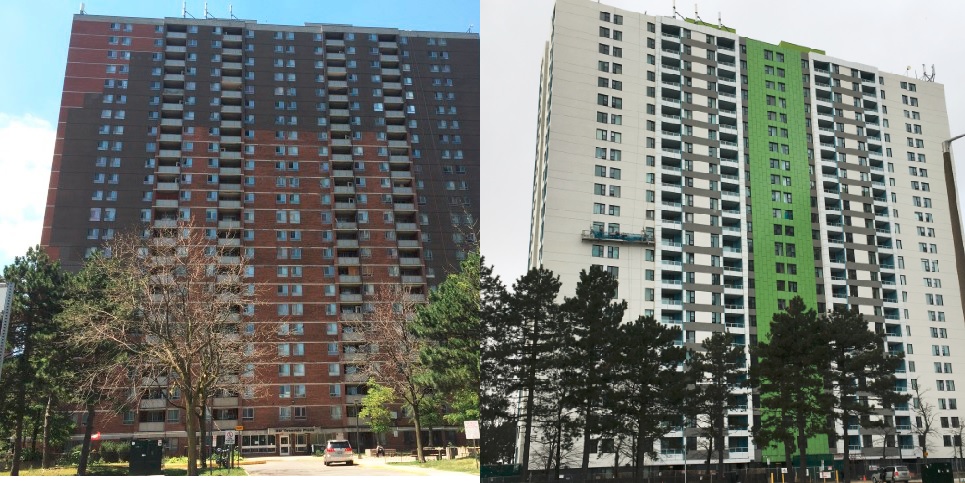
Teesdale Place: Before (left) and after (right) undergoing a building façade restoration

Mucciarone references two recent projects RJC conducted for Toronto Community Housing as examples of what can be achieved today: Teesdale Place (pictured above) and 200 Wellesley Street. “Both projects incorporated a holistic approach to façade restoration in order to provide durable continuity of control layers between wall cladding, window replacement and balcony restoration.”

To find out more about what RJC can do for you, please contact Andrea Mucciarone directly at [email protected] or visit www.rjc.ca.

Big three retail landlords thrive on experience

Yorkdale Shopping Centre again takes the title of Canada’s most productive mall in the Retail Council of Canada’s annual analysis of shopping centres with more than 250,000 square feet of gross leasable area. Recently released results reveal Oxford Properties’ super-regional mall in northwest Toronto generated average sales of $1,964 per square foot in the 12 months ending June 30, 2019, equating to a 3.1 per cent increase from the previous year’s sales levels. It also ranks as the ninth busiest mall in Canada, welcoming 18 million visitors last year.

The Retail Council suggests Yorkdale’s strengths are grounded in: a tenant and merchandise mix “offering shoppers a wide range of options, from fast fashion to luxury retailers and many food and beverage choices”; dual highway and transit access, including an on-site connection to a Toronto subway station and 8,000 parking spaces; and ongoing ambitious capital investment and expansion. It’s commended for creating enticing differentiations from competing malls and online shopping.

“The movement towards ‘experiences’ is an opportunity that both retailers and landlords are enthusiastically embracing, especially as value in real estate assets continues to grow exponentially,” the Retail Council report submits. “By carefully curating compelling and productive retailer mixes, upping square footage devoted to food and beverage options, introducing innovative, one-of-a kind, destination-worthy entertainment attractions, and building more residential and office complex options on their properties, shopping centre owners in Canada are setting the groundwork for a renaissance.”

Rounding out the 2019 top-five achievers for sales per square foot are: CF Pacific Centre in Vancouver; CF Toronto Eaton Centre; Park Royal Shopping Centre in West Vancouver; and Southgate Centre in Edmonton. In total, 11 malls surpassed the $1,000 per square foot threshold. Cadillac Fairview manages six of those earners, while Oxford Properties and Ivanhoé Cambridge each manage two and Larco Investments manages one.

“Landlords in Canada have been proactive and have found dynamic strategies to attract new tenants and keep shoppers coming to the mall,” says Diane Brisebois, president and chief executive officer of the Retail Council of Canada.

Cadillac Fairview, Ivanhoé Cambridge and Oxford Properties emerge as the big three retail landlords on a longer list of Canada’s top 30 malls, based on sales per square foot. Cadillac Fairview, with 13 malls, is the most prevalent, followed by Ivanhoé Cambridge with nine, and Oxford Properties with four. Larco, Morguard, QuadReal Property Group and Cushman Wakefield Asset Services each own and/or manage one mall.

B.C. and GTA host large share of high-performance shopping centres

Nevertheless, the earnings spread is fairly dramatic across the Retail Council’s rankings. Yorkdale garnered 154 per cent more per square foot than did its sister shopping centre, Oxford Properties’ Upper Canada Mall, in Newmarket, Ontario, which fills the 30th slot at $773 per square foot. The three top performers all earn more than double per square foot than the malls in the bottom tenth — which also include CF Limeridge in Hamilton, generating $785 per square foot, and Mayfair Victoria, generating $783 per square foot.

Park Royal Centre enjoyed the steepest improvement with a 46.8 per cent jump in sales per square foot — from $914 in 2018 to $1,342 in 2019. “Landlord Larco attributes the gain to increased foot traffic from a newly opened VIP Cineplex Cinema, highly productive retailers such as Tesla and the addition of new retail tenants,” the Retail Council report notes.

That’s even without an Apple store in residence. The retailer, found in 25 of the top-30 revenue-generating malls, is purported to lift revenue by more than $100 per-square-foot wherever it locates.

Park Royal is one of four malls situated in British Columbia’s lower mainland to rank in the top-10 list, while, in total, seven B.C malls are among the 30 most productive. Regionally, the Greater Toronto and Hamilton Area dominates with 12 malls in the top 30. Calgary and the Greater Montreal area each boast two. Winnipeg’s CF Polo Park and Halifax Shopping Centre are the only malls outside Ontario, Quebec, British Columbia or Alberta in the top 30.

Nine of the malls on the list experienced declining sales levels in 2019, but only two — Edmonton’s Southgate Shopping Centre and Halifax Shopping Centre — have recorded two consecutive years of dropping sales. “It’s no secret that the loss of some major retailers was significant for many Canadian malls, with some experiencing a reduction in visitor count and revenue,” Brisebois acknowledges.

Ivanhoé Cambridge’s Conestoga Mall in Waterloo, Ontario, is alone on the top-30 list in falling below the $1,000 threshold after exceeding it in 2018. Sales of $936 per square foot in 2019 are a 7.8 per cent decline from $1,016 in 2018. However, it’s still a 1.8 per cent improvement over 2017 sales of $919 per square foot.

Among 2019 $1,000-plus performers, only Ivanhoé Cambridge’s Southgate Centre has registered a slip from previous levels, as this year’s $1,121 per square foot tally represents a 0.62 per cent dip from 2018 and a 2.27 per cent drop from $1,147 per square foot generated in 2017. Even so, that must be considered in the context of Alberta’s struggling economy. Interestingly, too, the West Edmonton Mall, which received the second highest influx of annual visitors of any Canadian shopping mall — 30 million — did not crack the top-30 for productivity.

In contrast, the performance of CF Chinook Centre and CF Market Mall in Calgary merits attention in the report. Both experienced a pickup in sales tallies, with the Chinook Centre surpassing the $1,110 threshold for the first time — an achievement partly attributed to “adding retailers such as Louis Vuitton and Saks Fifth Avenue.”

Comparable visitor traffic, but demographics differ from U.S.

In addition to placing as Canada’s third most productive mall, with sales of $1,592 per square foot, CF Toronto Eaton Centre was the busiest mall in North America last year, with 52.3 million patrons. That just edged out the Ala Moana Centre in Honolulu, Hawaii, which hosted 52 million, but was well ahead of the 40 million visitors at Mall of America, in Bloomington, Minnesota, which was the second busiest U.S. location.

With the exception of West Edmonton Mall, Canada’s 10 busiest malls are among the top 30 for productivity and seven surpass the $1,000-per-square-foot benchmark. The Retail Council notes that they “have comparable traffic to the top 10 centres in the United States” — generally in the range of 20 to 30 million visitors in both countries.

However, the Canadian malls are much more geographically concentrated with four in the Greater Toronto Area and three in B.C.’s lower mainland, while the busiest U.S. malls are sprinkled through nine different states. Other demographic differences are also apparent.

“While the suburbs are typically home to major shopping centres, four of the top shopping centres are in downtown cores — CF Toronto Eaton Centre, CF Pacific Centre, Montreal Eaton Centre and CF Rideau Centre. This demonstrates the continued strength of Canada’s downtowns when compared to cities in the United States,” the Retail Council report states.


CMLC announces new president and CEO

Kate Thompson has been named president and CEO of CMLC, assuming the role in 2020 after the departure of Michael Brown. She has served as CMLC vice president of development since 2013.

Charged with overseeing the strategic direction of the development team, Thompson’s exceptional leadership has been instrumental in the success of many major infrastructure and development projects—most notably (and most recently) Calgary’s new Central Library. She is highly regarded for her deep expertise, her uncompromising standards and her unwavering commitment.

Her passion for commercial design, construction, project management and communications comes through in day-to-day work with CMLC and her diverse roles throughout the community including chair of YWCA’s Board of Directors and adjunct professor with U of C’s Faculty of Environmental Design.

In 2014, Calgary’s Avenue Magazine recognized Kate in its Top 40 under 40 list and in 2015, YWCA’s She Who Dares project included Thompson among the 150 women who shaped Calgary over the last 150 plus years.

She belongs to the Alberta Association of Architects and the Royal Architectural Institute of Canada.

Thompson is a natural successor to Brown, who served in the role since 2011. Brown is moving on to become president of one of Calgary’s leading home builders, Trico Homes.

“Though there’s no good time to lose a leader of Michael’s quality, Kate’s outstanding leadership credentials give us full confidence that she will guide the organization through this complex period in our evolution,” said Randy Magnussen, CMLC chair of the board.

Calgary Municipal Land Corporation (CMLC) was incorporated in 2007 as a wholly owned subsidiary of the City of Calgary to implement and execute the Rivers District Community Revitalization Plan.

Feds invest $200 million in new rental housing at Mirvish Village

The federal government announced it is committing $200 million toward the construction of six new apartment buildings at Mirvish Village, a mixed-use rental community located at the site of the historic Honest Ed’s department store.

Featuring 916 units, the project, developed by Westbank Corp. and Peterson Group, is receiving this financing through the Rental Construction Financing Initiative (RCFi), a National Housing Strategy program delivered by CMHC. RCFi supports rental housing construction projects to assist in providing a stable supply of rental housing for middle-class families living in expensive housing markets.

“Today’s announcement reinforces our government’s commitment to creating homes that are affordable, energy efficient, and accessible,” said the Hon. Chrystia Freeland, Deputy Prime Minister and Minister of Intergovernmental Affairs. “By helping build communities such as Mirvish Village, where people can live close to jobs, schools, and public transit, we can make a meaningful difference in the lives of Canadians.”

Of the 916 rental units, 366 will be provided at rents at or below 30 per cent of median household income. Of the 366 affordable units, 100 will be secured at 80 per cent of Average Market Rent for the City of Toronto, as published by CMHC. These affordable units will be scattered throughout the project and will be of the same quality and design as market rent units.

The unit mix will include 279 studio apartments, 230 one-bedroom units, 284 two-bedroom units, 87 three-bedroom units and 36 live/work units. The project will also include the restoration of 24 heritage buildings, a public market and outdoor performance venue, a comprehensive cycling program, daycare, new public park, micro-retail incubator spaces created in collaboration with the Centre for Social Innovation and public art installations curated in partnership with David Mirvish.

“This funding for the Mirvish Village will help us preserve a historic and vibrant community in our city,” said John Tory, Mayor of Toronto. “Honest Ed’s was a beloved part of our city and by creating affordable housing on this vacant land we are able to address the housing challenges our city faces. I want to thank the federal government for providing this important funding. This $200 million commitment demonstrates the importance of all levels of government working together to address issues that impact Torontonians.”

The project includes a Neighbourhood Energy System by district energy provider Creative Energy, comprising a block-scale network that will provide reliable and low-carbon heating, cooling, and power. Mirvish Village is modelled to achieve a reduction of 23.7 per cent in annual energy use and 30.8 per cent in greenhouse gas emissions compared to the National Energy Code of Canada for Buildings 2015 reference building.

“Our years of experience with CMHC starting with the redevelopment of Woodward’s has resulted in some of the most meaningful city building in Canada and Mirvish Village is the largest of those projects to date,” said Ian Gillespie, Founder, Westbank. “Our ambitions with this project are very significant and none of this could be accomplished without the commitment from the team at CMHC and the commitment from the Government of Canada.”

Prize to celebrate elegant energy efficiency

The Passive House Institute is now accepting submissions for its international architecture prize for elegant energy efficiency. Any building that has attained Passive House, Low Energy or EnerPHit for existing building retrofit certification is eligible for the 2020 competition, as are multi-phase developments or districts if at least one certified building has been completed and an integrated renewable energy supply is functioning.

“We wish to draw attention to the fact that Passive House buildings actively contribute to climate protection and that these are sophisticatedly designed projects. That’s what we want to honour architects for,” says Wolfgang Feist, founder of the Passive House Institute.

Architects of acclaimed projects worldwide will serve on this year’s jury, tasked with assessing the design merits, cost-efficiency and energy supply of the award candidates. Jury members include: Deborah Moelis; principal and founding member of U.S. based Handel Architects; Ana Sánchez-Ostiz, associate professor at the School of Architecture at University of Navarra in Spain; Song Yehao, director of the Institute for Architecture at Tsinghua University in Beijing; and Tom Wright, principal and co-founder of WKK Architects, based in the United Kingdom.

Entries will be accepted until June 1, 2020. The prize will be conveyed in September at the International Passive House Conference in Berlin.

2020 prospects judged upbeat, but uneven

Canada’s major office and industrial markets present a more uneven picture to brokers and analysts in this country than their contemporaries in the United States see when contemplating 2020 prospects south of the border. A recent sentiment survey encapsulating insight from affiliated firms in the two countries finds generally positive national-level outlooks, but more pronounced regional highs and lows in Canada than in the U.S.

“With the exception of certain regions, major Canadian provinces like Ontario, British Columbia and Quebec all show robust conditions,” says Jean Laurin, president and chief executive officer of Devencore, the Canadian component of the joint survey that also gathered feedback from 34 Transwestern Commercial Services’ offices in the U.S.

Using a scale in which 100 is a neutral score, analysts in nine Devencore offices pegged Canada’s 2020 office market at 104 and the industrial market at 129. U.S. results rendered a higher average office score, at 106.9, and a lower industrial score of 116.2. Drilling down to the regions, however, there is a narrower range of scores in the U.S. — although the northeast and mid-Atlantic are picked to outperform the southwest and mid-west — compared to some significant variations in Canada.

Notably, Quebec and Ontario hit or approach 140 on the office index versus scores of less than 80 for Alberta and slightly more than 60 for Nova Scotia. Ontario soars above 160 on the industrial index, while Alberta sits well below 90. Accompanying commentary outlines how industrial tenants and landlords hold the upper hand on differing sides of the industrial sector’s “sharp divide”.

“In Quebec and Ontario, a scarcity of available space is forcing tenants to renew, while in Alberta, the market is experiencing a flight to quality as tenants take advantage of lower rates amidst available space,” it observes.

Looking at some of the expectations for the coming year, 57 per cent of survey respondents foresee increased office leasing levels and 87 per cent predict stronger rent growth. New tenants are widely expected to reduce their space demands as per-employee footprints continue to shrink. Nevertheless, a scarcity of large blocks of quality space translates into likely shorter timelines to get leasing deals signed and prompts for new development — two trends foreseen for Ontario, Quebec and British Columbia.

Prospects for the industrial market are considered similar. Canada-wide, 50 per cent of respondents predict increased leasing levels, while 64 per cent expect rental growth. Rising land costs and limited availability of land for development could act as something of a brake on industrial development. Half of respondents expect development activity to remain on par with last year’s activity; 28 per cent foresee an increase; and 22 per cent anticipate a slight decrease.

Investors are expected to continue or ramp up their already healthy interest in office and industrial properties. In the office market, 77 per cent of respondents predict upward pressure on investment pricing and 26 per cent expect cap rates will compress further, while 50 per cent predict they will stay flat. A larger share of respondents — 57 per cent — suggest industrial cap rates will remain flat, but 29 per cent foresee them decreasing.

Will Craig promoted to principal at Kasian

Kasian Architecture Interior Design and Planning Ltd. has announced the promotion of Will Craig to principal in the firm’s Calgary office.

Since joining the firm in 2017, Craig has contributed significantly to the growth of the Calgary office and has been a vital member in building the commercial sector and Lifescape practice.

He brings more than 15 years of Canadian and international design experience with a specialty in mixed-use and commercial work. In his three years at Kasian, he has successfully secured work with numerous new clients, including Spear Street Capital, QuadReal, Brookfield, Triovest, and more. Along with his strong business development skills, Craig has led and contributed to the design of multiple commercial projects at Kasian including The District, BP Centre, Hiawatha, Symons Valley Centre, and Alleyway Activation Projects, to name a few.

“Being part of a passionate and purpose-driven practice is the reason I decided to come to Kasian three years ago. The people are amazing.” says Craig. “As a leader of the firm, I am excited to extend my contribution, building on the firm’s national commercial presence and helping grow our commitment to human-oriented design through our Lifescape team.”

Craig received his Bachelor of Architecture from the University of Nottingham in the United Kingdom in 2004 followed by a post baccalaureate diploma at the University of Westminster in 2009.

Prior to joining Kasian, he was an associate, architect at Dialog in Calgary and led project teams for commercial, mixed-use, cultural, and institutional sites. Craig brings a strong passion for architecture and urban design. He’s an active member of the Calgary community and is currently acting as the chair for the Urban Land Institute, Alberta chapter.

“I’m excited to welcome Will in his new role,” notes Don Kasian, president and CEO. “He’s been a vital member to Kasian, both in his contributions to the growth of our market sectors and his role as a design advocate. I’m looking forward to working with Will at the leadership level and supporting his commitment to our Lifescape practice.”

New BOMI entity promises seamless transition

BOMI Education Canada is the newly launched delivery agent for training and designations for commercial property professionals, assuming the role the Building Owners and Managers Institute of Canada previously fulfilled. The new entity is likewise aligned with BOMI International and promises enrollees in various programs a seamless transition as they work toward attaining widely recognized industry designations, such as Real Property Administrator (RPA) or Facilities Management Administrator (FMA).

“Our goal is to provide building professionals best-in-class training and development opportunities while also advocating on behalf of the Canadian constituency with BOMI International,” says Laurie Ell, general manager, real estate management services, with Colliers International and chair of BOMI Education Canada’s board of directors.

Other members of the new board include: Susan Allen, president, Building Owners and Managers Association (BOMA) of Toronto; Kim Saunders, property manager, East Port Properties Limited; Anne Marie Guèvremont, 2017-18 chair, BOMA Canada; Howard Arndt, president and chief executive officer, Fieldstone Management; Nicholas Stolatis, vice president, EPN Real Estate Services; and Jeffrey Horn, president and chief executive officer, BOMI International.

“Our roots in Canada go deep,” Horn notes, as the non-profit educational organization marks its 50th anniversary as a provider of industry-related learning and skills development support in 2020. Over five decades, BOMI International has responded to new and continuing job performance demands that property, facilities and operational personnel face in an evolving industry — and today offers a path to achieve five professional designations, along with associated certificates and continuing education opportunities.

“BOMI Education Canada is pleased to be open for business to serve the professional development needs of building managers, facility managers and building operators throughout Canada,” Ell affirms.

Great Gulf Group appoints new CEO

Great Gulf has appointed Ilias Konstantopoulos as the new CEO, succeeding Jerry Patava who will now chair the Great Gulf Strategic Advisory Board upon retiring as CEO after 13 years.

Konstantopoulos was recently chief financial officer at Granite Real Estate Investment Trust, where he was responsible for all aspects of finance and contributed to Granite’s strategy and transformation. He brings to the new role more than 30 years of experience in operations, corporate finance, mergers and acquisitions, capital markets and extensive real estate industry expertise. He was also a managing partner at Brookfield Financial and managing director at BMO Capital Markets.

Patava led the transformation and growth of the Great Gulf Group during his tenure. He will also continue as chair of Ashton Woods USA L.L.C., as a board member of Terra Firma Capital Corporation and will also provide oversight of some of the Group’s ancillary business investments.

“Ilias will be overseeing all aspects of the Great Gulf Group, reporting to the Great Gulf Strategic Advisory Board,” said Patava. “He will be continuing our efforts to expand our business and strengthen and enhance our business relationships in both Canada and the United States. He is an exceptional business leader and his wealth of experience will take the organization to the next level in line with the Board’s strategic plan.”

Great Gulf Group, including Great Gulf Homes, is an international low-rise and high-rise residential developer.