Articles Archive - Page 466 of 928 - REMINET
REMI

HAVAN appoints Ron Rapp as CEO

The Homebuilders Association of Vancouver (HAVAN) has announced the appointment of Ron Rapp from interim CEO to full-time CEO.

Bringing with him a wealth of industry experience, tremendous knowledge of the association, key relationships with industry and government influencers; and most importantly a passion for the Association, Rapp naturally is the voice for the association and industry.

HAVAN chair Mark Cooper said, “The board conducted a broad search, and we are confident Ron is the right person to help drive forward HAVAN’s mandate to deliver on its core values of increased advocacy, education and opportunities for our members. To find someone of Ron’s caliber and in-depth industry knowledge is a rare opportunity. We are thrilled to have Ron leading the accomplished team at HAVAN.”

Rapp served as HAVAN director for seven years including board chair in 2015, and sat as director and chair of Government Relations Committee CHBA BC. he has more than 35 years in the building industry which will benefit all members, and help to drive industry initiatives.

As V.P. construction, Morningstar Homes for 15 years, Rapp oversaw the planning, design, delivery, and customer service for more than 2000 homes. His experience encompasses low and high rise multi residential, seniors housing and long-term care facilities, subsidized housing, and industrial and commercial projects, complimented with a with a broad range of exposure to, and or a direct hand in land acquisition, planning and development, product design and site planning, sales and marketing, construction, and after sales service.

“During the past 10 months, while in the interim CEO role, I have had the opportunity to work closely with the education, marketing, membership and government relations teams at HAVAN,” said Rapp. “A recent Housing Infograph prepared by the HAVAN government relations identifies only two municipalities are reaching Metro Vancouver’s regional growth strategy projections  – I’d say we’ve got our work cut out for us.”

Starlight and KingSett acquire Northview Apartment REIT

Starlight Investments and KingSett Capital announced that they have entered into an agreement to acquire Northview Apartment REIT in a transaction valued at $4.8 billion.

Northview, one of Canada’s largest publicly traded multifamily REITs with approximately 27,000 residential units, was formed in 2015 through Northern Property REIT’s acquisition of True North Apartment REIT and a Starlight Investments apartment portfolio.

This announcement comes two months after Starlight acquired 44 GTA apartment properties owned by Contiuum REIT. The company now manages more than $10.6 billion (C$14 billion) of direct real estate and real estate investment securities, with a portfolio totalling roughly 43,000 multifamily units.

“This transaction provides Northview unitholders with a premium above Northview’s all time high unit closing price, with the option of continuing to invest alongside Starlight and KingSett in what we believe will be an attractive, publicly-listed, newly formed, high yield, multi-residential fund,” said Daniel Drimmer, Starlight’s President and Chief Executive Officer. “We look forward to building on Northview’s tenant focus by maintaining high-quality, well-operated and sustainable buildings.”

Moving forward, Starlight will assume operations of the Northview properties and says it intends to retain “substantially all of Northview’s site level employees and operational staff, as well as its offices in Calgary and Toronto.”

Under the proposed transaction, a joint venture between Starlight and KingSett Canadian Real Estate Income Fund LP will acquire certain “core” properties that account for about 17 per cent of the Northview portfolio. The remaining assets, except for those comprising the new High Yield Fund, will be acquired by a joint venture between Starlight and KingSett Real Estate Growth LP.

Northview unitholders will be entitled to receive all-cash consideration of $36.25 per unit, representing a 12 per cent premium above Northview’s near all-time high closing price on the Toronto Stock Exchange  of $32.50 per Unit on February 19, 2020. They will also have the option of investing in the High Yield Fund, which is expected to have a distribution yield in excess of 10 per cent,  and will hold a geographically diversified portfolio of more than 10,900 of Northview’s multi-residential suites, more than 340 of Northview’s current execusuites, and more than 1.1 million square feet of Northview’s current commercial portfolio.

More details about the transaction can be found at Starlight.com


Construction starts on Highway 91/17

Construction is underway on upgrades to Highway 91/17 to improve safety and travel time for Lower Mainland commuters and commercial truck drivers.

The project includes improvements to Highway 91 at the Nordel interchange and upgrades at the Nordel Way intersection. A new interchange will be built at the Sunbury Highway 17 and Highway 91 connector and the interchange at River Road connecting to Highway 17.

“We are proud to be working closely with regional partners and municipalities in B.C. to get projects built that contribute to safety and improve people’s lives. These important upgrades to Highway 91/ 17 will help keep commuter and commercial traffic moving safely and smoothly across Metro Vancouver and the Lower Mainland. This is key to strengthening the local economy, easing traffic flows and creating jobs,” said Federal Minister of employment, workforce development and disability inclusion Carla Qualtrough.

The project is part of the $260-million Highway 91/17 and Deltaport Way upgrade project run through the B.C. Ministry of Transportation and Infrastructure, and funding partners include the Government of Canada through the National Infrastructure component of the New Building Canada Fund, the province of British Columbia and the Vancouver Fraser Port Authority. The $5.2 million 27B Ave upgrade component is complete and was funded by the Tsawwassen First Nation.

“Through this significant safety improvement project, we are working to solve traffic headaches by creating better connections and faster, safer routes for everyone on the road,” said Delta North MLA Ravi Kahlon.

The project is expected to be complete by 2023.

REITs boast 2019 gains on TSX Venture Exchange

Two real estate investment trusts (REITs) are in the newly announced Venture 50, recognizing the top performers last year on the TSX Venture Exchange for emerging companies. European Residential REIT ranked fourth and Nexus REIT ranked seventh in the diversified industries category — one of five industry sectors, along with clean technology/life sciences, energy, mining and technology, in which top-10 companies are identified.

Venture 50 accolades are awarded based on three equally weighted criteria for one-year gains in share price, trading volume and market capitalization. To qualify, companies had to be listed on the Venture Exchange (TSXV) for at least a year previous to and including December 31, 2019; record a closing share price of at least $0.10 on December 31, 2018 and at least $0.25 on December 31, 2019; and boast a market capitalization of at least $5 million on December 31, 2019. Top performers were named from 349 companies meeting that threshold and a total of 1,681 TSXV listed companies at year-end.

“We are especially proud to recognize this year’s Venture 50 winners, a diverse cross-section of visionary, early-stage companies that have performed well during challenging market conditions,” says Brady Fletcher, TSXV managing director.

As the name indicates, Toronto-headquartered European Residential (ERES) REIT is focused on building a portfolio of multifamily properties in key European markets. Currently, that’s concentrated in the Netherlands, with key pieces acquired from CAPREIT’s Dutch holdings.

CAPREIT serves as asset manager and property manager for ERES REIT’s 122 multifamily assets, encompassing more than 5,100 suites, while CAPREIT chief financial officer Scott Cryer additionally fills that role for ERES REIT. The portfolio also includes three commercial buildings, located in Belgium and Germany, managed by Maple Knoll Capital.

“We expect to see a meaningful increase in fee revenue as we provide property and asset management services to the growing ERES portfolio while also providing our unit-holders with the ability to participate through our increased ownership position in ERES as they prosper going forward,” CAPREIT president and chief executive officer Mark Kenney remarked upon the closing of last September’s €170.5 million (CAD $243.8 million) deal for an 18-building, 942-unit portfolio in the Netherlands.

Unit-holders enjoyed a 24 per cent increase in share price last year, as it rose from $3.75 to $4.65 over the 12 months ending December 31, 2019. The market cap grew 341 per cent — from $60.77 million to nearly $268 million —
in the same period, with approximately 57.6 million outstanding shares at year-end.

Nexus REIT saw a 15 per cent increase in share price, from $1.80 to $2.17, over the course of 2019. The market cap gained 26 per cent, from $175.2 million to $221.6 million, ending the year with more than 102 million outstanding shares. The company now owns and manages a 72-property portfolio of office, industrial and retail buildings with a combined total of 4 million square feet of rentable space.

“We are extremely proud to have earned 2020 TSX Venture 50 ranking,” says Nexus REIT chief executive officer Kelly Hanczyk. “We believe there is significant value creation potential in our portfolio, which we plan to begin executing this year. We are looking at graduating to the TSX in the near future.”

The top performer in the diversified industries category, British Columbia-based Well Health Technologies Corp., already made that move in January 2020 — the sole company in the Venture 50 to have done so thus far this year. Meanwhile, another real estate based company, StorageVault Canada Inc., ranked second among diversified industries and is unique among the Venture 50 for finishing the year with a market cap in excess of $1 billion. StorageVault saw a 57 per cent increase in share price, from $2.37 to $3.71, and 60 per cent growth in market capitalization, from $843 million to $1.3 billion, during 2019.

Clean technology player, dynaCERT Inc., claimed the title as last year’s top-performer in the TSX Venture Exchange, registering a 248 per cent increase in share price. It jumped from $0.19 to $0.71, while the market cap grew from $49.3 million to $229 million, or by 384 per cent.

“We celebrate these compelling success stories and many more across TSXV, the foundation of the world’s premier two-tiered capital formation ecosystem and an engine of opportunity for issuers and investors alike,” Fletcher asserts.


MCAC announces new leadership

Pierre Boucher, CEO of the Mechanical Contractors Association of Canada (MCAC), will leave the association on Feb. 28.

Boucher’s leadership helped to move MCAC forward on a number of important issues, including a new emphasis on innovation and technology, great progress on key advocacy issues such as the naming of subtrades and other industry practices, helping to modernize many of the operations at the MCA Canada national office, and creating a closer working relationship with MCA partners across Canada.

MCAC has appointed Tania Johnston as its new CEO along with Ken Lancastle as COO. Johnston and Lancastle will work together in close partnership on the strategy and operations of MCAC. Johnston has been with MCABC for almost 20 years in a number of roles. She became MCAC executive director, education and special projects in 2018. Lancastle joined MCAC in 2018 as executive director, communications, industry outreach and innovation.

“On behalf of the MCA Canada executive committee, we would like to thank Pierre for his service as MCA Canada CEO these past two years,” said MCA Canada president and chair Dave Holek. “Pierre brought a new and innovative perspective to the association on a number of important issues for MCAC. As Pierre moves on, we would like to wish him all the best and extend our appreciation for his hard work and dedication to the association and the industry.”

Condo is LEED Platinum first for Toronto

Aqualina at Bayside is the first high-rise condo in Toronto to earn LEED Platinum certification.

Topping off at 13 storeys in the Bayside Toronto Community on the waterfront, Aqualina is also the second high-rise multi-residential project in all of Canada to achieve the designation.

Both project partners, Hines and Tridel, started pursuing the certification back in 2017.

“Energy conservation is a crowning feature of Aqualina and the entire Bayside Community,” says Tridel’s Director of Innovation and Sustainability, Adrian Wang. “Our collective efforts translate to a healthier, more sustainable community for residents and the city, and the financial savings are passed on to our purchasers. Because of our site-wide approach at Bayside, we’re well positioned to replicate our success at Aquavista, Aquabella and Aqualuna.”

LEED Platinum

From left to right: Director of Innovation and Sustainability at Tridel, Adrian Wang; Aqualina Condo Board President Dave Hamilton; VP Construction at Hines Canada, Michael J. Gross

Hines, developer of the mixed-use Bayside Toronto Community, has also been an early supporter of the LEED program, overseeing more than 102 million square feet of LEED certified, pre-certified and registered properties in six countries.

“Sustainability has been a core value since the inception of our master-plan and we have taken a site-wide approach to energy conservation,” adds Avi Tesciuba, senior managing director of Hines Canada.

Canada Green Building Council President and CEO Thomas Mueller noted how the condo plays a key role in the site’s transformation to a vibrant mixed-use community.

“As the first condominium residence in Bayside, Hines and Tridel’s Aqualina includes solar panels for renewable energy generation, and water-efficient plumbing fixture,” he said. “Beyond environment, “Aqualina leverages the holistic approach of green building by improving residents’ well-being through a healthy indoor.”


B.C. demand for skilled labour high

The latest forecast from BuildForce Canada reveals construction demands will remain exceptionally high for the next couple of years and peak in the latter half of 2021 based on the number of currently tracked projects in B.C.

The province’s construction industry will be short 11,700 workers over the next two years and some 23,000 workers short by 2029.

“Unemployment in the B.C. construction industry remains at historically low levels, below 4 per cent,” says Bill Ferreira, executive director of BuildForce Canada. “While the industry will need to focus on long-term recruitment and skills development strategies, worker mobility will be critical to meeting the province’s anticipated construction needs, particularly over the short term.”

B.C.’s construction and maintenance industry will be driven primarily by non-residential projects over the next decade. The residential sector will also remain strong, and moderate declines in new housing construction will be more than offset by growing renovation and maintenance demands.

Non-residential construction demand in B.C. is driven by several major projects, including: Site C, LNG Canada export terminal, TC Energy Coastal GasLink pipeline, and the Trans Mountain Pipeline Expansion. In the Lower Mainland, demand is driven by key infrastructure projects including: the Pattullo Bridge Replacement, SkyTrain expansion in Surrey and along Broadway, ongoing expansion of Vancouver International Airport (YVR), redevelopment of St. Paul’s Hospital, and the Vancouver Fraser Port Authority container expansion program.

The Vancouver Regional Construction Association (VRCA) is calling on the provincial and federal governments to help address the ongoing shortage of skilled labour in British Columbia and the Lower Mainland.

Specifically, VRCA is asking that Victoria and Ottawa work with the construction industry to improve the mobility of workers within and between provinces, as well as reduce the hurdles faced by skilled trades wishing to immigrate to Canada and work in B.C.

“B.C.’s construction industry is facing a perfect storm,” said Fiona Famulak, VRCA president. “The construction industry’s unemployment rate is at historically low levels while demand for construction services continues to increase to new highs.”

In response to project demand, employment in B.C.’s construction industry is forecast to grow by 16,600 workers by 2029. In the same period, the industry is expected to lose 44,200 workers to retirement, which will be offset somewhat by the 37,800 first-time local new entrants aged 30 years and younger anticipated to enter the province’s construction workforce. This still leaves the industry with a shortfall of some 23,000 workers to meet the forecast demand for construction labour.

The next decade will also be challenging for the Lower Mainland’s construction industry. During this period, the industry is expected to lose 25,300 workers to retirement, which will be offset somewhat by the 22,900 new entrants anticipated to join the local construction workforce. This still leaves the Lower Mainland 17,400 workers short by 2029.

The Lower Mainland’s near-term outlook is particularly challenging. With numerous overlapping infrastructure projects underway or about to break ground, the industrial, commercial and institutional construction industry will need at least 7,500 additional workers by late 2021 to meet demand.

“The forecast confirms again that British Columbia and the Lower Mainland need both long- and short-term strategies to address the skilled labour shortage,” said Famulak. “We need continued investment in the training and development of skilled trades people to build our future workforce. At the same time, there is an immediate need for skilled trades workers that cannot be satisfied simply by increasing training and apprenticeships.”

The 2020-2029 Construction and Maintenance Looking Forward highlights reports for each province are available on the BuildForce Canada website.

SkyTower to be tallest condo in Canada

Another condo coming to downtown Toronto’s evolving skyline will be Canada’s tallest once it rises to 95 storeys at Yonge Street and Queens Quay.

At more than 1,000 feet high, SkyTower promises a mix of 840 one- to three-bedroom units starting in the $800,000s, which for many is a reasonable price given the location, its high-end features and the fact that there really isn’t enough supply to keep up with demand.

Jamie Johnston, broker of record and owner at RE/MAX Condo Plus, which is selling some of the units, says he has seen the average price of an entry-level condo jump from $500,000 to about $600,000 in the past 15 months. In downtown Toronto, the asking price stands between $1,200 and $1,400 per square foot, with SkyTower on the high end of that spectrum; its suites ranging from 520 to 2,300 square feet.

“They’re going to sell this out because there’s a shortage of larger units in downtown Toronto,” says Johnston. “There are also going to be lot’s of amenities; it’s hooked into the Path and right at the waterfront. One of the reasons people want to live in condos is because they want to walk everywhere. It’s a prime location.”

The condo will be the second of three residential towers, part of a 2,200-unit development at Pinnacle One Yonge, where a 65-storey condo called The Prestige is currently on the rise. Mixed-use space will ground the 4.4-million-square-foot residential development with two office buildings, retail, a 2.5-acre public park, hotel and community centre.

SkyTower3

“The homebuyer is looking at local amenities to add to quality of life,” notes Mark Tang, sales representative at Trace Property Group. “With proximity to TTC, walking distance to restaurants, cafes, grocery stores and entertainment venues including Scotiabank Arena and the Harbourfront Centre, this project will do very well with selling the 800 units that have been released.”

Developer Pinnacle International, along with designer Hariri Pontarini Architects and interior designer Tanner Hill Associates Inc. have also planned for building amenities both functional and aesthetically pleasing. An indoor play area for kids, a pool, yoga studio, and outdoor terrace with barbecues, are just a few.

Underground parking will be equipped with cameras, placed in pre-selected locations with two-way voice communication to concierge, while every level will feature waste management and recycling systems.

When SkyTower finally does sprout up, with occupancy starting sometime in 2024, it will stand taller than The One and YSL Residences, which are on track to exceed the height of First Canadian Place—currently the tallest skyscraper in Canada.

Pinnacle’s vice-president of sales and marketing Anson Kwok noted, in a press release, that the location of One Yonge demanded an “iconic architectural statement.” Interest is expected from young professionals, move-up buyers, move-down buyers and young families, to name a few.

“Our approach to this phase, and the other elements of this master-planned development, was predicated on a commitment to not just merely add yet another condo to the downtown core,” he said. “Instead, we recognized the unique privilege provided by this site to forever reshape the Toronto skyline.”

Canada’s hottest rental markets: January 2020

Canada’s major rental markets continue to thrive in 2020, according to the latest rent report from Rentals.ca and Bullpen Research & Consulting.

Montreal, London, Winnipeg and Toronto are all experiencing double digit percentage increases for annual growth in median rents, with Montreal leading the way at 38 per cent. Other cities with increases over 10 per cent include: Mississauga, North York, Etobicoke, Ottawa, Scarborough, Quebec City, Kitchener and Hamilton.

On the other end of the spectrum, four cities witnessed double digit percentage decreases for annual growth in median rents in January: Saskatoon, Red Deer, Regina, and Edmonton.

In the city of Montreal, average monthly rents spiked in 2019 after a relatively tame 2018. Since last January, average prices on the island have risen nearly $400, an increase that is being felt by prospective renters.

“We see that renters in Montreal keep on searching for lower cost of living, and they’re willing to search outside of central areas to find affordable housing,” said Vincent-Charles Hodder, CEO of Local Logic, referring to the fact that listings in areas outside of the more expensive downtown core are being viewed by more searchers.

Canadian rental markets. Feb 2020

“The strong rent growth in Quebec and Ontario is enticing developers to build more apartments,” said Ben Myers, president of Bullpen Research & Consulting. “According to Canada Mortgage & Housing Corporation, there were more rental starts than condo starts in January in both provinces. This supply is much needed to satisfy the increasing tenant demand, as the flattening out of condo rental rates could negatively impact investor activity and reduce secondary market supply.”

National and provincial averages

Nationally speaking, average rents for all property types are up just 1.3 per cent overall, but for rental apartments specifically, year-to-year rent has grown 5 per cent rising from $1,463 per month to $1,536 per month.

Following three consecutive months of decline, the average rental rate in Canada for all property types increased month-over-month in January by 1.3 per cent to $1,879 per month. This increase remains well below the September 2019 high average rate of $1,954 per month.

“Annual growth in the average rental rate nationally cooled off in January, despite major rent increases in a number of municipalities in Canada,” commented Matt Danison, CEO of Rentals.ca. “Some rental demand is shifting to the resale market as we are recovering from the stress test’s credit tightening, and the fear of interest rate hikes. This shift is also affecting the high-end rental market, as households choose to buy instead of considering these units.”

Toronto remains at the top of the list for January average monthly asking rent for a one-bedroom and two-bedroom home at $2,315 and $2,926 respectively. Ten of the top 11 cities for highest average monthly rent in January for one-bedroom and two-bedroom homes are in Ontario.

Rents have increased significantly for all property types year-over-year in Quebec (22%) and British Columbia (17%), but declined in Alberta (-3%) and Saskatchewan (-11%).

Average rental rates in Ontario continue to outpace the other major provinces in Canada, with an average rent of $2,290 per month in January 2020, a 6 per cent increase year-over-year.

Other key takeaways from the rental markets report:

  • The community of Fort Nelson in northeast British Columbia had the lowest average monthly rent of the 30 cities analyzed for January with a one-bedroom home going for $587 and a two-bedroom at $707.
  • Other cities on the low end of average monthly rents in order of most affordable for a one-bedroom home, include: Quebec City, Gatineau, Saskatoon, Lethbridge, Red Deer and Regina.
  • Rental apartments in Canada have seen rents per square foot increase by 6.8 per cent annually from $1.89 per square foot in January 2019 to $2.02 per square foot in January 2020. The average unit size has declined by 20 square feet year-over-year to 810 square feet. Smaller units typically have higher per-foot rental rates.

Pay raise, slowing volume, shortage of workers

The B.C. construction industry plans to raise pay for its workers by 10 per cent over the next two years but there are concerns about slowing volume of work and shortage of workers.

Independent Contractors and Businesses Association (ICBA) president Chris Gardner highlighted the results of the association’s annual survey of approximately 1,000 construction companies at the 23rd annual CEO Breakfast, kicking off the Buildex Vancouver 2020 construction tradeshow.

“Construction is the unsung hero of our provincial economy. What the 250,000 men and women in construction do accounts for about 10 per cent of our economy,” he said. “It doesn’t get the kind of attention that other industries do.”

Survey respondents said they expect to give their workers a 4.8 per cent raise; in 2021, they expect another 5.2 per cent increase. That’s more than double the rate of inflation, which is hovering at 2 per cent.

“It’s another strong year for the construction industry, with workers looking at substantial pay increases this year and next,” said Gardner. “Yet there are notes of caution being sounded by our members…the percentage of companies who expect more work this year than last is now at 40 per cent – the lowest in several years.”

The breakdown across regions show:

  • Interior: 40% of contractors expect more work in 2020 than last year; 60% say they are short of workers, especially labourers, carpenters and framers.
  • North: 38% of contractors expect more work in 2020 than last year; 46% say they are short of workers, especially carpenters, labourers and welders.
  • Vancouver Island: 24% of contractors expect more work in 2020 than last year; 64% say they are short of workers, especially carpenters, labourers and plumbers.
  • Lower Mainland: 42% of contractors expect more work in 2020 than last year; 68% say they are short of workers, especially carpenters, labourers and plumbers.

The major issue for members remains the same, with 64 per cent of construction contractor members say they cannot find enough workers. Gardner said the issue cuts across the entire economy.

“It’s not just about contractors not being able to find workers. It is in the retail sector, the hotel sector, the restaurant sector. Every sector of our economy is facing a shortage of workers. We are going over a demographic cliff in Canada,” he said.

Gardner added that the province has made the situation worse with the community benefits agreement, which he said excludes open shop workers from major projects like the Pattullo Bridge.

“It’s not fair, it’s not right and it is discriminatory,” he said.

Gardner was followed by guest speakers Bob Rennie and Andrew Ramlo of the Rennie Group, who discussed the current state of the market and some of the key economic and demographic factors that are driving it. They touched on the impacts of the aging Baby Boomers, immigration, the current state of new housing supply and housing policy changes, as well as where they think the market is going in 2020 and beyond.


Cheryl Mah is managing editor of Construction Business.

2020 National Urban Design winners selected

Twelve projects across Canada have been selected for the 2020 National Urban Design Awards. Six Awards of Excellence were handed out along with five Awards of Merit and a Special Jury Award by the Royal Architectural Institute of Canada (RAIC), the Canadian Institute of Planners (CIP), and the Canadian Society of Landscape Architects (CLSA).

The winning projects range from public art installations and parks to a revitalized underpass. The awards are part of a two-tier program held in cooperation with Canadian municipalities. The National Urban Design Awards program judged winners of the 2020 municipal awards and entries submitted at large.

The awards in each category will be presented during the RAIC’s Conference on Architecture hosted in Edmonton from June 3-7, 2020.

Award of Excellence winners are:

Civic Design
Award of Excellence
Mechanized River Valley Access (Edmonton, AB)
DIALOG

Urban Fragments
Award of Excellence
18 Shades of Gay (Montréal, QC)
Claude Cormier et Associés

Community Initiatives
Award of Excellence
The Warming Huts (Winnipeg, MB)
Sputnik Architecture Inc. & The Forks Renewal Corporation

Urban Design Plans
Award of Excellence
Plan d’intervention pour le confort et la sécurité des piétons et cyclistes dans le Vieux-Québec (Quebec, QC)
Groupe A / Annexe U

urban

Urban Architecture
Award of Excellence
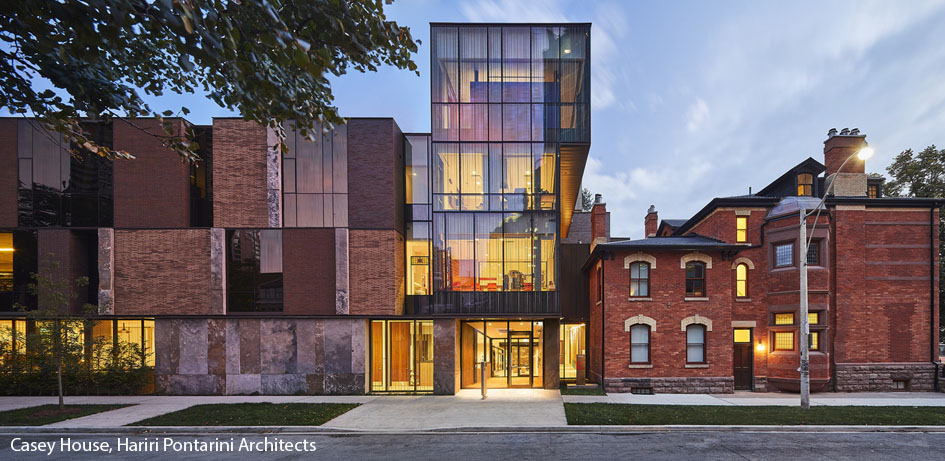
Casey House (Toronto, ON)
Hariri Pontarini Architects

Special Jury Awards
Sustainable Development Award
Corridor de biodiversité, Arrondissement de Saint-Laurent, Montréal (Montréal, QC)civiliti, LAND Italia, Table Architecture and Biodiversité conseil

Student Projects
Award of Excellence
Topographic Urban Expansion (Toronto, ON)
Qiwei Song (University of Toronto)

For the full list of winners, visit CSLA.


NKBA announces 2020 Design Award winners

The National Kitchen & Bath Association (NKBA) announced its 2020 Design + Industry Award winners. The annual competition recognizes excellence in design and execution. Wood tones, sculptural elements and textural accents were among the elements featured in this year’s winning designs.

These awards shine a spotlight on the design professionals whose work is raising the bar in kitchen and bath design, building and remodeling, outdoor living and Living In Place. At this year’s NKBA awards, seven Canadian interior design firms received a number of awards.

Michelle Miazga-Hall, founder and principal of Vancouver based Port + Quarter Interiors was a top winner, taking the Best Overall Bath award for Spyglass. She won first place in both the Contemporary Bath, Large and Contemporary Bath, Small.

Other winners include:

CONTEMPORARY KITCHEN, SMALL

NKBA

First Place: Svetiana Tryaskina, Estee Design, Toronto, Ontario
Ontario/Canada Chapter
Open-Plan Kitchen

Third Place: Nyla Free, Nyla Free Designs Inc., Calgary, Alberta
Prairie Provinces Chapter

CONTEMPORARY BATH, LARGE

Second Place: Carly Nemtean, Carriage Lance Design-Build, Mississauga, Ontario
Ontario/Canada Chapter
Indian

CONTEMPORARY BATH, SMALL

Second Place: Madeleine Sloback, Principal, Madeleine Design Group, Vancouver, British Columbia
British Columbia Chapter
Ocean Bluff Estate

TRADITIONAL BATH, SMALL

NKBA

First Place: Dvira Ovadia, Owner, Dvira Interiors, Toronto, Ontario
Ontario/Canada Chapter
Industrial Boys Bathroom

Second Place: Dvira Ovadia, Owner, Dvira Interiors, Toronto, Ontario
Ontario/Canada Chapter
Jewel Powder Room

LIVING IN PLACE

First Place: Kendall Ansell, Principal, Kendall Ansell Interiors, Vancouver, B.C.
British Columbia Chapter
Reed — Cote

Status quo rejected for Saskatchewan land fill

Education, innovation and regulation underpin a newly announced effort to reduce the volume of solid waste sent to Saskatchewan land fill sites. Currently, Saskatchewan ranks second among Canadian provinces for per capita disposal, equating to 842 kilograms of waste per resident every year, but the government is now aiming for a 30 per cent reduction from 2014 levels by 2030 and a 50 per cent cut by 2040.

“This strategy is about working together to address the ongoing challenges of waste management and to identify potential new economic opportunities for industry,” Environment Minister Dustin Duncan announced when the solid waste management strategy was unveiled in late January. “This is important because the status quo is unsustainable and the province needs a comprehensive and strategic action plan.”

To begin, a new composting guidance document is pending and the six existing material stewardship programs — which require product producers/distributors to take responsibility for end-of-life decommissioning or disposal — will be reviewed, with a mandate to create additional programs where feasible. The Ministry of Environment will produce an annual progress report with details on six performance measures:

  • amount of waste generated in kilograms per capita;
  • percentage of population served by a regional landfill model;
  • number of landfills closed and decommissioned;
  • percentage of population aware of provincial waste reduction and recycling programs;
  • amount of new investment to reduce, manage and divert solid waste from landfills;
  • number of landfill operators with landfill operator certification;
  • percentage of population with access to recycling programs.

Aligned with the new strategy, Innovation Saskatchewan, a provincial agency supporting technological research, development and commercialization, is piloting two new artificial intelligence applications for tracking haulage to and disposal at Saskatchewan land fill sites. The technologies from Regina-based Prairie Robotics Inc. and environmental engineering researchers at the University of Regina were $10,000 prize winners last year, responding to the provincial government’s 2018 plea for monitoring technology.

“Our tech community has developed a tracking and reporting mechanism using artificial intelligence, which can reduce the expense of landfill operations and lead to long-term environmental efficiencies,” says Saskatchewan’s Innovation Minister, Tina Beaudry-Mellor.

Building community with B.C. wood

In small towns and remote communities throughout British Columbia, local residents are using sustainably harvested B.C. wood to build arts, cultural and community centres — places where people can play, gather and access services.

Many communities founded on forestry are returning to their roots by constructing landmark buildings and community amenities with local wood products and using local expertise, labour and manufacturers.

On the East Coast of central Vancouver Island, École au-cœur-de-l’île is a modern school by day and a hub for the local Francophone community at night. Sustainably harvested wood is used in McFarland Marceau Architects’ plan throughout the building. Interior spaces use exposed glue-laminated timber (glulam) beams and mass timber panels to form unique reading alcove and multi-purpose spaces. The nearly 3,000-square-metre roof is made of timber. Reclaimed Douglas-fir from the site’s previous building was used to create a 7.5-metre glazing wall, with more salvage wood used as benches and display cabinets.

wood

Wood is used extensively throughout École au-cœur-de-l’île, including a large-scale timber roof structure, creating a modern school by day and a hub for the local francophone community by night in Comox. Photo: Derek Lepper

Drawing on Vancouver Island’s forestry origins, the Cowichan Lake Sports Arena’s revitalization was built in part with 15 truckloads of wood products donated by local logging companies and distributors. The heavy-timber hybrid structure, located west of Duncan, features glulam beams with solid-wood decking and exterior tongue-and-groove western red cedar cladding. A dramatic entrance leads inside where birch-plywood millwork is featured. Designed by HDR | CEI Architecture Associates Inc., the arena includes warm viewing areas, multi-purpose rooms, and dressing rooms tailored to local curling and hockey teams.

Located in Hazelton, the Upper Skeena Recreation Centre is a practical and beautiful structure that was made possible through grassroots community involvement. Designed by Hemsworth Architecture, the centre replaces the community’s former arena. It has an NHL-sized ice rink with seating for 500, a gymnasium and areas for community programs. The exposed wood roof, supported by glulam beams and columns, is an economical framing solution. Simplified construction methods for the roof and exterior walls, which are made with plywood and dimension lumber, deliver added cost savings. The wood wall and roof panels were prefabricated by local workers and then dropped into place, speeding up construction.

To showcase the Prophet River Multiplex’s dramatic wood structure, David Nairne + Associates Ltd. featured a fully glazed atrium that extends the entire length of the building, filling the interior with natural light. The linear lobby is a Douglas-fir glulam post-and-beam system; opposing posts form a triangular pattern. The interior of the building features decorative wood finishes. In the gymnasium, Douglas-fir plywood on the walls and Douglas-fir boards on the ceiling provide a robust and durable finish for sporting activities and present a warm and welcoming atmosphere when the space is used for feasts and events. The building provides administrative space, council chambers, a health and community centre, and an Elders’ lounge. Building with wood in the region has a history that dates back thousands of years, and community members were involved in the construction.

These projects and others are featured in a newly released book, Naturally Wood, which showcases B.C.’s cutting‐edge wood architecture and design. The beautifully illustrated, 160-page publication contains more than 65 innovative wood buildings and projects, including how wood is being used in community and culture.

Four continuing education units have been developed based on the book. They are recognized by the Architectural Institute of British Columbia and are available at naturallywood.com/naturally-wood-ceus.

Download the Naturally Wood e-book at naturallywood.com/nwbc.

Indicators map way for smart energy communities

The newly launched Smart Energy Communities Benchmark provides Canadian municipalities with a consistent set of indicators to assess how their policies, services and infrastructure support energy efficiency and sustainable economic development. The benchmark, which was developed with the input of nine cities and towns nationwide, is a joint initiative of QUEST, a non-governmental organization that promotes community energy systems, and the public interest and research group, Pollution Probe.

“Local governments and utilities can show elected officials, stakeholders and citizens where they’re making headway on becoming a Smart Energy Community and where opportunities remain,” advises Richard Carlson, director of energy policy with Pollution Probe.

The benchmark creates that context through five indicators to gauge local capacity to plan and manage energy systems and five others that measure tangible outcomes in land use, energy networks, water and waste services, transportation and the local building stock. Scores are designed to be an internal reference tool for participating municipalities rather than a competitive ranking.

Nine communities were chosen from the 18 expressing interest in the pilot to reflect a diversity of size and climatic conditions. They include: Calgary; Yellowknife; Inuvik; London and Markham, Ontario; Beaconsfield, Quebec; Campbell River, B.C.; Grand Prairie, Alberta; and Bridgewater, Nova Scotia.

“Communities will use the Smart Energy Communities Benchmark to assess where they stand on a range of actions that have been proven to strengthen the economy, reduce energy costs and emissions and boost community resilience,” observes Mayor Georges Bourelle of Beaconsfield.

Accordingly, Mayor Andy Adams of Campbell River underscores the economic development benefits that his city hopes to reap from energy retrofits and renewable energy, which particularly flows through to the buildings sector, while Mayor Ed Holder of London looks forward to the redeployment of savings.

“For every percentage point we reduce our energy use, $13 million stays in the London economy and can be used for other needs,” he says.

Misericordia Community Hospital renewal underway

A new emergency department expansion is now underway at Misericordia Community Hospital, an acute care hospital in west Edmonton.

Now in the four-month long demolition and remediation phase, the re-development will include space for six ambulance bays, emergency waiting and treatment areas and diagnostic services, and will accommodate 60,000 patient visits per year.

The chapel, west annex and the Family Medicine Centre (the centre was relocated to the Cabrini Centre) will be taken down to make room for the emergency room expansion.

“This is an exciting next step towards a bigger, better and more modern hospital emergency department for west Edmonton,” said Minister of Health Tyler Shandro. “I know it’s been a long wait for residents and staff, but our government is committed to this vital project at the Misericordia Hospital that will provide a better environment to serve more patients and families.”

All phases of construction are closely co-ordinated with hospital staff to ensure public safety and to minimize impact on patients, staff and visitors.

Researchers develop new sensor for detecting water leaks

A new, battery-free sensor, developed by researchers at the University of Waterloo, uses nanotechnology to power itself and send an alert to smartphones when exposed to moisture.

By eliminating a battery and related circuitry, researchers estimate their sensor could be commercially produced for $1 each, about a tenth of the cost of current leak detection devices on the market.

“One of the big issues related to water damage in buildings is that owners don’t install enough sensors because they are too expensive,” George Shaker, an engineering professor at Waterloo, said in a news release. “The much lower cost of our sensor enables the deployment of many, many more to greatly improve protection.”

Water leaks are the leading cause of property losses in apartments, offices and other buildings, resulting in expensive repairs and higher insurance premiums.

The new sensor, which is smaller than a nickel at five millimetres in diameter, is comprised of stacked nanoparticles. When the nanoparticles get wet, a chemical reaction produces enough electricity to power a wireless radio and additional sensors to record environmental conditions such as temperature.

The wireless radio and other sensors are on a circuit board packaged with the leak sensor in a box just three centimetres square.

“We harvest the energy that is created when the sensor is exposed to water and that energy then powers the electronics to send an alert to the user’s cellphone via the internet,” said collaborator Norman Zhou, a professor of mechanical and mechatronics engineering.

The new sensors are also environmentally friendly, reset after use, can be installed in hard-to-reach places – including otherwise inaccessible areas during building construction – and require much less maintenance.

A paper on the research, Development of novel water leak detection mesh network utilizing batteryless sensing nodes, was presented at a recent international conference on smart cities and the Internet of Things.

The research team also included student Oliver Witham, postdoctoral fellow Ming Xiao, research associate Jiayun Feng, physics and astronomy professor Walter Duley, and graduate student Nathan Johnston.