Articles Archive - Page 457 of 928 - REMINET
REMI

Nova Scotia introduces new COVID-19 measures at long-term care homes

The provincial government has introduced new measures to protect long-term-care facility residents and staff from the spread of COVID-19.

On April 6, 2020, Dr. Robert Strang, Nova Scotia’s chief medical officer of health, gave a news conference outlining the new steps.

These include screening all residents and staff once a day, and twice a day if operationally feasible; physical distancing; and additional steps to be taken if a COVID-19 case is diagnosed. All respiratory illnesses must be reported to Public Health.

The measures also specify new requirements for facility cleaning and disinfection regimes. This includes twice-daily cleaning and disinfection of high-touch services; the use of hospital-grade disinfectants with a drug-identification number; and that any equipment shared between residents must be cleaned and disinfected before use on or by another resident.

The full directive for long-term-care facilities can be found on the Government of Nova Scotia website.

New Brunswick creates pandemic task force

The New Brunswick government has established a pandemic task force to help combat COVID-19, to oversee the pandemic response for all aspects of the health-care system, including regional health authorities, Extra-Mural and Ambulance New Brunswick, primary care, and the long-term care system.

The task force is led by Dr. Jennifer Russell, chief medical officer of health; Gérald Richard, deputy minister of health; Dr. Gordon Dow, infectious disease specialist; and Dr. Nicole LeBlanc, chief of staff at Vitalité Health Network. A clinical group of experts will also be called upon as appropriate.

In addition, the province has received a donation from the Saint John Regional Hospital Foundation’s COVID-19 emergency fund to upgrade testing and purchase equipment.

Steering the journey back to business as usual

At a time when property managers are looking both to industry associations and professional service providers for support to navigate COVID-19 upheaval, REMI Network is bringing the three groups together for webinar-based sharing of insight on what might lie ahead on the journey back to business as usual. Set for April 16, Cheryl Gray, 2020 president of the Institute of Real Estate Management (IREM) and head, special projects, operational excellence, with QuadReal Property Group, will moderate the discussion, which will also include Justin Taylor, chief operating officer of Greenrock Real Estate Advisors and Rob Wesley, senior partner with MNP, a national accounting, tax and business consulting firm.

All represented organizations have proactively reached out to their tenants, members and clients since COVID-19 upended business routines and daily life — providing informational updates, resources and reassurance of a network with a shared goal. Webinar participants will reflect on their experiences, problem-solving successes and challenges thus far.

“The primary focus for IREM right now is to support our members and the property management industry by providing them with relevant information, tools and resources as they deal with the challenges of managing through the impact of COVID-19,” Gray reports. “This webinar is a key example of ensuring we are getting the message out through collaboration with subject matter experts and industry peers.”

Notably, Greenrock has offered its residential tenants the option of using their on-deposit last month’s rent as a credit toward required rent payments and has mailed out a $100 grocery gift card to every household. Turning to business needs, MNP is guiding clients through the details of government support programs, tax credits and deferrals, and alerting them to potential COVID-19 related scams and other destabilizing threats as suddenly scattered workforces adjust to a new kind of remote team-building.

In the coming weeks, REMI Network will continue to delve into the day-to-day demands of this temporary business reality, but also with an eye to ever-present needs for effective management, operations and professional development strategies that will serve the commercial real estate industry in post-crisis recovery and resurgence. Stay tuned for future digital discussion.

To register for the April 16 webinar, click here.

Deferrals should address GST/HST remittances

Tax specialists are reminding commercial landlords that rent deferrals could have flow-through implications for required GST/HST remittances to the Canada Revenue Agency (CRA). In a recent explanatory memo, Neil Bass, a tax lawyer with Aird & Berlis LLP, reiterates that landlords are obligated to submit GST/HST on behalf of their tenants and should formally address the issue in any rent deferral agreement.

“Properly structured, a rent deferral arrangement will also postpone the day on which GST/HST is payable so that landlords who have agreed to defer collection of rent do not have to remit GST/HST that they do not collect,” he advises.

The conventional April 30 deadline for remitting GST/HST has been pushed to June 30 as part of the Canadian government’s COVID-19 response efforts so short-term rent deferrals won’t necessarily transfer the tax burden to landlords, provided owed rent is paid in full by that date. However, specific arrangements within a rent deferral agreement could be valuable for landlords at a time when cash flow is under pressure.

Under CRA rules, tenants will still be eligible for input tax credits on deferred rent payments. “As a compromise to the GST/HST implications for a mere payment deferral, the landlord can require the tenant to pay the GST/HST at the time the rent is due under the lease even if payment of the rent itself is deferred,” Bass suggests.

In contrast, if the landlord-tenant agreement actually changes the due rate for the rent, this option will be eliminated. “Tenants will also not be eligible to claim an input tax credit for the GST/HST payable on such rent until the new due date,” Bass notes.

Montreal’s residential market on pause

The COVID-19 pandemic is predicted to push buyers and sellers in Montreal’s residential market to the sidelines for now, rather than throw the market into turmoil.

According to recent statistics from The Quebec Professional Association of Real Estate Brokers (QPAREB), the crisis slowed down the market during the second half of March, however, the first half of the month was one of the busiest on record.

“In Quebec, Montreal is the CMA that is most affected by the spread of the virus, due to the city’s greater exposure to international trade and the size and density of its population,” explained Charles Brant, director of the QPAREB’s market analysis department. “As a result, this market is exposed to psychological stress caused by stricter distancing measures and greater economic uncertainty. These factors help explain the faster and more pronounced drop in transactions compared to other regions, notably that of Quebec City.”

The high level of activity in March was due to the conclusion of transactions initiated earlier in the year. The real estate market was also boosted by three consecutive drops in interest rates (-150 basis points) in March, bringing rates to levels that are comparable to those seen in 2008 during the last financial crisis.

“In contrast to what we’ve been seeing since the start of the year, April and May are expected to be among the least active months recorded for a spring season since the start of the millennium,” added Mr. Brant. “In a context where uncertainty about the economic outcome of this crisis is very high, we can expect buyers and sellers to remain on the sidelines. However, far from being in a downturn situation, the market will, rather, be on pause.”

There were 5,907 residential sales transactions in March 2020, a four per cent increase compared to March of last year. Still, this was the 61st consecutive month of sales growth. For Q1, 14,662 transactions were concluded in the Montreal CMA, a 13 per cent increase compared to the first quarter of 2019.

Mural offers a visual of East Bayfront community

A new mural gracing the construction hoarding around the Lakeside Residences condominium project in Toronto offers a visual of what the East Bayfront community and the city’s skyline will look like once the condo is complete.

The recent collaboration between developer Greenland Group and local public art organization the PATCH Project involved Toronto muralist and designer Pam Lostracco. She created the 375-foot mural, called Reflections, after much research into the history of the neighbourhood.

Reflections pays homage to Toronto’s industrial past by incorporating the historic Redpath Sugar Factory into the piece, and illustrates an exact reflection of the water, including the warm tones that are seen at Toronto’s waterfront during certain times of the day. Lostracco also used horizontal lines to evoke a calming space, seen in the mural’s water and skyline.

A new home for first responders in Delta, B.C.

Delta, B.C. is a wide-open landscape of quiet neighbourhoods and sprawling farms and migrating birds that gather near the coast of Boundary Bay. A network of three communities, combined with a population of about 100,000 people, the city is also home to one of the largest, developing industrial lands in the Greater Vancouver Area.

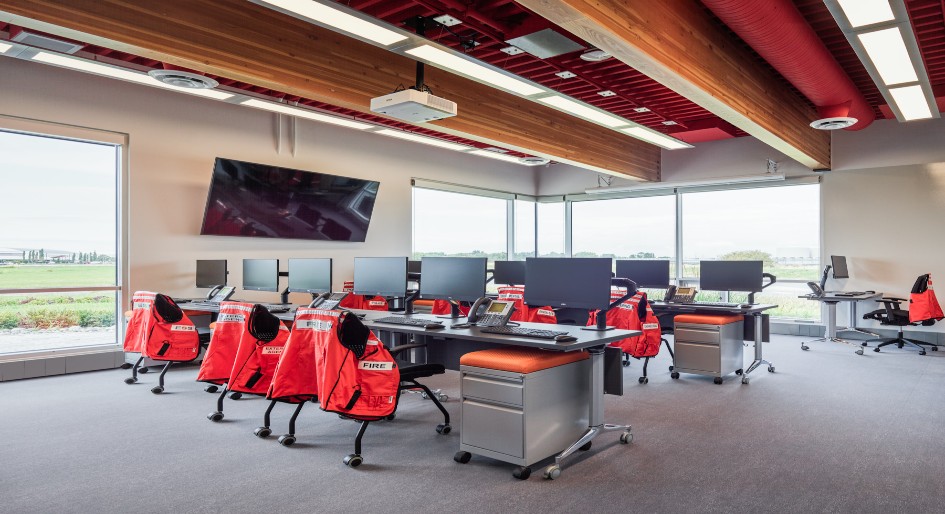
With this growing market near an airport and two provincial highways, a small, aging fire hall couldn’t keep up with the community’s emergency response needs. Also lacking was a proper emergency operations centre (EOC). During an event, such as a flood, rooms in city hall were cleared into makeshift workspace for 30 to 40 people overseeing different functions.

“When you’re dealing with disasters and emergencies, tensions are running high,” says Michel Latendresse, Delta deputy fire chief. “That doesn’t serve a one-room model where phones are ringing and people are trying to have private conversations.”

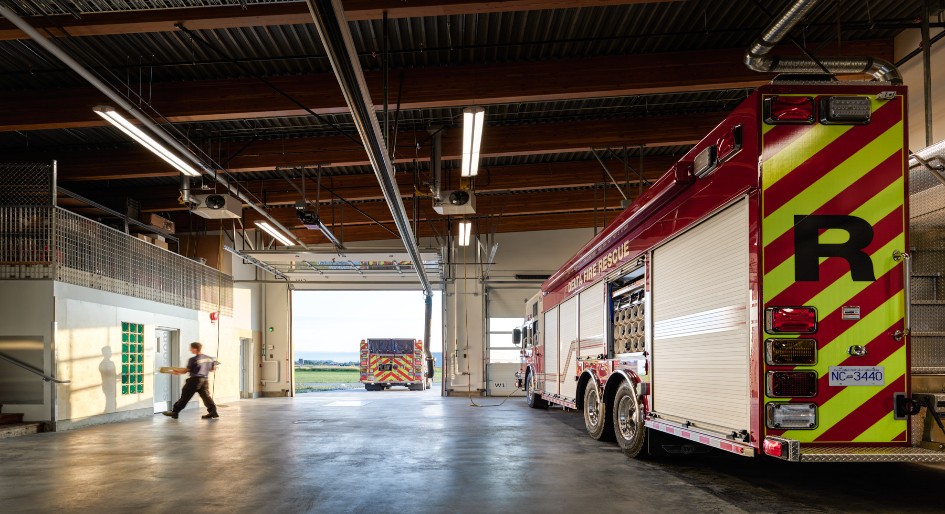
Delta commissioned a new building, and in 2019 the Boundary Bay Fire Hall was unveiled. Led by west coast firm Johnston Davidson Architecture, the facility blends wood design with human-centric, functional spaces. It brings together a multi-purpose satellite fire station, a live-fire training building, and a municipal EOC that flips into a corporate training facility, depending on the needs of the day.

Each function of the EOC, from planning to logistics, has its own dedicated spot, all connected through technology. When not being used for emergency purposes, city staff reserve the rooms through a centralized booking system for training or meetings.

“As a building user, it’s very functional how the rooms communicate with one another, yet provide intimacy and quiet workspaces,” adds Latendresse. “It’s also a really comfortable training environment. Since opening, it’s been so popular; everyone wants to come because of the technology, room lay-out and acoustics.”

Disaster Ready

For Kimberley Johnston, principal at Johnston Davidson Architecture, function transcends into the structural elements, from controlling storm water run-off on a former greenfield site to choosing wood (80 per cent above grade) as a primary building material.

Using plywood sheeting and wood-to-wood connections, the resilience of the design permits the facility to remain operational during a catastrophic event. More than aesthetic, large glulam beams and post-disaster wood frames are visible in the structure throughout the interior millwork. Since the facility had to comply with post-disaster standards, withstanding 1.5 times the seismic forces of a regular building, the soil presented a challenge.

“Because of the liquefied soil on site, we had to create a really interesting raft slab foundation,” says Johnston. “If there was an earthquake and the soil liquified, the whole building would move. The thick slab allows for subtle movements found in seismic conditions, but it is also revealed on the main floor as a final finish throughout.”
first responders

A municipal emergency operations centre flips into a corporate training facility, depending on the needs of the day.

Through her experience with wood design—more than 50 fire halls across Canada—Johnston found that integrating similar materials makes for good seismic conditions.

“Wood walls with wood roofs is a good combination; the building moves at the same rate during an earthquake,” she notes. “The tricky part is the way it’s put together; unlike your average house framing, post-disaster framing is much more intense. Getting people around that mind-set is always a challenge.”

To ensure a fast and cost-effective process, the designers worked alongside the sub-trades through a series of digital meetings, zoning in on close sections of the building model to refine crucial details before the wood elements arrived on site. Recently earning a 2019 Wood Design & Building Award in the Canadian Wood Council Award category, Boundary Bay Fire Hall is helping to bring mass timber into the mainstream.

“Speed, innovation and technology have made a huge difference in how people understand where to use wood,” says Johnston. “Where once it was seen as a residential product, it’s now moving into larger institutional and civic projects.”

She believes as contractors become more familiar with the variety of wood products and how they remain viable outside the residential realm, this will open the door for more trades and a larger workforce on a project, which helps with better bidding.

Outside its durable qualities, Johnston says she really wants occupants to “feel the wood” because of its great health benefits. Research has long shown that visual exposure to natural materials like wood reduces stress and elicits feelings of comfort.

Enlightened Facility for First Responders

As is the case with many innovative facilities, wellbeing was top of mind during the Boundary Bay Fire Hall design. Firefighters are living with much higher rates of suicide and mental health issues compared to other professions. Regularly facing life-and-death situations can lead to depression and post-traumatic stress disorder. Delving deeper into these issues was key to various design choices.

Large windows in the facility frame views of the greenhouses in the field, sweeping natural light across every room. Structural elements contrast with the brightness of the white walls reflecting the light, with a smash of blue and red colour added to key locations.

The comfort of the facility extends into the kitchen, with natural wood cabinetry and cool water tones of a blue floor and grey countertops. The strict use of LED lighting throughout the entire hall takes on various forms, from long, linear pendant lights to under cabinet valences.

“LEDs are warmer than they used to be, so we worked with lighting designers to make sure the rendering of colour the light is giving off feels warm and comforting, rather than stark white,” Johnston says.

first responders

The comfort of the facility extends into the kitchen, with natural wood cabinetry and the cool water tones of a blue floor and grey countertops.

An outdoor patio on the upper level is an immediate place to decompress and gaze out at the field. The training rooms feature a fine, carpet-like material of brushed nylon that gives a softness to the room and provides comfort for any hand-and-knees first-aid training. The brightly coloured linoleum dorm floors, reflecting the range of danger levels, add a pop of colour and help crew members with wayfinding.

Risky Business

Outside the fire hall, crew members learn how to control modern-day fires in a very modern structure—a four-storey burn building fashioned from steel shipping containers. The lego-like, modular design houses a flexible interior for live-fire scenarios with balconies, rooftops and confined spaces. Skills are honed in a simulated, pollution-free environment with natural gas as a heat source and theatrical smoke. Props can be operated remotely from a separate control room.

“With the advent of building construction and modern technology and early detection systems, fires are becoming less common,” says Latendresse. “But the risk to firefighters is becoming greater because they’re not practicing as often.”

When fires do occur, he muses, they’re larger and complex. Soundproofing and air tightness are causing more confined buildings. Synthetic materials are more toxic, and heat can quickly build up if an early detection system isn’t in place.
first responders

Fire halls require highly specialized systems that must meet code requirements and energy efficiency standards. It can often be tricky to blend the objectives of an engineer and architect with a facility that works for the firefighters.

Delta Fire & Emergency Services helped inform the burn building design, as well as the mechanical building systems inside the hall itself. Fire halls require highly specialized systems that must meet code requirements and energy efficiency standards. It can often be tricky to blend the objectives of an engineer and architect with a facility that works for the firefighters.

“That’s one thing we can never lose sight of,” says Johnston. “You want to be concerned with aesthetics, sustainability and energy efficiency, but it can’t be at the cost of functionality. We worked really hard to blend those elements.”

Rebecca Melnyk is editor of Canadian Facility Management & Design

Significant turbulence upends Q1 outcomes

The first quarter ended very differently than it began across Canadian real estate markets as a long-conjectured brake on momentum arrived in an unexpected form. Analysts foresee cap rates will hold steady in the coming months because few trades are expected. Rather, CBRE’s newly released quarterly cap rates and investment report — the first for the new decade — is more an exercise in weighing and digesting the “significant turbulence” that has engulfed the business landscape.

“It has become clear that the short-term economic impact of COVID-19 will be unprecedented and real estate asset values will not escape the carnage,” surmises Paul Morassutti, CBRE’s vice chair, valuation and advisory services. “However, at this point, there is little actual evidence of material cap rate expansion. NOI (net operating income) erosion as a result of widespread rent concessions will likely have greater impact.”

The national average cap rate hovered just below 6 per cent at the end of March with a 493 basis point spread above the 10-year bond yield. Similar to several recent previous quarters, rates were tightest in the multifamily sector, at an average of 3.79 per cent nationally for Class A high-rise product, and in select industrial markets, including Vancouver, Toronto, Ottawa and Montreal.

CBRE analysts project the office, industrial and multifamily sectors are better positioned to recover solidly once business activity resumes, while retail and hotels will take longer to catch up. Although the circumstances of the 2008 financial downturn were very different, Morassutti sees some likely parallels for commercial real estate.

“That crisis saw deal flow essentially halt and resume once the smoke had cleared,” he recounts. “We fully expect that this will be the case in Canada as well-capitalized owners have little inclination to sell into a market at a discount if they believe conditions will be markedly different 12 months from now.”

“In a world which came to a jarring stop for everyday life and conventional commerce, the principles of commercial real estate haven’t changed but implications have,” observes Carmin Di Fiore, executive vice president, debt and structured finance, with CBRE. “Systemic pragmatism about the flow of rental payments through the real estate daisy chain is now the singular focus for tenants, landlords, lenders, regulators and governments.”

Accordingly, it’s expected office landlords will be primarily focused on issues around rent deferrals and mechanisms for payment support well into Q2. Meanwhile, social distancing imperatives have accentuated somewhat diametrical trajectories for industrial and retail assets. The potential for strong e-commerce gains should bolster industrial fundamentals, while bricks-and-mortar retail reels from radically curbed consumer demand and retail tenants’ mounting business constraints.

“The critical role of industrial assets in omnichannel and global supply chains is only forecast to increase and will ensure the sector remains well supported by strong fundamentals, especially on a relative basis,” CBRE analysts hypothesize. “Mandatory closures (in the retail sector) have had severe impacts on business revenues across the industry. Given current market conditions, it’s expected that this slowdown will have significant impacts on near-term operating proformas moving forward. That said, the magnitude of NOI deterioration is yet to be seen.”

Multifamily landlords are deemed to have more of a cushion. “Due to the record strength in fundamentals pre-shutdown, its overall inherent resilience and its counter-cyclical relationship to economic downturns, the multifamily sector is well-positioned relative to other sectors and investment products,” maintains David Montressor, executive vice president with CBRE’s national apartment group.

Nevertheless, Morassutti suggests all real estate players will be navigating much rougher terrain than the signs indicated three months ago. “Buckle up,” he advises.

Ontario construction crews to work 24/7 on health care facilities

Construction work on new health care facilities in Ontario, including new hospitals, expansions and COVID-19 assessment centres, will now be a round-the-clock effort, the province announced.

Premier Doug Ford, Monte McNaughton, minister of labour, training and skills development, and Christine Elliott, deputy premier and minister of health, also laid out other measures to keep Ontario workplaces safe.

“During this escalating crisis, we are taking immediate steps to ensure the necessary infrastructure is in place, particularly to properly care for those with severe COVID-19 symptoms and other patients who require critical care,” said Ford. “That’s why we’re extending construction hours to allow us to build essential infrastructure faster, while ensuring construction workers can practice physical distancing on work sites to stay safe and healthy.”

Ontario will temporarily limit local noise bylaws from applying to these types of essential construction activities. Extending hours for essential construction will also give worksite managers more flexibility to stagger shifts, limit the number of people in one place, and take reasonable precautions to keep workers safe and healthy under the recent guidelines issued by Ontario’s chief prevention officer for construction sites.

“Our government is doing everything in its power to make sure workers on the job are safe during this pandemic,” said McNaughton. “That means more inspections, more inspectors, more phone lines, and more people to take your calls. We have conducted thousands of inspections and investigations across the province in March and we will continue to conduct more this month.”

LTB develops Urgent Hearing Motion form

The Landlord Tenant Board (LTB) has developed an Urgent Hearing Motion form to address instances in which immediate action is required due to a “serious and ongoing health or safety issue” or an illegal act at a residential complex during the COVD-19 moratorium on evictions.

Landlords and legal representatives who’ve recently submitted an application to the LTB, served with a N6 or N7 notice, have likely received an email with a link to the new form, as was the case with Joe Hoffer of Cohen Highley LPP.

“The legal test and the facts to support an “Urgent Motion” are high, so care must be taken to assess whether or not to proceed,” he advises applicants. “If the LTB is overwhelmed with frivolous requests, the serious cases will be delayed in the backlog.”

The form provides details intended to help landlords determine whether their situation falls under the “urgent” category. Hoffer cites examples in which a tenant’s conduct poses a serious risk of harm to residents and staff—i.e. if someone were in breach of quarantine following a positive COVID-19 diagnosis—as cases warranting immediate action. “As with all proceedings of this sort, you must supply specific details much as you would in a properly prepared N5,” he says.

Any landlord believing their situation is urgent based on the guidelines provided by the TLB can submit the form, and a determination will be made by a Board member advising on next steps.  A link to the instructions for the Urgent Hearing Motion can be found here.

HDR selected to design mass timber hotel

PB Hotels and Resorts has selected HDR to provide architectural design services for the development of a new 82-suite, 12-storey mass timber Ramada Hotel in Kelowna, B.C. Construction is anticipated to commence in 2021.

The development will be the tallest mass timber tower in Kelowna. The city was an early adopter of B.C.’s new regulations allowing mass timber construction of up to 12 storeys.

The tower will be constructed using partial encapsulation and exposed CLT (cross-laminated timber), in addition to glulam (glue-laminated timber). The new hotel will provide three different suite typologies with access via a single-loaded corridor, day-lit from north and south.

The development is divided between façade articulation and material treatments — distinguishing street-level retail amenities, the hotel’s main lobby and two penthouse suites, which are recessed from the main suite block on the west elevation. The façade’s glass projection, which captures common space on each floor for guests to socialize, will showcase the innovative mass timber design and construction.

The proposed hotel is located on the southwestern portion of the existing hotel site, which is currently surface parking. The design team proposes to minimize disruption of the existing infrastructure by providing a small development presence.

Despite the challenging footprint, the development will provide a generous landscape buffer on all sides in accordance with city requirements.

As part of Kelowna’s many green initiatives, the proposed development will provide four on-site vehicle charging stations, short-term and long-term bicycle parking.


IICRC no longer accepting OSHA 10-Hour General Industry Training HST equivalent for master designations

The Institute of Inspection, Cleaning and Restoration Certification (IICRC) has announced it will no longer be accepting OSHA 10-Hour General Industry Training for the Health and Safety Technician (HST) course for Master Designations, as of Nov. 1, 2020.

Individuals who previously obtained their Master Designations with the course will maintain their designation, and the OSHA 10-Hour General Industry or equivalent course will continue to be accepted through Oct. 31, 2020.

The IICRC cites the decision as “a way to continue to uphold the standards that shape the cleaning and restoration industries,” and that while the OSHA 10-Hour General Industry Training provides broad safety information, it lacks specific important details.

The IICRC offers a two-day, 14-hour HST course covering topics such as OSHA standards, inspections, citations and penalties, record keeping, personal protective equipment (PPE), hazard communication, hazardous materials, confined spaces and bloodborne pathogens. For further information about IICRC certifications, visit iicrc.org/IICRCCertifications.

CannonDesign creates COVID 19 testing booth

To address the need for testing in urban areas for those without vehicles, CannonDesign architect Albert Rhee has created a walk-in testing booth that is slated for public use.

Rhee, a healthcare architect and husband to a Chicago-based nurse, is witnessing firsthand the enormous pressure caregivers are experiencing as they work to protect our communities while caring for COVID-19 patients.

“This is a challenge that is very personal to me,” explained Rhee. “Healthcare workers are extremely concerned about their personal safety and the safety of their families. The current strain on PPE supplies adds enormous stress on an already difficult situation.”

Keeping medical professionals healthy during the COVID-19 pandemic is essential in both slowing the rate of infection and meeting heightened staffing needs. Coronavirus testing operations are often the first physical point-of-contact between a healthcare provider and patient, bringing with it an inherent risk of transmission.

According to CannonDesign, large drive-thru testing operations have proven effective in limiting provider-patient exposure and accelerating test administration here in the United States. But this form of testing requires significant PPE supplies, running low due to a global shortage, for testing center staff and administrators. It also presents accessibility challenges for communities where large segments of the population don’t have access to a vehicle.

A walk-in testing booth provides an alternative solution that eliminates physical provider-patient exposure in a modular format that is simple to deploy for temporary testing operations.

The design is based on testing operations already in place at Yang Ji General Hospital in Seoul, South Korea (featured in this YouTube video). Similar solutions have emerged throughout the world, but design development and production seem to be limited to single-user, single-site applications.

cannondesign

CannonDesign developed a drawing set for the modular system to establish a universal basis of design for broad-scale production and implementation of these walk-in testing booths.

Rhee began to search for a design solution that might eliminate provider-patient exposure completely, thus reducing the consumption of PPE supplies. While monitoring recent COVID-19 developments in his hometown of Seoul, South Korea, he came across a local news segment exploring Yang Ji General Hospital’s novel solution for public testing: a telephone booth-inspired testing enclosure.

The booth system can be deployed on virtually any flat, outdoor surface and be powered by a single household electrical outlet. The dual-booth system is designed to accommodate alternating patient flow. While one booth is occupied by a patient, the adjacent booth can undergo a 10-minute disinfection process in preparation for the next patient.

Rhee began to search for a design solution that might eliminate provider-patient exposure completely, thus reducing the consumption of PPE supplies. He also wanted to find something that could be effective in his own Chicago neighborhood.

While monitoring recent COVID-19 developments in his hometown of Seoul, South Korea, he came across a local news segment exploring Yang Ji General Hospital’s novel solution for public testing: a telephone booth-inspired testing enclosure.

The interview detailed how nearby hospitals expressed interest in the system, only to learn that the staff at Yang Ji General Hospital had constructed their booths without drawings or detailed plans. Rhee drew upon his own experience to develop a drawing set adapted from what he observed in the video.

The resulting design documents are a collaboration between Rhee and Buffalo-based mechanical engineer, Raymond Shultz, PE. Together, they hope that sharing these drawings will help to advance and accelerate the deployment of these modular systems in cities across the globe.


CUI launches COVID-19 learning platforms

The Canadian Urban Institute (CUI) has released two new platforms online to support quick learning and adaptation at the municipal and community levels during COVID-19.

“We designed these easy-to-use tools to give people opportunities to highlight what’s happening in cities across the country, shorten learning curves, and accelerate the adoption of effective local solutions,” says Mary Rowe, CEO and president of the Canadian Urban Institute, the national non-profit that launched both sites.

CityWatch Canada features daily updates on emergency measures put in place by local governments across Canada. The site currently features 40 of Canada’s larger municipalities, with CUI staff and volunteers adding more each day.

CityShare Canada is a crowdsourced site that aggregates the smart and imaginative responses that groups, organizations, neighbourhoods and citizens are coming up with across the country. So far there are 150 examples being profiled, and everyone is invited to actively submit more.

The two platforms are themselves the result of quick collaboration with a cross-country network of CUI resiliency partners.

“This is an all-hands-on-deck moment that calls for us to put our shoulders to the wheel and unleash our collective ingenuity – neighborhood-by-neighborhood, block-by-block,” concludes Rowe.

ISSA launches online course in response to COVID-19

Worldwide cleaning industry association ISSA has launched a new online course to help cleaners combat the COVID-19 pandemic.

The virtual seminar, by the Global Biorisk Advisory Council (GBAC), a division of ISSA, will train participants how to prepare for, respond to, and recover from biohazards in the workplace, including control measures for infectious-disease outbreaks such as COVID-19. The course also includes information on the origin, symptoms, and treatment of COVID-19 along with any information useful for cleaners who may have to deal with areas contaminated with the virus.

The GBAC Fundamentals Online Course is available at www.issa.com/gbac-fundamentals and costs US$150 for ISSA members, and US$300 for non-members.

GBAC will provide a certificate of completion to participants who complete the course within 30 days of enrolment.

Convenience retail channel steps up to crisis

One of Ontario’s designated essential services is, in turn, saluting essential service workers in the trucking and supply chain sector. Onroute rest stops along Highways 400 and 401 will be serving free coffee to truck drivers on April 8.

“This small token of appreciation demonstrates our gratitude for the many ways they are helping our province and country during this challenging time,” says Melanie Teed-Murch, chief executive officer of the company, which operates 23 highway service centres on a 24-hour, 365-day basis. “We know it is a hard time to travel.”

Although cash transactions and eat-in dining areas are not available, all locations remain open, providing fuel pumps, truck parking, convenience stores, takeout food services and public washrooms. It’s part of the vast network of small and mid-sized businesses in the convenience retail channel that are contributing to the continued functioning of the Canadian economy and supporting daily life in general.

“They have become a vital and integral part of the landscape in these days of stay-at-home directives and social distancing,” reflects Brenda Johnstone, publisher of Convenience & Carwash Canada. “A retail channel that was perhaps never considered a full-fledged industry has now become an essential service during the COVID-19 outbreak, and owners and operators are standing strong across the country.”

“Over the past ten or more years, the convenience store industry has evolved from the milk-and-smokes store to the neighbourhood food market,” she adds. “Some are now offering late-hour shopping and many have set up in-store stations to dispense hand-wipes and sanitizer. Meanwhile, some gas stations have full-service, pay-at-the-pump facilities so that customers don’t have to touch anything or even go inside.”

Cleaning schools in the age of COVID-19

Currently, we are in the midst of a worldwide COVID-19 pandemic, and for the foreseeable future, this will have serious implications for the cleaning of our schools and indeed all public spaces. This pandemic has resulted in considerable morbidity and mortality. As we struggle to deal with COVID-19, we need to ask ourselves, “will we be prepared for the next novel pathogen?” Future pandemics are inevitable; global warming allows novel pathogens to migrate to areas where humans do not have immunity. Ever-increasing human travel for vacations and trade aids their distribution.

Custodians and environmental service managers deal with a variety of pathogens in our schools on a daily basis, as well as frequent outbreaks of influenza, norovirus, and the common cold. Much needs to be done to promote student safety and good health by developing an effective environmental cleaning strategy for routine cleaning and disinfection, as well as dealing with infectious outbreaks in our schools.

The five-second rule

The five-second rule is the belief that if you drop food or candy on the floor and pick it up within five seconds that it is safe to eat it. Let’s imagine you drop a honey-glazed donut on a student desk at the end of the day before scheduled cleaning. You snatch the delicious donut up in five seconds. Should you eat it?

In the study, An Evaluation of Conventional Cleaning and Disinfection and Electrostatic Disinfectant Spraying in K-12 Schools, published in upcoming issue of the Canadian Journal of Infection Control, we tested this rule on uncleaned desks using sticky agar plates that were lightly pressed to desks for five seconds. Student desks in K-12 schools were found to be highly contaminated with viable microbes before cleaning and disinfection. Our study results do not support the five-second rule; the dropped donut will likely be contaminated. If you scrape off the glaze on the side that landed on the desk, is the delicious donut now okay to eat? We will leave that decision up to you.

Researchers have found that student desktops are rife with numerous and various pathogens, such as Streptococcus and Staphylococcus bacteria, and viruses such as influenza and norovirus. While viruses such as influenza, the common cold, and noroviruses can live on desks for several days, bacteria and fungi can live for months. On hard surfaces like desks, the Center for Disease Control (CDC) reports Covid-19 can also survive for several days. These findings highlight the need for effective cleaning and disinfection in our schools. Efficacious cleaning and disinfection would help to prevent the spread of infectious illnesses such as colds, pharyngitis, influenza, intestinal ailments, and COVID-19 amongst students, teachers, and their families and community.

Cleaning and disinfection methods

Effective cleaning and disinfection of classrooms can kill disease causing pathogens and reduce student illness and absenteeism. The CDC and the Public Health Agency of Canada (PHAC) have developed cleaning and disinfection recommendations for COVID-19 (aka SARS-CoV-2) that are similar to recommended practices for controlling other respiratory infections. High touch surfaces, such as light switches, door knobs, tables, washrooms, and desks should be cleaned and disinfected frequently, at least twice a day and when soiled. The CDC recommends cleaning with soap and water and disinfecting with diluted bleach, 70 per cent alcohol, or EPA-registered disinfectants. PHAC recommends disinfection with solutions having a Drug Identification Number (DIN) that are labeled as broad-spectrum virucides.

Conventional environmental cleaning in schools involves manually applying cleaning and disinfection solutions and wiping with cloths. Spray and wipe cleaning and disinfection procedures in schools and healthcare settings may not achieve the desired level of decontamination. Newer technologies such as ready-to-use wipes, ultraviolet light towers, and hydrogen peroxide vapor / spray mist units have improved disinfection of hospital surfaces and may prove to be useful in schools.

The electrostatic spraying of disinfectants is a newer technology that could also be readily used in schools. We conducted an evaluation of this technology in K-12 schools and found that for a single use, the electrostatic sprayer was effective in decreasing viable microbial loads. The electrostatic sprayer sends a negatively charged plume of quaternary ammonium disinfectant that envelopes sprayed objects and can reach locations where pathogens are not readily accessible to manual spray bottle and wiping. It was thought electrostatic disinfectant spraying may be especially beneficial during influenza and other infectious outbreaks to increase the frequency of disinfection. There is the need to conduct further research into the effectiveness of electrostatic spray technology and other newer technologies such as ready-to-use wipes, ultraviolet light towers, and hydrogen peroxide vapor / spray mist units in cleaning and disinfecting our schools.

Present cleaning and disinfection procedures in schools

We asked school custodians about cleaning methods and products they used. In all schools this method was cleaning and disinfecting in one step; referred to as one clean. The conventional cleaning and disinfection practices of school custodians were quite variable. Most schools sprayed and wiped with hydrogen peroxide based solutions; however, one used a quaternary ammonium solution and another school used a bucket based system. Most schools used microfiber cloths while one used rags. Some schools clean the desks at lunch and then place un-wiped chairs on desks at the end of the day, so floors could be cleaned. One school cleaned and disinfected desks only once a week. Meanwhile microbes re-establish themselves on student desks in as little as two days.

In addition to asking custodians about cleaning practices, we observed their work setting. Cleaning carts and housekeeping storage rooms were stocked such that soiled items were found in close proximity to or in contact with clean items. These practices risk cross contamination and negatively impact cleaning and disinfection efforts.

Evidence-based best practices

School administrators and custodial managers have the responsibility to prevent and control infectious diseases in schools and to protect students, teachers, and the public by ensuring the most effective cleaning and disinfection practices are used. The COVID-19 pandemic makes this mission even more imperative. A first step would be to assess pathogen types and levels in schools. Numerous and various locations in classrooms, washrooms, gyms, and school libraries need to be sampled to determine which microbes inhabit our schools and where and at what contamination levels.

The next step would be to rigorously evaluate current cleaning and disinfection practices: Equipment, detergents and disinfectants, cleaning schedules, and staff training. Are present environmental cleaning practices helping students to be safe from infectious diseases? This research initiative, in conjunction with an extensive literature review and lab investigations would aid in the development of a best practices cleaning and disinfection program for schools. A cleaning and disinfection best practices training program for custodians would also need to be developed, evaluated, and implemented.

In Ontario, the Provincial Infectious Diseases Advisory Committee developed an evidence-based best practice document for cleaning and disinfection in healthcare settings. The development of effective and standardized cleaning and disinfection guidelines and standards for schools would have both health and fiscal benefits. Reductions in levels of potentially harmful viruses, bacteria, and fungi in our schools would result in less student illness as well as less infectious diseases in teachers and the general population. Our healthcare system would realize lower financial costs through reductions in environmentally-acquired infections. Standardized cleaning procedures, equipment, and solutions would enable further cost savings from bulk purchasing. It is recommended the Ontario ministries of education and health develop evidence-based best practices for cleaning and disinfection in schools.

B. Douglas Ford is a senior researcher for the Canadian Association of Environmental Management. He can be reached at: [email protected]

Keith Sopha is president of the Canadian Association of Environmental Management and founder of CleanLearning. He can be reached at: [email protected]