Articles Archive - Page 456 of 928 - REMINET
REMI

Surrey approves $63M in construction contracts

The City of Surrey has approved $63 million in capital and private construction contracts to stimulate the local economy and create local jobs.

City council approved four city engineering capital contracts valued at $14M that will result in the creation of approximately 140 new jobs. Work will commence by the end of this month. City council also granted final approvals to five private projects that have a combined total construction value of $49M.

“With the uncertainties of COVID-19, the City of Surrey is doing its part to stimulate the local economy and create local jobs,” said Mayor Doug McCallum. “That’s why council has placed a priority on private projects that are deep in the development approval process. Our goal is to make sure they can quickly and efficiently move through the application and building process so they can get shovels in the ground and people to work as quickly as possible.”

The engineering capital contracts include upgrades to drainage pump station facilities, watermain upgrades to deliver safe and fresh drinking water, sewer upgrades, drainage utilities upgrades, and sidewalk installations.

Private projects approved include 15 single family lots, a 6-storey modular building, 127 townhouse units, an industrial warehouse building, renovations to a fast food restaurant.

In addition to the approvals made, building and development activity from March 16 to April 3 have resulted in a total construction value of $133M. During this three-week period, the City of Surrey issued 157 permits for a variety of projects including 168 single detached and multi-family (condos/townhouses/apartments) that have been added to Surrey’s housing stock.

“Clearly the numbers from the last three weeks show an unshaken confidence in investing and building in Surrey. I want to thank the development community for their unwavering commitment,” said Mayor Doug McCallum. “In unprecedented times like this, it is crucial that Council is united in doing everything we can to shore up our local economy and provide opportunities for new work wherever appropriate.”

Opinions on remote work become more favourable

Corporate real estates executives worldwide are reassessing their views of remote work. Fully two-thirds of respondents to a recent CoreNet Global survey confirm that COVID-19 experiences underlie their new, more favourable opinions of working from home or other venues outside corporate office space. However, the majority of surveyed executives are also from firms with essential workers who are still required to be on-site in commercial buildings.

With CoreNet Global’s membership located in 50 different countries, survey findings offer a wide-angled snapshot of corporate pandemic responses and expectations for recovery. Notably, 77 per cent of respondents are part of their company’s COVID-19 response team — a responsibility they typically share with colleagues representing human resources, operations, communications and IT and, to a lesser degree, security and health and safety divisions.

Questioned during the week of April 8 to 13, the majority of surveyed corporate real estate executives are planning for a phased return of their workforces once public officials within their jurisdictions lift COVID-19 related stay-at-home orders. They also expect heightened awareness of cleaning and social distancing protocols to continue well into the future.

Thirty-five per cent of respondents expect staff will begin returning to their offices in May and another 30 per cent project a June return, but just 16 per cent foresee all employees returning to the workplace at the same time. Suggested strategies for incremental re-entry include:

  • Expanded work hours and shifts to reduce numbers in the office at any one time
  • Staff working alternating weeks in the office or at home
  • Empty seats/desks between each occupied one to maintain a six-foot distance
  • Allowing or encouraging some staff to continue to work from home

Sixty-five per cent of respondents said it should be safe to begin such procedures once government stay-at-home orders are lifted. However, about one quarter are looking to more stringent thresholds tied to confirmation of no new COVID-19 cases for a stipulated period.

Safeguards currently in place for essential workers and/or those who must occasionally go to the workplace include: social distancing; expanded cleaning regimes; limits on in-person group meetings; and temperature checks. Fifty-eight per cent of respondents work for companies that have at least some staff deemed essential and in the conventional workplace. Of those companies, one third are providing bonus or hazard pay.

To brainstorm for return-to-work and other strategies, CoreNet Global will sponsor a hackathon April 20 to May 3, and invites corporate real estate leaders to register by April 17 to tackle one of the following topics: space utilization and metrics; distributed work; workplace wellbeing; the autonomous workplace; environment and climate change; or manufacturing and industrial.

Housing prices to hold steady during pandemic

As the pandemic spreads across Canada its impact on the housing market is starting to become more clear. What was meant to be a record-breaking sales season in cities like Toronto and Vancouver has slowed down. Buyers and sellers are navigating uncertainty, while realtors have had to alter the way they operate showings.

“The real estate industry in general is going to go through a tremendously difficult time in 2020,” says Royal LePage CEO Phil Soper. The impact on everything from tenant revenue to brokerage sales to mortgage sales is going to plummet in a way that will make the 2008/2009 economic crisis look minor. The industry will weather the storm, but the year will be very difficult.”

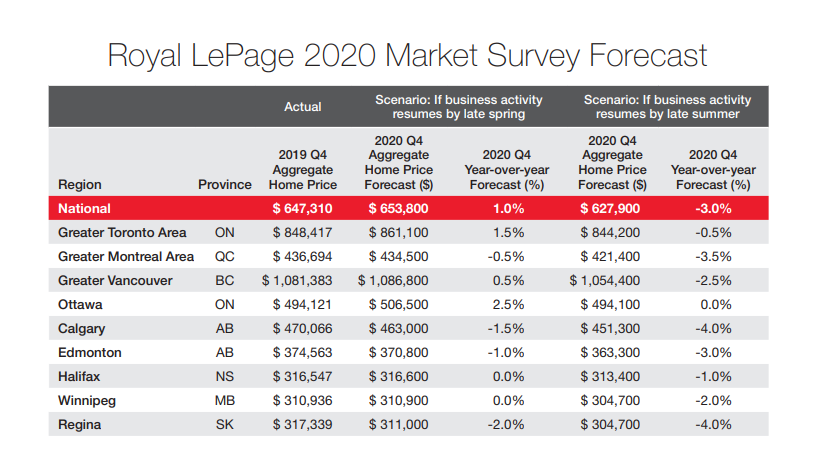
While there are many variables still at play, housing prices are forecasted to remain steady through 2020, according to Royal Lepage’s newly released Housing Price Survey and Market Forecast. Any changes that do occur will depend upon the timespan of stay-at-home orders, the reports states.

During the first three months, when COVID-19 cases were beginning to make their ascent and social distancing rules weren’t as strict, the average national home price saw a 4.4 per cent increase compared to last year’s first quarter, sitting at $655,276.

If restrictions are lifted and the pandemic eases by the end of June, the average price is proposed to rise only one per cent year over year to $653,800. If the crisis continues on through the end of the summer, the price could fall three per cent to $627,900.

Sharp drops in interest rates haven’t been passed on to consumers by Canada’s big banks, so its effect on housing prices is negligible. People aren’t out shopping for homes, or even most non-essentials.

The reason that home prices are expected to remain relatively stable comes down to supply and demand, says Soper. There are fewer people looking to buy a home, but there are also fewer listings for sale as people prefer to stay at home. What would change prices is an imbalance between the two.

“Right now, as strange as it might seem, there is a sellers market in Canadian residential real estate because there is lots of competition between a far reduced group of buyers for a limited number of properties,” he notes. “That will continue through the evolution of this crisis.”

When things do ease back to normal, first-time buyers are predicted to return faster to the market than sellers. This group, says Soper, makes up 35 to 40 per cent of all transactions; sellers, on the other hand, have owned a home for a while and tend to be older. They also can’t manage their safety as easily as a buyer. Under new protocols, anyone selling their condo has to leave and can’t be on the property during a showing.

“That perceived additional risk that comes with age—all of these things are going to lend to a strange kind of housing shortage during the pandemic,” Soper forecasts, “When you have a housing shortage it’s kind of hard for prices to fall.”

He says the condo market will likely suffer more than the single-detached market for a couple of reasons. The short-term rental industry, currently restricted to those in need of housing during the emergency, will likely see a slow recovery, while the fate of employment and job security could also cause younger renters to move back home with families, which would take some housing demand away. Developers have also slowed plans for new builds that will bring less supply to cities already seeing housing shortages.

housing market

High demand and low inventory in Toronto, Montreal and Ottawa fueled rising home prices in Q1. What is the regional forecast?

In the Greater Toronto Area (GTA), demand outpaced supply in Q1. The average condo price in Toronto jumped 8.8 per cent year over year to $580,508 —higher than any other housing type. Overall home prices in the GTA saw a 7.5 rise to $866,211. If business activity resumes by the end of the second quarter, the GTA may see a year-over-year increase of 1.5 per cent, pushing homes to $861,100 by the end of 2020. If quarantine remains in place throughout summer, this would bring prices down 0.5 per cent to $844,200.

In Ottawa, condo prices jumped 8.1 per cent in Q1. The city is expected to see a gain of 2.5 per cent if the virus remains a threat by the end of Q2 and will stay flat if business resumes by summer’s end.

Housing prices in Vancouver, Edmonton and Calgary are on a downward trend, with the average price of a condo dropping 2.5 per cent ($636,012), 5.3 per cent ($215,223) 7.2 per cent ($261,778), respectively. If business doesn’t resume before the summer, Edmonton could see a drop by as much as three per cent and Vancouver could see prices go down 2.5 per cent compared the end of 2019 and Calgary would see a 4.0 per cent drop.


CMRAO extends licence renewal period

CMRAO is extending the application and payment of licence renewals for the 2020 to 2021 licensing year to September 8, in an effort to ease pressure from the pandemic.

To ensure that there is no breakage in licensure, information in the CMRAO’s system will be updated to reflect this change, Ali Arlani, registrar and CEO of CMRAO, said in a press release. Licensed individuals and companies can continue offering condo management services as long as they submit their renewal applications by the new date.

The steps for the 2020 to 2021 renewal process are as follows:

For individual condominium managers

  • Beginning August 1, all licensed individuals may log in to the system, complete the renewal application form, and pay the annual fee for the 2020–21 licensing year.
  • Licensees will have until September 8, 2020, to submit their renewal application and pay for their licence renewal.

For condominium management companies

  • On July 1, the CMRAO will send a notice to all licensed management provider companies. During the month of July, licensed provider companies will be required to log in to their account and validate their roster of licensed employees.
  • On July 31 at 11:59 p.m., the system will calculate the annual licensing fee for all licensed companies based on the information in the system.
  • Beginning August 1, all licensed companies may log in to the system, complete the renewal application form, and pay the annual fee for the 2020–21 licensing year.
  • Licensed companies will have until September 8, 2020, to submit their application and pay for their licence renewal.

Next year, the CMRAO will return to its regular licence renewal process beginning on May 1, 2021, and ending on June 30, 2021.

Five new Alberta schools to stimulate economy

The Alberta government is moving forward with tender packages for the design and construction of four K-9 and one K-4 school projects that will be located throughout the province.

Construction on the projects is expected to get underway in September 2020, with occupancy set for September 2022. Request for proposal is anticipated to begin April 30.

“Continued investment in public infrastructure projects like the construction of these five schools is an integral part of the government’s economic stimulus package to invest in needed infrastructure and get Albertans back to work,” said Minister of Infrastructure Prasad Panda. “We are working hard to identify shovel-ready projects, accelerate processes and get construction underway as quickly as possible.”

The five schools that will be built are:

  • K-4 public school in Calgary, Auburn Bay
  • K-9 Catholic school in Cochrane
  • K-9 Francophone school in Legal
  • K-9 Catholic school in Edmonton, Windermere-Keswick
  • K-9 public school in Edmonton, Windermere-Keswick

According to the province, the five schools will cost $100 million and create approximately 560 construction jobs.

“The Alberta Construction Association welcomes the decision by the Government of Alberta to accelerate this bundle of projects to provide much-needed economic stimulus and recovery for the construction industry and our province,” said Frederick Vine, chair of the board of directors, Alberta Construction Association.

Virtual meetings find new relevance during crisis

Effectively operating a condominium is a juggling act at the best of times. In a few short weeks, COVID-19 has utterly upended our world; keeping all the balls in the air is now trickier than ever.

The Ontario government recognized that property management companies are essential to the health and safety of condominiums by allowing the firms to stay open for business during this global pandemic.

But how do you ensure a community runs smoothly in the new reality of social distancing and self-isolation when a best practice of good condominium management is holding regular meetings with quorum? Without hashing it all out in person, how does a board and its management team collaborate to pick contractors for repairs, ensure completion of urgent work, set timelines, monitor finances, develop budgets, protect the health and safety of residents and staff, pinpoint priorities, address resident concerns, and so much more?

Condominium life doesn’t get put on hold during a worldwide health crisis; if anything, clear communication and nimble decision-making become paramount when the global situation and business landscape can change hour by hour. Add to the mix the spring AGM season and the challenges may seem insurmountable.

Enter virtual meetings. In this emergency, the infrastructure that developed in recent decades has stepped into the breach. When stakeholders can’t be in the same room, connecting remotely is an excellent alternative that still enables all parties to engage and collaborate—even face-to-face—without missing a beat. Ontario condominium legislation permits digital or electronic board meetings (e.g., by video or teleconference) as long as directors can communicate concurrently. This applies only to board meetings, not AGMs or other owners’ meetings, unless the condominium’s existing bylaws contain such a provision. Boards can also vote remotely to amend a bylaw to allow for digital owners’ meetings. This should be considered when social distancing is in place.

Here are some insights about remote communication

  • The Difference Between Videoconferencing and Teleconferencing: Most organizations that are accustomed to working with their teams in-person prefer videoconferencing over audio-only calls. Video isn’t difficult to use and it more easily facilitates social learning and focus even while working remotely. It can also be preferable for tallying votes when a motion is presented at a meeting and for keeping track of who says what. But make no mistake, making decisions and taking action by teleconference are still preferable over not acting at all merely because an in-person meeting isn’t possible.
  • The Top Platforms — Zoom vs. Google Meet vs. GoToWebinar: All three platforms can support dozens of attendees at a time, enable screen sharing, and offer good connectivity. All that’s needed are a decent Internet connection and a functional device. Zoom is easy-to-use, intuitive, and simple to schedule. Google Meet is a smooth transition for users of other Google products. GoToWebinar is the best tool for polls, voting, and obtaining attendee reporting/analytics.
  • Your Recording Secretary Can Still Attend Your Meeting Virtually: As always, proper documentation creates continuity for a corporation as it navigates all the decisions and tasks involved in managing a condominium. Your minute taker can log-in or dial-in to take minutes live, or can complete the minutes offline from a recording. All the above videoconferencing options can also record your meeting; if you go this route, make sure your team consents to your policies for recorded meetings and understands the privacy considerations.

While it’s true there can be an initial learning curve in adapting to new technology, the pandemic has highlighted the convenience and efficiency of virtual meetings, not just when social distancing is required. When calmer times return, remote, live communication will complement in-person meetings, and may even replace them in some situations.

Virtual solutions expand the business landscape by offering further options for following best practices in condominium management and for tackling new challenges creatively and collaboratively.

Marko Lindhe is vice-president of sales and marketing at Minutes Solutions [email protected] | 888.570.1149 x 2 | www.minutessolutions.com

Tech aids condo compliance during COVID-19

ICC Property Management is using technology to digitally track its response to COVID-19 and enhance safety for residents and staff in its condominium high-rises and townhouses in the Greater Toronto Area.

Steven Christodoulou, founder and chief visionary officer of ICC Property Management, worked with Toronto tech firm Safe Buildings to begin digitizing their risk management program, which is helping staff to access building operations information while respecting work-from-home and social distancing guidelines at the buildings.

“The problem with the way we were doing it before was that it was manual and there was no way of proving compliance to our boards,” says Christodoulou. “As a property manager, you have to be a jack-of-all-trades and navigating through the fire and safety code requirements can be difficult.”

The technology also includes a digital checklist for cleaning, safety and security checks. ICC rolled out the initiative several weeks ago and is seeing significant benefits for its COVID-19 response. The management team is now digitally tracking safety and security compliance, and the cleaning of targeted touch points.

“As an industry, we are all taking steps to enhance employee and resident safety and with technology we can remain at the forefront,” said Judy Statham, president of ICC in Toronto. “Board members may access this as part of a condo corporation’s business continuity plan, something that we are taking very seriously here at ICC. This makes it easy to implement protocols at each of our buildings and allow us to apply lessons learned – strengthening our portfolio of communities.”

ICC is the first property management company in Canada to use this technology across its entire portfolio. The initiative is said to reduce the ongoing costs of fire safety plans by up to 50 per cent.

“The technology is changing how we look at evidence of compliance,” says Jason Reid, developer and technical advisor for Safe Buildings in Toronto. “Most organizations do great work and complete their safety and security checks. The problem is, they lack the evidence of completion.”

ICC’s platform provides both date, time and photographic stamped evidence that elevates the standard of care within a building.

“By going digital, we are supporting building staff with the right tools to have a direct impact on resident safety before and during emergencies,” expressed Lisa Rapisardi, an ICC condo manager in Toronto. “Code requirements can be broken down into daily, weekly, monthly and annually—that’s a lot to remember when you’re overseeing the day-to-day operations of a building during these trying times. Forgetting even one of these checks can pose huge issues for a property manager when fire inspectors visit.”

Other property management companies are using technology to enhance safety and security and realizing the value of technology to their properties.

“We went digital two months ago – I receive a report every morning,” said Lubko Belej, general manager of The Residences of Maple Leaf Square, managed by Del Property Management. “Doing the daily checks, we can see some of the safety issues that might pop up. If a report isn’t done, I get a notification. Then, I can ask our staff why it wasn’t done and to complete it so that we have the evidence – and keep our residents safe.”

Currently, there are condominiums in the GTA digitally tracking the cleaning of touch points in the building every three hours as part of their COVID-19 response plan.

“If they forget, the staff are reminded until it’s completed, and the date and time stamped evidence is maintained forever,” says Reid. “In risk management, it’s this evidence of completion that’s as important as the task.”

Rebecca Gicante oversees administration and special projects at National Life Safety Group and is a certified corporate wellness specialist.


Construction faces pandemic challenges

Risks and challenges are nothing new for the B.C. construction industry. As the COVID-19 pandemic continues to wreak havoc on businesses and daily lives, the industry will need to rely on its diversity, resiliency and innovation more than ever to soften the economic blow of the global health crisis.

Due to the often dangerous working conditions in the industrial, commercial, and institutional (ICI) sector, construction sites already have strict safety protocols in place. This has made it somewhat easier for companies to respond and implement new best practices to combat the novel coronavirus.

“The construction industry is resilient and used to managing risk. COVID-19 will challenge us, but we will work together and we will come through it,” said Chris Atchison, president of the B.C. Construction Association. “With construction contributing just under 10 per cent of provincial GDP, the sector is absolutely essential to the economic health of our province.”

The B.C. government has defined the construction industry as an essential service, so jobsites are allowed to remain open as long as the required COVID-19 health and safety precautions are followed. Because the health threat could last months, many in the industry are rising to the challenge and finding innovative ways to comply.

“Our sites remain operational and we have taken all the necessary steps to be compliant with the orders from the provincial health officer,” says Mike Maierle, principal and founder of ETRO Construction. “We’ve been monitoring the situation closely from the beginning and have been very proactive in taking the necessary actions to keep our people safe.”

Some of the measures ETRO have taken include physical distancing rules, additional signage, additional hand washing stations and a digital screening questionnaire prior to any worker entering jobsites.

“Because we are a Gsuite company and we have a thoughtfully implemented tech stack, the transition has been seamless and we have been able to stay connected and productive,” says Maierle.

While construction is allowed to continue, some projects are being put on hold or delayed as a result of the pandemic.

“We anticipate further impact to current projects as we implement physical distancing requirements and limit resources on site. In regards to supply chain issues, we are just beginning to feel the effects and it will be a challenge for months to come,” says Maierle.

At LMS Reinforcing Steel Group, work is continuing but most projects have slowed down schedules to accommodate for less workers on site. Rebar supply is not currently an issue, according to Norm Streu, LMS president and chief operating officer.

“The industry in B.C. has done a good job in coordinating an approach to safe procedures on sites. There has been broad sharing of best practices among all parties, and good communication. All parties have understood that safety of the workers is the top priority, not short term schedule objectives,” says Streu.

Wales McLelland Construction has implemented all Health Canada recommendations to reduce the potential risk to employees, vendors, and associates.

“Our employees are embracing the changing work environment,” says Kevin Armon, Wales vice president of construction. “Yes, working conditions are challenging, but our people remain positive and focused, and approach each day with intention and ambition.”

All of Wales’ construction sites are open with work progressing on schedule, while adhering to recommended upgraded sanitation, monitoring of personnel, and practical separation protocols.

“We are sharing lessons learned, innovations, and success stories across our job sites. We are also providing weekly video updates to our clients to keep them updated on the status of current projects,” said Wales president Doug Scott.

He adds, “The investment our clients make in their projects is significant. Delays are costly and disruptive, and we are fortunate to have a strong network of suppliers and subcontractors who are committed to supporting each other and our clients through this crisis.”

While much of the economy is grinding to a halt due to the pandemic, construction offers some optimism. The construction sector is one of Canada’s largest employers and will be a major contributor to the country’s economic recovery. The industry, 70 per cent which are small and medium-sized business, employs more than 1.5 million Canadians and contributes 7 per cent of Canada’s Gross Domestic Product.

In B.C., construction is a $16 billion dollar industry, and over the past decade has consistently been one of the fastest growing sectors. Construction supports many critical sectors such as transportation, water, and healthcare. Development applications continue to be processed and reviewed by municipalities to stimulate the local economy and create jobs, helping to ensure the industry keeps operating during this challenging time.

“B.C.’s construction industry is in the privileged position of being defined as an essential service,” says Fiona Famulak, president of the Vancouver Regional Association. “As the largest employer in the goods and services sector, the health and safety of our workers continues to be our No. 1 priority; we are ready and able to implement enhanced safety protocols that will keep our workers safe and employed; and we own our collective responsibility to help position B.C. for economic recovery.”

The construction industry is also doing their part to support communities and healthcare providers during the COVID-19 crisis. In-demand equipment, routinely used in construction including n95-rated masks and eye protection, have been collected by members and donated. At #CDNConstructionGives, there are hundreds of examples of how the industry is making a difference from food banks to pet shelters.

ETRO Construction is giving back and supporting the community in any way possible including volunteering with Meals on Wheels.

“We have reached out to the Health and Home Care Society of BC and are in the process of having our team volunteer with Meals on Wheels. Meals on Wheels typically provides meals to 500 people per day and because of COVID-19 they have had to reduce this to about 200. They are in desperate need of volunteers and we want to do our part to support the vulnerable people in our society during this time,” says Maierle.


Cheryl Mah is managing editor of Construction Business. For more COVID-19 coverage, visit here.

 

The Benefits of Building Energy Modelling

Building Energy Modelling (BEM) is a versatile, multipurpose tool used in both new construction and existing buildings. Now mandatory for all new builds in many jurisdictions throughout Canada, energy modelling can help inform decision-making at the design-stage; show code compliance; achieve green building certification; and guide policy and code development as the world collectively seeks out new ways to reduce its carbon footprint.

“An energy model is a computer simulation of a building that takes into consideration the architectural geometry, building enclosure systems, mechanical and electrical systems,” explains Mohammad Fakoor, Senior Building Performance Engineer with RJC Engineers. “It can be used to simulate the thermal performance of a building in order to calculate the Thermal Energy Demand Intensity (TEDI), Total Energy Use Intensity (TEUI), and Greenhouse Gas Emission Intensity (GHGI).”

The simulation software works by enacting a mathematical model that provides an approximate representation of a building. It requires a vast amount of data input, as well as a qualified energy modeller to achieve optimal results.

Terry Bergen, Managing Principal at RJC Engineers’ Victoria office is a huge advocate of this technology, calling it “the most powerful design-assist tool available to a project team.”  According to Bergen, a well-prepared energy model will account for the following factors:

– Building mass, shape and orientation;
– Neighbourhood effects of surrounding buildings;
– Building structure;
– Enclosure and façade performance;
– Mechanical and HVAC loads;
– Electrical loads and lighting intensity;
– Future climate loads.

When inputted correctly, the benefits delivered can be invaluable for building owners, designers and occupants alike. Projections can play a significant role in determining Energy Conservation Measures (ECMs), leading to reduced operating and maintenance costs over the life cycle of the building. They also lead to improved occupant thermal comfort and a lowered carbon footprint. In new buildings, design-assist iterations can help the design team determine the most suitable form of the building, and the impact of design choices on energy efficiency.

energy modelling RJC

Getting reliable results

Although the end results may not represent the actual energy consumption of a building, the overall reliability of an energy model is largely dependent on the component information being as accurate and meaningful as possible. For example, Bergen points to the performance values of a building enclosure, stating that they should account for the effects of thermal bridging and linear transmittance to be accurate.  “A frame wall with R20 batt insulation must not be input into the model as an R20 assembly,” he says. “Accounting for wall framing and thermal bridging, the clear effective value may be R10.  Factoring in building structure, linear transmittances, and thermal bridging, the correct value would be R5 or less.”

When done accurately, energy modelling can lead to more cost-effective energy conservation measures and a long-term reduction in energy consumption. Well-prepared energy models can also be used to perform thermal comfort studies to forecast occupant comfort under different meteorological data, including future climate projections.

Energy modelling and the future

Energy modelling has been a part of the building code for more than a decade; however, with Canada’s commitment to reducing greenhouse gas emissions by 30% by 2030, the importance of this multipurpose building tool is more pronounced than ever.

“Different provinces across the country are adopting more contemporary energy codes and standards to advance the energy performance of buildings” says Fakoor. “For example, both British Columbia and the City of Toronto have adopted new stringent energy standards using a passive house philosophy, with the goal of “net-zero ready” buildings by 2030. We anticipate that energy modelling will become an inevitable part of the building design in the future, and more qualified practitioners will be employed to meet the demand.”

To find out more about energy modelling, please visit www.rjc.ca or reach out to Mohammad Fakoor directly at: [email protected]

Ontario electricity prices flout sliding demand

An hourly Ontario energy price (HOEP) of $0.00 per kilowatt-hour (kWh), like the one posted yesterday afternoon, doesn’t translate into windfall savings for commercial electricity customers. Rather, it signifies that the global adjustment (GA) — the opaque bucket of costs for contracted supply, nuclear facility refurbishment programs and conservation and demand management initiatives that accounted for more than 85 per cent of the commodity cost in Ontario electricity prices last year — is set to climb higher still.

“The negative HOEP is interesting, but not especially relevant for commercial and institutional consumers,” advises Michael Lithgow, manager, energy and climate change, at Sunnybrook Health Sciences Centre. “It’s inversely correlated to the GA and, for every kWh, you’ve still got to pay the usual regulated (transmission and distribution) charges.”

Despite a steep drop in province-wide energy consumption due to COVID-19 triggered business shutdowns, many building owners/managers expect a more modest flow-through dip in operating costs. The GA is central to that forecast, both due its quirky apportionment and its track record as the repository for added, often unspecified costs the Ontario government needs to cover.

In the latter case, that could be the burden recently removed from residential, small business and farm customers when the government flattened time-of-use pricing and set prices at the off-peak rate of 10.1 cents/kWh for at least 45 days. “It’s a great initiative, but one consequence could be that the GA goes up to cover the cost,” says Neal Bach, president of the energy analytics firm, Energy Profiles Limited.

Blended rates snare some Class A consumers

There may be another shock for some Class A customers who enjoy a locked-in factor for calculating their monthly GA allocation. The select group of large industrial and commercial consumers with average monthly peak demand of at least 1 megawatt (MW) and smaller manufacturers with average monthly peak demand of at least 500 kilowatts typically includes commercial buildings in the 350,000+-square-foot range.

However, the formula for apportioning the GA, which will be in place until June 30, doesn’t align well with a sudden sharp decline in province-wide demand. Bach suggests the larger group of Class B customers — generally encompassing small and mid-sized commercial buildings — which pays the GA on a volumetric per kilowatt-hour (kWh) basis, may now be in a preferred position compared to some Class A consumers.

“Some Class A commercial customers are currently experiencing much higher blended rates because the GA costs are fixed until June 30. Consumption has dropped considerably at most properties — e.g. largely vacant office towers — but costs for borderline Class A customers are dropping to a much lesser degree,” he observes. “On that basis, for March to June 2020, Class B consumers with significantly reduced consumption will end up paying less than they would have if they opted in for Class A.”

Under the rules of Ontario’s Industrial Conservation Initiative (ICI), Class A customers pay a share of the GA prorated to their energy demand during the five hours of system-wide highest peak demand in the period from May 1 to April 30. That’s then used to calculate their GA allocation in the ensuing 12 months from July 1 to June 30. Thus, current Class A customers pay GA that’s tied to five hours in the summer of 2018 when system-wide demand peaked at 23,240 megawatts (MW) to 21,885 MW.

After Class A customers’ allocation is calculated each month, the remainder of GA costs is simply apportioned to Class B customers as a straightforward per-kWh charge. With Ontario’s daily peak demand hovering in the 14,000 MW range thus far in April, it’s expected that Class A customers will take on a larger than usual share of GA costs — a scenario that has always been possible, but never really anticipated. In 2018, for example, Class B paid about 35 per cent more of total GA costs than Class A.

“Theoretically, if the majority of Class A customers don’t have a good peak demand factor, Class A would actually pay more and Class B would get a break, but I don’t think that’s going to happen,” Scott Rouse, managing partner of the consulting firm, Energy@Work, mused in 2017.

Now, he projects Class A customers with relatively stable energy consumption should continue to benefit from their status. “However, those Class A customers that have been forced to shut down are going to be in for a surprise,” he notes.

New ICI cycle soon to begin

This also occurs within the context of anticipated price adjustments for industrial customers, following last year’s consultation process and strong hints in the Ontario government’s fall 2019 economic outlook and fiscal review. “The government is proposing to take near-term action to reduce the red tape burden in the electricity system by working with the Independent Electricity System Operator (IESO) to simplify and streamline industrial electricity billing and the Global Adjustment settlement process,” it stated.

With the COVID-19 crisis delaying the release of the full Ontario 2020 budget and putting other provincial business on hold, that action is unlikely to occur before another one-year cycle of the ICI program begins on July 1. Class A customers have already carved out their share of the GA for the 2020-21 period since the five determining peak hours from May 1, 2019 to April 30, 2020 period all occurred last July.

Now it’s just a matter of waiting for their local distribution companies (LDCs) to confirm their performance — known as the peak demand factor, based on their energy demand during those five hours. Conventionally, LDCs report to Class A customers by May 29 so that they, in turn, can decide whether to opt into the ICI program by a June 15 deadline.

“If they’ve guessed the correct five hours and curbed their energy loads accordingly, they’ve reduced their global adjustment charge, which can be particularly beneficial for companies that have large pieces of energy-consuming equipment, like an arc furnace, for example,” says Andrew Pride, an energy management specialist who consults on energy efficiency and strategic conservation programs. “If all use drops 10 to 15 per cent and a Class A customer hasn’t picked the correct peaks, it would be on the hook for a larger bill than last year.”

Even so, others speculate that could still be the best option.

“With demand so low, the HOEP can be expected to drop even lower than it already is, which would put more upward pressure on the GA and cause costs to go up for Class B consumers as well,” Bach says.

“If the Class A consumers have a fixed amount based on their peak demand factor and the residential rates are capped, who will pay the increased GA costs?” Rouse ponders. “Class B is left.”

The Building Owners and Managers Association (BOMA) of Greater Toronto will once again host its annual workshop to weigh the  possibilities, which, this year, will take form in a May 12 webinar.

Barbara Carss is editor-in-chief of Canadian Property Management.

VRCA joins call for construction cost relief program

The Vancouver Regional Construction Association (VRCA) is joining the Canadian Construction Association (CCA) in calling on the federal government to establish an emergency COVID-19 Construction Cost Relief Program.

Simultaneously, VRCA is urging its member companies and their employees to support the call by sending a letter to their local member of parliament to demand action in support of the industry and its workers due to the COVID-19 crisis.

“Working in lockstep with a strong national association has never been more important than during this pandemic,” said Fiona Famulak, VRCA president. “Our partnership with CCA helps amplify our regional voice to ensure the concerns and challenges of our member companies and their employees are heard by the federal government.”

The federal government has hundreds of critical projects that are already in progress or need to be maintained. Many of these are essential to the well-being of Canadian citizens, including defence, security, infrastructure and the administration of justice and government. The associations are asking the federal government to continue with these projects and to tender and award new projects.

In British Columbia, the construction industry has been identified as a non-health essential services provider, that can not only help to keep workers employed during the pandemic – provided enhanced site safety protocols are in place – but also positions the province and country for economic recovery following the pandemic.

During these unprecedented times, the industry is looking to the federal government to exercise fairness and consideration when addressing schedule and cost impacts experienced by contractors on federally funded contracts. The associations are calling for the federal government to:

  • Provide businesses with fair extensions of time and fair compensation for reasonable costs incurred due to the COVID-19 pandemic.
  • Compensate businesses for reasonable costs incurred and that are supported by sufficient documentation. For example, costs incurred as a result of:
    • Demobilization;
    • Making a site safe;
    • Interruptions of the supply chain;
    • Extended rentals;
    • Additional overheads during delay; and
    • Site security.
  • Continue existing payment terms with prompt and appropriate approvals to ensure timely release of monies.

The associations’ request acknowledges that contractors will need to provide proper notices as required under contracts, keep adequate records of all relevant information, mitigate costs, and be transparent and forthcoming in discussions with the Government of Canada regarding the schedule and cost impacts related to the COVID-19 pandemic.

“Our industry is privileged to be an essential services provider in B.C. and has pivoted quickly to put enhanced safety protocols in place in order to continue to operate,” said Famulak. “Those steps come at significant additional cost to the industry that need to be recognized and addressed.

“The creation of an emergency COVID-19 Construction Cost Relief Program that is separate and distinct from existing contractual documents and obligations is a practical solution to the COVID-19-related cost burden associated with federally funded infrastructure projects and has the potential, over time, to also be implemented by other levels of government.”

Rent delinquencies in April lower than expected

Despite calls for a rent strike by tenant groups in late-March due to COVID-19-induced financial woes, approximately 85 per cent of Canadian renters paid part, if not all of their rent according to CIBC’s deputy chief economist, Benjamin Tal.

Tal said that close to 75 per cent of tenants paid rent in full, another 10 per cent paid roughly half, while 15 per cent did not pay any rent for the month of April. These figures were drawn from estimates calculated from surveys conducted among rental housing companies.

Given the crippled state of the economy and the fact that more than 25 per cent of Canadian households are renters, experts projected that rent delinquencies in April would have been higher. With May fast approaching, we may see a significant drop.

B.C. is currently the only province with a formalized policy to assist renters. For those impacted by COVID-19, the government is offering financial support to the tune of $500 per month, rent freezes throughout the pandemic, and a complete moratorium on evictions.

Whether other provinces will follow suit with a rental supplement program remains to be seen, but a petition containing hundreds of thousands of signatures has been sent to Prime Minister Trudeau calling for all rent and mortgage rates to be suspended during the pandemic.

Senior housing in the age of COVID-19

From Vancouver to Bobcaygeon, Ottawa to Montreal, facilities catering to seniors have been battling surging infection rates since COVID-19’s devastating path began. Given that older Canadians are more vulnerable to catching severe forms of any illness, robust protocols are needed at the best of times, particularly at Long-Term Care Homes (LTCHs) where residents are older, frailer, and have complex chronic conditions. But throw in a highly contagious global pandemic and suddenly it’s a fight against all odds.

Revera, the parent company of multiple long-term care and retirement homes throughout Ontario, has been battling outbreaks in several locations despite having adhered to what it calls “strict pandemic protocols”. Currently, Stoneridge Manor in Ottawa and Forest Heights in Waterloo are Revera’s hardest hit properties, accounting for dozens of positive cases in residents and staff members alike.

In a press release issued April 12th, Revera announced it is working closely with public health officials to contain the situation, implementing decisive new measures that include: disinfecting all facilities using the Clorox 360 Disinfectant Cleaner system; effecting a universal masking policy for all staff; ceasing all group recreation programs; and other strict practices to mitigate the spread.

“We continue to update residents, their families and the staff on the status of the outbreak,” Revera said in the statement. “Right now, our energy and resources are focused forward on containing the spread of this outbreak and protecting our residents and staff. We welcome a time when we can look back and reflect on these events with the benefit of hindsight.”

Of course, Revera isn’t the only senior living operator facing difficult times. Since the state of emergency began in mid-March, even homes without any known cases have been affected by the stark images circulating of ailing residents suffering alone in what appear to be poorly run facilities.

In Ontario, new emergency measures intended to increase the service capacity of long-term care homes had some groups fearing more harm than good. CARP, the Canadian Association for Retired Persons has long advocated for the government to take action in providing better ratios of qualified staffing in long-term care, but worries that the removal of requirements for incident reporting could further jeopardize lives.

“It shouldn’t take a pandemic to trigger action from government in addressing the shortage of qualified personal support workers in Ontario,” said Marissa Lennox, Chief Policy Officer at CARP. “Now is not the time to gamble with the welfare of vulnerable seniors in long-term care.”

In Quebec, the ongoing health emergency has exposed deep concerns about the province’s long-term care sector, which had already been struggling from staff shortages before COVID-19 began. The recent deaths of more than 30 residents of a private nursing home in Montreal have sparked an official investigation by health authorities and the police. Allegedly the owner, Gatineau-based Katasa Group, concealed health information while failing to properly maintain the facility or adequately isolate those who’d been infected. Addressing the situation at a press conference in April, Quebec Premier François Legault said the situation seemed like “gross negligence.”

Meanwhile earlier this month, the Quebec government announced a series of new measures aimed at helping the overburdened long-term care system, including testing for all patients and workers, promising more equipment and the deployment of 450 additional doctors and 500 nurses to the centres. But what about those retirement homes also weathering this challenging storm?

Operationally intensive

As Sienna Senior Living pointed out in a recent statement to stakeholders, the management of COVID-19 is “operationally intensive” given the demographic of your typical retirement home tenant base. Despite being generally healthier and more independent than residents of long-term care facilities, older individuals are simply more susceptible to falling critically ill.

In late March, the Ontario government announced $20 million in funding for retirement homes facing extraordinary expenses related to COVID-19—this in addition to the $243 million allocated to long-term care homes managing the pandemic crisis.

“We are working extensively with sector associations, peers and all levels of government agencies to navigate this situation together with one collective goal of preserving health and the safety of residents, teams and their families,” Sienna Senior Living said.

Chartwell Retirement Residences has also issued a statement to the public in hopes of alleviating some of the concerns that have arisen about congregate living, citing government regulations as one reassuring factor.

“Retirement residences are regulated by government authorities, meaning all homes are mandated to have robust policies and protocols that protect the wellness of residents,” it said. “These regulations are implemented not just in times of outbreak, but at all times—meaning retirement communities are always prepared to respond to illness outbreaks and other emergencies.”

Other key points in support of congregate living:

  • Retirement residence staff are tasked to regularly monitor residents for any signs of illness. Unlike an older adult living alone who may face barriers to seeking immediate medical attention, trained staff are there 24/7 should help be required.
  • Residences are equipped for quarantine situations. Staff are there to support a resident if they require isolation in their suite during an outbreak, including delivering three meals a day, continuing to provide care services, laundry and cleaning of their suite, and to provide reassurance that they will be cared for.

The question is, will this pandemic reshape our thinking about senior’s homes in general? Congregate living has its advantages, to be sure, but the containment of contagious illnesses doesn’t appear to be one of them.


Responding to the coronavirus crisis

The level of uncertainty is high. The COVID-19 crisis presents challenges for architects and all those in the profession, as well as our families, clients, colleagues, and communities. The impacts are far-reaching, affecting us socially, mentally, and financially. We face this pandemic collectively, and we must all do our best to respond to this crisis in a manner that is prudent and compassionate.

I would like to iterate that the public’s expectation of professional standards has not diminished. Confidence in the regulation of the architectural profession remains, and the response to this crisis must be in alignment with these expectations in order to maintain the public’s trust.

AIBC has received communication/feedback regarding COVID-19 – various ideas, concerns, and recommendations – and how the profession should respond, and what role the AIBC should play. Several common themes have emerged:

Practice Resources

Many members have reached out with specific practice-related questions. They have ranged from clarification on professional obligations, to inquiries about impacts on municipal permit processes. Registrants are looking for resources during this time of uncertainty, specifically about how architectural professionals should be navigating and responding to COVID-19.

To help address this, the Institute has created a dedicated COVID-19 webpage to share information with registrants. An “Architectural Practice” section can be found at the top of the page, which includes specific information about field reviews, digital seals, standard form contracts, and more. I highly encourage you to check the page frequently, as new information is posted as soon as it becomes available. In addition to the website, registrants can reach out directly to the AIBC Practice Advice team, who can also assist with questions.

AIBC Council and staff are aware of the profound impacts this has on the profession – the Institute is committed to helping registrants navigate the practice-related challenges caused by COVID-19, and will continue to share information as quickly as possible.

Continuing Education System Deadline Extension

We have also received feedback – both in support and not – of the CES deadline extension to September 30. Given the rapidly changing situation, I would like to emphasize that all decisions, professional expectations and regulatory obligations are being reviewed as the crisis evolves.

The three-month extension was the maximum length that could be granted without seeking AIBC Council’s formal input; expediency was paramount, and extensions beyond this threshold require additional regulatory and procedural steps. Regulatory bodies across Canada have approached their continuing education extensions in a variety of ways, and this is because there are fundamental differences between jurisdictions, including mandates, policy, and approaches to CES.

To help registrants meet their requirements, the AIBC is compiling a list of additional online learning opportunities that will be shared. It is worth noting that the AIBC requires half the number of total hours than several other jurisdictions and that 50 per cent of AIBC CES participants are currently compliant, or within six hours of being compliant.

Again, and most importantly, we recognize the response must be reasonable given these unprecedented circumstances. As needed, further adjustments and action – including a possible additional CES extension – will be taken to help ensure registrants can fulfill their requirements, while still upholding the Institute’s core regulatory mandate.

Role of the Regulator

All of the primary functions of the Institute (from registration and licensing, to professional conduct and illegal practice) continue as staff work from home, and committee meetings take place remotely. While several programs have been affected by the pandemic, the AIBC continues to operate within its regulatory scope, and further its mandate through delivering a range of services and initiatives.

The role of the regulator during this crisis is to ensure that the public-interest is still being met, while also being adaptable and understanding of the impacts COVID-19 has on the ability of the profession to carry out its obligations and duties. These are unprecedented circumstances that have affected us all in different ways, and the regulator must be cognizant of this in its actions and responses. It is about balance.

With that in mind, registrants are encouraged to reach out and be part of their own communities. Across Canada and within the province, there are architectural and design-focused organizations with mandates that are centred around advocacy and community. The RAIC, for instance, has conducted surveys and drafted templated letters for members to send to the federal government encouraging the inclusion of the architectural sector in their funding support.

Looking Ahead

While it is unclear what exactly the long-term effects will be from this crisis, it is clear that the world, and the profession, will not be the same once it passes. There will be implications for how architecture is practiced: how we collaborate with colleagues, engage with clients, and review construction, will all change.

Likely new guidelines and protocols will greatly alter how we consider and shape space in general. However, as with many epochal events, the present circumstance also contains opportunity for advancement, and it is my hope that it aids in our ability to address other large systemic challenges like climate change – a challenge that is also abstract to many but requires collective action.

The practice of architecture is an intrinsically hopeful one, having as its core tenet faith in there being a tomorrow. This is still true, and I encourage us all to take a breath and remember this fact as we look ahead, and plan for the future – a future, that as architects, we will have a hand in shaping.

Ian Ross McDonald, Architect AIBC, AAA, NWTAA, OAA Council president

CAO announces changes to board

The Condominium Authority of Ontario (CAO) announced some changes to its board and officer roles.

In a recent press release, CAO says its chair had suggested that one of the board’s elected members consider stepping down due to conflict of interest and governance concerns. A board meeting was scheduled on April 8 to establish a process for reviewing those matters. Vice-Chair Frank D’Onofrio and Board Directors Tom Wright , Armand Conant and Genevieve Chornenki stepped down from their elected terms. The resignations were accepted and are effective immediately.

The process for filling these vacancies will begin later this month.

The CAO Board retains quorum and will continue to govern and guide the organization under Board Chair Heather Zordel , Board Director Judy Sue as Treasurer and Chair of the Audit and Risk Committee, and Board Director Margaret Samuel as Corporate Secretary.

The CAO says it remains fully operational to support condo owners through its ongoing digital information and services, and throughout the COVID-19 situation


Flood response to rely more on independent action

COVID-19 health protocol is sure to complicate flood response and cleanup in commercial and multi-residential buildings in the coming months, particularly if evacuation is required. Resilience experts are urging both property managers and residents to prepare and think about unconventional contingencies.

The timing is opportune for waterfront communities since peak springtime lake and river levels are still about a month away, and many homeowners and tenants are now ensconced in the very places that might need some attention. However, resilience experts warn that intense weather systems can wreak havoc at any time.

“The flash flood, which is really like a water bomb, can occur anywhere,” observes Natalia Moudrak, director, climate resilience, at the University of Waterloo’s Intact Centre for Climate Adaptation. “The time to prepare is when we don’t yet have an issue. The downside, if you don’t, is that you will be scrambling more than ever.”

In a flood situation, social distancing stipulations will necessitate independent action. Temporary quarters for evacuees will not be available in the conventional venues like community centres or school gyms and it will be highly problematic for volunteers to rally to the scene.

“Communities are asking residents and businesses to do everything they can to prepare. It’s very important to get ahead of this,” Moudrak reports. “If there’s a flood and you have to evacuate, you have to manage for yourself to figure out where you are going to go.”

Similar dilemmas could arise for multi-residential properties. Previously, local service providers have often used city buses to provide short-term shelter when residents have been forced to suddenly vacate a building. This is no longer an option.

“Is there space even available for people to congregate for a simple fire drill, let alone dealing with flooding?” Moudrak asks.

Such questions should be on property managers’ agendas now. To help with the answers, the Intact Centre has produced guidelines for both larger commercial buildings and single-family homes, outlining a range of mitigation and recovery considerations —including equipment, training/procedures and contracted services that may need to be deployed — along with simple, cost-effective actions owners and managers can take to reduce damage.

For example, apartment and condominium dwellers could organize and take inventory of their storage lockers, remove valuable and/or vulnerable items from the floor and take photos that could support insurance claims. Property managers should likewise ensure critical equipment is elevated above potential flood zones, and that emergency response equipment is in working order and on-site personnel know how to use it.

Homeowners should proactively clean out eaves troughs and catch basins, and disconnect downspouts. Those with time and resources for some simple landscaping might want to look at ways to channel the flow of water away from their homes. For guidance, they can download the Intact Centre’s checklist app, which will take them on a tour of all the potential vulnerable areas on their properties and automatically compile resulting homework assignments — an exercise that could perhaps serve double duty as a homeschool lesson.

“Right now is the perfect time to get your ducks in order and get prepared,” Moudrak asserts.

Traffic intensifies on migratory songbird flight path

Although Canadians are staying close to home these days, the migratory songbird flight path is experiencing a seasonal spurt of nighttime traffic. Advocates for bird-friendly lighting practices and building design are recommending some adjustments to the special lighting displays now popping up on the urban landscape to express solidarity and pay tribute to frontline workers responding to COVID-19.

“The birds we seek to protect play a significant role in helping us cope with the challenges of social distancing,” asserts Michael Mesure, executive director of FLAP Canada, an organization promoting simple steps for boosting the survival rate of birds in urban environments. “The more birds we see and hear in our neighbourhoods, the happier and calmer we find ourselves.”

Pointing to examples like Toronto’s CN Tower, which has been cloaked in special lighting effects for the past few weeks, a newly released statement from FLAP Canada applauds the sentiment behind the gesture but notes “we are compelled to remind everyone of the dangers that emitting bright light at night during migration periods can pose to migratory birds”.

In particular, bright, unwavering light in the white and red spectrum interferes with the moon and starlight cues that migratory birds instinctively use to guide their journeys. Instead, they may veer toward and continue to circle sources of bright light, risking fatal exhaustion or collisions with buildings.

Drawing on its expertise in lighting practices and design features that diminish the likelihood of birds becoming disoriented and fatally colliding with buildings, FLAP Canada suggests alternative light designs using intermittent light beams in the blue spectrum. “Blue light seems to attract fewer birds. In green light, birds are more disoriented than in blue light, but they are significantly more disoriented in red and white light (than either blue or green light),” Mesure explains.

Additional bird-friendly tips include, casting light downward, which will play less havoc with birds’ navigation systems than upward pointing beams that create sky glow. Limiting special light displays to the hours before midnight would also provide plenty of time for human observers to see and enjoy the message, while avoiding undue extra glare during the busiest flyover hours from midnight to dawn.

“We ask all building management, including the CN Tower, to find a balance between expressing appreciation for essential workers and protecting the lives of birds,” Mesure implores.