Articles Archive - Page 436 of 928 - REMINET
REMI

Quebec condo prices up 6 per cent despite pandemic

The average price of a Quebec condo increased to $255,000, a 6 per cent increase from the second quarter of 2019.

Sales, however, were down, with 4,760 condos sold since April—a 34 per cent dip since last Q2. The average selling time of condominiums also dropped significantly over the past year. Across the province, a condo sold in the second quarter of the year remained on the market for 77 days, which is a drop of 16 days compared to the second quarter of 2019.

Prices also jumped in the single-family market by 4 per cent, with a 19 per cent decline in sales. The largest price increase happened in Gatineau (17 per cent) Montreal (12 per cent) and Sherbrooke (10 per cent). Outside these cities, prices are trending even higher. Sainte-Agathe-des-Monts saw the average price go up 49 per cent since last year’s Q2.

In total, 22,102 residential sales transactions were concluded, a significant drop of 24 per cent since second quarter of last year when sales were at their highest level in fourteen years. In response to the pause in Quebec’s real estate market in the second quarter, market conditions stabilized in the vast majority of areas and continue to give sellers the upper hand.

“Although significant, this decline was offset by a strong rebound in June,” said Julie Saucier, president and chief executive officer of the QPAREB. “This market resilience was particularly evident in agglomerations located outside the province’s CMAs, where close to 4,300 sales transactions were recorded, an increase of 4 per cent in the second quarter, despite a 41 per cent drop in new listings,” she adds. “In the context of the health crisis, the Laurentides administrative region is one of the peripheral areas of the Montreal CMA that saw a sharp increase in prices.”

BC announces rent repayment framework

With the ban on evictions poised to lift September 1, 2020, the B.C. government has announced several planned residential tenancy changes, including a rent repayment framework for tenants owing money due to COVID-related income loss.

At a press conference on July 17th, B.C. Minister of Municipal Affairs and Housing Selina Robinson said the framework gives renters advance notice to plan ahead for upcoming payments so they may continue to live in their current housing after the moratorium lifts. All back-payments are to be paid to landlords in structured installments by July 2021, while the ban on rent increases will continue until December.

LandlordBC, a member-driven association and BC’s top resource for owners and managers of rental housing, supports the new plan, calling the repayment framework a workable solution.

“It is our view that the Province has navigated the COVID-19 crisis extremely well under very challenging circumstances,” said David Hutniak, CEO. “Renters are being provided a very fair and reasonable process to amortize the repayment of their unpaid balances, without any fees or interest being applied. Our approach has always been to work with government to find balanced solutions, and we feel that this repayment framework achieves this.”

That said, not all B.C. landlords are on side with the government’s pandemic measures  to date, but fortunately, numerous surveys show that most renters paid all or a significant portion of their rent throughout the state of emergency.

“As a sector, we understood that we were in the midst of an unprecedented health crisis,” Hutniak said. “We immediately encouraged our members to work collaboratively with their tenants to accommodate them as much as possible and to demonstrate appropriate sensitivity and compassion during the crisis. We are pleased to say that they answered the call.”

Changes to residential tenancies

B.C. renters and landlords impacted by COVID-19 can anticipate the following changes to residential tenancies as Phase 3 of the reopening continues:

• Renters will need to pay their monthly rent in full beginning September 2020
• A landlord whose tenant has unpaid rent or utilities during the emergency period would be required to enter into a repayment plan for those arrears
• A landlord would not be able to issue a Notice to End Tenancy for unpaid rent or utilities during this period unless the tenant has defaulted on their repayment plan
• A landlord would be able to issue a Notice of Rent Increase, but it will not come into effect until December 1, 2020

Many cities are aggregate recycling laggards

Millions of tonnes of asphalt and concrete are trucked away from construction sites in Ontario every year. Instead of being cleaned, screened and recycled, the popular building materials are dumped into landfills and stockpiled.

The Residential and Civil Construction Alliance of Ontario (RCCAO) just released a podcast, Aggregate Reuse and Recycling, highlighting reasons why this is happening.

Despite the many benefits to recycling aggregates, Rob Bradford, executive director of the Toronto and Area Road Builders Association (TARBA), and Kyle Martin, project manager at Fermar Paving said that many engineers are still choosing to use virgin material. TARBA commissioned independent research to examine the aggregate recycling policies and practices and ranked the municipalities based on whether they are leaders or laggards in supporting aggregate recycling.

“It’s easier to go with the virgin aggregate option than to, in their minds, take a chance and use a recycled aggregate,” Bradford said in the podcast.

An independent research study commission by TARBA and released in 2018 showed some municipalities used virtually no recycled aggregate and therefore were throwing away perfectly good renewable resources into the garbage via their landfills.

“We’ve got millions and millions of tonnes of stones going to landfill as garbage, said Bradford. “That doesn’t speak to any nature of environmental commitment by the municipalities, in my opinion.”

According to Martin, recycled aggregate is being used by the ministry of transportation and on some of the biggest stages, but some smaller municipalities have still been reluctant to use the material. That sort of culture probably won’t change until a new approach is adopted that advocates for a more sustainable way of doing things, he says.

“If you had to tell them that they had to find a spot or a home for 100,000 tonnes of recycled asphalt coming off the road they would certainly promote trying to get some of that going back into it as well and that’s what hasn’t happened yet on the contract side.”

Lemay unites Western locations under one name

Lemay + Toker, in Western Canada, is now officially recognized as Lemay, unifying the firm’s nation-wide brand. Founded more than 60 years ago in Montreal, Lemay has five offices across Canada.

The revision to the name ensures strategic alignment with Lemay’s transformation and expansion over the past few years, simplifying its regional operations and sharing tools and processes to provide its many national clients with more clarity and seamless collaboration.

“As one unified team, we will continue to combine our creative efforts to reflect our shared values, achieve our common goals, and display even more agility within our firm,” said Louis T. Lemay, president.

Eric Toker and Dedre Toker, founders of Toker + Associates and senior partners at Lemay + Toker following the 2017 merger, are retiring after 17 years. Grace Coulter Sherlock and Laura Grandan have been named regional directors in the West. Previously, they were associates at Lemay + Toker.

Coulter Sherlock has designed a wide range of award-winning architectural and interior design projects across Canada, many of them grounded in the prairie and mountain vernacular. She holds a master’s degree in architecture and a bachelor’s degree in urban studies from the University of Calgary.

Grandan holds expertise in constructability solutions, project management, and risk mitigation strategies, positioning client needs at the forefront of each project. She was named an associate after five years with Lemay + Toker. She achieved a Bachelor of Architecture from the University of Manitoba in 2009 and earned PMP Certification in 2014.

The Calgary office maintains its location on 12th Ave and the Edmonton office remains on Jasper Ave, supported by a team of 37 professionals between the two locations.

New Brunswick extends program supporting women in trades

A New Brunswick program aimed at supporting and mentoring women in apprenticeable trades has been extended by three years.

The program, entitled “New Boots: Progressing Women in Trades,” has been running since April 2018 following a 30-month pilot project and has since expanded from a cohort of 14 tradeswomen to more than 250.

“The New Boots program has continued to be proven successful and not only am I pleased to see it continue, our government is taking steps to ensure that it will,” said New Brunswick Post-Secondary Education, Training and Labour Minister Trevor Holder in a statement. “It has succeeded in getting more women to register for apprenticeship and has been an important resource hub for women in construction-related skilled trades.”

The program’s priorities over the next three years include aligning with:

  • department objectives related to training and labour,
  • poverty reduction and women’s equality initiatives under the New Brunswick Family Plan Framework,
  • the Social Development Strategic Plan, and
  • the government’s economic growth and development targets.

One participating company, J.D. Irving Ltd., had nine women invest in developing skilled trades last year through an in-house program, according to Linda Speedy, vice-president of human resources. “As we continue to grow our business and invest in the region, we look forward to continuing partnerships with government and community agencies that focus on increasing the representation of women and other underrepresented groups in our workplace,” Speedy added.

The New Boots program has benefited hundreds of female trades workers around New Brunswick. Program goals over the next three years include:

  • connecting 36 women annually to a skilled trade job,
  • increasing the program’s social media presence by 25 per cent,
  • creating new opportunities for participants by fostering relationships among trades groups and employers, and
  • finding more tradeswomen who can serve as counsellors to others entering male-dominated trades.

New Boots is sponsored by the Department of Post-Secondary Education, Training and Labour; led by a nonprofit organization, Mentor Apprentice Program Strategic Workforce Services; and has also been supported by the New Brunswick Building Trades Unions.

For more information on New Boots, visit the program’s official website.

Condos see ‘significant shift’ in operations

In many ways, condos are a microcosm of our society at large. In the context of the COVID-19 pandemic, many of us have seen this firsthand, with each condo navigating the restrictions and risks associated with COVID-19 in their own community.

Condo Meetings 2.0

Some significant and rapid technological advancements are changing the way condos are operating. Boards who previously never would have dreamed of virtual board meetings are—with the occasional microphone feedback, “Zoom mullets” (business on the top, party on the bottom) and awkward camera angles – embracing the opportunity to transact business virtually.

The Condominium Act, which contemplates electronic voting, board meetings by teleconference and electronic delivery of notices to owners was nevertheless inadequate to meet the needs of condos during the pandemic. Additional flexibility needed to be added as emergency legislation to ensure boards were able to govern in accordance with the requirements of the Act – permitting owner’s meetings virtually without a by-law, permitting notices to be sent electronically without the consent of owners and permitting boards additional time within which to hold their AGM.

Fully virtual condo owners’ meetings were unheard of just several months ago. Now, various platforms have emerged offering fairly seamless and commendable alternatives to in-person meetings, enabling owner participation, communication and transparency in owners’ meetings.

Many corporations are taking the opportunity now—while virtual meetings are permissible without a bylaw—to pass a bylaw to permit virtual meetings after the pandemic. While most will likely revert to in-person owners’ meetings when it is safe to do so, the future for many condos may be a hybrid meeting – offering both an in-person and virtual option. Those owners who are unable to physically attend the meeting would be able to log-in, participate and vote from the convenience of their living rooms.

The goal is not to replace the in-person meetings and the sense of community and transparency that is associated with those; but to replicate those crucial components online, while increasing owner participation by expanding the ways owners are able to participate and vote.

While some condos were utilizing technology wherever possible, COVID-19 has undoubtedly fast-tracked this transformation.

Common Element Use and Restrictions

Under the Occupier’s Liability Act, corporations are deemed to be the occupier of the common elements. This means a corporation has an obligation to keep the property reasonably safe for residents, guests and service providers. The Act requires corporations to manage the common elements and to prevent dangerous conditions on the property.

In the context of COVID-19, we have rightfully seen a significant shift in how a corporation manages its common elements and protects people on the property.

Each community is unique—and so too are the processes, protocols and restrictions that corporations have put in place to protect their communities, including deliveries, garbage disposal, in-suite renovations and real estate showings.

Heeding the advice of public health authorities, most common element spaces have been substantially closed to mitigate the spread of COVID-19 and protocols have been established to minimize common element traffic. As the economy slowly starts to reopen, the weather improves and people return to work, more requests (and regrettably, demands) will continue to roll in from owners to reopen the amenities and ease the protocols.

For the time being, and unless/until a vaccine is developed, the risks associated with COVID-19 remain – and so too do the risks of contracting COVID-19 within the common elements, especially amenity areas such as gyms.

During the transition back to reopening these areas and easing protocols, corporations should plan and carefully consider how to do so safely. For a corporation to discharge its obligations to ensure the property is safe, it will not be enough to simply reopen, rely on residents to follow appropriate use guidelines and to use the spaces at their own risk. Corporations will need to be able to dedicate sufficient resources, such as cleaning staff, to regularly clean and disinfect the areas and ensure compliance by residents with guidelines by the public health authorities. For some corporations, this may have financial implications as well, requiring an increase of the budget.

Remember: just because one can, does not mean that one should, and importantly, does not mean that a failure to exercise reasonable precautions would not attract liability.

Noisy Neighbours

For now – and for the foreseeable future at least – increased numbers of people will be working from home, creating unique challenges for condos. Noise and other nuisance issues, increased utility consumption and costs and increased deliveries are just the tip of the iceberg.

In particular, with respect to noise, while residents have never been entitled to absolute silence in their units, the threshold for what is excessive or unreasonable noise may actually be higher than it was pre-pandemic. Corporations should consider this when dealing with noise complaints. While enforcement of the governing documents is necessary, consider engaging in more communication (with the noise-maker and the complainant) and initial efforts to mediate and de-escalate the dispute where possible.

As we all navigate the circumstances brought on by COVID-19, continue to plan, adapt and keep your communities safe.

Josh is a condo lawyer at Lash Condo Law whose experience spans all things condo-related. He is actively involved in the condo industry and is a frequent speaker at industry conferences and seminars. As the past president of his condo corporation in downtown Toronto, Josh learned first-hand about being a director – and gained valuable insight into what directors want from their lawyers.

Update on status of LTB hearings

Relaying information from the Executive Chair of Tribunals Ontario, Joe Hoffer, Partner at Cohen Highley LLP Lawyers, said landlords should expect LTB hearings to resume in September once the backlog of pending eviction orders has cleared.

“Since the lifting of the Emergency Order will, in any event, be effective July 31, it means that enforcement of pending eviction orders—those obtained before March 17— will begin August 4, 2020,” he wrote in a recent bulletin. “At that time you may ask the Sheriff to enforce those orders currently in the queue, of which there are about 2,400 in the province right now.”

Additionally, Hoffer confirmed that Tribunals Ontario is expecting a surge in new applications after the Emergency Order is lifted and plans to have a full complement of adjudicators at the ready in September to handle the demand.

“We are advised they will be using Microsoft Teams for the hearings and mediations because of the break-out feature on that platform and there will be an emphasis going forward on video hearings rather than via phone,” he said. “There is a video-conference pilot project scheduled to begin in August (not sure exactly what that entails), but stay tuned.”

As Bill 184 nears the end of the legislative process, tenant groups have been extremely vocal in their opposition to the law, expressing concerns that it will make evictions easier for landlords while putting vulnerable tenants impacted by COVID-19 in jeopardy.

But according to Hoffer, this isn’t necessarily the case. “Currently, if you mediate a settlement, the settlement usually includes a s. 78 clause which allows a landlord to file a motion for an eviction and arrears order if the tenant fails to pay,” he said. “Under Bill 184, instead of waiting for hours for a mediator (followed by months’ long adjournments because the mediator was unable to get to your file) you will be able to work out a settlement with the tenant and include a s. 78 clause in the settlement. The file will then be shelved by the Board the same way a mediated settlement is.

Hoffer maintains that everything else about s.78 clauses remains the same, including the right of a tenant to move to “set aside” an Order when the tenant breaches the settlement.

“We often have recommended against mediation because professional tenants know they can use it as an interim step to further drag out proceedings (the set aside motion and hearing process can take months) and the same will hold true for settlements under Bill 184,” he said. “Bottom line, not much will change when Bill 184 becomes law but you might get your hearing day over with more quickly if you enter into settlement agreements.

Tribunals Ontario will be updating the settlement forms on the website soon to facilitate early resolution options (which is now being emphasized) and to align with the proposed changes to allow landlord/tenant settlements under Bill 184.


Community centres redefined for a new era

How to socially distance in spaces charged for social interactions? This is just one challenge facing community centres as they prepare for reopening—bit by bit—across Ontario.

Municipal social hubs—from recreation centres to libraries—have switched to live-streaming during the pandemic and community members are growing accustomed to the flexible approach. Such is the impetus for a new perspective on design that includes a hybrid of physical and virtual programming. How the pandemic might shape the future of these facilities is front and centre in the minds of designers like ZAS Architects’ Principal Peter Duckworth-Pilkington. Here, he talks about the changing role of community centres like Canoe Landing Campus—the firm’s new downtown Toronto community centre/multi-school complex serving CityPlace.

community centres

Canoe Landing Campus

How is Canoe Landing Campus fostering a social experience during COVID-19?

As the community centre and schools are still closed by provincial order, Canoe Landing Campus’ social programming has focused on the exterior elements, such as the community open plaza, that allow for physically-distanced small gatherings. The site’s naturalized landscape elements and public art afford a relief from the typical urban environment. In addition, critical services such as children’s day camps, run by City of Toronto Parks Forestry and Recreation, along with the childcare centre are open and fulfilling their critical social role. In preparation for a green light by public health officials to reopen, Canoe Landing Campus’ other community facilities such as the gyms, indoor playground, community kitchen, fitness studios, rooftop park, and program rooms are all being planned to allow for save use.

How might a hybrid model of physical and virtual programming inform the future design of community centres?

Even before the lock down, there was more demand for remote and asynchronous access to programming. For example, it is difficult for most of us to commit to, say, a cooking class at the community centre every Wednesday night for 10 weeks due to work, family and other obligations. Yet studies have shown, and many of us have felt during this period of isolation, the value of physically getting together with others in a shared activity. Providing a hybrid model of physical and virtual programming, where a participant can have a high-quality experience either in the physical space or remotely, is an important offering to address this dichotomy. As we adjust to this ‘new normal,’ being able to extend the physical architectural space to the web will be critical to allow a diverse range of users to fully participate in community events, regardless of their individual obligations or location.

How can these social hubs encourage safe collaboration among varying groups—from a more senior population to young children who are unable to social distance properly?

Most community centre programming is scheduled and requires registration, whereby they can limit the numbers of participants and schedule the movement of people through a space. In fact, ‘drop-in’ programming may be limited or eliminated as a key method to reduce possible risk of contact and spread.

Programming for more vulnerable groups can be timed to avoid programming for those, like young children, who may have more trouble with physical distance. Beyond the programming methods, design interventions can also be integrated to limit the spread of the virus, including one-way circulation paths, distancing cues and signage, and no-touch light switches and door openers. We should also make better use of outdoor spaces, which have lower risk of transmission, including sports courts, rooftops and outdoor gathering and learning spaces. Toronto’s extreme climate has tended to compel activities indoors for much of the year but as designers and architects, we have an opportunity to embrace our four-season city and outdoor living through clever design interventions. This could mean placement of shelter elements to block winter winds and shade the summer sun or localised mist cooling or winter heating to mitigate extreme temperatures. It is important to remember that COVID-19 is a new disease and science’s understanding of its transmission is still evolving so it is critical that design responses remain agile and ready to adapt as new public health advice is disseminated.

For older facilities, what are some creative solutions for retrofitting spaces to make them COVID-safe?

The scheduling discussed above is an important measure that can be reasonably implemented in existing facilities. Design interventions are more challenging, however, signage and distance cues such as floor markings can be implemented. Installing automatic controls especially for lighting and plumbing fixtures are more expensive, but will often provide energy and water use savings that will offset costs, provide long-term environmental benefits and generate employment in this uncertain economy.

Do you think these physical spaces will matter even more post-pandemic?

During this period of collective isolation, the necessity of community spaces has never felt more urgent. Even as the world has embraced remote ways of “gathering,” we have also realized their limitations. While virtual classes and meetings are convenient, and necessary in lockdown, the data shows that physically meeting in one place is still extremely valued by people from all demographics.

Yet, many people simply do not have the access to virtual programming, meaning a key function of community centre programming—providing equal access for all—is not being achieved through online offerings. Now, more than ever, civic facilities like Canoe Landing Campus are learning the benefits of physical, online, and hybrid programming options and understanding what type of programming is best suited to which modality. Going forward, I am hopeful that this newfound appreciation of public space will lead to further investment, a broadening of the kinds of programming being offered in community centres, and more flexibility to choose how we access this programming—be it in-person or from our computer at home.


Tarion plan shows ‘significant work ahead’

Tarion Warranty Corporation released its implementation plan to address recommendations arising from Ontario Auditor General Bonnie Lysyk’s special audit last October. The audit criticized Tarion for ignoring thousands of requests from new homeowners who needed to resolve disputes with builders over defects, but missed restrictive deadlines.

“We have moved the needle despite the severe challenges posed by the COVID-19 outbreak, and the improvements outlined in this plan will have meaningful benefits to homeowners,” Tarion President and CEO Peter Balasubramanian said in the report. “As an organization, we recognize we have significant work ahead of us.”

According to the plan so far, Tarion has rolled out 11 of the 25 recommendations. Improvements to date include reducing executive compensation, eliminating the backlog of investigations into illegal building and homeowner complaints, establishing a new process to complete timely investigations, a training program for staff to obtain Ontario Building Code certification and stronger oversight of builders, for instance, deeper investigations into why projects are cancelled.

Eight more recommendations are expected for completion by the end of this year. Completion on the remaining six is targeted for 2021.

Public input on 10 consumer protection initiatives is also being sought. These consultations were on hold due to the pandemic. In spring 2021, Tarion says it will also seek public input on a new warranty that will protect homebuyers who take occupancy of an unfinished house—redefining “finished house.”


GTA vacancy rate rises to 1.8 per cent

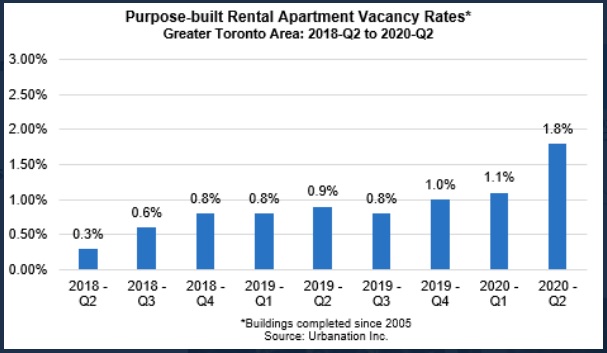
New data from Urbanation shows a rise in the GTA vacancy rate from 1.1 per cent in Q1 to 1.8 per cent in Q2-2020, up considerably from the 0.9 per cent recorded a year ago.

The survey of purpose-built rental apartment projects completed since 2005 also looked at availability rate, which measures vacant units as well as units in which the tenant has provided notice to vacate.  According to the report, that number rose to 3.2 per cent from 2.3 per cent in Q1-2020 and 2.0 per cent in Q2-2019. Both the vacancy and availability rate reached their highest levels since Urbanation began surveying the data in Q1-2015.

“The GTA rental market has been clearly impacted by COVID-19, though the transition has been orderly so far with vacancy remaining low and rent declines being modest outside of some specific pockets in the city,” said Shaun Hildebrand, President of Urbanation. “Government income support has played a big role as job losses mounted and immigration dropped.”

Vacancy rates were highest in the former City of Toronto (largely representing the Toronto core) at 2.3 per cent, compared to 2.0 per cent in the outer 416 regions of Etobicoke, North York and Scarborough, and 0.9 per cent in the 905 region.

Within buildings that have been completed for at least one year, average monthly rents for units that became available during the second quarter declined by 3.7 per cent year-over-year to $2,420, based on an average unit size of 751 square feet. However, when measured on a per square foot (psf) basis, rents declined by only 0.6 per cent from last year to $3.22 psf. The decline in rents was additional to incentives being offered. Urbanation found that 31 out of 73 surveyed buildings offered some form of incentive to attract renters, with the most common being one month of free rent.

At the end of Q2-2020, the number of purpose-built rentals under construction in the GTA totaled 13,358 units, remaining near its more than 40-year high reached in the previous quarter (13,580) and 17 per cent higher than a year ago (11,421 units). Close to two-thirds of rentals under construction were located in the former City of Toronto.

Declines in condominium rents within downtown markets

Total condominium apartment lease activity for unfurnished, long-term rentals in registered buildings declined 31 per cent year-over-year in Q2-2020 to 6,114 units. However, by June as the GTA was entering into Stage 2 of the province’s economic reopening plan, lease activity during the month rebounded by 79 per cent from the April low to come within 5 per cent of its level recorded in June 2019.

At the same time that demand for rentals declined in the second quarter as a result of COVID-19, condo rental supply surged to record highs. The total number of listings during the second quarter increased 22 per cent year-over-year to 13,576 units, while active listings still available at the end of June more than tripled from a year ago to 6,757 units. Measured against lease activity in Q2, the remaining inventory equaled 3.3 months of supply, which compared to less than one month of supply last year.

The softening in the condo rental market led rents to decline by 3.6 per cent year-over-year to $3.26 psf ($2,356 for 722 sf). However, the decline was almost entirely concentrated in the former City of Toronto, which reported a 6.0 per cent annual decrease to $3.59 psf ($2,453 for 683 sf). In the outer 416 region, rents were down by 1.8 per cent from a year ago to $3.02 psf ($2,285 for 756 sf), while in the 905 region rents held up best with a 1.0 per cent year-over-year decline to $2.78 psf ($2,181 for 786 sf). The stronger rent decline in the former City of Toronto may be attributable to relatively less demand for more expensive rentals given the economic hardship and the expectation that work from home arrangements may become permanent, as well as a greater concentration of supply in the core due to rising condo completions and units formerly offered as short-term rentals.

One indicator of the conversion of short-term rentals to long-term rentals is the number of furnished condo rental listings offered for 12 month leases, which grew 52 per cent in Q2-2020 to 1,877 units, representing 12 per cent of all condo rental listings in the GTA during the quarter and 21 per cent of the growth in total condo rental listings compared to last year. With demand for furnished long-term rentals declining in Q2-2020 (lease activity fell 24 per cent year-over-year), average monthly rents for furnished units dropped 12.5 per cent from last year to $2,492.


Pest management strategies for reopening buildings

As businesses and offices begin to reopen after coronavirus lockdowns, following appropriate health and safety guidelines is at the top of everyone’s mind, and the cleanliness of these facilities is more important than ever as the world returns to work. For building operators and owners, pest management should be a critical piece of any reopening plan, so customers and employees have one less worry when returning to the office.

While employees and tenants in communities across the country have sheltered at home over the last few months, pests may have found new homes in unpopulated facilities. As tenants return to the office, knowing the signs of pest presence, who to reach out to for assistance, and how to prevent future pest issues can all be helpful.

Know the Signs of Pests

Knowing the signs of pests is the first step in determining whether you’ve had uninvited guests in your space during closures. Nests under eaves, on ledges or unscreened vents and droppings near the building are signs birds have taken up residence in or around your facility. While not always considered a “pest,” birds do present certain risks. Their droppings can cause health concerns for humans while also being a slip hazard on sidewalks. Plus, bird droppings contain acids that are corrosive to building exteriors and sidewalks. Wasps are more active in the warmer months, and signs of wasps can be paper or mud nests on ledges or overhangs and gaps in walls. Wasps concentrated in one specific area can be a sign that their nest is nearby.

Rodents, on the other hand, are some of the worst offenders when it comes to pests on any property. They prefer warm, dark and undisturbed spaces to make their homes. With cities in lockdown and facilities being closed, the decrease in human activity has sent rodents looking for new food sources and shelters. Food storage bins or garbage cans offer a good meal to rodents now that restaurant closures mean less food being thrown away. You’ll also want to look for trails of grease or trodden paths in the foliage outside a building as a sign of rodent presence.

Be sure to pay attention to places with high moisture opportunities such as sink drains and other kitchen areas, as areas that have not been in use for a while can easily be breeding grounds for insects. For those that are in use, the dampness can trap organic material which will attract flies and rodents. Cockroaches also love warm dark spaces, so if any countertop appliances, such as coffee makers, were left plugged in during building closures, be sure to check for cockroaches and ants and clean them thoroughly in accordance with the machine’s instructions.

Reach Out for Help If Needed

Your established pest management professional should be the first call you make after finding evidence of pest activity in your facility during lockdown. The technician’s knowledge of your pest history will be helpful for diagnosing and solving issues in a timely manner. Your pest management provider will likely want to see and evaluate any evidence of pest activity you may have found, as this is critical in identifying the right solution. If you do not have a pest management provider, research what types of buildings a potential company services as well as where their branch locations are so they can conveniently get to you when needed.

Prevent Future Issues

To help keep pests out of your building, make sure the landscaping surrounding the building is trimmed and maintained. Unkempt landscaping can provide homes for pests right outside your building, as well as create a bridge for pests to get from the ground or trees into the building.

Be sure outdoor trash receptacles are placed away from the building, and indoor trash cans are emptied daily whenever people are in the buildings. Rinse out trash bins at least once a week, as organic material can build up at the bottom of trash cans and attract flies.

Ensure all cracks, holes, and vents on exterior walls are caulked and sealed properly, as many pests can utilize these unexpected entry points. Doors that are not properly sealed can also be inviting spots for pests to make their way inside.

Developing a reopening plan for your facility may seem daunting but assessing your property’s position with pest management should not be. These tips can help you make informed decisions and ensure a pest-free environment for your tenants when they return to your building. Should you see signs of pests again, call your pest management provider immediately to establish a plan and solution for your building.

Alice Sinia, Ph.D. is quality assurance manager of regulatory/lab services for Orkin Canada, focusing on government regulations pertaining to the pest control industry. With more than 20 years of experience, she manages the quality assurance laboratory for Orkin Canada and performs analytical entomology as well as provides technical support in pest/insect identification to branch offices and clients. For more information, email Alice Sinia at [email protected] or visit orkincanada.com

BM Group expands with two Vancouver acquisitions

BM Group of Companies (BM Group) has acquired Vancouver Ready Mix and Fraserway Prekast. The acquisition supports the company’s growing portfolio of construction, project management, material supply, and land development companies.

“BM Group now represents 14 active independent businesses, offering a comprehensive network of complementary businesses to our clients,” said Balraj Mann, chairman and CEO, BM Group. “Our financial strength matched by our portfolio of businesses brings cost savings, time efficiencies, and other benefits to our clients.”

The acquisition of Vancouver Ready Mix will enable the group to double production capacity and serve new geographic locations.

“Purchasing Fraserway Prekast as part of this acquisition was a unique opportunity, with capabilities to manufacture precast concrete products, which is aligned with BM Group’s core specialties,” said Racy Sidhu, partner, Material Supply division.

The acquisition included fleet, equipment, property, goodwill, and unique opportunities in manufacturing concrete products. Both Vancouver Ready Mix and Fraserway Prekast will maintain their brand identities while becoming part of a local company with established roots in the construction industry.

“We are bringing revitalization to an industry that is seeing ready mix and related concrete businesses continue to be absorbed by large multinational companies and equity companies,” said Milan Mann, vice president. “We are proud to be a family-owned local business that can provide opportunities for employment and growth in our communities.”

Headquartered in Vancouver, BM Group has more than 30 years of experience in concrete (supply, restoration and materials testing).

Severe sexual harassment found on NYC jobsites

A construction firm in New York City will pay a USD $1.5 million settlement and undergo three years of outside monitoring following the State Attorney General’s investigation of sexual harassment complaints. Trade Off Construction Services agreed to the conditions related to Attorney General Letitia James’ findings that 18 women had been subjected to a toxic and discriminatory work environment created by both coworkers and company management.

The determined “pattern of severe sexual harassment” over a four-year period included verbal and sexual harassment, failure to discipline perpetrators of belittling behaviour and demand for sexual acts in return for overtime and increased pay opportunities. At least 12 of the women were fired after they reported and condemned the abusive treatment.

“The agreement will end Trade Off’s deplorable and unlawful treatment of its female employees and provide affirmative relief to the brave women who came forward,” James says.

The company will also be required to report to James regularly on the progress it is making in fortifying and implementing policies and procedures to combat sexual harassment, including documented proof of its investigations into future sexual harassment complaints. Along with the USD $1.5 million compensation for the 18 women specifically involved in the agreement, the company will establish a fund for other workers who have experienced sexual harassment while in Trade Off’s employ.

“We thank the former employees of Trade Off for their courage in coming forward to expose the horrific treatment they experienced while on the job,” says Robert Bonanza, business manager for the labour local, Mason Tenders’ District Council of Greater New York and Long Island, which referred the issue to the Attorney General. “Attorney General James and these brave former employees have sent their message loud and clear: Sexual harassment in the construction industry is pervasive, but the state of New York will always be on the side of the workers.”

HVAC Maintenance: Keeping Tenants Safe & Comfortable

It’s critical to execute on your building’s mechanical system’s upgrade before the next heating season to make sure you’re providing tenants with fresh, filtered air and a reliable supply of hot water before it’s too late. No doubt, it takes time to plan, order, and install commercial equipment, particularly in light of the current supply chain constraints, and planning replacements in advance of a breakdown will help you manage those risks while ensuring occupants have a safe and reliable heating system in the midst of a global pandemic.

“The last thing property stakeholders want to do is wait until it gets cold to turn on your heater and find out it’s not working,” notes Scott Beneteau, General Manager of Commercial Services at Enercare. “Not only do you risk running against tenant guidelines for providing heat if nothing is working come September, but you could also find yourself vying for a repair appointment time, among other properties.”

By waiting until heating season, he adds, property managers and landlords will need to work swiftly to complete projects to keep the systems safe and reliable throughout the winter season.

A proactive partnership

There are many reasons why it’s critical to stay one step ahead of HVAC repairs and replacements. At the same time, there are reasons why property management teams may lack the time, manpower, or expertise to do so effectively. Delegating HVAC maintenance to a trusted and experienced HVAC maintenance partner can help avoid costly and constant system repairs.

This is the thinking behind Enercare’s preventative maintenance program. After working with clients to select a maintenance program that fits, Enercare’s fully-licensed technicians carry out a broad range of inspections and services throughout the year to ensure virtually all heating, cooling, and other HVAC components are operating at peak condition. What’s more, the program grants property teams access to Enercare’s 24/7 Support Centre to handle more timely concerns and emergencies.

“Before we leave your business, we’ll ensure your cooling, heating, and other equipment covered by our program is operating as safely and efficiently as possible, and provide you with a report of any system deficiencies identified during our service call,” says Beneteau.

To learn more about Enercare’s HVAC maintenance program, click here. 

Meat processing facilities face unique disinfection challenges

Following a series of SARS-CoV-2 outbreaks in worldwide meat processing plants, Diversey has released a new guide to help operators improve facility hygiene, mitigate the spread of the COVID-19-causing virus, and prevent fines, shutdowns, and labour shortages.

“Enhanced Cleaning and Disinfection of Meat Processing Facilities” examines why the industry faces an accelerated prevalence of infection. Operators, the paper suggests, may be infected outside of the workplace and then spread the virus while living or travelling to the facility with coworkers.

World Health Organization (WHO) and published government recommendations were taken into consideration in the creation of the guide, in addition to local recommendations. It also covers personal protective equipment (PPE) and chemical selection, the cleaning and disinfection of amenity and production areas, plus best practices for resetting a plant if an outbreak does occur.

“The global meat processing industry has recently been susceptible to outbreaks of SARS-CoV-2 infection,” said Hein Timmerman, global sector specialist at Diversey. “Consequently, inspection authorities are making it mandatory for meat processors to take extra measures to prevent the spread of the disease among their employees. Diversey envisages this new guide as a key resource for our customers, enabling them to quickly and efficiently intensify personal hygiene practices and employee screening, while also updating current SOPs and delivering continued control for water quality.”

The guide outlines six areas meat facility operators should take into consideration:

  1. Recommendations for the Meat Processing Industry: Topics include reducing employee flow, employee screening, social distancing, protective screening, ensuring proper PPE use, and creating a policy of respiratory etiquette.
  2. Suitable Personal Protective Equipment (PPE) and Chemical Selection: Includes a guide to products which meet the criteria for virucidal efficacy in Canada and the U.S.
  3. Prevention of Transmission – Facility-wide Solutions: Provides links to hand hygiene signage downloads as well as information regarding entrance control systems.
  4. Prevention of Transmission – Cleaning and Disinfecting of Amenity Areas: Includes maps of high touch point areas in meat processing facilities, such as cafeterias/restaurants, kitchens, meeting rooms/offices, reception/lobby areas, and public washrooms and changing rooms.
  5. Prevention of Transmission – Cleaning and Disinfection in the Production Area: An in-depth look at notable aspects of cleaning and disinfection, from air sanitation to fogging.
  6. Reset Procedure – When a Case or Outbreak Has Occurred: A six-step process to follow before production resumes that should be followed in addition to a facility’s standard cleaning protocol.

North American and EMEA versions of the guide can be download for free on Diversey’s website.

Dealing with abusive behaviour in condos

The Protecting Condominium Owners Act, 2015 provided some new protections for owners, but may not have gone far enough to provide protection for condominium directors, managers and condominium corporations as a whole.

While the majority of condo owners treat each other, the board and management with respect, there are some who do not. If this is happening to you – or in your condo – what should you do? Here are some steps that condo corporations should consider to protect managers and directors from unreasonable treatment.

Document, Document, Document

It is critical to document any issues and bring them to the attention of the board of directors of the condominium. When documenting, it is helpful to set out the date, time and location of the incident and any steps that were taken to address the issues at that time. Preparing notes contemporaneously to the events is also helpful as it would then be fresh in your mind.

Violence and Harassment Policies and Rules

Ideally, condominium corporations can consult their violence and harassment policy, which should be in place before a harassment problem arises from within the community.

It is also recommended that a rule be passed confirming that the provisions of the policy (which govern workers) are also applicable to owners and directors in the condominium. The policy and, hopefully, the adopted rule, will define violence and harassment and set out steps that can be taken in the event that a manager, director or owner faces inappropriate treatment.

The condo corporation should ensure that it is taking the required steps as outlined in the violence and harassment policy. This usually begins with a review of the procedures, including receipt of a complaint and consideration of whether the complaint amounts to harassment. It is important that the policy be practical and user friendly in order to be effective.

The corporation may wish to obtain legal advice in order to ensure that the policy has outlined the necessary steps to protect the manager or director(s) who might encounter such difficult behaviour.

Dealing with Problematic Behaviour or Complaints

It is essential to address abusive behaviour that is making life difficult for managers, directors and even other owners. Generally, the implementation of a policy and rule should set the tone and standard for acceptable behaviour within the community. In the event that specific problems arise, the corporation must take action to address the situation.

The corporation should immediately consider writing to the affected owners, directors or manager to confirm the basis for complaint and the allegations of improper conduct. This letter should also confirm that the respondent has a right to know who is making allegations against them, and that he or she will receive a copy of the complaint.

The corporation should then write to the person who engaged in the behaviour to confirm the complaint and seek a response. In the case of clear contraventions of the Condominium Act, 1998, and the corporation’s declaration, by-laws and rules, the letter can confirm what breaches have occurred and advise that the behaviour must stop. The letter could also state that a failure to comply with the obligations under the Condominium Act, 1998, and the corporation’s declaration, by-laws and rules could result in the matter being turned over to legal counsel.

Depending on the nature of the complaint, the condo corporation may consider appointing an external investigator to determine whether the alleged behaviour occurred and make recommendations to the condo board.

If the behaviour does not stop, legal counsel may need to get involved. The circumstances of each individual case will then be reviewed to determine how best to proceed and resolve the situation.

In some cases, a communication protocol can be developed to control behaviour. Other times, a meeting between parties may resolve the conflict or problematic behaviour. In cases when the behaviour does not stop, despite several letters and attempts to resolve the matter, the corporation will need to bring an application for compliance to the court and seek the court’s assistance in resolving the matter.

Case in Point

The court’s assistance may be necessary to establish protection orders and remove the person engaging in harassment or violence if the abusive behaviour continues.

We recently had to seek an injunction from the court due to an owner’s problematic behaviour. The behaviour continued to escalate because of an ongoing disagreement between the owner and the corporation. Despite many letters and previous court orders, the owner continued to harass, intimidate and abuse the board and their spouses, the corporation’s manager and contractors.

The court reviewed the behaviour and found that the owner’s conduct included harassment, intimidation, verbal abuse and physical assault of directors, associated personnel and residents of the condo. The court declared the owner’s behaviour, including the physical misconduct and his campaign of aggression, constituted workplace harassment—a breach of the Occupational Health and Safety Act and a breach of Section 117 of the Condominium Act. As a result, the corporation’s motion was granted. The owner was ordered to comply with the Condo Act, declaration, by-laws and rules, and prohibited from communicating with the board, management and contractors—except in very specific circumstances. The owner was also ordered to pay all of the corporation’s costs.

There have been other cases where the court has ordered the removal of a problem tenant or the forced sale of an owner’s unit when the abusive behaviour was severe enough. Unfortunately, the court process can take time and often leaves managers and directors who are exposed to this type of behaviour frustrated and exhausted. An interim protection order may be necessary if the litigation process is slow-moving.

Managers and directors must be protected by the condo corporation. While it is hopeful that owners will show managers and directors proper respect, in the event they do not, the condo corporation needs to take steps to ensure they are protected. This includes creating policies to follow and taking immediate steps to seek compliance in the event of abusive behaviour behaviour.

Cheryll Wood is an associate at Davidson Houle Allen LLP, and has been practicing condominium law for seven years. She represents condominium corporations, their directors, owners and insurers throughout eastern Ontario.


COVID-19’s impact on housing choices

As the pandemic continues to put downward pressure on the rental market, more Canadians are making conservative housing choices due to sustained income loss and fear of a second wave.

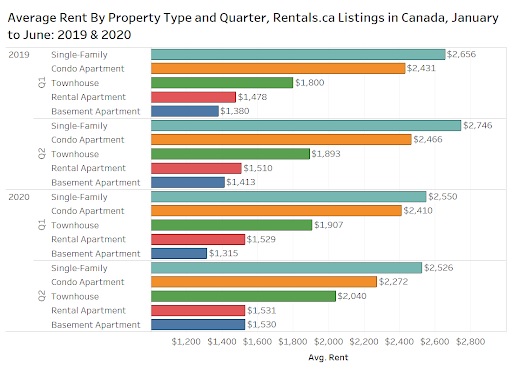
New data from Rentals.ca and Bullpen Research & Consulting show that average monthly rents for one- and two-bedroom units were down for the third straight month in Toronto, Vancouver, Calgary, Edmonton, Winnipeg, Saskatoon and Regina. But while the more expensive properties saw declines, rental units once perceived as less desirable and/or more affordable (i.e. rental apartments and basement units) are beginning to trend up.

Rental apartments, which typically account for 55 per cent of Rentals.ca listings, saw average rents bounce back in the month of June by 6.7 per cent to $1,564 from May’s $1,465.

“Tenant demand has returned to the market as lockdown restrictions end, and employers bring back furloughed employees and rehire staff,” said Matt Danison, CEO of Rentals.ca. “But lost income due to COVID-19 and fear of a second wave are resulting in conservative housing choices.”

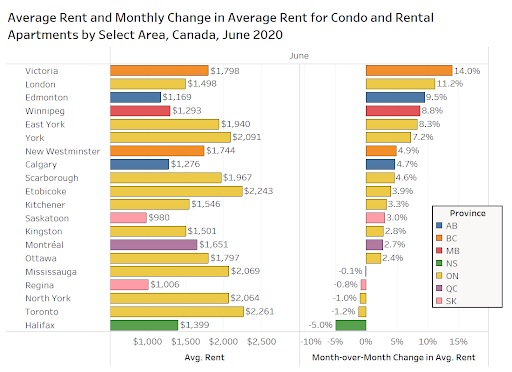
At the city level, month-over-month average rates for apartments and rental condominiums increased by over 10 per cent in Victoria (14.0 per cent) and London (11.2 per cent). Edmonton (9.5 per cent), Winnipeg (8.8 per cent), East York (8.3 per cent) and York (7.2 per cent) all had monthly increases of greater than 5 per cent. Mississauga (-0.1 per cent), Regina (-0.8 per cent) North York (-1 per cent), Toronto (-1.2 per cent) and Halifax (-5 per cent) all experienced negative growth.

Housing choices; prices by city

Toronto had the highest rent in June for apartments and rental condominiums at $2,261 per month followed by Etobicoke at $2,243. Saskatoon had the lowest rent at $980, and was the only city with average rental condominium and apartment rents under $1,000.

The impact of COVID-19 is not uniform across the country. About 950,000 jobs were added last month nationally, and according to some estimates, about 40 per cent to 45 per cent of the people who lost jobs during the pandemic have gained them back. The resale housing market in several major Canadian cities has started to gain steam, as well—an indicator that the pandemic-related recession could be short-lived. But the unemployment rate is still high, immigration will be well below recent annual intakes, and many students will continue to live at home as classes are held virtually. These will all negatively impact demand.

And more changes are on the horizon, predicts Ben Myers, president of Bullpen Research & Consulting. “Rental forecasting remains uncertain as the potential for greater mortgage defaults continues, eviction bans will soon expire, CERB payments will end, and our borders remain closed, ” he said . “There is data that suggests both rent increases and decreases are coming.”

More key takeaways from the July National Rent Report:

• Toronto had the highest average monthly rent in June for a one-bedroom home at $2,063 and for a two-bedroom at $2,684. Red Deer brought up the bottom of the list with average monthly rent for a one-bedroom at $870 and for a two-bedroom at $963.

• In Toronto, apartment rents per square foot rose 15.4 per cent from January 2019 to January 2020, rising from $2.93 per square foot to $3.38 per square foot. That rate then dropped 12.4 per cent to a pandemic-low of $2.96 per square foot in May. But the rental market bounced back in June, rising 7.7 per cent monthly and is now up year over year at $3.19 per square foot. Rentals.ca has a significant sample of rental listings in Toronto, and this type of monthly rent volatility is rarely observed. But many landlords are offering incentives, with a number of new purpose-built rental apartments offering two months free rent.

• In Calgary and Edmonton, while average rent for all bedroom types of apartments and rental condominiums is down year over year, they are all up monthly.

• On a provincial level, rent increased quarterly in British Columbia, Saskatchewan and Quebec, while Alberta, Manitoba, and Ontario all experienced decreases between the first and second quarters of 2020. Ontario had the highest average rent ($2,116) followed by British Columbia ($1,987), while Saskatchewan had the lowest ($1,040).