Articles Archive - Page 435 of 928 - REMINET
REMI

Bill 184 is now a law in Ontario

Ontario has moved ahead with the controversial Bill 184 despite opposition from tenant advocates claiming it will lead to mass evictions. Since the state of emergency in Ontario began, landlords have been banned from evicting non-paying tenants. The new law will require tenants owing money to pay back their landlords in a scheduled repayment plan.

“We know tenants and landlords have struggled during COVID-19, and some households may be facing eviction due to unpaid rent during this crisis,” said Steve Clark, Minister of Municipal Affairs and Housing. “By making these changes we are trying to keep people in their homes, and at the same time, helping landlords receive payment through a mutual repayment agreement. It’s a better approach, especially during these difficult times.”

Other changes to the legislation include:

• Requiring tenant compensation of one month’s rent for “no fault” evictions;
• Allowing the Landlord and Tenant Board to order up to 12 months’ rent in compensation for eviction notices issued in bad faith or where the landlord does not allow the tenant to move back in after renovations or repairs;
• Doubling the maximum fine amounts for offences under the Act to $50,000 for an individual and $250,000 for a corporation.

According to the release, the changes will also “modernize and streamline” the dispute resolution processes at the Landlord and Tenant Board and encourage the use of alternatives to formal hearings to resolve certain issues and encourage negotiated settlements. The Landlord and Tenant Board must now consider whether a landlord tried to negotiate a repayment agreement with a tenant before it can issue an eviction order for non-payment of rent related to COVID-19. Certain disputes, such as those related to unpaid utility bills, will shift from Small Claims Court to the Board.

In addition, the government has made changes to the Housing Services Act, 2011, in what it calls “an effort to help maintain the existing community housing supply.” Amendments will give housing providers with expiring operating agreements and mortgages ways to remain in the community housing system through a new service agreement with service managers. It will also encourage existing and new housing providers to offer community housing.

Despite these efforts, tenant advocates concerned about vulnerable tenants continue to oppose the bill and remain active in their opposition.

ASHRAE releases HVAC guide for reopening schools

The ASHRAE Epidemic Task Force has developed guidance on the operation of HVAC systems to help mitigate the airborne transmission of SARS-CoV-2, the virus that causes COVID-19, as schools prepare to reopen in the fall.

The 41-page presentation includes checklists to prepare educational buildings to resume occupancy such as starting up HVAC systems, as well as checks and verifications to maintain during the academic school year. The guidance is meant to provide practical information to school districts and university campus environmental health managers, facility managers, administrators, technicians, and service providers.

“As schools prepare to reopen for the fall academic semester, it’s important to keep children and school staff safe,” said Charles E. Gulledge III, P.E., 2020-21 ASHRAE president. “ASHRAE’s school reopening guide will serve as a resource to school leaders as they work in lockstep with health experts to finalize plans to keep everyone safe.”

The guide includes the following topics:

  • Determining building readiness
  • Equipment- and system-specific checks and verifications during the academic year
  • New/modified facility design recommendations
  • Filtration upgrades
  • Operations of occupied facilities
  • Controlling infection outbreak in school facilities
  • Higher education facilities recommendations

Also included is guidance formulated to help designers retrofit and plan for the improvement of indoor air quality and to slow the transmission of viruses via the HVAC systems as well as new guidance on student health facilities, laboratories, athletic facilities, residence halls, and large assemblies, lectures, and theatres.

“School and university officials are challenged with making very difficult decisions on how to best protect both students and staff as education facilities reopen,” Corey Metzger, ASHRAE Epidemic Task Force Schools Team lead, commented. “This guidance offers a solid framework on ventilation control, filtration, and maintenance that can be applied to different climate zones, building types, and HVAC systems.”

For the complete ASHRAE Epidemic Task Force school reopening guide and other COVID-19 resources, visit ashrae.org/COVID-19.

Q2 transactions down significantly: JLL Real Estate

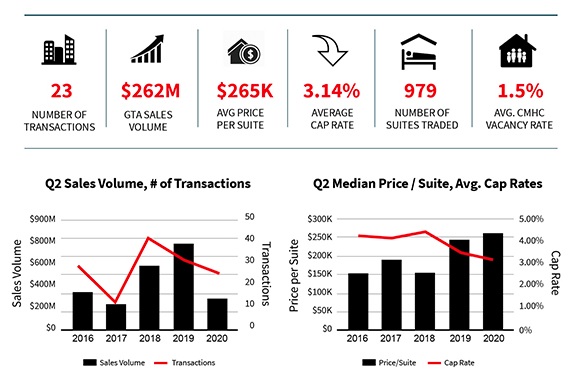
After a record-breaking 2019 and Q1-2020, the GTA multifamily investment market has felt the effects of COVID-19 with Q2 transactions plummeting to just 23 in total. This, according to JLL Real Estate Services, is the second lowest sales volume in the past five years, dropping 66 per cent year-over-year to $262,428,000.

Highlighting the quarter was the Flagship Property-Timbercreek portfolio with nine apartments for a combined price of $143,360,000. This was the largest of the Q2 transactions accounting for 55 per cent of the total Q2 sales volume. The median price per suite increased 10 per cent to $265,000 and cap rates continued to compress to 3.14 per cent, down 25 basis points.

Q2 transactions

Looking back 

In 2019, the GTA multi-residential investment market witnessed over $3.3 Billion in transaction volume, shattering the previous benchmark set in 2018 by almost $1 Billion. The year was capped off by the largest single multi-residential transaction in Canadian history, as Starlight Investments acquired 6,271 suites for $1.7 Billion in the Continuum REIT privatization, of which 4,708 suites were in the GTA, representing $1.44 Billion. Not only did volume transaction increase, capitalization rates continued to compress, and the average price-per suite reached a new historic high of $288,739.


B.C. coalition takes CBA challenge back to court

A coalition of British Columbia’s largest construction associations is resuming its legal challenge of the NDP government’s community benefits agreement (CBA) policy in the B.C. Court of Appeal.

The coalition is asking the court to reverse a lower court decision that referred part of their case on the government’s labour rules infringing on the charter rights of workers to the Labour Relations Board (LRB) and to return the entire case to B.C. Supreme Court.

According to the coalition, delays and cost overruns on the first projects built using B.C.’s CBA are costing taxpayers an extra $384 million.

The coalition’s case has been, and will continue to be, about Transportation and Infrastructure Minister Claire Trevena ’s decision – her statutory discretion – to impose an unfair and discriminatory policy on the construction industry. It is not challenging the collective agreement embedded in the CBA or any other issue within the jurisdiction of the LRB.

“Right now, government and industry should be working together to rebuild the economy,” said Chris Gardner, president of the Independent Contractors and Businesses Association. “That’s a lot harder to do when public infrastructure dollars are not going anywhere near as far as they should.”

The coalition argues that the NDP government’s CBA policy, violates the rights of 85 percent of B.C.’s construction workforce.

“If the NDP government continues to impose its CBA on public infrastructure projects, construction costs will spiral upwards and, ultimately, leave government with four options: to build fewer projects; reduce the scope of projects; increase taxes to pay for the projects; or incur debt to build them,” said Fiona Famulak, president of the Vancouver Regional Construction Association. “At the end of the day, B.C.’s taxpayers will bear the brunt.”

“As we face the future of COVID-19 no one knows for certain what will happen. All we can do is control what is within our ability to control, and this spending on the CBA is entirely optional, it doesn’t add value” says Chris Atchison, BC Construction Association president.  “Such wasteful spending at a time when the Minister of Finance is repeatedly stating the need to “spend every cent wisely” is a blatant contradiction between words and actions. British Columbians deserve better.”

The B.C. Court of Appeal heard the coalition’s arguments last week.

Taking the next step with mass timber

Architects are calling for a return to wood as a principal building material. As the use of solid or engineered wood for load bearing structures and interior finishing is proving to be a sustainable alternative to concrete and steel construction for multi-family, commercial and institutional buildings, mass timber is becoming a ‘market disrupter’ in Canada.

Mass timber is the next big step in green buildings. The benefits of mass timber include its ease of construction, light carbon footprint, positive effects on human health and well-being, and better organizational performance. This research is summarized in my report on Wood, Well-being and Performance: The Human and Organizational Benefits of Wood Buildings.

Increasingly, employers recognize that promoting employee well-being ultimately contributes to humanly sustainable improvements in business performance. Mounting evidence now highlights how the physical workspace contributes to organizational performance when employees are healthier and more engaged.

Wood is one of the few natural building materials that can simultaneously achieve four important goals: reduced carbon emissions; increased sustainability in a building’s life cycle; improved occupant well-being; and increased organizational benefits from having happier, healthier and more productive employees.

Corporate sustainability strategies are starting to align with human resource goals. ‘Green human resource management’ is an emerging trend. This views employers’ sustainability actions and branding as useful for achieving their employee recruitment, retention, and engagement goals. Employers who adopt wood as the main structural and interior design material for a new building stand to reap additional human resource benefits, given wood’s strong green credentials.

The strongest evidence of wood’s human and organizational benefits is based on wood’s biophilic properties. Biophilia refers to humans’ innate need for connections to nature. When individuals have contact with nature, their neurological, physiological, and psychological responses result in less stress, lower blood pressure, more relaxation and positive moods, and increased concentration.

The organizational benefits of biophilia include reduced employer costs and increased productivity based on the following employee outcomes: reduced illness, absenteeism and presenteeism; increased retention; increased job performance; and reduced stress and fatigue.

Important human benefits of wood interiors include better indoor air quality because of wood’s hypoallergenic properties, reduced off-gassing of harmful volatile organic substances, and better sound absorption.

Studies document that wood interior design is associated with higher occupant satisfaction. Furthermore, wood surfaces in an office environment can reduce the body’s stress responses. Mass timber buildings benefit workers involved in the construction process because of reduced construction time and safer, cleaner building sites.

Employers stand to benefit from employee well-being and job performance improvements that come from using wood in building construction and interior design. For building owners, this can translate into increased building value and rents.

Graham Lowe has over 30 years of organizational, labour market and policy consulting experience across Canada and internationally. He is president of The Graham Lowe Group Inc., a workplace consulting and research firm, and a Professor Emeritus at the University of Alberta.


Planting native trees cools communities over time

A new study has found that planting native trees, shrubs, flowers and grasses can cool the summer daytime temperature of an area by more than 4 C in a decade.

University of Waterloo researchers used a new thermal camera on the International Space Station (ISS) called ECOSTRESS to gather images that show temperature decreases over time when biodiverse, native species are restored to areas of Southern Ontario.

“We found a decrease of 4.5 C in summer daytime temperatures over 12 years and we found that this change was dependent on biodiversity,” said Jonas Hamberg, PhD candidate at Waterloo’s School of Environment Resources and Sustainability and lead researcher on the study.

Hamberg’s team is one of the first to work with the new ECOSTRESS technology which was attached to the ISS in 2019 via a SpaceX rocket and the Canadarm2 (the Canadian-made robotic arm).

“I’m honoured to have had access to this new technology,” said Hamberg. “It opens up so many avenues for exploration – not just in my field, but for the whole scientific community.”

“Jonas’ study utilizes ECOSTRESS surface temperature products to examine how different plant communities cool their surroundings and assess restoration outcomes,” said Dr. Christine Lee, applications lead for ECOSTRESS at NASA’s Jet Propulsion Laboratory. “ECOSTRESS is focused on advancing the understanding of terrestrial ecosystem response to changing environmental conditions, such as water availability, as well as how this data can be used for practical applications. We look forward to seeing continued research and work in these areas.”

Hamberg hopes that his work will encourage thoughtful reforestation and restoration practices in Ontario and more broadly. He notes that given the recent heatwaves, people should be thinking about planting local, native species in their own outdoor spaces, and governments should consider doing the same when planting any new areas within their jurisdictions.

“I’ve advised local governments that restoring natural areas with diverse native plants and trees is a very effective way for us to adapt to a hotter summer climate on a local level,” said Hamberg. “Native species are adapted to the local environment and can cool their surroundings better. For example, native tall-grass species have deeper roots and can pull up water to cool, much like a water-cooled AC, long after non-native lawn grasses have gone yellow and dry.”

The Study, Surface temperature as an indicator of plant species diversity and restoration in oak woodland, was published in the journal Ecological Indicators in June, 2020.

UNIDO offers guidance for refrigeration energy efficiency

The United Nations Industrial Development Organization (UNIDO) is launching its latest guidance document supporting domestic and commercial refrigeration manufacturers seeking to improve energy efficiency and reduce greenhouse gas emissions.

The project is funded by the Kigali Cooling Efficiency Program (K-CEP) and supported by International Copper Association (ICA).

As COVID-19 restrictions are in effect, the UNIDO study will be launched through a webinar, hosted by the American Society of Heating, Refrigerating and Air-Conditioning Engineers (ASHRAE). The presentation will outline the outcomes of the project and provide insight into how to use the guidance document, analyze changes in manufacturing, evaluate technical and financial options for energy efficient refrigeration equipment, and calculate associated emission reductions.

The study examines and explains methodology and tools for manufacturers to understand cost and net benefits for different energy efficient refrigeration design options and the required manufacturing line upgrades.

The refrigeration and air conditioning sector is currently responsible for around 17 per cent of global electricity consumption and can exceed 40 per cent of the national electricity demand in some developing countries.

Manufacturers are now able to ascertain which changes to their offerings can be taken cost effectively. The simulation software, named Commercial Refrigeration Analysis (CERA), gives visual modelling of the changes in components, the benefit in energy efficiency, and the cost involved in promoting green design and thus keeping the product competitive in the long term.

The free webinar will be held on July 22 from 9 a.m. to 10 a.m. EST. Following the presentation, a recording will be available on the ASHRAE Global Training Centre website. For further information and to sign up, visit ASHRAE’s website.

Investors express interest in seeking new deals

Commercial real estate players entered June expressing uncertainty mixed with some traces of cautious optimism about the state of Canadian office markets, Altus Group’s recently released survey results show. Many of the respondents — 136 individual practitioners working for institutional investors, publicly traded and private companies and in brokerage services — foresaw the possibility of a bounce-back, contingent on avoidance of a renewed phase of pandemic-triggered business disruptions.

Compared to an earlier round of questioning during the height of April’s widespread lockdown, a greater percentage of respondents indicated they would be seeking new deals in the second quarter and beyond. Pension funds and life insurance companies appeared most anxious to get back into the game, with more than 50 per cent reporting they were pursuing acquisitions.

If or when those deals transpire, the majority of respondents expect cap rates for prime office properties will be relatively on par with pre-pandemic times, but cap rates will rise for Class B and C product. That said, a significant minority of 18 to 19 per cent project that cap rates will rise by 25 to 50 basis points for both prime and more moderate quality properties.

Ultimately, they tie a full return to normal to the arrival of a COVID-19 vaccine and/or effective treatments. However, in the interim, prospective investors are seeking some clear gauges of risk, including clear underwriting guidelines and understanding of the depth of the recession.

Survey respondents were generally more apprehensive about the potential for a longer-term economic downturn than they were in April. In particular, commercial landlords fear what layoffs and business closures would mean for office space demand, leasing timelines and rents.

Looking at near-term financial concerns, many cited the mounting operation costs related to heightened cleaning protocols and implementing social distancing measures. Although office rent collection exceeded 80 per cent in both April and May, there is some concern about whether deferred payments will be forthcoming soon or at all.

Automated tool makes CECRA application easier

KPMG in Canada has launched a new automated tool to help commercial landlords apply to the Canada Emergency Commercial Rent Assistance (CECRA) program, making it easier for them to offer rent relief to their impacted tenants.

The tool collects and coordinates tenant and property information in a centralized database, determines tenant eligibility for the program, and provides end-to-end application processing and submission to the Canada Mortgage and Housing Corporation (CMHC).

“While many of our commercial landlord clients want to provide rent relief to their tenants, the preparation and application process for the CECRA can be lengthy and present a significant administrative burden on landlords,” said Ali Baniasadi, partner, Business Law, KPMG Law LLP. “We wanted to provide an automated tool that would make the process much easier and less time-consuming, particularly for landlords with multiple tenants, and for smaller landlords who may lack the infrastructure and human capital to participate.”

Initially announced on April 24, 2020, the CECRA enables landlords of eligible small businesses to apply for forgivable loans to cover up to 50 per cent of the monthly rent owed by their tenants for the months of April, May and June 2020.

In Quebec, this amount will be increased by a further 12.5 per cent. Under the program, the landlord is required to forgive not less than 75 per cent of the rent, while the tenant is responsible for paying up to 25 per cent.

On June 29, the federal government announced an extension of the federal-provincial program until the end of July. Despite a moratorium on evictions in numerous provinces, uptake of the program (which is not mandatory) by landlords has been slower than anticipated. Most provincial governments have introduced eviction bans that prevent landlords from evicting commercial tenants if they are eligible under the CECRA program, but the landlord has decided not to participate in the CECRA program.

“The level of interest we are seeing from the launch of our CECRA automation tool is encouraging, and includes both our landlord and tenant clients,” said Gino Piazza, national leader, Tax Transformation & Technology at KPMG. “We worked on behalf of our clients to develop an online App to fully automate the entire application process and help minimize the need for manual intervention.”

Applications for the CECRA must be submitted by August 31, 2020.


COVID-19 expected to drive transparency metrics

Canada’s expanding breadth of transparency metrics provides real estate investors with some of the best available insight into the financial performance, environmental, social and governance (ESG) factors, digital adeptness, market oversight and regulatory compliance of their holdings. Ranked fifth out of 99 countries, Canada once again places in the top tier of “highly transparent” nations in the newly released 2020 edition of the JLL/LaSalle Global Real Estate Transparency Index, plotting the comprehensiveness, consistency and accuracy of reporting requirements and options.

“The 2020 Index is launched at a time of massive economic and societal disruption. During times of such uncertainty, the need for transparent processes and accurate, timely data becomes more important than ever,” says Christian Ulbricht, JLL’s chief executive officer. “The current disruption may well force the pace of change. We fully expect the mass adoption of technology, together with advancement in data availability and sensor technology, to accelerate the integration of proptech, helping to boost real estate transparency. The real estate industry is now harnessing huge amounts of data, but we will need to ensure that privacy and security are protected by ethical behaviour.”

The United Kingdom, United States, Australia and France comprise the top four of the highly transparent category. New Zealand, the Netherlands, Ireland, Sweden and Germany also join Canada on the list of top-tier countries defined as the “world’s leading investment destinations.” That’s based on a 210 distinct measures, grouped into six variously weighted categories to derive a score on a scale of 1 to 5, with 1 representing total transparency.

With a composite score of 1.51, Canada’s rate of improvement since 2018 is noted for outpacing the global average. Scores within the highly transparent group of nations range from the U.K.’s 1.31 to Germany’s 1.93.

“These 10 markets are pushing the boundaries of transparency through technology, a focus on sustainability, anti-money laundering regulations and enhanced tracking of alternatives sectors,” the accompanying report submits.

The next “transparent” tier of 22, with composite scores from 1.96 to 2.64, is largely made up of European and Asian nations, along with South Africa. After the United States and Canada, Mexico is next highest ranked country from the Americas, with a composite score of 2.83 translating into “semi-transparent” status. However, Costa Rica is given special commendation for the most improved score among participating countries from the Americas, with a 2020 composite score of 3.64 placing it “on the cusp of entering the semi-transparent tier”.

Sustainability factors, which account for 10 per cent of the total score, contribute to improved results in this biennial index update, with one third of countries registering better scores than in 2018. Nevertheless, the report’s authors express disappointment that scores for sustainability transparency are generally lower than the other five categories — performance measures; market fundamentals; governance of listed vehicles; regulatory and legal; and transaction process.

Canada is among the top six for sustainability transparency. It earns special mention for energy-use benchmarking, ESG guidelines, proptech uptake and as one of just four countries with financial performance metrics for green buildings (along with France, Australia and South Africa).

Across all global participants, average transparency scores have improved by 1.1 per cent since 2018. That’s progress, but a more moderate degree of progress than the past four editions of the index — in 2012, 2014, 2016 and 2018 — when scores improved by an average of at least 2 per cent.

In contrast, the 2010 index, following the global financial crisis, recorded the most muted improvement in the average score, at 0.7 per cent, of the past 14 years. With 2020 surveys having been completed in March, just before COVID-19-related shutdowns and associated stresses, analysts are already contemplating what the 2022 index may reveal.

“The COVID-19 crisis is shining a bright light on the transparency of real estate’s legal and regulatory systems. New rules to establish how social distancing, virus testing and contact tracing all intersect with existing property and privacy laws are being created in a compressed time frame. Sorting out these challenges still lies ahead in the second half of 2020 and in 2021,” the report notes.

“The COVID-19 pandemic could help to fast-track digitization and stimulate innovation in the use of technology due to the need for accurate and just-in-time data to keep track of activity, especially relating to health, mobility and space usage,” it projects. “The pandemic is leading to an acceleration in new types of non-standard and high-frequency data being collected and disseminated, which is taking transparency to new levels due to its near-real-time nature.”


CaGBC launches green recovery initiative

Canada Green Building Council (CaGBC) has launched a new green recovery initiative, calling for government investment that prioritizes green building. Industry leaders Real Property Association of Canada (REALPAC), Canadian Urban Institute, Royal Architectural Institute of Canada, and more have lent their support to encourage government decision-makers to direct stimulus spending toward green building initiatives.

According to CaGBC research, Canada’s green building sector already contributes $47.9B to the GDP and employs almost half a million people. As part of a new report coming this fall, a government stimulus package that prioritizes green building combined with progressive policy leadership can contribute almost $150B to the GDP and 1.5 million direct green building jobs by 2030.

“We firmly believe that investments in green building will not only help to reignite Canada’s economy, but provide opportunities that no other sector can offer,” said Thomas Mueller, president, and CEO of CaGBC. “Green buildings offer an immediate financial return on investment as they are less expensive to operate and are healthier for occupants. Even better, they will benefit Canadians for years to come by driving sectoral innovation and creating skilled jobs, all while reducing the carbon impact from buildings.”

Following an unprecedented global health crisis, Canada is presented with the challenge of reigniting a stalled economy. Like the 2008 recession, governments are likely to turn to economic pillars such as construction and infrastructure to create urgently needed jobs.

Such a massive investment will have far-reaching impacts for Canadians well into the future. But as Canada battles this pandemic and its economic fallout, the government must not overlook the opportunity to achieve its commitment of net zero emission by 2050.

“In these difficult times, it is easy to lose sight of other challenges we face right now,” said Mueller. “Canada has less than 10 years to reach its 2030 targets on carbon reduction. Without targeted action today, future generations will suffer from significant environmental, economic, and social disruptions that will outpace the impact of COVID-19.”

CaGBC is asking building industry leaders to add their voice to the call for a green recovery at cagbc.org/greenrecovery.


Ontario Electricity Rebate applied unevenly

Many condominium corporations and owners of multi-residential rental buildings can expect higher electricity costs this fall when hydro accounts specifically tied to the common areas of larger buildings lose eligibility for the Ontario Electricity Rebate (OER). Late last year, the Ontario Energy Board (OEB) determined that the nearly 32 per cent rebate could be applied on all common area accounts during a transitional period that is slated to end October 31, 2020. After that, only accounts reflecting less than 50 kilowatts (kW) of demand or 250,000 kilowatt-hours (kWh) of annual consumption will qualify.

In practical terms, energy managers advise that most common area accounts serving multi-residential buildings with more than about 70 units will no longer receive the rebate. That will equate to a 31.8 per cent premium on the pre-tax costs for electricity consumption and regulated transmission/distribution charges. Common area accounts typically encompass many of the building’s most power-intensive services, including: elevators; lighting in corridors, stairwells and parking areas; ventilation systems; delivery of heating and cooling in buildings with centrally located boilers and chillers; and pumps for the delivery of water.

“For a 250-unit condo, it will be an extra $40,000 a year,” estimates Rob Detta Colli, manager of energy and sustainability with Crossbridge Condominium Services. “This will impact about 30 per cent of our client base. What makes this worse is condo residents who are paying directly for their own in-suite consumption are being penalized, while condo corporations that chose to remain bulk-metered, meaning the suites have no individual accountability for consumption, will continue to get a 31.8 per cent break on their common area bills.”

The OER is targeted to residential households, small businesses and farms covered in the provincial Regulated Price Plan (RPP), and began showing up on hydro bills in November 2019 to replace the previous 8 per cent Provincial Rebate. Multi-residential buildings enjoyed blanket eligibility for that rebate, but a two-sentence decree in the OEB’s December 2019 memo creates a new distinction to exclude some accounts from the OER.

“There have been questions regarding the treatment of the common area account in multi-unit complexes where the distributor directly meters the individual units and the common area account has its own meter. In this case, the common area would not qualify for the OER unless it has a demand of less than 50 kW or uses less than 250,000 kWh a year,” it states.

Detta Colli and other knowledgeable observers suggest there should be further explanation of how that decision was reached.

“It treats similar buildings differently, giving some an advantage or others a disadvantage, based on how the building is wired, metered and sub-metered,” observes Andrew Pride, an Ontario-based consultant specializing in energy management and strategic conservation planning. “That seems unfair, particularly since it relates to a wiring choice that was often made years ago.”

Differing interpretations of regulatory intent

Detta Colli argues the guidance contradicts the intent of the enabling regulation — under the Ontario Rebate for Electricity Consumers Act (ORECA) — which generally states that a common area account is eligible provided a multi-unit complex contains at least two “qualifying” units and at least 50 per cent of all units within the complex are also “qualifying” units.

“The wording of the regulation states that it (the rebate) is to be applied to the account that is ‘solely in respect of a multi-unit complex’ and common area accounts are absolutely in respect to a multi-unit complex. Before the OEB interpretation came out, the LDCs (local distribution companies) had actually concluded that a condo’s common area account would get the rebate,” he reasons. “However, after failing to get the ruling changed, we have moved on to explaining to our clients what will be happening.”

In addition to informing affected condo boards that they will need to budget for a jump in hydro costs, Detta Colli and his peers have reached out to Members of Provincial Parliament. Notably, although oversight of the rules generally rests with the OEB, the enabling legislation does give the Minister of Energy, Northern Development and Mines the authority to prescribe eligibility for the rebate.

“The MPPs seem confused as to why the OER won’t be applied to common area accounts in condos,” Detta Colli reports. “It might be easier to administer, but it’s clearly not equitable with the treatment of bulk-metered buildings.”

“The old rules treated multi-residential buildings as a whole property, which required more administration to apply the rebate. This interpretation drills down to the metered account, which streamlines the process,” Pride concurs. “Now it appears common areas are being treated like businesses that are either above or below the 250,000 kWh threshold.”

He speculates that could lead to some create manoeuvring. “What if building owners start breaking their common elements into more than one separately metered account so they can qualify for the 31.8 per cent rebate? It’s an absurd premise, but it could have a good payback,” Pride muses.

As with other sometimes baffling billing formulas — such as for the allocation of the global adjustment to Class A and Class B consumers — using less electricity remains one certain way to lower costs. “Regardless, this policy encourages owners and managers of large apartment buildings and condominiums to implement deep efficiency retrofits to drive down demand and consumption,” Pride says.

Barbara Carss is editor-in-chief of Canadian Property Management.

Disinfecting a condo gym 101

To open or not to open. Most condo boards and managers are wondering how to safely reopen public spaces in their buildings, including shared gyms.

According to rules for areas of the province in phase three, “the total number of members of the public permitted to be at the facility in areas containing weights or exercise machines at any one time must be limited to the number that can maintain a physical distance of at least two metres from every other person in the facility, and in any event cannot exceed 50 persons.”

If a condo does choose to reopen its gym, there is much to consider, from social distancing to proper cleaning and disinfecting. The public has had the time and self-interest to educate themselves on the risks, causes and how to prevent or lower the risk of an outbreak. And let’s face it, there has never been such an emphasis on cleaner, safer spaces than there is now.

We must also understand that we are cleaning and disinfecting public gyms not only to manage the risk of spreading COVID-19, but also to keep a long list of bacteria and other viruses at bay.

First impressions

Your gym needs to make a great re-entry impression. This impression may only be for appearances, but it really matters—especially now, and especially after being closed for so long. If your gym looks, smells and appears well organized, that is a good start. It will be very important to provide visible hand washing and sanitizing stations, with ample paper products and a quality hand soap or hand sanitizer. You will want to now have social distancing signage and employee plexi-screens when applicable. These new signals are basic, everyday expectations in today’s world.

Develop your SOP

Standard Operating Procedures (SOP) are essential in the time of a global pandemic, and beyond. What worked before for your condominium gym will not work today. Not sure where to start? The good news is that in the cleaning industry, you have many resources to help you develop SOP from scratch. All you have to do is ask. The distributor or manufacturer of your cleaning products and equipment will be more than happy to lend their expertise and support you in developing your SOP.

Disinfect the right way

COVID-19 has identified a major shortfall in education surrounding proper disinfection and cleaning procedures. There are five major points when it comes to disinfection. If you do not follow these points, you run the risk of cross contamination, or even outbreak.

  • You must use a registered disinfectant with either an EPA (US) or DIN (Canada) number. These registration numbers show that the product is effective against killing the viruses and microorganisms it claims to kill when the proper process is followed.
  • You must dilute exactly according to the label directions (read the instructions).
  • Pre-clean all surfaces before you apply your disinfectant. This removes soil that can interfere with the disinfectant’s effectiveness.
  • Respect the required dwell time. Dwell times are always printed on a disinfectant’s label. This is the amount of time you will need to leave the disinfectant wet on a surface for the disinfectant to achieve its kill claims.
  • Conduct a potable water rinse in areas of food contact.

Unfortunately, the smallest percentage of public facilities follow these guidelines, and this alone may be where our problem begins.

What to disinfect when

Government directives also state that equipment, as well as any washrooms, locker rooms, change rooms, showers or similar amenities made available to the public must be cleaned and disinfected as frequently as is necessary to maintain a sanitary condition.

A gym has many different types of surfaces, and most of them are high-contact. People touch everything in a gym. That means the maintenance or cleaning staff will need to clean and disinfect all of your surfaces frequently, which means several times a day depending on use.

A quick overview of surfaces that will need to be cleaned and disinfected frequently includes all gym equipment, in addition to the entire ‘’resident transfer trail.” This includes all areas that residents walk through to get to the facility, like elevator buttons, push bars and handles.

You should be advertising your cleaning, sanitizing and disinfecting protocol with cleaning timelines and frequencies recorded for the public to see. Frequency depends on your staff makeup, the popularity of your gym, and the peak times of use. This is a topic that will need to be included in your SOP.

Self-cleaning stations

Self-cleaning stations are highly recommended for gyms in addition to regularly scheduled cleaning and disinfecting protocol by staff. These stations allow the public to use wet wipes, sanitizers or even disinfectants on their equipment before they use it, as well as after their personal use.

If you don’t already have one, now is the time to set one up. Post signage encouraging residents to clean before and after personal use. Advertise which products you are using and even list if they are registered with Health Canada or the EPA to be effective against COVID-19.

What have you done to ensure the safety of your condo building’s residents? Be sure to advertise all of the procedures, cleaning methods and investments in new cleaning programs that you have completed. After all, COVID-19 has proven that we need to do a better job of lowering the risk of an outbreak and be kinder to those that surround us. You are 100 per cent responsible for your contribution to making our world a cleaner, safer place.

Jim Flieler is vice-president of Canadian sales and marketing at Charlotte Products.

Acciona-Ghella selected for $2.8B Broadway Subway

Acciona-Ghella Joint Venture has been selected as the preferred proponent for the Broadway Subway Project in downtown Vancouver.

The project is an extension of the Millennium Line and a key link in Metro Vancouver’s transportation system.

The Broadway Subway Project will see Millennium Line extended almost six kilometres from VCC-Clark Station to Broadway and Arbutus. The province noted that SkyTrain service is badly needed in the area, which is B.C.’s second-largest jobs centre and hosts a growing residential community as well.

The contract includes the design and construction of 5.7 new kilometres of network, part of which will be underground, including twin tunnels with an excavation diameter of six metres (5.2 metres internal diameter) as well as six new stations.

Construction of the subway will involve works starting in 2020, with the new extension opening in 2025. Once opened, the commute from VCC-Clark Station to Arbutus Station will take about 11 minutes.

“This new contract will mark ACCIONA’s 6th active infrastructure project in BC.  We are proud to share the trust of the Province of BC and are looking forward to another strong collaboration with Ghella,” said Carlos Planelles, president for ACCIONA North America.

Transportation Investment Corporation (TI Corp) is leading the delivery of the Broadway Subway Project on behalf of the Ministry of Transportation and Infrastructure. TI Corp will provide the controls, practices and other oversight that are essential for this complex project.

The project budget is $2.83 billion, funded and delivered by the Government of B.C., with contributions from the Government of Canada and the City of Vancouver. The Broadway Subway project is a key part of the rapid transit program in the Metro Vancouver Mayors’ Council’s 10-Year Vision, funded by the governments of B.C. and Canada, TransLink and local municipalities.

Alberta increases apprentice financial award

The Alberta Apprentice Training Award will increase from $1,000 to $1,500, effective September 1, 2020.

The financial award helps apprentices not employed in their trade by providing financial assistance to help offset the costs of completing technical training. The award is applicable for “Unemployed in the Trade” registered apprentices who are attending technical training at an Alberta-approved technical training provider.

The increased financial support will help about 3,300 unemployed apprenticeships continue their training by providing funds that can be used for costs like tuition, books, material fees, tools, transportation, and living expenses during their classroom instruction period.

“Alberta’s Recovery Plan is an ambitious plan to build, diversify and create jobs,” said Demetrios Nicolaides, minister of advanced education. “As our economy recovers and labour market demand increases, we need skilled people to fill those jobs. That is why we are increasing financial support to about 3,300 unemployed apprentices so they can continue their training and get back to work.”

To be considered for the award, an apprentice must meet the following criteria:

  • be registered in the Alberta apprenticeship program for at least 30 consecutive days immediately prior to the start of technical training,
  • be registered in a technical training class at an approved training provider,
  • be “Unemployed in the Trade” for at least 30 consecutive days immediately prior to the start of technical training, and
  • not be a previous Apprentice Training Award recipient for the same training period.

“Unemployed in the Trade” means the apprentice does not have an employer holding their Contract of Apprenticeship. For apprentices registered with the Boilermakers or Ironworkers Apprenticeship Administration Agency, “Unemployed in the Trade” is defined as being on the out-of-work list.

For more information on how to apply, visit tradesecrets.alberta.ca.

Tory urges apartment owners to make masks mandatory

Toronto Mayor John Tory is urging multi-residential building owners to make masks mandatory throughout all indoor common areas. At a press briefing on Monday, Tory revealed that he had reached out to the Greater Toronto Apartment Association (GTAA) in an effort to encourage property owners to implement their own mask rules in the interest of health and safety.

“I believe that implementing these rules in buildings will help residents protect each other from the spread of COVID-19, especially when you take into account the number of Torontonians who live in rental residential apartment buildings,” he said.

Currently, private residential properties are not included under the bylaw requiring individuals to wear masks or face coverings when entering indoor public spaces, but some condo corporations have already implemented their own. Tory said multiple renters have since reached out to him with concerns about the lack of rules at their apartment buildings. Calling these policies “an act of good corporate citizenship by landlords”, Tory emphasized that implementing a mask policy would come at no cost to them while “contributing significantly to the war on COVID-19.”

On behalf of GTAA, Daryl Chong, President & CEO, said he supports the idea of making masks mandatory in apartment building common areas.

“Mayor Tory and Toronto’s Medical Officer of Health continue to implement best practices to safeguard the residents of our City and beyond,” he said. “They and health experts around the world agree that wearing masks will save lives. We support their decision and will do our part. The Greater Toronto Apartment Association is urging members to require face masks/coverings in common areas (lobby, laundry room, elevators, other amenity spaces) in apartment buildings they own and/or manage.”


ISSA adds metric calculations to online bidding tool

ISSA has announced enhancements to its Workloading & Bidding Tool, including the addition of metric calculations and the ability to add daily and weekly frequencies, to help its members document and analyze their cleaning services during the COVID-19 pandemic.

With the tool, available exclusively to ISSA members worldwide through the organization’s website, members can build out a location or cleaning project by entering room type, the area in square metres or square feet, and the activities to perform. The activities correspond with ISSA’s 612 Cleaning Times, a guide to industry time standards for performing cleaning tasks.

Additional features include the ability to:

  • show the days of week each task will be performed, along with the number of times per day,
  • add specific tasks associated with heightened disinfecting,
  • create workload based on a room, floor, area, or building, and
  • calculate revenue to labour, supply costs, and general overhead.

Dianna Steinbach, ISSA vice president of international services, commented, “ISSA constantly updates and develops member resources to ensure members are best poised to implement industry best practices. The current pandemic made clear that the calculator needed more flexible cleaning times to meet increased demands and help with explaining the impact of current changes in cleaning scope of work. Thanks to the metric system update, members from all over the world now will be able to use the tool to improve their services and communicate cost calculations.”

ISSA members have a one-month period to transfer their saved calculations from the previous version of the workloading and bidding tool to the new version or to download them.

ISSA members can access the tool via the myISSA portal. An educational video that walks users through the updates to the tool can also be found on the ISSA website.