Articles Archive - Page 434 of 928 - REMINET
REMI

Bird Construction acquiring Stuart Olson

Bird Construction and Stuart Olson have announced that they have entered into a definitive arrangement agreement where Bird will acquire Stuart Olson for $96.5 million. The deal is expected to close early in the fourth quarter of this year, subject to obtaining the required approvals.

“The combination of our two businesses will create a company with substantially increased breadth and scale, diversified across services, end-markets and geographies,” said Terrance L. McKibbon, president and CEO of Bird.

The merger will see a combined workforce of 5,000 people with an established presence in a number of Canadian markets. Both companies have a similar history with roots dating back more than 100 years in Canada and share a strategic focus on growth and strong cultural alignment throughout their organizations.

“In the face of the challenges currently being experienced by Stuart Olson, including operating under risks related to the COVID-19 pandemic, and the significant economic changes in Canada, it’s a move that renews opportunities for our people, expands new services to our clients and is expected to create long-term value for all our stakeholders,” said David LeMay, president and CEO of Stuart Olson.

Based in Mississauga, Bird Construction provides services focused primarily on new construction for industrial, commercial and institutional markets as well as heavy civil construction and contract surface mining sectors.

Stuart Olson Inc., based in Calgary, provides construction services including vertical infrastructure and electrical building systems contracting in the public and private construction markets as well as a full suite of services including, electrical, mechanical and specialty trades, such as insulation, cladding and asbestos abatement, in the industrial construction and services market.

Fast + Epp completes mass timber hybrid home office

The superstructure of the new Fast + Epp mass timber hybrid home office in Vancouver, B.C. is complete.

Located near Broadway and Cambie on the corner of 7th Ave and Yukon Street, the four-storey superstructure was erected in just four weeks using CLT (cross-laminated timber) floor and wall panels, glulam beams and steel posts. Exterior wall panels including the firewall at the property line were pre-clad with membrane and insulation.

The resilient design for the new office building uses Tectonus devices, an earthquake-resistance technology applied for the first time in North America, according to a Fast + Epp. These connectors act as shock absorbers, ‘snapping’ the building back into position without damage after a significant earthquake and allowing for immediate return to occupancy. They are installed at the base of the CLT shear walls and will be left uncovered as part of the design aesthetic, along with exposed timber as the interior finish.

Meanwhile, an electro-chromatic glazing system will be used on the north, south, and west elevations. This dynamic glass system can be automated or remotely controlled to adjust tint levels according to the natural daylight to reduce energy costs and optimize comfort.

The economical floor system, which consists of 105mm thick CLT panels with 50mm concrete topping is being tested extensively by the Fast + Epp team using accelerometers to assess vibration performance.

“As a living laboratory, it is exciting to be able to test new ideas and technologies beyond the construction phase, but also throughout the life of the building, and create a safe and healthy work environment,” says Fast + Epp founder Paul Fast.

The new office has been designed collaboratively with f2a architect ltd. and HCMA (interiors). Move-in is anticipated for late 2020.

B.C.’s LNG industry will create jobs, boost economy

A new Conference Board of Canada report estimates that growing the liquefied natural gas (LNG) industry in B.C. will create jobs and boost economy for decades.

The economic potential includes creating 96,550 new jobs, boosting total wages in Canada by more than $6 billion, and increasing Canada’s Gross Domestic Product (GDP) by $11 billion every year for the next 44 years.

“Canada’s LNG industry holds potential economic benefits for Canada,” said Roger Francis, director of sustainability at The Conference Board of Canada. “Under the scenario researched by the Conference Board of Canada, thousands of well-paying jobs could be created and billions of dollars in new revenue could be realized by governments across the country.”

The report, A Rising Tide: The Economic Impact of B.C.’s liquefied natural gas industry, examines the potential economic impacts of growing Canada’s LNG industry to 56 million tonnes per annum (MTPA) by 2034 with the investment in infrastructure, additional LNG projects and the expansion of the $40 billion Phase 1 LNG Canada project in Kitimat, B.C.

The report analyzes the economic impact this scale of investment would have across the country and the impact to the Canadian manufacturing, resource, tourism, finance, transportation, technology, arts and professional services sectors. LNG facilities are long-lived assets and will operate over an expected 40-year lifespan, providing economic growth, employment, taxes and royalty revenues to B.C., other Western provinces, Ontario, Quebec and the federal government for decades to come.

“This report shows that by all of us working together– governments, industry, Indigenous nations, workers and communities – to responsibly build an LNG industry, we can provide a significant and much-needed economic boost to our country,” said Bryan Cox, president and CEO of the Canadian LNG Alliance. “Importantly, through our low-emission LNG, Canada will make an outsized contribution to reducing global emissions and particulate matter, while investing in the critical infrastructure we need for our continued transition to a cleaner energy future.”

Going touch-free in a collaborative workplace

Shared spaces in facilities often mean sharing germs. Occupants tend to cluster in core areas of activity, such as washrooms and workspaces. As organizations prepare to welcome back employees and clients, many are eager to know how facilities will limit the risk of infection while supporting and inspiring social connections.

A recent study revealed that 52 per cent of workers feel anxious about returning to work, feeling their facility has not done enough to mitigate risk. Research points out that COVID-19 can live on many surfaces for up to 72 hours, which means facility managers need to flag areas of virus transmission to protect the health of returning building occupants. They must also identify hot spots and understand how to make them touch-free through automation or disinfection.

Consumer demand for touch-free offices has been increasing over the past few years, most notably since the emergence of the coronavirus pandemic. The global touchless sensing market is projected to have a 22 per cent growth rate by 2027, valued at USD 65.9 billion. In addition to limiting exposure to viruses and bacteria, touch-free technology offers reduced operating costs and increased user satisfaction. When it first emerged within facility management, it gained popularity in washrooms. Today, the technology expands throughout all areas of facilities and has a new focus on protecting occupant well-being by reducing surface-to-person contact.

Touch-Free Washrooms

Cross-contamination is present on almost all surfaces throughout the washroom. Users transport bacteria from stalls and sinks and throughout the entire facility. Adding touch-free fixtures eliminates the need to touch common hot spots, like faucets, and reduces the chance of surface-to-person transmission. People use a variety of maneuvers to avoid contact with washroom fixtures. The following touch-free components will not only limit virus transmission risk but improve the overall hygiene of the washroom.

Toilet Seat Cleaner. A toilet seat typically houses 300 bacteria per square inch, putting people at risk for fecal-oral transmission and spreading fecal bacteria throughout the facility. Toilet seat cleaner effectively cleans the seat before each use, eliminating any bacteria that may be present as a result of previous flushes.

Personal Hygiene Disposal Unit. The old metal wall box commonly found in a public washroom is a major germ hotspot, containing bloodborne pathogens. COVID-19 has also been found to last 72 hours on stainless-steel. Implementing a touch-free disposal unit with a DIN-registered dry treatment agent is the only solution to effectively minimize risks.

Toilet Flush Handles. Automatic flush systems eliminate surface-to-person contact while providing overall cost savings for high-traffic washrooms. When considering options to implement a touch-free washroom, facilities should consider renting the equipment as an alternative to buying. This allows managers to have a clear resource for any mechanical issues that may arise and provides facilities with the option to easily upgrade their equipment as new technology emerges.

Soap Dispensers. Occupants can track human-gut and skin-associated bacteria from the stall to the sink area, so soap dispensers will harbour the same bacteria. Automatic soap dispensers ensure hands are properly cleaned before leaving the washroom, dispensing a precise amount of soap. They should be outfitted to use closed-cartridge soap, as research suggests one quarter of refillable bulk soap dispensers are contaminated with bacteria.

Touch-Free Workspaces

Provincial governments have mandated efforts to limit virus exposure as employees return to work. Businesses are now providing employees with resources to reduce surface-to-person contact. Touch-free solutions to accompany these recommendations will heighten an occupant’s satisfaction.

Disposing Personal Protective Equipment. The use of PPE is encouraged and even mandated in some areas where social distancing cannot be achieved. Employees who use PPE will first need to be trained on its use, care and safe disposal. PPE is often thrown into open garbage cans or treated as litter. The World Health Organization (WHO) recommends the use of a closed receptacle to avoid further contamination. Used PPE should be disposed of separately from regular waste and accompanied with educational signage to ensure proper removal and disposal.

Hand Sanitizer

The WHO recommends placing hand sanitizer dispensers in key, high traffic areas to promote proper hand hygiene, including elevator machine rooms, mechanical and electrical rooms and main janitorial rooms. Automatic dispensers release a precise amount of sanitizer each time while reducing risks of cross-contamination. They should have enough capacity so the sanitizing agent offers a constant flow during the day and be nimble enough to hold multiple brands in case of a supply crunch. Sanitizer services should also offer educational signage to promote a facility’s hygienic resources. When stockpiling sanitizer, be wary of the expiry date; shelf life can range between one and three years, depending on the product and storage methods.

Touch-Free Doors

Door handles create a common spot for surface-to-person transmission. Installing automated devices eliminates direct contact with the door handle. Among popular touch-free door accessories, equipment that allows users to open the door with their feet can provide a cost-effective option. Other items, including one-use, sanitized door knob covers also have had a notable interest since the demand for touch-free amenities has increased. They operate by automatically placing a new sanitized cover over the doorknob each time it is turned. These items allow users to open doors safely, without increased electricity costs often associated with automatic door openers.

Peter Farrell is president and CEO of Citron Hygiene. He has more than 25 years experience in the jan-san and facility services industries.

Markham Centre Campus to begin ascent

Plans for Markham Centre Campus (MCC)—an outpost for York University—are beginning to unfold as construction begins this month on what will be the first public university in York Region.

York University President and Vice-Chancellor Rhonda L. Lenton said the campus, located in Markham, Ont., will focus on “digital technologies, entrepreneurship and experiential education in high demand areas such as business and entrepreneurship, data analytics, new media and communications.”

Set for completion in 2023, the Diamond Schmitt-designed facility will feature a vertical campus building that is fully integrated with the area’s diverse, growing network of commerce, athletics, arts, and entrepreneurial communities.

“The design of this highly accessible building defines a collegial academic community within a series of interconnected, multi-storey spaces of gathering and interaction,” said Donald Schmitt, principal, Diamond Schmitt.

The building form consists of a five-storey podium with five-storey tower above. Bronze-anodized aluminum cladding and fritted bird-friendly glazing are interspersed within a syncopated fenestration pattern. Cantilevers and curves animate the building form and create fluid, interactive spaces supporting teaching and research within a vertical campus.

The 400,000 square-foot facility opens onto a sloping Campus Green at several levels, strengthening its connection to the landscape as well as to future development phases. The Campus Green creates an outdoor focal point for social gathering, Indigenous learning and respite. Lowincline curved pathways connect with a nearby civic athletic centre, transit hub, cinemas and commercial district.

Markham Centre Campus

The initial phase of this compact, connected, vertically integrated campus will accommodate up to 4,200 students with the flexibility to respond to future growth demands. Bright and naturally lit circulation binds the stacked campus together with large and small common areas to support student interaction throughout the building.

Photo by Diamond Schmitt Architects

Survey finds significant number of adult Canadians moving back home 

A new survey by Finder.com found that a significant number of adult Canadians are moving back home with parents due to the financial pressures of COVID-19. While approximately 1.5 million Canadians have already completed the move, another 1 million (4 per cent) said they are considering it.

Not surprisingly, young people aged 18 to 24 make up the largest cohort of individuals moving back home (13 per cent) with men being more apt to do it than woman. 21 per cent of male respondents said they have already made the move home, while 141 per cent said that are contemplating it.

“Between the high cost of rent in Canada’s big cities and a recession with record levels of unemployment, young people trying to launch or grow careers while paying the bills are now faced with challenges that may seem insurmountable, making returning home to their parents the most attractive option for many of Canada’s young adults,” said Scott Birke, Publisher at Finder.com. “Our data reveals about a million Canadians who haven’t yet moved home with their parents are still seriously considering it, which tells us this trend is not just confined to the pandemic and could be a longer-term setback when it comes to young Canadian adults building wealth and establishing their careers.”

The provinces hardest hit by COVID-19—Ontario, B.C. and Quebec—saw the most moves among young adults, with Finder.com calling Ontario the epicentre of Canada’s ‘Generation Boomerang’. 10 per cent of Ontario respondents said they’d moved back in with their parents or had adult children move home with them.

While young people moving back home with parents make up the bulk of the trend, the reverse scenario is also quite common: 278,532 Canadians have already moved in with their adult children and another 455,780 are seriously considering it.

“It is safe to assume that many of the parents who moved in with their adult children are also grandparents who are helping to provide childcare for exhausted working parents of young children, who have limited or no childcare options until school begins,” Birke said.

To see the full report, including a breakdown by age, gender and region, visit https://www.finder.com/ca/boomerang-generation.


Building CRE Asset Value in a Post-Pandemic World

It’s time to say goodbye to “business as usual.” The 2020 pandemic has forever altered the commercial real estate industry, and conditions aren’t likely to return to normal for a long time to come. The good news is that digital solutions are available that can help savvy CRE strategists manage today’s chaos while protecting and strengthening their portfolios for tomorrow.

“If the experience with COVID-19 has taught us anything, it’s that we need to be better prepared,” says Michael Meltzer, Principal of Concatenate, developer of the Concatenate RealTime real estate business management platform. “It is imperative that CRE executives always know how their asset plans are unfolding and if their targets are being met. To achieve this, it is essential that you have a transparent view of the key work deliverables that must be executed for an asset to realize its maximum return.”

Ahead are some considerations to help CRE teams meet their goals and position themselves for growth in a post-pandemic world.

Real-time planning

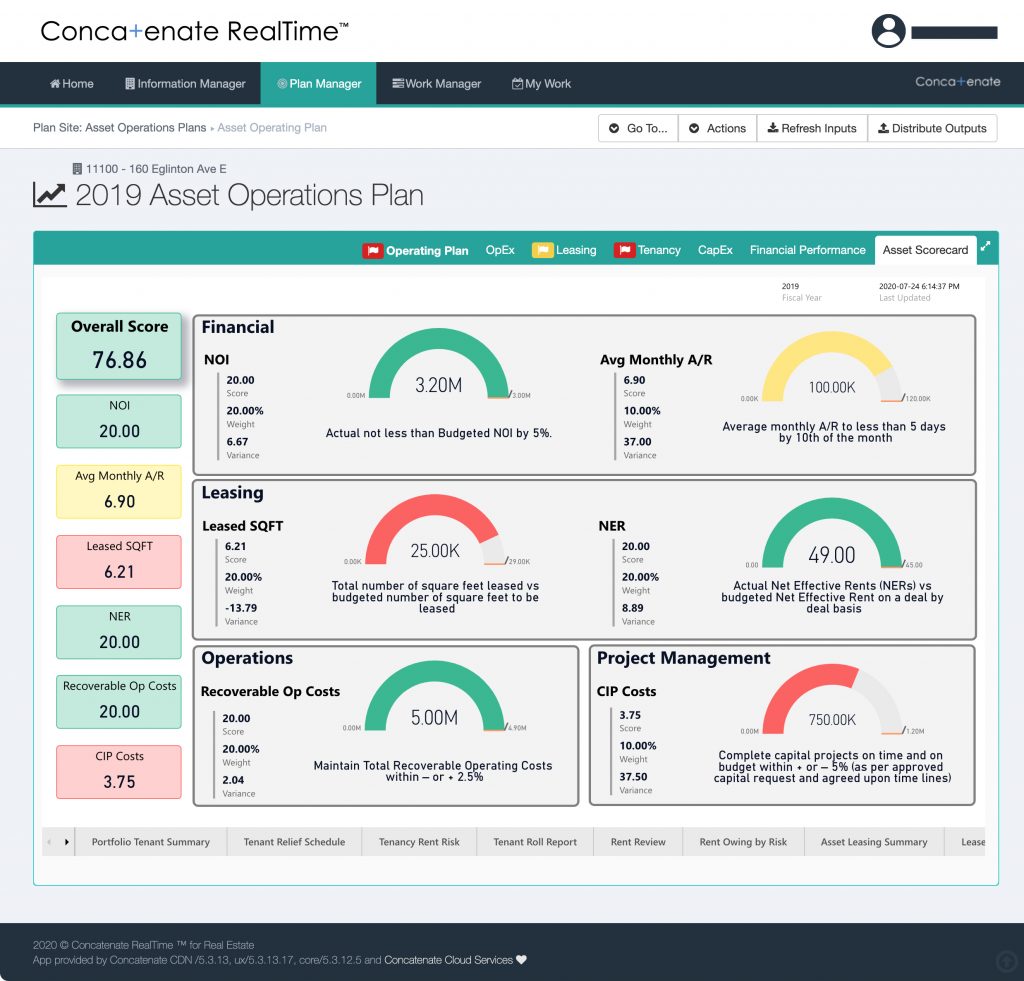
The annual Asset Business Plan defines the path by which CRE companies can achieve their primary objective: to meet their investors’ targeted NOI (net operating income). The plan is produced by making assumptions on all the key deliverables (e.g., leases, capital improvement projects, mortgages, operating budgets) for the targets to be met. The individual teams responsible for producing key deliverables have a linear dependence on each other. As anyone who has ever been part of this iterative process can attest, however, it can involve months of agonizing and frustrating work.

Ironically, it’s when the Asset Business Plan is completed that larger challenges surface. At this point, the plans are approved in printed documents, effectively freezing them in time. However, real estate operates in a dynamic world, and conditions change. Therefore, the plan’s underlying assumptions need to be adjusted in response to the changing conditions.

Herein lies the problem: the assumptions are locked in because they’re buried in the various systems and documents where they were created. As a result, updating Asset Business Plans with revised assumptions that reflect changing conditions is difficult at best. Moreover, it’s not easy for CRE executives to get a clear picture of how their plans are unfolding at any given point in time. It’s when they realize their plan’s targets are not being met, and they need to re-forecast the balance of the planning period, that everything falls apart. With everything locked into PDFs, there is no choice but to go through the labourious planning process all over again.

The solution to this problem relies on transparency. That requires having a common enterprise platform for all the teams to share information, report on the status of their work, and exchange their deliverables once completed.
A connected team

The nature of CRE operations means that no one department operates alone. Unfortunately, few CRE companies have the systems in place to foster the collaboration required to execute a company’s plan optimally. COVID-19 has added to this problem by accelerating the trend toward employees working from home.

“Take, for instance, a situation where a property manager needs to prepare a leasing forecast for the balance of the year,” says Meltzer. “Because there is no shared information platform, getting this done often means contacting each listing agent or leasing rep. This is both tedious and a waste of time.”

By contrast, uniting teams on a shared platform will facilitate well-executed plans and help ensure that targets are met.

Tech integration

Prop-tech has come a long way over the last five years. The CRE industry has been inundated with new and innovative line-of-business (LOB) solutions, each promising significant benefits. These LOB solutions require the exchange of output deliverables with one another and access to common asset information. The problem is that the solutions are stand-alone and often with overlapping functionality. As such, each organization needs to decide what its digital landscape is going to look like and how each solution will work with their enterprise accounting system. This can ultimately lead to the creation of even more data silos.

“CRE organizations have all these systems but no single, cohesive platform where teams can bring their deliverables together,” says Meltzer. “This disconnect can undermine the Asset Business Plan, if not the organization entirely.”

With this in mind, Meltzer has spent the last few years designing and fine-tuning Concatenate RealTime, a real estate business management platform designed to sit “on top” of accounting systems, spreadsheets, and LOB solutions. RealTime monitors work deliverables, integrates work processes, and provides instant status reports to all levels of the organization.

“The potential benefits to bringing solutions to these three issues are massive,” Meltzer explains. “Not only do you get transparency into everything that’s happening in your organization, with all work mapped back to the Asset Business Plan, but a platform like this allows leaders to make changes to any Asset Business Plan and then track those changes to ensure they happen.”

CRE management 2.0

If there’s one thing that the COVID-19 pandemic has made clear, it’s that times are changing for CRE businesses. What hasn’t changed is the need for CRE companies to preserve and build portfolio value by optimizing the management of their assets and planning for the future. This is easier said than done in today’s demanding environment, but as with most modern challenges, people, processes, and technology are all part of the solution.

Michael Meltzer is the Principal of Concatenate Inc. Learn more about the Concatenate RealTime real estate business management platform at www.concatenateinc.com , email [email protected] or call 647-291-5987.

Kicking Horse River Dike phase 2 set to begin

The design for the downtown riverfront area as part of the Kicking Horse River Dike Improvement Project has been completed and construction for phase two is set to begin in early August.

“In addition to protecting Golden from the risks of river flooding, this project will transform the riverfront space between our downtown core and the Kicking Horse River, making it a place where residents will come to work, play and connect,” said Mayor of Golden Ron Oszust.

The Kicking Horse River Dike Improvement Project represents the largest infrastructure grant the Town of Golden has ever received at $5.87 million.

The Town of Golden conducted both in-person and online public engagement opportunities to residents in September 2019, receiving feedback from over 200 people. Overall, public engagement participants described their vision for the area as a place to walk along the river, visit and shop at local businesses, connect with the community and come to enjoy the space and surrounding natural environment.

The overall design by Urban Systems includes the flood protection wall, the addition of seating areas, lighting, vegetation and landscape elements, as well as the relocation of garbage bins.

“The Kicking Horse River Dike project will improve the waterfront by controlling flood risks and making the area more sustainable, which are critical as we address the effects of climate change,” said the Honourable Catherine McKenna, Minister of Infrastructure and Communities.

TYBO Contracting Ltd. will kick off construction in early August with riprap work and the construction of the flood protection wall. Work will take place six days a week from August to November with TYBO returning in spring 2021 to complete the landscaping and beautification elements of the project. The project is set to be completed by July 2021.


Converting hotels into multifamily apartments

While demand for multifamily housing remains relatively robust, COVID-19 continues to devastate Canada’s hotel sector with Altus Group reporting a 90 per cent drop in revenue since the state of emergency was declared in March. Given the uncertainty of the travel and tourism industry and Canada’s pressing need for affordable housing, could converting hotels into multifamily rental apartments serve as an effective solution?

Qaiser Mian, Senior Director, Hospitality and Senior Housing at Altus Group, is one of many experts who believes that it could. “Although the long-term prospects for the Canadian hotel sector remain positive, COVID-19 has impacted the industry severely with fewer than 50 per cent of hotels now open during the peak travel summer months,” he reveals. “In the absence of this crucial summer revenue, combined with the possibility of a prolonged recovery period and increased operating costs, hoteliers, like many small business owners, must make the assessment as to the long-term viability of their operations.”

And the novel coronavirus isn’t the only force creating waves throughout the sector. Videoconferencing and virtual meeting apps intended as interim solutions during the lockdown period have potentially reduced the need for business travel. Furthermore, fears surrounding exposure to illness and the aggravation of adhering to strict isolation rules are keeping most leisure travellers from venturing too far abroad, at least until a vaccine is in the picture.

By contrast, the pandemic has shone a spotlight on housing need, with most jurisdictions in Canada continuing to search for affordable solutions. As Mian points out, converting hotels into multifamily apartments can help meet this demand by enabling owners and investors to quickly move supply into the market—with real benefits to the owner if the conversion is done right.

“Due to their design, hotels can be adapted into apartment use relatively easily compared to other real estate,” he says. “When the stability of cash-flow, access to broader sources of capital, and lower capitalization rates relative to hotels are taken into consideration, some owners would be well advised to consider the possibility of a conversion. The key is to determine whether the property is well positioned to thrive in an emerging marketplace, or if the asset is better suited for something else.”

Likely, smaller, older, owner-operated hotels in secondary and tertiary markets will find it harder to rebound from the crisis—which is why Mian advises owners of these assets to carefully evaluate their options.  A thorough “SWOT” (strengths-weaknesses-opportunities-threats) analysis looking at everything from pre-pandemic market conditions to building size, floor plate, location and zoning, will help inform a decision. But it all starts with an ability to “get out of your comfort zone and undertake an objective assessment of your competitive position,” he says. “Most hurdles can be mitigated through careful planning, entering strategic partnerships and engaging the right advisors.”

Evaluating the options

If a conversion does look preferable to staying the course as a hotel, the next step is to evaluate the options. According to Mian, affordable, market rental, seniors and student housing all represent potentially profitable conversions for hotels with complementary footprints and infrastructure.

To determine the right fit, a “highest and best use” analysis and a feasibility study are recommended. These steps will help owners quantify the level of demand and supply for optional uses of their buildings within specific markets, while projecting which options will likely add value and generate long-term returns. They’ll answer key questions, like:

  • What is the macroeconomic environment of the area: employment, income growth, population growth, demographic characteristics?
  • Current and future market demand?
  • Sector profitability?
  • Competitive landscape?
  • Industry cost structure?
  • Regulatory controls?
  • The community’s position on potential redevelopment?

Other key factors with potential financial ramifications:

  • Condition of the building – envelope, HVAC, electrical, lighting and fire systems, technology infrastructure and finishes;
  • Tenant space – floor plate size and shape, usable square footage, common area factors;
  • Legal/regulatory – building codes, insurance requirements, government regulations.

Already, as lenders review their hotel portfolios and are forced to make tough decisions about which operators to support at the expense of others, properties with no cash flow  and burgeoning carrying costs are most at risk of closure. To find out if a conversion is in your property’s best interest, visit: https://www.altusgroup.com/services/insights/its-an-optimal-time-for-converting-hotel-assets-to-multi-family/


Mass timber office tower T3 Bayside begins to rise

Starting its ascent in the Bayside Toronto community last week, T3 Bayside will bring 251,000 square feet of mass timber office space with 30,000-square-foot floorplates to the eastern waterfront in early 2023.

This is the phase one of a partnership between Hines and Waterfront Toronto that, once complete, will see two twin heavy timber office buildings constructed using a highly sustainable mass timber structure.

T3 Bayside, which stands for Timber, Talent and Technology, was designed by Danish firm 3XN and WZMH Architects and is set to be Toronto’s tallest wood-frame building. CBRE Limited will market and lease phase one.

“These are unique and unprecedented times, and we remain committed to building infrastructure and getting shovels moving across Ontario,” Ontario’s Minister of Infrastructure Laurie Scott said at the ground-breaking ceremony. “The construction of the tall timber buildings will make way for future investments and opportunities in the Waterfront area, while also creating jobs and contributing to our economic recovery and renewal for many years to come.”

Once complete, Bayside Toronto will include two million square feet of new residential housing, including market condominiums and affordable housing, modern office space, shopping and restaurant destinations and cultural venues, along with a newly activated and engaging public realm.

Hines was named the master developer of Bayside Toronto, following an international competition by Waterfront Toronto. Hines brought condominium developer Tridel on as its exclusive residential development partner at Bayside. So far, Hines and Tridel have launched four residential projects: Aqualina, Aquavista, Aquabella and Aqualuna. 3XN’s design for Aquabella marked the Danish firm’s first project in North America.


Pembina Institute’s action plan for CleanBC goals

The Pembina Institute is calling on the B.C. government to ensure that economic relief and stimulus programs enhance and accelerate progress toward the vision and goals of the province’s climate plan, CleanBC.

The Institute has released Rebuilding a Resilient B.C., an action plan for investing in jobs and better health and well-being for British Columbians. The action plan outlines four principles for a resilient recovery in B.C. and offers recommendations in support of low-carbon homes and buildings, clean transportation, and clean energy.

These recommendations include:

• Position B.C. to be a leading supplier of renewable fuels.
• Set B.C. on a path to be a leading producer and consumer of low-carbon and zero-carbon hydrogen.
• Grow and train the workforce and develop the supply chain for building retrofits.
• Raise incentive caps to deepen retrofits of homes and buildings.
• Provide funding for capital and operating costs for transit.
• Invest in active transportation.

“Across Canada and elsewhere, B.C. is being commended for its deft navigation of the COVID-19 pandemic. Now B.C. has another opportunity to show leadership — by rebuilding the economy to ensure our province’s future resilience,” said Karen Tam Wu, B.C. director at the Pembina Institute.

For low-carbon homes and buildings, the Institute recommends:

  • Raising incentive caps to deepen retrofits of homes and buildings.
  • Boosting funding to accelerate retrofits and construction of social and Indigenous housing.
  • Investing in deeper retrofits of public buildings.
  • Growing and training the workforce and develop the supply chain.

Hilti unveils wearable exoskeleton

Hilti North America has unveiled a wearable exoskeleton that will help commercial contractors, tradesman and management alike tackle health and safety as well as labour shortage challenges.

The new human augmentation device called EXO-O1 wearable exoskeleton was created in partnership with Ottobock, a global leader in prosthetics, orthotics and exoskeletons.

Wearable systems like exoskeletons will help reduce strain and fatigue for both experienced and novice users, at a time when the industry is managing a workforce shortage challenge.

Hilti is currently in real-world jobsite testing and will be bringing the exoskeleton to the market later this year.

“We want to improve the health and safety of our customers, directly impacting jobsite productivity – so they can stay on time and on budget,” said Johannes Huber, head of business unit Diamond Systems at Hilti Group, parent company of Hilti North America. “Customers that embrace innovation and invest in the latest health and safety technology will be better able to attract and retain the best people as well as keep their jobsites productive.”

The EXO-O1 is Hilti’s first foray into exoskeletons for the construction industry. There will be more human augmentation developments to come from the brand. The exoskeleton development is initially focused on overhead and shoulder height and above applications because this type of motion is so physically intensive and fatiguing.

The machinery is only part of the company’s solution. Hilti understands that for customers to embrace technology transformation, it requires organizational change management and a focus on people. That’s why they also plan to offer implementation, training and support services on site for Hilti’s customers and their teams.

“Our innovations have always been fueled by our deep understanding of our customers’ challenges and needs, so it’s only natural that we can drive innovation with solutions for human augmentation and jobsite automation,” said Rafael Garcia, Senior VP and CMO of Hilti North America. “Human augmentation and jobsite automation innovations, alone or combined, will create productivity gains the likes of which haven’t been seen since cordless tools got a foothold in commercial construction.”

CBRE Caledon invests in 12 Vantage data centres

CBRE Caledon acquired a stake in a $3.5-billion portfolio of 12 purpose-built high-quality data centres based in North America.

Vantage Data Centers, a leading global provider of hyperscale data centre campuses manages the portfolio—a partnership involving a group of investors including Colony Capital, Inc, Hana Financial Investment and Rasmala Investment Bank.

“We are excited to complete this investment as we believe these data centres are located in prime markets with top-tier clients and are expected to provide our investors with long-term contracted cash flows that escalate annually,” said Jeffrey DeBlock, partner at CBRE Caledon. “Through our prior investment in Vantage, we have forged a strong relationship with the management team and are pleased to acquire a significant minority interest in these operational assets, which meets our investors’ objectives.”

Vantage’s executive team, led by CEO Sureel Choksi, will continue to manage and operate the portfolio, which spans more than 1.4 million gross square feet and over 150MW of IT capacity across key markets in the U.S. and Canada.

“CBRE Caledon is excited to complete this investment on behalf of our fund, separately managed accounts and co-investors as we continue to invest in infrastructure for the new economy,” said Stephen Dowd, Chief Investment Officer, Private Infrastructure Strategies, CBRE Caledon. “In addition to providing the resilient characteristics that our clients are looking for in today’s investment environment, we are impressed by Vantage’s commitment to its ESG-goals of reducing emissions and energy efficiency, which include its Washington and Quebec data centre campuses that draw power from renewably sourced electricity.”

Calgary East Village project set to top off

The 9th Avenue SE Parkade and Platform Innovation Centre in Calgary’s East Village is set to be topped off with the final concrete pour for the seventh floor. This will mark the end of the substantial structural work on the building.

On track for a spring 2021 completion, the $80 million project includes an open-air parkade with 500+ parking stalls, public bike parking and an outdoor sport court. Located on 9th Avenue at 3rd Street SE, the parkade is integrated with the 50,000 square foot Platform Innovation Centre, a key piece of public infrastructure designed to accelerate Calgary’s innovation economy by concentrating tech entrepreneurs, high impact programs, partners and investment under one roof.

“This building is unique for Calgary but is exactly in line with the forward-looking approach that’s guided development in East Village from the outset. Its flexibility means it’s responsive to the evolving needs of the neighbourhood and is built with an approach that is mindful of our communities’ needs—present and future,” said Kate Thompson, CMLC president & CEO.

CMLC, serving as development manager, worked with partners Calgary Parking Authority (CPA), Platform Calgary and architects Kasian and 5468796 Architecture to bring the building to life.

The building has a new look since the early design renderings were released due to a change in the exterior screen material. The project team made the adjustment to address anticipated challenges with the constructability of the original screen. The new design and material offer a local fabrication solution and improved long-term maintenance efficiencies while maintaining the original striking design aesthetic.

The parkade itself offers design innovations that allow for future conversion into office or residential uses.

“We really wanted to reimagine how a parking structure could be designed, to integrate into its surroundings and be a dynamic part of an urban mosaic. 9th Avenue Parkade provided just that; it is designed, developed and built to address the evolving transportation needs of the community,” says Glen Furtado, CPA general manager.

New B.C. online tool to extend COVID-19 layoffs

The B.C. government has unveiled a new online tool for employers and workers who need to extend temporary layoffs due to COVID-19.

The process to apply for a variance can now be done using the Employment Standards Branch’s new online application.

In June, government extended the time period for temporary layoffs related to COVID-19 to a maximum of 24 weeks, expiring on Aug. 30, 2020. This is expanded from 16 weeks, to give employers and workers more flexibility.

The new online application simplifies and streamlines the process for employers and workers to jointly apply for an extension beyond Aug. 30 by eliminating the need for hardcopy documents and signatures, while ensuring the integrity of the branch’s decision-making process.

Government engaged with stakeholders, including small businesses, to test the online process to make it as simple as possible to support B.C.’s workplaces in economic recovery.

Employers are encouraged to apply as soon as they have received worker support. An application deadline of Aug. 25, 2020, has been set to ensure that all applications will be processed by the Aug. 30 expiry date.

There are now two steps. Employers must:

  • Survey their workforce to obtain more than 50 per cent support from workers before applying. Workers will receive information about the variance, including what their rights are and can provide their support using a new online response tool;
  • Once worker support is documented, employers complete the online form and submit the document in a new portal directly to the Employment Standards Branch.

There are new supportive templates and tools to assist employers and workers in taking these steps.

Under B.C.’s Employment Standards Act, temporary layoffs related to COVID-19 can last up to 24 weeks, or until Aug. 30, before the layoff becomes permanent.

Government recommends that employers submit their variance applications early to avoid the potential of permanent staff layoffs and compensation for length of service to eligible workers upon the expiry of the COVID-19 emergency layoff period on Aug. 30.

The province also encouraged employers to make use of the federal wage subsidy to assist them in bringing their workers back

Vancouver approves controversial Birch Street rental tower

The City of Vancouver has approved plans for the controversial Birch Street rental tower, a 28-storey development located at the corner of West Broadway. While the height of the new building had many residents in opposition, ultimately the need for more affordable rental housing won the City Council’s vote.

When complete, the 280-foot tower by Jameson Development Corp. will deliver 200 market rental homes and 58 units geared to households earning between $30,000 and $80,000 per year. Mayor Kennedy Stewart described the vote as a necessary step toward achieving Vancouver’s 10-year goal of approving 72,000 new homes for construction by 2027.

The unit mix is comprised of 30 studios, 121 one-bedroom, 70 two-bedroom, and 27 three-bedroom units. Rents for the 58 moderate-income units will be between $950 per month for a studio and $2,000 for a three-bedroom unit — roughly half of the market rental rates. Within the first two levels, there will also be roughly 30,000 sq. ft. of retail and office space. All units will be pet-friendly.

The Birch Street rental tower project falls under the city’s Moderate Income Rental Housing Pilot Program (MIRP), which was designed to provide homes for households that are not eligible for or do not want to live in social housing, but cannot afford a market rental home.

Though the majority was in favour of the project moving forward given the city’s need for more rental housing, those opposed expressed concerns about the tower’s height, shadowing, and the impact on neighbourhood character. A previous design, approved in January 2018, had the tower rising just 17 storeys, but the plans were since revised.

Renderings: Jameson Development Corp. 


Bill 184 is now a law in Ontario

Ontario has moved ahead with the controversial Bill 184 despite opposition from tenant advocates claiming it will lead to mass evictions. Since the state of emergency in Ontario began, landlords have been banned from evicting non-paying tenants. The new law will require tenants owing money to pay back their landlords in a scheduled repayment plan.

“We know tenants and landlords have struggled during COVID-19, and some households may be facing eviction due to unpaid rent during this crisis,” said Steve Clark, Minister of Municipal Affairs and Housing. “By making these changes we are trying to keep people in their homes, and at the same time, helping landlords receive payment through a mutual repayment agreement. It’s a better approach, especially during these difficult times.”

Other changes to the legislation include:

• Requiring tenant compensation of one month’s rent for “no fault” evictions;
• Allowing the Landlord and Tenant Board to order up to 12 months’ rent in compensation for eviction notices issued in bad faith or where the landlord does not allow the tenant to move back in after renovations or repairs;
• Doubling the maximum fine amounts for offences under the Act to $50,000 for an individual and $250,000 for a corporation.

According to the release, the changes will also “modernize and streamline” the dispute resolution processes at the Landlord and Tenant Board and encourage the use of alternatives to formal hearings to resolve certain issues and encourage negotiated settlements. The Landlord and Tenant Board must now consider whether a landlord tried to negotiate a repayment agreement with a tenant before it can issue an eviction order for non-payment of rent related to COVID-19. Certain disputes, such as those related to unpaid utility bills, will shift from Small Claims Court to the Board.

In addition, the government has made changes to the Housing Services Act, 2011, in what it calls “an effort to help maintain the existing community housing supply.” Amendments will give housing providers with expiring operating agreements and mortgages ways to remain in the community housing system through a new service agreement with service managers. It will also encourage existing and new housing providers to offer community housing.

Despite these efforts, tenant advocates concerned about vulnerable tenants continue to oppose the bill and remain active in their opposition.