Articles Archive - Page 433 of 928 - REMINET
REMI

New course guides design for zero-energy schools

Leading industry organizations have developed a new e-learning course on how to achieve cost-effective advanced levels of energy savings for zero-energy schools.

Achieving Zero-Energy Building Design is adapted from the Advanced Energy Design Guide for K-12 School Buildings and establishes a set of energy performance goals for achieving zero-energy schools in all climate zones, in both site and source energy.

The course was developed by the U.S. Department of Energy through the National Renewable Energy Laboratory, in partnership with ASHRAE, the American Institute of Architects, the Illuminating Engineering Society and the U.S. Green Building Council. The course will be offered through each partnering organization’s e-learning platform.

“The goal of this e-learning course is to prepare engineers, architects, designers building owners and other practitioners with in-depth knowledge to improve skills in high-efficiency building design,” said Paul Torcellini, project committee chair. “There are many incentives for schools to reach zero energy usage including budget benefits of lowered energy consumption and increased student performance due to a healthier learning environment. This course includes the information and real-life best practices needed to encourage practitioners and school administration officials to consider that zero energy school buildings are within their reach.”

The eight-hour course consists of twelve modules with content that applies to commercial buildings, including case studies that focus on zero-energy K-12 schools. The format includes open-ended thought questions, reference lists for additional reading, real-life case studies, video testimonials from design professionals and separate learning paths for architects and engineers. Certificates of completion will be available for download for the successfully completed course.

Galleria on the Park breaks ground

A socially-distanced ground-breaking ceremony took place for Galleria on the Park—the mixed-use community that will rise on a 20-acre site at Dufferin and Dupont streets in Toronto’s west end. The plan includes eight mixed-use buildings with almost 2,900 condo residences, 300,000 square feet of retail and the new 95,000 square-foot Wallace Emerson Community Centre.

Representatives from ELAD Canada joined Councillor Ana Bailao and staff from the City’s affordable housing division, as well as project team members from CORE Architects, PSR Brokerage and Clark Construction Management, to commemorate the occasion on-site.

“We are extremely proud to deliver such a significant project to the City of Toronto,” said Rafael Lazer, CEO of ELAD Canada. “We have always deeply believed in the West End – its rich industrial past, its strong sense of community, and its vibrant arts and culture scene.”

As part of the first phase of the development, Galleria on the Park will include mixed-use towers Galleria 01 and 02, 150 affordable rental units, retail, the community centre and Phase 1 of the expanded eight-acre park. Galleria 01 and 02 are now more than 95 per cent sold of released units.

The towers—a CORE Architects’ design—are clad with dark and rich metals, paying homage to the industrial character of the neighbourhood. The amenities and suites, by design firm U31, feature modern interiors that take cues from the neighbourhood. Family-friendly amenities include an expansive co-working space that doubles as an event space opening out to a wrap-around outdoor terrace, an outdoor pool and a state-of-the-art fitness centre.

Galleria on the Park

Six rainbow murals along Galleria Mall by artist Thrush Holmes send message of positivity and hope to Toronto’s west end. Photo credit: Geoff Fitzgerald.

HVAC systems and COVID-19: Q&A

Ensuring indoor air is fresh, clean and safe is one of many tasks that boards and managers must oversee on behalf of their residents. SARS-CoV-2, the virus that causes COVID-19, has made this even more daunting. With prevailing uncertainty over potential exposure to the virus through building ventilation systems, how concerned should condo communities be and what measures can they undertake to reduce transmission?

Here, Robert Borovina, director of mechanical engineering at McGregor Allsop, offers some guidance.

The American Society of Heating Refrigeration and Air Conditioning Engineers (ASHRAE) has recently published their position document on infectious aerosols, in which they state that transmission of SARS-CoV-2 (COVID-19) through the air is sufficiently likely, so airborne exposure to the virus should be controlled.

The document also states that ventilation and filtration provided by heating, ventilating and air-conditioning (HVAC) systems can reduce the airborne concentration of SARS-CoV-2 and therefore the risk of transmission through the air. Disabling HVAC systems is not a recommended measure to reduce the transmission of the virus.

In general, pathogen transmission through the air occurs via droplets or aerosols. While larger droplets fall by gravity to the floor or surrounded surfaces within two meters of their source, the operation of the HVAC systems do not affect their transmission. Contrary, the smaller infectious aerosols, such as droplet nuclei (particles smaller than 10 microns) that can form from desiccation (drying) of the larger droplets, can stay suspended in the air for longer periods, with HVAC system operations affecting their pattern.

Precautionary Measures

There are a number of measures to reduce the transmissions of pathogens via HVAC systems, however, few can be readily implemented. They include:

  • Dilution of room air by increasing the amount of outdoor air in the overall recirculation;
  • Increasing the efficiency of the filtration system or use of single space high-efficiency filtration units (portable or fixed);
  • Maintaining proper temperature and relative humidity to reduce desiccation of larger droplets into aerosols.

HVAC for condominium buildings is quite different from commercial office buildings. Some precautionary measures that may require implementation in commercial buildings are not necessary for condominiums.

Reducing Transmission in Floor Corridors, Suites and Common Spaces

There are three distinctive HVAC systems in typical mid to high-rise condos. The first one is HVAC for the floor corridors. These areas are served by the dedicated make-up air unit (MAU) that supplies 100 per cent of outdoor air, without any recirculation within the building. In some cases, the MAU only provides heating and ventilation and in other cases air conditioning as well. Since the MAU only provides outdoor air there are no special filtration sections required, other than standard filtration for this type of operation. The MAU generally does not provide humidification during winter months.

The second HVAC system relates to the individual suites. This typically includes fan coils or heat pumps. In newer buildings, individual suites are also equipped with dedicated energy recovery ventilators (ERV), that provide continuous ventilation for the suites, utilizing energy recovery from the suite bathroom exhaust.

In older buildings, pressurized corridors provide outdoor air for suites, forcing air through the door cracks of the individual suites that are normally kept under negative pressure through centrally or individually operated bathroom exhausts. In buildings where suites are provided with ERV-s, there is practically no possibility of cross-contamination between corridors and individual suites. In buildings where suite ventilation is provided via pressurized corridors such a possibility exists, especially in winter months when dry make-up air can desiccate droplets into aerosols capable of being suspended in the air for longer periods. Although dilution of the air in the corridors is significant, due to a large amount of outdoor air being introduced into such areas, it would be a good practice for residents to carry protective wear when walking through the corridors and elevators, primarily to prevent possibility of creating droplet particles by coughing or sneezing.

The third HVAC system relates to common spaces, such as lobbies, recreational rooms or facilities. Due to the building stack effect, lobbies are generally diluted with large amounts of outdoor air any time the main entrance doors are used, so no additional measures for the HVAC units are required. The outdoor air for recreational rooms or facilities are usually directly ducted from the outside to the HVAC units serving such spaces. The amount of outdoor air is usually limited to two air changes per hour at the best, which is not enough for proper dilution of the air in the space. In cases where upgrades to the HVAC system to enable larger amounts of outdoor air are too costly or technically challenging, it is recommended that such spaces become equipped with high efficiency, self-contained filtration units. It is also recommended that temperature and relative humidity is kept at the proper levels, especially in the winter.

Although preliminary research results have been released on the transmission of COVID-19, there is a general consensus that HVAC systems in non-medical buildings may contribute very little to the transmission of the disease. This is particularly true for condos, therefore, basic principles of social distancing, surface cleaning and disinfection, should be more important at this moment than contemplating major retrofits of the HVAC system.

Robert Borovina is the director of mechanical engineering at McGregor Allsop, Toronto. He brings 37 years experience in all aspects of HVAC engineering.

Hotel recovery relies on impulsive staycationers

Following what’s characterized as the most difficult quarter yet recorded for Canadian hotel owners and operators, industry analysts are tracking the arduous climb back from the early April trough when the national occupancy rate bottomed out at 12 per cent. Colliers Hotels’ recently released INNvestment report now concludes the sector has moved from survival to recovery mode as it absorbs and responds to a 54.2 per cent year-over-year drop in revenue per available room (RevPAR) and a 46 per cent year-over-year slide in occupancy for the first half of 2020.

The national occupancy rate had inched up to nearly 29 per cent by early July as inter-regional and inter-provincial travel restrictions gradually eased. However, overnight visits from outside the country have dropped dramatically with the closure of the Canada-U.S. border and other restrictions on international air travel. Last year, approximately 25 million Americans and 7.5 million visitors from other countries entered Canada.

It’s estimated Canada hosted just 93,000 overnight visits from outside the country during April, May and June versus more than 6 million in the same period of 2019. Prior to the COVID-19 outbreak, Canada welcomed greater numbers of international overnight visitors than in January and February of the previous year, but since then year-over-year overnight stays have declined by more than 72 per cent.

Staycation demand would have to surge to remarkably unprecedented levels to begin to fill the void. Nevertheless, it is considered a key, yet slippery element of hotel recovery. The INNvestment report acknowledges that close-to-home travel will represent a significant share of summer business and that many of those travellers will pick destinations somewhat impulsively.

“The recovery will likely include exceedingly short planning times driven by gradual lifts of the travel restrictions and very short booking windows as travellers monitor the situation,” it advises. “Hoteliers are being creative to tap into new segments of demand and shift marketing efforts to a more local approach.”

Turning to investment activity, BC Housing emerged definitively as the most prominent buyer of the second quarter, buying four hotels — two each in Vancouver and Victoria — to convert to other housing uses. The nearly $108 million investment translates to $270,000 per suite and represents 54 per cent of trade value for the quarter. Two other properties were also purchased to be converted. However, only one of this spring’s transactions involved a distressed property.

Year-to-date trade value of $500 million lags $830 million in trades during the first half of 2019. A total of 12 deals during April, May and June was down from 23 in the first quarter and 36 in the second quarter of 2019.

“Reflective of the challenges hotel owners are facing, sellers for the most part were reluctant to value their hotels on depressed income levels,” the report notes. “As the market slowly recovers and demand for accommodations returns, we predict increased transaction activity for the second half of the year.”

GBAC STAR program for building service contractors in the works

The ISSA and its Global Biorisk Advisory Council (GBAC) division have announced intentions to release the new GBAC STAR Services Accreditation Program for building service contractors by the end of August.

The new program will help building service contractors distinguish their cleaning, disinfection, and infectious disease prevention measures through third-party accreditation from GBAC’s biorisk experts.

The program will complement the GBAC STAR Facility Accreditation Program and outline specific protocols, work practices, and training requirements for cleaning contractors to earn the GBAC STAR Services designation. The program will be designed to supplement other industry certifications and training but with an emphasis on validating firms’ procedures to help their customers prepare for, respond to, and recover from infectious disease outbreaks.

Complete program details and pricing will be available by August 31.

Information regarding GBAC STAR, including exclusive discounts for the GBAC STAR Facility Accreditation Program and the GBAC Fundamentals Online Course: Cleaning & Disinfection Principles, can be found here.

“GBAC STAR is the gold standard of safe facilities, providing third-party validation that ensures facilities implement strict protocols for biorisk situations,” says Patricia Olinger, executive director, Global Biorisk Advisory Council. “Accreditation empowers facility owners and managers to assure workers, customers, and key stakeholders that they have proven systems in place to deliver clean and healthy environments that are safe for business.”

Numerous facilities across North America have already pledged their commitment to the program, including the Edmonton Convention Centre, the Edmonton EXPO Centre, and the Toronto Congress Centre.

Investment deal resumption foreseen for Q3

Static cap rates reflect limited transactions in the second quarter of 2020, but commercial real estate analysts express confidence that asset values are holding under COVID-19-related pressures. CBRE’s recently released Q2 cap rate and investment summary pegs the national average cap rate at just below 6 per cent — roughly on par with 2018 levels, but with a significantly greater 512 basis point spread above 10-year bond yields.

“Defensive asset classes are performing as expected and these sectors have even exhibited lower levels of cash flow volatility than originally anticipated. Long term investment demand for logistics and multifamily assets remains particularly elevated,” notes Paul Morassutti, vice chair, valuation and advisory services with CBRE.

Nationally, cap rates still rest below 5 per cent for downtown Class AA office and all types of multifamily properties. Class A industrial cap rates are also below 5 per cent in Vancouver, Toronto, Montreal and Ottawa. Likewise, the four major markets continue to post cap rates below the national average for downtown office properties. On the flipside, Calgary, Edmonton, Winnipeg and Halifax generally exceed the national average for all property types.

While CBRE analysts conclude investors have switched focus for prospective office acquisitions with “longer term lease profiles and strong tenant covenant” now taking precedence over rent growth potential, industrial fundamentals reflect strong e-commerce performance before and during the COVID-19 lockdown. “Investor demand and asset pricing should hold for the foreseeable future,” they project, and that’s foreseen for both struggling and more robust markets.

“Recent increases in industrial activity have been driven by the logistics sector, specifically by food distribution tenants,” reports Richie Bhamra, CBRE’s senior vice president based in Calgary. Otherwise, cap rates trended upward for most property types except Class A office space and Class A high-rise multifamily buildings.

Nationwide, CBRE analysts concur that industrial and multifamily markets exhibit the most resilience and are poised for investment deal resumption. Demand for other assets is more market-specific.

“We have seen very few discounts applied due to COVID-19, with the exception being assets with pre-existing challenges,” observes Jim Szabo, CBRE’s vice chairman, investment, in Vancouver.

Vancouver registers the lowest cap rates in every property type among the 13 regional markets CBRE surveys. Class A multifamily, both high-rise and low-rise, presents the slimmest yield range of all with cap rates at 2.75 to 3.75 per cent. Downtown Class AA office and Class A industrial post cap rates no greater than 4 per cent, while caps for even the most hard-hit retail properties —power centres, neighbourhood shopping centres and non-anchored strip malls — don’t surpass 5.5 per cent.

The outlook is also presumed to be optimistic in Toronto, Montreal and Ottawa.

“Ottawa is proving to be exceptionally resilient during these turbulent times and has only experienced mild pain in isolated asset classes,” submits Nico Zentil, senior vice president with CBRE investments. “Several sizeable deals are expected to close in Q3 2020 and this should help stem the decline in overall volumes this year.”

“High quality assets have seen less value erosion and more robust investor interest,” reiterates Peter Senst, CBRE’s president, Canadian capital markets, based in Toronto. “The focus for investors has been on industrial, multifamily, land and office assets with term and covenant. Levered returns and development upside in select asset classes are still resonating with investors.”

Disinfection of healthcare floors more important than ever

The U.S. Centers for Disease Control and Prevention (CDC) has revised its stance on healthcare facilities and the care of their floors.

Previously, its position was that extraordinary cleaning and decontamination of floors was unwarranted. This was based on studies that demonstrated the disinfection of floors offered no advantage over regular detergent/water cleaning, and had minimal or no impact on the occurrence of healthcare-associated infections (HAIs). In defending its reasoning, the CDC stated people in hospitals rarely touch floors and floors only need to be cleaned when visibly soiled, with the exception of operating rooms, which should be mopped at the end of each day.

In 2016, a group of researchers decided to test the CDC’s conclusions. They enrolled 10 hospital patients in a study. For each patient, a section of floor adjacent to their hospital bed was inoculated with sterile water containing bacteriophage, a virus that can infect bacteria and potentially destroy it. The floor areas were then allowed to dry.

None of the patients knew of the precise area of the inoculation and hospital staff was not made aware of the study.

All cleaning protocols remained the same during the research period. High-touch and commonly touched surfaces were cleaned with bleach and wipes each day. Following the CDC’s recommendations, floors were only cleaned when visibly soiled.

Just one day after commencement of the experiment, researchers detected bacteriophage on multiple surfaces near the patient beds. Within three days, the bacteriophage was detected on various surfaces within three feet of the beds. After three days, contamination was found on high-touch surfaces in adjacent hospital rooms, the nursing station and on portable equipment, such as wheelchairs, medication carts and vital signs equipment.

The researchers concluded the bacteriophage was likely acquired during direct contact with the contaminated floor adjacent to the hospital bed. During removal of footwear, patients could easily acquire the virus on their hands, with subsequent transfer to touched surfaces and other skin areas. The finding of contamination in adjacent rooms and the nursing station suggests that healthcare personnel contributed to the dissemination. This happened after acquiring the virus during contact with contaminated patients or surfaces.

According to ISSA education manager Mark Werner, people can have as many as 50 direct and indirect contacts with potentially contaminated floors every day. Contact may occur, for instance, when picking up items like pens, pencils, or paper that have accidentally fallen onto floors or tying shoelaces that have been in contact with floors.

It is also interesting to note that studies conducted in Wuhan, China have confirmed floors, at least in medical settings, can become contaminated with coronavirus. In one study, pre-moistened swabs were used to test floors in a hospital. “The rate of positivity was relatively high for floor swab samples, perhaps because of gravity and airflow causing most virus droplets to float to the ground,” wrote the researchers.

It’s also possible to inhale floor contaminants. A 2016 study published in the Journal of Applied Microbiology determined that from the floor, air currents, human movements over the floor, and other factors that aerosolize or provide an airborne opportunity for the organism may occur, causing human infections via inhalation or horizontal or cross-contamination from other persons, clothing, or equipment that the organism resettles upon.

So, what can be learned from these studies?

The CDC failed to recognize that people make scores of contacts with floors on a daily basis and pathogens on floors can become airborne. As well, while ‘extraordinary’ steps may not need to be taken to properly clean floors, the health protection agency’s claim that disinfectants are not required goes too far. An effective floor care program should comprise the use of effective disinfectants, detergents, cleaning agents and tools.

Speaking of tools, the CDC suggests that mops be used to clean floors. However, it’s well known that mops spread pathogens. No-mop floor cleaning alternatives like spray-and-vac systems were just being introduced in 2003, so it is possible the CDC was not aware of them at that time. Spray-and-vac has since been supplemented with dispense-and-vac and other no-mop cleaning systems, all of which have become standard floor care equipment in the cleaning industry.

The CDC also neglected to address cleaning frequency. In most healthcare facilities, keeping floors both visibly clean and healthy requires dividing floor care into three steps based on need: daily, periodic, and yearly maintenance.

Daily maintenance involves the removal of dry soils from surfaces, and vacuuming instead of sweeping is the healthiest way to perform this type of cleaning. Alternatively, floors can be cleaned using a no-mop floor care alternative. Periodic maintenance consists of scrubbing floors with an auto-vac floor cleaning system or automatic scrubber.

Once per year, floors should be refinished. This involves the removal of all finish from the floor and a new finish applied. However, if daily and periodic maintenance are performed frequently and correctly, this last step can be delayed for as much as two years.

The CDC has realized its past errors when it comes to floor care. Its recent guidelines place considerable emphasis on the need to keep floors clean and disinfected as much as possible in order to protect human health. They include: cleaning floors on a regular basis, when spills occur or visibly soiled; following manufacturer’s instructions for proper use of disinfecting products; preparing disinfecting solutions as needed and replacing with fresh solution frequently (for example, mopping solution should be changed after every three patient rooms and no less than at 60-minute intervals); decontaminating mop heads and cleaning cloths regularly to prevent contamination; and using an Environmental Protection Agency (EPA) registered hospital disinfectant designed for housekeeping purposes in patient care areas where there is uncertainty about the nature of the soil on the floor (for example, blood or body fluid contamination versus routine dust or dirt) or the presence of multi-drug resistant organisms.

The CDC now also has specific floor cleaning recommendations for when patients have certain, very contagious diseases. For instance, daily cleaning is required if a patient has Ebola, and the floor must be thoroughly cleaned and disinfected once that patient moves out of the room.

Robert Kravitz is a frequent writer for the professional cleaning industry.

WorkSafeBC issues heat stress warning

WorkSafeBC is reminding employers and workers about the risk of developing symptoms of heat stress when working outdoors. With high temperatures in many parts of British Columbia, heat stress when left untreated can lead to injuries from heat exhaustion and heat stroke.

“With the hot weather, workers and employers need to be aware of the risks from sun exposure and heat stress,” said Barry Nakahara, senior manager of Prevention Field Services at WorkSafeBC. “Heat stress is a preventable injury, yet last year in B.C. there were 26 accepted claims for work-related heat stress injuries.”

To prevent heat stress injuries, WorkSafeBC requires employers to conduct heat stress assessments. As appropriate, employers must have a heat stress mitigation plan that provides education and training in recognizing the symptoms of heat stress and heat stroke.

Employers are encouraged to change work practices and policies to limit risk, monitor heat conditions and require workers to not work alone, and determine appropriate work-rest cycles.

Employers should also rotate work activities or use additional workers to reduce exposure, establish cooling areas with shade and water, and make sure emergency procedures are in place and there is adequate first-aid coverage. Physical modifications should also be made to facilities, equipment and processes to reduce exposure.

Workers should stay hydrate, wear light-coloured and loose fitting clothing, and take rest breaks in cool, well-ventilated areas. Hard physical work should be done during the coolest parts of the day before 11 a.m. and after 3 p.m. They should also know their personal risk factors such as medications of pre-existing conditions, and check for signs and symptoms of heat stress.

Alberta cities receive $1.1B infrastructure funding

Alberta is providing $1.1 billion in funding to cities for core infrastructure projects in 2020.

The provincial government announced it is providing municipalities with $500 million in additional funding as part of the province’s Alberta Recovery Plan and will also match $233 million in federal funding to support municipal operating costs during the COVID-19 pandemic and $70 million to support public transit operating costs for a total of $606 million under the Safe Restart Agreement.

“The past five months have been tough for Albertans as we faced the global coronavirus recession, the unprecedented collapse of energy prices, and the COVID-19 pandemic. But Albertans are resilient, and Alberta’s Recovery Plan is a bold plan to build, diversify and create jobs. This investment will provide municipalities with the funding they need to get through this crisis, create good jobs now, and build the infrastructure that will fuel economic growth in our province for generations to come,” said Alberta Premier Jason Kenney.

The $500 million in additional municipal infrastructure funding is part of the more than $10 billion infrastructure spending announced as part of Alberta’s Recovery Plan.

Municipalities and Metis Settlements can begin applying for funding to build roads, bridges, water and wastewater treatment plants, and other infrastructure that would not have been built in 2020 or 2021 without the stimulus.

Funding will be distributed on a per capita basis with a $50,000 minimum funding amount for municipalities with small populations. Summer villages will be allocated a base of $5,000 plus the per capita amount.

A local government must commit its entire allocation to projects by Oct. 1, 2020. Any remaining funding may be reallocated to other municipalities.

Up to five applications can be submitted per municipality. Applicants are encouraged to use their allocation on one or two projects to minimize administrative and reporting requirements, a government release stated.

“Alberta’s communities play a critical role in our economy and we want to help them get shovel-ready projects into the ground immediately to create jobs, drive economic growth and improve Alberta’s competitive position. We’re also asking municipalities to reduce taxes and red tape to make it easier to start up a new business, speed up approvals for development permits and make their municipality a better place to invest. Together, we’ll continue to make Alberta the best place to live and do business in North America,” said Alberta Minister of Municipal Affairs Kaycee Madu.

Prior to the municipal stimulus program, the Alberta government committed $1.85 billion in Budget 2020 for municipalities through the Municipal Sustainability Initiative and $244 million from the federal government’s Gas Tax Fund.

ACI names new senior manager, meetings coordinator

The American Cleaning Institute (ACI) has announced a new senior manager and the appointment of a coordinator to their meetings and membership departments.

Arielle Brown has been promoted to senior manager, government affairs, while Kaitlyn Doherty has been appointed coordinator, meetings and member services.

Brown has been with ACI since 2019 and she will continue to play an integral role in advancing proactive messaging regarding the impact of policy issues affecting the cleaning products supply chain. Brown received a bachelor of arts in political science from Wartburg College and a master of public policy from University of Northern Iowa.

“Arielle has shown great leadership and this promotion recognizes the work she has done in providing outstanding service to ACI and our members across the cleaning product supply chain,” said Douglas Troutman, ACI general counsel, corporate secretary and senior vice president, government affairs.

Doherty will provide support to the ACI meetings and membership departments, acting as coordinator of member meetings including ACI’s annual convention and mid-year meetings. Doherty graduated from Washington, DC’s George Washington University with a bachelor of business administration, event management.

ACI will also be hosting a webinar on August 5 outlining the importance of hand hygiene, cleaning, and disinfection for schools as they prepare to reopen in the fall. For more information regarding the event and ACI membership, visit the organization’s website.

Construction underway on UVic student housing

Construction is officially underway for two new student housing and dining buildings at the University of Victoria (UVic).

The project will create 621 new student housing spaces, plus a modern 600-seat dining hall, classrooms and conference space. This is the first major capital project since a new Campus Plan was completed by UVic in January 2016.

The two new student housing and dining buildings will be located outside of Ring Road south of the Student Union Building. They are replacing the Cadboro Commons Building as well as Margaret Newton and Emily Carr residences.

The two buildings will accommodate nearly 800 students with a combined total of 783 beds, including 162 replacement beds. A mix of traditional dormitory rooms and community style rooms (single rooms with a shared kitchen and living area) will be offered.

Designed by Perkins + Will, the new facilities are targeting LEED Gold and Passive House standards. Kinetic Construction and EllisDon Corporation are providing construction management services for the $135 million project.

Following UVic’s Indigenous Plan, the buildings will include an Indigenous student lounge and design elements that embrace and reflect Indigenous history and culture.

Amenities will include: a 600-seat dining hall, commercial kitchen, small grocery and new coffee shop; and a wide range of meeting rooms, informal gathering places, classrooms.

A rejuvenated outdoor area will connect the new housing and dining hall to the centre of campus. Other amenities include student group and study spaces, communal social spaces, laundry facilities and secure indoor bicycle storage.

A temporary 500-seat modular dining facility will be operational from September 2020 to July 2022 for students while the new dining hall is under construction. The new hall is expected to open in 2022.

Rooms in Building 1 will be available for students beginning in September 2022. All new housing, dining, meeting spaces and classrooms in both buildings will be available by early 2023.

Condo communities build up resilience in 2020

Several condo communities across southwestern Ontario with larger concentrations of senior citizens quickly watched their everyday routines change like quicksilver as the pandemic hit. Paper copies of board meeting packages and hand-delivered notices morphed into virtual meetings, electronic messaging and crash courses in Zoom.

“Suddenly, people had to figure out how to communicate and do that safely for everyone,” says Casey Beacock, president of Sanderson Management Inc. and president and director of the Grand River Chapter of the Canadian Condominium Institute. “What made our boards survive was their ability to adapt to change and not be afraid of it.”

Managers and boards have long been tasked with preparing communities for uncontrollable events. The pandemic is revealing some gaps while testing the resilience of condo communities—enhancing communication channels, rethinking technology and even reimagining the way common spaces are designed and used.

Connect and Communicate

For Debbie Dale, president of MCRS Property Management, positive relationships among residents are evolving as they face protocols together.

“Communicating in a time of crisis is a quintessential element to successful survival as a community collective,” she says. “Ideally, the communities that have successfully communicated in these difficult times are the ones that will truly excel in the future through the lessons learned—together.”

For Judy Statham, president of ICC Property Management, clear and constant communication is something to strive for always and especially now.

“At the onset, due to mixed demographics with varying degrees of understanding, acceptance, needs for amenity spaces and usage of their condo dwellings, there were diverse viewpoints on the severity of the pandemic, as well as acceptance of protocols put in place by the board, with management recommendations,” she says. “We have seen our communities pull together and help one another during this time. Continuing to manage our communities with care and proper communication and listening to our residents has and will continue to ensure our condominium corporations are strong and resilient.”

Part of Beacock’s job, to an even larger degree now, includes listening. For property managers, she says, this pandemic is about learning how to listen actively.

“People are home, so there is a lot more communication coming in,” she says. “They were typically too busy before so we didn’t hear from them until we needed to; now we are hearing from people every day— sometimes those we have never heard of, who have lived in the condos for years.”

Catching COVID-19 could mean serious infection or hospitalization for those who are more vulnerable in her buildings. This requires a tailored perspective by which to manage.

“You have to think about the plan moving forward and be prepared to go slow—we tend to lag behind what is allowed provincially a bit just because our demographic is vulnerable for the most part,” she adds. “But they don’t always understand that either—they’re tired of being locked down and isolated.”

To help a community’s most vulnerable residents absorb the shock of such a crisis, “support, care, empathy and understanding the various economic, social and physical limitations of the communities should all be considered,” Statham points out.

Uneducated assumptions should also be avoided, says Dale. Resilience cannot be successfully created without living and learning another’s experience. She suggests that a confidential survey to pull out variables and define commonalities is a great first step, along with direct engagement.

“Vulnerable populations require specifically crafted measures to protect their rights and entitlements in a respectful manner,” she says. “There is no one-size-fits-all approach to simply copy and paste repeatedly. Understanding the goals and needs of each individual or defined group yields the basis from which to draft potential resiliency driven measures.”

Hi-Tech, Low-Tech

Technology also plays a role in building stronger, more cohesive communities, helping to facilitate connections among residents, owners and staff.

“Technology has proven to be an invaluable tool, prior to the pandemic, and even more so now,” says Statham. “It allows us to communicate frequently and accurately without the need to print and post notices, track maintenance items, conduct inspections and host board and owner meetings.”

A few critical tools ICC has deployed at their Greater Toronto Area properties include email, a community website or portal, a video chat conference line, cloud-based servers to access corporation records, VPN connections for remote access and IP cameras to view footage.

The need to virtually monitor both operations and compliance and enhance the community has also pushed many condos to embrace mobile technology, says Jason Reid, senior adviser for Fire & Emergency Management with National Life Safety Group in Toronto. This includes the ability to track cleaning requirements, security guard patrols, virtual board meetings, property inspections and even amenity bookings,

“Technology is not only leading operations; it’s enhancing community safety,” he says. “Today, condos in Toronto can even allow the fire department to send text messages to residents during evacuations and power outages.”

While technology may never replace an experienced “boots-on-the-ground superintendent or concierge at the front door,” it’s been proving its worth lately—such as the Ontario government’s emergency order allowing condos to conduct virtual meetings and e-voting, whether or not they have a bylaw permitting so.

“Even the screen-sharing aspect in a virtual meeting is a great resource,” says Dale. “We can keep the entire board focused on one subject matter as a group fairly easily, which is hard to do in a live meeting. For a virtual owners’ meeting, I suspect the more timid folks will be empowered, too, to participate as they tend to stay quiet in large groups.”

The emergency order on allowing virtual meetings, however, is fleeting. Whether or not most condos will pass a bylaw before the order ceases is unclear. Some managers believe that to implement one would at least offer a choice for boards going forward.

“This sets the corporation up for success over the years in making it easier for directors, who travel or go south for months at a time, to still participate effectively, thereby hanging on to that valid volunteer resource pool,” says Dale.

Besides new methods that help the business side of a condo corporation, Director of the Condominium/Strata Group at McIntosh Perry Consulting Engineers Jon Juffs, foresees the social networks of a corporation developing more over the next few months, such as more variant social media communication that promotes interconnectivity and conversations.

Condos will not only be able to reach out among their own communities, but also connect with similar condos elsewhere—perhaps to acquire free expert advice or opinions, he says. For instance, a 60-unit townhouse corporation in suburbia might want to talk to another 60-unit condo in another suburb to see what challenges they face with completing pavement markings. Potential advancements could also support more vulnerable residents, he notes, such as an electronic Neighbourhood Watch-type program that monitors the lack of activity in a condo’s light fixtures.

“People would be able to react more quickly, but it will be a tougher challenge,” he says. “I don’t think it will get that invasive, but rather boil down to the practical realities of keeping our communities safe and better informed, and potentially having far-reaching consequences, like saving money, as residents understand their time of use.”

Canadians believe emerging technologies are helping to improve communities by making them safer, more efficient and environmentally sustainable, according to research last year from the Consumer Technology Association. However, the Emerging Technology in Canada: 2019 Consumer Sentiment report found there are regional gaps when it comes to awareness of tech innovations, from smart home devices to 5G connectivity, with a greater recognition found among Torontonians. Such sentiment translates to condominium communities.

“Condo communities have such diverse demographics, so in the urban centres there is a tendency to have a great deal of acceptance of technology as a means of conducting business or staying socially connected,” says Juffs. “That is less so when you get into the more suburban, rural areas where the demographic tends to be a little older.”

He remembers back to when people insisted mail be delivered by Canada Post—few would sign a contract by email. That has changed in the last few years. He expects a more general acceptance to unfold over time despite the locale.

“We will eventually see more standard, tried-and-true methods of communication being abandoned for these more avant guard ones that will become mainstream,” he says.

Designing for Resilience

How can the built environment adapt to help residents’ respond and recover from stressful events like pandemics, or even climate change emergencies? Quadrangle and Human Space recently set forth a vision that reimagines how amenity spaces transform into welcoming community assets, or “neighbourhood nests.”

As condo communities think about local risks they face and prioritize physical maintenance—an adaptive communications network, back-up power, a continuous clean water supply and refrigeration for medical and other essential supplies—soft infrastructure like social connections should also be considered.

The idea is, the more social bonds, the more resilient the community will be when a crisis hits. As Ken Brooks, senior associate and design director at Quadrangle, says, “a key characteristic of resilience is redundancy . . . having such a rich network of connections that the loss of one connection does not jeopardize the stability of the whole.” The lobby, a common space in most condos, is a fitting place to begin fostering these bonds.

Michelle Xuereb, director of innovation at Quadrangle, says such a space should provide an invitation to pause, stay for a while and return. Placing a couple of chairs outside makes people feel welcome and “blurs the boundaries of public space and private space.” A security guard, for instance, could be reimagined into someone who also facilitates inclusive community engagement and sets a welcoming tone—or becomes the “nest curator.”
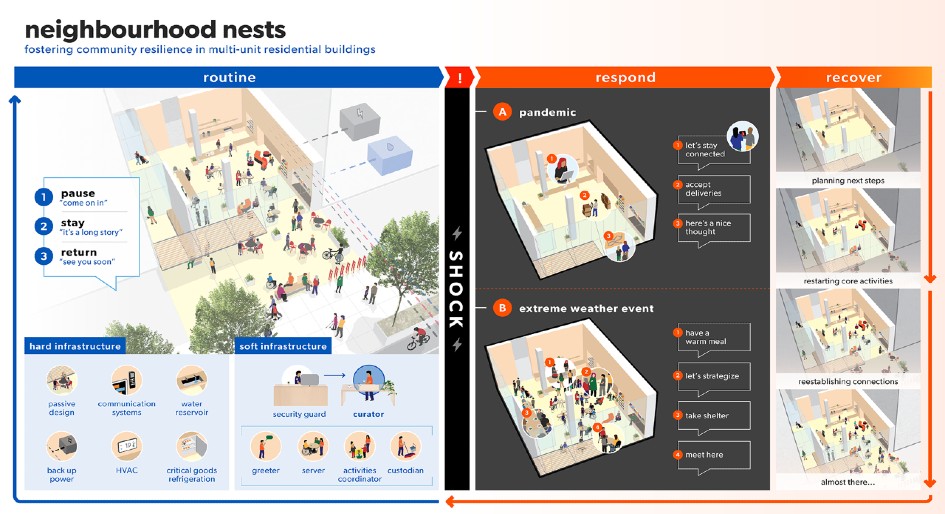
Infographic courtesy of Quadrangle and Human Space.

“Instead of being the gate-keeper whose role it is to keep people out, what if their job description included qualities that you want more in a barista or a bartender— where that person’s job is to engage people,” she says. “When something happens, you can check with the concierge who will know what to do.”

Accessible design elements, a counter for coffee and snacks, a bookshelf for toddlers, a music event or postings for local farmers markets are just a few elements that could entice people to return to the space. Long tables with room for casual conversations or nooks around the periphery for quiet reflection invite people to hang out.

When a crisis occurs, the lobby is already a place people trust— a place to take shelter, plan next steps, coordinate emergency provisions and pool resources. When physically distancing, these places can become the communications hub that keeps residents connected, providing necessary information. The nest curator could even coordinate grocery orders delivered to the space, then notify residents to receive them one by one.

“The space could be used to still keep people connected, while also providing these really fundamental services,” says Xuereb. “This is really about providing people with the ability to adapt over time so they can build their resilience.”

The preceding article originally appeared in the June issue of CondoBusiness magazine.

Face masks now mandatory in Toronto multi-res common areas

Toronto City Council has voted in favour of a temporary bylaw requiring face masks or face coverings in common areas of apartments and condominiums.

The new bylaw, recommended by the Medical Officer of Health and City Solicitor, will require building owners or operators to have a policy to ensure masks or face coverings are worn by individuals in the enclosed common spaces, such as lobbies, elevators and laundry rooms, and post corresponding signage.

The bylaw formalizes last week’s strong recommendation from Mayor Tory and the Medical Officer of Health for all building owners and operators to proactively require masks or face coverings in common areas. Like the City’s existing mask or face covering bylaw, the recommendation includes exemptions for individuals who are unable to wear a mask or face covering for medical reasons, children under two years old, and other reasonable accommodations. The bylaw comes into effect on Wednesday, August 5.

“Today, City Council took further action to make sure we are doing everything we can as a City government to stop the spread of COVID-19,” said Mayor Tory. “This measure for masks and face coverings in common areas in apartments and condos was strongly recommended by our public health professionals. Many buildings have already done this voluntarily but we have heard from tenants and condo dwellers asking for this measure to be mandated. I encourage all buildings to adopt a face covering policy for common areas as quickly as possible to help us continue to protect the health of our residents and fight this pandemic.”

Toronto Public Health has created guidance documents for commercial and residential buildings. The City of Toronto is also creating signage that building operators can print off and display in common areas. Signage will be available online.

Thinking outside of the box

As construction continues on the 400 West Georgia project, its eye-catching cube design is starting to take shape.

Designed by Tokyo-based OSO and Vancouver-based Merrick Architecture, and developed by Westbank, the distinctive design is inspired by a Japanese noguchi lamp, featuring offset cubes sprouting from a central stem. The building will consist of a circular concrete core with structural steel beams and steel decking, effectively forming a cogwheel of boxes.

Each four-storey cube consists of a triple-paned curtain wall, openable windows, large spans of column-free space, and glass floors.

Every space between each cube incorporates hydroponic living walls of foliage and water features. It also includes a garden and amenity space on the roof for tenants.

On the ground level, a four-storey high lobby offers space for galleries, cafes, restaurants and retail spaces. An extensive public area will include seating, smart lighting, a water feature, and a raised terrazzo platform for performances and gatherings.

“The character of the work space at 400W. Georgia is designed to be open, fluid, flexible, but also diverse. This new, creative work environment elicits collaboration, creativity, and spontaneity. Here, the boxes create natural compartments within a continuous floorplate, allowing offices to be variously partitioned while also staying close to the façade. The floors and ceilings of the cantilevering portions are glazed to visually link the garden, the offices, and the street below. The resulting diversity of spaces is complimented by the diversity of views, whose orientation is not only horizontal, but also vertical,” says Michael Sypkens, OSO.

The EllisDon suite of in-house services was utilized during pre-construction and construction phases, most notably the Virtual Design and Construction and Construction Sciences teams.

These services improved the coordination and collaboration between the project team, consultants and trades.

“Using these services on this project demonstrates EllisDon’s affinity for change, adoption of new technology and our entrepreneurial enthusiasm,” says Jordan Switzer, project manager of 400 West Georgia.

The eye-catching design aims to set a new standard for future office developments in Vancouver.

The 400 West Georgia project will be equipped with the latest information management and technology. This includes implementing Power over Ethernet to manage and automate the building’s day-to-day functions. These features aim to attract and support the growing tech industry in the city.

The building is targeting LEED Platinum certification and will welcome tenants including Apple and Deloitte. Construction is scheduled to wrap up in 2020.


Average rent in GTA down for 7th straight month

Average rent in the GTA has declined for the seventh straight month in June to $2,129, according to the most recent data from TorontoRentals.com and Bullpen Research & Consulting Toronto and GTA rent report.

The average rent dropped 1.7 per cent monthly, and 7.3 per cent annually.

The COVID-19 pandemic has continued to put downward pressure on the rental market in the GTA, with job loss, economic uncertainty, and fear of moving for health reasons having severely reduced demand.

“The rental market in the GTA continues to soften, but the average rent for rental apartments increased month over month,” said Ben Myers, president of Bullpen Research & Consulting. “This isn’t likely due to owners raising rent, but shows that landlords are standing firm on their asking rent, convinced that demand will return in the late summer as every region enters Stage 3 of the reopening.”

Specific GTA neighbourhoods

In June, average monthly rent was down year over year in North York and Markham by 11 per cent; Mississauga by 10 per cent; the former City of Toronto and York by 8 per cent; Etobicoke and East York by 4 per cent and Vaughan and Brampton by 1 per cent. Scarborough was up year over year by 1 per cent.

Average rent for apartment and rental condominiums dropped 8 per cent to 12 per cent annually in eight of 10 Toronto neighbourhoods. Rents were up 10 per cent annually in North St. James Town, but the area was boosted by an increase in the number of listings on TorontoRentals.com at the new high-end purpose-built rental apartment called The Selby. The biggest decline was seen in the Moss Park area, which was down 14 per cent.

Other takeaways from the July Toronto and GTA Rent Report:

  • Not all property types in the GTA are seeing the same downward trend. Rental apartment lease rates grew month over month in the GTA from $1,922 to $2,047, an increase of 6.5 per cent. The average monthly rent was up 15 per cent year over year in January, but fell all the way to -4 per cent annually in May. But rents are now above the June 2019 level by 1.7 per cent.
  • Condominium apartments did not experience the same bounce back in June, as rents declined 1.4 per cent monthly and 8.7 per cent annually.
  • Within the former City of Toronto, condominium apartments for rent were nearly $260 per month cheaper in the second quarter of 2020 compared to the same period last year.
  • Despite the pandemic, on average, a tenant would only be saving about $15 on a purpose-built rental apartment compared to a year earlier.
  • Average rent per square foot for rental apartments in the GTA increased by nearly 11 per cent month over month, and is higher than June 2019, nearly fully recovering from its pandemic-related decline.
  • Rent per square foot for condo apartments has increased in each of the last two months, rising 1.9 per cent month over month in June to $3.33 per square foot. But the average rent level is still below the 2019 pace in June (-1.1 per cent year over year).
  • May marked the third highest monthly total over the last three years for condominium apartment completions at 2,229, according to the Canada Mortgage and Housing Corporation. A significant portion of those units were purchased by investors and are hitting the rental market.

For more information, see the July Rentals.ca and Bullpen Research & Consulting National Rent Report.

When cleaning schedules don’t work

The importance of cleaning schedules in hospitals, office buildings, schools, and other public facilities is becoming increasingly obvious, especially as the world returns to work and life post-COVID-19.

Take, for example, a hospital in the U.S. that had installed buttons so staff and visitors could notify housekeeping when the facilities needed cleaning attention. Over an eight-month period, the buttons were pushed 1,920 times.

Analyzing the requests, most were made between 3 p.m. and midnight. The buttons were also pushed in some areas more than others, and weekends had the fewest calls for cleaning. Despite this, the hospital’s public restrooms continued to be cleaned at about the same frequency and time each day, regardless of location, day of the week, and whether they required cleaning attention.

This frequency of service, as it is typically called in janitorial request for proposals (RFPs) or tenders, was not working for the hospital. Administrators decided to replace these set routines with ‘demand schedules’ to better address the healthcare facility’s needs.

NAVIGATING CHARGES FOR SERVICE

In the professional cleaning industry, frequency of service schedules are crucially important. Sometimes referred to as specs or specifications in janitorial proposals, cleaning contractors use them to determine charges for service. They are also designed to ensure all areas of a facility are cleaned according to a specified timetable. This way nothing is missed or overlooked.

But in most cases, these specs are not set in stone. Cleaning contractors are usually willing to make modifications to accommodate client needs, as long as they don’t go too far. If they do, this can add to labour costs. The contractor will then either need to absorb the added expense or ask the client to accept an adjustment in their monthly service charge.

Over the years, some cleaning contractors have tried to work around this predicament. They have moved away from the frequency of service to ‘cleaning needs’ schedules, similar to the demand schedules recommended by the hospital’s administrators. For instance, instead of specifying ‘floors shall be swept and cleaned once per day’ in cleaning proposals, statements like, ‘floors shall be free of dust, debris, soil, and heel marks’ are being used. Essentially, this means floors will be cleaned whenever they look like they need to be.

While this may help address client needs, specifications like this can make it difficult for contractors to bid on the cleaning requirements of a facility.

What if the contractor assumes the floors will only need cleaning once daily but when service begins, they need to be swept and cleaned three times per day?

There is a way to prevent this, better meet client needs, and still provide an acceptable method for cleaning contractors to determine their charges. It’s called a SOW or scope of work.

SOWING THE SEEDS FOR CLEANING FREQUENCIES

The SOW is a formal, written document that serves as the foundation for a RFP. It breaks down a facility into sections and identifies the cleaning needs of each. For instance, areas subject to adverse weather conditions often require more cleaning attention.

While the SOW involves cleaning frequencies, in most cases it is based on an evaluation of the facility’s needs, not set schedules, as they change with time. Occasionally, lightly trafficked areas or rarely used restrooms become much busier. In such cases, the SOW will have to be adjusted along with the RFP. Keeping these documents current through regular evaluation helps both the client and cleaning contractor ensure the cleanliness and health of the facility and satisfaction of building users.

In the best of scenarios, the client has already prepared an updated SOW. A SOW prepared even five years ago may not reflect the ways facilities are cleaned today. Often, larger facilities will call in a cleaning consultant to help revise it.

LEVELLING THE FIELD

The hospital in the U.S. serves as a good example of how a SOW can work. Let’s assume the administrators already conducted their study of requests for service. But instead of basing their SOW on this analysis, they used adenosine triphosphate (or ATP) testing to monitor soil buildup during the course of a day. If the monitoring systems indicated that certain restrooms required cleaning every four hours, five days a week, while others only needed attention once per day, seven days a week, this would be written into the SOW.

Now the hospital administrators would know more precisely how often certain restrooms required cleaning. This information, written into the RPF, would help contractors determine their charges and if the hospital is taking bids, ensure all are tendering on the same needs of the facility.

Ron Segura is president of Segura Associates. His company works with building managers as well as large and small contractors, helping them build their brands and streamline business operations. This helps reduce costs and allows them to operate more profitably. Ron can be reached at [email protected]

ACI provides COVID-19 guidance for schools

In an effort to help facility administrators better prepare for the reopening of schools this fall, the American Cleaning Institute (ACI) is hosting a webinar on the best practices to prevent the transmission of COVID-19, with emphasis on the vital role of hand hygiene, cleaning, and disinfecting.

The webinar, “Considerations and Guidance for Schools: Hand Hygiene, Cleaning and Disinfection for Reopening,” will be held Wednesday, August 5, 2020 at 4:00 PM EST.

Resources and recommendations from the U.S. Centers for Disease Control and Prevention (CDC) on preparing for K-12 school reopening and their subsequent operations during the COVID-19 pandemic will be made available to participants. Questions from attendees will also be addressed.

Presenters include the CDC’s Jennifer Cope, MD, MPH, team lead domestic water, sanitation, and hygiene (WASH) epidemiology team; and Carrie Dooyema, MPH, MSN, RN, team lead, early care and education team. The discussion will be moderated by ACI’s Brian Sansoni, senior vice president, communication, outreach, and membership.

“Schools, working together with local health departments, have an important role in slowing the spread of diseases and protecting vulnerable students and staff, to help ensure students have safe and healthy learning environments,” read an ACI press release announcing the webinar. “Schools serve students, staff and visitors from throughout the community. All of these people may have close contact in the school setting, often sharing spaces, equipment and supplies.”

Interested parties can register for the event on ACI’s website.