



Articles Archive - Page 419 of 928 - REMINET
REMI

Making data-driven decisions to cut energy losses

Any project, including a building retrofit, benefits from having several key components: a measurable goal, an action plan, and a way to evaluate the results. Although these would appear to be simple enough, often retrofit projects lack the specificity and clarity needed for their success.

Because the building envelope is the “face” of the building to its occupants and the public, and because so much energy loss is attributed to the building envelope, it should be an obvious target for retrofit projects, but building envelope retrofit projects may be especially prone to lack of clarity and foundation in known facts.

Retrofits to remedy energy losses through the building envelope are sometimes based on assumptions (if we repair the roof, the moisture problem will be solved); uncertainty (this retrofit needs to be done, but we don’t know the short and long-term payoffs); failure to prioritize spending according to the most urgent requirements (let’s fix the sealing because that’s the cheapest, not necessarily the most urgent thing to do); and failure to consider the values and mission of the building owner (a decision to improve the aesthetics when there are more pressing issues to be considered for the long-term sustainability of the building).

Resources may be wasted (both financial and human) when plans are based on assumptions, decisions are made without proper research and returns are uncertain. This waste can all be addressed by data-driven decision-making. In fact, reliable data should be the underpinning of any business decision.

A data-driven retrofit

Data-driven decision making involves measurable project goals that are based on unbiased, objective data. Research and the required data should be collected before the goals are set (not after, as is sometimes the case). Quality data obtained should allow for various alternatives to be considered and evaluated to determine the best course of action that serves the organization’s purpose. The facts need to be assembled into an at-a-glance overview with graphics or visualizations from which actionable insights may be gleaned. Such a report should be understandable by all stakeholders, not just a select few. Data powers the engine that is constant improvement.

Data is a useful tool, but only if the resources exist to gather it and use it, to take the time to gather and analyze data about energy losses related to the building envelope. Assemble it into an orderly, comprehensive, and meaningful collection. Weed out the irrelevant details. Extract the most significant facts, based on the goals, values and mission of the organization.

Establish specific retrofit goals as a result. Define and prioritize the problems. And determine the most effective use of limited funds to address the problems. Quantifiable costs should be weighed against measurable benefits. Priorities need to be established, and a complete plan developed. A data-driven approach should be a pillar of the culture of the whole organization.

A data-driven approach offers additional long-term benefits: objective data collected is useful for clearly documenting the concrete results of efforts made to achieve energy reduction targets, achieve GHG reduction targets, and become more sustainable. Energy performance can be compared before and after the retrofit in quantifiable terms. The data can be used to demonstrate retrofit outcomes when communicating with stakeholders, building occupants, financial institutions, and government.

Historically, attempts to determine where energy losses occur in the building envelope have not generated precise data, nor have they provided the means to benchmark the before and after status of a retrofit. These same methods have been inconvenient for building occupants; hi-rise buildings make such information gathering even more difficult, if not impossible.

New evolution for determining energy losses

The introduction of infrared cameras mounted on drones has enabled buildings to see the energy losses due to faults in the building envelope, including in hi-rise buildings. An up-close visual inspection of a particular wall may show no visible signs of cracks, for example. A thermal image, on other hand, may tell a much different story. Infrared is used to measure the heat radiated by aspects of the building envelope.

Thermal images clearly reveal differences in temperature between the outside air and the surface temperature of the various components of the building envelope. Such thermal signatures are based, not on as-designed conditions at the time of construction, but on real conditions, at the present time. They are based, not on the perceptions of building occupants that there are cold spots or drafts, but on factual data.

Many temperature differences are unintended and unwanted. Some may indicate the presence of moisture inside the wall. When moisture-laden air is allowed to penetrate the building’s exterior through cracks and crevices, it condenses and may wet the insulation. Other temperature differences are caused by convective air currents (air leaking out of the building due to cracks or cavities in the building envelope) and conduction (heat moving from a warmer object to a cooler one).

The use of drones to identify energy losses has changed the landscape of building inspections for this purpose. The next challenges are: What can be done with this data? Of all the sources of energy losses, which should be addressed first? Which energy management strategies will generate the best return on investment? These are the questions faced by building owners, investors, and property managers alike. Solutions involving artificial intelligence will no doubt define the next evolution of this important process.

Only by knowing the precise cost of the energy wasted can a realistic plan be created to remedy these failures, starting with the most critical ones. The existence of artificial intelligence (AI) to calculate and quantify these energy losses defines the next evolution of building envelope retrofit opportunities. AI enables the data acquired by the drones to be actionable on a broad scale.

The cost of energy losses due to leaked gas in a single insulated gas unit (IGU) can be more than $60 per year. This amount is staggering when you consider a hi-rise building with over 4000 of those poor performing IGUs – a total, annual loss of more than $275,000. Based on reliable data, such dollar values make a building envelope retrofit project a worthwhile investment.

Only by reliably identifying energy losses, analyzing the data, quantifying it, assessing costs versus benefits, and establishing priorities, can a data-driven retrofit plan for rectifying building envelope failures be created.

Mansour Asrani is a project manager at QEA Tech. He has 20 years of experience working on innovation and technology development with a decade of successful experience in cleantech and environmental solutions. Mansour specializes in image processing and precise imaging technologies. He is responsible for managing building envelope thermal inspection and energy loss quantification projects.

Susan Horne is a retired college chair. She is currently self-employed as a writer/editor of reports, articles, curriculum and textbooks.

Photo courtesy of QEA Tech.

ISSA’s GBAC STAR accreditation success is a sign of a cleaner world

It sounds strange to say it during an ongoing pandemic, but we’re arguably already living in a cleaner world. COVID-19 has brought a renewed focus on cleaning, disinfecting, and infection control and one quantifiable way to show that is through the GBAC STAR accreditation program. Launched by ISSA’s Global Biorisk Advisory Council in the spring, just weeks after the virus’ spread was defined as a full-blown pandemic in North America, the program is creating a new standard for facilities in how they clean and disinfect and, just as pertinently, how that is communicated to the public. It was born under the vast shadow of COVID-19 but combats all infectious disease.

The program

The program currently exists in two forms, facility accreditation and individual training. The former is intended for everything from stadiums to restaurants, from hotels to transportation hubs, from malls to grocery stores – in short, any public-facing arena in need of thorough sanitization. The latter is being taken up by supervisors and managers across all walks of life, from distributor salespeople to plumbing industry personnel. A third branch, open to service providers like building service or restoration contractors, is coming in the next few weeks.

GBAC STAR is designed by specialists who are well-versed in biohazardous situations and is built on 20 elements encompassing five stages – facility leadership and planning, goals and strategies, supplies and inventory management, training and prevention, and constant vigilance. Just six months on from its implementation, it’s fair to say it’s revamping the way cleanliness is practised and communicated by public-facing facilities.

Reflecting society’s new needs

ISSA did not set out to create such a seminal shift, Executive Director John Barrett says. He believes it’s simply a reflection of the needs of a pandemic world that the uptake has been so huge.

“It’s been a journey,” Barrett explains. “We didn’t set out to create a new global brand, we’re a trade association. But that’s what happened. It’s achieved the level of notoriety that you couldn’t have wished for, you couldn’t plan for. I don’t think it speaks to our skills, I think it speaks to the need more than anything.”

As ISSA Canada’s Executive Director Mike Nosko adds, it’s also recognition of the fact that the janitorial cleaning and maintenance industry is now acknowledged as a “frontline fighter” when it comes to infection prevention. “Since the pandemic started, the world has come to realize the significance and sheer importance of cleaning for health,” Nosko says. “A career that was once under-valued has now risen to the forefront and professional cleaners are finally receiving the recognition they truly deserve.

Barrett notes that to date since the facility program’s May launch, 3500 organizations in 80 countries have committed to GBAC accreditation and several hundred have already been through the process. For the individual program, launched a month earlier, over 15,000 people have committed in around 70 countries. Truly, it is a global phenomenon.

Clear benefits

At the heart of its appeal is that it ensures facilities can remain operating in full confidence and that that confidence can be passed on to consumers – patrons, tenants, travellers, and everyone in between – who can be assured they are entering a safe and clean space. After all, particularly during COVID-19, a space just looking clean is often not enough, with the general public hesitant – in most cases, at least – to venture back into high-density public spaces.

“Cleaning has always been viewed as an expense and with COVID-19 and programs like GBAC, it became a risk mitigation strategy really in two important ways,” explains Barrett. “It’s the pivot from pretty and nice-smelling to the removal of powerful pathogens, but it’s also real risk mitigation.” He notes that insurers are looking at GBAC STAR accreditation as one of the ways facilities and operators can demonstrate they haven’t been negligent. “We’re very close to having the link established where it will actually influence premiums,” Barrett says.

Then there’s the effect the enhanced consumer confidence has on facilities being able to maintain revenues. Barrett calls it a revenue generator and a differentiator for organizations like never before. He notes ISSA just opened its GBAC store for accredited people and facilities to buy a door decal of the shield denoting the achievement. “If anyone gets on an American Airlines plane, they’ll see the seal,” he says. “Every Hyatt hotel in the world. As time goes on and they increasingly see this seal, they’ll want to see it on the door of the beauty parlour, the restaurant, the bowling alley.”

Big-name adopters

A new facility directory tool launched by ISSA this month allows users to search for and locate any facility worldwide which has either achieved the accreditation or has committed to achieving it. In North America, these run the gamut across numerous industries. But a visible trend, particularly in Canada, has been that large venues like convention centres and stadiums have been the first to take it up.

Nosko stresses that the importance of any facility achieving GBAC STAR accreditation is “immense.” He notes this is regardless of the facility’s size, although in Canada it has largely been high-capacity venues in several major cities that have announced their accreditation, such as Toronto’s Exhibition Place convention centre, Vancouver’s BC Place stadium, and Montreal’s Montreal-Trudeau Airport. Recent weeks north of the border have seen things gathering pace, with facilities in Calgary, Edmonton, and Saskatoon all added to the list of venues to have achieved or committed to the program.

Barrett explains that in the U.S., due likely in no small part to the higher case counts and rates of infection, things have gone even further in just a few months. He notes that one of the great surprises ISSA has had with GBAC STAR is that entire cities are starting to commit to becoming GBAC cities. He cites Dallas, Baltimore, and Columbus as examples and notes that up to around 20 cities are proclaiming that the majority of their facilities – hotels, bars, restaurants, museums, transportation hubs, stadiums, convention centres – will be GBAC-certified.

In many cases, they’re going as far as to fund the certifications. “I think those cities are trying to use ‘GBAC destination’ as a differentiator,” says Barrett. “And I think it’s growing because of who is signing up. In New York, you’ve got the major transportation venues that have committed – LaGuardia, Kennedy – and the number one commercial office complex in New York, Hudson Yards.”

A “no-brainer”

While large public-facing venues were the first to adopt the accreditation, it’s actually hotels that are the most numerous in the program because they’re so public-facing. The cost of accreditation varies notably by size – from $15,000 for huge facilities like airports to just a few hundred dollars for restaurants and other smaller facilities – but the program is a “no-brainer” regardless, says Barrett.

“The cost of certification is so diminished compared to the benefits they receive. I think if people really understood the trade-off between the cost and the benefit, they’d go for it. It’ll just take time.”

For now, though, it’s certainly not a bad start.

For additional program details and information, please email Chuck Nervick at [email protected] or contact him at (416) 803-4653.

Building resiliency during a pandemic

Nine months into the COVID-19 pandemic, we are finding out how resilient we are. After a near global lock down in March, countries and jurisdictions across the world have entered different stages of recovery with a focus on outdoor gatherings to maintain social distancing. As we move into the fall and winter season in the Northern Hemisphere, we are expecting a second wave with a spike in infections of COVID-19.

Without a vaccine and the increasing necessity of being inside in the winter months, we need design solutions to mitigate our environments so that we feel more comfortable gathering indoors. Our indoor environments need to be resilient towards airborne viruses such as COVID-19, but in many buildings that is not the case. Our industry has been focused on building resiliency for the last decade in respect to climate change, but not in respect to pandemics.

Resiliency in architecture comes from potential catastrophes; is your structure resilient enough to resist the forces of nature? It’s no different from human resilience. Do you have grit? Do you have the strength within you to overcome? Sometimes we do and sometimes we don’t, and buildings are no different. Resilience whether for humans or buildings requires the appropriate groundwork in place.

One aspect of building resiliency is energy. As architects, we have focused on reducing building energy through energy codes and constructing buildings that are airtight. As the codes have become more restrictive, we are seeing major gains in energy savings in all types of buildings, including high performance buildings. Energy efficient building design requires all the building systems, including building envelope and HVAC, to work together to be as efficient as possible. COVID-19 has placed the focus on indoor air quality and thermal comfort, which includes variables such as temperature, humidity, ventilation, etc. Increasing or decreasing these variables in a building not designed to handle these new values can increase energy use and result in a less energy efficient building. The challenge now becomes balancing the sustainability of a building with pandemic resilience.

How can we design buildings that are resilient to both climate change and pandemics? Sustainability is still critical, the health impacts of climate and environmental change is one of the five World Health Organization’s priorities.2 As architects, we need to continue to be mindful of our energy reduction targets and environmentally resilient design while finding solutions to mitigate the risk of airborne viruses such as COVID-19. Humans and microbes (viral, fungal and bacterial) are all linked by our indoor environments. We need to ask what indoor factors can contribute to infections.

It is understood that infectious particles are suspended in the air and settle on surfaces. Research from as far back as 1985, the Stirling Chart below shows that relative humidity plays a large role in our indoor environment with respect to the increase and decrease of infection rates for pathogens.

This pandemic has forced us to look again at this important indoor factor. While pathogens thrive in low relative humidity and even very high humidity levels, pathogens including the coronaviruses do not do well between 40-60 per cent. At the same time, the optimal humidity levels for human comfort, development, and health sits between 40-60 per cent.

These levels can support our respiratory tract and the skin’s natural defenses. This same body of research also shows that if a building can maintain the relative humidity sweet spot of 50 per cent, the burden of infectious diseases is decreased by:

  • decreasing the airborne aerosols in our breathing zone;
  • decreasing actual infectivity of SARS CoV-2 virus in airborne aerosols and surface particles;
  • increasing the efficacy in effectiveness hand and surface cleaning by decreasing resuspension and resettling of particles;
  • increasing the rate of air exchanges combined with appropriate level of air filtration for re-circulation.

Controlling humidity levels is not new – along with laboratories, archival spaces for galleries and museums have very precise humidification and temperature controls for long term preservation. Working on the design of these types of spaces requires an understanding of what the optimal environmental conditions are for these collections to avoid deterioration. The design of our indoor environments should have the same considerations for human health.

Currently, we have recommended humidification levels in North America but these are not mandatory. In areas that are naturally humid, such as British Columbia, additional humidification to the building’s HVAC systems may be perceived as an additional cost. As such, the target identified of 40-60% is not necessarily implemented. If it is determined that we need to add humidification to mitigate the spread of COVID-19, it becomes an issue in the places that have never considered additional humidification. To add higher rates of humidification into existing buildings, both the new humidification systems and improvements to the other building systems to support this addition, is an economic proposition. Resiliency does have a cost factor associated with it, how much do we spend and implement now for future unknowns?

Climate change is not going anywhere, and COVID-19 certainly won’t be our last pandemic. While the costs of resiliency must be considered, the economic implications of pandemics and climate change cannot be underestimated. We have an opportunity to design buildings that are resilient for high risk conditions for now, the short-term, and the long-term future to support our health, our economy, and the planet.


Peggy Theodore is principal at Diamond Schmitt Architects.

What Ontario’s mask regulation means for residential landlords

Ontario’s new mask regulation now requires that masks or face coverings be worn in all building common areas where people are unable to maintain a physical distance of at least two metres.

Part of Ontario’s 364/20 Regulation under the Reopening Ontario (A Flexible Response to COVID-19) Act, the rule applies to any person entering a residential apartment and condominium with the exception of the following:

  1. Children under two years of age;
  2. Persons with an underlying medical condition which inhibits their ability to wear a mask or face covering;
  3. Persons who are unable to place or remove a mask or face covering without assistance;
  4. Employees and agents of the person responsible for the residential complex within an area designated for them and not for public access, where they can maintain a physical distance of at least two meters from any other person;
  5. Persons who are reasonably accommodated by not wearing a mask or face covering in accordance with the Accessibility for Ontarians with Disabilities Act; and
  6. Persons who are reasonably accommodated by not wearing a mask or face covering in accordance with the Ontario Human Rights Code.

“A person shall not be required to produce proof of a medical condition and/or qualification for any of the exemptions set out above,” explained Kristin A. Ley, Partner at Cohen Highley LLP Lawyers in an update on the new mask regulation. “Owners and property managers of apartment buildings and condominiums should ensure proper signage is posted at the entrances and in the common areas of such buildings advising of the mandatory mask requirements.”

According to Ley, failure to comply with any regulation under the Act can result in one of the following penalties:

(a) in the case of an individual, subject to clause (b), to a fine of not more than $100,000 and for a term of imprisonment of not more than one year;

(b) in the case of an individual who is a director or officer of a corporation, to a fine of not more than $500,000 and for a term of imprisonment of not more than one year; and

(c) in the case of a corporation, to a fine of not more than $10,000,000.

In addition, Ley explained that certain municipal jurisdictions such as Ottawa and Toronto have other restrictions in their by-laws regarding mask use in common areas of residential apartment buildings and condominiums. For example, in Toronto, there is mandatory language that must appear on signs that are posted in and around the  property. Visit your municipal website for specific rules and regulations required to safely operate your building.


Don’t Forget the Soap

The 2020 pandemic has turned a focus on hand hygiene – and for a good reason. Yet while using hand sanitizer is important for preventing the spread of SARS-COV-2, the virus which can cause COVID-19, it’s critical to keep regular handwashing with soap in the mix.

Certainly, as October’s Global Hand Washing Day makes clear, the power of washing with soap and water cannot be understated. Using soap and water physically removes germs from the hands; soap contains ingredients known as surfactants, which break down contaminants on the skin. Friction created by rubbing the hands helps the surfactants to encapsulate the dirt and hold it away from the skin – water then rinses this away.

At the molecular level, soap breaks things apart. The soap takes care of things such as viruses like it takes care of the oil in the water. Much like a crowbar; one side of the soap molecule buries its way into a virus’s fat and protein shell. The chemical bonds holding the virus together aren’t very strong, so this is enough to break the virus’s coat, making it soluble in water, and it disintegrates. Sanitizers, on the other hand, kill germs present on the skin.

In short: soap simply works. This an important factor in the fight against the spread of SARS-COV-2, an “enveloped virus” with lipid membranes that are particularly vulnerable to soap.

Still, while hand soap is an effective weapon against the likes of SARS-COV-2, it only works when applied using effective handwashing techniques. Quick rinses and haphazard techniques won’t do much to mitigate the spread of germs, especially in public areas such as offices, commercial settings, and facilities where coming into contact with surfaces that may be frequently touched by other people, such as door handles, tables, shopping carts, or electronic cashier registers/screens, etc., is more common.

Hand hygiene best practices come down to common sense: wash often and wash thoroughly.

Sealed cartridge vs. bulk

Proper handwashing techniques are critical, but so is ensuring that soap is stored and distributed in a clean environment, with the highest considerations for hygiene. Here’s where the advantages of sealed cartridge systems over bulk dispensers in high-traffic areas (e.g., offices and commercial settings) makes a difference.

The differences between bulk and sealed soap come down to how the material is stocked. In bulk dispensers, soap is kept in an unsealed environment that can be exposed to bacterial contamination during refills or everyday usage. Additionally, there is the risk of “new soap” being contaminated by older soap that has been sitting within the dispenser’s reservoir.

In contrast, sealed dispenser systems are refilled by inserting sealed cartridges into the dispenser. This method eliminates contact between the product and the environment and minimizes the risk of contamination of the soap.

Sealing the deal

Ultimately, any soap is better than none. In a time where public safety relies on effective and consistent handwashing, however, there is value in providing Canadians access to clean, gentle, and user-friendly hygiene products.

This is something SC Johnson Professional has taken to heart during its 80-plus years of developing skincare programs for institutional, industrial and healthcare environments. It’s also the philosophy behind its Refresh Foam Soap line, which utilizes the world’s first hygienically sealed inverted foaming soap pump and cartridge system.

Developed using input from facility owners, cleaning professionals, fragrance experts, and users, Refresh Foam Soap was designed to elevate the handwashing experience. One pump eliminates over 99% of dirt when combined with proper handwashing techniques, and the soap is formulated with mild preservatives, skin conditioners, and signature fragrances to promote comfortable, consistent handwashing in public places.

In the fight against the spread of SARS-COV-2, the benefit of proper hand hygiene cannot be understated. Herein, facility owners and occupants alike have a role in making clean, reliable handwashing a daily priority.

SC Johnson Professional® has 80-plus years expertise in developing skin care programs for institutional, industrial, and healthcare environments. Learn more about its Refresh Foam Hand Soap line.

—


10 Prince Arthur moves forward in Yorkville-Annex neighbourhood

A high-end condo project called 10 Prince Arthur is moving forward in the Yorkville-Annex neighbourhood of Toronto.

Developer North Drive has teamed up with architect Richard Wengle, interior designers Brian Gluckstein and Michael London, and landscape architect Janet Rosenberg to collaborate on a boutique community with expansive terraces and customizable suite layouts. Residents will have the option to combine units. Configurations include two-bedroom and three-bedroom layouts ranging 1,430 square feet to 5,920 square feet.

Prices are expected to range from $3 to $15 million.

10 Prince Arthur

At seven-storeys high, the design will include 28 units. Each residence offers a spacious floorplan averaging 2,500 square feet. The architecture is said to blend clean, contemporary lines with carefully selected materials.

“When you own a suit that is handmade, and you see the stitching, you appreciate the kind of craftsmanship that went into making it, said architect Richard Wengle. We tried to apply that mindset to this project. We’re using handmade brick from Denmark, as well as an Indiana limestone and a second Algonquin limestone from Northern Ontario. There is going to be a lot of texture, and a mélange of colours that inform the details of the building. It’s a sophisticated, intentional palette.”

The building itself steps back in the front and back, allowing residents to enjoy both privacy and cityscape views. The collection of outdoor spaces is imagined as natural extensions of the interiors, with opportunities for artful landscaping and furniture. The terraces offer an outdoor oasis in an urban setting for each resident, while contributing an organic, sculpted layer to the overall architecture of the building.

“For the purchaser, moving into a boutique community like this is not about downsizing, but more about the reorganization of their living spaces,” says Gluckstein. “Some purchasers might have the same size apartment as their single-detached house, but instead of six bedrooms, they might have a grander dining room or his-and-hers bathrooms. It’s about reallocating the way you live—rightsizing rather than downsizing.”

10 Prince Arthur

10 Prince Arthur

A closet area in a suite at 10 Prince Arthur

10 Prince Arthur marks North Drive’s fourth project with Wengle and London, and their third project with Gluckstein and Rosenberg.

“With each project we’re more dialed-in and attuned to the needs of our purchaser,” said North Drive co-founder Jordan Morassutti. “We have the mandate to emphasize the unique characteristics of a project like 10 Prince Arthur, and the benefit of knowing that we’ve done this before at the highest standard. Ultimately that confidence gets passed on to the buyer.”

Rental demand continues to decline through September

The work-from-home phenomenon and pandemic continue to shift rental demand patterns across Canada as tenants look for cheaper locations farther from their place of employment.

According to the latest data from Rentals.ca, rents in September were down 9.5 per cent overall with rents in downtown Toronto for a one-bedroom home dropping below the 2,000 mark for the seventh straight month.

“Toronto is seeing the biggest decline in rental and condo apartment rental rates on average among major municipalities in Canada; this is driven by the rapid decline in downtown condo rents, with many recently completed buildings seeing rates drop by 10 to 15 per cent annually,” said Ben Myers, president of Bullpen Research & Consulting. “Several of the condos experienced listings growth of 100 per cent to 200 per cent annually—a textbook example of what happens with less demand and more supply.”

Rental demand in six GTA cities

Mississauga came in third for average monthly rent for a one-bedroom home at $1,932 and eighth for average monthly rent for a two-bedroom at $2,152.

Burlington finished fourth for average monthly rent for a one-bedroom home at $1,883 and 12th for average monthly rent for a two-bedroom at $2,009.

Oakville came in sixth for average monthly rent for a one-bedroom home at $1,841 and fourth for average monthly rent for a two-bedroom at $2,268.

North York finished seventh for average monthly rent for a one-bedroom home at $1,819 and for average monthly rent for a two-bedroom at $2,189. Year over year, average monthly rent for a one-bedroom was down 5.5 per cent in September and down 11.9 per cent for a two-bedroom.

Brampton came in 13th for average monthly rent for a one-bedroom home at $1,614 and 15th for average monthly rent for a two-bedroom at $1,904.

Oshawa finished 21st for average monthly rent for a one-bedroom home at $1,360 and 19th for average monthly rent for a two-bedroom at $1,661.

Influx of new supply

The decline in average monthly rent at downtown properties can be attributed to the high number of condos for rent, and there is a significant influx of new supply hitting the market via completed projects.

Adding to the challenging conditions, the reduction in demand for short-term rentals from tourist and out-of-town contract workers has added vacancies—as has the fact that many students attending downtown colleges and universities have remained at home for virtually learning.

Other major markets

Toronto and North York, along with Winnipeg, saw drops in rental rates of about 14 per cent. Toronto’s -14.1 per cent annual rent drop is the worst in the country among major markets.

Montreal (17.2 per cent) and Kitchener (11.5 per cent) were the only two major municipalities in all of Canada to see rent appreciation for apartments and condo rentals. (Hamilton and London were removed from the chart because of a high number of listings from new purpose-built rental apartment projects pulling the average rent up).

Vancouver posted the highest average annual rent for apartments and condo rentals at $2,249, followed by Toronto at $2,158; Etobicoke next at $2,095; Mississauga at $2,066; and Vaughan at $2,044. North York is the only other municipality showing average annual rents of above $2,000 per month at $2,025.

In Vancouver, the average rent for single-family homes in the third quarter was $2,553 per month, lower than condo apartments, and down 29 per cent annually. Condo rents in Vancouver are down 17 per cent in Q3-2020 versus Q3-2019.

The most bizarre results are in Montreal, where average condo rents were down 17 per cent annually while the average rental apartment rents were up 20 per cent. According to Rentals.ca changes in the location, unit size, balcony size, level of finish, or unit views can vary significantly from quarter to quarter and impact the rental rates charged by landlords. Secondly, owners of rental apartments are more likely to offer rental incentives like a month or two free rent.

 Other key takeaways from the October National Rent Report:

  • Lloydminster had the lowest average monthly rent of the 35 cities listed for a one-bedroom home in September at $737, and Prince Albert had the lowest average monthly rent for a two-bedroom at $855.
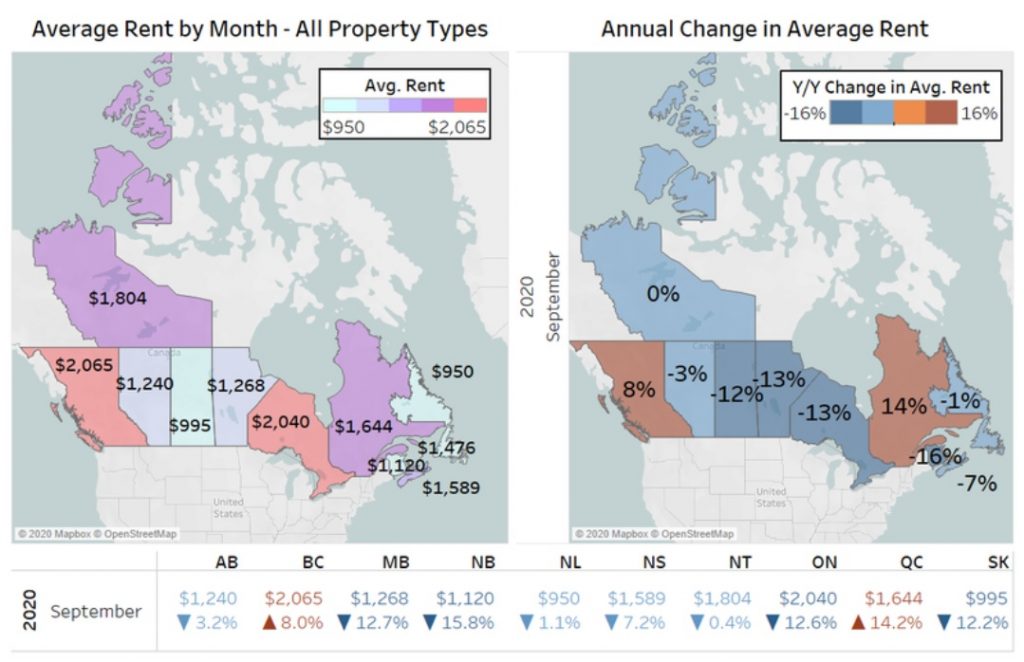
  • On a provincial level, British Columbia had an average rent of $2,065 per month, edging out Ontario ($2,040) for the highest average rents in September for all property types. British Columbia was one of just two provinces to post positive year-over-year rent growth, joining Quebec.
  • The average monthly rent is down for all bedroom types in Canada with one-bedroom suites falling 6.3 per cent annually to just under $1,600. Two-bedroom units fell by 5.4 per cent year over year to about $1,890 per month. Three-bedroom units in the third quarter declined from $2,258 per month to $2,155 per month, a 4.6 per cent decline. Four-bedroom homes saw the smallest drop (-3.6 per cent) to $2,725 per month.
  • The latest employment data suggests Canada added nearly 380,000 jobs in September, and analysts have estimated that 75 per cent of employees who lost their jobs during the early months of the pandemic have been rehired or found new work.
  • With schools open and day cares re-opening, and the paring back of government assistance programs, more Canadians have the ability and motivation to return to work, and/or look for work. More employed Canadians and more hiring results in more demand for housing, and could send the rental trendline climbing upward again this winter.

The complete rent report can be found at: Rentals.ca

Ontario to defray costs of public health controls

Public health controls will come with some property tax and utility cost relief for Ontario businesses forced to curtail operations due to intensifying COVID-19 concerns. The outline of a planned $300-million fund to help cover these expenses was announced late last week as the Ontario government imposed new restrictions on gatherings in various retail, recreational and business venues in Toronto, Ottawa, Mississauga and Brampton. Further details are promised soon.

“We are providing support to our small businesses in these hotspots,” Premier Doug Ford submitted.

Stricter limitation are now in place on people congregating in the affected regions — under the auspices of the Toronto, Ottawa and Peel Region Health Authorities — until at least November 7. That includes a complete shutdown of entertainment, exhibit and fitness facilities such as: movie theatres; performing arts centres; casinos; racetrack spectator stands; gyms and associated training rooms; and areas within museums and galleries where viewers could be in close proximity.

In addition, indoor food and drink service is prohibited in restaurants, cafeterias, bars and mall food courts. Meeting and event spaces are allowed to accommodate no more than 10 people indoors or 25 people outdoors, while a maximum of 10 people can be on-site at a real estate open house if appropriate social distancing is maintained.

Ontario’s $300-million contribution to easing fixed property costs was affirmed on the same day federal Finance Minister Chrystia Freeland announced the new Canada Emergency Rent Subsidy. The successor program to Canada Emergency Commercial Rent Assistance (CECRA) will channel relief directly to commercial tenants and small owner-operator mortgage holders to cover up to 65 per cent of fixed property expenses, or up to 95 per cent in situations where newly imposed public health controls have created extra hardship.

“Ontario will build on the historic collaboration with the government of Canada to ensure workers are protected, businesses are supported, and that this support arrives as soon as possible,” noted Ontario Finance Minister Rod Phillips.

Earlier last week, the provincial government also announced a plan to assist small businesses in responding to and rebounding from COVID-19-related financial pressures. Among measures, businesses with two to nine employees will be eligible for one-time grants of up to $1,000 for the purchase of personal protective equipment (PPE).

Legislation tabled in Bill 215, the Main Street Recovery Act, would: allow deliveries to retail facilities at all times despite any existing municipal by-laws; open the potential for the Ontario Food Terminal to sell a broader range of products; and increase penalties for those found to be operating taxi services without a license. The provincial government has also indicated the current temporary allowance for alcohol to be delivered with food deliveries to private homes will be made permanent.

Guide to manage water system stagnation released

At a time when many buildings are not fully occupied due to COVID-19, stagnant water conditions can result in discoloured water, lower chlorine levels, higher concentrations of lead and copper and even the proliferation of Legionella, under certain building conditions.

The American Water Works Association (AWWA) and the International Association of Plumbing and Mechanical Officials (IAPMO) have developed a guide to help building managers address water system stagnation.

Stagnation within building water systems is a concern in periods of low or no occupancy. When water does not move through the system, water quality issues may arise at an outlet, a group of outlets or throughout an entire building water system, causing potential health risks.

Titled Responding to Stagnation in Buildings with Reduced or No Water Use, the guide “provides a decision-making framework for building managers to design responses to building water system stagnation,” said William Rhoads, a co-author of the guide and a post-doctoral researcher at Virginia Tech.

Peter DeMarco, executive vice president of Advocacy and Research at The IAPMO Group, said the new document provides essential guidance at a crucial time.

“As buildings reopen across the country, it will be critically important for building owners and facility managers to actively address water quality concerns in plumbing systems due to stagnation,” he said. “We appreciated the opportunity to work with Dr. Rhoads and the other authors on the development of this important guidance document.”

Because of the many differences in building water system operation and design, one set of instructions is not appropriate for all buildings. The guide provides a framework for building managers and a resource that water systems can utilize in supporting the business community in their service areas.

Contractual clauses in a post-COVID-19 world

The effects of COVID-19 have been immense and widespread. COVID-19 has changed how we communicate with one another and the ways in which we do business. It has also made us realize that pandemics and events, once only conceivable in the movies, can significantly impact every aspect of our daily lives.

COVID-19 has also taught the importance of well-drafted comprehensive force majeure clauses and other standard contractual clauses, which should now be scrutinized more than ever and redrafted to provide greater certainty.

Price and Payment Terms

Pandemics such as COVID-19 negatively impact supply chains and the availability of labour, which, in turn, increase operating costs. As operating costs rise, contractors and suppliers will want to pass these additional costs onto their customers. Accordingly, clauses pertaining to price and payment terms should be carefully reviewed going forward. Furthermore, given these uncertain times, fixed-price contracts, which are preferable for condominium corporations, may be less common and if a fixed-price contract is proposed, the same should be carefully reviewed by a solicitor prior to a condominium corporation entering into the same. In a fixed-price contract, it is essential that the clauses pertaining to the contract price, scope of work, supplies, exclusions and payment terms be carefully scrutinized. As it is imperative that a condominium corporation that is a party to a proposed fixed-price contract has a clear understanding of what work and what supplies are included in the fixed price and if there are exclusions, the circumstances giving rise to the exclusions are clearly stated and are reasonable.

Alternative Dispute Resolution

During the height of COVID-19 this past spring, the court system largely shut down. Accordingly, dispute resolution clauses in a post COVID-19 world should be redrafted to ensure that the same contain alternative dispute resolution mechanisms such as referring the dispute to a predetermined neutral third-party expert for determination as well as mediation and/or arbitration.

COVID-19 Clause

Force majeure clauses in any contract entered into going forward will likely not apply to any future consequences of COVID-19 or to any future waves of COVID-19 since those consequences and waves are now foreseeable. Until there is a wide spread vaccine and COVID-19 is no longer a global pandemic, it is advised that any future contracts include a COVID-19 clause. It should address the current and future consequences of COVID-19 on the performance of the parties’ respective obligations, and advise how COVID-19 and the measures implemented in response to the same may impact the parties’ respective rights and obligations.

Force Majeure Clauses

Although it is presumed that force majeure clauses in contracts entered into going forward will not apply to any future consequences or waves of COVID-19, the pandemic has significantly impacted contractual performance. Force majeure clauses should be carefully reviewed and redrafted in future contracts. Condominium corporations should have their solicitors carefully review the force majeure clause in any proposed contract to ensure that the same applies to any future health emergencies, pandemics, geopolitical events, nuclear, chemical or biological contaminations, contagions and measures required to comply with any laws or government orders. Solicitors should also ensure that force majeure clauses specify the consequences of a force majeure event in detail, and delineate the termination rights in the event of an extended force majeure event as well as the resulting consequences of the same.

The foregoing is just a snapshot of some of the contractual clauses which should now be carefully scrutinized and redrafted by solicitors going forward. Additional contractual clauses that should be carefully examined post COVID-19 include those that pertain to insurance coverage, disease prevention, workplace safety, performance standards and termination. However, the power to instruct solicitors to review and redraft these now critical contractual terms rests in the hands of condominium corporations, many of whom are now suffering from operating deficients due to unanticipated increase in cleaning costs and common expense arrears.

Some condominium corporations that see the value of reviewing and redrafting these key contractual clauses will significantly reduce the likelihood of a dispute arising as well as the time and money spent resolving a dispute should one arise, which in a post-COVID-19 world is now uncertain.

Ashley Winberg is a corporate lawyer specializing in condominium law at Elia Associates. She assists a diverse array of condominium boards and management companies throughout Ontario on all matters relating to condominium governance and management. She is also the chair of CCI Huronia’s Communication Committee, a director on CCI Huronia’s Board of Directors, and a member of CCI Toronto’s Volunteer Committee and CCI Toronto’s By-Law SubCommittee.

The preceding article appeared in the August issue of CondoBusiness

Ontario unveils more regulatory adjustments

A recycled title adorns a fresh package of Ontario government regulatory adjustments, framed as red tape reduction. Bill 213, the Better for People, Smarter for Business Act, 2020, introduced in the provincial legislature last week, is an omnibus effort to amend more than two dozen statutes.

As with the identically dubbed 2019 iteration of the legislation, which received royal assent last December, it comes in tandem with announced plans to revise or repeal numerous regulations under these and various other Acts. This can be done simply on Ministers’ authority without need for approval in the legislative assembly.

“The pandemic reinforces the urgency of our work to modernize regulations, take processes online and tackle obstacles to growth and success,” maintains Prabmeet Sarkaria, Ontario’s Associate Minister of Small Business and Red Tape Reduction.

A few of the proposed statutory amendments — including allowance for changes to the governance proceedings of private corporations — are likely to have some, albeit limited bearing for the commercial real estate and/or development sectors. Hinted but yet-to-be-detailed updates to regulations appear to have a broader range of potential implications for developers, building owners/managers and their service providers, as well as municipalities and other public sector entities.

That includes promised steps to: ensure consumers’ access to energy-use data; update rules related to brownfield redevelopment; quash incompatible land uses near existing industrial sites and operations that produce noise and/or odours; reduce the requirements for traffic studies for proposed developments; and extend intervals for registering in-house security guards. There is also an emphasis on replacing paper-based administrative processes with online digital alternatives.

“By making it easier for people and businesses to interact with government, we are delivering on our commitment of building simpler, faster, better services in Ontario,” submits Peter Bethlenfalvy, president of the Ontario Treasury Board.

Proposed statutory amendments address corporate governance and forfeited property

A proposed amendment to the Business Corporations Act would remove restrictions on the composition of boards of directors, eliminating the current requirement that at least 25 per cent be residents of Canada. “Canadian director residency requirements discourage businesses from incorporating in Ontario in favour of other provinces. This change will allow Ontario to better compete both nationally and internationally as a home for business headquarters,” the government’s accompanying background document reasons.

Other proposed amendments would loosen requirements for when shareholders’ meetings must be called for private corporations. A separate review of the regulation of Ontario’s capital markets, including various board functions and practices for publicly traded companies, is also in progress.

Currently, the Business Corporations Act allows for shareholders to pass a written resolution in lieu of a meeting if they unanimously agree. The proposed amendments would lower that threshold to a simple majority of shareholders, and also open the ability for that majority to remove a director or auditor via written resolutions rather than through a meeting.

Proposed amendments to the Forfeited Corporate Property Act would give the Minister of Government and Consumer Affairs authority to dislodge invalid occupants from commercial premises or to transfer titles wholly to co-owners. As outlined in the amendments, the Minister would be able to enter into agreements for the disposition or management of forfeited properties, and could enforce the removal of any occupants and contents from a forfeited property, not just the forfeiter and his/her belongings. The amendments also clarify that vesting orders, which the courts can use to transfer ownership of land to another entity, will not be granted if the corporate property in question has been forfeited due to debt or other legal circumstances.

In its accompanying overview of proposed legislation, the government suggests this “would help get forfeited corporate properties back into productive use for the community more quickly and efficiently”.

The provincial government would also issue a blanket exemption from municipal development charges for all universities to which it provides operating funds via the proposed amendment to the Ministry of Training, Colleges and Universities Act. Until now, under Ontario’s Development Charges Act, exemptions have been left to municipal discretion.

“The proposed changes would provide development charge exemptions for all publicly assisted universities to provide for the same treatment in regard to new developments,” the government backgrounder states.

New regulations promised to modify or clarify development requirements

As proposed, electrical and gas utilities would be required to make consumption data available via the Green Button Connect My Data and Download My Data standards so that customers with metered accounts can monitor their usage in real-time on their smartphones or other devices. The previous provincial government also tried to invoke this requirement through proposed amendments to its Green Energy Act, but the parliamentary session ended before the legislation could be enacted and the current government repealed the Green Energy Act in the fall of 2018. It now suggests the proposed mandate for utilities would both prompt energy and cost-saving behaviour and supply information that consumers are entitled to have.

“Research shows household energy efficiency savings from real-time data can be as high as 12 per cent,” the government’s backgrounder states. “A modern Ontario that works better for people, smarter for business includes ensuring that Ontarians, rather than just their utility, have access to their own energy-use data.”

Of interest to developers, the same document spells out the government’s agenda and presumed pending new regulations related to:

  • modifying excess soil storage requirements and creating standard rules for processing excess soil for resale as a garden product;
  • reviewing processes and providing new and updated guidance to better clarify rules for property owners and municipalities that want to redevelop and revitalize historically contaminated lands; and
  • updating its land use compatibility planning guidelines to help municipalities prevent new residences or other incompatible land uses from being approved near sites and industries that may create noise or odour impacts.

Building owners/managers or condominium corporations with in-house security staff are also promised a nominal cost saving and offloading of administrative burden when the requirement to re-register annually with Ontario’s Ministry of the Solicitor General is stretched to a three-year interval. “The registered employer’s annual cost of registration will effectively be reduced from $80 to $27,” the government’s backgrounder confirms.

New subsidy tagged for fixed property expenses

Qualifying commercial tenants and businesses operating in owned premises will be eligible for direct subsidies of up to 65 per cent of their fixed property expenses through the new Canada Emergency Rent Subsidy (CERS). Deputy Prime Minister and Finance Minister Chrystia Freeland announced the widely expected successor to Canada Emergency Commercial Rent Assistance (CECRA) earlier today, and reaffirmed the Throne Speech pledge for an extension of the Canada Emergency Wage Subsidy until June 2021. Legislation is promised later this month to enact both measures.

“With the country now in the second wave of this virus, our government knows businesses and workers need continued support,” Freeland observes.

That includes a built-in contingency for businesses faced with future compulsory shutdowns for COVID-19-related public health reasons. They will be eligible for a 25 per cent top-up subsidy in addition to the base CERS amount.

As outlined, qualifying businesses, charities and not-for-profit organizations can receive coverage to a maximum of 65 per cent of the cost of rent or interest on commercial mortgages until December 19, 2020. Further extensions “to be adapted and targeted as needed” are expected to June 2021. Retroactive support is also available for the period from September 27 to October 24, 2020.

“The new program is very ambitious. We will look closely at details, such as how the rent subsidy part actually finds its way to the landlord, but, all in all, it’s very encouraging,” says Michael Brooks, chief executive officer of REALPAC, an organization counting many of Canada’s most prominent commercial landlords among its membership. “A tenant-side rent bank or rent subsidy is what REALPAC has been asking for from the outset. We are also encouraged that mortgage support is also apparently available in this version of the program.”

The federal government reports approximately $1.8 billion has been dispersed to more than 130,000 business through the landlord-focused CECRA program as of early October. In addition, approximately 765,000 loans, equating to more than $30 billion, have been allocated through the Canada Emergency Business Account (CEBA) in the same period.

CEBA, which provides partially forgivable loans of up to $60,000 to qualifying small and mid-sized businesses, will continue to accept applications until December 31, 2020. However, loan candidates will be required to provide attestation of their financial losses due to COVID-19.

“As we get through this difficult situation, we will keep taking action to support our businesses, protect jobs and keep Canadians safe and healthy,” Freeland asserts.

New GBAC STAR Facility Directory helps locate facilities accredited for cleaning excellence

Press release

The Global Biorisk Advisory Council® (GBAC), a Division of ISSA, today launched its GBAC STAR™ Facility Directory. This new web-based tool allows users to identify facilities that have earned or committed to achieve GBAC STAR accreditation, the designation reserved for facilities that have demonstrated a thorough approach to cleaning, disinfection, and infection prevention.

“We’re excited to unveil this new tool to help the public discover which facilities are taking important steps forward with their approach to cleaning,” said GBAC Executive Director Patricia Olinger. “The GBAC STAR program has more than 250 facilities accredited and 3,000-plus committed to accreditation in more than 80 countries, with additional facilities added daily. This results in an impressive directory that is easily searchable and always accessible.”

The GBAC STAR Facility Directory is a searchable listing of facilities around the world, including stadiums and arenas, convention centers, hotels, restaurants, airports, commercial facilities, and more. Users can search the directory by facility name, facility type, location (region, state/province, country, or zip/postal code), or keyword. Each resulting pin provides the property’s name, address, website, facility type, and accreditation status.

GBAC STAR-accredited facilities have completed a rigorous screening process to ensure they are truly committed to championing cleanliness; have established goals and risk mitigation strategies; implemented effective tools, equipment and supplies; and prioritized training, prevention, and preparation.

“GBAC STAR accreditation indicates that behind the scenes, facilities are properly conducting cleaning and disinfection to keep employees and visitors safe,” said ISSA Executive Director John Barrett. “This new directory is a visual resource that instills confidence in consumers as they aim to normalize their daily lives during this pandemic and into the future.”

To apply for GBAC STAR facility accreditation or for more information, visit gbac.org/star.

Site C diversion tunnels open on Peace River

The gates to the two huge tunnels on the north bank of the Peace River have been opened to temporarily divert the river flow at the Site C dam project.

One of the most important steps for the Site C megaproject is to change the route of a short section of the Peace River during construction. Diverting the river allows the earthfill dam to be built across the main river channel, while keeping the river flowing.

Two large diversion tunnels, approximately 750 metres long and 11 metres in diameter, will be able to pass 3,000 m3 of water a second.

BC Hydro officials reminded boaters and other river users to stay away from the area due to the powerful river current pulling into the diversion tunnels.

A two-kilometre section of the Peace River around the Site C dam was closed to boaters this June when a debris boom was installed across the main river channel.

Earlier this year, crews began placing a rockfill berm across the river to seal off an area for the dam to be built on dry land, while keeping the water flowing through the tunnels on the north bank.

BC Hydro officials advised that river conditions will likely change over the next few months without warning and river users should use caution.

The Peace River will be diverted until the completion of the Site C dam, at which point BC Hydro will close the diversion tunnels and water will flow through the generating station and spillway.

Main civil works is the largest single contract for construction on the Site C project, which was awarded to Acciona Infrastructure Canada. It includes the construction of an earthfill dam, two diversion tunnels, and a concrete foundation for the generating station and spillways

Construction of the multi-billion dollar Site C project started in summer 2015. The generators is expected to be on line in 2024 and the project will be completed in 2025.

Harnessing the power of video

Why is it that in the 21st century, mops and buckets are still being used to clean floors despite the fact that these tools are not the most effective?

It’s because of the high turnover rate in the contract cleaning industry. The revolving door of employees prevents building service contractors and facility managers from implementing more modern cleaning methods and technologies, even though they know it could make buildings cleaner and safer while saving millions of dollars.

Negative impact of falling numbers

Employee turnover is the rate at which employees leave a company and are replaced by new hires. For years, building service contractors in the U.S. have experienced turnover rates as high as 300 and 400 per cent, according to the National Service Alliance. This means a single position may need to be filled with three or four different people in the same year, which equates to hiring a new employee every three to four months. While there are no similar statistics available in Canada, it is expected that the numbers are comparable.

Most building service contractors today no longer have the time, nor the ability to afford, the more traditional classroom and one-on-one training programs they once employed. In some cases, all a contractor can do is trust that a new hire has been adequately trained at another company to perform cleaning duties. The takeaway is that the lack of proper and effective training is one of the key reasons the professional cleaning industry has a revolving door of workers.

Even when building service contractors make time to train staff as a group or hire outside help to do so, they often encounter challenges. These include conflicting work schedules that make it hard to schedule training for all workers, language barriers, different learning rates, and reluctance to learn new cleaning methods or use new cleaning tools and equipment.

When training is insufficient, workers often return to old cleaning methods, ignoring what they have been taught. If new cleaning equipment has been introduced, it ends up becoming janitorial closet “artwork,” parked in the back and not used again. On occasions when the “artwork” is utilized, it may not be done so safely or properly. Ultimately, the opportunity to learn updated cleaning methods, which can reduce costs and improve worker effectiveness, is lost.

Tap into the online training portal

To turn this situation around, a different way of thinking is necessary. Thankfully, the internet offers some solutions.

Online training videos provide a powerful resource for the cleaning industry. This enriching medium can be used to train workers in a comprehensive way that can be referenced again and again at any time or place, including on job sites where tasks are to be performed by simply mounting a mobile device to cleaning equipment.

Multiple reports have shown the effectiveness of online videos. One study of business students with highly varied academic abilities and motivation found a large percentage who watched these videos received several learning benefits, including improved topic understanding, better grades, and greater ease of learning. Further, the results revealed that “weaker” students were especially helped, with significantly reduced course withdrawal rates.

This last point is important. In the cleaning industry, course withdrawal rates can be interpreted as cleaning worker turnover rates. So, effectively, if students continued with the course as a result of training videos, the same can be true of cleaning workers staying on the job.

The study, published in the Journal of Information Technology Education, also found that a statistically significant number of students used the videos as a helpful tutoring resource. They liked that they could replay segments of the course and stop the lecture to better understand the content. Students also appreciated that they could skip topic segments they already knew, which in effect adjusted the training speed and topics covered to match their individual learning pace and interests.

The cleaning industry has made several changes over the past decade. When pressured to improve worker productivity and reduce cleaning’s environmental impact, new equipment was introduced to streamline cleaning tasks and new cleaning solutions and procedures were implemented to become eco-friendly. Now, the industry is asking for ways to reduce employee turnover. Onboard training videos may prove to be just the answer.

Bob Robinson Sr. is the CEO and president of Kaivac, developer of the No-Touch and OmniFlex Crossover cleaning systems, and serves on the board of ISSA.

Edmonton firm wins IREM award of excellence

Edmonton-based Ayre & Oxford Inc. is doubly celebrating its 25th anniversary in the real estate management business and its newly received Real Estate Management Excellence (REME) Award from the Institute of Real Estate Management (IREM). The firm has been named the accredited management organization (AMO) of the year for 2020, and is among the select group of honourees announced in a virtual event earlier this week.

“IREM and the real estate management profession is full of inventive talent,” says Cheryl Gray, 2020 IREM president, and head, special projects, operational excellence, with QuadReal Property Group. “It’s an honour to be a part of an organization and work alongside the individuals and companies doing such great work for their tenants, residents, owners and communities. They raise the bar on excellence and elevate our profession across the world.”

Ayre & Oxford’s staff of 230, led by company president Roseanne Evans, collectively manage more than 180 residential and commercial properties primarily in the Edmonton and Red Deer areas, working with residential landlords, condominium boards and homeowner associations. Co-founder John Ayre died in November 2019, while Don Oxford, a Fellow of the Real Estate Institute of Canada, remains active with the firm.

It became an IREM AMO in 2014, and is cited in the 2020 REME Awards for delivery on its employee improvement goals. Those have focused on: maintaining ethical behaviour; developing a sense of how each individual fits into the organization and relates to coworkers; and building strong relationships with clients and their tenants.

Other 2020 IREM award recipients include: Brody R. Sheets of Pedcor Management Corporation, Carmel, Indiana, who was named residential manager (ARM) of the year; and Michael DiGiacomo, of the United Group of Companies, Troy, New York, who was named certified property manager (CPM) of the year. Two awards were bestowed in the innovator category, to Cortland, based in Atlanta, Georgia, and the Ohio Capital Corporation for Housing, based in Columbus, Ohio.

The REME awards were announced ahead of the upcoming IREM Virtual Summit, occurring October 15-16.

National strategy for women in trades released

In celebration of National Women’s History Month, the Canadian Apprenticeship Forum (CAF-FCA) is releasing a National Strategy for Supporting Women in Trades.

In 2019, CAF-FCA led a task force of more than 60 skilled trades stakeholders who came together to guide and inform a strategy to create measurable change for women’s representation in skilled trades careers in Canada.

The industry driven strategy has four measurable action items that are intended to generate awareness, trigger policy change, recognize best practices and create skilled trade workplace environments where women’s representation increases.

“The SWiT National Strategy has brought together groups and organizations doing the work to recruit and retain tradeswomen in the construction industry. And together, through identifying barriers and developing strategies for success, SWiT will help change the face of construction and increase diversity within our industry,” said Lindsay Amundsen, director of Workforce Development at Canada’s Building Trades Unions (CBTU).

According to the Statistics Canada Registered Apprenticeship Information System 2018 data, when apprentice registrations in the construction, manufacturing and transportation sectors were analyzed, women represented 4.5 per cent of apprentice registrations.

The SWiT task force established a national target to increase participation and retention of women in skilled trades careers to 15 per cent by 2030.

“CAF-FCA is committed to being a catalyst for diverse and inclusive workplaces.” says France Daviault, executive director of CAF-FCA.  “Under-represented groups including women, transgender, two-spirited, intersexed or gender non-binary have a fundamental right to a safe, healthy and equitable workplace, free of harassment, bullying, and discrimination.”

The strategy is a national movement and call for champions who commit to making a difference through a public pledge. The pledge requires that they share their internal numbers on the percentage of women apprentices and journeypersons they employ in skilled trades work annually.

“Those who join the movement as champions by taking the #CHAMPIONS4CHANGE pledge are truly changemakers and leaders”, says Daviault. “They understand that numbers matter and aren’t afraid to be part of the discussion. We are beyond rhetoric as the number hasn’t increased in years. It’s time to be bold by holding industry accountable for the numbers”.