Articles Archive - Page 395 of 928 - REMINET
REMI

Canderel launches Bayview at The Village

Bayview at The Village, a 10-storey boutique mid-rise , is launching near Bayview and Sheppard in Toronto, across from the soon-to-be-revamped Bayview Village Shopping Centre.

Set in the heart of the Bayview Village neighbourhood, it features a communal workspace, media room, fitness centre and a lounge for socializing and dining—all done up with a warm palette of creams, browns and black. A dining area will be styled to feel like a private members’ club for intimate parties with family and friends.

“The intent behind the programming of the amenity spaces was to create opportunities for neighbours to come together and socialize in a sophisticated way,” said Dan Menchions, II BY IV DESIGN. “It is about the celebration of people coming together in a building they are proud to be part of.”

Suite layouts designed by Graziani + Corazza Architects maximize living space, with no corridors or obstructing columns. Majority of the suites also have expansive private balconies or terraces with some reaching a depth of six feet. The kitchen design will take on monolithic and monochromatic clean lines and porcelain tile slabs that blend harmoniously with furniture.

From the outside, the building appears as seven storeys and stands apart with a high contrast façade with a black and white rectilinear pattern. On the quieter residential side, Urban Town units with private front gardens face Greenbriar Road and transition to townhouses that surround a new park. A modern retail frontage wraps around the northeast corner of the building and separates the more public-facing frontage on Sheppard Avenue from the private residential entrances.

“It’s a project that fits into its context really well,” said Barry Graziani, principal of Graziani + Corazza Architects. “To the north you have a very animated public realm and to the south you have a design that mimics the residential scale of the street.”

Available suites range from studios to three-bedrooms from the mid $400’s and Urban Towns from $1 million.

“As part of Bayview at The Village’s unique residential offerings, purchasers will also have the opportunity to combine suites into larger homes and work with Canderel’s design team to customize where possible,” said Canderel CEO Brett Miller. “We know there is a big need in Toronto for larger, more spacious condo units, especially for downsizers who are coming from larger homes and want to stay in the neighbourhood they love.”

Proposed plans for the Bayview Village Shopping Centre’s renewal call for a highly animated pedestrian-focused landscape with a central park and outdoor retail promenade with direct underground access to the TTC. Connected to the city at large, Bayview at The Village is also footsteps from Bessarion Subway Station and a quick drive to Highway 401 and Don Valley Parkway.

Photo of Bayview at The Village by ADHOC Studio

Susan Speigel is named new OAA president

Susan Speigel, BA, B.Arch., (EQ. M.Arch), OAA, FRAIC, is the new president of the Ontario Association of Architects (OAA), the regulatory body for the province’s architecture profession that protects the public interest. Speigel was named to the one-year position at an OAA Council meeting, which took place on January 21.

“A few years ago, I wouldn’t have imagined I would find myself in this wonderful role,” says Speigel. “I’m honoured, excited, and eager to get to work.”

Speigel’s career has spanned more than 30 years and five cities, including Sudbury, Ottawa, New York, Neuchâtel, and now Toronto. As a young graduate—aware of the barriers faced by women in the profession—she and four other designers launched an all-women firm, Villa Villa, a group she describes as “brave and creative,” where she cut her teeth in the industry.

Rooted in her passion for community-building, activism, and innovation, she launched her own multidisciplinary design firm, Susan Speigel Architect Inc. (SSA), focused on architecture, landscape, and urbanistic public realm projects for non-profit organizations, the public housing sector, and private residences. Speigel is also an educator at the Institute Without Boundaries through George Brown College School of Design, where she works at the intersections of architecture, landscape architecture, urbanism, activism, community, ecology, and academia.

Speigel’s commitment to equity and inclusion in the built environment is reflected in her extensive work with social housing and community spaces; she has modernized more than 250 projects for the Toronto Community Housing Corporation and Peel Living and Woodgreen Community Living, and has led research in support of mobile-home parks as affordable housing models. Since 2017, Speigel has also been the Professional Advisor and Acting Architect for the Thunder Woman Healing Lodge—Toronto’s first Healing Lodge and transitional housing for Indigenous women in conflict with the law, which is slated to begin construction this spring.

Over the years, Speigel has been involved with the OAA in various capacities, from helping to plan the first OAA Conference in the mid-1990s to working on the first committee for the Ontario Association for Applied Architectural Sciences (OAAAS). In 2019, she ran for OAA Council, joining several committees and eventually serving as senior vice president and treasurer.

“There are tremendous shifts emerging in the world that demand our attention and meaningful action,” Speigel observes. “I am energized by out-of-the box and daring thinking; by people with the foresight to envision something marvelous and the gumption to make it happen. In order to meet the numerous challenges before us, we need fresh new voices, and there is much we can do to make the profession more inviting and welcoming.”

PCL team selected to build new St. Paul’s Hospital

PCL Construction has been selected to build the new St. Paul’s Hospital at 1002 Station Street in Vancouver. The selection of PCL Construction follows an extensive evaluation of two teams shortlisted in the fall of 2019 to design, build and partially finance the new hospital.

Construction is expected to begin early this summer and completion is expected in late 2026. The PCL team includes HDR Architecture Associates and Stantec Architecture.

It’s anticipated final terms of the contract will be complete and signed off by the end of February 2021. Renderings of the new hospital will be made public after the agreement is finalized.

The new St. Paul’s will have capacity for up to 548 beds, which includes 115 net new beds. The site will be the home of several leading provincial programs and referral centres, including for heart and lung care, renal, eating disorders and specialty surgeries and transplants.

The hospital will also offer a diverse and long list of general and specialized care, including HIV/AIDS, chronic disease management services, emergency and critical care, mental health and addictions beds and programs, ambulatory services and outpatient clinics, end-of-life care, Indigenous health, maternity, colorectal and gastrointestinal services, and community care and community outreach programs.

The first phase of the St. Paul’s redevelopment project is building a new core hospital. Phase 2 is expected to include a clinical support and research centre. Future development opportunities will be confirmed upon completion of the Station Street rezoning.

St. Paul’s Hospital will continue to operate at full capacity at its current site on Burrard Street until the new hospital is fully operational and ready to welcome patients.

“Our vision for the new St. Paul’s Hospital is to lead in the delivery of B.C.’s patient-centred model for health care by providing the highest-quality, innovative and compassionate care, which adds the most value to the patients that we serve.  The new hospital will be an opportunity to create care that’s more centred around people – and that means everyone who works here as well as patients,” said Fiona Dalton, president and chief executive officer of Providence Health Care.

RESCON requests funds to advance pressing issues

The Residential Construction Council of Ontario (RESCON) is requesting funds to address specific industry-related issues. As documented in its spring 2021 pre-budget submission, these items include expanding the use of e-permitting to speed-up the approval processes for new housing, training and apprenticeship programs for women and Black youth and continued COVID-19 mitigation resources.

“Ontario municipalities need a standardized development approvals process and streamlined e-permitting system to help reduce the amount of time it takes to get housing projects approved in Ontario,” said RESCON president Richard Lyall. “Government has made digitization of services a priority through its Ontario Onwards Action Plan, and we are in desperate need of new housing, so this is a good fit.”

Development applications continue to rise to meet the demand for housing supply, but municipal resources are limited, causing bottlenecks which slows the process,” RESCON’s press release states. The use of paper-based submissions only adds to the problem, especially with municipal staff working remotely.

Specifically, RESCON is asking the province to support the One Ontario proposal which is requesting funds to establish guidelines for provincial data exchange standards for a comprehensive e-permitting system.

A 2020 report by the Canadian Centre for Economic Analysis indicated the GTA could see up to 100,700 additional housing units by 2040, with the City of Toronto seeing 21,100 additional units by 2025, if there was a reduction in delays to the approvals process by six months and a 10-per-cent increase in investment.

To mitigate the spread of COVID-19, RESCON is also asking that the province keep working with the industry on enhanced screening measures and rapid-testing, as well as maintain existing efforts, including the Workplace PPE Supplier Directory, to ensure that PPE supply is sustained throughout the remainder of the pandemic.

The pre-budget submission notes that the government’s leadership in mitigating the spread of COVID-19 has been integral to the construction industry’s continued operation.

RESCON also recommends that support for training and education programs in the residential construction trades be sustained, as a skilled labour force is necessary to build new housing. By partnering and supporting employers, the province can improve and fund pathways into in-demand trades.

“It’s essential that we promote careers in construction to students, guidance counsellors and parents in order to let them know that the skilled trades are a viable, well-paying career path,” said Lyall.

COVID-19 clips 2020 investment performance

No winner has been declared in the REALPAC/MSCI challenge to peg the 2020 investment performance of directly held standing assets in the Canada Annual Property Index. That’s likely because no one foresaw a 1,000+ basis point slide in the average total return — settling at negative 4.1 per cent — when the annual contest was conducted last winter.

A ten-year run of capital growth abruptly reversed in the ensuing months, resulting in a 7.8 per cent loss of value across the 2,356 assets that the 44 portfolios represented in the index collectively hold. Income return continued the record-setting downward trajectory witnessed in 2018 and 2019, dropping 70 more basis points to 3.9 per cent.

“That’s not just down to the cap rate suppression we were seeing before; it’s really out of income suppression,” Simon Fairchild, executive director with the index producer, MSCI, advised during the online release of the 2020 results earlier this month. “Performance in 2020 is more severe than we experienced in the financial crisis. You have to actually go back to the deepest years of the 1990s’ recession to see similar falls in value — in 1992, 1993.”

The overarching numbers hide a more uneven picture. Industrial once again emerged as the top-performing property type, delivering a 12.7 per cent total return. Multifamily also remained on the plus side of the scale, recording a 5.7 per cent total return. In counterbalance, office and retail, which together account for more than 68 per cent of index value, pulled the average down with total returns of negative 1.5 per cent and negative 15.1 per cent, respectively.

Canada’s 2020 decline was steeper than in the United States where MSCI index results show investors realized a modest average total return of 1.8 per cent — down about 4 per cent from 2019. Meanwhile, investors in the United Kingdom experienced less slippage, recording an average total return of negative 0.8 per cent. Industry insiders tasked with providing on-the-spot reaction to and context for the Canadian returns point to differences in market size, relative weight of property types within the index and responses to the COVID-19 pandemic as underlying reasons for national discrepancies.

“I suspect in the all-property index, Canada is being skewed a little bit by the office and retail component and that is impacting those capital returns,” hypothesized Peter Cuthbert, president and head of global real estate with Fiera Real Estate Investments. “Two bad quarters — quarter 2 and quarter 3, with quarter 2 being particularly bad — have made a difference.”

Industrial and Ottawa emerge as property and regional leaders

Looking at the capital growth and income return splits for all property types, retail took the biggest hit, with a 17.8 per cent loss of capital value and an income return of 3.2 per cent. It suffered a 30 per cent drop in net operating income relative to 2019, compared to a 13 per cent decline across all properties.

While both industrial and multifamily properties recorded capital growth — at 7.8 per cent and 2.2 per cent respectively — only industrial saw year-over-year income growth, at 1.2 per cent. Office properties, equating to 37 per cent of the index value, lost 5.9 per cent of capital value with an income yield of 4.7 per cent. The sector experienced a 2 per cent decrease in net operating income for a better year-over-year outcome than multifamily assets, which sustained a 2.7 per cent loss.

Also indicative of office and retail weight in the index, seven of the eight major markets represented in the index registered a negative total return. Only Ottawa squeaked out a positive margin with a 0.1 per cent total return largely attributable to 4.3 per cent income yield. Toronto — last year’s top-performing market — held on to second place with a total return of negative 0.8 per cent, while Calgary bottomed out the field at negative 12.7 per cent.

Colin Lynch, head of global real estate investments for TD Asset Management, contrasted Canada’s relatively sparse canvas to the much denser overlay of markets and wider range of economic, social and government influences at play in the United States. There, the stringency of COVID-19 outbreaks and public health measures varied across a deeper pool of commercial real estate tenants and patrons.

“We’re in the middle of an exceptional situation where the response to that exceptional situation is clearly different country by country by country, and that’s having an impact, I think, on how folks are looking at property,” Lynch mused. “So much of this is relying on the nature of the government responses to the pandemic. That’s having a real impact — whether it is (commercial real estate) assets that are open versus closed, or whether it’s certainty in the market.”

Yet, in serving as the discussion moderator, REALPAC chief executive officer Michael Brooks cited a per capita U.S. death rate that’s more than 2.5 times greater than Canada’s to weigh that pandemic-induced uncertainty against other outcomes. “Maybe we’ve clamped down harder and that’s hurt our markets more, but more people are alive,” he said.

Ghost town tableaus haunt urban office

Looking to the recovery period, panellists and MSCI analysts alike agree that some sectors of the economy and some property types face a more arduous climb back to pre-pandemic levels. Real estate owners, managers and investors are now grappling with some ongoing challenges that have intensified over the past year and digesting others that they didn’t see coming.

In the latter category, total returns for downtown office in major markets fell from the 8 to 9 per cent range in Q3 to negative 1.7 per cent in Q4, while suburban office experienced a gentler slide from about 4 per cent to negative 0.9 per cent in the same period. Fairchild links the quarter-to-quarter difference to the timing of evaluations and write-downs for rent abatement and deferrals appearing on the books, and the downtown-to-suburban contrast to the twists of pandemic fallout.

“One quarter doesn’t make a trend, of course,” he noted. “But it’s maybe not surprising. From what we know, the downtowns have been like ghost towns for the last year so that’s maybe starting to impact the values.”

If the year’s events have somewhat upended assumptions about stronger locations, they’ve also perhaps bolstered ESG (environmental, social, governance) policies, practices and monitoring. Deborah Ng, head of responsible investment and director, total fund management, with the Ontario Teachers’ Pension Plan Board, maintains ESG has helped steer building owners/managers along unexpected bumpy terrain and will also serve landlords in a market where they’ll be seeking a competitive edge.

“If you want to attract and retain top-tier tenants in office and retail, you really need to have best-in-class sustainability,” she asserted. “Corporate Canada is increasingly setting targets and goals with relation to sustainability, and their property is a big reflection of that end and purpose. So there is definitely a role for real estate to help tenants achieve some of their goals.”

Warning that COVID-19 could be a relatively low hurdle ahead of looming climate change upheaval, she notes that the past year has also fleshed out the social dimension of asset management as almost all building users became more attuned to health, safety and exposure to risks that could affect their wider personal networks.

“There is always a focus on the E part of ESG, but I think COVID has really brought out the S aspect of it,” Ng said. “It’s been a challenging time for real estate on a number of fronts with increasing costs for labour as well as dealing with workers who need to self-isolate or need to take time off because they are unwell, and this is all happening at a time when the real estate market has been battered, people aren’t going to the office and retail is down.”

Retail awaits post-pandemic uptick

Diverging performance of neighbourhood and regional shopping malls was even more pronounced, with a 13.5 per cent difference in their total returns at Q4 — at negative 3 versus negative 16.5 per cent — and a further drop to negative 18 per cent for super-regional malls. “Retail has been under pressure for a number of years since the peak in 2013 and we’ve seen a gradual decline since then, but it’s turned into a sharp decline in 2020 and it’s the largest malls that are being hit the hardest,” Fairchild summarized.

Panellists foresee some upturn from those depths when COVID-19 threats subside. With a few recent years of rising industrial values bringing the economics in line with big box retail, Cuthbert suggests the timing could be right for hybrid repositioning.

“Some of that big box retail is in exactly prime position to serve last mile logistics, particularly the return channel. So who’s to say that your 15,000-square-foot box can’t have 10,000 feet of warehouse and 5,000 feet of single-use retail in the front?” he asked. “I think retail and retail properties will bounce back in a different form.”

Gradual loosening of public health controls should also bring back consumers who initially may have few other options for discretionary spending. “We may have underestimated retail as leisure activity for a lot of people. A lot of people, that’s what they do with their spare time. They go to the shopping centre and hangout and interact socially, and a lot of those major centres are community centres as well,” Cuthbert observed.

After 2020’s 28 per cent differential between the best and worst-performing assets, he predicts the spread will close tighter this year. “It’s very possible that industrial cools off a bit. The pricing has gone through the roof,” he said. “I think we might be surprised to the downside on the top performer, industrial, and get a little bit of recovery in retail and office.”

“Retail will get a bit of reprieve post-COVID,” Lynch concurred. “A lot of us are locked up and cooped up and we would like to get out and experience things. So there’s going to be a bit of that when we’re all allowed to.”

Nevertheless, from the perspective of one Canada’s most prominent retail landlords — Ontario Teachers’ real estate arm, Cadillac Fairview — Ng sounded a note of caution. “I’m not as bullish on retail, just thinking of the number of bankruptcies that we’ve had, and those are our tenants,” she said.

Modest capital growth projected for 2021

Although last year’s annual contest proved to be a washout, panellists and online attendees were invited to predict the timing of the recovery and to project capital growth for 2021 — an exercise that largely drew consensus around early 2022 for a return to pre-pandemic GDP, and 0.1 to 5 per cent capital growth over the coming months. Panellists agreed that much will depend on curbing COVID-19’s potency, but that there is more economic stimuli in play than has been seen in previous downturns.

“There are sectors — take travel, hospitality, leisure — where there is quite a bit of damage that will take some time to come back. Then, clearly, a lot depends on things that are beyond the world of real estate: mutations; vaccination rollout; and the associated confidence of Canadian consumers around that,” Lynch reflected. “I do think that the dynamic of low interest rates and fiscal policy will provide a little bit of floor relative to other periods of distress. However, I can’t see a dramatic positive overall return for real estate in Canada.”

“We’ve got massive amounts of stimulus going into the major economies around the world and one would hope that will mean it will be a short downturn, but there are some very strong sectoral trends playing out within the real estate sector as well. We’ve got to think hard about the shape of the recovery,” Fairchild submitted. “Asset allocation is just such a critical part of the fund management process and now we see why.”

Barbara Carss is editor-in-chief of Canadian Property Management.

Home-buying intent heats up during second wave

More people plan on buying a home compared to last summer, suggests newly released data analyzing housing expectations across Canada. The fifth part of the Rapidly Evolving Expectations in the Housing Industry survey, written by Mortgage Professionals Canada’s (MPC) Chief Economist Will Dunning, looked at 1,000 Canadians, including home owners with mortgages, renters, and people who live with their parents. This survey took place in the thick of the second wave, between January 14 to 25, 2021.

Compared to the first part of this survey, which began last summer, the desire for non-owners to buy in the next few years has grown incrementally from 14 per cent to 27 per cent. A disclaimer of the survey, however, acknowledges this data is difficult to interpret; ‘not everyone who expects to buy has realistic prospects of actually buying,’ it states. Then pile on employment uncertainty, unaccessible financing arising from mortgage stress tests, and other factors.

“While prices are now rising rapidly in many communities across Canada, extremely low interest rates have more than offset the effects of higher prices, said Dunning. “When I did the calculations, I was surprised to find that affordability has actually improved in the past few months. The consequence is that interest in buying is currently far in excess of the available supply, and the imbalance between demand and supply is resulting in very rapid price growth across Canada. Clearly, not everyone who wants to buy a home will be able to.”

As an alternative to economic forecasting, which is ‘challenging and uncertain,’ these particular surveys have created some new data on shifting attitudes and expectations about the housing market, to help interpret evolving market conditions, and possibly provide clues about future changes.

“The data from our survey provides an explanation for what’s happening in the housing market: Canadians in very large numbers are re-organizing their housing situations,” Dunning added. “It is possible, but far from being guaranteed, that this active process of re-organization could last for quite some time.”

The report comments on data from the federal housing agency, Canada Mortgage and Housing Corporation (CMHC), which shows that the rental sector is also being re-organized. Vacancies have increased for apartments, as tenants are tending to move towards low-rise dwellings; however, that data only arrives annually. The report, notes that, for other major economic activities of similar scale, data is produced monthly. Producing the CMHC rental market data more frequently, at least quarterly, would be immediately useful to governments, the private sector, and consumers, all of whom must make important decisions quickly through COVID-19 and beyond.

Auditing a condo’s pandemic response

As government officials in Canada grapple with pandemic response, similar efforts linger in condo communities from on-the-ground decision-makers. Condo corporations have already implemented a flurry of new policies and procedures, while professional property managers continue to oversee safe building operations amidst public health and workplace safety requirements.

Now, in the wake of a potential third wave, industry members are more aware of the transparency and foresight required of them, prompting recent questions about how to currently respond.

With respect to the pandemic response in residential buildings, what’s the most important message to communicate to condo corporations?

As a basic measure of fundamental due diligence, condominium corporations through their professional property management firms should be auditing everything they have implemented to date.

We’re coming up to the one-year mark since property managers throughout Ontario led the response in condo-land and implemented an array of new policies and procedures to protect residents and staff. These policies and procedures were based on public health guidelines, emergency orders, municipal bylaws and published best practices at the time.

To date, the condo industry has remained vigilant thanks to dedicated management and an informed community, but it’s now time to identify what’s working, what’s not, and what needs to be updated based on the current advice. More importantly, are we doing what we are supposed to do?

The simple step of auditing a COVID-19 safety program will serve managers and their corporations well in the event of an outbreak within a community. An audit of a program does not have to be intense and should focus on some key elements. For example, in early 2020, corporations likely implemented a high standard of cleaning with a focus on touch points, such as elevator buttons, door handles, and shared workstations to reduce the risks of COVID-19 transmission. Corporations should have vigorously implemented cleaning schedules, while documenting them in detail, including their frequency and additional resources to ensure high-traffic touch points were cleaned.

An audit should confirm that this is still happening. If not, why is that? Is the documentation readily available? Is the documentation validating completion? Do the records serve the corporation as evidence of compliance in this area?

Another area of focus in an audit is the condominium’s requirement to maintain social distancing, including signage and mask requirements. To support this recommendation, the executive director of Toronto Municipal Licensing and Standards recently said that the City will be conducting inspections in apartment buildings and condominiums. The City will be taking enforcement actions against the “operators of the building” if the required signage and mask policies are not in place.

Finally, the audit will serve as a foundation to “health check” your corporation’s actions to date and will allow building staff to re-engage on the topic of workplace safety. Again, back in March 2020, in order to meet the requirements of the Occupational Health and Safety Act (OHSA), building managers explained the workplace risks to employees and how to properly don and doff the required Personal Protective Equipment (PPE), as well as how to efficiently wash their hands.

As a due diligence organization responsible for a workplace under OHSA, condo corporations revised internal workplace procedures to address the new risk and hazards of COVID-19. It’s time to do this again. Re-engage building staff: managers, superintendents, security, concierge and cleaning personnel. Reiterate the risks and hazards in the workplace regarding COVID-19.

This education must be ongoing and documented. Review the requirements of social distancing, face coverings and proper hand hygiene in the workplace. Be prepared to discuss and have answers to questions about attendance and sick-leave, access to clean washrooms, antibacterial soap, hand sanitizer, cleaning supplies suitable for disinfecting shared workstations, etc. Document the date and time you spoke with each employee so that you as the employer have evidence of completing this vital step.

For service providers and essential services entering the building, implement a strict zero tolerance for violations of your safety procedures and communicate this in writing to your vendors. If this was already executed back in March, a due diligent condo would reiterate these procedures now at the 12 month mark.

What is one event I can prepare for right now through proactive building management?

Have a plan in the event of a confirmed exposure in relation to your building. Essential workplaces are already required to have this plan in place.

Consider the scenario where a security guard is confirmed positive in a high-rise building. In a virtual setting, along with property management and directors of the condo corporation, itemize how the building leadership would respond to this.

Ask, what information is public health going to request of us as the corporation? Are we tracking contact information from essential trades and workplace visitors? Are we pre-screening essential services before they come into the building? Is this documentation available, and is the data in the documentation all accounted for? What would the board communicate to residents? What would management say to employees?

When reviewing your organization’s response, and communication strategies, use the viewpoint of both an employee and a building resident. Don’t simply look for the risks and liability. In using this dual-lens approach, your team will learn to be considerate of everyone within the building.

Another challenge for condo corporations will be the requests from residents to reopen amenities. In order to effectively respond, property managers must ensure that the why, what and how are documented as to what should be opened or closed.

While amenities should not be considered for reopening until the end of April 2021, condo corporations are to start the planning process and create a detailed plan for each amenity that could potentially reopen.

This plan should consider the following areas of focus: access control; health screening; cleaning; signage; social distancing, notification requirements, equipment and resources needed, including any reduced occupancy loads. In addition, the plan—as simple as two pages— must show how it shall be audited and enforced.

Once created, the board can “sign-off” to either reopen the amenity or keep it closed, while also acquiring the documentation to prove they have a safety plan and are practicing due diligence.

In most jurisdictions, this plan must be posted and shared with anyone who would enter the amenities, including residents, owners and condo employees. There are numerous free templates available for these safety plans. Check your local public health website or engage a professional to have these developed.

Jason Reid is the senior adviser for Fire & Emergency Management with National Life Safety Group in Toronto. He has worked with international embassies, government, public and private sector critical infrastructure facilities; commercial/residential high-rise buildings; world class shopping centres and mass assembly facilities. He is also recognized throughout Canada for innovative best practices in the fire service and property/facility management industry – protecting people, assets, reputation and the bottom line. He can be reached at: [email protected] Main: 647-794-5505 Toll Free: 1-877-751-0508 www.nationallifesafetygroup.ca

Getting creative with rent collection

These are stressful times for landlords. While the job may call for collecting rent, a tough economy and pandemic measures have made it harder for most to make good on this responsibility.



For many, pursuing eviction is an unwelcome option. Landlords already have a lot to worry about, be it lease audits, back-office accounting, budgeting, and forecasting. As such, they need to find creative ways to keep finances strong while maintaining positive tenant relations.

Finding those creative solutions is part of what drives Akan Thurairajah and his team at Assetsoft, a global technology consulting firm with headquarters in Markham, Ontario, that offers most property real estate management solutions, including lease audits and back-office accounting, to its clientele. One of the core areas of focus is to ensure property management clients can leverage technology to keep rental income flowing, and Thurairajah has a few ideas for 2021.

“It’s in everyone’s best interest to find ways to make the rental payment process easier and more consistent. This is especially true now when a majority of tenants are having a more difficult time making those payments and landlords don’t want to take extreme actions,” says Thurairajah. “Fortunately, there’s a lot you can do with today’s technology and platforms like Yardi Voyager to encourage consistent, on-time rental payments.”

Getting creative
There are several strategies that Assetsoft is exploring to help landlords collect rent. For example, one is taking a cue from existing “loyalty programs” to set up an incentive system whereby tenants are awarded points for paying on time and through preferable methods.

“It could be a situation where a tenant earns five points for making an on-time payment, another 10 for doing so by pre-authorized, and maybe more for making those payments consistently throughout the year”,” he explains. “Those points could then be redeemed for a dollar amount through a network of Canadian vendors, like restaurants, gift cards, and other rewards.”

Establishing a rent payment loyalty program is more than an idea for Thurairajah and his team. The firm has already been in talks with a reputed rewards point organization and is ready to help clients make it happen.

“We’ve already worked out the details, and they have the vendor rewards network. All we would need to do is connect the client’s Yardi system to this point system, and they’re ready to start the program”,” he says, adding, “This is one solution that we can do for landlords within a week.”

No doubt, incentivizing tenants is always a better option. To that end, Assetsoft has also been in contact with the credit score reporting agencies to explore the possibility of using rental histories to help tenants build their credit scores.

“Let’s say a newcomer to Canada is renting a place, and they don’t have a credit history. Whenever they paid their rent on time, the system would send a report to the credit bureau that would help them build that credit history”, suggests Thurairajah.
Reversely, tenants that don’t pay on time could also be encouraged to get back on track if they understood that their credit history might be affected.

“This is just one of the ideas we’re looking at to encourage tenants and give landlords that extra bit of support to do their job,” adds Thurairajah.

Tech-savvy solutions
Technology has a part to play in incentivizing tenants. At the same time, there are strategies for using property management platforms to help keep finances healthy.
For example, setting up easier and more automatic payment systems can make rent collection less of a monthly headache. This can include promoting pre-authorized payments and electronic fund transfers (EFTs), or even setting up automated rental notices and payment options over the phone.

Similarly, changes can be implemented in property management systems like Yardi Voyager that automatically send out the required forms to late tenants who are late with their rent.

“In Ontario, you’re supposed to issue a form N4, which is a Notice of Termination for Non-Payment of Rent, but what happens is that landlords are very busy and forget to send that out,” notes Thurairajah. “Using Yardi software, we can implement an automatic program that handles that entire process.”

Finding help
While most landlords will need regular property management solutions, from property onboarding services to lease abstraction, it’s time to look for creative solutions for rent collection. After all, everyone wins when tenants make rent.

“There are innovative solutions out there, whether it’s through Yardi or some other piece of technology. Our job is to help clients recognize these opportunities, understand which would work best in their building, and take the first steps,” says Thurairajah.

The Assetsoft team encourages any questions and inquiries. Email them at learnmore@assetsoftbiz or visit their website at www.Assetsoft.biz.

The real story on disposable gloves

It’s no secret that the supply of disposable gloves has been heavily impacted by COVID-19. With cases all over the world rising at exponential rates, that impact is going to continue, and every business involved in facility cleaning needs to be prepared.

To better understand where we are and what’s ahead, it’s useful to understand more about the disposable glove industry as a whole.

The largest producer of disposable gloves has always been Malaysia, because of the abundance of rubber trees for making latex. Now, the world has largely shifted to nitrile gloves due to the prevalence of latex allergies, increasing environmental regulations on vinyl gloves, and because nitrile is more durable and offers a wider range of protection against chemicals.

As the global pandemic spread around the world, demand for disposable gloves soared – and so did prices. This is not only because of the surge in demand but because increasing glove production capacity is extremely difficult. Why? Manufacturers normally run nearly to capacity, so the only current short-term solution to increase production may be to run a plant for 24 hours per day for 7 days a week, rather than for 6 days. But that one extra day of production cannot come close to meeting the increased demand.

The other option is to build new factories, but the glove forming equipment takes time to manufacture and is very expensive. Getting one new plant up and running can take a full year, and requires enormous amounts of capital.

When you combine this challenge with the current global shortage of nitrile material and the rising number of global cases of COVID-19, we expect the supply and demand imbalance to worsen, and prices to remain elevated into 2021. This will be exacerbated by medical glove manufacturers buying up available Asian production.

So, what should you be doing to ensure you have the gloves you need to keep employees safe?

  1. Plan your inventory requirements and create a forecast to the best of your ability. If your supplier understands your expected requirements, they will be in a better position to allocate supply as it becomes available.
  2. Use disposable gloves correctly and responsibly. While disposable gloves should NEVER be reused and should always be worn when required, employees should use them with care. For example, reduce waste by completing groups of tasks that require gloves at one time (where feasible) to reduce the number of times gloves are donned and removed each day.
  3. Invest in reusable, chemical-resistant gloves. These can be made of neoprene, nitrile, or PVC to protect hands when mixing chemicals, and for other tasks that require less dexterity. To understand which products are best suited to each type of task, consult the Glove Selection Guide below.

disposable glove guide

disposable glove guide 2


Bunzl Canada is a global distributor that provides cleaning and hygiene products and personal protective equipment to over 45,000 Canadian businesses. For more information please contact Lajos Guta, General Manager, Bunzl Safety at [email protected]

Self-governing islands judged welcoming havens

Isle of Man and Jersey rank among the world’s most welcoming havens for high-net-worth individuals looking for a combination of financial secrecy and low corporate taxes, advises a mortgage broker specializing in such clientele. Enness Global places the two self-governing islands at the top of 12 preferred locales for property investment, also factoring in the availability of luxury housing and proximity to major global centres.

Based on the latter two criteria, Enness Global analysts suggest Jersey, situated in the English Channel near the coast of France, offers the best total package even though Isle of Man, found in the Irish Sea midway between Northern Ireland and Scotland, scores slightly higher for financial considerations. Average house prices in Jersey — at £533,000 (CAD $922,750) — are more than double the Isle of Man’s £266,000 (CAD $465,500) average.

“The majority of companies that are managed and controlled in Jersey pay no corporate tax, whilst income tax for individuals is around half of what is payable by residents in the United Kingdom,” notes Jack Goguelin, a director with Enness Global. “Jersey offers easy access to beaches, parks and other open spaces, whilst its close proximity to London, only a short flight away, means that attending to business or social interests in the UK are relatively stress free when compared to travel from the continent.”

Nations ensconced in the continent round out the top five, with Switzerland, the Netherlands and Monaco ranked third, fourth and fifth respectively, while two more islands — Malta and Cypress — are slotted at sixth and seventh. The highest average housing prices are found in Monaco, at £4.07 million (CAD $7.11 million) — more than 66 times higher than the best bargains found in 10th-ranked Hungary, with an average housing price of £61,370 (CAD $107,400).

Getting serious about climate smart construction

Climate change and its associated effects may be a global challenge, but B.C. municipalities are taking action to reduce its impacts at the local level. One way cities and towns across British Columbia are doing this: encouraging low carbon construction using light-frame wood and mass timber, along with high-performance energy-efficient design.

Timber on the rise in B.C. municipalities

Wood construction is a central component of the Union of BC Municipalities (UBCM) housing strategy for British Columbians. And in the summer of 2020, the City of Vancouver made amendments to allow mass timber construction up to 12 storeys for residential and commercial use, doubling the current height allowance for wood from 6 storeys. As the city points out, “this will make it easier to build with low carbon materials, support housing affordability, and remove barriers for the construction industry at a time of economic recovery.”

By far the most economical way of constructing new rental housing is mid-density wood frame development. Wherever practical, government financed initiatives should utilize and showcase BC wood products. This is especially important when it involves less traditional uses for wood, such as taller buildings.

~ UBCM  | Report: A Housing Strategy for British Columbia

The Heights residential rental building is one of the largest buildings in Canada to earn the rigorous energy-efficiency standard of Passive House. The project shows how long-proven light-frame wood construction is contributing to a new generation of affordable, high-performance, energy-saving housing. | Architecture: Cornerstone Architecture
Photo: Raffi Karakouzian

Surrey, the province’s fastest-growing city continues to make timber central to its infrastructure expansion and urban design. Along with more than 50 other municipalities, it was an early adopter of the province’s Wood First initiative that recognizes wood’s social, environmental and economic benefits and makes it the material of choice for public buildings.

Other municipalities, big and small, are also encouraging more low carbon timber-built construction. More than 370 buildings in the province feature mass timber and 13 B.C. communities have signed on as early adopters of mass timber for taller wood building.

At the provincial level, mass timber is being encouraged as part of its capital construction programs and the expansion or replacement of public facilities such as the Royal BC Museum and BCIT’s student housing project.

Reducing carbon emissions with the help of sustainable forest management

Municipalities have the power to impact roughly half of Canada’s total greenhouse gas (GHG) emissions. From schools and health facilities to public infrastructure and housing, building more and taller with wood in B.C. can play an important role. Wood construction, when paired with sustainable forest management practices, can offer significant emissions reductions for the province, according to the Pacific Institute for Climate Solutions. Under the best-case scenario modelled by B.C. researchers, combining sustainable forest management with long-term carbon storage in wood products could contribute up to 35 percent of the province’s 2050 emissions target.

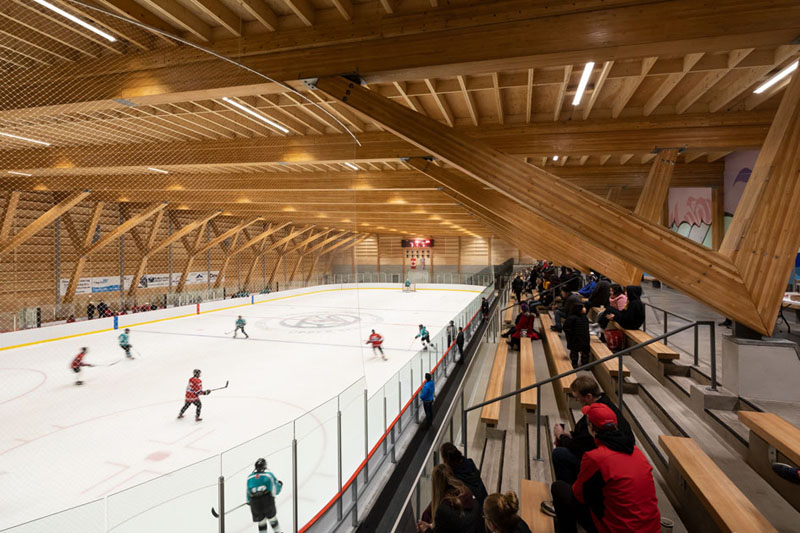
Complete with an NHL-sized rink with seating for 500 spectators, a full-sized gymnasium with a fitness room, and areas for cultural programs, the facility’s construction was initiated by local residents and is designed to be more than a place to play sports—it provides a safe place to come together and strengthens the sense of community. Architecture: Hemsworth Architecture | Photo: Ema Peter Photography, courtesy of Hemsworth Architecture

Industry responds with innovative wood construction  

B.C. has a longstanding history of building with wood and over the last two decades has emerged as a leader in mass timber construction. Industry has responded with a growing list of climate-smart wood construction. This is demonstrated by such flagship projects as Brock Commons Tall Wood House, the Wood Innovation and Design Centre, more than a dozen mass timber projects built by post-secondary institutions along with a growing list of multi-family and mixed-use commercial projects. And more and more public, cultural and civic projects are turning to wood as a central feature—such as the Audain Art Gallery, the Upper Skeena Recreation Centre and VanDusen Botanical Garden Visitor Centre to name a few.

From architects and engineers to developers and contractors, the B.C. industry is well-positioned to respond to the rising demand by B.C. municipalities for climate-smart construction—including the call to build larger and taller with wood.

FM leaders share career-boosting advice

Cheryl Carron, president of integrated facilities management, North America, Sodexo, has this advice for women professionals looking to build their careers: Have confidence. Take risks. Bet on yourself.

Such is a philosophy that has moved her forward in the complex field of facilities management. “You don’t need to be 90 per cent qualified for a role before you embark on it,” she said. “You need to have faith in yourself—that you can figure out how to figure it out.”

She was speaking at the session, Women in FM: A Panel Discussion, which took place at IFMA’s virtual World Workplace 2020 Conference in December. Industry members revealed obstacles they overcame to attain their higher-level positions, how future leaders can follow suit, and what trends to take note of.

Looking back over the pandemic, as people were exposed to unexpected situations, Carron pointed to the resilience and intelligence that has prevailed. “You need to use that same train of thought as you go looking into other roles in FM,” she advised. “Too often, I see women who say, ‘I don’t think I have what it takes, or enough experience.’ You have everything you need to shoot for the moon. I’m looking for my replacement. . . get there because we need you in this field.”

Get training to eliminate self-doubt

With a background working in corporate real estate, a lack of engineering acumen left Carron unsure of how “relevant” she would be to whom she managed. Self-doubt ceased once she immersed herself in learning what made buildings tick. “I remember when I watched my first boiler get installed. . . spending a lot of time with technicians and listening to them, understanding what their day is like. . . and being like a sponge with people I felt knew more than I did. Really, I learned a lot over time.”

Her financial know-how—understanding how to run a FM business— skyrocketed after entering the field, with help from additional classes and studying commercial finance. “Part of being in outsourcing is you really need to understand money and how you can help your client understand challenges with their own fiscal budgets,” she noted. “So, really understanding the ins and outs of the commercial side of things was an obstacle early on. I made sure that I was going to get all the training I needed.”

With a background in hotel management, Tiffany Williams, district manager, campus services, Sodexo, felt her biggest challenge was her “learning journey,” and having confidence in technical knowledge. She suggests finding peers or mentors to job-shadow—watching someone power down a boiler, for instance,— grabbing as many training opportunities as possible, and not being shy about asking questions. “The greatest achievement is having that field credibility with my team who are all technicians and hard FM people,” she added. “When they are impressed that is the biggest boost.”

Before diving into a learning program, people should determine what FM sectors are most personally captivating, suggests Jeanie Choi-Kang, senior director of project management services, Sodexo. “Narrow down to areas you are interested in and then connect with people,” she said “Being able to have those meaningful conversations is where you get the most information.”

Know subject matter and be succinct

In an industry that requires critical thinking and quickly simplifying complex information, Choi-Kang is constantly reminding people about effective and meaningful communications. To improve executive performance, up-and-coming managers are advised to know their subject matter.

“Whenever you’re in front of the decision maker have the compelling story available with data to make your point,” said Williams. “Really talk about what the impact of the decision will be so you are known as the person who has the answers. . . and be confident because you’ll be seen as the go-to person. Always have your knowledge, info and data available.”

Carron mused over her own experiences sitting in the “decision-maker” chair, where she is often faced with people who are unprepared to ask for what they want. “Be succinct. I recommend everyone go out and take a communications course because it will help you in everything you do,” she said. “Having effective written and verbal skills in FM are critical, especially when you’re sitting in front of anyone on an executive team. Understand their time is very precious so have your messaging mapped out. Practice if you have to.”

Create honest dialogue with your team

Since facility management is not just about managing facilities but managing people, there are often challenges, Choi-Kan pointed out. A reluctance to collaborate may call for “one-on-one, casual, outside-the-office conversations,” to determine where resistance is stemming from. “Once you find that core reason you can know the next steps for action,” she said.

Finding common ground is important for Carron. If people don’t understand a vision, they may feel isolated from the process. She suggested finding ways to engage people and show what “is in it for them,” while also having a stopping point. “At the end of the day, if you’ve been as dynamic as you possibly can, you have to have that tough one-on-one that says, you need to get onboard and if you’re not getting onboard then maybe this is not the environment for you,” she said. “That’s always a tough conversation for any leader to have, but it’s something you need to recognize.”

Leaders also know how to foster opportunities for communicating. “As you are building your team, work to create an environment and culture where you can have honest dialogue so people feel comfortable expressing how they feel about a direction,” said Williams.

Allowing people to disagree, but somehow all “get onboard,” is key. “You have to allow for that exchange,” she added. “If you can create that culture you’ll be able to move forward with your vision with a lot less resistance.”

Note the trends COVID-19 is triggering

How will the world of facilities management shift post COVID-19? An industry known to centre around problem solving will pivot into one that is more forward-thinking, said Carron, adding the focus will be on the human experience, “the attraction and retention of employees—around the trust and culture that is built within the company.”

“FM is going to be brought into conversations that we’ve always been on the periphery of discussing because what we do fundamentally provides the backdrop for the human experience,” she said. “It’s how do I feel when I walk into a building? Do I feel like it’s clean? Do I feel like it provides me with what I need? Is there a reason for me to truly be here and productive versus being at home where I am safe? The way our industry is already pivoting is in that direction.”

Once the pandemic is over, Williams hopes facilities such as restaurants, grocery stores and airports will commit to the same cleaning standards dictated by COVID-19 safety precautions. “Aesthetics matter. . . as a consumer it’s this feeling of being safe because it’s clean; it’s a perception,” she said. “Sometimes, we let the cleaning slide; it moves down the priority list. But it really does matter.”

Unassigned seating has become a “big work trend that is now reverting,” As Choi-Kang noted, shared spaces pose challenges as they lose their gloss and gleam. “If you sift through all the trends real estate experts are talking about, the just of it is that we are going to get back to the norm, and when we do, we need to think about how we can be more flexible with our work environment, yet have an overall understanding of using technology to collaborate.”

Russell Zirnhelt to lead Ledcor construction division

Ledcor has named Russell Zirnhelt executive vice president of construction and leader of the division. He takes over from Peter Hrdlitschka, long-time president of the construction division, who will begin his retirement while staying on as a senior advisor.

“Working for Ledcor for almost 30 years has been the defining achievement of my professional career,” said Hrdlitschka.  “Leading the building construction division has been an unforgettable experience, working with many wonderful people, building amazing structures and helping develop our communities along the way. I’m very proud of what we accomplished together and forward to continuing to mentor, coach and advise the group for the foreseeable future.”

The change in leadership comes at a time with Ledcor taking on larger and complex projects and growing in eastern Canada markets, according to Tom Lassu, president of Ledcor Industries Inc.

“Russell is a strong advocate for innovation, sustainability, new technologies, and inclusion and diversity initiatives. His insight and forward-thinking approach will help us continually enhance and expand our market leadership with safety, quality, and efficiency always at the forefront,” said Lassu.

Zirnhelt joined Ledcor in 2010, and most recently served as chief business officer for Ledcor building construction.  Previously, he was Ledcor’s chief operating officer, infrastructure development.

“I am excited to have the opportunity to lead Ledcor’s building construction division and continue building lifetime clients as a market leader in safety, quality, and innovation,” said Zirnhelt. “We have the best people in the market working on complex, industry-leading projects for many brand-name clients. The opportunities for value enhancements are immense.”

Zirnhelt has a Bachelor of Science, Electrical Engineering in Electrical Engineering from the University of Victoria, British Columbia and a Master of Business Administration from San Diego State University, California.

“I am pleased to congratulate Peter Hrdlitschka on his remarkable 29-year career with Ledcor and thank him for his significant contributions in growing the building construction division.  Peter’s division handled the construction of some of Western Canada most familiar building landmarks, safely and dependably.  Through his career he has mentored hundreds of construction professionals across Canada in offices and on construction sites,” said Dave Lede, chair and CEO of Ledcor.


Ontario prepares mega-site inventory

The Ontario government is moving forward with plans for an inventory of land tracts that could accommodate large-scale manufacturing. Newmark Global Commercial Real Estate Services has been named to lead the selection process once the in-progress call for 500- to 1,500-acre mega-sites closes on July 31.

Thus far, 19 proposals have been received from targeted participants, which include industrial property owners, municipalities and economic development agencies with sites that either have utilities and services already in place or are well positioned to attain them. Successful proponents have been promised an opportunity to team with the provincial government in an effort modelled on U.S. programs to market mega-sites to investors.

“A mega site brings new opportunities for long-term investment that can create thousands of good-paying direct and indirect jobs throughout the industrial supply chain to benefit communities across the whole province,” maintains Vic Fedeli, Ontario’s Minister of Economic Development, Job Creation and Trade. “Now more than ever, the challenge acts as an important investment-attraction initiative for Ontario’s economic recovery and for restarting the province’s economic engine.”

Gregg Wassmansdorf, Newmark’s senior managing director, is a member of the board of directors of the U.S. based Site Selectors Guild for professionals providing advisory and brokerage services for corporate site selection, and is expected to apply that demonstrated expertise to the task of forging Ontario’s mega-site inventory.

“Gregg and the Newmark team have a solid track record for choosing the right communities and sites to meet the needs of major companies,” says Prabmeet Sarkaria, Associate Minister of Small Business and Red Tape Reduction.

B.C. program funds high demand skills training

The B.C. government has launched a new Skills Training for Economic Recovery program in order to support people affected by COVID-19 to get access to new training opportunities for high-demand jobs.

“As the Labour Force Survey has shown us, our employment numbers continue to be affected by the pandemic. That’s why our government’s investment in enabling thousands of people to reskill or upskill through new, innovative short-term training programs in sought-after fields is so important,” said Anne Kang, Minister of Advanced Education and Skills Training. “These short-term training projects enable people to get the training they need to get back to work and take advantage of high-demand jobs.”

The government is investing $20-million to provide short-term skills training to people most affected by COVID-19 so they can develop the knowledge, skills and competencies for good job opportunities while the economy recovers. Almost 2,500 British Columbians will be able to quickly build the skills needed to access jobs that are in demand and get back to work sooner.

“We know there are British Columbians who are really struggling through this pandemic and we want to help,” said Ravi Kahlon, Minister of Jobs, Economic Recovery and Innovation. “I’m proud we are investing in short-term skills training projects that allow people throughout the province to access training to get them back to work and help rebuild our economy.”

The new program is a stream within the Community Workforce Response Grant program and will provide funding for training providers to equip British Columbians with skills for new jobs. Programs offer a diverse range of opportunities and will prepare people for careers in areas such as technology, manufacturing, hospitality, horticulture and automotive trades.

Some programs are underway such as:

  • The First Nations Technology Council’s Focus Web Development project, which will provide Indigenous participants with digital skills training for careers in the technology sector.
  • Aspect Safety will provide training that prepares participants for employment on major industrial projects in northwest B.C.

“Through the Skills Training for Economic Recovery program, we are excited to be delivering over 1,500 industry-recognized construction certificates to residents in rural and remote communities in northern B.C.,” said Jesse Santos, general manager, Aspect Safety. “We’ve seen early successes of the program in the job market, and are proud that the enrolment of women and Indigenous participants in our programming is significantly above industry average.”

Closing the condo manager skills gap

Managers usually have a chance to stress test their aptitudes when a crisis strikes. As predictable as this may seem, the pandemic caught the industry by surprise and somewhat unprepared. But here is the beauty of humanity: it learns and adapts.

This pandemic has taught many lessons. If anything, it helped managers to identify relevant skill gaps in relation to being prepared for the unexpected.

Back in spring 2020, when the government imposed certain measures to slow the spread of the virus, most managers were forced to work remotely or rely more heavily on technology to communicate. We had to quickly adapt to using new software, being unfamiliar with Zoom, Webex, Microsoft Teams, etc. We had to adapt to working efficiently from home, to overcome the challenge of good internet infrastructure, and we learned how important it is to have electronic records.

Communication skills gap

We all know how important communication was before COVID-19. Now, in the middle of a pandemic, communication is paramount. Being able not only to use virtual tools to communicate but also to do so concisely, to tailor not only the content, but the tone of our message became equally important. It’s not easy to infuse confidence and compassion when you are anxious and worried. Managers had to learn how to overcome their state of mind to better support communities and staff. The content of their message had to be correlated with the rapidly changing messaging coming from local, provincial and health departments and, of course, had to be relevant and tailored to the specifics of their communities.

Planning and organizing gaps

Operating plans were in place before the pandemic. Everything was lined up. From regular maintenance to future projects, managers were all looking forward to the beginning of spring; instead, their world came to a full halt. When the first lockdown was imposed, everything went up in the air. Planning was now in need of adjusting, without disrupting the life of the condo communities and with financial implications in mind. All projects had to be reassessed and rescheduled. Access to buildings and units was restricted. How do you plan regular in-suite maintenance in the middle of a pandemic with social distancing in place? Again, we learned and adapted and changed priorities and actions, adapting projects to the newly created conditions. Nevertheless, all this was a learning curve.

Procuring gap

Pre-pandemic, procuring materials and services for buildings has its regular schedule. In a time of crisis, the “normal” disappears. In early March last year, I remember placing orders for PPE and disinfectants for our staff. All email requests received no response. We had to switch to a personal approach, working the phones and using networks—asking for favours to be able to at least get even some limited quantities.

People skills gap

How we always interacted with residents, members of the board and staff was somewhat constant and built on developing good working relationships and good ethics. But when a crisis strikes, there is another dimension that adds to this interaction: anxiety. There was worry about what tomorrow could bring, and everyone reacts differently under certain factors.

During the first wave, many building staff members were afraid to come into work. It took patience and compassion to understand their worries and put their mind at ease. It became clear that, as leaders, managers have to instill confidence and calm. Being truthful is another important characteristic. These are not times for mixed messaging or even “massaging” the message. Interactions have to be based on total transparency. I remember being asked questions to which I didn’t have the answer. I struggled between the need to show confidence and the fact that I had to admit that I don’t have all the answers. In the end, I chose to be candid and said, “I don’t know.”

The interesting fact of this pandemic was that, all of a sudden, experience took secondary place. Managers were not experienced enough for something of this magnitude, and adaptability became the primary ingredient for a good community leader. The past eight months have been a learning curve for all managers. We have been able to not only identify our skill gaps, but also adapt and find ways to overcome them. We are far from being out of the woods in the middle of a second, more aggressive wave of infections, but we learned a thing or two. We now know how to overcome our skill gaps and be able to better serve our communities.

Bogdan Alexe is president and CEO of B1 Management Group Inc. B1 Management Group provides expert condominium management and consulting services for clients in the GTA, employing the latest technology and 20+ years of hands-on experience. b1managementgroup.com

Vancouver’s Fire Hall 17 sets aggressive goals

Vancouver’s new Fire Hall 17 reflects the city’s design challenge to build a structure that meets the design certification requirements of the Canada Green Building Council’s Zero Carbon Building Program, one of 16 such pilot projects in Canada. The partners are also pursuing LEED Gold certification and, if approved, the building will be the first fire hall in North America to attain Passive House certification. These ambitious targets were set to align with the city’s sustainability policies. According to HCMA Architecture and Design, the building will reduce operational carbon emissions by 77 per cent, compared with the fire hall it is replacing.

The 1800 m2 (19,375 sq ft) facility comprises four drive-through apparatus bays, accommodations for two firefighting crews and offices in the main building, and a six-storey hose storage/training tower. Like all fire halls in Canada, the facility will serve as a post-disaster emergency hub, which requires a resilient building that can withstand seismic events.

To meet the seismic requirements of Canada’s National Building code, the building has a stout reinforced concrete structure with a structural steel frame for portions of the third level. The main building is clad in brick and metal panels that cant outward at the base giving the form a strong and sturdy presence.

Mitigating exterior and interior thermal bridging

Central to meeting zero carbon goals is the building’s high-performance envelope, which wraps reinforced concrete walls with a 20 cm (8 in.) thick layer of mineral wool board having an R-value of 33, and an air barrier that allows a scant 0.6 of air change per hour at 50 Pascals of pressure.

However, structural concrete and steel elements that penetrate the envelope between the main building and tower, maintained at dissimilar temperatures, would allow the unabated passage of heat energy, absent a thermal bridging solution.

“The fire hall has two thermal zones: the administrative offices and living spaces set to 20˚C and the ground-level apparatus bay and training tower set to 10˚C,” says Elise Woestyn, Passive House consultant with HCMA Architecture and Design.

The structures share a concrete frame at ground level, and are connected by combinations of steel frame and concrete bridges on levels two and three, and a steel frame at level four. Due to the temperature differences, the designers needed to thermally isolate the two zones, while maintaining structural continuity.

“Our need to address thermal bridging led us to structural thermal breaks,” says Federica Piccone, architect with HCMA.

At the connection points, the design team specified concrete-to-concrete and concrete-to-steel structural thermal breaks from Schöck North America. Each concrete-to-concrete module consists of a rigid foam block penetrated by stainless steel rebar that is tied into rebar on both sides of the slab or wall before concrete is poured conventionally. Each concrete-to-steel structural thermal break includes stainless steel rebar projecting from one side of the module that ties into rebar of the interior slab, and stainless steel threaded rod projecting from the opposite side of the module that bolts to exterior steel beam flanges.

Three concrete balconies also project from the tower’s facade. Concrete-to-concrete thermal breaks were installed between each balcony and interior slab to mitigate thermal bridging, while withstanding the rotational and shear forces created by these cantilevers.

In addition to reducing heat energy loss, the structural thermal breaks prevent concrete structures on the warm sides of both the exterior and interior walls from becoming chilled, reaching dew point, or supporting mould growth.

Installed between the concrete-to-concrete thermal breaks are special thermal breaks that resist seismic shear forces in compliance with National Building Code of Canada 2010 standards for seismic resistance.

“The most unusual application for structural thermal breaks was a high parapet wall at the top of the tower,” says Meredith Andersen, associate engineer with Read Jones Christoffersen Engineers. The parapet changes in height from about 1.2 to 4.3 m (4 to 14 ft) as the top of the building steps down behind it.

A parapet is essentially a vertical cantilever and, because of its height, can encounter significant moment, shear and seismic forces. Concrete-to-concrete thermal breaks were aligned horizontally at each “step” and vertically in the plane of the wall to prevent thermal bridging.

Other energy-saving measures

The high-performance building envelope allowed the designers to reduce the size of the building’s heat pump to one-fifth of that needed for a comparable code-compliant building in Vancouver. The heating/cooling system is supplied by a high efficiency ground-source heat pump served by 15 geothermal bore holes. An 80 kW solar panel array supplements electricity and six energy recovery ventilators transfer heat from outgoing interior air to incoming fresh air, reducing the required capacity of the HVAC system.

Overall energy savings allowed the designers to include elements that reduce energy loads further such as electro-chromatic glass that blocks heat gain and glare by becoming translucent when activated.

“This project responds to the urgency of the climate crisis,” says Darryl Condon, managing partner at HCMA. “It shows that even large, complex facilities can lead the way in reducing our industry’s carbon footprint, while still improving the public service they provide.”

In the words of Danica Djurkovic, director of facilities planning and development at the City of Vancouver, “This community facility is a leading example of the City of Vancouver’s climate commitments, showing that we can make near zero-emissions buildings the new normal, while enhancing occupant comfort, and reducing energy and water consumption costs.”