Articles Archive - Page 393 of 928 - REMINET
REMI

Economic recovery program addresses climate change

Several communities in B.C. will be benefiting from more reliable roadways and local jobs as a result of funding from StrongerBC: BC’s Economic Recovery Plan. The new $20.7-million Climate Adaptation Program features a range of projects throughout the province that will increase the resiliency of the highway network and help lessen the adverse effects of climate change.

“One of the key threats to the reliability of the highway network is climate related, and examples include high-intensity rainfall events, extreme freshet seasons and flooding,” said Rob Fleming, B.C.’s Minister of Transportation and Infrastructure. “These events have been increasing in intensity due to climate change, and this initiative ensures a reliable transportation system will be in place for future emergency events as well as the continued movement of people, goods and services.”

The ongoing COVID-19 pandemic has highlighted the need for the transportation network to be reliable to help ensure people in rural communities can get to medical facilities quickly, and so first responders, medical personnel, and medical supplies can get to communities in a timely manner.

The program features projects that will mitigate and address the effects of climate change in more than 60 locations, while building back B.C. by providing good jobs.

“Every year, British Columbians see first-hand the escalating impacts that climate change has on our communities and infrastructure,” said George Heyman, B.C.’s Minister of Environment and Climate Change Strategy. “Floods, wildfires and water shortages are increasingly common and severe. This investment will upgrade systems to guard against extreme flooding, erosion and other climate change events. It’s part of our economic recovery plan and CleanBC commitment to help people, communities and the natural environment protect against the impacts of climate change.”

According to Fleming, the projects are spread throughout the province as this issue is not specific to one geographic area, “This ensures work created by this program will benefit people in many communities, particularly small construction companies that have seen a reduction in work due to the COVID-19 pandemic.”

Projects include riverbank erosion protection, creek channel training, culvert upsizing, flood protection works, slope erosion protection, and avalanche system maintenance.

B.C.’s total provincial response to the COVID-19 pandemic is $10 billion.

Scam callers claiming to be Tarion persist during pandemic

Fraudsters on the hunt for personal banking information continue to call up homeowners and claim they work for Tarion Warranty Corporation. In some cases, the scammers are insisting to speak with the homeowners.

Tarion flagged the issue last June when it first came to light. Homeowners on the receiving end of the phone calls were offered tax refunds and asked for banking information.

As Tarion mentioned in a previous press release, the organization calling may identify itself as Tarion, a home warranty company or the ‘Ontario governing body that provides warranty coverage for homes’, and may refer to a carbon tax, environmental tax or green tax.

“Tarion does not charge nor refund carbon taxes or any other environmental tax, and we are not affiliated with any organization claiming to do so,” the release stated. “If you are contacted by an organization offering a tax refund of any kind, do not provide any personal or financial information over the phone.”

If you have been targeted in this phone scam you should report it by visiting the Canadian Anti-Fraud Centre website at www.antifraudcentre.ca or by calling 1-888-495-8501.

Stantec commits to carbon neutrality and net zero

As part of its continued commitment to industry-leading sustainable practices, Stantec pledged to carbon neutrality by 2022 as a first step in achieving net-zero operations by 2030 across its entire global footprint. In doing so, Stantec continues to demonstrate leadership in aligning itself to the most ambitious aim of the Paris Agreement―to limit global temperature rise to 1.5°C above pre-industrial levels.

Specifically, Stantec has committed to set science-based emissions reduction targets, for all three scopes, in line with 1.5°C emissions scenarios. Furthermore, Stantec has committed to a long-term target to reach net-zero emissions by no later than 2030 in line with the criteria and recommendations of the Science Based Targets initiative.

“We are making this commitment to do our part in protecting communities from the worst impacts of climate change,” said Gord Johnston, Stantec president and chief executive officer. “Our team members apply sustainable best practices to projects around the world daily. By making this pledge we demonstrate that Stantec applies the same passion to address our own impact.”

Stantec anticipates achieving carbon neutrality – beginning with reported 2022 emissions – by meeting emission-reduction targets and addressing remaining emissions through the purchase of renewable energy certificates (or the country-level equivalent) and certified carbon offsets.

Carbon neutrality is recognized as an interim step towards the net-zero goal. To meet its net-zero commitment, the organization plans to transition offset purchases to options that directly produce renewable energy or reduce carbon. That transition is anticipated to rely on a combination of traditional and innovative pathways that connect directly to Stantec’s client work and technical expertise.

Besides addressing Stantec’s operational carbon impact, net-zero also represents a significant business opportunity for engineering and design firms, which have the unique ability to lead in defining new innovative solutions for the market. Stantec’s Innovation Office will fund employee-driven research and business solutions that will not only serve as a strategic resource in reducing Stantec’s carbon emissions, but also those of its clients.


Plans for $500M esports and entertainment complex in Toronto

The design firm responsible for various Olympic Games’ venues and Super Bowl stadiums will be manifesting a $500-million, 7,000-seat performing arts and esports complex in downtown Toronto, smack in the heart of the CNE Grounds and the first new sports or entertainment venue built in Toronto since BMO Field in 2007.

OverActive Media, owner of four major global esport franchises, including Toronto’s two professional teams, Toronto Ultra and Toronto Defiant, announced details today about its plans to build the privately-financed facility in collaboration with architect Populous. The aim is to create a home for the two teams by 2025, while positioning Toronto and Canada as the “destination of choice” for the global gaming and esports industry.

esports

Positioned on four acres on the north side of Lakeshore Blvd., and across from the Ontario Place lands, the complex will extend off a master plan the city already put in motion. The project will be also feature premiere music artists and entertainment acts, with plans to incorporate a hotel complex and host 200-plus events per year. It also hopes to attract major city-wide conventions, corporate events and product launches, awards shows and a full slate of esports events increasing over time.

esports

“It has always been our intention to develop a venue and hosting strategy and to build a facility that could not only serve as an iconic home for our two franchises, but ultimately emerge as a global hub for major international esport events,” said OverActive’s President and CEO Chris Overholt. “We are already in active discussions to attract some of the biggest esport events in the world. This venue will redefine Toronto’s event hosting opportunities in every way.”

The building will overlook the Toronto waterfront and reflect a modern expression of a new age theatre for sports and entertainment.

“The theatre architecture creates a merger of the old and the new,” said Jonathan Mallie, senior principal and lead designer for Populous. “The old channeling the rhythmic repetition of historic landmark theatres, and the new, integrating the progressive forms of avant-garde twenty-first-century design. In combination, a symbiotic balance delivers a one-of-a-kind theatre experience, unique to Toronto and the world.”


Canadian suppliers lauded for clean earnings

Product and service suppliers to the property and facilities management sector are among eight Canadian companies on the newly released list of the 200 publicly traded companies earning the highest global revenues tied to clean economic enterprise in 2019. The annual rankings — jointly undertaken by the Canadian and U.S. research firms, Corporate Knights and As You Sow — also compare the investment performance of this Clean200 against MSCI’s world (ACWI) and world energy indices.

“While tech companies like Amazon and Zoom have had a good run through this pandemic period, the broad-based trend of outperformance has been dominated by companies providing sustainable solutions,” reports Toby Heaps, Corporate Knights chief executive officer.

From July 1, 2016 to January 31, 2021 the Clean200 have generated a 113.4 per cent total return, surpassing the ACWI’s 78.7 per cent total return. Meanwhile, fossil fuel companies in MSCI’s energy index experienced a 13.8 per cent drop in value during the same period. To illustrate, $10,000 invested in the Clean200 in July 2016 would now have grown to $21,340 whereas $10,000 invested in fossil fuel companies would have diminished to $8,617.

“There is now clear financial evidence showing a broad spectrum of companies and market forces making the economic transformation, which is our greatest hope in controlling climate change,” submits Andrew Behar, chief executive officer of As You Sow.

The Clean200 is drawn from approximately 8,080 publicly listed entities with annual earnings in excess of USD $1 billion. To qualify, companies must derive at least 10 per cent of their annual revenue from business activities aligned with a low-carbon economy. That includes: energy efficiency; green energy; electric vehicles; financing low-carbon ventures; low-carbon real estate footprints; environmentally responsible forestry, mining and resource management; low-carbon food and apparel production; and information and communications technology that supports such endeavours.

Some other types of listed companies are disqualified from consideration, including: oil, gas and other fossil fuel companies; utilities earning less than 50 per cent of revenue from green energy sources; companies with earnings tied to deforestation, climate change denial, weaponry or private prisons; and/or companies with track records of worker exploitation, racial and/or gender discrimination or criminal activity.

Collectively, the newly announced Clean200 generated about 39 per cent of revenue from clean economy earnings — placing three Canadian suppliers to the property and infrastructure sectors as above-average standouts:

  • Cascades Inc., a Quebec-based manufacturer and distributor of paper products and hygiene-related amenities, ranked 86th with CAD $5.2 billion (USD $3.9 billion) in clean earnings, representing more than 93 per cent of company revenue in 2019.
  • Canadian Solar Inc., a manufacturer and distributor of solar modules, inverters and energy storage systems headquartered in Guelph, Ontario, derived all CAD $4.2 billion (USD $3.2 billion) of its annual revenue from clean economy activity, placing 105th. It is also one of just 16 companies in the Clean200 with a racially diverse chief executive officer.
  • Brookfield Renewable Partners LP, headquartered in Toronto, literally generated 100 per cent of CAD $3.95 billion (USD $2.98 billion) in 2019 earnings from clean power. Ranked 194th, it is the only power generation company in the Clean200 list.

Railway operators, Canadian National and Canadian Pacific, are the highest ranked Canadian companies on the list at 35th and 62nd respectively. Both also surpass the Clean200 average quotient for clean economy revenue with CN’s 85 per cent share translating to CAD $12.88 billion (USD $9.7 billion) and CP’s 77.6 per cent stake equating to CAD $7.39 billion (USD 5.57 billion) in 2019.

Bombardier Inc., Telus Corp. and Hydro One Ltd. complete the Canadian contingent in the Clean200. Of these, Hydro One, ranked 175th, has the highest percentage of clean earnings at 30 per cent or CAD $2.16 billion (USD $1.63 billion), while Bombardier’s 26.3 per cent portion translates into the highest dollar amount at CAD $5.5 billion (USD $4.15 billion) earning it 80th position. Telus Corp. is slotted at 167th with about 14.4 per cent or CAD $2.33 billion (USD $1.76 billion) of 2019 income in clean earnings.

Calgary’s Arts Commons project moves forward

The Calgary Municipal Land Corp. (CMLC) has announced that Colliers will take on project management for the Arts Commons Transformation project, and New York firm Fisher Dachs Associates has been selected as the theatre consultant.

“This project will be a major boost to arts in our city,” says Kate Thompson, CMLC’s president and CEO. “The Arts Commons Transformation will support the growth and recovery of arts in Calgary and the province, providing new opportunities to come together to engage as a community—when it’s once again safe to do so.”

Alex Sarian, Arts Commons president and CEO adds, “The pandemic has taken a disproportionate toll on Calgary’s arts sector and those who depend on it—for enjoyment and for employment. This new facility will be a vital component in the recovery and growth of Calgary’s artistic community and an important contributor to our city’s economic revitalization. The Arts Commons Transformation project will not only create jobs, bringing needed immediate and ongoing economic benefits, but will also serve as a longer-term draw for those who take part in its creation, operation and performances.”

CMLC and Arts Commons will continue assembling the rest of the project team—prime designer, construction manager, and acoustic and specialty consultants—and anticipate that all will be in place by the summer.

“Our long-term strategy is to make sure Calgary is the city of choice for the world’s best entrepreneurs solving the world’s greatest challenges,” says Mayor Naheed Nenshi. “That means investing in this city, in the industries, amenities, and services that support that unrivalled quality of life. These projects are all elements of that work, and that’s why I’m incredibly excited to share this update today.”

Other projects including the BMO Centre expansion, Event Centre and 17th Avenue extension and Victoria Park/Stampede Station rebuild will also continue to advance this year.

“Despite all the challenges of the past year, CMLC remains firmly focused on the important work of supporting our city and building for the future,” says Thompson. “These vital projects and the many others CMLC will be undertaking this year are just what the city needs. People will always need places to live and work, and our whole city will benefit from the new infrastructure and development we’ll be helping to make happen in 2021.”


Infrastructure projects spur construction activity

Across Canada, governments at all levels have prioritized infrastructure investment to stimulate economic recovery from COVID-19. In the 2020 budget, the B.C. government made capital commitments totalling $22.9 billion over three years – the highest level of capital spending ever recorded.

Several multibillion-dollar infrastructure projects will ensure the B.C. construction industry stays busy including two high-profile transportation ones: the $1.4 billion Patullo Bridge replacement across the Fraser River and the $2.8 billion Broadway SkyTrain extension in Vancouver. Transportation Investment Corporation (TI Corp) is leading the delivery of both projects on behalf of the Ministry of Transportation and Infrastructure.

Site work has begun on the Broadway Subway Project, a 5.7 km extension of the Millennium Line, from VCC-Clark Station to Broadway and Arbutus, with six new stations. The design-build contract was awarded to the Broadway Subway Project Corporation, an Acciona-Ghella joint venture in September 2020.

Current work includes some building demolition to make space for the new station entrances, and laydown areas for storage and staging. The first buildings scheduled for removal are on the 100 block of East Broadway and 2500 block of Main Street for the future Mount Pleasant Station. All demolition work is to be completed by the end of April, in preparation for the start of station construction.

A key component for this project is traffic management, which runs along one of Vancouver’s busiest corridors, according to executive project director Lisa Gow at TI Corp.

“Unlike the Canada Line, it’s not intended to be cut and cover. There will be some surface disruption at each end of the line at Arbutus and Great Northern Way. There will be excavation at station locations from the surface but phased decking will be put in place. The objective is to ensure there are four lanes of traffic at all times,” said Gow, who was a speaker at the Transportation Conference 2021 hosted virtually by ACEC-BC.

Upcoming construction activities will include the tunnel portal and elevated guideway near Great Northern Way, with tunnelling to begin in 2022. Two tunneling boring machines will bore parallel 6m diameter tunnels to Arbutus. The station boxes will be excavated before the TBM machines arrive, said Gow. Great Northern Way will be the first station built, and Arbutus will be the last station built.

For the design of the stations, opportunities for integration were explored. The station at Cambie Street will be fully integrated with the Canada Line’s existing Broadway-City Hall Station where passengers can transfer underground between the two lines.

“At South Granville, PCI is building a new commercial building. They will build the South Granville station box and our contractor will do the station fit out. This is the first fully integrated station in B.C.,” noted Gow. “The design of most of the stations has been done to allow for future developments to do overbuilds over the station head houses.”

Although the Broadway project was well underway when COVID-19 hit in 2020, it still created anxiety and the province had to adapt to the market’s willingness to take on fixed price risk.

“During COVID, we ask bidders to be specific about where they felt they can manage the risk and where they cannot manage the risk,” said Gow. “We ultimately reached a balance with proponents taking on known risks and the province taking on future risks related to changes in health orders, inability to get materials and unforeseen COVID related risks.”

The pandemic has also changed community engagement. The Broadway line has more than 2,000 stakeholders and the normal engagement methods such as public open houses and in person meetings weren’t possible because of the pandemic, noted Gow, requiring more focus on social media and providing more information on websites.

“Major projects require adaptation, innovation and communication,” she said, crediting the construction industry for stepping up and keeping the project on track. “Everyone’s learned to be creative during COVID.”

The global crisis similarly impacted the Pattullo Bridge Placement project, according to Wendy Itagawa, executive project director, TI Corp.

“We awarded the contract and then COVID hit,” she said. “We had to adjust pretty quickly and switched to virtual and online – not just with our internal team but stakeholders and municipalities. It was a challenge to implement quickly.”

Itagawa said the construction team did a “superb job of implementing protocols” with the onset of COVID and the project has been able to progress despite the “new normal.”

Fraser Crossing Partners led by Acciona was awarded the contract in February 2020 to build the new four-lane cable stayed bridge that is a key connection between Surrey and New Westminster.

The design includes dedicated pedestrian and cyclist lanes, separated from traffic, that will improve safety for all road users and encourage active transportation options. The bridge will be built to allow for potential future expansion to six lanes. The design uses two in-river piers instead of the six piers of the existing bridge.

The new bridge will be built to modern safety and seismic standards, located upstream of the rail bridge and the existing Pattullo Bridge, said Itagawa, pointing out key considerations include working in and around the Fraser River (marine traffic, underwater noise) and building in highly urban areas (minimizing disruption and traffic management).

The project also focuses on integration with each municipality so “many urban design features are being incorporated including boulevards, landscaping, street furniture and wayfinding,” said Itagawa, adding environmental permitting is a big component of this project which required extensive consultations.

Subject to final permitting, major construction in the Fraser River is scheduled to begin over the coming months. When the new bridge opens in 2023, work will begin on the demolition of the existing structure.

Cheryl Mah is managing editor of Construction Business.

 

SAPL announces winners of CBDX competition

The School of Architecture, Planning and Landscape (SAPL) at the University of Calgary have announced the winners of an international design ideas competition. Titled CBDX: CITIES FOR ALL, the competition sparked an international discussion around equitable, inclusive cities.

Organized in teams of one to five, 405 people from around the world participated. The competition received 145 submissions from 108 cities representing 26 different countries.

The competition call asked, “How might matters of equity and activism, ecology and environment, and health and wellness converge, and unfold, within our future cities?

The three winning entries—”2050 Lagos Amphibious City,” by Gi chul Choe (South Korea) and Joanne Li (China), “Brewing Flower Power: An Ice Teaporium Celebrating Women’s Rights,” submitted by Diana Guo (Canada), Tian Wei Li (Canada) and Joanne Li (China). and “Process not Product” from Mattie Wong (USA) —all addressed the competition prompt in innovative and refreshing ways.

“The climate crisis and social inequality have converged against the backdrop of a pandemic, prompting us to rethink the way cities are being designed, built and operated. It is an opportunity for architects, planners, landscape architects, and other creative practitioners and students to imagine how we can make our futures better for everyone. The ideas generated from this competition offer a glimpse into how a city for all might look, how it might operate, and how it might come into being,” said Dr. John L. Brown, PhD, SAPL dean.

Assistant Professor Alberto de Salvatierra, inaugural faculty lead and CBDX chair noted, “Solutions must come from, and be for, everyone. This competition provides a platform to highlight how architects and designers might address underrepresented and marginalized voices.”

Top entries — three winners, 15 honourable mentions and 26 finalists — will be exhibited at http://cbdxcitiesforall.com and in downtown Calgary at SAPL’s pilot research hub, the City Building Design Lab, and City Hall until the end of April. Entries will also be published in the inaugural annual volume later this year.

CBDX: CITIES FOR ALL is made possible through the support of Stantec, a global design and delivery firm.

Turning the workplace into a calming retreat

As we reflect on more than a year of unprecedented global stressors and contemplate a return to the workplace, the necessity of creating a comforting environment for employees cannot be understated. With so many workers facing difficult decisions about returning to enclosed office spaces, it is the responsibility of designers to make the transition as easy as possible and above all, to ensure that occupants feel safe. Something often overlooked is the simple power of colour to promote a sense of comfort and ease in the workplace, and to enable us to treat our fellow humans with greater empathy and kindness.

It’s all about the first impression; if employees feel welcomed as they enter a space, they are more likely to maintain a sense of safety and be productive throughout their work day. During a global crisis fueled in part by psychological fear, the feeling of being cared for by our fellow humans goes a long way in boosting comfort levels. For city-dwellers whose daily commute requires travel through areas of heightened activity, or for workers seeking relief from media over-saturation and cramped living environments, the workspace can function as a retreat from the overstimulation of daily life.

To offer inspiration and direction for workplace designers, global paint suppliers are reflecting these trends in recently released colours palettes. For instance, PPG Paints just released “Be Well,” which includes: Transcend, a mid-tone oatmeal-coloured hue that draws on earthy influences; Misty Aqua, a watercolour cerulean blue; and Big Cypress, a shaded ginger with persimmon undertones. This selection of earthy, tranquil colours evokes natural elements and brings to mind the restorative interiors of a spa. At a time when people are searching for safe havens, the overlap between the objectives of a spa and an office is greater than one might think. Incorporating colour palettes that conjure memories of peaceful outdoor environments is an effective way to reduce stress levels. In complement to the representative quality of earthy paint tones, integrating natural elements into the workplace adds further texture and depth.

The premise of biophilic design is that humans fundamentally seek to make connections with the natural world, which in turn increases interpersonal connections. As urbanization drives us further from the outside world, the desire for access to green spaces and fresh air has skyrocketed. Bringing the outdoors in is critical in the creation of healthy work environments. The integration of plants, sunlight, and water elements not only enhances the colour and look of a space but has been shown through scientific studies to increase physical and mental well-being, reduce blood pressure and heart rates, and even support cognitive function and creativity.

Access to natural light is key. Paint colours and natural elements look their best when illuminated by rays of sunlight. Beyond aesthetics, the benefits of exposure to Vitamin D are vast, from heightened productivity to overall mood regulation. Workplace designers can incorporate large windows that take advantage of available views, install skylights wherever possible, and consider adding balcony spaces or courtyards. Allowing occupants control of window settings encourages air filtration in enclosed spaces, which also decreases the spread of germs.

Historically, biophilic design is one of the first aspects to be value-engineered out of a design, as project managers make tough decisions about cost-effectiveness and which aspects of a plan are “necessary.” This is the key shift in priorities that we will see in the years following the COVID-19 crisis. Employers can no longer afford to overlook the emotional health of their workers, and will be more inclined to invest in these kinds of human-centred approaches to interior design. If we are able to walk away from this difficult time with a greater regard for our fellow humans, it will be a silver lining in the midst of great hardship.

Rachel Robinson, IIDA, LEED AP, is the design director at Ted Moudis Associates. She is a collaborative leader who guides and inspires design teams through all project phases, from programming through implementation. Her thoughtful, analytical approach to design has led to a timeless body of work that spans national and global work for large-scale corporate, hospitality, government, institutional, and higher education projects.

Upfront costs hinder access to energy savings

The upfront costs to tap into Canada’s new incentives for home energy upgrades could pose an economic barrier for those who would most benefit from the resulting savings. More than 110 industry associations, building service/product providers and public advocacy and community development groups are voicing support for a separate program targeted to low-income households.

Efficiency Canada, a national research group promoting the dual economic and environmental benefits of energy and water efficiency, is leading a campaign to urge the Canadian government to invest $2 to $3 billion in no-cost energy efficiency improvements for qualifying low-income recipients. That would match funds that have already been pledged for commercial and residential retrofits.

An open letter to Finance Minister Chrystia Freeland and four other federal Ministers, which 113 supporters have now endorsed, argues that offering incentives to trigger further spending — a stated tactic to stimulate post-pandemic economic recovery — overlooks the roughly 16 per cent of renter households and 22 per cent of homeowners currently paying at least 6 per cent of their after-tax income on energy costs. That’s more than double the national median and above the threshold considered to be energy poverty, based on the common formula that consumers should pay no more than 30 per cent of income on housing and no more than 20 per cent of housing costs on energy.

“Low-income homeowners and market renters cannot reasonably be expected to pay the upfront costs required to access federal grants or to take on additional debts from the planned federal low-interest loan. Supporting low-income households requires a separate approach,” the letter submits.

In keeping with Efficiency Canada’s twin economic and environmental interests, it foresees returns in reduced energy costs, which would make room in low-income householders’ budgets for other kinds of spending, and reduced greenhouse gas (GHG) emissions. It also suggests funds could be further leveraged for skills and economic development if low-income, rural and racialized recruits were trained to deliver energy management services and outreach programs.

As part of the campaign, Efficiency Canada will host an online rally March 4, bringing together energy policy activists and program delivery agents from across Canada.

Women bear brunt of 2020 real estate job loss

Women suffered more than 89 per cent of job losses recorded in Ontario’s real estate, rental and leasing sector last year. Newly released labour force data from the provincial Financial Accountability Office (FAO) shows that COVID-19 delivered a relatively glancing blow to men in real estate roles, who accounted for less than 0.5 per cent of the 355,300 jobs Ontario shed in 2020. In comparison, women were jettisoned from 14,300 of the roughly 16,000 positions the real estate sector trimmed, making up more than 4 per cent of the province’s newly unemployed.

That’s generally in keeping with reported trends across the entire labour force. Women absorbed 57 per cent of the layoffs in Ontario, translating to a 5.8 per cent drop from pre-pandemic employment levels, while men experienced a 3.9 per cent decline in employment.

The pace of recovery has also been slower for women. That’s most noticeable in the 15-to-24 age cohort, in which women were still 13.2 per cent below February 2020 employment levels at the end of year, while their male contemporaries were 2.2 per cent shy of the pre-pandemic count. Meanwhile, 49 per cent more women than men in the 25-to-54 age cohort — 104,900 versus 70,200 — simply exited the labour force last year.

“In particular, core-age (25-54) working mothers with children under the age of 18 faced greater labour market attachment challenges compared to fathers,” the FAO report states. “Nearly one-fifth of core-age mothers with children under the age of 18 were absent from work, more than twice the share of absence among fathers (9.1 per cent).”

Real estate is one of three sectors the FAO report highlights for the disproportionate gender split of layoffs. The others are: Information, Culture and Recreation, in which 27,800 women lost jobs, while 3,000 men were newly employed; and Services other than Public Administration, in which 16,400 women lost jobs and 2,700 additional men were hired.

The report notes “job losses among males and females were largely proportional” for Accommodation and Food Services — the hardest hit sector, which lost 110,700 jobs or nearly 25 per cent of its pre-pandemic workforce — and for Retail Trade, which shed 47,000 jobs, equating to a 5.6 per cent reduction in employment.

Beyond permanent job loss, the FAO report tallies more than 410,000 employees who experienced at least a 50 per cent reduction in working hours last year, equating to an estimated 9 per cent decrease across Ontario’s labour force. It also cautions that Ontario’s 9.6 per cent unemployment rate does not capture those who have dropped out of the labour force, and points to the shrinking labour force participation rate, which fell to 63.6 per cent from 64.9 per cent in 2019, for greater context.

“Combined, the total number of employees impacted by the pandemic was 765,340 in 2020,” the report states. “Ontario’s labour underutilization rate reached an unprecedented 22.1 per cent in 2020, meaning one in five workers were either unemployed, did not look for a job although they wanted one or worked fewer hours than they desired.”

Multidisciplinary reach employs talent from several job fields

Given its multidisciplinary reach, not all employment tied to commercial real estate is classified as directly in the Real Estate, Rental and Leasing sector. Five other overlapping fields offer a wider and more varied picture of COVID-19’s impact — ranging from the beleaguered Accommodation and Food Services sector to Finance and Insurance, which gained 32,700 jobs over the course of the year.

Construction — a sector in which men are the acknowledged vast majority — tallied 25,200 layoffs, representing 4.7 per cent of the pre-pandemic workforce. However, the FAO places much of that unemployment in the subset of self-employed individuals less likely to be working on major commercial development sites. (Province-wide, self-employed workers accounted for about 14 per cent of job losses versus 81 per cent with private sector employers and just 5 per cent in the public sector.)

Building operations personnel would presumably be classified among Business, Building and Other Support Services, which lost 17,700 jobs in 2020. The sector has been slower to recover, with year-end employment levels still more than 15 per cent below the pre-pandemic benchmark.

In contrast, a range of consultants and skilled trades contracted to the commercial real estate industry would fall into the Professional, Scientific and Technical Services sector. It recorded a more modest slip of 3,200 jobs or less than 1 per cent of new unemployment in Ontario.

Drilling down to commercial real estate asset types, retail job loss appears in sync with retail properties’ flagging investment returns. There’s perhaps more dissonance between the 38,200 lost jobs in the Transportation and Warehousing sector, representing 9.7 per cent of pre-pandemic employment, and current vibrant market dynamics for warehouse/distribution and logistics sites.

Study finds human cost of transit-oriented development

Transit-oriented development can both be a blessing and a curse for communities, a new UBC study finds.

“Transit-oriented development (TOD) can reduce traffic congestion and air pollution, encourage active mobility, and revitalize a neighbourhood,” Craig E. Jones, study author, PhD candidate in geography and the research coordinator for the Housing Research Collaborative at UBC’s faculty of applied science, explained in a recent press release.

“However, it can also cause gentrification through the demolition of affordable rental housing. It can tailor the area towards condo homeowners, creating a very clear class difference between the former residents, who may not be able to afford to stay, and the new condo dwellers.”

Refugees displaced

TOD concentrates high-density housing, commercial activities and public spaces around a rapid transit station. The Evergreen Line—an expansion of Metro Vancouver’s SkyTrain line into the suburb of Coquitlam—improved mass transit in the region but also contributed to displacement.

Jones conducted interviews with eight former residents of Whitgift Gardens, an older rental apartment complex located near the Evergreen Line that had long been a landing place for recent immigrants and refugees.

When Whitgift Gardens was redeveloped following the construction of the Evergreen Line, many residents were displaced, including the study participants.

“This is an example of perhaps the worst possible outcome of TOD in the region—where it compounds an existing housing crisis,” noted Jones. “What happened to these individuals speaks to concerns raised by researchers and policy analysts that TOD interventions could result in gentrification and the displacement of low-income groups.”

From 2015-2019, this neighbourhood saw a net loss of more than 600 rental units, indicating that a large number of tenants were displaced.

“It’s important to note that new transit stations are also often put in areas where there is less resistance to high-density development, such as areas with stigmatized social housing, certain suburbs, ethnic enclaves or central business districts, rather than single-family dwellings. So ironically, even though one of the goals of TOD is to equitably enhance accessibility, these high housing costs displace low-income households, resulting in a reduction of access to affordable rapid transit for those who need it the most.”

Mitigating the human costs of transit-oriented development

Jones notes that what happened in Whitgift Gardens is not unique. In Burnaby, hundreds of older rental apartments were demolished for redevelopment around Metrotown SkyTrain station prior to the last municipal election.

He forecasts that Vancouver’s upcoming Broadway subway, which will go through a huge concentration of older, low-rise rental buildings in Kitsilano and Granville, will create significant pressure on these buildings.

“When plans clearly state that hundreds of affordable rental units are going to be demolished, then there has to be a lot of thought put into what the potential consequences are, and what could be done to at least mitigate those costs and the harm it will do to people,” said Jones.

He added that the city of Burnaby now has one of the most ambitious tenant assistance policies in Canada in response to community outcry over the demolition of older rental buildings.

“Since 2019, tenants displaced due to demolition must be offered a replacement unit with the same number of bedrooms in the new building at 20 per cent below average rents. There are ways to pursue rapid transit and growth without causing gentrification and displacement.”

Photo: Whitgift Gardens in 2017, pre-demolition. 

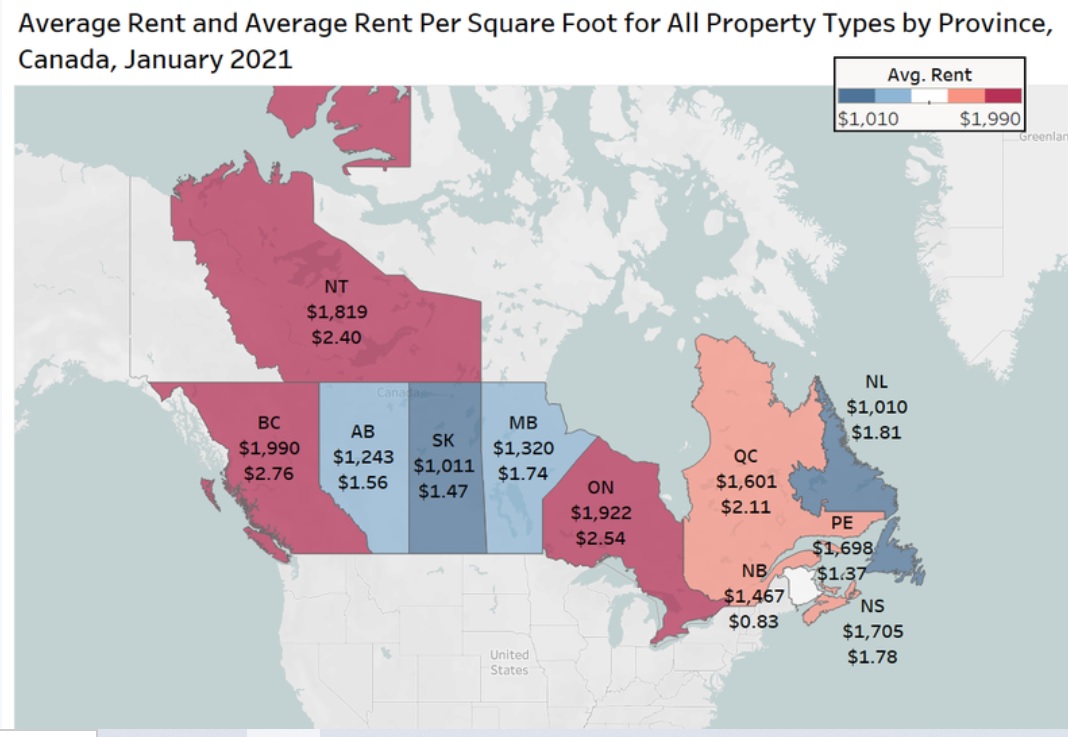
Average rent in Canada down 8.7% in January

The average rent for all Canadian properties in January 2021 was $1,714 per month, down 8.7 per cent compared to last year. This decline is slightly worse than the average we saw in the second half of 2020, according to the latest data from Rentals.ca and Bullpen Research & Consulting.

“Prospective tenants continue to experience a market flush with choice and have more bargaining power than they’ve had in many years,” said Matt Danison, CEO of Rentals.ca.

For the month of January, Toronto was the second most expensive city out of 35 with average price for a one-bedroom coming in at $1,811. Vancouver, meanwhile, remains the most expensive market for both one- and two-bedroom homes at $1,901 and $2,592 respectively. Year over year, rent for a one-bedroom home in Toronto was down 21.9 per cent, and 18 per cent for a two-bedroom.

“Single-family homes and condominiums for rent continued their downward slide in January, as the most expensive properties continue to get less expensive to rent during the pandemic,” said Ben Myers, president of Bullpen Research & Consulting. “The rental apartment market has been relatively flat over the past six months, with landlords offering a number of incentives to sweeten the pot.”

Other GTA cities

Mississauga finished third on the list for highest monthly rent in January for a one-bedroom home ($1,779) and sixth for a two-bedroom home ($2,097). Year over year, the average price for a one-bedroom home in Mississauga was down 7 per cent, and 8.5 per cent for a two-bedroom.

Etobicoke came in fourth for monthly rent for a one-bedroom home ($1,772) and third for a two-bedroom ($2,175). Year over year, rent for a one-bedroom in Etobicoke declined by 15.6 per cent and 5.8 per cent for a two-bedroom.

Richmond Hill finished fifth on the list for average rent in January for a one-bedroom ($1,742) and $2,143 for a two-bedroom. Year over year, the price for a one-bedroom home in Richmond Hill was down 8.5 per cent, and 9.9 per cent for a two-bedroom.

North York came in eighth for average monthly rent for a one-bedroom home at $1,684 and ninth for average monthly rent for a two-bedroom at $2,063. Year over year, rent for in North York declined by 15.6 per cent a one-bedroom and 15.8 per cent for a two-bedroom.

Markham finished ninth on the list for average monthly rent for a one-bedroom home at $1,664 and 12th for a two-bedroom home at $1,930. Year over year, rent in Markham was down 10.5 per cent for a one-bedroom and 19.3 per cent for a two-bedroom.

Both Kitchener and Hamilton experienced increases in monthly listing prices for apartments and condo rentals with average rent in Kitchener up by 16 per cent to $1,613 and average rent in Hamilton up by 10 per cent to $1,820.

Apartment and condo rentals

For apartment and condominium rentals in Toronto, prices have dropped 21 per cent year over year to $2,000 on average. A year ago in January, Toronto had the most expensive average rent for apartments and condo rentals at $2,528, which at the time was up 8 per cent.

Outside of old Toronto, the areas with the largest annual rent declines in January for apartments and condo rentals were Etobicoke, with a decrease of 18 per cent to $1,926 and North York, with a decline of 15 per cent to $1,936. Mississauga was also down 9 per cent to $1,963, but Brampton’s monthly rent for apartments and condo rentals was up 7 per cent to $1,785.

Other takeaways from the February National Rent Report include:


  • Given the latest COVID-19 numbers and the slow vaccination rollout, a return to work en masse is not expected for several months, and could push back the recovery forecast for the second half of this year to 2022.
  • Many of the major resale housing markets in Canada are a feeding frenzy of activity, with low interest rates and changing housing demands fueling a buying spree. But it’s not having an impact on the rental market in any meaningful way.
  • The latest Canada Mortgage and Housing Corporation data came out in late January, showing the vacancy rate in Canada increasing to 3.2 per cent from 2.2 per cent year over year for apartments, as the pandemic has cut immigration, reduced household formation, and kept many students at home with their parents.
  • The average rent per square foot for all property types has declined to $2.25 in January from $2.40 in January 2019.
  • St. John’s had the lowest monthly rent of the 35 cities for a one-bedroom home in January at $888, while Red Deer had the lowest monthly rent for a two-bedroom at $1,026.

For the complete report, visit: www.rentals.ca


How FMs can leverage data in 2021

Data collection and an increased scrutiny placed on the workplace was already gaining traction before the COVID-19 pandemic, but it now seems to have solidified its footing amongst leading organizations. In fact, expanded data collection was the second trend listed in Gartner’s recent report, “9 Future of Work Trends Post COVID-19,” and it seems to be one of the more complex topics to both digest and execute.

IoT platforms that use overhead sensors, booking data, and smartphone space-reservations to pull analytics, are increasingly playing a key role in supporting the growing data-driven workplace. This technology gives facility managers a deep understanding of their real estate while also empowering employees to find the best spaces to work efficiently.

While some may view this as an encroachment on privacy, most organizations are not gathering any personally identifiable data, but rather using occupancy, behaviour, and usage data to improve employee experience and better support the health and safety of those who work in and visit their facilities.

The following are four important ways facility managers can leverage data to not only make returning to work easier, but also promote a more flexible, healthier and more effective environment for facility end users.

Understand space usage

As many leading organizations prepare to return at least a portion of their workforce to the office, it is important they understand how full their spaces are and what sort of usage capacity they can support. Only with headcount and usage data can teams begin to measure how well they’re performing with regards to maximum capacity regulations. This data supports both a deep understanding of how spaces are being used now, as well as how future spaces might best support the needs of the changing workforce beyond 2020.

Increase employee and occupant awareness

Many employees are being told to continue working from home indefinitely, while others are expected for scheduled intermittent office visits. Making meeting room, workstation, and huddle space availability easily accessible is essential to lowering “return to work” fears and showing users that their organization cares about their concerns. Smartphone apps, interactive map displays, and digital signage are all professional ways of delivering this data to users. These methods increase the flow of information and help users identify an ideal and unoccupied place to get work done—whether that be based on capacity, location, or amenities to support work preference. Gartner’s research also showed that many full-time employees are being replaced with contracted or contingent workers—making the need for office information visibility even more relevant.

Inform space changes

Will cubicles be an appropriate workstation going forward? Does our office need more open collaboration spaces? Are our current meeting rooms too large for the desired capacity? These questions should be expected as real estate expenditure continues to become more scrutinized in the days ahead. Measuring space usage to adjust furniture and space allocation and configuration to support workplace habits and norms will become increasingly important as offices continue to reopen. Gathering data to see which spaces are high-demand vs lesser-used is a key metric—and not one that’s particularly new to the corporate real estate market. Understanding these spaces so that proper new buildings can be secured and built out with the best spaces to support the work of today and tomorrow is more important than ever before.

Improve building services

Leveraging usage and occupancy data to better understand when and where workstation, common area, and restroom cleanings need to take place not only ensures that the appropriate places are cleaned regularly, but can also save time and money over traditional scheduled cleanings. Many organizations are exploring and adopting this type of usage-focused model to support their workers and demonstrate their commitment to employee health and safety in the workplace.

While no one is certain how exactly corporate North America will move through 2021 as “return to work” strategies will differ across organizations—one thing does seem certain: data will play a key role. Employee experience, data science, visibility, and an emphasis on health and safety will continue to move to the forefront of organizational concerns. The workplace of the future is upon us, and facility managers need to understand how to access, gather and use available facility and workplace data to ensure their spaces can evolve to meet changing needs.

Jarrod Easterwood is director of marketing and partner relations at AVUITY. Based in Atlanta, Jarrod has a history of supporting the technology and collaboration needs of his clients both as a consultative sales specialist and technology subject matter expert across the southeast U.S. as well as New York City.

Canadian steel institutes agree to integration

The Canadian Institute of Steel Construction (CISC) has announced that an agreement has been reached with the Canadian Sheet Steel Building Institute (CSSBI), to integrate the Canadian sheet steel construction sectors within the CISC.

The integration will see the Canadian sheet steel construction sectors join forces with the structural steel, steel bridge, steel plate and miscellaneous steel construction sectors. The sheet steel construction industry includes commercial and residential steel roofing, structural roof deck and composite floor deck, steel siding and cladding, steel studs and joists, and steel building systems.

“The CISC is looking forward to expanding the voice and strength of Canada’s steel construction industry with the addition of this very important sector,” says Todd Collister, chairman of the CISC and director of technical services at Supreme Group. “This further builds on the CISC’s efforts to advance the use and benefits of steel construction, showcase steel’s design and environmental advantages, and to advocate for the Canadian steel construction supply chain, their employees, and their families.”

Paul Lobb, president and chair of CSSBI and president of Vicwest Building Products stated, “CSSBI remains committed to its mission to advance sheet steel as the most durable and reliable building material in the market, and to be the leading source for technical information and support to the general public and sheet steel manufacturers alike. We are excited about the strategic opportunities with the CISC and ability to leverage their management and infrastructure to not only advance the CSSBI brand, but to strengthen the voice of steel in the construction market.”

The two institutes believe with the integration of the two sectors and steel’s low carbon footprint, new framing solutions will further advance opportunities for the construction industry to lower its environmental impact.

CISC is Canada’s voice for the steel construction industry, providing leadership in sustainable design, advocacy, construction, efficiency, quality, and innovation.

PCL introduces Job Site Resourcing

PCL Construction has introduced Job Site Resourcing (JSR), a mobile construction logistics management solution integrated with the company’s Job Site Insights smart construction platform. 

The platform is designed specifically for the construction market to manage the shared usage of resources, and track details of delivery and movement of materials to job sites. Site resources can include elevators, staging or unloading areas, and material handling equipment like cranes and hoists.  

Projects have control using availability and booking restrictions applied to the resources, and the authority to review the bookings requests for approvals. Using the JSR self-service mobile application for iOS or Android devices, subtrades and suppliers have access and transparency to the site calendar for availability of resources and autonomy to manage their bookings.

Automated notifications remind subtrades of their delivery appointments and notify project staff when new bookings have been created for review. Using the JSR™ reporting and analytics features, projects are able to use the insights to monitor and adapt in order to drive maximizing the utilization of project resources, and increase the overall efficiency of project staff managing the supply. This has a direct impact in decreasing operating costs on project sites.

“The trades jumped on board quickly, and now our site deliveries are running completely through online requests,” says Aaron Akehurst, project manager, PCL Construction. “This process streamlines superintendent approval and puts the onus back on the trades for determining weights and material routing. We are minimizing printing, transfer of paper, and removing the need to keep a delivery board updated on site. This is a fantastic tool which will bring value to any busy job site.”

Job Site Resourcing can be used as a stand-alone application or with the Job Site Insights IOT telemetry platform.

“Reducing costly rework, improving build quality, and making improvements to productivity through proactive scheduling proves we are rewriting the history book of construction,” said PCL’s CIO, Mark Bryant.

UTIP receives $63M skills training funding

The Government of Canada has announced $63.5 million, over five years, for 68 projects as part of the Union Training and Innovation Program (UTIP) 2020 call for proposals. The investment will help certify skilled tradespeople and prepare them to fill available jobs as the economy restarts.

The UA Piping Industry College of British Columbia is receiving close to $9 million over five years from 2021 to 2026 for its Inclusion in the Trades from Upgrading to Red Seal Certification project. This initiative will help more than 500 apprentices—including more than 300 from key groups facing barriers—successfully enter and complete their training through programing focused on skills improvement. The college will also work to eliminate barriers, such as accessibility and distance to training, and build partnerships with community stakeholders that will lead to better apprenticeship outcomes.

“This funding will allow us to continue supporting underrepresented groups in the trades and help bring training to communities around the province of British Columbia. We are very excited to get to work with this new funding and hopefully open new doors of prospect and opportunity to people throughout the province who would not have had this opportunity in the past,” said William Schwarz, director of operations, UA Piping Industry College of British Columbia.

The UTIP supports union-based apprenticeship training and works to reduce barriers to participation and success in Red Seal trades. The first stream, Investments in Training Equipment, helps unions across Canada improve the quality of training through investments in equipment and materials. The second stream, Innovation in Apprenticeship, supports innovation and strengthened partnerships to address challenges that are limiting apprenticeship outcomes in Canada.

“As we continue to fight this virus, our support for workers remains strong. Skilled tradespeople across the country have been critical to essential sectors during this pandemic, and they will continue to be so as Canada moves toward economic recovery. This investment will help Canadians, including Canadians from key groups facing barriers, get the training they need to launch exciting and well-paying careers in the trades,” said Minister of Employment, Workforce Development and Disability Inclusion, Carla Qualtrough.